

A
Species Profile

African Civet

Civettictis civetta

Africa's midnight musk-maker
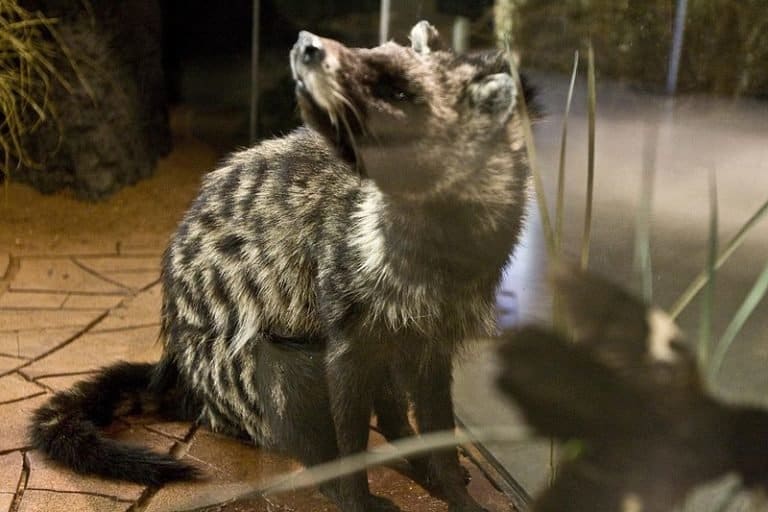
Николай Усик / http://paradoxusik.livejournal.com/, CC BY-SA 3.0, via Wikimedia Commons

African Civet Distribution

Click a location to explore more animals from that region

Loading map...

Size Comparison

Human 5'8"
African Civet 1 ft 6 in

African Civet stands at 26% of average human height.

An African Civet

At a Glance

Wild Species
Also Known As civet, civet cat, large-spotted civet, musk cat
Diet Omnivore
Activity Nocturnal+
Lifespan 12.5 years
Weight 20 lbs
Status Least Concern
Did You Know?

Size: head-body 67-84 cm; tail 34-47 cm; typical mass 7-20 kg (reported for Civettictis civetta in major field references/ADW).

Scientific Classification

The African civet is a nocturnal, mostly solitary viverrid (civet) native to sub-Saharan Africa, known for its masked face, ringed tail, and musky perineal scent secretions historically used in perfumery.

Kingdom
Animalia
Phylum
Chordata
Class
Mammalia
Order
Carnivora
Family
Viverridae
Genus
Civettictis
Species
Civettictis civetta

Distinguishing Features

  • Black-and-white facial mask with prominent muzzle
  • Coarse, grizzled coat with bold black spots/stripes on the body
  • Ringed tail; robust, catlike-canine body plan typical of viverrids
  • Strong scent glands (perineal gland) producing 'civet' musk
  • Primarily nocturnal and omnivorous (small vertebrates, invertebrates, carrion, fruits)

Physical Measurements

Height
1 ft 6 in (1 ft 4 in – 1 ft 8 in)
Length
3 ft 10 in (3 ft 5 in – 4 ft 4 in)
Weight
31 lbs (20 lbs – 44 lbs)
Tail Length
1 ft 4 in (1 ft 1 in – 1 ft 7 in)
Top Speed
20 mph
About 32 km/h

Appearance

Primary Colors
Secondary Colors
Skin Type Thick, coarse fur with prominent guard hairs; long erectile dorsal mane/crest. Semi-plantigrade stance with short legs and robust feet bearing largely non-retractile claws (Viverridae trait).
Distinctive Features
  • Adult African civets have head-body lengths of about 67–84 cm, tails 34–47 cm, and usually weigh 7–20 kg; weights vary by sex, location, and condition.
  • Elongated, low-slung body with relatively short legs and a semi-plantigrade gait; appears heavier-bodied than genets (Genetta) and lacks the distinctly catlike proportions of felids.
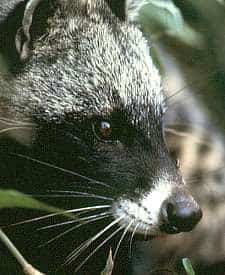
  • High-contrast facial mask: black around the eyes and across the face with paler/whitish accents on muzzle and cheeks; contributes to the species' distinctive 'masked' look.
  • Tail conspicuously ringed (alternating dark and pale bands), usually carried low while walking; helpful for separating it from many other sympatric small carnivores.
  • Erectile dorsal crest (mane) of long black hair from neck to rump; can be raised to increase apparent size in threat displays.
  • Well-developed perineal/anal scent-gland complex; produces musky secretion ("civet") historically collected for perfumery. Scent-marking is frequent: rubbing and deposition at prominent objects and at latrine sites are characteristic behaviors in this nocturnal, mostly solitary species.
  • Nocturnal and typically solitary: most activity and foraging occur at night; daytime spent resting in dense cover, burrows, or sheltered sites (behavioral ecology widely reported in species accounts).
  • Omnivorous, opportunistic forager: dentition and muzzle form support a broad diet (invertebrates, small vertebrates, carrion, fruits), consistent with its generalized, habitat-flexible lifestyle across much of sub-Saharan Africa.
  • Longevity: reported to reach ~15-20 years in captivity in zoo settings; wild longevity is lower (often cited around a decade, depending on local pressures).
  • Human interactions reflected in appearance/handling notes: individuals are generally shy and avoid people, but may be hunted or trapped locally (meat and for scent glands), influencing wariness and nocturnal concealment behavior.

Sexual Dimorphism

Sexual dimorphism is generally weak (both sexes similarly patterned). Males tend to be slightly larger/heavier on average, and perineal scent structures can appear more prominent in adult males, but external coat pattern and coloration are broadly alike between sexes (as summarized in standard species accounts).

  • Slightly larger average body mass within the reported adult range (~7-20 kg overall), giving a more robust appearance in many populations.
  • Perineal scent-marking structures may appear more pronounced in mature males, consistent with frequent territorial scent-marking.
  • Typically slightly smaller/lighter on average; overall coloration and spotting/banding pattern essentially the same as males.
  • Mammae may be visible in lactating females (seasonal/individual), but coat pattern remains consistent.

Did You Know?

Size: head-body 67-84 cm; tail 34-47 cm; typical mass 7-20 kg (reported for Civettictis civetta in major field references/ADW).

Total length is often given as ~112-134 cm when head-body and tail are combined (ADW).

Reproduction: gestation ~60-64 days; litters commonly 1-4 young (often 2-3) (ADW/field handbooks).

Longevity: recorded up to ~15-20 years in captivity (ADW); wild lifespans are typically shorter due to predation, disease, and hunting.

The "civet" used in historic perfumes is a waxy secretion from perineal glands; key odorants include macrocyclic musks such as civetone (civet musk chemistry literature).

African civets often use repeated defecation sites ("latrines") plus glandular secretions to advertise territory and status (carnivore behavioral ecology reports).

When threatened, they can raise a dorsal crest/mane and display boldly-one reason early writers likened them to small hyenas despite being viverrids.

Unique Adaptations

  • Powerful perineal scent glands producing long-lasting musk used for individual and territorial identification-highly effective in nocturnal, low-visibility habitats.
  • Viverridae body plan: elongated torso, relatively short limbs, and a semi-plantigrade stance that supports steady, quiet walking during night foraging.
  • Bold black-and-white facial mask and ringed tail: high-contrast markings that can aid close-range recognition in low light and during threat displays.
  • Erectable dorsal mane/crest: makes the animal appear larger and more intimidating to predators or rivals.
  • Generalist dentition and digestive flexibility consistent with omnivory-able to switch between animal prey, insects, and seasonal fruits across varied habitats.
  • Keen night senses (especially smell and hearing) that pair with scent-based communication to reduce the need for direct encounters.

Interesting Behaviors

  • Strictly nocturnal activity peaks: forages after dusk and before dawn; spends daytime resting in dense cover (typical for the species across much of its range).
  • Mostly solitary: adults usually travel alone except during mating or when females are rearing young.
  • Scent-marking routines: rubs/presses the perineal gland area on vegetation and objects; also uses urine and feces to reinforce olfactory "signposts."
  • Latrine behavior: repeatedly uses the same dung sites, which can function in communication and may help neighbors assess occupancy without direct conflict.
  • Opportunistic omnivory: hunts small vertebrates (rodents, birds, reptiles, amphibians), takes insects and other invertebrates, scavenges carrion, and eats substantial fruit when available (seasonally important in many areas).
  • Human-edge foraging: may patrol farm edges or settlements at night for rodents, fallen fruit, or poultry scraps, increasing conflict risk.
  • Defensive display: raises the black dorsal mane/crest, hisses and growls, and may spray/daub strong-smelling secretion when cornered.

Cultural Significance

African civet (Civettictis civetta) has long ties to perfume: civet musk was a valued ingredient and Ethiopia kept civets for musk. In sub-Saharan Africa they help control rodents but are hunted for bushmeat, musk, and skins.

Myths & Legends

The name 'civet' came into European languages from French and earlier from Arabic, tied to its musky scent. The African civet became known more for perfume trade than for local myths.

In perfume history, the African civet (Civettictis civetta) was seen as a nearly magical animal note that turned simple floral scents into rich, long-lasting perfumes; this idea stayed even after synthetic musks.

In Ethiopia, stories and travel books said people kept African civet (Civettictis civetta) to collect musk. This made the civet seen as a night-time maker of perfume, not as a hunted meat-eater.

English writers long called the African civet (Civettictis civetta) a 'civet cat' and wrote of civet as a prized exotic perfume, seeing the animal more as a scent source than a wild carnivore.

Conservation Status

LC Least Concern

Widespread and abundant in the wild.

Population Decreasing

Protected Under

  • Not listed on CITES Appendices (no global CITES trade controls specific to this species).
  • Occurs in numerous protected areas (national parks/game reserves) across its wide sub-Saharan African range; local legal protection varies by country and is often covered under general wildlife legislation and protected-area regulations.
  • IUCN Red List: Civettictis civetta assessed as Least Concern; population trend reported as decreasing in the Red List account (assessment authorship varies by update; commonly cited in IUCN Red List entries).
  • Species reference notes (biology/measurements; commonly reported in standard mammal references such as Kingdon and Nowak): head-body length ~67-84 cm; tail length ~34-47 cm; adult mass commonly ~7-20 kg; predominantly nocturnal and mostly solitary; gestation ~60-64 days with litters typically 1-4; longevity reported up to ~15-20 years in captivity (wild longevity likely lower).
  • HUBS (Viverridae/group context): Viverrids range from Least Concern (many widespread, adaptable species) to threatened categories (VU-EN/CR) in taxa with restricted ranges or heavy exploitation. Common cross-group threats include habitat loss/fragmentation from agricultural expansion/logging, hunting for bushmeat, capture for the wildlife trade (including civet musk in some regions), and localized conflict/persecution. Notable at-risk viverrids globally include several island/endemic civets and linsangs, and heavily hunted/fragmented Asian civets; African civet remains comparatively secure due to broad distribution and ecological flexibility, but local declines are consistent with increasing hunting pressure and habitat conversion.

Life Cycle

Birth 3 kits
Lifespan 13 years

Lifespan

In the Wild
10–15 years
In Captivity
15–20 years

Reproduction

Mating System Promiscuity
Social Structure Solitary
Breeding Pattern Transient
Fertilization Internal Fertilization
Birth Type Internal_fertilization

African civet (Civettictis civetta) are active at night, solitary adults that use scent marks and meet mainly to mate. Both sexes may have multiple partners. Gestation ~60–64 days; litters 1–4, weaned by 2–3 months; little male care.

Behavior & Ecology

Social No stable group (solitary) Group: 1
Activity Nocturnal, Crepuscular
Diet Omnivore Fleshy fallen fruit (reported frequently in field diet descriptions; often including figs/other seasonally abundant fruits).

Temperament

Mostly solitary and avoidance-oriented (tends to evade rather than engage conspecifics)
Territorial/space-defended via scent marking; home ranges may overlap but direct contact is limited (Kingdon 2013)
Can be defensive and aggressive when threatened (hissing, growling, lunging reported in species accounts; Nowak 1999; ADW)
Opportunistic and bold around anthropogenic resources in some regions (reported scavenging/foraging near settlements in multiple African mammal field accounts; Kingdon 2013)

Communication

growls Threat/aggression
hisses Defensive/threat
snarls/spits Close-range defense
screams/shriek-like calls High arousal/distress; reported in viverrid species accounts including African civet summaries: Nowak 1999; ADW
chemical scent marking using strong perineal gland secretion 'civet') deposited on objects/vegetation; primary long-distance communication channel in the species (Kingdon 2013; Nowak 1999
urine marking and fecal deposition; latrine use reported in civet/viverrid natural history accounts as a signaling mechanism for occupancy/reproductive status Kingdon 2013
tactile contact primarily in mating and mother-offspring interactions Grooming/close contact at den sites; ADW
visual threat displays Piloerection of the dorsal crest, body posturing) used at close range; described for African civet in field guides/monographs (Kingdon 2013

Habitat

Biomes:
Tropical Rainforest Tropical Dry Forest Savanna Wetland Temperate Forest
Terrain:
Plains Hilly Plateau Valley Riverine Coastal
Elevation: Up to 10498 ft 8 in

Ecological Role

Omnivorous mesopredator and scavenger that also functions as a frugivore/seed disperser in many habitats.

population control of small vertebrates (e.g., rodents) and large insects scavenging and carrion removal (nutrient recycling) seed dispersal via fruit consumption (potentially aiding plant recruitment)

Diet Details

Main Prey:
Rodents Shrew Small birds and nestlings Bird eggs Reptiles Amphibians Large insects Terrestrial invertebrates Carrion +3
Other Foods:
Fallen and cultivated fruits Seeds Roots and tubers Grasses and other plant material Human food waste

Human Interaction

Domestication Status

Semi domesticated

The African civet (Civettictis civetta) is not a true domestic animal, though people have kept animals in cages, especially in Ethiopia, to be 'milked' for civet scent used in perfume. Mostly wild and active at night. People interact by sharing farms, hunting for meat and skins, killing in conflicts, keeping for civet or zoos, and roadkill.

Danger Level

Moderate
  • Defensive biting and scratching when cornered/handled; can inflict significant lacerations given adult size (~7-20 kg reported in standard references).
  • High-odor perineal secretion used defensively/territorially; can cause intense nuisance exposure in enclosed spaces.
  • Potential zoonotic disease risk typical of wild mesocarnivores (e.g., rabies exposure risk in endemic regions; bacterial enteric pathogens; ectoparasites), especially when kept in captivity without specialized veterinary oversight.
  • Human-wildlife conflict: occasional poultry predation near settlements can provoke close contact and retaliatory control actions.

As a Pet

Not Suitable as Pet

Legality: African Civet (Civettictis civetta): Laws vary by place. Often treated as an exotic wild carnivore—many places ban ownership or require state, local, or import/export permits. Always check current local and national rules.

Care Level: Expert Only

Purchase Cost: $500 - $2,500
Lifetime Cost: $20,000 - $80,000

Economic Value

Uses:
Perfumery/fragrance industry (historical) Traditional/heritage animal products Bushmeat/subsistence hunting Zoo exhibition/education Research and conservation programs
Products:
  • Perineal gland secretion ("civet paste"), historically used as a fragrance fixative (key odorants include macrocyclic ketones such as civetone)
  • Skins/fur (local use; generally minor/variable)
  • Meat (bushmeat in some regions; legality varies)

Relationships

Related Species 5

Classification And Evolution

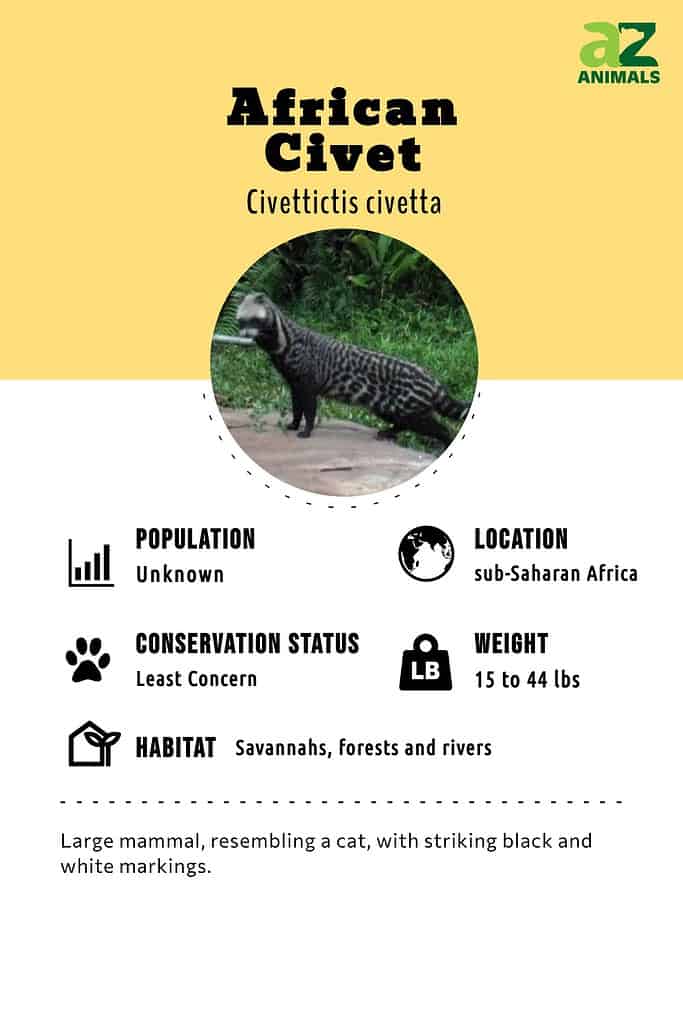
The African Civet is a large species of civet found in savannahs and forests across sub-Saharan Africa. It is the only member in its genus and is considered to be the largest civet-like animal on the African continent. Regardless of their cat-like appearance, African Civets are not felines but are in fact, more closely related to other small carnivores including weasels and mongooses. Best known for the musk that it secretes to mark its territory (called Civetone), which has been used in the production of perfumes for centuries. This mammal’s striking black and white markings make it easy to identify.
Evolution And Origin

It is believed that the African Civet is a descendant of the Viverra genus. Although closely related, they most likely diverged over 12 million years ago. Due to several distinct differences between the two, it was determined that this genus was a new species and is currently, as a result of the significant amount of contrasting characteristics, the only member of the genus Civettictis.

Anatomy And Appearance
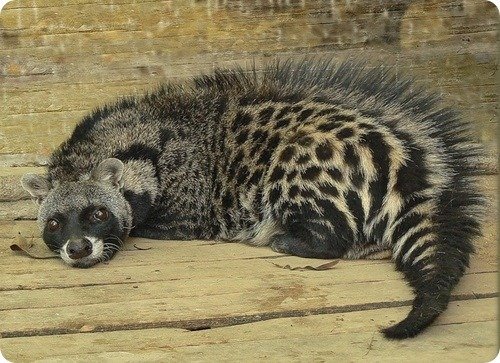
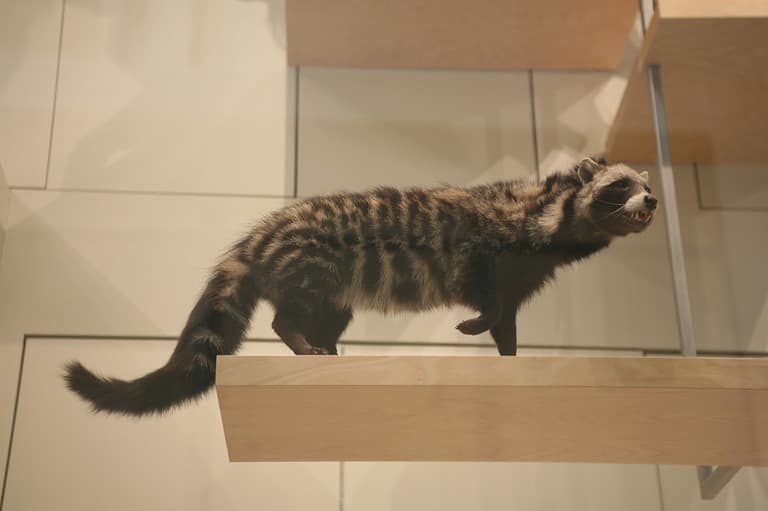
An African Civet

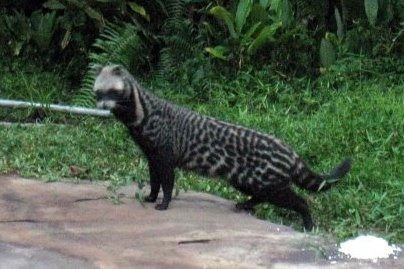
An African Civet is distinct because of its black and white markings on their fur.

One of the African Civet’s most distinctive features is the black and white markings on their fur and grey face. Along with the black band around their eyes, their coloring gives these animals a raccoon-like appearance. The similarity is only intensified by the fact that the African Civet’s rear legs are quite a bit longer than the front legs, making its stance very different from that of the mongoose. The average adult African Civet has a body length of around 27.55 inches with a tail of nearly the same length, and paws that each have five digits with non-retractable claws to enable it to move through the trees easily.

Distribution And Habitat

The African Civet is found in numerous habitats on the African continent, with its range extending coast to coast, and can also be found in river systems in Chad, Mali, and Niger, all located in sub-Saharan Africa. They are most commonly found in jungles and tropical forests and areas where there is plenty of heavy vegetation to provide both concealment and animals that the African Civets lives on. These mammals are rarely found in arid regions and always must be in an area that has a good water source, although it is not out of the ordinary for them to be found along rivers that lead into more arid environments. In addition to being capable swimmers, they also often spend their time hunting and resting in trees as well as on the ground.

Behavior And Lifestyle
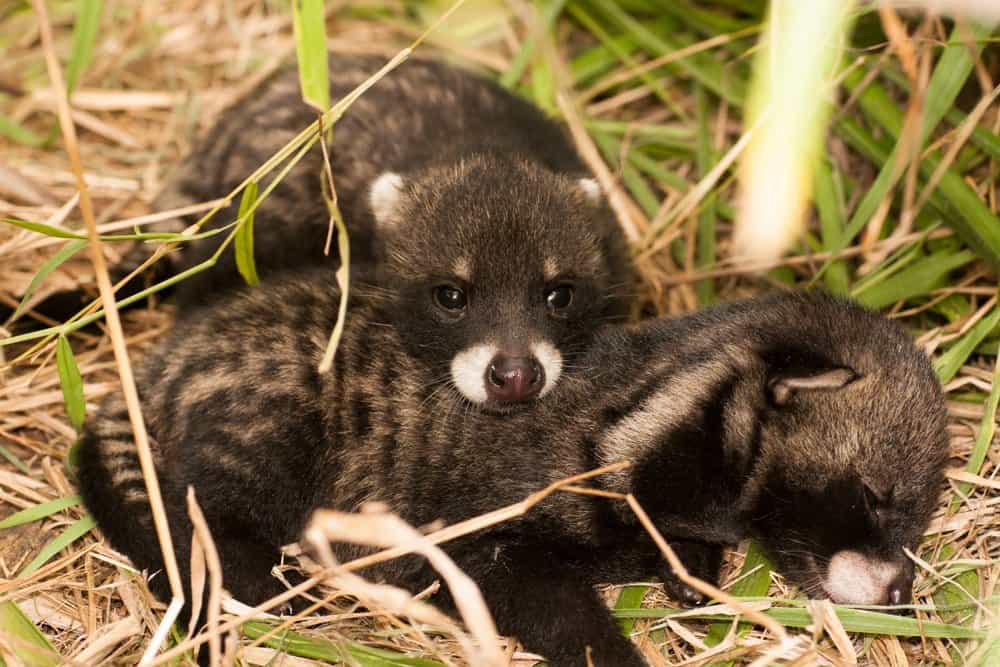
African Palm Civet (Nandinia binotata) - african palm civet babies

The African Civet is highly territorial and during mating season, has been known to gather in large groups.

Lone animals that only come out during the dark to hunt and catch food, these nocturnal animals are mainly tree-dwelling and spend most of the day resting in the safety of the trees. African Civets tend to be most active at twilight, just after sunset, but tend to hunt in areas that still provide plenty of cover. Despite being altogether solitary creatures, the African Civet has been known to gather in larger groups, up to 15 members, especially during mating season. Highly territorial animals, they will mark their boundaries with the scent released by their perineal glands.

Reproduction And Life Cycles

The only time African Civets seem to be seen together is when they are mating. The female generally gives birth to up to 4 young after a gestation period that lasts for a couple of months and nests in an underground burrow that has been dug by another animal in order to safely raise her young. Unlike many of their carnivorous relatives, civet babies are usually born quite mobile and with their fur. The babies are nursed by their mothers until they are strong enough to fend for themselves. African Civets can live for up to 20 years, although many rarely get to be this old.

Diet And Prey
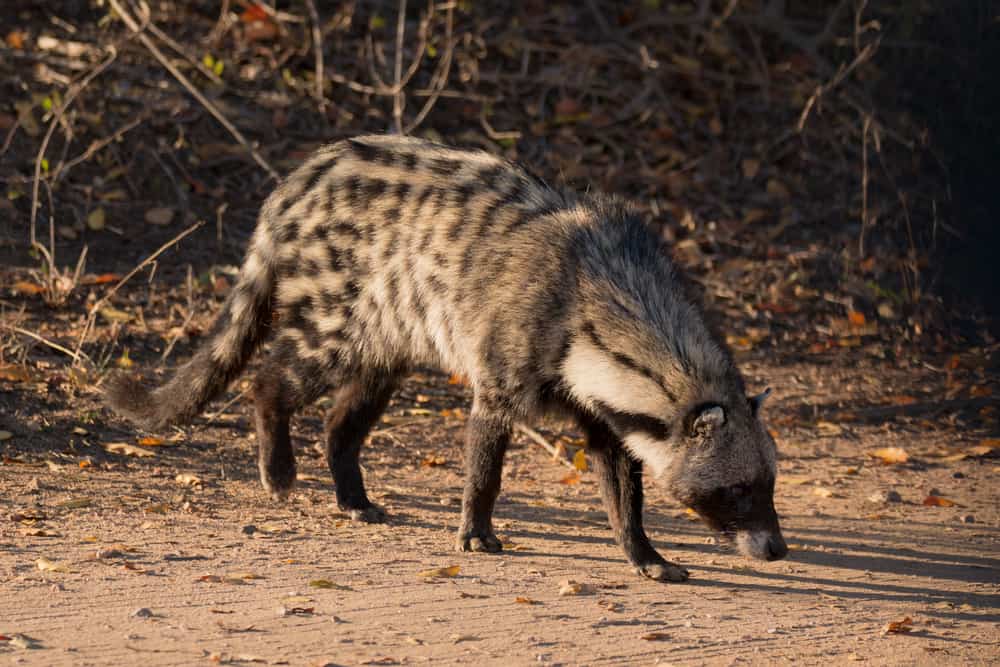
African Palm Civet (Nandinia binotata)

The civet has a varied diet consisting of both meat and plants.

Despite the fact that the African Civet is a carnivorous mammal, it has a very varied diet that consists of both animal and plant matter. Small animals such as frogs, rodents, lizards, and snakes make up the majority of the African Civet’s diet, along with berries, insects, fallen fruits, and anything that it finds on the forest floor. Rather than use its paws, the African Civet primarily uses its teeth and mouth to gather food and this way of eating means that it can use its 40 sharp teeth effectively to break down its catch while its strong jaw makes it harder for its meal to try and escape.

Predators And Threats

Despite being a covert yet relatively merciless predator, the African Civet is in fact preyed upon by numerous predators within their natural environment. Large predatory cats are the most common hunters of the African Civet including leopards and lions, as well as large snakes and crocodiles. African Civet populations are also under threat from both loss of habitat and deforestation and have been vulnerable to trophy hunters in the past, across Africa. One of the biggest threats to the African Civet is the demand for their musk.

Interesting Facts And Features
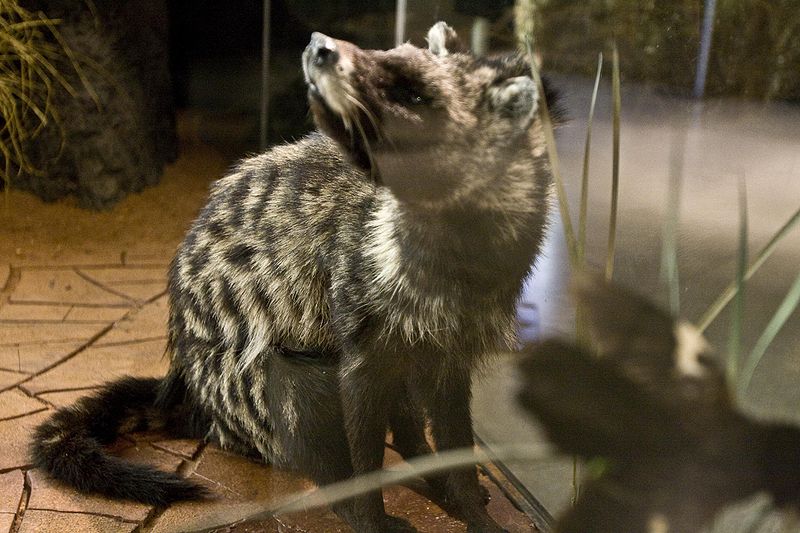
African Civet musk glands were an ingredient in some of the most expensive perfumes in the world.

The glands close to the African Civet’s reproductive organs secrete a musk that has been collected by humans for centuries. The smell is said to be quite offensive to people when it is in a concentrated form but much more pleasant once it’s diluted. This is the scent that became one of the ingredients in some of the most expensive perfumes in the world and led to the African Civet becoming a well-known animal. African Civets are known to carry rabies disease, which is contracted through contact with an infected animal.

Relationship With Humans

Each African Civet secretes up to 4g of musk on a weekly basis, which is ordinarily garnered from them in the wild. However, it is not unknown to capture and keep African Civets for their musk, and is thought of as an incredibly cruel industry. Today, there are very few perfumes that still contain actual musk from their glands as there are many scents today that are easily artificially reproduced. Although it is not yet an endangered animal, its population has also been severely affected by human hunters, who like to add their fur and skin to the trophy cabinet.

Conservation Status And Life Today
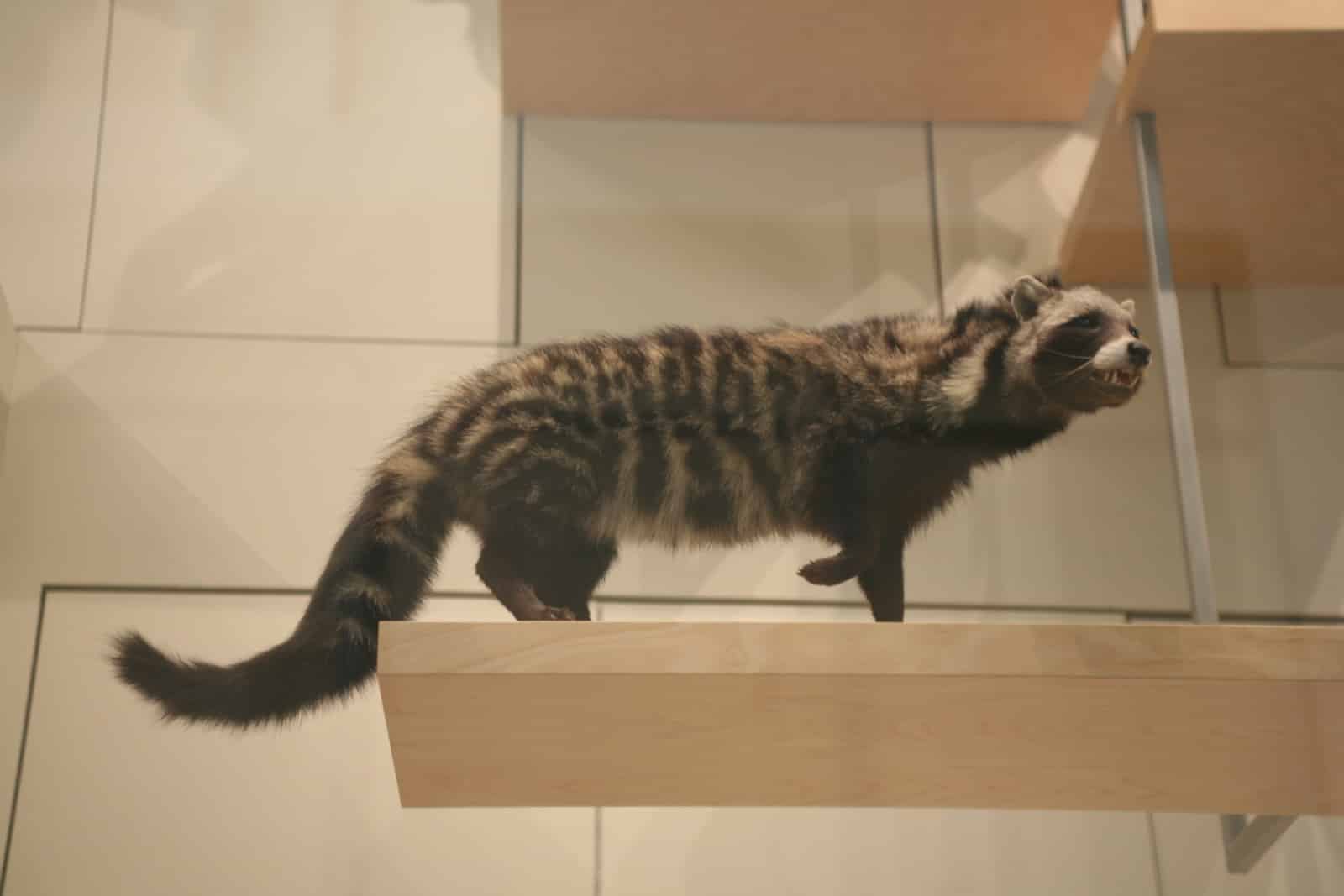
An African Civet is not currently in danger of becoming extinct.

Today, the African Civet is under threat from deforestation and therefore in danger of losing much of its natural habitat. There is such an extensive case of deforestation in the area due to logging and clearing of the land. The African Civet is currently classed as being the Least Concern, which means that there is little threat at the moment that the African Civet will become extinct in the near future.

View all 326 animals that start with A
How to say African Civet in ...
German
Pardelroller
English
<a href="https://a-z-animals.com/animals/african-palm-civet/">African Palm Civet</a>
Finnish
Afrikanpalmunäätä
French
Civette palmiste africaine
Dutch
Pardelroller
English
Afrikansk palmeruller
Turkish
Afrika palmiye misk kedisi

Sources

  1. David Burnie, Dorling Kindersley (2011) Animal, The Definitive Visual Guide To The World's Wildlife / Accessed August 10, 2010
  2. Tom Jackson, Lorenz Books (2007) The World Encyclopedia Of Animals / Accessed August 10, 2010
  3. David Burnie, Kingfisher (2011) The Kingfisher Animal Encyclopedia / Accessed August 10, 2010
  4. Richard Mackay, University of California Press (2009) The Atlas Of Endangered Species / Accessed August 10, 2010
  5. David Burnie, Dorling Kindersley (2008) Illustrated Encyclopedia Of Animals / Accessed August 10, 2010
  6. Dorling Kindersley (2006) Dorling Kindersley Encyclopedia Of Animals / Accessed August 10, 2010
  7. David W. Macdonald, Oxford University Press (2010) The Encyclopedia Of Mammals / Accessed August 10, 2010
  8. About African Civets / Accessed August 10, 2010
  9. Civet Scent Glands / Accessed August 10, 2010
  10. African Civet Benhaviour / Accessed August 10, 2010
  11. The African Civet / Accessed August 10, 2010
Melissa Bauernfeind

About the Author

Melissa Bauernfeind

Melissa Bauernfeind was born in NYC and got her degree in Journalism from Boston University. She lived in San Diego for 10 years and is now back in NYC. She loves adventure and traveling the world with her husband but always misses her favorite little man, "P", half Chihuahua/half Jack Russell, all trouble. She got dive-certified so she could dive with the Great White Sharks someday and is hoping to swim with the Orcas as well.
Connect:

Thank you for reading! Have some feedback for us?


African Civet FAQs (Frequently Asked Questions)

African Civets are Omnivores, meaning they eat both plants and other animals.