A
Species Profile

Asian Palm Civet

Paradoxurus hermaphroditus

Fruit by night, civet by scent
trubavin/Shutterstock.com

Asian Palm Civet Distribution

Click a location to explore more animals from that region

Loading map...
Asian Palm Civet in a tree

At a Glance

Wild Species
Also Known As Common palm civet, Toddy cat, Luwak, Musang, Palm civet, Civet cat
Diet Omnivore
Activity Nocturnal+
Lifespan 10 years
Weight 7 lbs
Status Least Concern
Did You Know?

Not a cat: despite the nickname "civet cat," it's a viverrid (Family Viverridae) in the order Carnivora.

Scientific Classification

The Asian palm civet is a small, nocturnal viverrid (civet family) native to South and Southeast Asia, well known for its adaptability to forests, plantations, and human-dominated landscapes.

Kingdom
Animalia
Phylum
Chordata
Class
Mammalia
Order
Carnivora
Family
Viverridae
Genus
Paradoxurus
Species
Paradoxurus hermaphroditus

Distinguishing Features

  • Small, cat-like carnivoran with a long tail and pointed muzzle
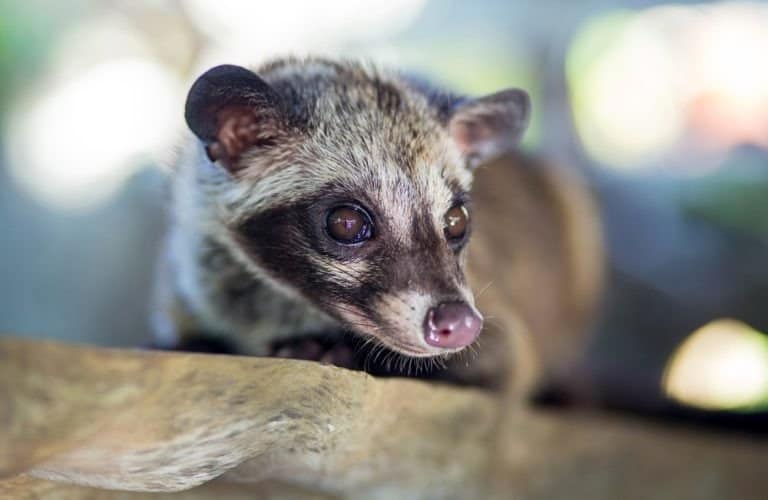
  • Grey-brown coat with darker facial markings and dorsal patterning that can appear as spots/stripes
  • Nocturnal and omnivorous (notably includes fruits); strong scent glands typical of civets
  • Often encountered near human habitation compared with many other viverrids

Physical Measurements

Length
3 ft 8 in (2 ft 10 in – 4 ft 6 in)
Weight
8 lbs (6 lbs – 11 lbs)
Tail Length
1 ft 9 in (1 ft 4 in – 2 ft 2 in)
Top Speed
12 mph
Estimated top speed 20 km/h

Appearance

Primary Colors
Secondary Colors
Skin Type Dense fur (short-to-medium length guard hairs with underfur) over mammalian skin; coarse, grizzled (agouti) appearance typical of Viverridae. Prominent perineal scent-gland region used for scent marking (civet-type glandular secretions).
Distinctive Features
  • Overall size/shape (adult): head-body length typically 42-71 cm; tail length 33-66 cm; adult mass commonly ~2-5 kg (reported across major references such as IUCN species accounts and standard mammal field guides).
  • Elongate body with relatively short legs; semi-plantigrade stance and flexible ankles aid climbing-arboreal tendencies are reflected in strong grasping feet/claws (but it is not a true cat, Family Viverridae).
  • Nocturnal eye-shine and large eyes adapted for low light; facial pattern often includes dark eye-to-muzzle stripes and a darker muzzle.
  • Tail long and thickly furred, used for balance in trees; often shows darker rings/mottling rather than the bold ring pattern of some other civets.
  • Perineal scent glands well developed; individuals frequently scent-mark trails, latrines, and feeding sites-typical civet-family trait associated with territorial/communication behavior in nocturnal, largely solitary mammals.
  • Dentition and robust jaw reflect omnivory; diet includes substantial fruit (often dominant seasonally) plus insects and small vertebrates-this fruit-heavy omnivory aligns with their frequent use of disturbed habitats (plantations, gardens, forest edges).
  • In captivity, Asian palm civets can live over 20 years (often about 22 years). In the wild they usually live less because of predators, hunting, and disease; numbers vary by place.

Sexual Dimorphism

Sexual dimorphism is generally subtle in external appearance; males tend to be slightly larger/heavier on average, but coat color/pattern is similar in both sexes. Both sexes possess well-developed perineal scent glands typical of civets; external genital differences are the most reliable field distinction at close range.

  • Slightly larger average body mass/robustness (population-dependent).
  • Externally visible male genitalia; otherwise similar coat and markings to females.
  • Slightly smaller average body mass/overall size (population-dependent).
  • Mammae present (most evident when lactating); otherwise similar coat and markings to males.

Did You Know?

Not a cat: despite the nickname "civet cat," it's a viverrid (Family Viverridae) in the order Carnivora.

Size: head-body length 43-71 cm; tail length 40-66 cm (tail often nearly as long as the body).

Typical adult mass is about 2-5 kg, varying by region and habitat quality.

Gestation is ~60-70 days; litters commonly 2-4 young (reported range 1-5).

Diet is strongly omnivorous: fruit can dominate the diet seasonally (figs/Ficus are especially important), but it also eats insects and small vertebrates.

Its perineal scent glands produce "civet," historically used in perfumery (as a fixative) and in traditional pharmacopeias.

Highly tolerant of disturbance-often uses plantations, gardens, and edges as well as forests, largely because fruit and rodents are abundant there.

Unique Adaptations

  • Powerful perineal scent glands (a key Viverridae trait) for communication in low-light environments where vision is limited.
  • Flexible dentition and digestive strategy for an omnivorous diet with substantial fruit intake while still processing animal prey.
  • Climbing proficiency: semi-arboreal build with good balance and a long tail (40-66 cm) aiding maneuvering in trees.
  • Behavioral plasticity: tolerance of fragmented habitat and willingness to exploit plantations and settlements where fruit/rodents concentrate.
  • Camouflaging pelage pattern (often grey-brown with dark facial mask and body markings) that breaks up outline in forest shade at night.

Interesting Behaviors

  • Nocturnal foraging: most activity occurs after dusk, with travel and feeding split between ground and trees depending on food availability.
  • Solitary spacing: adults are usually encountered alone outside breeding/parenting periods, using scent marks to advertise presence and status.
  • Scent-marking routines: rubs/marks substrates with perineal gland secretions and leaves conspicuous scent cues along travel routes.
  • Arboreal feeding: climbs to harvest fruit and may linger at productive fruiting trees, moving between canopy and understory.
  • Opportunistic omnivory: switches rapidly between fruit crops, insects, eggs, and small vertebrates-an important trait in disturbed landscapes.
  • Den use: commonly rests by day in tree hollows, dense vegetation, or roof spaces in human-dominated areas when natural refuges are scarce.

Cultural Significance

Asian palm civet (Paradoxurus hermaphroditus) is known for civet-processed coffee and for civet scent used long ago in perfume. It visits fruit trees at night, helping spread seeds and control rodents, but sometimes raids fruit.

Myths & Legends

Perfumers in West and South Asia prized scent from the Asian palm civet (Paradoxurus hermaphroditus) as a rare night perfume tied to luxury and attraction. Some old medical books called it a tonic or aphrodisiac.

In coffee-growing regions of Indonesia, a common origin story told around civet-processed coffee holds that civets "choose" only the best, ripest coffee cherries-an idea that became part of the drink's mystique and gifting culture.

Across parts of Southeast Asia, folk storytelling often treats the civet as a stealthy night orchard-raider-an archetype used in cautionary tales about guarding fruit trees and food stores.

Conservation Status

LC Least Concern

Widespread and abundant in the wild.

Population Decreasing

Protected Under

  • CITES Appendix III (listed by India for Paradoxurus hermaphroditus; international trade controls apply where relevant).
  • Protected under various national/subnational wildlife laws in parts of its range; legal status and enforcement vary by country (see country-specific wildlife legislation and schedules).

Life Cycle

Birth 2 cubs
Lifespan 10 years

Lifespan

In the Wild
6–15 years
In Captivity
12–20 years

Reproduction

Mating System Polygyny
Social Structure Solitary
Breeding Pattern Transient
Fertilization Internal Fertilization
Birth Type Internal_fertilization

Asian palm civets (Paradoxurus hermaphroditus) are solitary, nocturnal, meet briefly to mate with no pair bond and little male care. Likely polygynous/polygynandrous. Gestation 60–70 days; 1–5 young (usually 2–4); mothers rear helpless young; no helpers.

Behavior & Ecology

Social No fixed group name (typically solitary) Group: 1
Activity Nocturnal, Crepuscular
Diet Omnivore ripe figs (Ficus spp.)

Temperament

Shy/elusive in low-disturbance habitats; tends to avoid direct encounters (Duckworth et al., 2016).
Opportunistic and highly adaptable; readily exploits cultivated fruit, small vertebrates/invertebrates, and anthropogenic food sources-often leading to increased tolerance of people in villages/plantations (Duckworth et al., 2016).
Primarily arboreal/scansorial: frequently uses trees for travel and foraging but also moves and forages on the ground (general viverrid ecology; Nowak, 1999).
Territorial/space-defending tendencies expressed mainly through scent marking and avoidance rather than group defense (Nowak, 1999).
Species benchmarks (often reported in identification/biology references for P. hermaphroditus): adult body mass commonly ~2-5 kg; head-body length ~48.5-62 cm; tail length ~43-53 cm (Nowak, 1999).
Longevity: maximum recorded longevity in captivity reported at ~22 years in compiled longevity databases (e.g., AnAge entry for Paradoxurus hermaphroditus); wild longevity is typically lower but not well quantified with a single robust species-wide estimate.

Communication

Growls and snarls during aggression or close-range disputes Nowak, 1999
Hisses/spits when threatened or handled Reported in wildlife handling/field accounts; summarized in Nowak, 1999
High-pitched screams/shrieks in intense distress or aggressive encounters Nowak, 1999
Soft contact calls Low mews/chirps) reported in close-range interactions such as mother-young contexts (behavioral summaries in species accounts; Duckworth et al., 2016
Scent marking is primary: perineal/anal gland secretions Civet) deposited by rubbing and/or at marking sites; used for individual identification and spacing (viverrid trait described for the species in Nowak, 1999
Urine marking Spraying/dribbling) and fecal deposition at repeated sites used as territorial/route markers (summarized in Nowak, 1999; Duckworth et al., 2016
Tactile communication during mating and mother-young care Grooming/close contact), but overall tactile interactions are infrequent due to solitary lifestyle (Nowak, 1999
Body postures and facial expressions Arched back, piloerection, baring teeth) used as threat displays at close range (general carnivore/viverrid behavioral descriptions; Nowak, 1999

Habitat

Biomes:
Tropical Rainforest Tropical Dry Forest Temperate Forest
Terrain:
Mountainous Hilly Plateau Plains Valley Coastal Island Riverine Karst Rocky +4
Elevation: Up to 8202 ft 1 in

Ecological Role

Omnivorous mesocarnivore with a strong frugivory component; functions as both predator and major seed disperser in many South/Southeast Asian landscapes.

seed dispersal of numerous fleshy-fruited plants (including Ficus spp.), aiding forest regeneration and connectivity across fragmented habitats potential enhancement of seed germination for some species via gut passage (reported in seed-dispersal studies of the species) suppression of some invertebrate populations and occasional predation on small vertebrates (pest-control function in agroforestry mosaics) movement of nutrients via defecation/latrine use, locally redistributing seeds and organic matter

Diet Details

Main Prey:
Insects Other arthropods Earthworms and other soft-bodied invertebrates Small mammals Small birds and nestlings Bird eggs Small reptiles Amphibians Carrion +3
Other Foods:
Ripe fruits Figs Coffee cherries Berries and drupes nectar and flower parts

Human Interaction

Domestication Status

Wild

Asian palm civet (Paradoxurus hermaphroditus) is wild, not domesticated, though sometimes kept as pets or caged for civet coffee. Adults are 50–71 cm body, 47–66 cm tail, and 2–5 kg. It is nocturnal and lives near plantations, orchards, and villages, causing crop raids and making dens in roofs; people often remove or capture them. Lifespan up to ~15–20 years in captivity.

Danger Level

Moderate
  • Bites and deep scratches when cornered/handled (sharp canines and claws); risk increases with attempted capture, pet handling, or cage maintenance.
  • Zoonotic disease exposure from bites, saliva, urine/feces, and ectoparasites-civets have been implicated in spillover contexts for SARS-related coronaviruses in wildlife trade supply chains (notably during the 2002-2003 SARS outbreak investigations), and like many small carnivores can carry other pathogens/parasites depending on region and husbandry.
  • Human-wildlife conflict: raiding fruit in orchards/plantations, taking poultry/eggs, and denning in buildings can lead to aggressive encounters during eviction or trapping.

As a Pet

Not Suitable as Pet

Legality: Laws for Asian palm civet (Paradoxurus hermaphroditus) vary by country and local area. Often treated as an exotic wild mammal with permits, cage rules, trade controls, or bans; check national and local laws.

Care Level: Expert Only

Purchase Cost: $500 - $2,500
Lifetime Cost: $15,000 - $45,000

Economic Value

Uses:
Wildlife tourism/education (zoos, rescue centers) Agro-ecosystem predator of some pests (context-dependent) Commodity production (civet coffee) Nuisance pest costs (orchard and poultry-yard losses; trapping/relocation)
Products:
  • civet coffee (coffee beans processed through the civet's digestive tract)
  • live-animal trade (exotic pet market; often regulated/illegal)
  • wildlife display/education services (zoo/rescue admissions)

Relationships

Related Species 10

Brown palm civet Paradoxurus jerdoni Shared Genus
Golden palm civet Paradoxurus aureus Shared Genus
Sulawesi palm civet Paradoxurus stenocephalus Shared Genus
Masked palm civet
Masked palm civet Paguma larvata Shared Family
Small-toothed palm civet Arctogalidia trivirgata Shared Family
Binturong
Binturong Arctictis binturong Shared Family
Large Indian civet Viverra zibetha Shared Family
Malayan civet
Malayan civet Viverra tangalunga Shared Family
Small Indian civet Viverricula indica Shared Family
Owston's civet Chrotogale owstoni Shared Family

Ecological Equivalents 5

Animals that fill a similar ecological role in their ecosystem

“Although not a cat, the Asian Palm Civet shares much in common with felines, including its hunting and tree-climbing.”

The Asian Palm Civet occupies a broad range that stretches across much of southern Asia, from India to China. These creatures are most closely related to mongeese and weasels. Civets climb trees both to escape from other predators and to hunt. The most serious threat that these creatures face today is habitat loss, much of it due to deforestation related to palm oil plantation development.
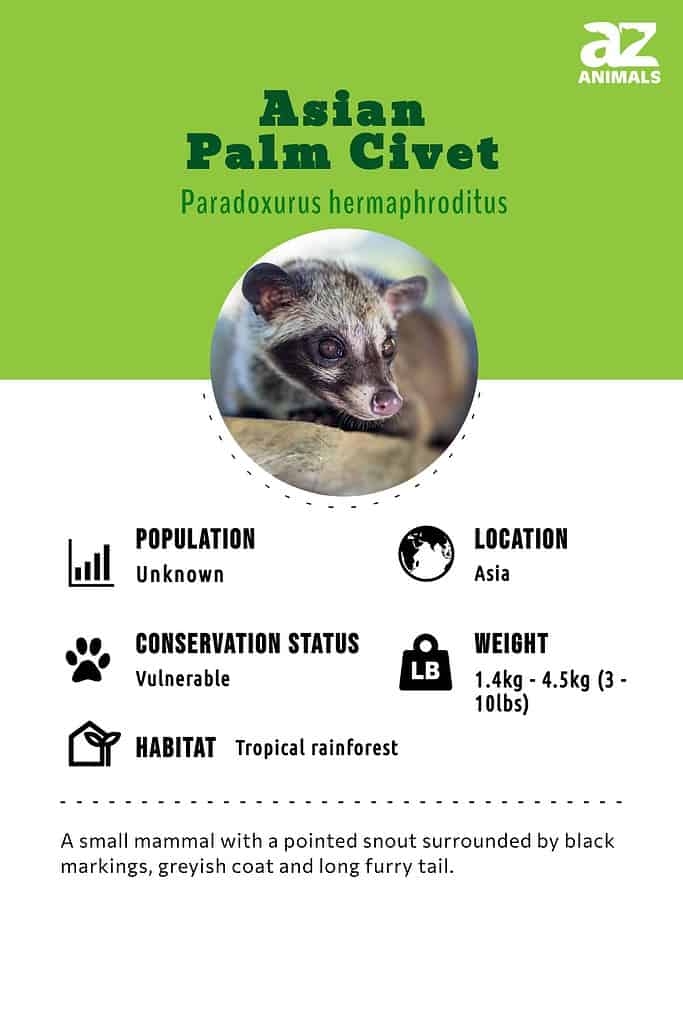
Incredible Asian Palm Civet facts!

  • These animals are viverrids that prey primarily on rodents, snakes, and frogs, while also eating fruit
  • Pointed, sharp teeth and an elongated body help this animal survive in its habitat
  • The unique habits of palm civets make them somewhat hard to observe, even with camera usage
  • Civets can adapt to live at higher altitudes, reducing population damage due to deforestation

Scientific name

The Asian Palm Civet’s scientific name is Paradoxurus Hermaphroditus. Hermaphroditus is a Greek term that comes from the mistaken perception that these creatures are intersex because of scent glands resembling testicles under the tail that are present in both genders. Males and females emit different types of scents with these glands, although the way they mark their territory is similar, leading to misconceptions about the species being intersexed.
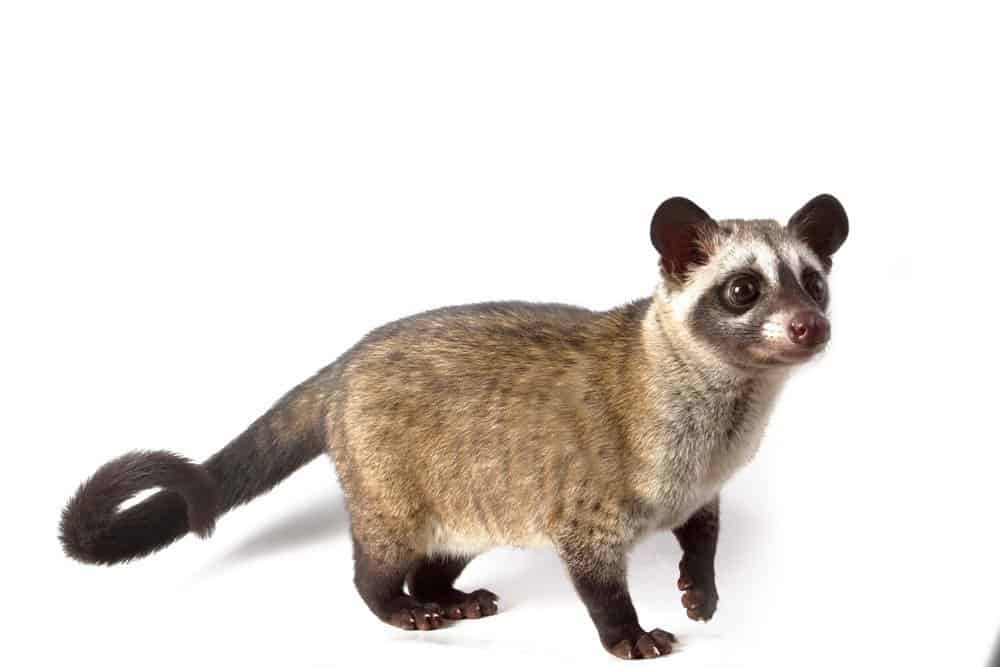
The Asian palm civet or luwak (Paradoxurus hermaphroditus). isolated on white background

Male and female Asian palm civets have scent glands under their tails.

Evolution

Civets are members of the Viverridae family of small feliform mammals. Viverrids were ancient inhabitants of the “Old World” tropics and comprise 33 species in 14 genera. It is believed that the Asian palm civet dispersed from Borneo during the Pleistocene. The animal was later introduced by humans to other Philippines islands.

Appearance
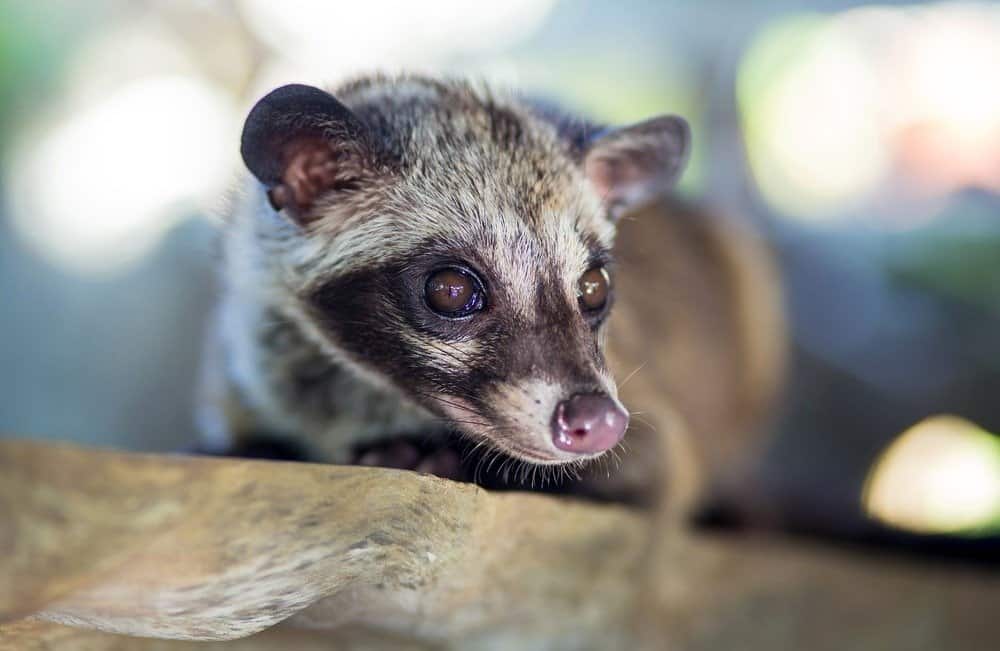
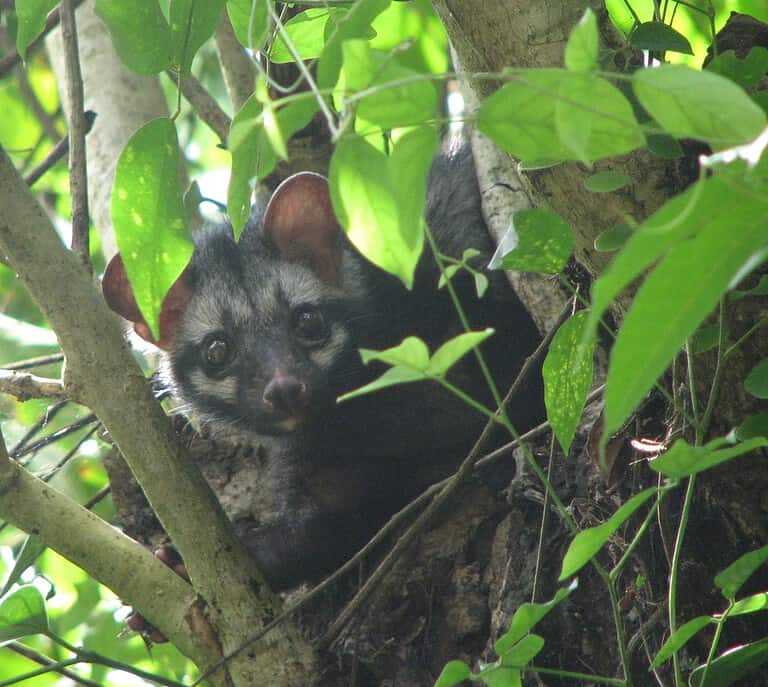
Asian Palm Civet in a tree

Asian palm civets are half the size of their African counterparts.

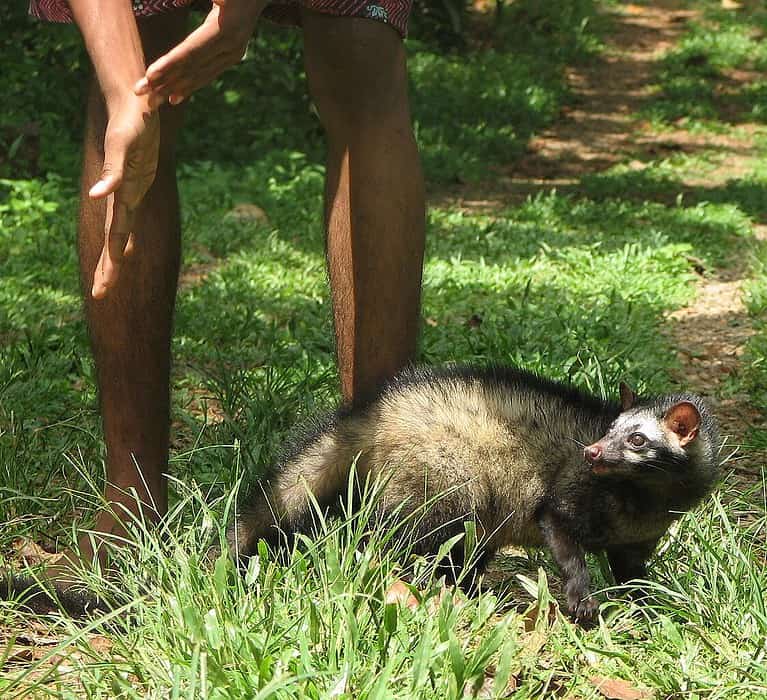
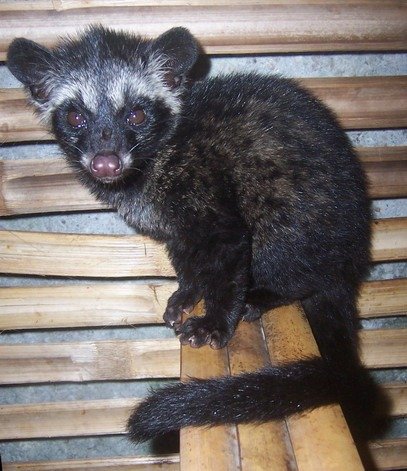
These civets are most commonly found in Southeast Asia, southern China, Sri Lanka, and southern India. Despite the common nickname of “toddy cat”, civets are viverrids unrelated to felines. These furry creatures have long bodies, including the tail, and may have coat colors in brown, tan, gray, white, yellow, or black, with facial banding similar to a raccoon that may also include the muzzle area.

The average weight for the Civet is 1.4 to 2.5kg (3 to 10 lbs). These animals weigh about half the weight of their African counterparts. The Large Indian Civet, one of the next closest species in size, is more than twice the weight of most Asian Palm Civets, with a noticeably larger profile.

Large eyes are one of the distinguishing characteristics of this species, which helps enable easier nocturnal hunting in the jungle environment where they live. These civets have a leaner build than many other civet species. These animals are built to scale trees very easily, as well as an escape from predators they may encounter in their jungle environment.

The elongated muzzle of an Asian Palm Civet, combined with sharp teeth, makes it easier for these animals to catch their prey. Palm civets’ small size makes them somewhat vulnerable to larger predators, despite their speed and agility. Their strong claws make scaling trees to escape from threats easier and can help them grasp their food more easily.
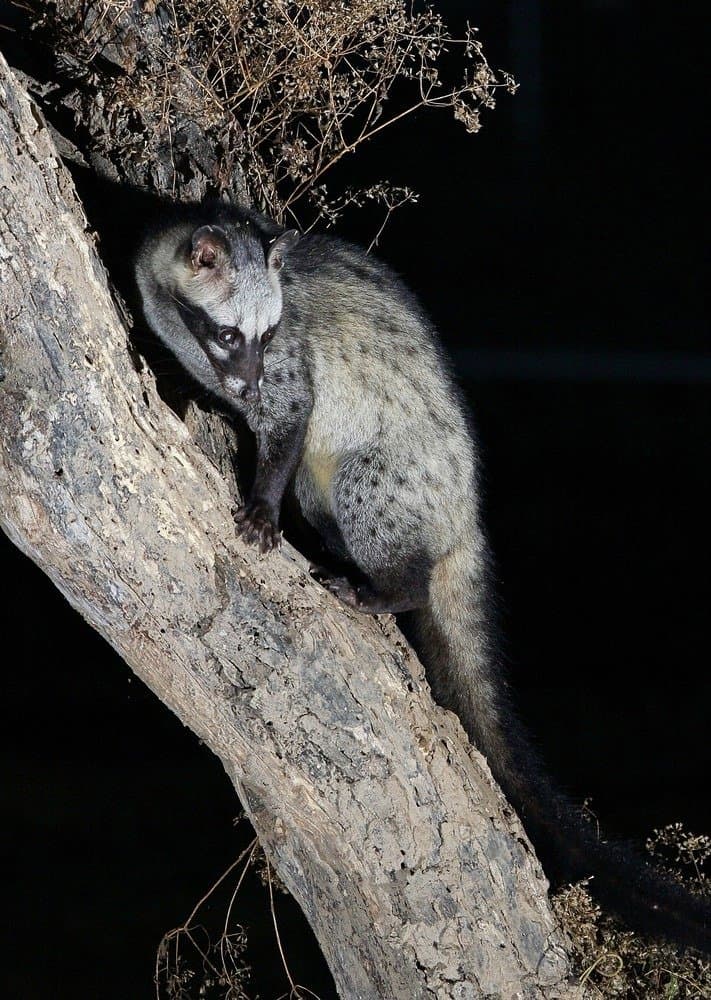
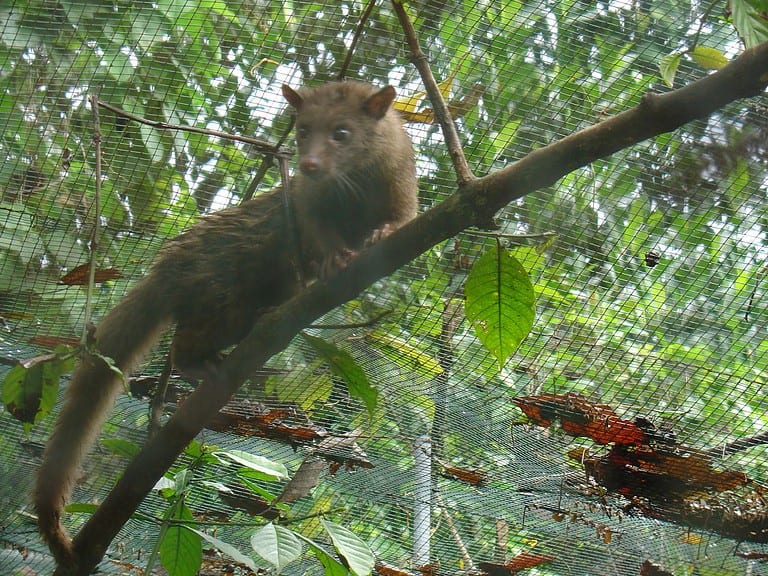
Asian palm civet on a tree branch

Asian palm civets are solitary animals that use their scent gland markings to communicate with each other.

Behavior

These civets are solitary animals for the most part, except when mating. These viverrids use a lot of scent-marking on the ground with the glands contained under the tail. The animals have sensitive-enough noses that they can easily identify other civets by the scents they leave behind with these glands.

These animals easily live in both terrestrial and arboreal environments, with more of a tendency towards nocturnal behavior. The species is nocturnal enough that there has been relatively little daytime behavior observation in the wild. When possible, these animals prefer to make their homes in forests with denser tree cover.
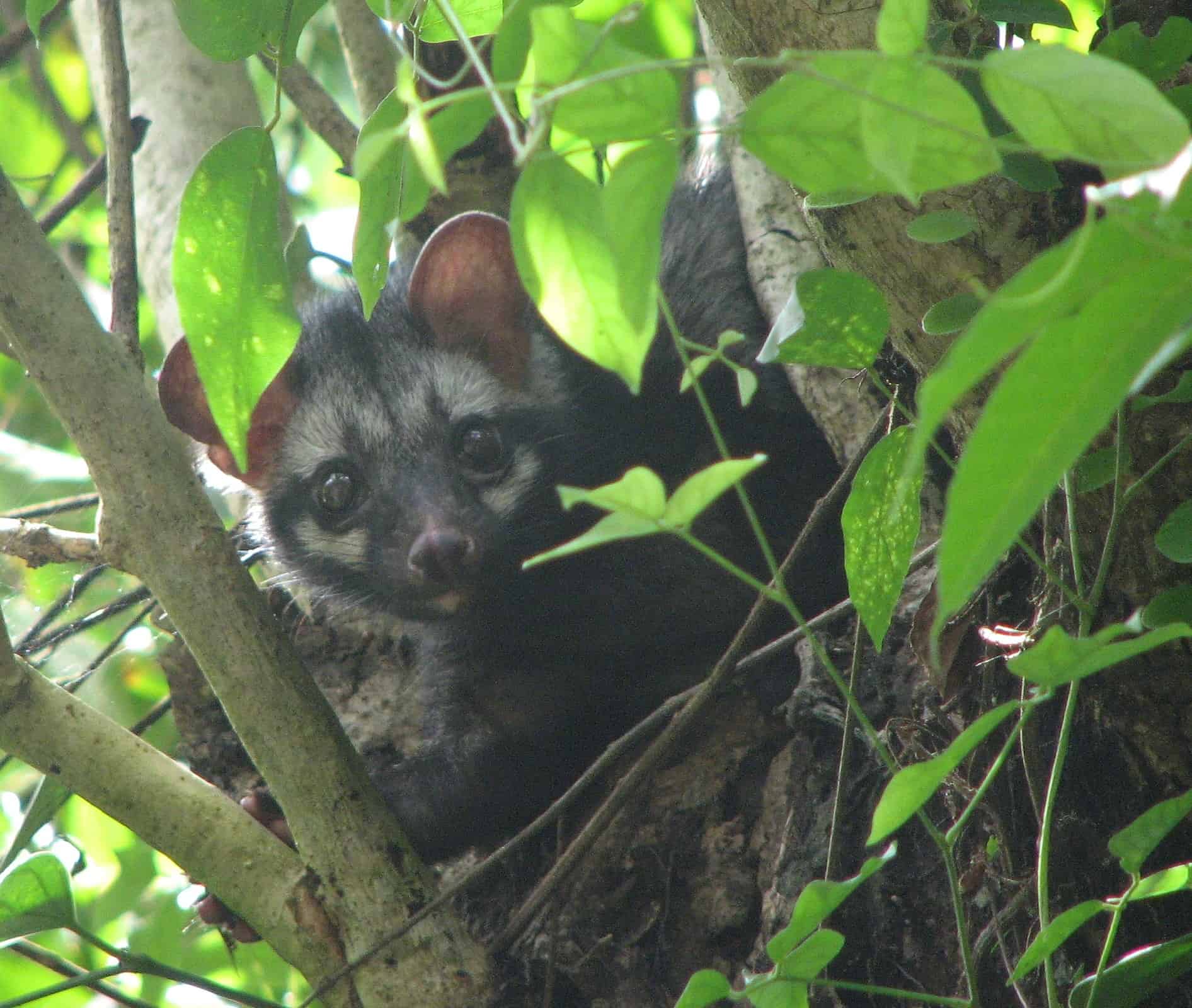
Asian Palm Civet in a tree. From Kerala, India

Asian palm civets thrive in tropical rainforests.

Habitat

These civets’ historical range has included the tropical rainforests of southern India, Sri Lanka, southern China, and other arboreal forest areas of Southeast Asia. Because of their tropical environment, they are able to manage warm temperatures very well. The high humidity of these regions is something that these animals have all adapted to very well.

This species has been threatened by the bushmeat and pet trades, as well as being captured for the Kopi Luwak coffee trade, which uses coffee beans fermented in a palm civet’s digestive tract. Deforestation due to logging and clearing for palm oil plantations are also threats to this unique species. A loss of habitat disrupts the animal’s ability to find as much food and maintain viable breeding populations.

Despite deforestation, the Asian Palm Civet has shown a high degree of adaptability. In areas that have undergone a lot of logging, Asian Palm Civets often go to gardens and parks with a lot of fruit trees. Some Sri Lankan homeowners have had issues with civets taking up residence in their attics, and interaction with humans in settled areas will likely become more common as territory loss continues.
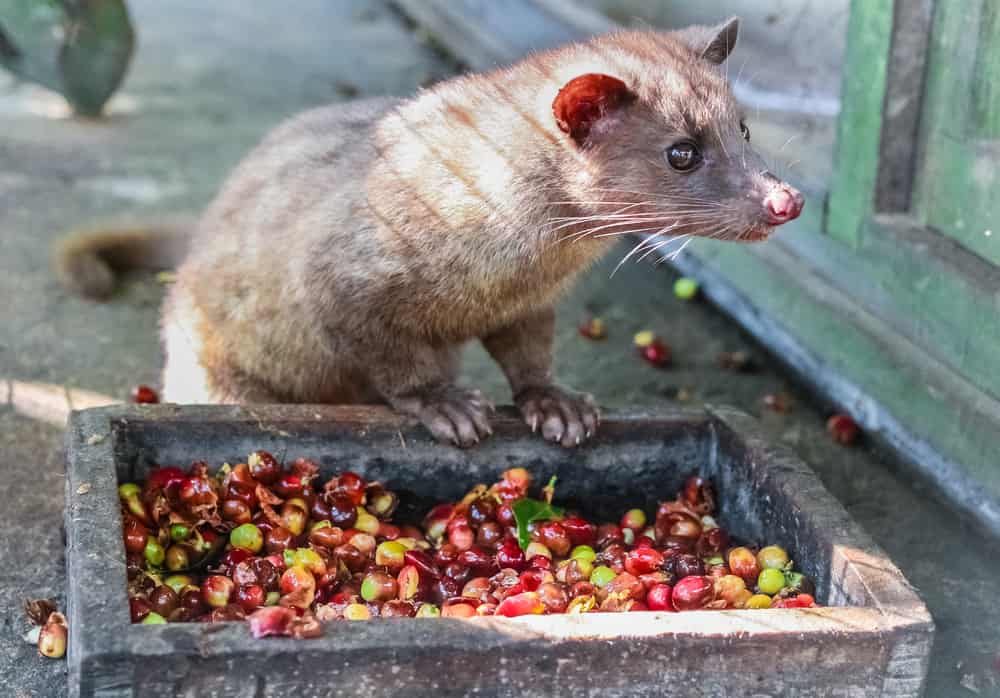
civet

Asian Palm Civets eat coffee berries but are exploited by coffee makers who make coffee from their digested berry remains.

Diet

What do Asian Palm Civets eat? Asian Palm Civets are omnivorous animals that supplement their meat-based diets with fruit and other plant-based foods. Prey includes smaller rodents, snakes, frogs, and insects. Plant-based favorite foods include Chiku, coffee, mango, rambutan, and palm flower sap.

Palm flower sap becomes fermented, used to make a sweet type of liquor called a toddy. The species’ toddy cat nickname comes from its habit of eating palm flower sap.

When Asian Palm Civets eat fruits, they are likely to consume berries. When these animals eat other fruits, they prefer pulpy varieties.

Predators and threats
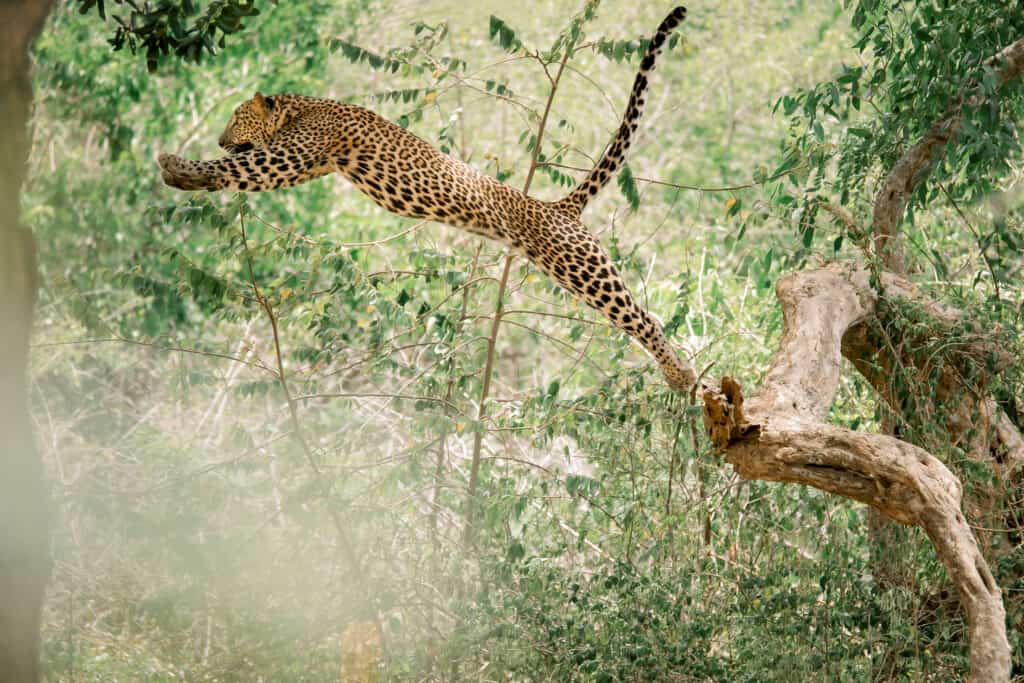
leopard

Leopards prey on Asian palm civets.

The biggest threats to Palm Civets and other musang species include big cats like leopards and tigers. Crocodiles may also pose a threat, as well as larger snakes.

Humans are the species that pose the greatest threat to Asian Palm Civets. Habitat loss due to the palm oil and logging industries has been a major issue of concern. Capturing these animals for the pet trade, for their meat, and for Kopi Luwak coffee production also remain threats of concern.

Reproduction, Babies, and Lifespan
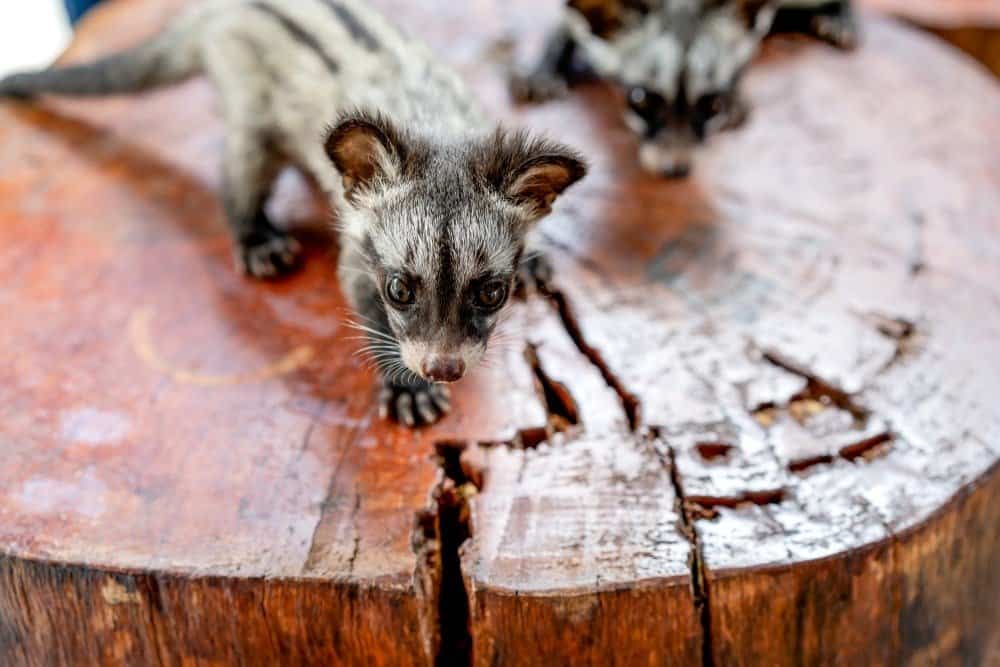
Baby Asian Palm civet on a tree stump

Baby Asian Palm civets are weaned and ready to be independent by four months.

Relatively few people have witnessed Asian Palm Civets mating, but enough is known to understand that they are solitary animals, except when mating. A male will usually mount a female for about five minutes several times before going back to their separate territories. The gestation period lasts about two months, with two to four offspring called pups per litter.

Asian Palm Civet pups are weaned and ready to be independent by three to four months, reaching reproductive age at a year old.

Asian Palm Civets can live 15 to years in the wild, although it is unknown how many of these animals reach this age. Ages of up to 22 years in captivity have been reported.
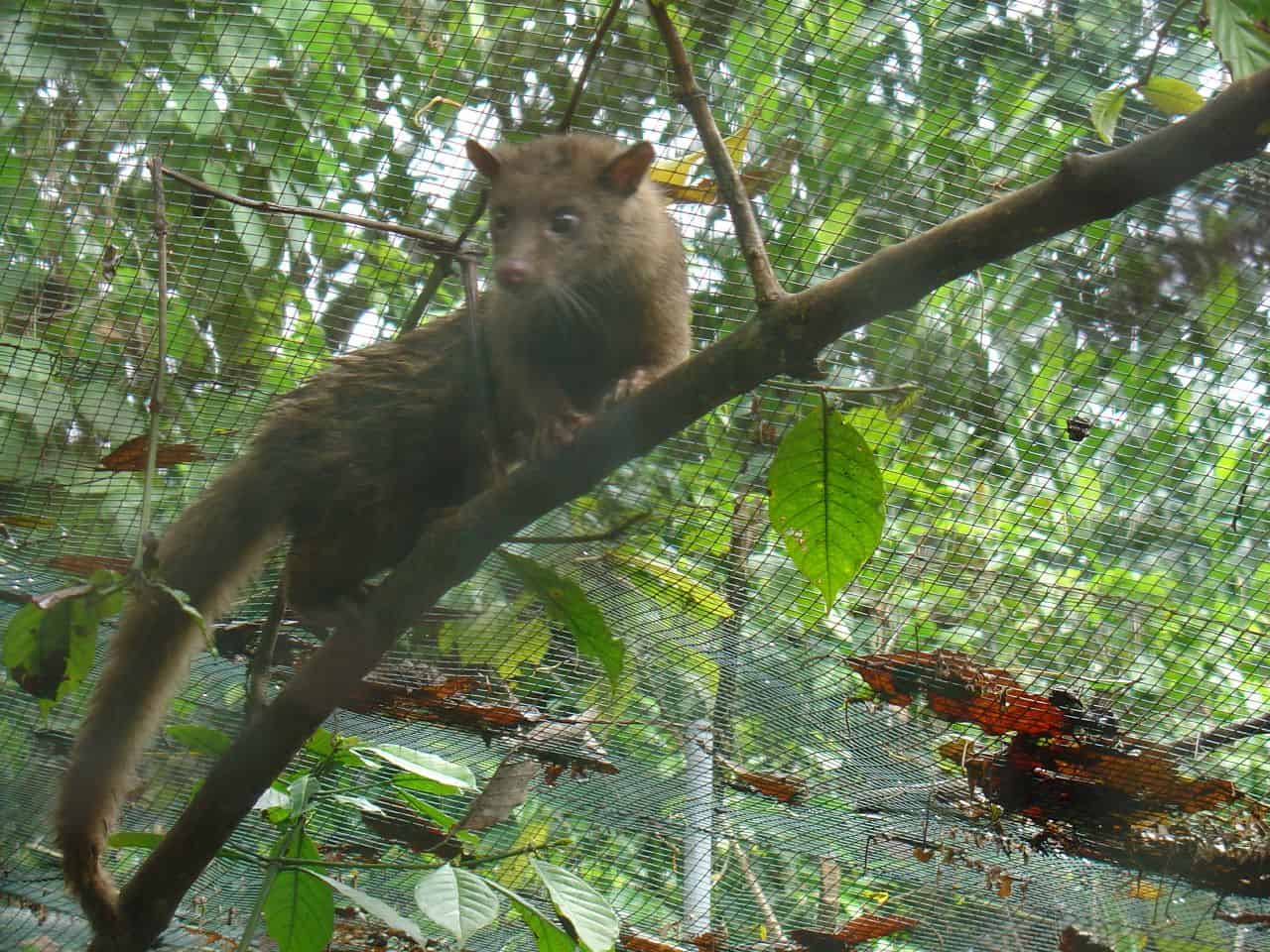
Asian Palm Civet Paradoxurus hermaphroditus

Asian palm civets can live 15 years in the wild and have lived 22 years in captivity.

Population

The Asian Palm Civet is considered a “Vulnerable” animal. The population has declined due to human activity. However, they have a widespread distribution and an ability to adapt by relocating to higher less-affected areas.

View all 326 animals that start with A
How to say Asian Palm Civet in ...
Bulgarian
Азиатска палмова цивета
German
Fleckenmusang
English
Asian Palm Civet
Spanish
Paradoxurus hermaphroditus
French
Paradoxurus hermaphroditus
Hungarian
Közönséges pálmasodró
Indonesian
Musang luwak
Italian
Paradoxurus hermaphroditus
Malay
Musang Pulut
Dutch
Loewak
Polish
Łaskun muzang
English
Careuh bulan
Swedish
Indisk palmmård
Vietnamese
Cầy vòi đốm
Chinese
椰子貓

Sources

  1. David Burnie, Dorling Kindersley (2011) Animal, The Definitive Visual Guide To The World's Wildlife / Accessed August 10, 2010
  2. Tom Jackson, Lorenz Books (2007) The World Encyclopedia Of Animals / Accessed August 10, 2010
  3. David Burnie, Kingfisher (2011) The Kingfisher Animal Encyclopedia / Accessed August 10, 2010
  4. Richard Mackay, University of California Press (2009) The Atlas Of Endangered Species / Accessed August 10, 2010
  5. David Burnie, Dorling Kindersley (2008) Illustrated Encyclopedia Of Animals / Accessed August 10, 2010
  6. Dorling Kindersley (2006) Dorling Kindersley Encyclopedia Of Animals / Accessed August 10, 2010
  7. David W. Macdonald, Oxford University Press (2010) The Encyclopedia Of Mammals / Accessed August 10, 2010
  8. Wikipedia / Accessed November 20, 2020
  9. Facts and Details / Accessed November 20, 2020
  10. Animals Diversity Web / Accessed November 20, 2020
  11. EOL / Accessed November 20, 2020

Lisha Pace

About the Author

Lisha Pace

After a career of working to provide opportunities for local communities to experience and create art, I am enjoying having time to write about two of my favorite things - nature and animals. Half of my life is spent outdoors, usually with my husband and sweet little fourteen year old dog. We love to take walks by the lake and take photos of the animals we meet including: otters, ospreys, Canadian geese, ducks and nesting bald eagles. I also enjoy reading, discovering books to add to my library, collecting and playing vinyl, and listening to my son's music.

Thank you for reading! Have some feedback for us?


Asian Palm Civet FAQs (Frequently Asked Questions)

Asian Palm Civets, although not openly hostile to people, have a muzzle that easily accommodates sharp teeth, as well as sharp claws. These features make a civet possibly dangerous if cornered. If encountered in the wild, their space should be respected.