Barn owls are stealthy nocturnal hunters with keen hearing and the ability to fly silently.
Barn owls are a globally widespread bird species known for their ghostly white faces, haunting screeches, and remarkable silent hunting abilities. They play a vital ecological role as rodent predators and have long held significance in various cultures as symbols of death or the afterlife.
Because these owls are so widespread, there are over 35 subspecies that vary in size and coloration, which are distributed across North and South America, Europe, Asia, and Australia.
The scientific name of the barn owl, Tyto alba, means “white owl.” It comes from the Greek word for owl, tyto, and the Greek word for white, alba. Barn owls differ from other members of the family Strigidae in several ways, including having a longer, narrow skull, longer legs, and a wishbone fused to the sternum.
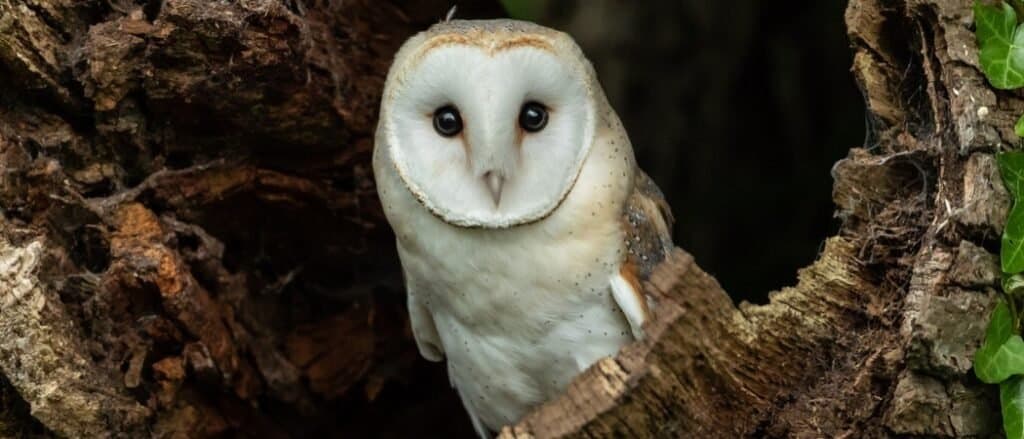
Barn owls are exceptional hunters.
©iStock.com/Alan Walker
Appearance and Physical Characteristics
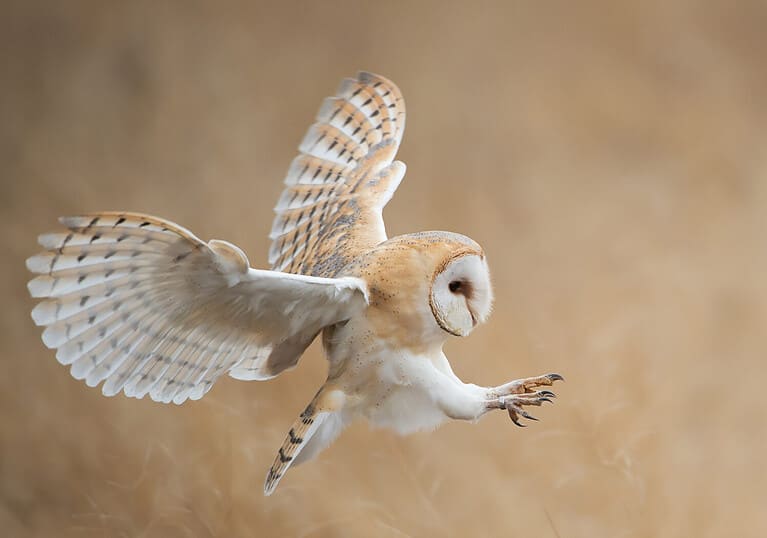
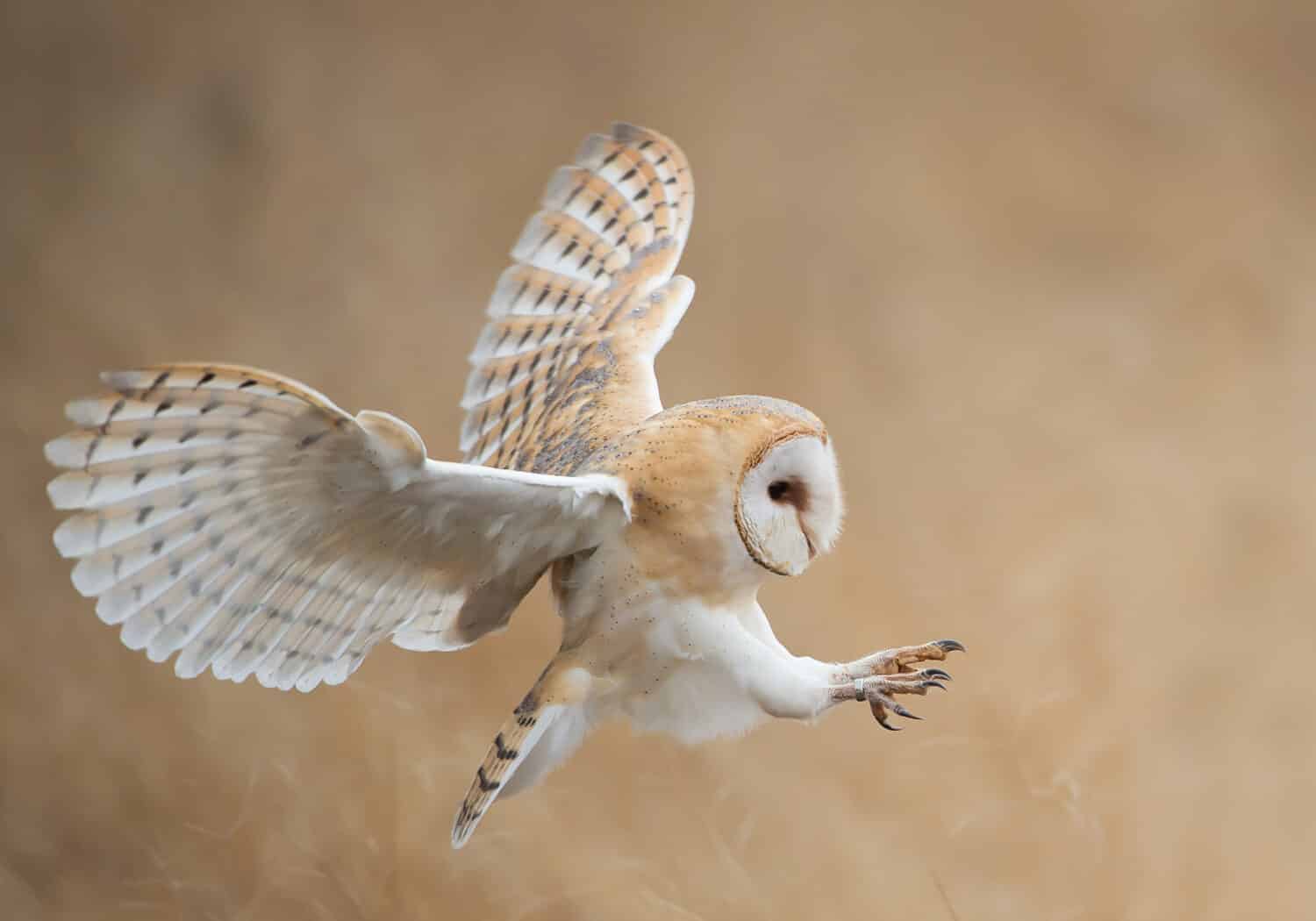
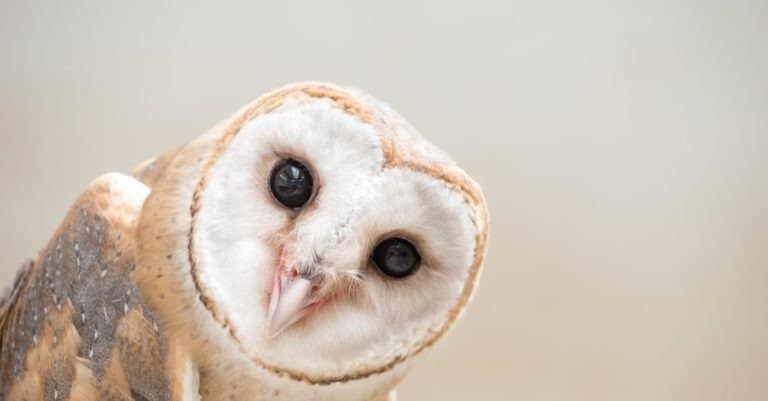
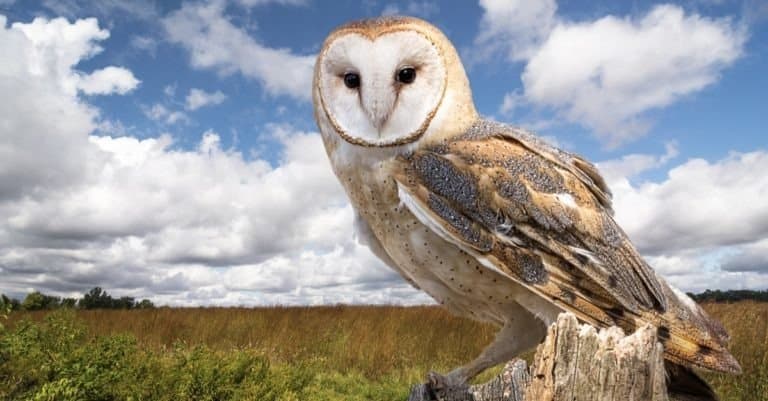
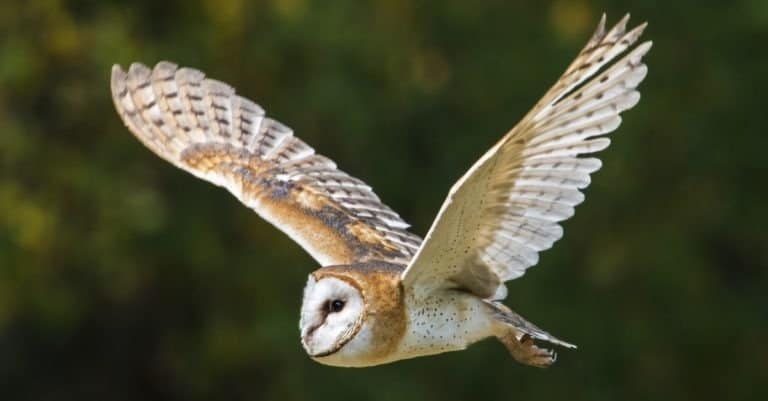
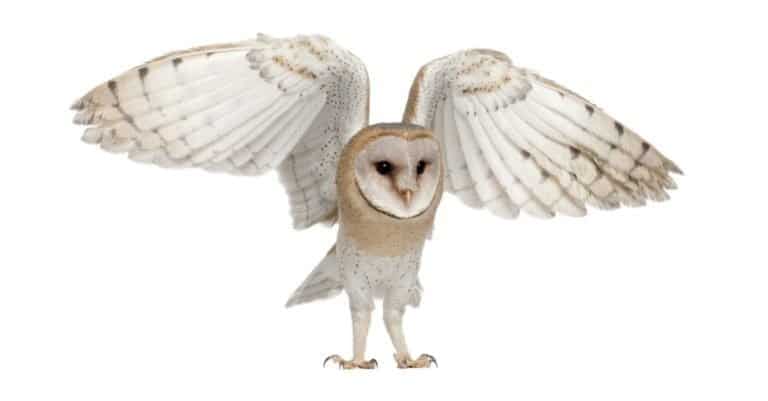
The barn owl is an animal that is most known for its bright white, heart-shaped face. Their heads are smooth and, unlike many other owl species, they do not have ear tufts. The owl’s eyes are large and dark. Their faces are framed by brown and grey feathers, as are the backside of their wings and their bodies. The wings are short, rounded, and pale beneath. Female owls with spots on their chests and plumage are more desirable to males.
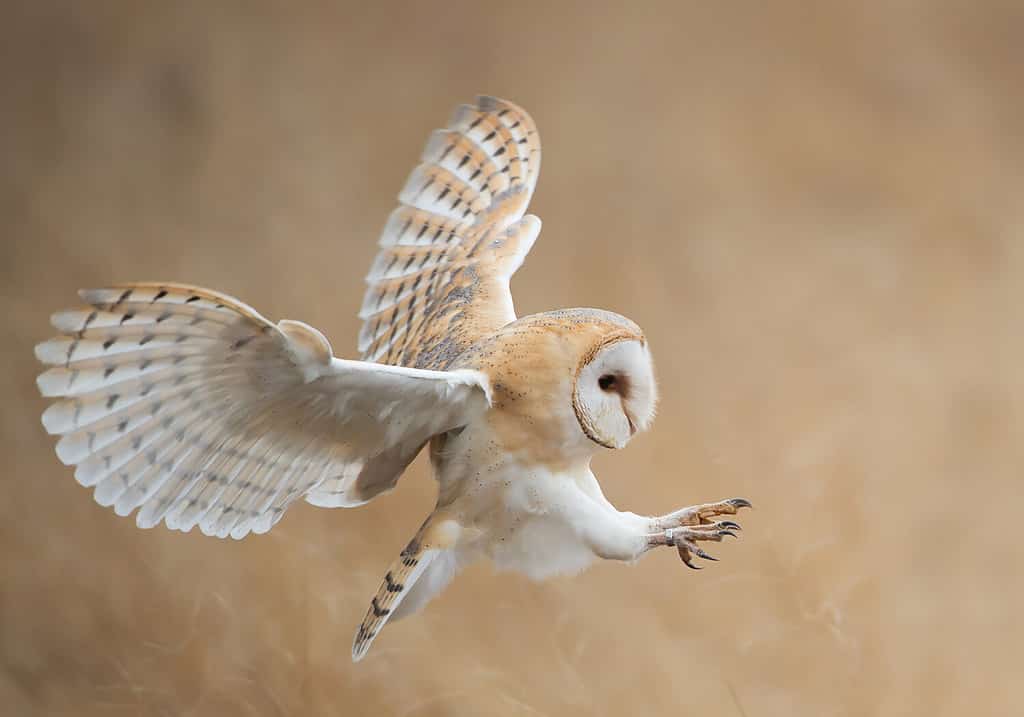
Buoyant in flight, the barn owl’s feathers are designed to break up turbulent air and funnel it over the wing. The velvety, soft feathers of the bird are stiff-edged to comb the air – contributing to the owl’s silent flight.
These owls weigh approximately 0.88–1.54 pounds, with the biggest barn owl weighing in at about 1.5 pounds. Males tend to be lighter in weight and smaller in size than females. These birds can be anywhere from about 12.5 to 15 inches tall. Their wingspan is about 39 to 49 inches.
Behavior
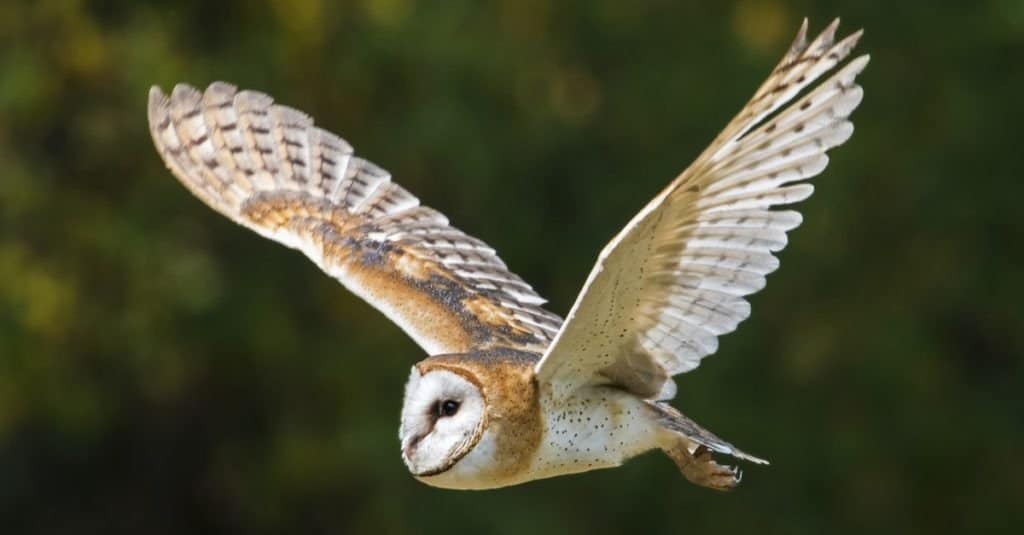
The barn owl’s feathers are designed to break up turbulent air and funnel it over the wing, contributing to its silent flight.
©Russ Heinl/Shutterstock.com
Barn owls are nocturnal hunters, using their acute hearing to locate prey. Their facial disks funnel sound to their ears, enhancing their ability to detect even the faintest rustle. These owls swallow their prey whole and then regurgitate pellets after most of the animal has been digested. The size of these pellets can be up to 1.5 inches, and scientists use them to learn many facts about what the barn owl eats.
Their eyes are twice as sensitive as the human eye. This feature, as well as their large wingspan compared to their bodies, buoyancy in flight, and unique feather design, helps them to hunt silently in open fields.
The barn owl’s vocalizations are distinctive, consisting of high-pitched screeches rather than the hoots typical of other owl species. These screeches are often described as banshee-like.
Habitat
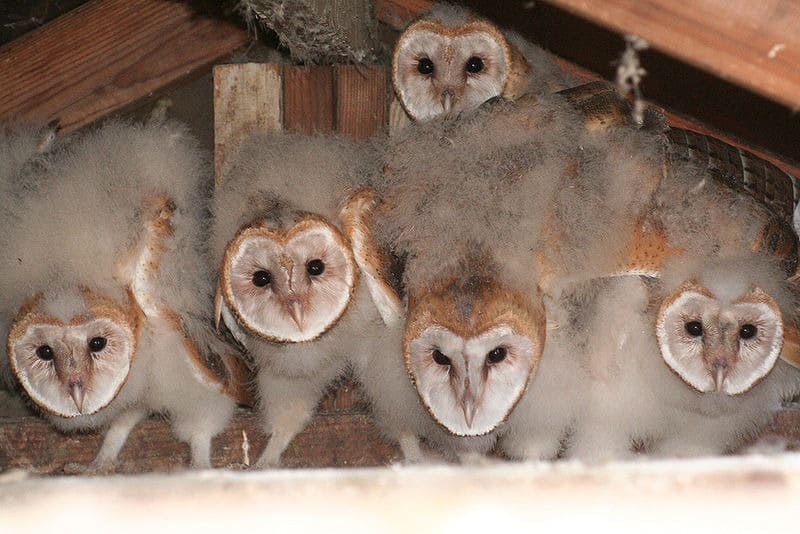
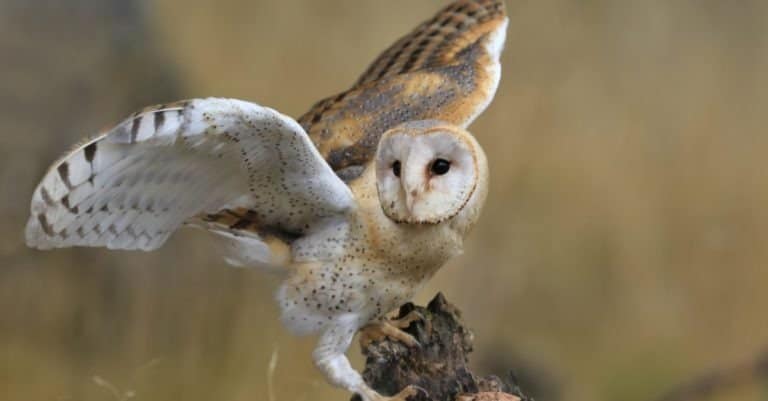
Barn owls often inhabit lofts in barns, even building nests there.
©chdwckvnstrsslhm / Creative Commons – Original
The many subspecies of these owls can be found all over the world in various habitats. They are an adaptable species that can live in most environments, from deserts to lush farmland. They get their name from their tendency to sleep in abandoned barns, but they also like empty tree cavities and other hollow places like bridges and observation towers. Because these owls are comfortable nesting in abandoned buildings, they can live in cities, suburbs, and other places that put them in close contact with human beings.
Diet
Barn owls are birds of prey, and they mostly target rats and mice. Sometimes, by dissecting pellets, scientists have found the occasional frog, smaller bird species, or even fish. Some of the smaller, island-dwelling barn owls survive on an insect-based diet.
Predators and Threats
Opossums, eagles, and raccoons prey on baby barn owls and barn owl eggs. Other owl species, such as the great horned owl and the eagle owl, also prey on their barn owl cousins.
These owls are a Least Concern species in terms of population decline. Their populations remain steady worldwide, but rehabilitation projects do exist in areas where barn owls are vanishing.
Reproduction, Babies, and Lifespan
When male owls are ready to attract a mate, they perform a mid-flight display by clapping their wings and flying back and forth to the nest. This courtship dance will include “moth flight,” a maneuver in which male owls hover in midair in front of the female.
These owls can populate up to 2 nests per year and can breed year-round. They remain in one territory once they mate, and about 75% of all barn owls mate for life. Barn owls do “divorce” if they cannot produce enough young owlets together.
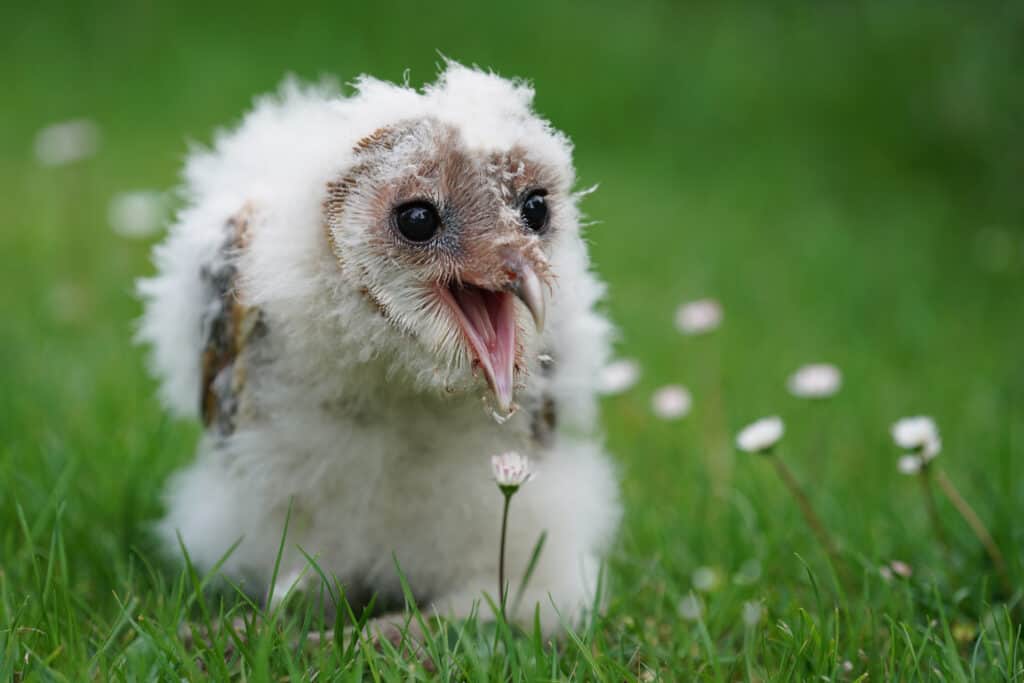
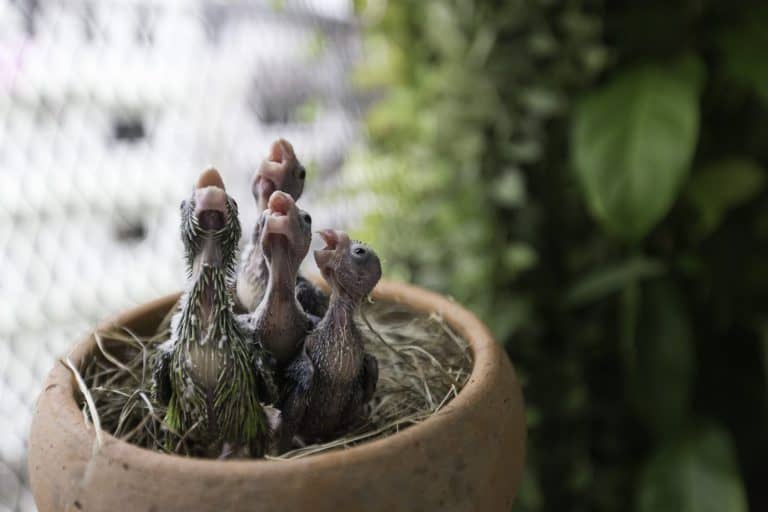
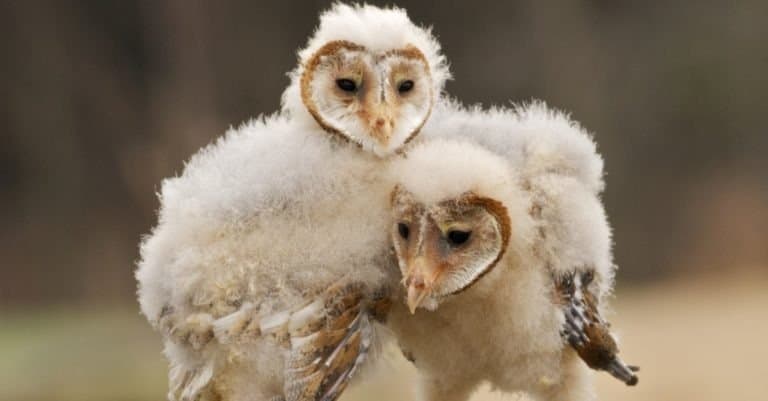
Barn owl chicks leave the nest after the parents have cared for them for approximately 15 weeks.
©Holger Kirk/Shutterstock.com
When preparing to lay eggs, barn owls choose trees closer to the large, open fields where they enjoy hunting, or abandoned places like barns. Females lay anywhere from 2 to 12 eggs, and the egg-laying takes place over multiple days. This spacing is so that the owlets do not hatch all at once. Each egg incubates for about 30 days. Chicks leave the nest after the parents have cared for them for about 15 weeks.
The average lifespan of a barn owl is around 4 years, with some living as long as 10 years in optimal conditions. Limited nesting sites, crashes with cars and the ingestion of rat poison contribute to their shortened lives.
Population
Because these owls are so widespread, it is hard to get an accurate account of the population. Recent counts estimate that there are anywhere between 4 million and 10 million barn owls in the world.
This species is listed as one of Least Concern by the IUCN’s Red List. Habitat decline is the biggest threat to these owls, though their populations remain mostly stable. The best way to help protect barn owls is to give them places to raise their young, such as providing nesting boxes.
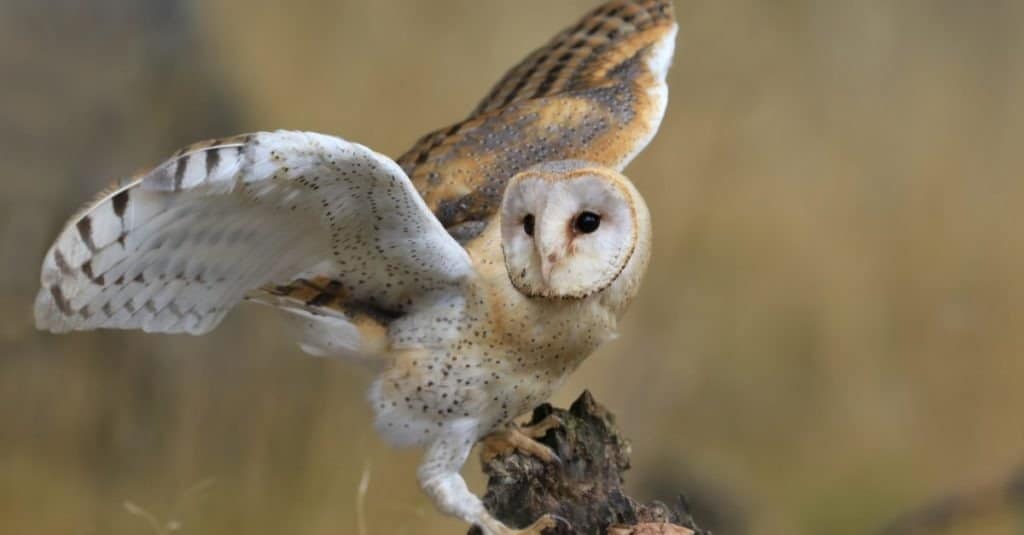
Though habitat loss is a threat to barn owls, these birds are listed as one of Least Concern by the IUCN’s Red List.
©Monika Surzin/Shutterstock.com
Cultural Significance
Many cultures have regarded barn owls as fatal omens with some, such as the ancient Egyptians, believing them to live in the realm of the dead. In England, barn owls often live in cemeteries – leading to the belief that the birds symbolize approaching death. Some native American tribes believed that evil people became barn owls when they died. Their ghostly faces, silent flight, and nocturnal behavior surely contributed to the barn owl’s frightening reputation. Owls are also associated with wisdom and were the symbol of the Greek goddess, Athena, the goddess of wisdom.
Barn Owl Pictures
View all of our Barn Owl pictures in the gallery.

Anan Kaewkhammul/Shutterstock.com
How to say Barn Owl in ...
Sources
- Belfast Zoo / Accessed January 16, 2021
- Honolulu Zoo Society / Accessed January 16, 2021
- All About Birds / Accessed January 16, 2021
- Audubon / Accessed January 16, 2021
- National Geographic / Accessed January 16, 2021
- American Bird Conservancy / Accessed January 16, 2021
- The Barn Owl Trust / Accessed January 16, 2021