

B
Species Profile

Binturong

Arctictis binturong

The popcorn-scented canopy climber
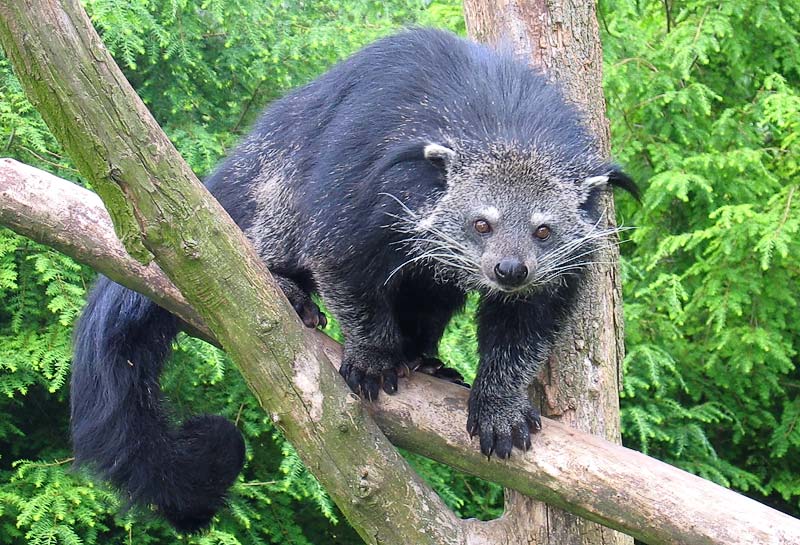
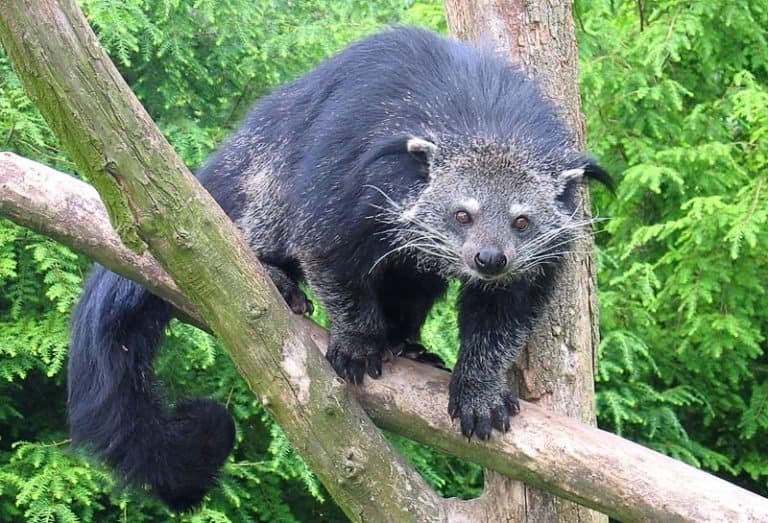
TassiloRau, CC BY-SA 3.0, via Wikimedia Commons

Binturong Distribution

Click a location to explore more animals from that region

Loading map...
Binturong in Overloon Binturong (Arctictis binturong) at Overloon, NL

At a Glance

Wild Species
Also Known As Bearcat, bear-cat, Asian bearcat, Malay bearcat
Diet Omnivore
Activity Nocturnal+
Lifespan 12 years
Weight 20 lbs
Status Vulnerable
Did You Know?

Not a bear or a cat: the "bearcat" is a civet relative in family Viverridae (genus Arctictis).

Scientific Classification

The binturong (also called bearcat) is a large, arboreal civet relative native to South and Southeast Asia, notable for its prehensile tail and a musky scent often compared to buttered popcorn.

Kingdom
Animalia
Phylum
Chordata
Class
Mammalia
Order
Carnivora
Family
Viverridae
Genus
Arctictis
Species
binturong

Distinguishing Features

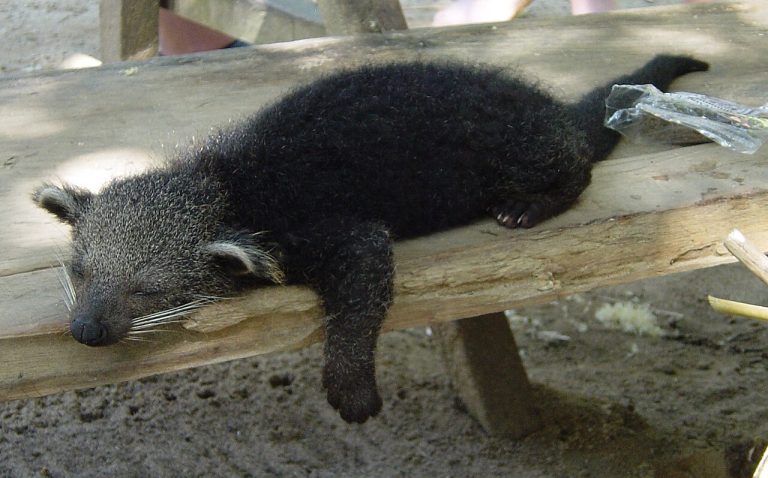
  • Large, shaggy black coat; robust body
  • Long prehensile tail used for climbing and anchoring in trees
  • Short face with prominent whiskers and tufted ears
  • Scent often described as ‘popcorn-like’ due to gland secretions
  • Primarily arboreal, slow-moving climber; mostly nocturnal/crepuscular

Physical Measurements

Males and females differ in size

Length
♂ 4 ft 9 in (3 ft 10 in – 5 ft 9 in)
♀ 4 ft 11 in (3 ft 10 in – 6 ft 1 in)
Weight
♂ 26 lbs (20 lbs – 33 lbs)
♀ 33 lbs (20 lbs – 44 lbs)
Tail Length
♂ 2 ft 4 in (1 ft 10 in – 2 ft 9 in)
♀ 2 ft 4 in (1 ft 10 in – 2 ft 11 in)
Top Speed
15 mph
About 24 km/h

Appearance

Primary Colors
Secondary Colors
Skin Type Mammalian skin covered by long, coarse, shaggy fur; leathery bare nose; robust foot pads and curved claws adapted for climbing and gripping branches (arboreal lifestyle).
Distinctive Features
  • Large arboreal viverrid ('bearcat' misnomer): heavy-bodied, short-legged, with a long shaggy coat; slow, deliberate climber in South & Southeast Asian forests (e.g., Macdonald 2009; IUCN Red List: Arctictis binturong).
  • Prehensile tail (rare among Old World carnivorans): tail length typically ~55-89 cm and used as a 'fifth limb' for stability in the canopy (Nowak/Walker's Mammals of the World; species accounts for A. binturong).
  • Head-body length typically ~60-96 cm; adults commonly ~9-20 kg, with some reports of heavier individuals; overall build is more 'bear-like' in bulk than most civets but taxonomically a viverrid (Nowak; IUCN/field guides).
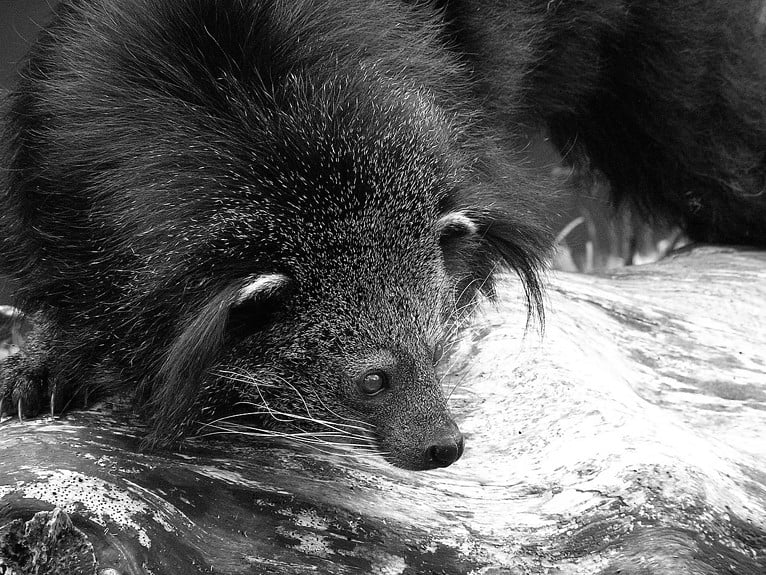
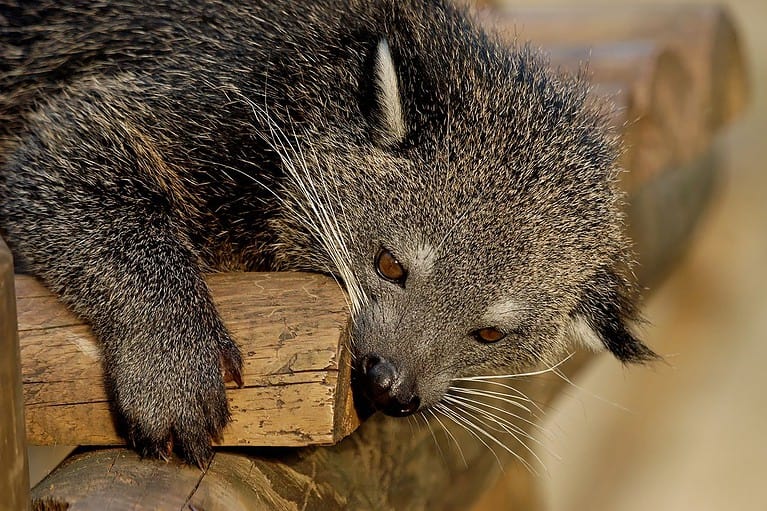
  • Distinctive facial features: long white-to-cream vibrissae (whiskers), small eyes, and conspicuous ear tufts of hair projecting from rounded ears.
  • Perineal glands make a musky smell like buttered popcorn. Binturongs scent mark branches and travel paths. This is seen in zoos and the wild.
  • Behavior-linked appearance cues: plantigrade posture and sturdy limbs (for climbing and branch-walking), with coarse fur that can look 'ruffed' or 'mane-like' along the neck/shoulders.
  • Longevity context (not an appearance trait but useful for species profiling): reported to live ~18 years and up to ~25 years in captivity in compiled mammal references (e.g., Nowak/Walker; zoo husbandry summaries).
  • Conservation context influencing observed condition/coat quality in the wild: habitat loss/deforestation and hunting/illegal trade are major threats across its range (IUCN Red List: Arctictis binturong).

Sexual Dimorphism

Sexual dimorphism is present but subtle externally: females are typically larger/heavier than males. Genital morphology can be unusual-females have a prominent, peniform clitoris and the vulvar area can appear scrotum-like, which can complicate sexing by casual external inspection (reported in anatomical and husbandry literature; summarized in mammal reference works).

♂
  • On average smaller body size than females (size dimorphism tends toward larger females).
  • Externally similar pelage and coloration to females; sexing often relies on close inspection rather than coat differences.
♀
  • On average larger/heavier than males (reversed size dimorphism relative to many carnivores).
  • Peniform clitoris/scrotum-like external appearance noted in anatomical/husbandry references; otherwise pelage and coloration similar to males.

Did You Know?

Not a bear or a cat: the "bearcat" is a civet relative in family Viverridae (genus Arctictis).

Size: head-body length ~60-96 cm; prehensile tail ~55-90 cm; adult mass commonly ~9-20 kg (varies by sex/locality).

Its scent often resembles buttered popcorn because scent glands can produce 2-acetyl-1-pyrroline, an aroma compound also found in popcorn and pandan rice.

A true tail-grabber: the binturong is one of the few Old World carnivorans with a strongly prehensile tail, used like a fifth limb while climbing.

Diet is omnivorous but fruit-leaning: figs and other forest fruits can be major foods, making binturongs important seed dispersers in tropical forests.

Reproduction: gestation is about ~84-99 days; litters are typically 1-6 young (often 2-3).

Longevity: recorded to live into the late teens in the wild; in human care individuals can reach ~20+ years (reports up to ~25 years).

Unique Adaptations

  • Strongly prehensile tail (muscular, flexible, furred): functions as an anchoring and balancing organ for canopy life-rare among carnivorans.
  • Plantigrade stance and powerful limbs: "flat-footed" walking and robust forelimbs aid slow, controlled climbing and clambering on large branches.
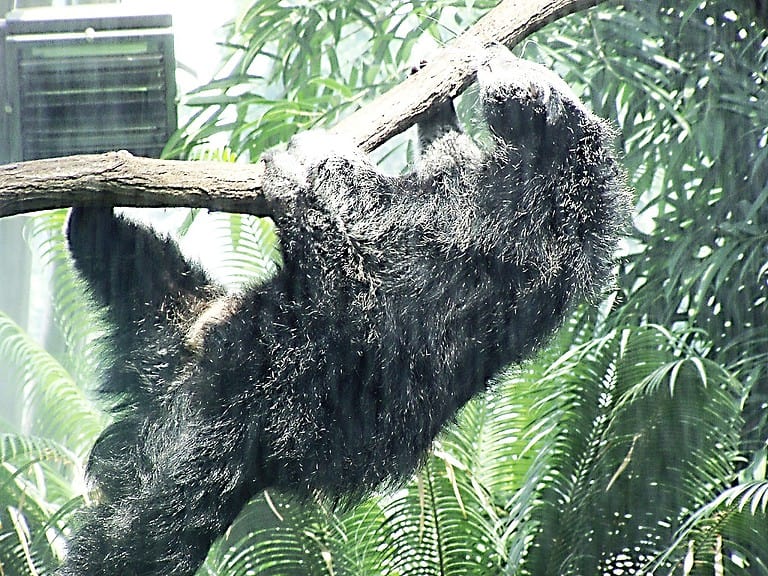
  • Highly mobile ankles/feet: hind feet can rotate to maintain traction on vertical surfaces, enabling controlled headfirst descents.
  • Chemical signaling with popcorn-like odor: scent glands produce odorants (including 2-acetyl-1-pyrroline) for long-lasting communication in humid forests.
  • Thick, coarse coat and sturdy build: helps withstand frequent contact with rough bark and dense vegetation in tropical forests.

Interesting Behaviors

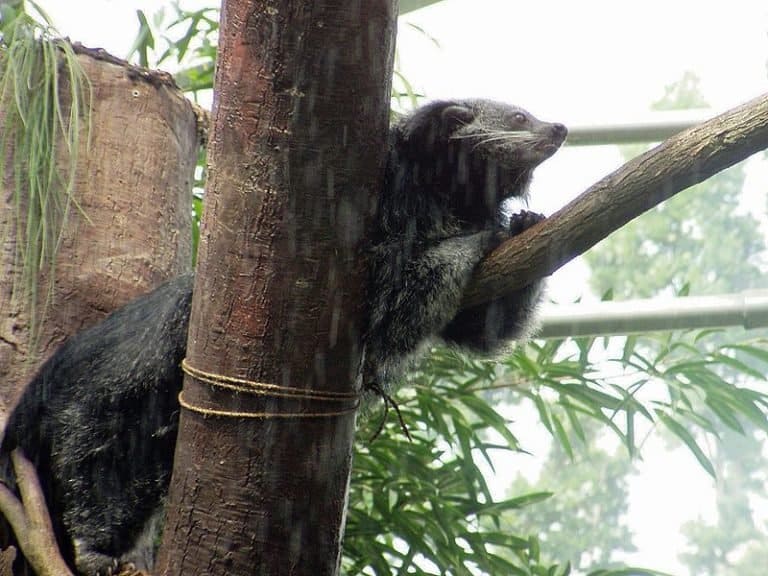
  • Arboreal slow-climbing: moves deliberately through the canopy, often using the tail to steady and bridge gaps while reaching for fruit.
  • Head-first descents: can climb down trunks headfirst by rotating the hind feet/ankles to grip bark while descending.
  • Scent marking: frequently rubs and deposits scent from glands and by urination to mark routes, feeding trees, and territory.
  • Mostly nocturnal/crepuscular: activity peaks at night and twilight; rests in trees by day.
  • Omnivorous foraging: feeds heavily on fruit when available, but also takes small vertebrates, eggs, and invertebrates opportunistically.
  • Vocal communication: produces a range of sounds (chuckles, huffs, growls, wails), especially during social encounters and breeding.
  • Generally solitary: adults are often encountered alone outside breeding/parental periods; mothers rear young in tree hollows or dense canopy cover.

Cultural Significance

Binturong (Arctictis binturong) is a hard-to-find canopy mammal in South and Southeast Asia. People hunt it for meat, use it in traditions, or keep it as a pet. Zoos show how it spreads seeds and faces threats from deforestation and illegal trade. Called "bearcat" though neither bear nor cat.

Myths & Legends

Early English natural history writers called the binturong a "bearcat," saying it looked and moved like a bear and a cat. That name stuck, even though it is actually a civet.

Popcorn-scent anecdotes: in local and zoo lore, the binturong's buttery smell is sometimes treated as a "forest perfume" or a sign an animal is nearby-an informal tracking tradition tied to its strong scent-marking behavior.

Colonial-era menagerie stories: 19th-early 20th century travelogues from South/Southeast Asia often portrayed the binturong as a mysterious 'tree-bear' of the rainforest canopy, helping cement its reputation as an odd, hard-to-place creature in popular imagination.

Conservation Status

VU Vulnerable

Facing a high risk of extinction in the wild.

Population Decreasing

Protected Under

  • CITES Appendix III (listed by India): international trade is regulated/controlled for the species when originating from the listing country.
  • National wildlife protection laws apply in multiple range states (specific schedules/annexes vary by country), and the species occurs in numerous protected areas across its distribution.

Life Cycle

Birth 2 cubs
Lifespan 12 years

Lifespan

In the Wild
10–15 years
In Captivity
18–25 years

Reproduction

Mating System Polygynandry
Social Structure Solitary
Breeding Pattern Transient
Fertilization Internal Fertilization
Birth Type Internal_fertilization

Binturong (Arctictis binturong) are solitary, tree-living mammals; mating likely involves brief male–female meetings and is not well known. Internal fertilization; gestation ~84–99 days (~90), litters 1–6 (commonly 2–3), young raised by mother, mature ~2–3 years.

Behavior & Ecology

Social No formal group name (usually solitary) Group: 1
Activity Nocturnal, Crepuscular, Cathemeral
Diet Omnivore Figs (Ficus spp.)

Temperament

Generally wary and secretive in the wild; tends to avoid open areas and human presence (IUCN: Jennings & Veron, 2015).
Slow, deliberate arboreal locomotion; often rests curled in tree forks or dense canopy by day, with most movement and foraging from dusk through night (regional field guides and species accounts across SE Asia).
Binturongs can shift toward more daytime activity (cathemerality) when disturbed, when temperatures change, or when food favors it. Captive binturongs often show more daytime activity than wild ones.
Typically non-aggressive unless threatened; can be defensive (hissing, growling, biting) when cornered or handled (general species accounts; zoo/husbandry observations).

Communication

Low growls and snarls during threat/defense contexts
Hissing as a close-range defensive signal
Soft grunts/chuckles used at close range Often reported in affiliative or investigatory contexts in captivity
Whines/squeals Notably from juveniles during distress or contact-seeking
Scent marking is central: urine-marking and glandular secretions are used to advertise presence and reproductive status; the species is well known for a strong, musky odor IUCN: Jennings & Veron, 2015; general carnivore/viverrid behavior references
Chemical signal distinctiveness: the characteristic 'buttered popcorn' odor has been linked in chemical ecology literature to 2-acetyl-1-pyrroline identified from binturong scent/urine samples Reported in peer-reviewed chemical analyses
Rubbing/dragging behaviors on substrates (branches/trunks) to deposit scent; repeated use of habitual routes in the canopy likely reinforces scent-based spatial communication.
Tactile communication in mother-offspring interactions (clinging, grooming, close contact) and during mating; tail and body contact used at close range in arboreal settings.
Visual/body postures: piloerection, open-mouth threat displays, and orientation/avoidance behaviors at close range.

Habitat

Biomes:
Tropical Rainforest Tropical Dry Forest Wetland
Terrain:
Mountainous Hilly Plateau Plains Valley Riverine Island +1
Elevation: Up to 5249 ft 4 in

Ecological Role

Arboreal omnivorous mesocarnivore with strong frugivory; important canopy seed-disperser (notably for figs) and occasional predator of small vertebrates.

Long-distance seed dispersal of large-seeded fruits (including Ficus), supporting forest regeneration and plant gene flow Maintenance of fig-fruit mutualisms that help sustain year-round food webs in tropical forests Moderate regulation of some prey populations (small mammals, nest contents, insects) through opportunistic predation Nutrient redistribution via defecation of fruit pulp/seeds across the canopy-to-forest-floor interface

Diet Details

Main Prey:
Small mammals Birds and nestlings Bird eggs Reptiles Fish Insects and other invertebrates
Other Foods:
Figs Ripe forest fruits Young leaves Tender shoots Nectar and sap

Human Interaction

Domestication Status

Wild

The binturong (Arctictis binturong) is a wild species, not domesticated. People sometimes keep it in zoos, rescues, or illegally as an exotic pet, but no domestic line exists. It is protected (IUCN: Vulnerable; CITES Appendix III — India). Human contact is mostly conservation, rescue, trade, hunting, and tourism.

Danger Level

Low
  • Bites and deep lacerations/scratches if handled or cornered (strong jaw, long canines; risk higher in captive/illegal-pet settings).
  • Zoonotic disease risk typical of wild carnivores if illegally kept without veterinary controls (e.g., potential exposure to rabies in endemic regions; parasites).
  • Injury risk from climbing/falls during capture/handling due to arboreal strength and prehensile tail aiding sudden movement.

As a Pet

Not Suitable as Pet

Legality: Binturong (Arctictis binturong) is usually illegal or tightly restricted as a pet. CITES Appendix III (India) needs export papers. Laws vary by country and US state; EU/UK often require permits. Check local rules.

Care Level: Expert Only

Purchase Cost: $1,500 - $8,000
Lifetime Cost: $30,000 - $120,000

Economic Value

Uses:
Conservation/education value via zoos and protected-area programs Illegal/regulated wildlife trade (live animals for exotic pet market; occasional trade in meat/parts in some areas) Ecosystem service value (seed dispersal in tropical forests due to high fruit consumption) Research value (behavior, ecology, captive husbandry/veterinary medicine)
Products:
  • Live-animal trade (illegal/regulated) for private collections
  • Zoo exhibition/education programs (non-consumptive)
  • Occasionally hunted meat in some local contexts (illegal in many areas)

Relationships

Related Species 10

African civet
African civet Civettictis civetta Shared Family
Large Indian civet Viverra zibetha Shared Family
Malayan civet
Malayan civet Viverra tangalunga Shared Family
Small Indian civet Viverricula indica Shared Family
Masked palm civet
Masked palm civet Paguma larvata Shared Family
Asian palm civet
Asian palm civet Paradoxurus hermaphroditus Shared Family
Banded palm civet
Banded palm civet Hemigalus derbyanus Shared Family
Otter civet Cynogale bennettii Shared Family
Small-toothed palm civet Arctogalidia trivirgata Shared Family
Large-spotted genet Genetta maculata Shared Family

Ecological Equivalents 6

Animals that fill a similar ecological role in their ecosystem

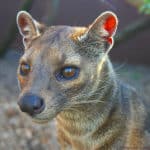
Fossa Cryptoprocta ferox Forest predator with strong arboreal capability and mostly solitary behavior. Ecologically analogous as a large, forest-dwelling carnivoran that uses trees extensively, though the fossa is more strictly predatory than the largely frugivorous binturong.
Kinkajou
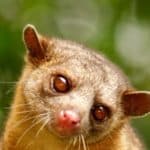
Kinkajou Potos flavus Convergent niche: a nocturnal, arboreal mammal that is largely frugivorous and omnivorous and uses a prehensile tail for climbing and feeding. Shares a similar canopy-foraging strategy despite distant relatedness (Procyonidae vs. Viverridae).
Masked palm civet
Masked palm civet Paguma larvata Overlapping habitat and habits in Asian forests: nocturnal/crepuscular, arboreal, omnivorous with heavy fruit use; likely niche overlap in foraging on fruiting trees and opportunistic predation on small prey.
Asian palm civet
Asian palm civet Paradoxurus hermaphroditus Similar forest-edge and canopy/understory omnivore. Both are nocturnal, scent-marking viverrids that consume substantial fruit and also take small animals, and may overlap in feeding on figs and other seasonal fruits.
Sun bear
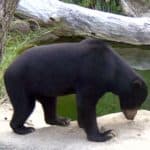
Sun bear Helarctos malayanus Not closely related, but both use Southeast Asian forests, eat a wide variety of foods with a strong reliance on fruit, and climb to feed. The binturong (Arctictis binturong) is more arboreal and smaller (60–96 cm, ~9–20 kg).
Binturong-like niche in Madagascar Galidia elegans Ring-tailed mongoose is a forest omnivore that uses trees and consumes fruit, invertebrates, and small vertebrates. Included as a smaller-bodied ecological analogue for omnivorous, scent-marking forest carnivorans.

Classification and Evolution

The Binturong (Arctictis Binturong) is a medium sized carnivore that is found inhabiting the dense forests of South-East Asia. It belongs to the same family as other small carnivores including Civets, Genets, Mongooses, and Fossa and shares a number of characteristics with them including a long snout and having more teeth than most other carnivorous mammals. The Binturong is thought to be most closely related to the Palm Civet and is the largest member of this family.

Also known as the Bearcat, the Asian Bearcat and the Asian Civet, the Binturong is an animal that was once commonly found throughout much of its historical range, but sadly, today they are a rare find in the thick jungles and very little is actually known about their behaviour in the wild. There are possibly nine different subspecies of Binturong which vary little in appearance but tend to be most easily distinguished by their size and geographic location.
Anatomy and Appearance

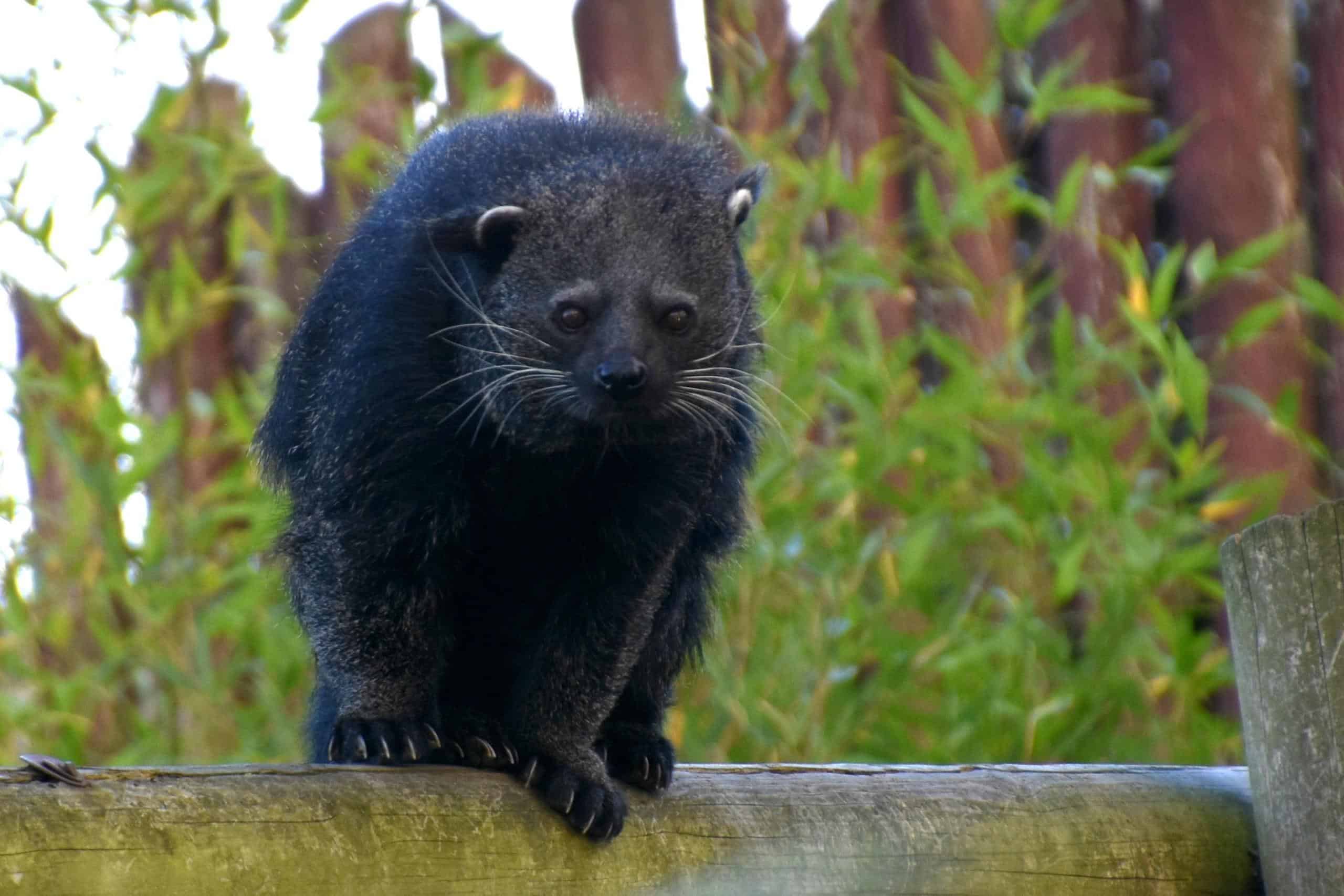
The Binturong is a large, heavy animal that can grow to more than a meter long from its snout to the tip of its tail, with females being up to 20% bigger and heavier than their male counterparts. They have very long, coarse and shaggy fur which varies from dark brown to black in colour and is tipped with grey, along with tufts of long and dark straight hair which protrude beyond the tops of their ears.

The Binturong (along with the Kinkajou of South America) is also unique among carnivorous mammals as they possess a prehensile tip to their tails, which acts almost like another leg helping both with climbing, and gripping onto branches to give the Binturong more stability.

The Binturong also has long, white whiskers that are thick and sensitive and are found both on their checks and above their brown eyes. These whiskers make it look like a cat, but its body is like that of a bear, which is why its nickname is “bearcat.”

Distribution and Habitat
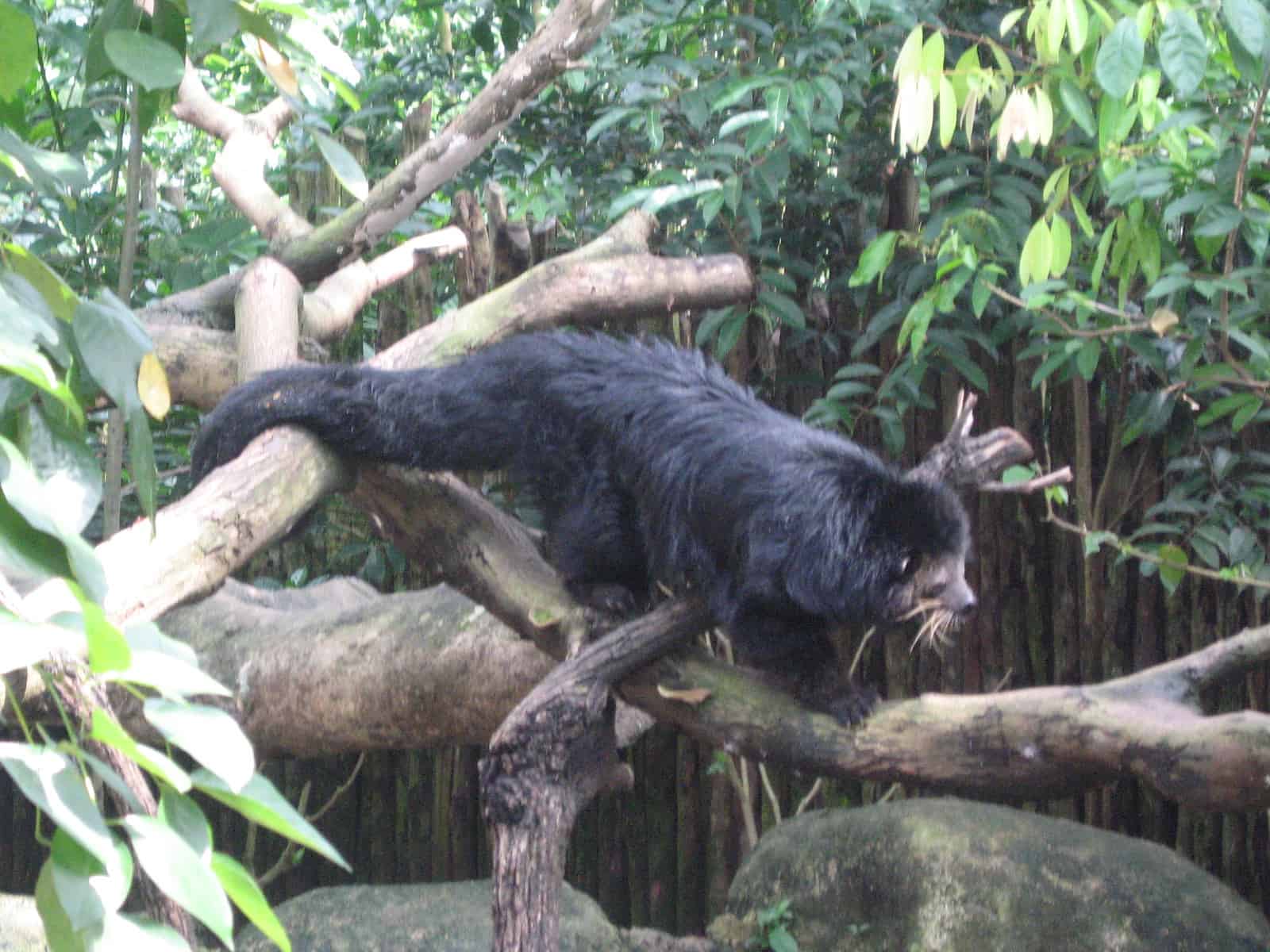
The Binturong is an animal that was once natively found throughout China, India, Thailand, Cambodia, Laos, Malaysia, Indonesia, the Philippines and on the island of Borneo, and although there are populations still found in a number of these countries, their numbers have been declining and the Binturong can now be extraordinarily hard to spot.

Found in dense, moist jungles and in areas that are close to a slow-moving water source, the Binturong has been most affected by habitat loss particularly in the more southern parts of its natural range. Towards the north however where the rate of deforestation is not quite as ferocious, they have been more affected by hunting and capture as well as generally expanding human populations. The Binturong relies heavily on dense, thick forest where there is plenty of cover both in the trees and on the ground and with a big decline in its native jungles, this mammal simply has fewer places to go.

Behaviour and Lifestyle

The Binturong is a generally solitary and nocturnal animal that spends the majority of its time moving about slowly and cautiously amongst the trees. Due to their large size the Binturong cannot leap between one tree and another and so must climb down to the ground to go from tree to tree. They are excellent climbers and are well aided by their strong feet, agile bodies, semi-retractable claws and their prehensile tail. The Binturong is also known to both swim and dive well and often spends time in the water to simply cool down in the heat of the sun.

Although they do tend to be mainly solitary, small groups of Binturong are not uncommon and usually consist of an adult pair and their young. As with the hierarchy in Mongoose society, however, it is the female Binturong who remains the dominant adult. The Binturong is known to be a very vocal animal and makes a number of sounds to both communicate with other Binturongs and to warn off species that it sees to be a threat. They are known to make chuckling sounds when they seem to be happy and appear to utter a high-pitched wail if they become aggravated.

Binturong Reproduction and Life Cycles

Although there is not thought to be a mating season as such, there are thought to be higher instances between February and April and then later in July and November. After a gestation period that lasts for around three months, the female Binturong climbs down to the ground to nest in thick vegetation that is sheltered both from the elements but is also out of sight of passing predators.

Between one and three small cubs are born that measure about the size of a human fist. Like a number of other mammalian young, Binturongs are born blind and cannot hear and rely solely on their mother to provide them with milk. They are usually weaned by the time they are 2 months old and reach their adult size after a year. The Binturong is thought to live for between 10 and 15 years in the wild but can happily reach older ages in captivity with one individual having died at the age of 26.

Diet and Prey
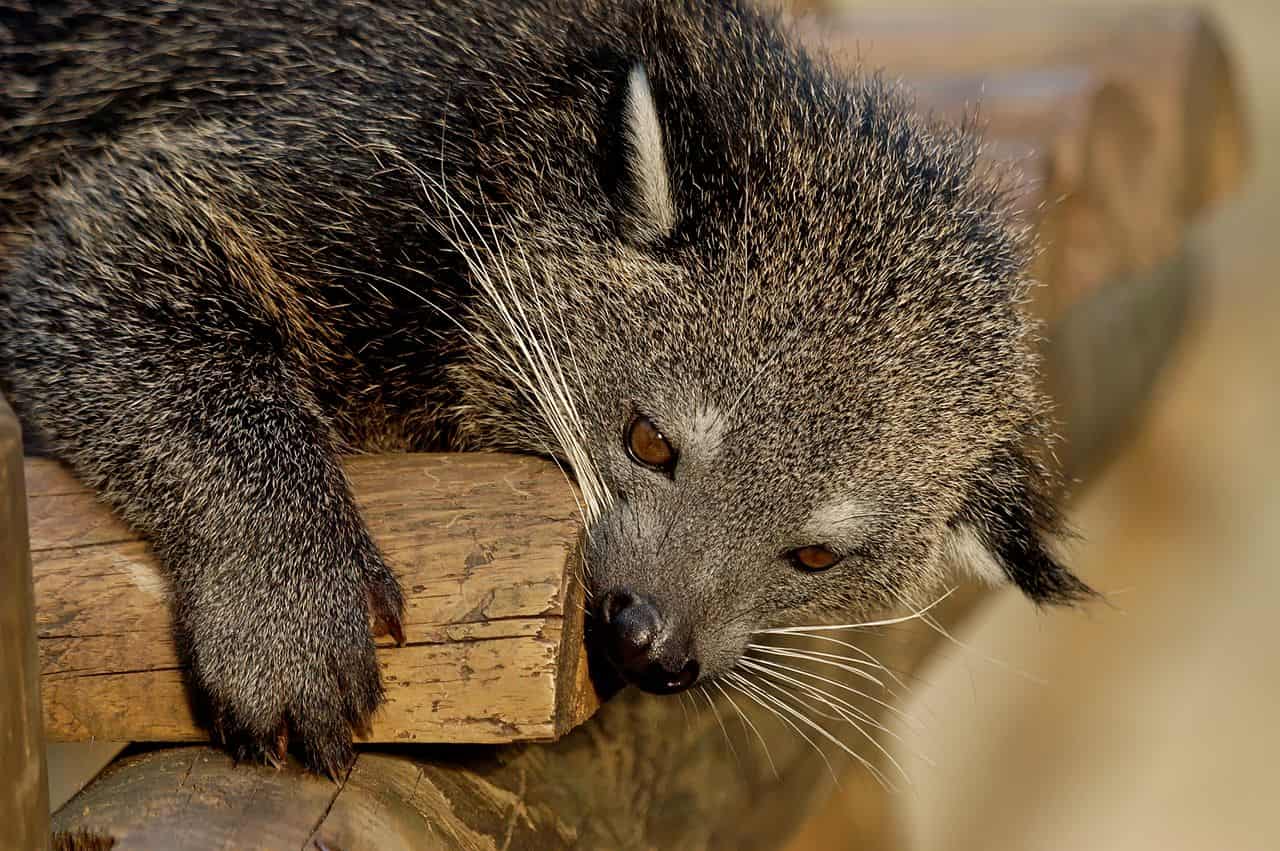
Despite belonging to the carnivorous mammal group, the Binturong is mainly frugivorous meaning that it survives primarily on a diet that is comprised of fruit. Although they are also known to hunt insects, birds and rodents which they stalk in a cat-like manner amongst the branches, the Binturong has evolved well to eating in the trees with front feet that are not only designed to climb and dig, but they can also hold onto fruit and even open it with their agile toes.

The Binturong primarily hunts for food under the cover of night but is also known to feed while resting in the trees in the heat of the day. Due to their ability to swim and dive well, the Binturong also hunts fish in the water when cooling down in the heat of the day.

Predators and Threats

The Binturong is a relatively large and slow-moving animal, yet it is not really a main source of prey to the predators that also inhabit the dense, surrounding jungle. Larger animals such as Tigers and Snakes would pose the biggest threat to the Binturong adults, along with birds of prey and small carnivores that could easily target one of the young cubs. The biggest threat to the world’s Binturong population, though, is people and in a number of ways. The Binturong has been caught for their meat, captured and sold into the pet trade, subjected to vast habitat loss (mainly in the form of deforestation), and is also trapped and caught to be sold into the Chinese medicine market, where a number of their body parts are used in traditional remedies.

Interesting Facts and Features
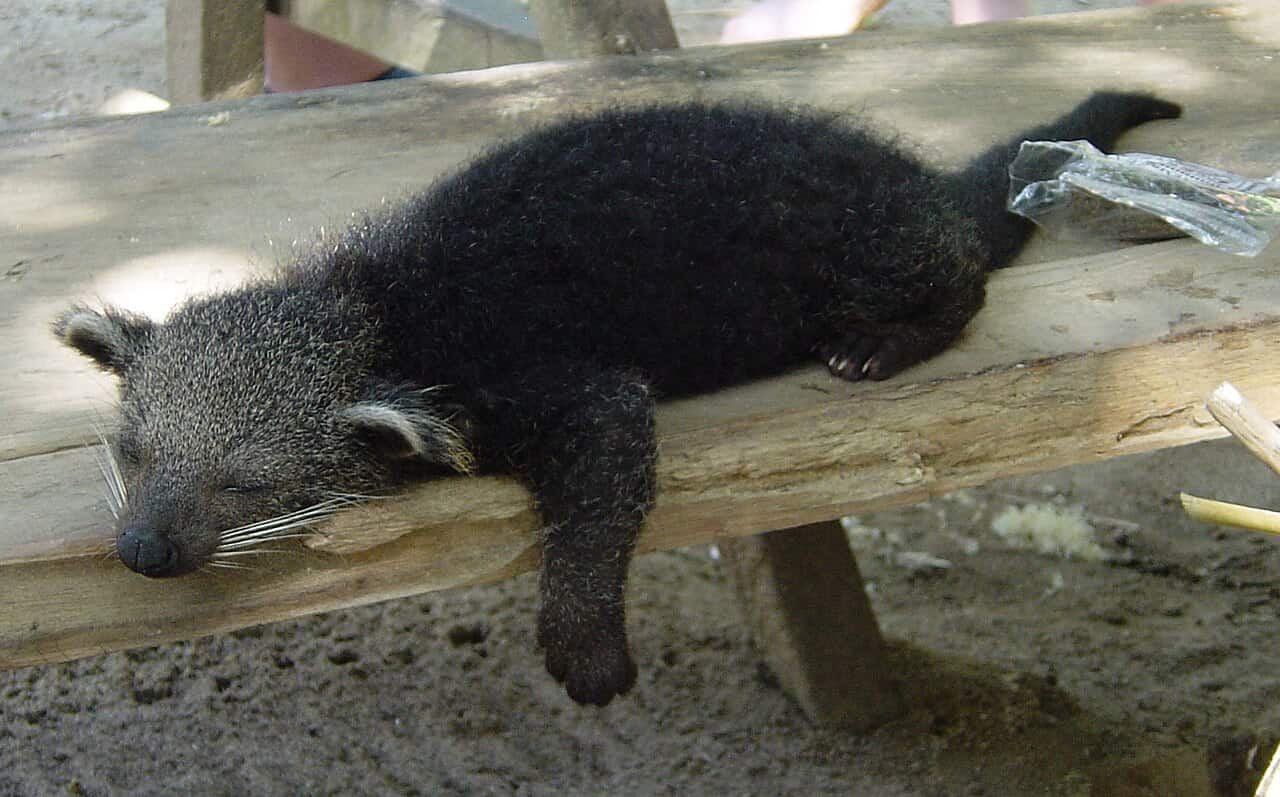
Like other members of the Civet family, the Binturong has scent glands which are located just under its tail. These glands are used to mark trees and foliage to outline an individual’s territory and is distributed whilst the Binturong is moving about. Oddly enough, the odour of this scent is said to smell like buttered popcorn as do Binturong cubs when they are newborn. Until they became stronger and are more aware of their surroundings, young Binturong are incredibly vulnerable and are able to spray foul smelling liquid (like a Skunk) when they are really frightened. This is not a behaviour however that has been observed in individuals who are more than a couple of months old because as they get bigger they are able to defend themselves more easily.

When climbing, the Binturong is actually able to rotate its hind legs backwards so that their claws still have a good grip when climbing down a tree head first.

Relationship with Humans

This tree-dwelling mammal is actually known to be startlingly passive towards people and has been easily domesticated and kept as an exotic pet all over the world. However, it is this industry that along with other factors, has aided in the rapid decline of Binturong population numbers throughout Southeast Asia. Not only having been over-exploited as pets, zoo attractions, in medicines and for food, the Binturong is also subjected to devastating loss of vast areas of its natural habitat which has pushed the remaining populations into smaller and smaller pockets of their once large historical range. Both growing human settlements and forest clearance for agriculture are the main culprits, and since the Binturong needs dense jungle to successfully survive, plantations provide no sanctuary in their dwindling homelands.

Conservation Status and Life Today
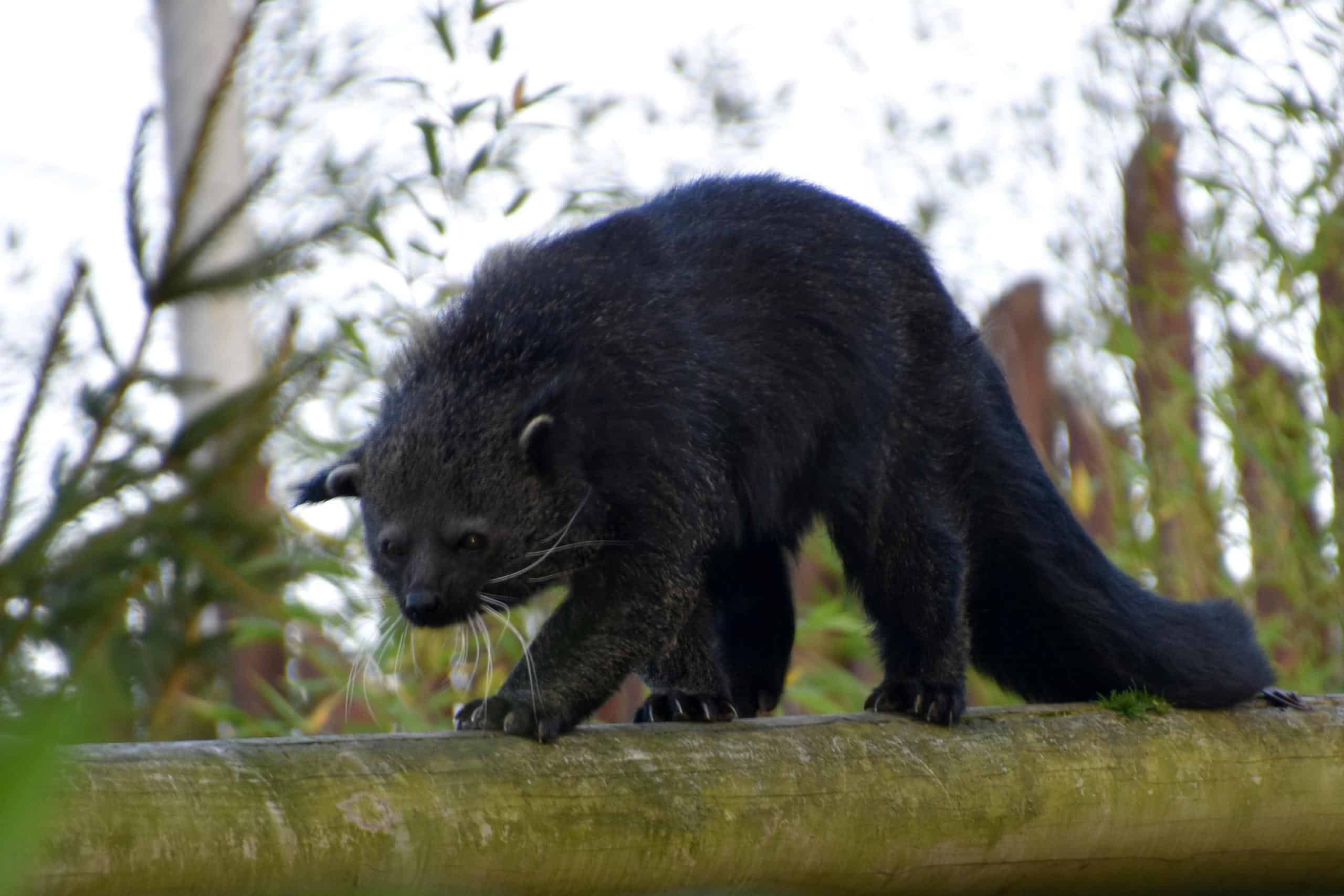
Today, the Binturong is rarely seen in the wild with just a handful of sightings having been reported over the past decade. The Binturong is listed by the IUCN as a species that is Vulnerable from extinction in its natural environment in the near future. Human encroachment on their historical habitats has meant that their numbers have declined drastically and, along with their capture in many places, has led to a 30% decline in Binturong population numbers in the last 30 years.

Types

The Binturong is in the family Viverridae. There are supposedly nine subspecies of Binturong, but our research found only seven. They are separated into two clades (a group of organisms believed to have evolved from a common ancestor): the northern clade in mainland Asia is separated from the Sundaic clade (i.e., from the Sunda Islands in the Malay archipelago) by the Isthmus of Kra. Each subspecies is practically identical in appearance, but their genomes may contain key differences between individuals from different populations.

  • Palowan binturong (Arctictis binturong whiteii) or bearcat is endemic to the island of Palawan in the Phillipines.
  • The Cambodian Binturong (Arctictis binturong albifrons) may be the largest and most robust binturong. It has shaggier, longer, and darker fur with a more distinct margin between the pale silver-flecked face and the body fur.
  • Malayan Binturong (Arctictis binturong binturong) lives on the Malay Peninsula.
  • Bornean Binturong (Arctictis binturong pageli), endemic to northern Borneo and darker than other subspecies.
  • Javan Binturong (Arctictis binturong penicillatus) lives on Java and possibly south Borneo.
  • East-Sumatran Binturong (Arctictis binturong kerkhoveni) lives in East Sumatra.
  • Chinese Binturong (Arctictis binturong menglaensis) relies on running to move around.

View all 453 animals that start with B
How to say Binturong in ...
Danish
Binturong
German
Binturong
English
Binturong
Esperanto
Binturongo
Spanish
Manturón
French
Binturong
Indonesian
Binturung
Italian
Binturong
Hebrew
בינטורונג
Japanese
ビントロング
Malay
Musang Binturong
Dutch
Beermarter
Polish
Binturong
Chinese
熊狸

Sources

  1. David Burnie, Dorling Kindersley (2011) Animal, The Definitive Visual Guide To The World's Wildlife / Accessed November 14, 2008
  2. Tom Jackson, Lorenz Books (2007) The World Encyclopedia Of Animals / Accessed November 14, 2008
  3. David Burnie, Kingfisher (2011) The Kingfisher Animal Encyclopedia / Accessed November 14, 2008
  4. Richard Mackay, University of California Press (2009) The Atlas Of Endangered Species / Accessed November 14, 2008
  5. David Burnie, Dorling Kindersley (2008) Illustrated Encyclopedia Of Animals / Accessed November 14, 2008
  6. Dorling Kindersley (2006) Dorling Kindersley Encyclopedia Of Animals / Accessed November 14, 2008
  7. David W. Macdonald, Oxford University Press (2010) The Encyclopedia Of Mammals / Accessed November 14, 2008
  8. Binturong Behaviour / Accessed November 14, 2008
  9. About Binturongs / Accessed November 14, 2008
  10. Binturong Information / Accessed November 14, 2008

Thank you for reading! Have some feedback for us?


Binturong FAQs (Frequently Asked Questions)

Binturongs are Omnivores, meaning they eat both plants and other animals.