
Quick Take
- Despite being roughly the size of a house cat's bigger cousin, bobcats regularly take down prey that should be completely out of their league. The way they do it is surprisingly calculated. See how bobcats hunt →
- People who hear a Bobcat in the wild almost never guess what animal it is, and the mistake they make says a lot about how underestimated this animal really is. Discover the vocal surprise →
- The Bobcat was pushed to the brink in parts of North America, but what reversed its fate wasn't what most conservationists would have predicted. See the recovery story →
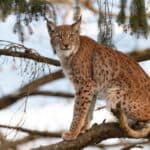
- Its coat color isn't random. The Bobcat's appearance is essentially a live map of exactly where it lives, and the variation between individuals is more dramatic than most people expect. Explore coat color variation →
The Bobcat is a medium-sized animal that is found in a variety of habitats across North America, ranging from southern Canada through most of the contiguous United States down to Mexico.
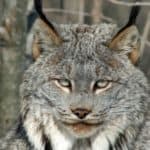
They are widespread and adaptable predators closely related to the larger, more northerly-dwelling Canadian Lynx, with the main difference being that the Bobcat has only a small “bobbed” tail, from which it gets its name.
Measuring about double the size of a domestic cat, the Bobcat has the greatest range of all North American felines, but its secretive nature means it is seldom seen by people.
There are currently two recognized subspecies of Bobcat which vary in their coloration and geographic range, with individuals found in the mountainous forests being darker with more markings than their lighter-colored cousins that are found in more arid, semi-desert regions.

Classification and Scientific Name
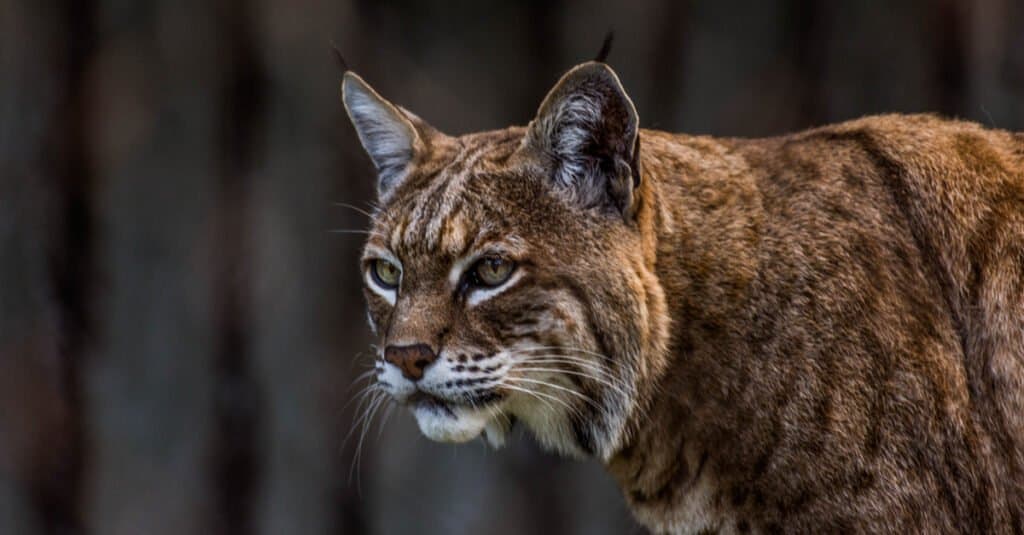
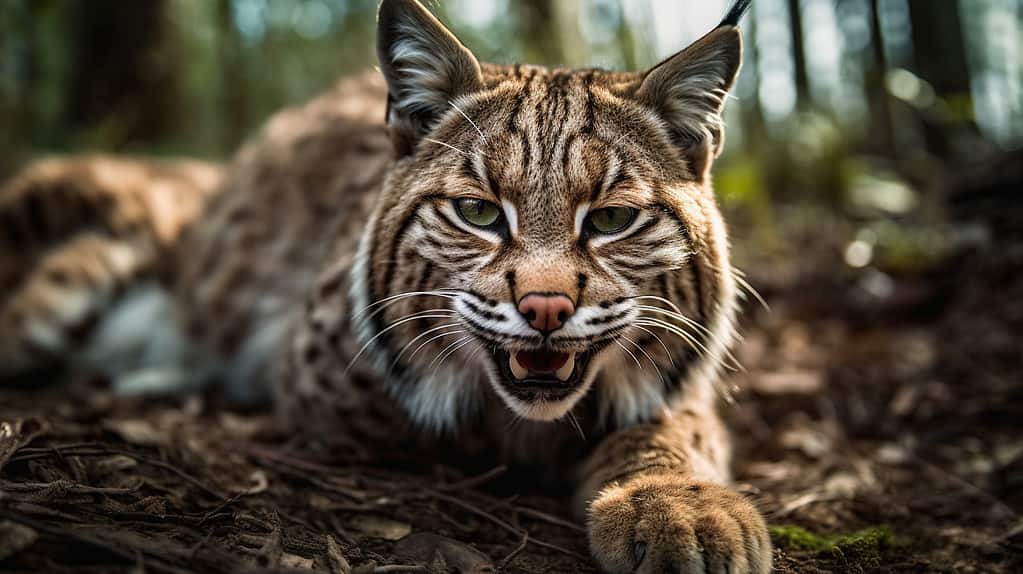
The Bobcat is a medium-sized animal that is found in a variety of habitats.
©Victor Arita/Shutterstock.com
The scientific name of the bobcat is Lynx rufus. It belongs to the animal kingdom, class Mammalia, order Carnivora, and family Felidae. It is among the smallest of the four extant species within the genus Lynx, alongside the Canada lynx.
There are two subspecies of bobcat: Lynx rufus rufus (east of the Great Plains) and Lynx rufus fasciatus (west of the Great Plains).
Anatomy and Appearance
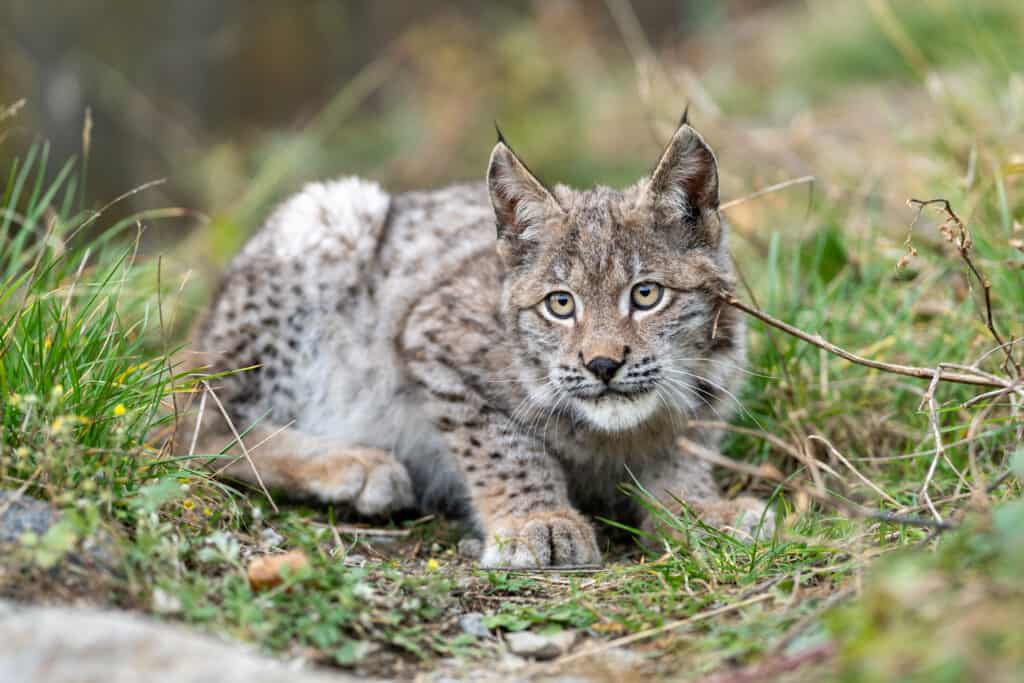
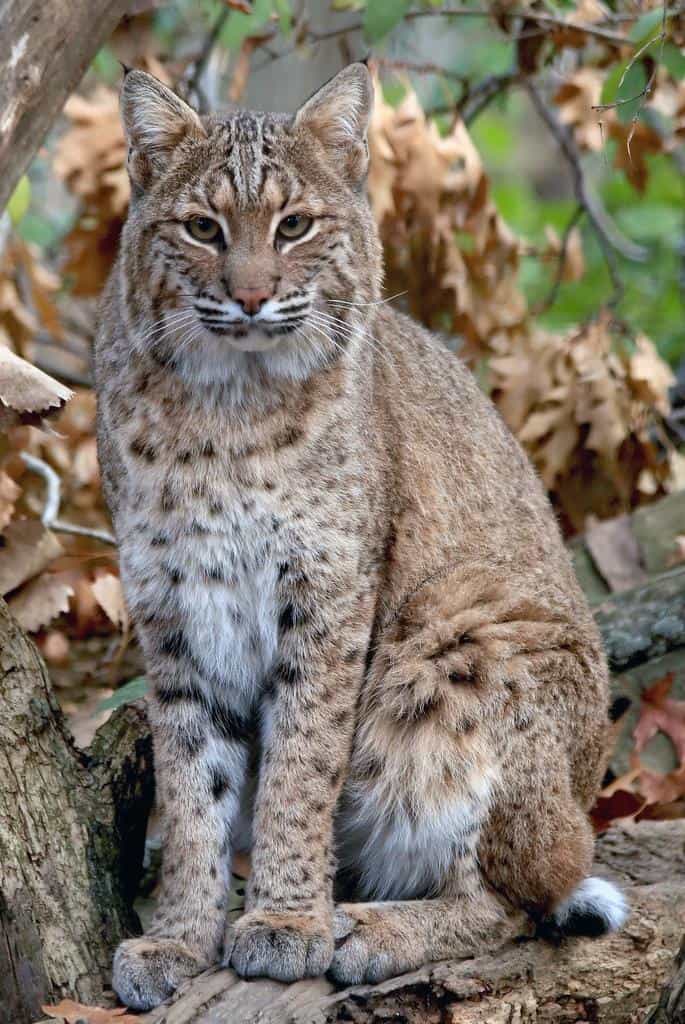
The Bobcat belongs to the same family as the Lynx and is similar in appearance.
©Vaclav Sebek/Shutterstock.com
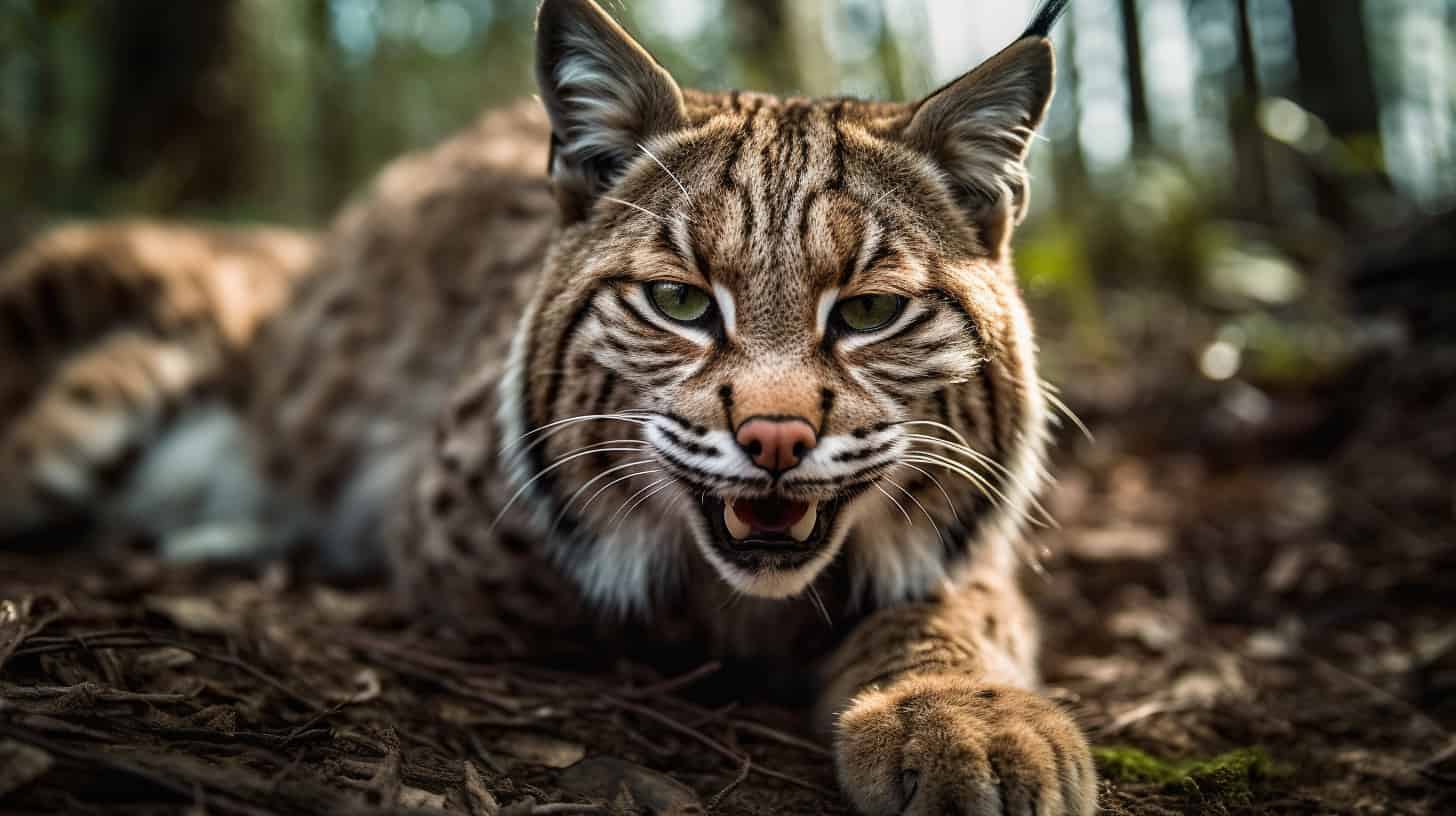
Because the Bobcat belongs to the same family as the Lynx, these animals are similar in appearance but not identical. The Bobcat is smaller and has smaller feet and ear tufts than the Canadian Lynx, and tends to be darker in color.
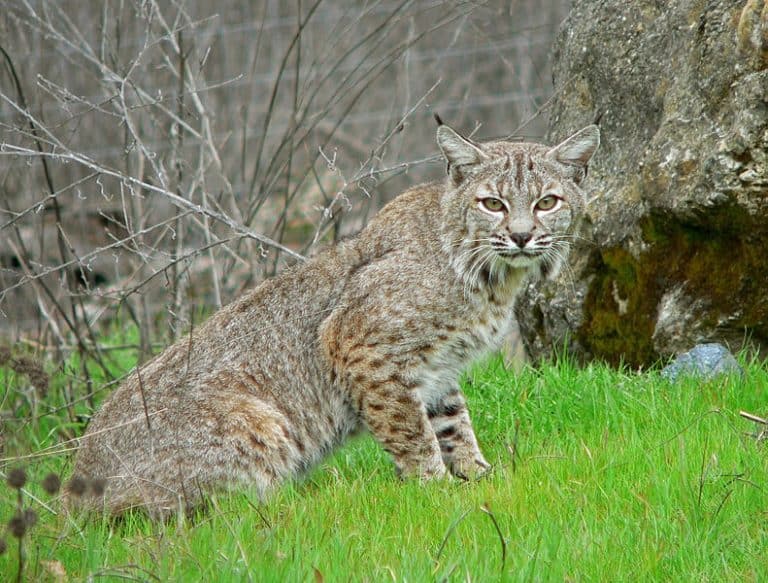
Bobcats have beige to brown or reddish fur that is mottled or spotted, with the intensity of these markings depending on the individual and where it lives (those found in more open, arid areas tend to have fewer markings than those found amongst dense cover).
The underside of the Bobcat is white, so the darker spots are more distinctive, and they also have a white tip to their short, black tail, which typically grows to around 5 to 7 inches (12 to 19cm) in length.
Like the larger Lynx, the Bobcat has ear tufts that are thought to heighten its hearing, and also has a ruff of longer fur around its face.
Distribution and Habitat
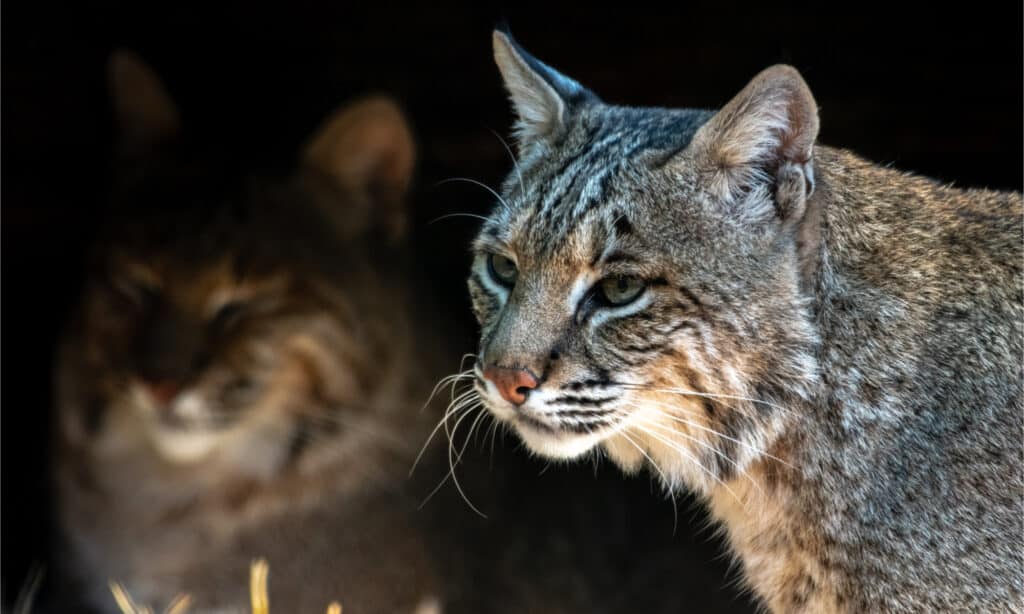
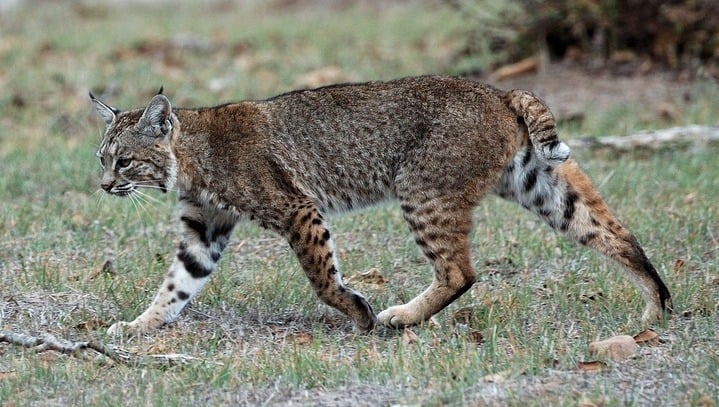
Bobcats in Arkansas can be found in woodlands.
©Karyn Honor/Shutterstock.com
The Bobcat is the most widely distributed of all North American felines, found from southern Canada to southern Mexico. They are incredibly versatile animals that have adapted to a variety of habitats across all three countries.
Although Bobcats are known to prefer well-vegetated rocky hillsides, they are found in numerous habitats throughout their natural range, including mountain woodlands, coniferous forests, swampland, deserts, and even in suburban areas in some places.
The exact appearance of the Bobcat depends on what kind of habitat it is found in, as differing coat colors allow the individual to remain as camouflaged as possible in its surroundings.
The historical range of the Bobcat once extended right across North America, but the capture of them for their fur and loss of their natural habitat have led to their disappearance in some areas.
Behavior and Lifestyle
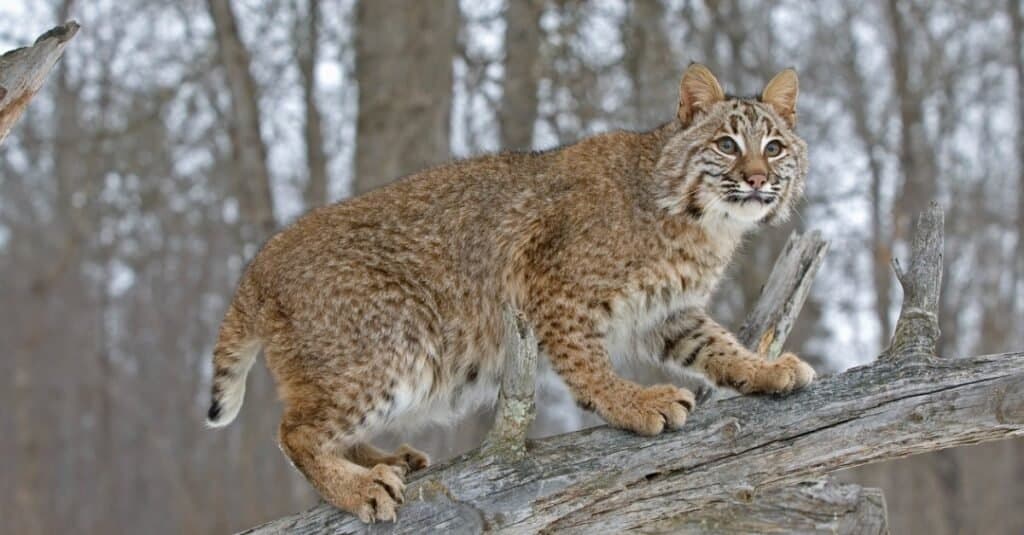
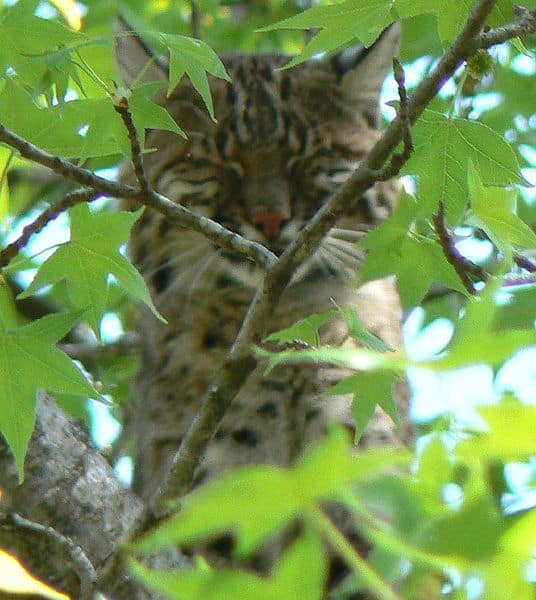
The Bobcat is a solitary and nocturnal animal that is most active in the dark.
©iStock.com/JohnPitcher
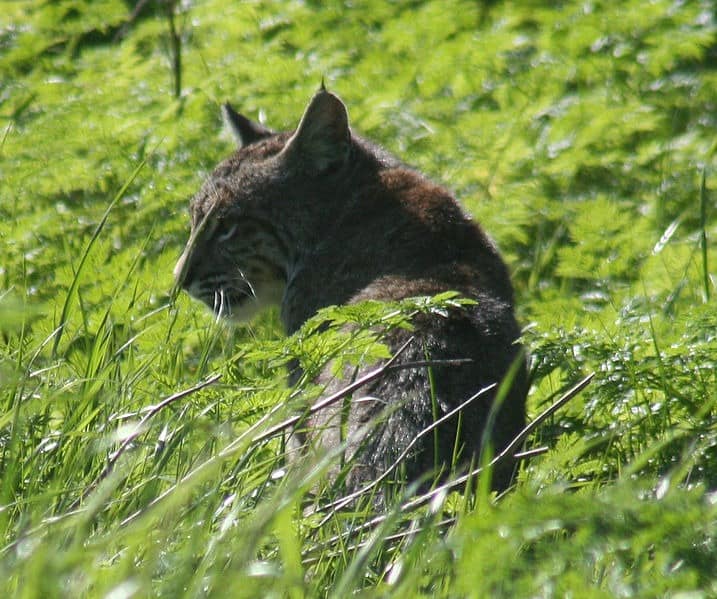
The Bobcat is a solitary and nocturnal animal that is most active in the darkness of night, tending to hunt most during dawn and dusk. During the day, Bobcats sleep and rest in dens, usually in a rock crevice or hollow tree, with one individual having a number of dens within its home range.
Bobcats are highly territorial animals and mark their ranges with scents from their urine and feces, and with distinctive claw marks on trees, to alert others of their presence.
Males patrol an extensive home range which often overlaps a number of smaller female territories, but the two will not interact until the breeding season begins in the winter.
At other times of the year, though, Bobcats tend to avoid one another to reduce the chances of them being injured in a fight.
Reproduction and Life Cycles
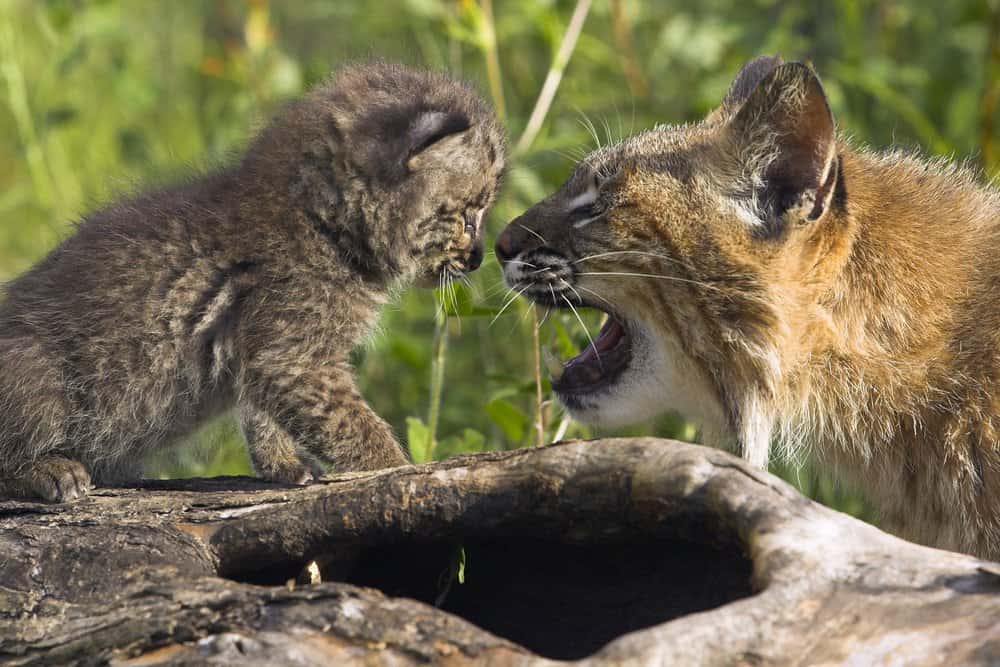
A mother bobcat with a young baby, Minnesota, USA.
©Bildagentur Zoonar GmbH/Shutterstock.com
Bobcats can only be found together during the breeding season when both males and females can mate with multiple partners, and after a gestation period that lasts for 50 to 70 days, the female Bobcat gives birth to a litter of one to six kittens in a safe and secluded den.
Bobcat kittens are born blind and open their eyes after about 10 days, feeding on their mother’s milk until they are old enough to begin consuming meat.
Most births occur in the late winter or early spring, with Bobcat kittens usually remaining with their mother until the following year when they are around 9 to 12 months old and have learned how to hunt independently. Female Bobcats tend to have a single litter every year, and after mating, the male Bobcat plays no part in rearing the young.
Diet and Prey
The Bobcat is a carnivorous feline, meaning it only hunts and eats other animals to gain the nutrients it needs to survive. Bobcats mainly hunt small mammals like rabbits, hares, and mice, along with birds close to the ground and the occasional lizard.
During the harsher winter months, they are also known to hunt larger animals, including deer, and will also feed on fresh carrion.
The Bobcat is an incredibly elusive predator that hunts its prey by stalking it silently in the dark before pouncing on it with incredible force. Despite their size, Bobcats are known to be able to kill animals that are much larger than themselves.
In areas where growing human settlements have encroached on the bobcat’s natural habitat, they have also been known to take occasional livestock such as poultry and sheep.
Predators and Threats
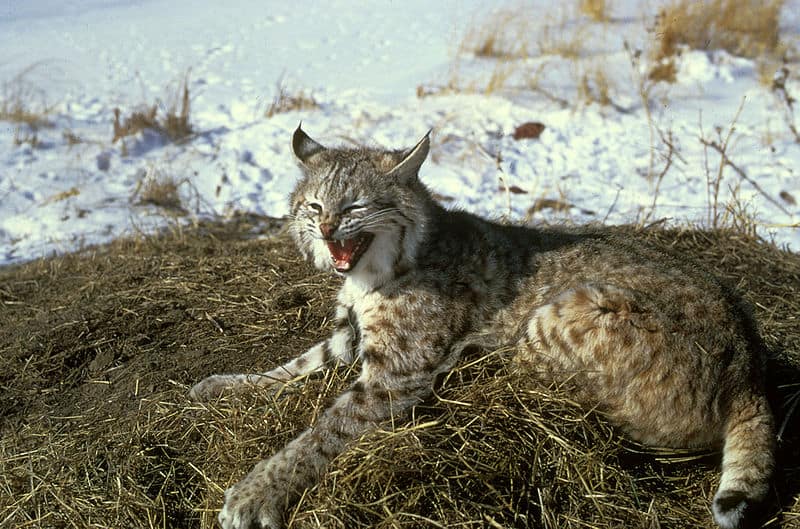
Bobcats are predators and only have cougars and wolves to look out for.
©Fijetland, Conrad – Public Domain by US Fish & Wildlife Service, from Wikimedia Commons, the free media repository – Original / License
The Bobcat is a fierce and dominant predator in its natural habitat, with adult Bobcats, therefore, being threatened by few animals, the biggest concern to them being cougars and wolves.
The small and vulnerable bobcat kittens, however, are preyed upon by several predators, including coyotes and owls, that are able to hunt the kittens while their mother has gone off to hunt.
The biggest threat to bobcat populations throughout North America is people, who have previously hunted the bobcat to near extinction in some areas for its soft fur. In areas where bobcats are now forced to share their natural ranges with growing numbers of people, they have also been hunted by farmers who fear for their livestock.
Despite the fact that they are very adaptable animals, bobcats are also threatened by habitat loss, with populations being pushed into smaller and more isolated regions of their once vast natural range.
Interesting Facts and Features
The bobcat is also known as the red lynx due to the fact that the two are very similar in appearance, but the bobcat tends to be much darker and richer in color than its northern relatives.
They are incredibly secretive yet powerful animals, able to pounce on their prey from up to 12 feet (3.7 m) away before delivering a fatal bite, allowing bobcats to hunt animals up to double their own size.
Although Bobcats are generally quiet and not greatly vocal animals, the fierce growls and snarls that they make when they are threatened often lead people to believe that there is a Mountain Lion in the area.
Relationship with Humans
Bobcats have historically dominated a wide variety of habitats across North America, with the bobcat known to people all over the continent, having roots in Native American folklore and in tales from the first European settlers in the northern USA and Canada.
However, the beauty, softness, and density of the bobcat’s fur led to an increased value in their pelts and therefore hunting them from the early to mid-1900s, which completely decimated populations, particularly in the mid-western and eastern USA.
Although they are now internationally protected, the hunting of bobcats continues in some areas, particularly those with the densest populations.
They are also seen as pests by farmers who hunt bobcats to protect their livestock, particularly in Mexico, where it has led to the Mexican Bobcat being listed as an Endangered species.
Conservation Status and Life Today
Today, the Bobcat is listed by the IUCN as Least Concern from becoming extinct in its native environment in the near future.
Since the international protection of the Bobcat in the 1970s put an end to the extensive trading of their fur, populations have been able to recover and are stable throughout much of their natural range.
However, in areas where there are increasing levels of human activity, numbers are still declining due to both hunting and habitat loss.
There are estimated to be between 800,000 and 1,200,000 Bobcat individuals left in the wild of North America.
Bobcat Pictures
View all of our Bobcat pictures in the gallery.

Becker1999 (Paul and Cathy), CC BY 2.0, via Wikimedia Commons
How to say Bobcat in ...
Sources
- David Burnie, Dorling Kindersley Animal, The Definitive Visual Guide To The World's Wildlife / Accessed November 10, 2008
- Tom Jackson, Lorenz Books The World Encyclopedia Of Animals / Accessed November 10, 2008
- David Burnie, Kingfisher The Kingfisher Animal Encyclopedia / Accessed November 10, 2008
- Richard Mackay, University of California Press The Atlas Of Endangered Species / Accessed November 10, 2008
- David Burnie, Dorling Kindersley Illustrated Encyclopedia Of Animals / Accessed November 10, 2008
- Dorling Kindersley Dorling Kindersley Encyclopedia Of Animals / Accessed November 10, 2008
- David W. Macdonald, Oxford University Press The Encyclopedia Of Mammals / Accessed November 10, 2008
- About Bobcats / Accessed November 10, 2008
- Bobcat Facts / Accessed November 10, 2008
- Bobcat Behaviour / Accessed November 10, 2008
- Bobcat Information / Accessed November 10, 2008