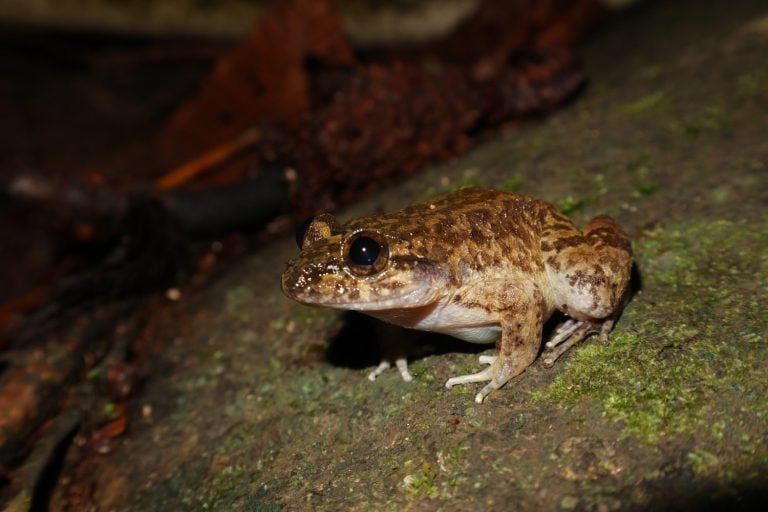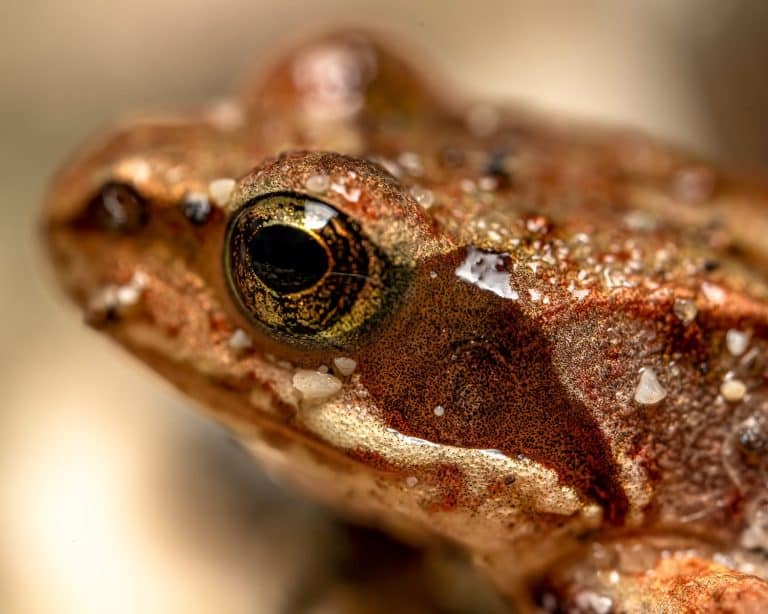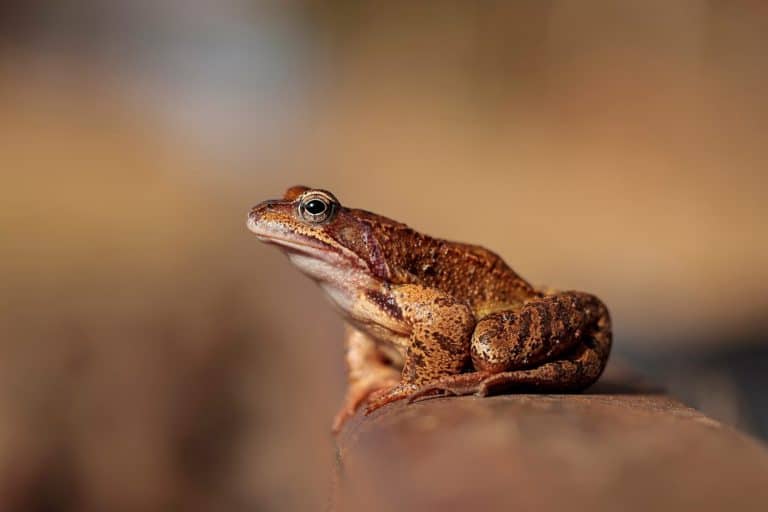
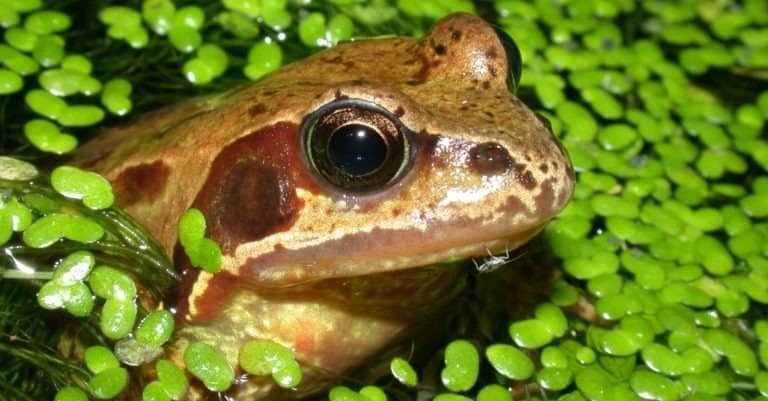
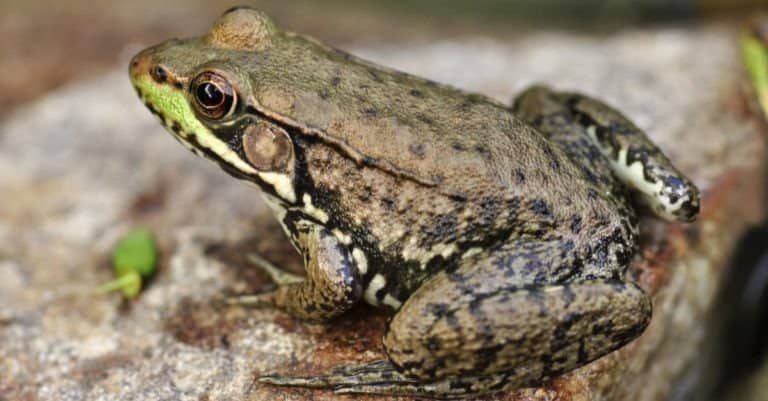
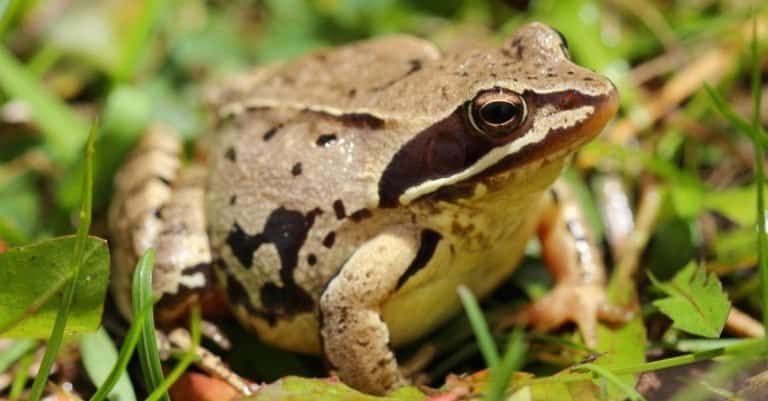
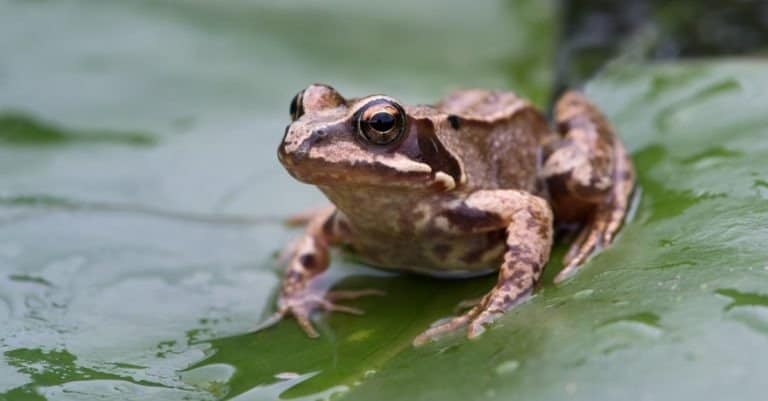


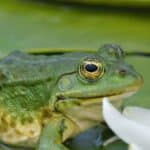
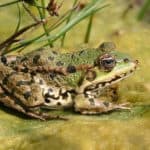
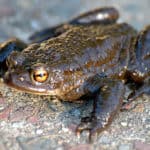
With its smooth, moist skin, long, sticky tongue, and elongated hind legs, the common frog is one of the most recognizable species of frogs on the planet.
Native to Europe, common frogs are found from Great Britain through Central Russia. Although the species is not considered endangered, its population numbers are believed to be declining.
In Great Britain and Ireland, the common frog is protected by law from trade or sale, so this amphibian isn’t meant to be kept as a pet. Like other frogs, common frogs have a distinct lifecycle featuring three stages of development.
5 Incredible Common Frog Facts!
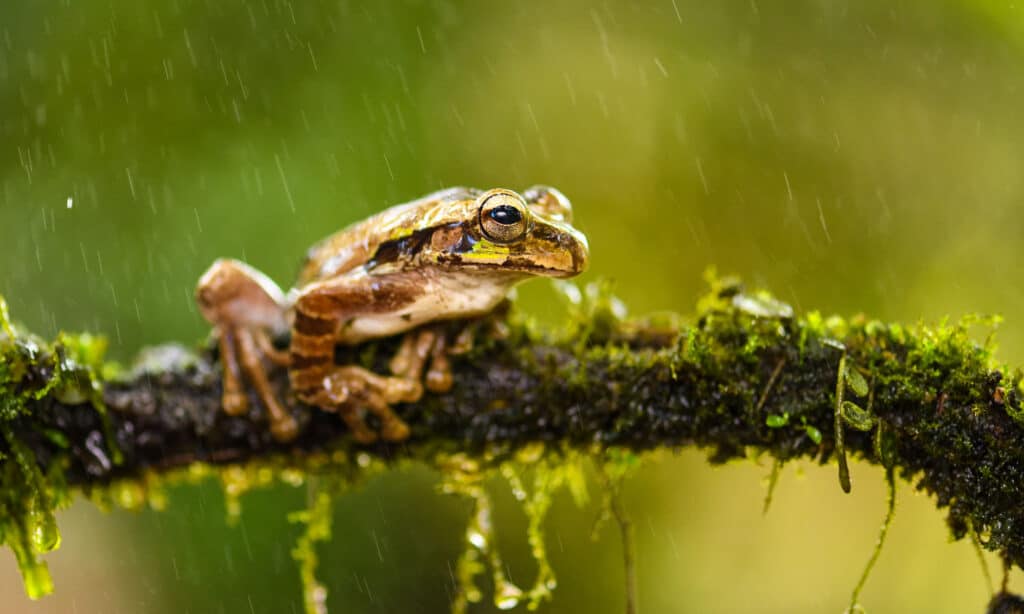
The common frog employs a tactic of changing the color of its skin to better blend in with its surroundings, a means of evading predators.
©petrdd/Shutterstock.com
- Chameleons: The common frog can lighten and darken its skin to blend in with its surroundings better, a strategy they use to hide from predators.
- Hibernators: During the coldest part of the winter, common frogs hibernate. In the northernmost reaches of their range, they can become trapped under ice for up to nine months but emerge unscathed with the thaw.
- Insect Lovers: Adult common frogs are carnivores, primarily subsisting off worms and other insects. In fact, they can detect the presence of a worm through their sense of smell.
- Protected: It is believed that common frog populations are declining – mostly because of human activity. The species is protected by law in Ireland and the UK, where they can’t be bought or sold.
- Varied Rate of Development: Like most amphibians, the rate at which the common frog develops is strongly influenced by temperature. Therefore, common frogs in warmer places develop faster than ones in colder areas.
Scientific Name
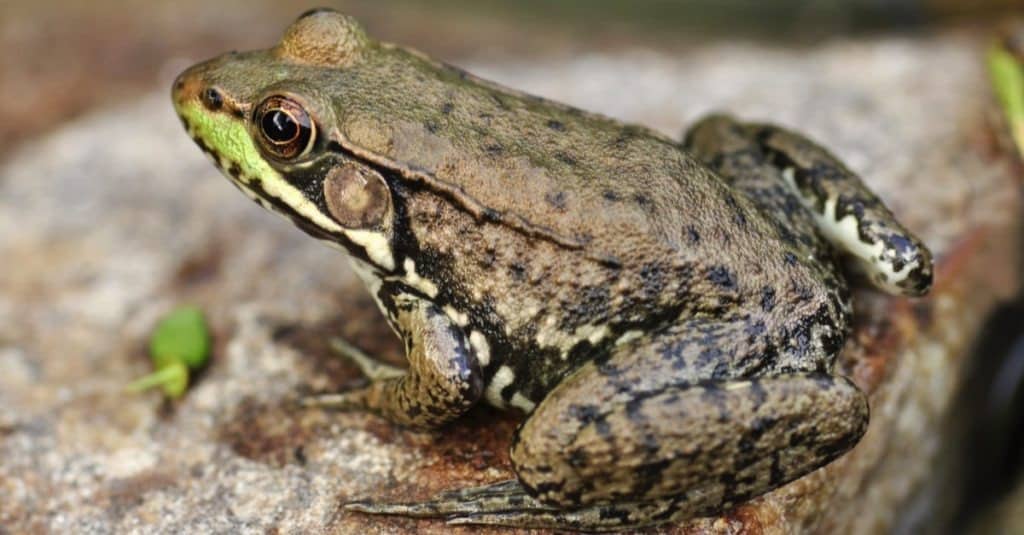
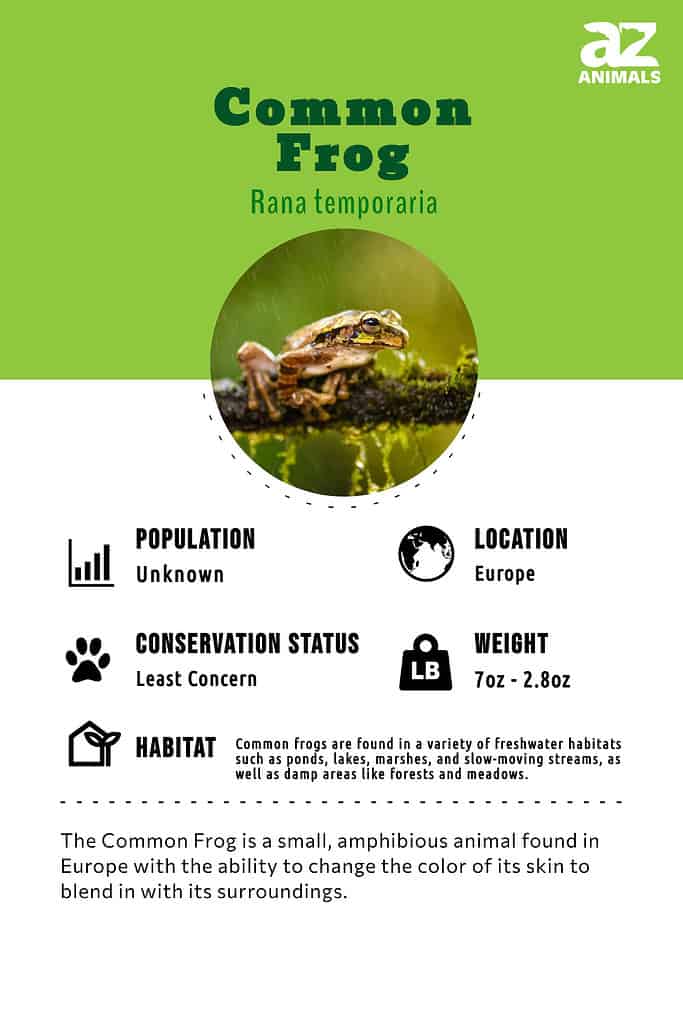
Rana temporaria is the scientific name for the common frog, which falls under the family Ranidae, the genus Rana, the order Anura, and the class Amphibia.
©Svetlana Foote/Shutterstock.com
The scientific name for the common frog is Rana temporaria. These amphibians belong to the class Amphibia, the order Anura, the family Ranidae and the genus Rana. As members of the Ranidae family, common frogs are considered true frogs.
Many different names are used for these frogs. They are also known as grass frogs, russet frogs, European common frogs, and European common brown frogs.
Evolution and Origins
Ichthyostega, an ancient ancestor to modern-day frogs, existed approximately 370 million years ago, in the Devonian era, and is sometimes known as “the first four-legged fish;” its skeletal remains were initially discovered in East Greenland.
Around 250 million years ago, preceding the age of dinosaurs, a flat-bodied, compact amphibian measuring ten centimeters in length emerged on Pangaea, a supercontinent, marking a significant departure from its salamander-like predecessors, featuring a small tail that was supported by six vertebrae; Triadobatrachus is considered to be the first frog in the world.
Furthermore, a new study has proposed that the high levels of diversity among modern-day frogs are largely due to the asteroid impact that resulted in the extinction of dinosaurs, with the research indicating that there was a rapid growth in the frog population following the event 66 million years ago.
Different Types
- American bullfrog
- Northern leopard frog
- Wood frog
- Gray treefrog
- Spring peeper
- Pickerel frog
- Green frog
- Southern leopard frog
- American green tree frog
- Northern cricket frog
- Pacific tree frog
- Red-eyed tree frog
- Boreal chorus frog
- American toad
- Barking treefrog
- Cope’s gray treefrog
- Western chorus frog
- Ornate horned frog
- Tomato frogs
- African clawed frog
- Mink frog
- Squirrel treefrog
- Columbia spotted frog
- Southern cricket frog
Appearance
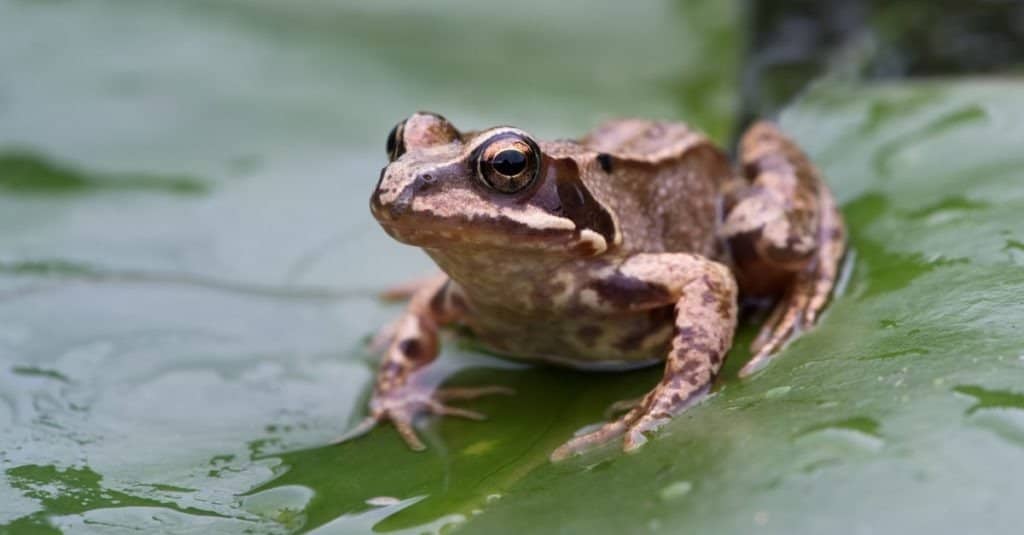
These frogs have a plump physique and usually attain a length ranging from 2.8 to 3.9 inches on average.
©davemhuntphotography/Shutterstock.com
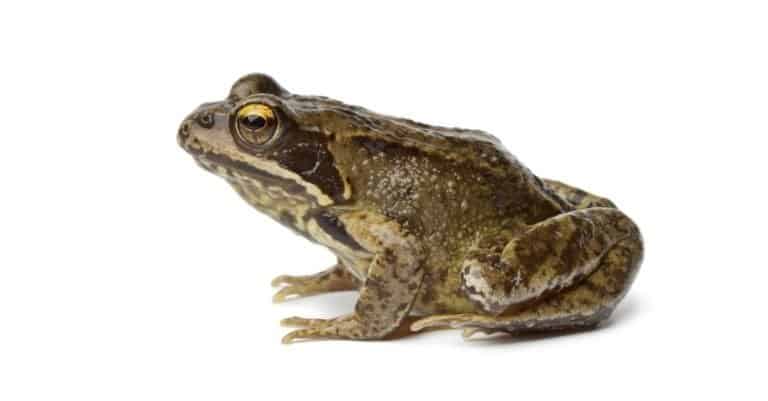
These frogs have corpulent bodies, and they grow to an average size of 2.8 to 3.9 inches long. On average, they weigh around 0.80 ounces, so they are tiny and lightweight. They have smooth, moist skin, and their coloring and markings vary.
The underlying skin may be greenish, gray, yellowish, red, or brown in appearance. Anywhere from a small smattering to a large concentration of markings may also appear, and they are typically reddish-brown or black in color. The underbelly side is usually white or yellow. Common frogs typically have stripes on their hind legs, and a “mask” appears behind their eyes and eardrums.
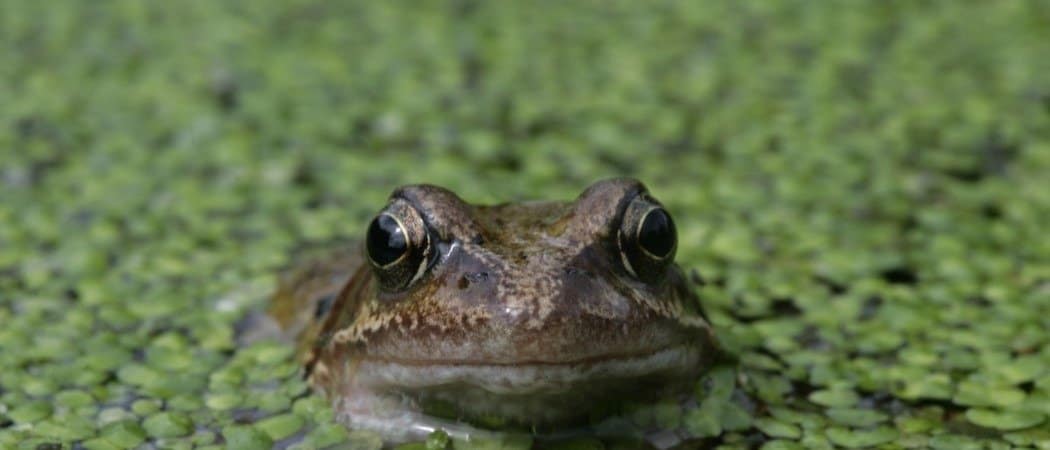
These frogs have unique faces. They possess brown, oval-shaped eyes with transparent, horizontal pupils. A transparent inner eyelid protects their eyes while they are underwater.
These frogs exhibit a small amount of sexual dimorphism. Females are usually a bit larger than males. During the mating season, the male’s throat may turn completely white. Males also have hard swellings, known as nuptial pads, on the first digits of their forelegs.
These swellings come in handy during mating because the male uses them to hold himself in the correct position atop the female.
Behavior
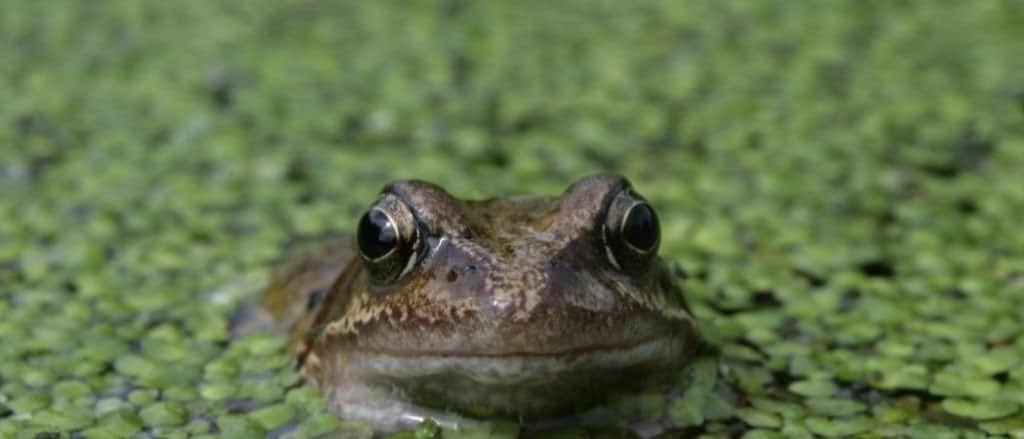
Apart from the breeding season, these frogs prefer to live alone and do not typically engage in social activities.
©iStock.com/MikeLane45
Outside of the mating season, these frogs are solitary creatures. While preparing for hibernation, these frogs will consume large amounts of insects, worms, and slugs. They hibernate during the coldest part of the winter, typically under rocks, inside compost heaps, or even underwater in the mud and vegetation.
In freezing northern climates, the common frog may even become trapped beneath the ice for as long as nine months at a time. They are able to take in moisture through their skin, which helps them make it through. Although they do hibernate, these frogs aren’t strict about it, often venturing out opportunistically to forage for food. This frog has a long, sticky tongue, and it darts it out quickly to snare various insects.
The primary call of the common frog is a croaking sound. Common frogs are most active during the nighttime.
Habitat
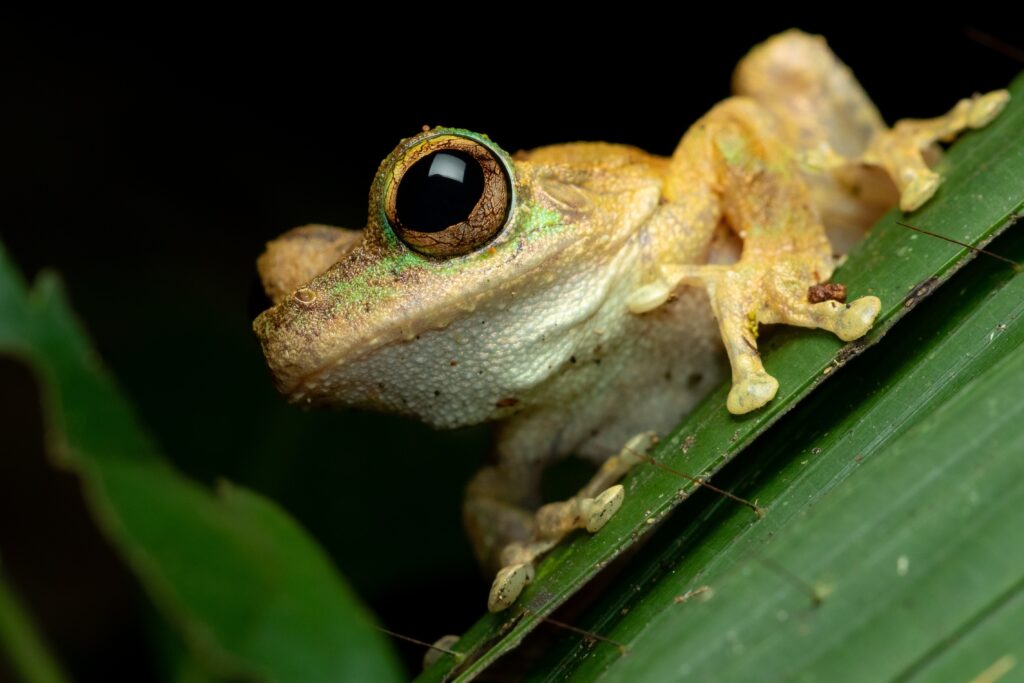
Indigenous to Europe, these frogs are predominantly distributed from Great Britain to central Russia.
©Vision Wildlife/Shutterstock.com
A native of Europe, these frogs are primarily found from Great Britain through central Russia. They are found as far north as Scandinavia, as far east as the Ural Mountains, and as far west as Ireland, and they are also found in parts of Asia through Japan. These amphibians prefer habitats with dark, shady areas and damp conditions, so they are primarily found in ponds, marshes, and areas of long grass.
Diet
As tadpoles, these frogs are herbivores, subsisting mostly of algae and other decaying plant matter. Adult frogs are considered carnivores because they mostly consume insects, insect larvae, woodlice, snails, spiders, and worms.
In fact, common frogs can detect the presence of worms through smell alone, so they are very attuned to locating and consuming them.
Predators and Threats
The most common predators faced by these frog tadpoles include beetles, birds, fish, and dragonfly larvae. Common predators of adult frogs include birds of prey, gulls, storks, herons, ducks, crows, snakes, and badgers. Housecats also target common frogs but usually do them little harm.
Although this frog is listed as Least Concern by the IUCN Red List, its population numbers are believed to be declining. Human activity is mostly to blame, especially alterations made to the land for real estate development.
Since this species thrives in ponds, a decline in the number of ponds in the UK is also likely to blame. Over the last 100 years or so, the number of ponds in the country dropped by one-third to around 500,000 or so. With around one-third of its favorite habitats gone, it should come as no surprise that these creatures are struggling to survive.
Work is being done to protect these frogs, fortunately. The species is protected by law in Ireland and the UK from trade or sale. Therefore, you can’t go to a pet shop to buy a common frog. This frog shouldn’t be kept as a pet at all. There are many other less vulnerable frog species, and choosing one of them to keep as a pet is the best option. Other species are easier to care for; the common frog can be difficult to care for effectively in captivity.
The common frog is also susceptible to many diseases, including the ranavirus.
Reproduction, Babies, and Lifespan
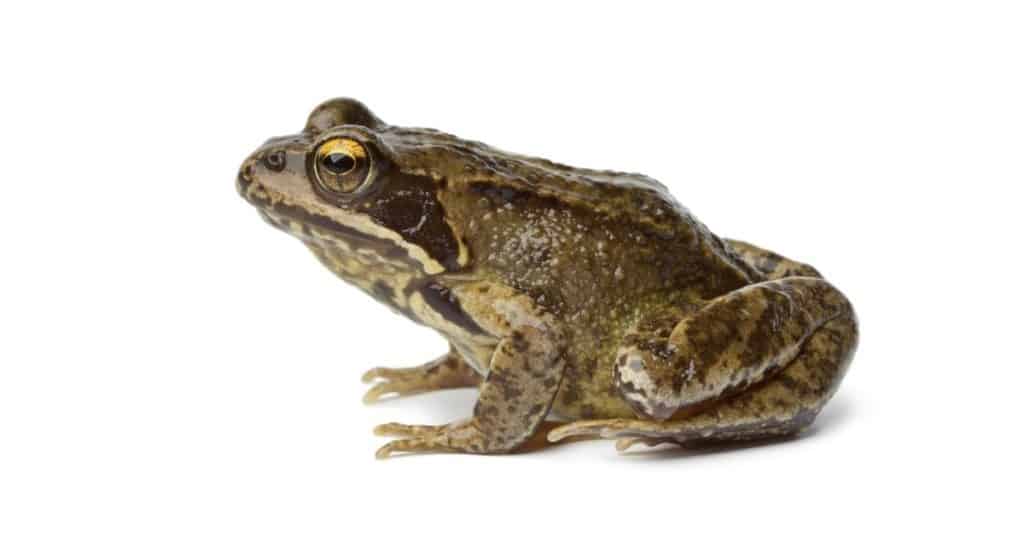
The average lifespan of the common frog ranges between five to 10 years, which can vary depending on its natural habitat and whether it is housed in captivity.
©Picture Partners/Shutterstock.com
The common frog has an average lifespan of five to 10 years. Its lifespan may vary depending on where it lives and whether it is kept in captivity. During its lifetime, this species undergoes a unique life cycle consisting of three primary stages: the aquatic larva stage, the terrestrial juvenile stage, and the adult stage. Early in the life cycle, an embryo develops inside an egg that is floating in the water.
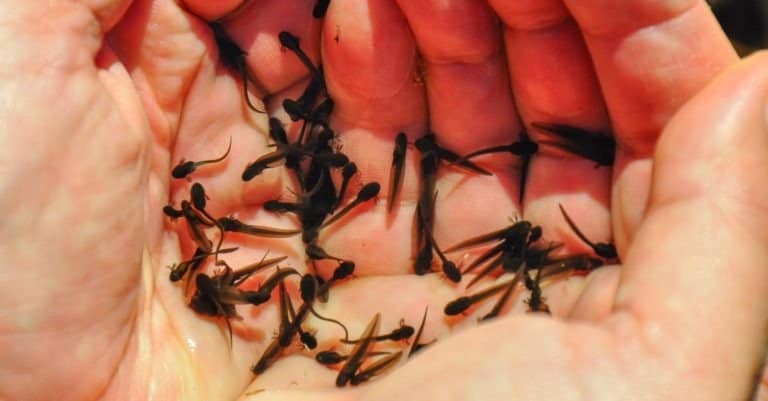
As an early tadpole, the creature forms a developing mouth and attaches itself to substrates. Next, as a late tadpole, the common frog develops a mouth with rasping teeth, and skin grows over its gills. At around 16 weeks of age, the hind legs form; they are followed shortly after by the front legs. The tail begins to shorten; when it is fully absorbed, the adult frog can leave the water for the first time. The life cycle is now complete.
These frogs typically breed during the later spring or whenever the water temperature reaches 57 degrees Fahrenheit. Around that time, the frog’s pituitary gland is stimulated by changes to things like the length of daytime, temperature, and average rainfall and begins to produce sex hormones. Males develop sperm, and females develop eggs. Males’ nuptial pads become swollen and may become pigmented too.
Male frogs compete for females in ponds through “choirs” of croaks. Female frogs are drawn to males who have the longest and loudest croaks, so males try to make as much noise as they can. Eventually, the female enters the pond, and a male frog climbs on top of her.
He grasps the female under her forelegs with his nuptial pads, and he may have to kick away other males who are competing for the female’s attention. The male remains in place until the female lays her eggs – she may lay anywhere from 1,000 to 4,000 of them, and they are black with a clear, jelly capsule. As the eggs are released, the male sprays sperm over them.
It takes around three months for tadpoles to metamorphose completely. When they initially emerge, they are entirely black in color. After developing hind legs around 16 weeks of age and losing their tail, they emerge as full adults. Adult frogs reach sexual maturity around two to three years of age.
Population
Global population estimates for these frogs are not available. The species is listed as Least Concern by the IUCN, but its populations are believed to be declining across Europe. In an effort to protect them, laws are in place preventing their sale or trade. As a result, this is not a good frog to keep as a pet.
Zoo
You can find these frogs at zoos around the world. Currently, the Moscow Zoo and the Ahtari Zoo – a zoo that is located in Finland – have common frogs on display. Visiting a common frog at the zoo is a great way to learn more about the species.
Common Frog Pictures
View all of our Common Frog pictures in the gallery.

Steve McWilliam/Shutterstock.com
How to say Common Frog in ...
Sources
- Discover Wildlife / Accessed February 5, 2021
- Amphibian and Reptile Conservation / Accessed February 5, 2021
- Ahtari Zoo / Accessed February 5, 2021
- Frog Life / Accessed February 5, 2021
- Britannica / Accessed February 5, 2021