C
Species Profile

Crab-Eating Macaque

Macaca fascicularis

Long tail, big brains, bold foraging
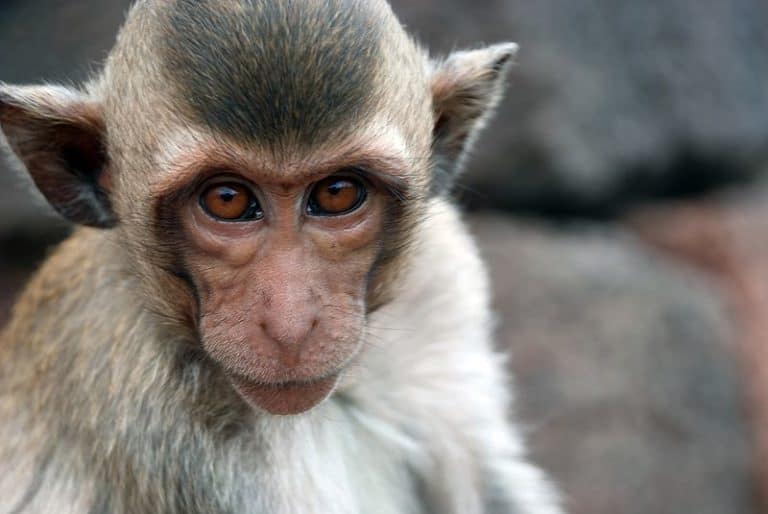
Chris huh, CC BY-SA 3.0, via Wikimedia Commons

Crab-Eating Macaque Distribution

Click a location to explore more animals from that region

Invasive Species
Loading map...
Sharpened and downsampled version of Image:Macaca_fascicularis_in_Lopburi.JPG.

At a Glance

Wild Species
Also Known As Long-tailed macaque, Longtail macaque, Cynomolgus macaque, Cynomolgus monkey, Shore macaque
Diet Omnivore
Activity Diurnal+
Lifespan 20 years
Weight 9 lbs
Status Endangered
Did You Know?

It's better called the "long-tailed macaque": tail length commonly exceeds head-body length (tail ~40-65 cm vs. body ~38-55 cm).

Scientific Classification

A widespread Southeast Asian Old World monkey known for its adaptability, omnivorous diet (including crabs and other coastal foods in some populations), and frequent association with human-modified habitats.

Kingdom
Animalia
Phylum
Chordata
Class
Mammalia
Order
Primates
Family
Cercopithecidae
Genus
Macaca
Species
fascicularis

Distinguishing Features

  • Slender-bodied macaque with a notably long tail (often near or longer than body length)
  • Gray-brown coat with paler underparts
  • Often found in coastal/mangrove settings; highly opportunistic omnivore
  • Highly adaptable and frequently encountered near people in many regions

Physical Measurements

Males and females differ in size

Length
3 ft 5 in (2 ft 7 in – 3 ft 11 in)
Weight
14 lbs (10 lbs – 18 lbs)
10 lbs (7 lbs – 13 lbs)
Tail Length
1 ft 10 in (1 ft 4 in – 2 ft 2 in)
1 ft 9 in (1 ft 4 in – 2 ft 2 in)
Top Speed
9 mph
About 14.4 km/h

Appearance

Primary Colors
Secondary Colors
Skin Type Dense fur over most of body; largely hairless facial skin and ear pinnae; bare skin on palms/soles; ischial callosities present (as in other cercopithecines).
Distinctive Features
  • Long, slender tail usually as long as or longer than the head and body, a key sign compared to pig-tailed macaques; tail about 40–65 cm, head-body about 38–55 cm.
  • Adult body mass is sexually dimorphic: males commonly ~5.0-8.6 kg; females ~2.7-5.7 kg (commonly cited compiled ranges; e.g., Smith & Jungers 1997; Rowe 1996).
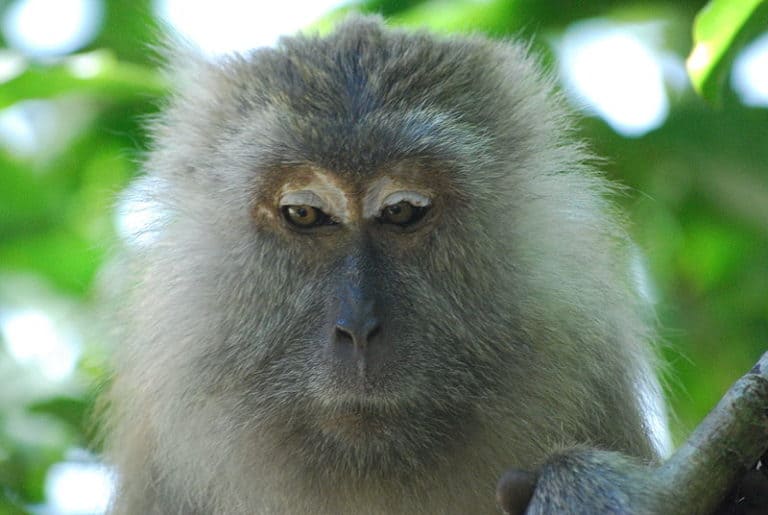
  • Face is relatively narrow with forward-facing eyes; facial skin typically grayish to pinkish-tan depending on individual and condition; muzzle not as broad as in some other macaques.
  • Cheek whiskers ("moustache"/sideburn effect) can be noticeable, sometimes appearing paler than surrounding fur, contributing to a slightly masked look.
  • Adaptable, often found in lowland forests, mangroves, riparian edges, and human-modified habitats across Southeast Asia; frequently forages on the ground and in trees.
  • Omnivorous and strongly opportunistic: diet can include fruits, leaves, seeds, insects, eggs, small vertebrates, and (in some coastal/mangrove populations) crabs and other intertidal foods-crab-eating is population- and habitat-dependent rather than exclusive.
  • Highly social, living in multi-male/multi-female troops; conspicuous in areas with human food sources, contributing to human-wildlife conflict (crop-raiding, raiding refuse/handouts).
  • Longevity: maximum recorded lifespan in captivity reported as ~37.1 years (AnAge database entry for Macaca fascicularis); wild lifespans are typically shorter due to predation, disease, and conflict.

Sexual Dimorphism

Marked size dimorphism with males larger/heavier and generally more robust; males also show relatively larger canine teeth and a more pronounced facial/jowl appearance in many adults.

  • Heavier body mass and larger overall dimensions (commonly cited ~5.0-8.6 kg).
  • Relatively larger canines; head and shoulders appear more robust, with thicker neck/cheek region in mature males.
  • May show more pronounced darkening on crown/upper back in some individuals (population/individual variation).
  • Smaller body mass and more gracile build (commonly cited ~2.7-5.7 kg).
  • Less pronounced canine development and less bulky head/neck profile compared with adult males.
  • Nipples and mammary area become more evident with reproductive status; otherwise similar pelage patterning to males.

Did You Know?

It's better called the "long-tailed macaque": tail length commonly exceeds head-body length (tail ~40-65 cm vs. body ~38-55 cm).

Adult mass is strongly sex-biased: males ~4.7-8.3 kg; females ~3.1-5.7 kg (compiled morphometrics, e.g., Smith & Jungers 1997).

Not "crab-dependent": many populations eat mostly fruit and other plant foods, but coastal troops may add crabs, mollusks, and other shoreline prey opportunistically.

Some coastal Thai populations routinely use stone tools to crack open shellfish and nuts-one of the best-known non-ape tool-use traditions in wild primates (field studies in Phang Nga region).

Typical social system is multi-male/multi-female with female philopatry (females usually stay in natal groups; males disperse).

Longevity can be high for a monkey: maximum recorded lifespan in captivity is ~38 years (AnAge longevity records); wild individuals are commonly far shorter (often ~15-20 years).

They are strong swimmers and readily cross channels and forage in mangroves-helping explain their success on islands and coastal edges.

Unique Adaptations

  • Very long tail (key field mark) used for balance during terrestrial running and arboreal travel, especially along mangrove roots and coastal vegetation.
  • Cheek pouches allow high-rate harvesting in risky, competitive, or human-dominated settings-supporting their "grab-and-go" feeding style.
  • Dietary flexibility: able to shift between fruit/leaf/invertebrate/vertebrate and human-derived foods, aiding persistence in disturbed habitats.
  • Semi-terrestrial locomotion with strong climbing ability: effective on the ground, in trees, and in structurally complex mangroves.
  • Behavioral plasticity around people: rapid learning about food sources, guarding, and human routines-one reason they thrive near settlements and tourist sites.

Interesting Behaviors

  • Mangrove and shoreline foraging: wading, probing mud, and timing feeding with tides to access crabs, mollusks, and stranded organisms in some coastal troops.
  • Cheek-pouch "gather then retreat": rapid food collection followed by safer processing away from competitors (a hallmark behavior in many cercopithecines).
  • Clear dominance hierarchies: priority of access to food and grooming is strongly rank-related; coalitions and "support" in conflicts occur in both sexes.
  • Opportunistic crop-raiding and urban foraging: troops exploit orchards, temple offerings, trash, and handouts-often escalating into human-wildlife conflict (bites, property damage).
  • Alarm calling and vigilance shifts: individuals give distinct alarm calls and troop members adjust scanning and spacing depending on perceived predator/human threat.
  • Stone-tool use in certain populations: selecting, transporting, and reusing stones (anvils/hammerstones) to open hard-shelled foods; local "tool cultures" vary by site.

Cultural Significance

Crab-eating macaques (Macaca fascicularis) are common at temples and roadsides in Southeast Asia. Some in Indonesia are treated as sacred. In Thailand they appear in festivals (Lopburi) and cause fights over feeding and management. Called "cynomolgus macaques" they are used in disease and vaccine research, which is controversial.

Myths & Legends

In a major South and Southeast Asian epic, a heroic monkey general leads a monkey army; temple monkey groups, including the crab-eating macaque (Macaca fascicularis), are often tied to this sacred-monkey image.

In Balinese and Javanese shadow-puppet Ramayana shows, a white monkey warrior and monkey allies help the prince; these tales are shown at temples and public performances where crab-eating macaques (Macaca fascicularis) often live nearby.

A South and Southeast Asian folktale, "The Monkey and the Crocodile", shows a crab-eating macaque (Macaca fascicularis) outsmarting a crocodile that tries to lure it across a river, teaching wit and caution.

In parts of Indonesia and Malaysia, crab-eating macaque (Macaca fascicularis) near sacred groves, temples, and burial sites appear in tales as forest guardians or punishers, teaching not to harm animals or sacred places.

For Macaca fascicularis, an old scientific name comes from Greek meaning "dog-milker," from a tale that monkeys could milk dogs; the strange name appears in early nature books and travelers' stories.

Conservation Status

EN Endangered

Facing a very high risk of extinction in the wild.

Population Decreasing

Protected Under

  • CITES Appendix II (Macaca fascicularis listed; international trade regulated via permits/quotas)
  • Protected under various national wildlife laws across range states (examples include: Philippines Wildlife Resources Conservation and Protection Act, RA 9147; Malaysia Wildlife Conservation Act 2010; Thailand Wildlife Preservation and Protection Act 2019-specific legal status and allowances for control/culling vary by country and locality)
  • Occurs in numerous protected areas within its native range; site-level protection effectiveness varies (IUCN Red List: Eudey et al., 2022)

Life Cycle

Birth 1 infant
Lifespan 20 years

Lifespan

In the Wild
10–30 years
In Captivity
15–38 years

Reproduction

Mating System Polygynandry
Social Structure Aggregation Group
Breeding Pattern Transient
Fertilization Internal Fertilization
Birth Type Internal_fertilization

Crab-eating macaque (Macaca fascicularis) live in multi-male, multi-female troops. They mate with many partners (polygynandrous); dominance and short consortships shape access. Females signal fertility, mate with many males to confuse paternity and lower infanticide risk.

Behavior & Ecology

Social Troop Group: 25
Activity Diurnal, Crepuscular
Diet Omnivore Ripe fruit-especially figs (Ficus spp.) where available (reported as a frequently targeted, high-reward resource in multiple field studies; e.g., Kurland 1973; Wheatley 1980).

Temperament

Crab-eating macaque (Macaca fascicularis) are relatively tolerant, with frequent make-ups and two-way fighting, yet males and females each keep clear linear dominance hierarchies.
Adaptable and opportunistic, Macaca fascicularis are flexible in behavior. Getting used to people can make them bolder, take more risks, and sometimes cause more group fights over clumped, high-value food.
Crab-eating macaques live in female-centered, stable groups; females stay in their birth groups, form matrilines, and groom and ally with kin. Immigrant males are more aggressive, and male takeovers can cause infanticide risk.
Crab-eating macaque (Macaca fascicularis) life history that shape social life: gestation about 162–193 days, interbirth intervals usually 12–18 months (depends on food/condition), max known lifespan ~37.6 years in captivity.

Communication

Contact 'coo' calls used to maintain cohesion/spacing during travel/foraging Commonly described for Macaca fascicularis; see Thierry 2007; Rowe 1996
Threat/aggression vocalizations including barks, growls/grunts, and screams during chases, fights, and harassment Rowe 1996
Infant distress calls that elicit maternal retrieval and group attention; alarm-type calls are given to predators/disturbances with context-dependent responses Wheatley 1980; Rowe 1996
Facial expressions: silent bared-teeth display Submissive/appeasement), open-mouth threats, and rapid facial signaling during tense encounters; strong use of gaze and head orientation (Thierry 2007
Body postures and gestures: lunges, ground slaps, branch shaking, and presenting Sexual/submissive contexts) to regulate spacing and dominance interactions (Thierry 2007; Rowe 1996
Tactile communication: grooming is central for tension reduction, alliance maintenance, and reconciliation; embraces/mounting can occur in socio-sexual contexts Thierry 2007
Olfactory/close-range cues: anogenital inspection/sniffing and urine-related cues used in reproductive and individual assessment contexts Rowe 1996

Habitat

Biomes:
Tropical Rainforest Tropical Dry Forest Wetland Freshwater Marine
Terrain:
Coastal Island Riverine Plains Hilly Valley Mountainous Sandy Muddy +3
Elevation: Up to 6561 ft 8 in

Ecological Role

Generalist omnivorous consumer and highly adaptable commensal primate that links forest, edge, and coastal food webs.

Seed dispersal (especially for fleshy-fruited plants; disperses and sometimes pre-disperses seeds through pulp removal) Invertebrate and small-vertebrate population regulation (predation on insects and other small animals) Nutrient translocation/cycling across habitats (moves marine-derived nutrients inland when feeding on intertidal prey, and redistributes nutrients via feces) Ecosystem engineering via extractive foraging (disturbs leaf litter/soil and intertidal substrates while searching for prey) Human-wildlife interface effects: can act as crop pest and disease-contact bridge in urban/temple/provisioned settings, altering local trophic dynamics

Diet Details

Main Prey:
Crabs Other crustaceans Mollusks Insects and other arthropods Earthworms and other small invertebrates Small vertebrates Bird eggs and nestlings Fish +2
Other Foods:
Ripe fruits Leaves Flowers and buds Seeds and nuts Bark and pith Cultivated crops Human foods and garbage +1

Human Interaction

Domestication Status

Wild

Macaca fascicularis (crab-eating or long-tailed macaque) is not a domesticated species. This wild primate often becomes used to people or food-conditioned near temples, parks, and urban edges, and is widely kept in captivity for biomedical research. Large managed breeding colonies (e.g., Mauritius) supply research. Trade is regulated (CITES Appendix II). Human interaction is commensal/habituated and captive-managed, not domesticated.

Danger Level

High
  • Bites and scratches, especially in provisioned/habituated groups; risk increases around food, infants, and during mating-season aggression
  • Zoonotic pathogens: Macacine alphaherpesvirus 1 ("B virus"/Herpes B) is enzootic in macaques; human infection is rare but can be severe and has high fatality if untreated in published clinical summaries
  • Other zoonotic risks reported from macaque-human interfaces include rabies exposure risk in endemic areas (from bites), Mycobacterium tuberculosis complex transmission concerns in close-contact settings, enteric bacteria/parasites (e.g., Salmonella, Shigella, Giardia, helminths) associated with fecal contamination in parks/temples
  • Traffic accidents and secondary injuries in urban settings (macaques darting into roads; humans attempting to feed/chase them)
  • Allergic reactions/asthma triggers from dander in captive contexts

As a Pet

Not Suitable as Pet

Care Level: Expert Only

Purchase Cost: $4,000 - $12,000
Lifetime Cost: $100,000 - $300,000

Economic Value

Uses:
Biomedical research and breeding (laboratory primate) Tourism and recreation (temples, parks, wildlife-viewing sites) Human-wildlife conflict economics (crop-raiding, property damage, urban management costs) Wildlife trade and enforcement costs (illegal pet/entertainment trade; regulated international trade under CITES) Invasive/introduced-population management (where introduced outside native range)
Products:
  • live animals for regulated research supply chains (captive-bred individuals)
  • tourism revenue tied to viewing/provisioned troops in some locations
  • pest-management/mitigation services expenditures (trapping, sterilization programs, exclusion infrastructure)

Relationships

Predators 6

Related Species 8

Rhesus macaque
Rhesus macaque Macaca mulatta Shared Genus
Southern pig-tailed macaque Macaca nemestrina Shared Genus
Northern pig-tailed macaque Macaca leonina Shared Genus
Japanese macaque
Japanese macaque Macaca fuscata Shared Genus
Stump-tailed macaque Macaca arctoides Shared Genus
Formosan rock macaque Macaca cyclopis Shared Genus
Dusky leaf monkey Trachypithecus obscurus Shared Family
Proboscis monkey
Proboscis monkey Nasalis larvatus Shared Family

Ecological Equivalents 5

Animals that fill a similar ecological role in their ecosystem

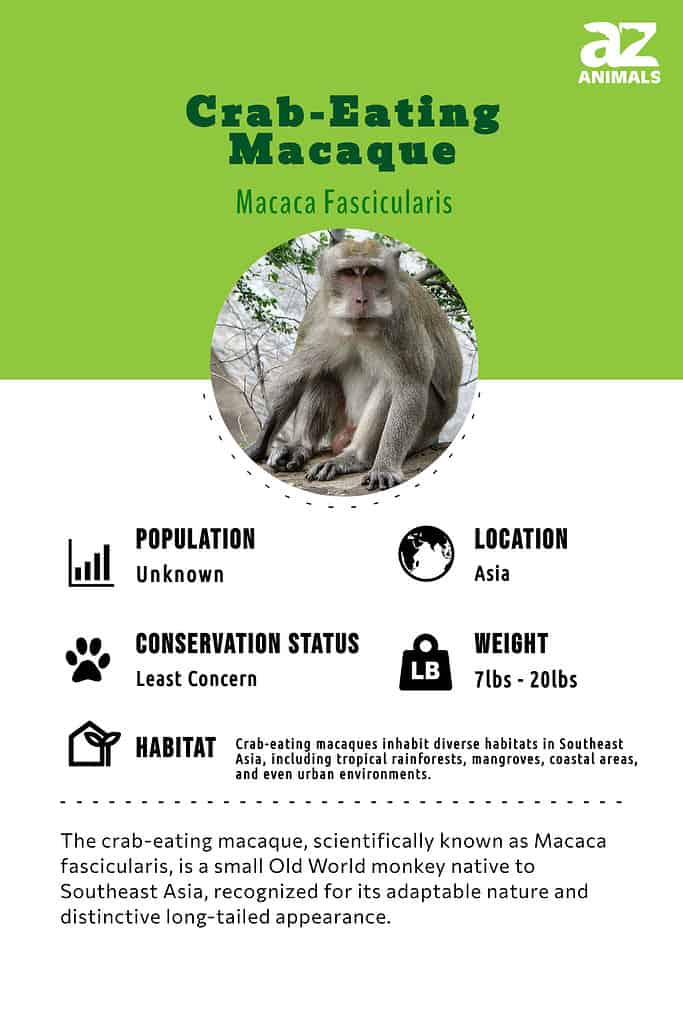
The crab-eating macaque, scientifically known as Macaca fascicularis, is a small Old World monkey native to Southeast Asia, recognized for its adaptable nature and distinctive long-tailed appearance.

The crab-eating macaque is one of the most widespread primate species in the world.

A familiar sight throughout the wildernesses of Southeast Asia, the crab-eating macaque has existed alongside human habitations for many thousands of years.

The animal’s playful, nurturing, intelligent, and socially active nature means that positive interactions with humans are fairly common. But human encroachment into the monkey’s natural habitat has put some pressure on the species as well.

5 Incredible Crab-Eating Macaque Facts
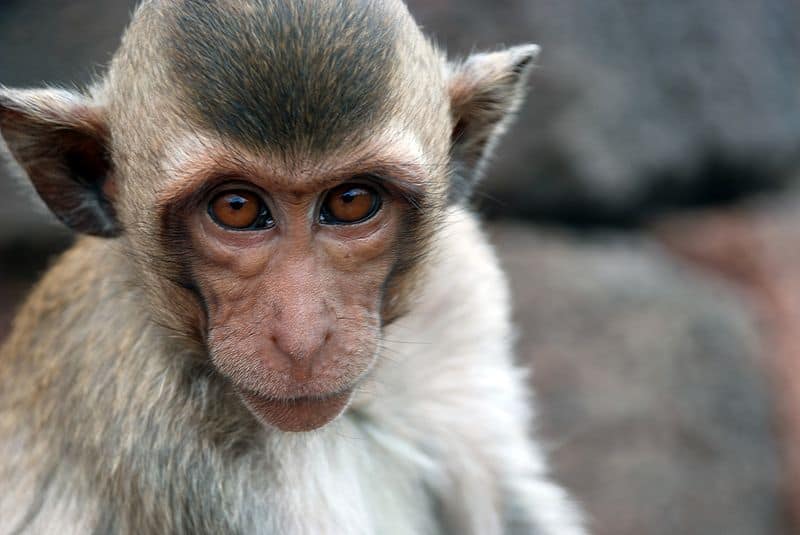
Crab-eating macaque (Macaca fascicularis) in Lopburi, Thailand

In certain regions, the crab-eating macaque is classified as an invasive species.

  • Alternate names of this species also include the long-tailed macaque and the cynomolgus monkey. Due to the sheer length of the tail, the long-tailed macaque is often the preferred name, while the term crab-eating macaque is a slight misnomer. Most individuals actually prefer fruit.
  • Macaques have a complex relationship with humans. Sometimes considered sacred beings, they are an important part of the mythology in some local cultures. And like rhesus monkeys, they are also commonly selected for medical experimentation and research due to their susceptibility to human diseases.
  • Scientists have observed that the crab-eating macaque may be capable of acquiring knowledge and culture across multiple generations. This has made them a useful subject of inquiry for animal intelligence.
  • The crab-eating macaque lives in female-dominated societies. This means the group is oriented around the female line of succession. Males tend to be more tenuously connected with the group.
  • The crab-eating macaque is considered an invasive species in some regions.

Scientific Name
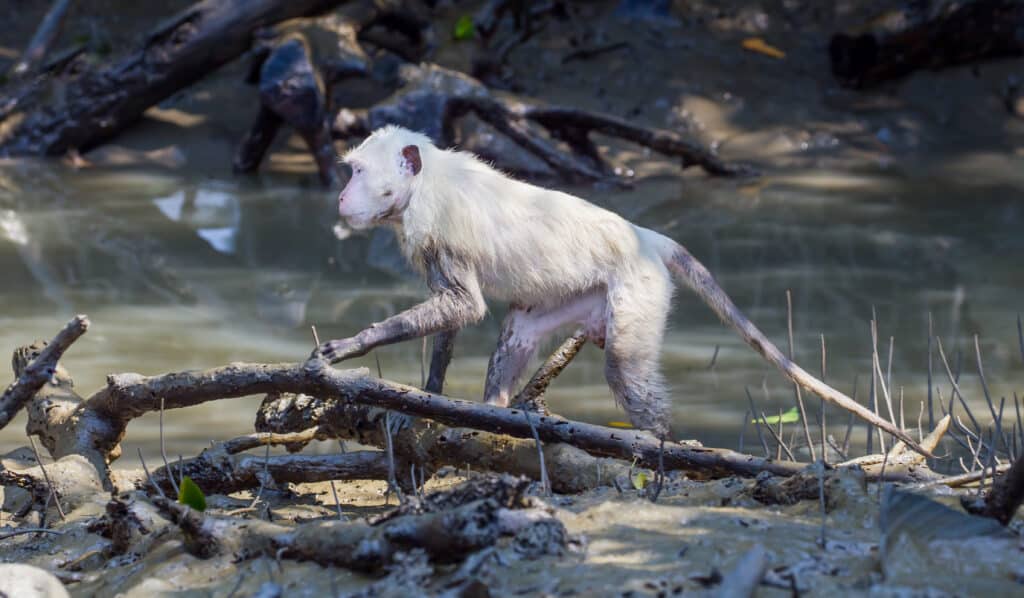
A white crab-eating macaque crossing a stream via a branch

Macaca fascicularis is the scientific name assigned to the crab-eating macaque.

The scientific name of the crab-eating macaque is Macaca fascicularis. Macaca, which is derived from the Portuguese word for monkey, originally came from the West African language of Ibinda. The term ‘fascicularis’ comes from the Latin word for a small band or stripe.

There are potentially up to 10 subspecies of the crab-eating macaque, including the common long-tailed macaque, the Nicobar long-tailed macaque, and the dark-crowned long-tailed macaque. Each one varies slightly in its habitat, diet, and physical appearance. More distantly, they are related to the rhesus macaque, Japanese macaque, and pig-tailed macaque, which all occupy the same genus.

The macaque genus is part of a family of primates known as the Cercopithecidae or the Old World monkeys. They diverged from the New World monkeys around 55 million years ago. The main difference between Old World and New World monkeys lies in their physical characteristics. Old World monkeys have narrower noses, downward-facing nostrils, and opposable thumbs. They also tend to lack prehensile tails.

Evolution and Origins

The crab-eating macaque (Macaca fascicularis), alternatively referred to as the long-tailed macaque and cynomolgus monkey in laboratory settings, is a primate belonging to the cercopithecine family, and it is indigenous to Southeast Asia.

Cynomolgus macaques have their origins in Southeast Asia and are found across a broad subtropical range, spanning from Vietnam, Cambodia, Thailand, and Malaysia to island populations in Indonesia, the Philippines, and more recently, Mauritius.

Furthermore, according to the Global Invasive Species Database (GISD), the crab-eating macaque (Macaca fascicularis) is indigenous to Southeast Asia and has been introduced to various locations including Mauritius, Palau (Angaur Island), Hong Kong, and parts of Indonesia (Tinjil Island and Papua).

Appearance
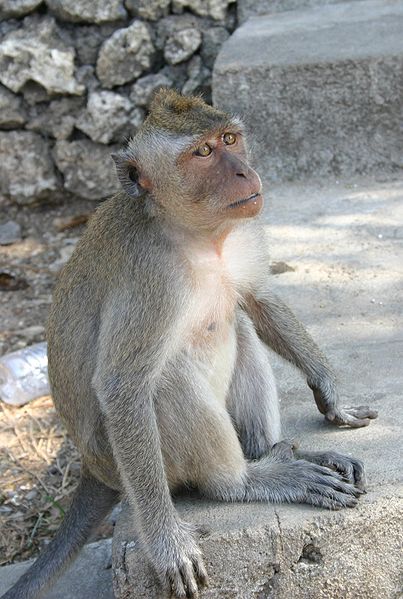
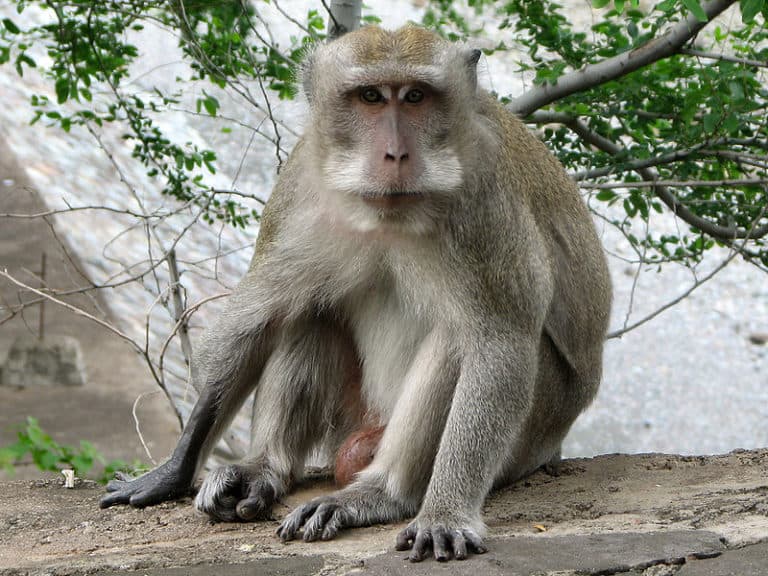
Crab-eating Macaque (Macaca fascicularis)

The crab-eating macaque, a small Old World monkey, typically measures around 15 to 22 inches in size, with slight variations depending on the specific subspecies.

The crab-eating macaque is a small Old World monkey that only measures about 15 to 22 inches on average, depending on the subspecies. The large sinewy tail, which adds another 16 to 26 inches, is typically larger than the body itself. The tail can provide the monkey with a finer degree of balance for jumping immense distances of up to 16 feet.

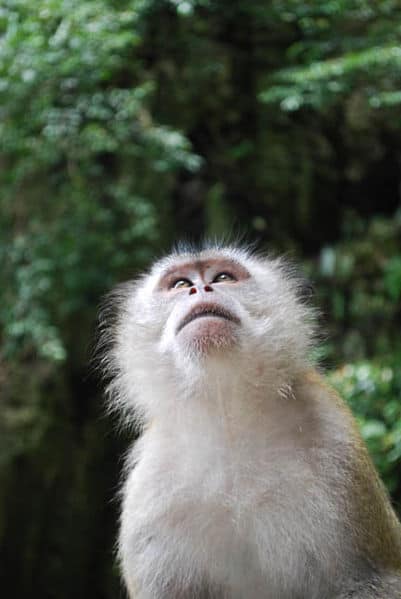
These animals have a coat of dark brown or gray fur with a crown of hair, sometimes golden in color, on their heads. The underside is usually much lighter than the back, and the color of the skin varies from black on the feet and ears to gray or pink around the face and mouth.

Because of a phenomenon known as sexual dimorphism, males and females differ slightly in appearance. Whereas males tend to have big mustaches and bigger canine teeth, females are smaller in size and tend to have beards. The females weigh up to nine pounds each, and males can weigh up to 15 pounds. Both genders grow cheek whiskers and have cheek pouches for temporarily storing food that they forage.

Behavior
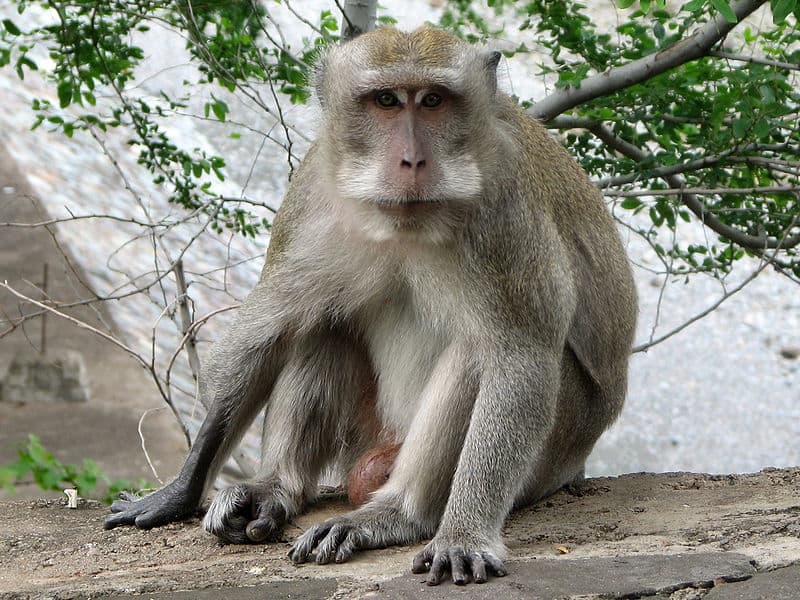
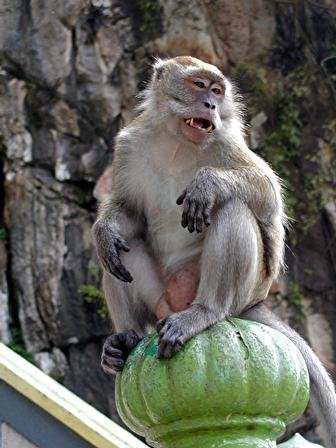
crab-eating macaque (Macaca fascicularis) adult crab-eating macaque
A crab-eating macaque group can range in size from three to 30 members, comprising the primary females, their offspring, and a small number of males.

Crab-eating macaques form matrilineal societies dominated by females. A single group can consist of anywhere between three and 30 members at a time, including the main females, their offspring, and a few males. Despite their lifelong relationships and apparent affection for each other, the female members of the group impose and enforce strict hierarchies at all times.

Males also tend to have a specific hierarchy depending on age, size, and fighting ability. The higher-ranked males usually gain access to the higher-ranked females for mating opportunities. Both sexes may have multiple mating partners throughout their lives.

Since individual macaques are small and weak, the group provides ample protection from outside threats and intruders. That means cooperation is integral to its survival. The species has several types of behavior for maintaining social order and cohesion. For example, grooming appears to be an important aspect of social bonding, courtship, and conflict resolution.

This species spends the majority of its life traversing the trees by moving on all four legs. Only a small fraction of time is actually spent on the ground, where they are more vulnerable to predation. With their lithe bodies and long tails, they are specially adapted for this arboreal lifestyle.

Their daily routine commonly consists of foraging and socializing during the day and then huddling together at night in order to keep warm. Groups tend to occupy only one tree at a time, and there appears to be little competition between groups for territory, at least compared to other species of primates. Nevertheless, the groups will guard their territory fiercely from potential threats.

Like many other primates, the crab-eating macaque appears to be highly intelligent. Some reports suggest that they can use stone tools to open nuts and shells. They may also have the ability to wash or rub their foods before consumption. Since it is often difficult to understand an animal’s intentions, these behaviors are the subject of ongoing research.

Crab-eating macaques exhibit a number of different vocalizations and calls to communicate their intentions. This is often combined with visual signals such as facial expressions and body posture. For example, they often bare their teeth and pull back on their ears and noses to signal aggression and ward off potential threats. They will also make loud noises and bounce on branches in one vigorous motion.

Habitat

The natural range of the crab-eating macaque extends throughout the region of Southeast Asia, including all or most of Thailand, Vietnam, Cambodia, Laos, Myanmar, Malaysia, Indonesia, Borneo, and the Philippines. They have also been introduced by people into several other locations, including Taiwan, Hong Kong, and various Pacific islands.

This species prefers the warm, humid climates of forests, including coastal forests, mangroves, swamps, bamboo forests, deciduous forests, and tropical rainforests with plenty of annual rainfall. They usually live near rivers or other bodies of water for easy access to a constant source of sustenance.

Diet

Crab-eating macaques are omnivorous animals that will take advantage of almost any kind of food they can forage or catch, depending on their seasonal or regional availability. They tend to feed continuously throughout the day in short bouts of only a few minutes at a time.

Despite their name, the crab is not an integral part of their diet. Instead, they primarily survive on a diet of fruits and seeds, which make up between 60 and 90 percent of their consumption. Less commonly they will sometimes feed on leaves, flowers, and grasses. If plant matter is not available, then they will attempt to hunt and consume small birds, lizards, fish, and eggs. Only a few populations actually consume crabs and other crustaceans.

Macaque feeding has become a popular activity for tourists visiting the region of Southeast Asia. However, this can lead to conflict between macaques for easy sources of human food, which potentially leads to injury or even death. They have also been known to raid garbage or steal food from human habitats.

Macaques overall play a positive ecological role in the local environment by inadvertently assisting in the distribution of plant seeds throughout their territory. But because they are known to compete with rare birds for resources and destroy local crops, crab-eating macaques are also sometimes considered to be a major invasive species in the non-native habitats where they are introduced. Some local people may consider them pests and hunt them down to prevent them from causing damage.

Predators and Threats

Crab-eating macaques are vulnerable to predation from larger carnivores. Based on observations, they face the gravest threats from tigers, crocodiles, snakes, and large birds of prey. The species is sometimes hunted or eaten by humans as well.

The biggest threat to their survival, however, is probably the loss of their main habitat in the forests of Southeast Asia, which are frequently cleared for plantations, logging, and human settlements. Climate change could also put further stress on their natural habitat in the future. Habitat preservation is therefore critical to the continued health and survival of the species.

Reproduction, Babies, and Lifespan
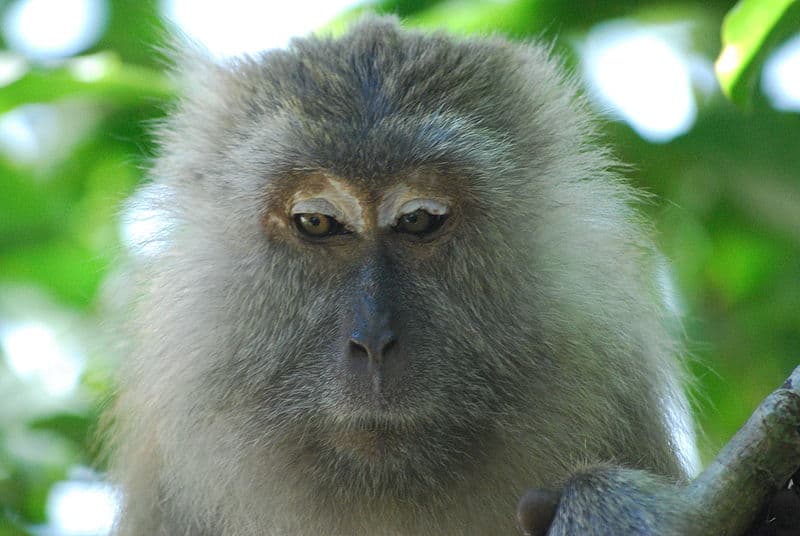
A crab eating Macaque perched on a tree in the Penang National Park, Malaysia

A crab-eating Macaque perched on a tree in the Penang National Park, Malaysia

Crab-eating macaques are capable of breeding at any time of the year, but births usually coincide with the height of the rainy season in the summer. Due to the time and resources required to raise young, the species only tends to mate once every two years. The female has a gestation period lasting six to nine months and gives birth to only a single infant at a time. Rarely do they produce twins.

The young baby macaque is born with black fur, which will begin to turn colors after a few months. They usually achieve full adult coloration by the end of their first year of life. Highly dependent on the solidarity of the group, crab-eating macaques spend most of their juvenile years receiving protection, nourishment, and critical survival and communication skills from the mother.

The young females reach sexual maturity around four years of age. They will usually stay with the group into which they were born and become part of the matrilineal line. Young males take a full six years to reach sexual maturity. They will become progressively more distant from the group until leaving altogether to form bachelor groups or join new groups.

The life span of the crab-eating macaque is not well-known, but it is likely that they can survive around 30 years in captivity. Due to their more precarious existence, males tend to have shorter lives than females. Potential sources of danger include male-on-male aggression as they compete for status or predation and injury from wandering off alone.

Population

The crab-eating macaque has one of the most extensive ranges of any species of primates. The exact number of individuals of this species remains unknown, but as a whole, the species is of least concern to conservationists.

They receive special protection inside of national parks and reserves, but even outside of these protected areas, the species is plentiful and widespread. Many countries in the region have extended legal protection to them.

Even though precise information about them is scarce, each individual subspecies may be facing different levels of pressure. For example, the International Union for the Conservation of Nature (IUCN) Red List, which classifies the conservation status of various wildlife, currently lists the Nicobar crab-eating macaque subspecies as potentially vulnerable.

Due to the scattered geographical range of the subspecies, it is believed that population numbers are decreasing over time.

View all 392 animals that start with C
How to say Crab-Eating Macaque in ...
English
Crab-eating Macaque
Chinese
長尾獼猴
Malay
Kera
German
Javaneraffe
Spanish
Macaca fascicularis
French
Macaque crabier
Hebrew
מקוק סרטנים
Hungarian
Közönséges makákó
Indonesian
Monyet pemakan kepiting
Italian
Macaca fascicularis
Dutch
Java-aap
Polish
Makak jawajski
Swedish
Krabbmakak

Sources

  1. David Burnie, Dorling Kindersley (2011) Animal, The Definitive Visual Guide To The World's Wildlife / Accessed January 18, 2010
  2. Tom Jackson, Lorenz Books (2007) The World Encyclopedia Of Animals / Accessed January 18, 2010
  3. David Burnie, Kingfisher (2011) The Kingfisher Animal Encyclopedia / Accessed January 18, 2010
  4. Richard Mackay, University of California Press (2009) The Atlas Of Endangered Species / Accessed January 18, 2010
  5. David Burnie, Dorling Kindersley (2008) Illustrated Encyclopedia Of Animals / Accessed January 18, 2010
  6. Dorling Kindersley (2006) Dorling Kindersley Encyclopedia Of Animals / Accessed January 18, 2010
  7. David W. Macdonald, Oxford University Press (2010) The Encyclopedia Of Mammals / Accessed January 18, 2010
Rebecca Bales

About the Author

Rebecca Bales

Rebecca is an experienced Professional Freelancer with nearly a decade of expertise in writing SEO Content, Digital Illustrations, and Graphic Design. When not engrossed in her creative endeavors, Rebecca dedicates her time to cycling and filming her nature adventures. When not focused on her passion for creating and crafting optimized materials, she harbors a deep fascination and love for cats, jumping spiders, and pet rats.
Connect:

Thank you for reading! Have some feedback for us?


Crab-Eating Macaque FAQs (Frequently Asked Questions)

Despite the name, crab-eating macaques are actually heavy fruit and seed eaters. To a lesser extent, they are omnivores who also eat leaves, flowers, grasses, and meat.