
D
Species Profile

Dwarf Crocodile

Osteolaemus tetraspis

Small croc, big armor.
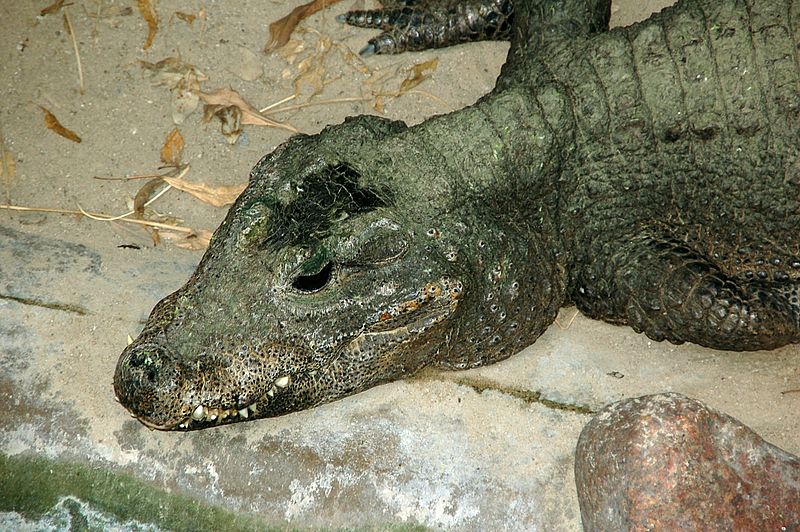
Fritz Geller-Grimm / Creative Commons

Dwarf Crocodile Distribution

Click a location to explore more animals from that region

Loading map...

At a Glance

Wild Species
Also Known As Dwarf crocodile, Dwarf croc, African dwarf croc
Diet Carnivore
Activity Nocturnal+
Lifespan 40 years
Weight 32 lbs
Status Vulnerable
Did You Know?

It's the smallest living crocodile species: adults are typically 1.2-1.5 m long; exceptionally up to ~1.9 m.

Scientific Classification

The African Dwarf Crocodile is the smallest living crocodile species, a secretive, primarily nocturnal crocodilian of West and Central Africa. It is a forest- and swamp-associated predator that takes fish, crustaceans, amphibians, and small vertebrates, and it often uses burrows or dense vegetation for shelter.

Kingdom
Animalia
Phylum
Chordata
Class
Reptilia
Order
Crocodylia
Family
Crocodylidae
Genus
Osteolaemus
Species
Osteolaemus tetraspis

Distinguishing Features

  • Very small adult size for a crocodilian (notably smaller than Nile crocodiles and other Crocodylus species)
  • Broad, relatively short snout compared with many crocodiles
  • Heavily armored body with prominent osteoderms (bony scutes)
  • Dark overall coloration suited to forested/swamp habitats
  • Mostly nocturnal and more secretive than many larger crocodiles

Physical Measurements

Males and females differ in size

Length
1 in (0 in – 1 in)
3 ft 11 in (2 ft 11 in – 4 ft 11 in)
Weight
40 lbs (26 lbs – 71 lbs)
26 lbs (15 lbs – 40 lbs)
Tail Length
2 ft 6 in (1 ft 8 in – 3 ft 1 in)
Top Speed
9 mph
About 14 km/h

Appearance

Primary Colors
Secondary Colors
Skin Type Thick, heavily armored reptilian skin with large keratinized scales and pronounced dorsal osteoderms (notably robust for a crocodilian of its small size), giving a rough, ridged texture along the back and tail.
Distinctive Features
  • Smallest living crocodile species: adults commonly ~1.2-1.5 m total length; large males reported up to ~1.9 m total length (values commonly reported in major species accounts such as IUCN/CSG and regional field literature).
  • Short, broad (blunt) snout relative to larger Crocodylus species; head appears compact and deep, consistent with a diet that includes hard/armored prey.
  • Exceptionally heavy dorsal armor for its size: prominent osteoderms form strong, ridged scutes along neck, back, and tail (a key visual trait when seen out of water).
  • West & Central African forest and swamp-associated crocodilian: most often encountered in slow, shaded streams, swamp forest, and marshy forest edges rather than open savannas.
  • Secretive and primarily nocturnal behavior: typically remains concealed in dense vegetation or in burrows/bank cavities during the day; eyeshine often the first visible cue at night.
  • Diet-linked appearance/functional traits: robust jaws and heavy cranial build consistent with taking fish, crustaceans (e.g., crabs), amphibians, and other small vertebrates; teeth and bite adapted to mixed prey including hard-shelled items.

Sexual Dimorphism

Sexual dimorphism is present but subtle compared with many larger crocodilians; males average larger and more robust, while females tend to be smaller-bodied with proportionally narrower heads.

  • Larger average total length and body mass; large males can approach ~1.9 m total length in reported maxima.
  • Head and neck typically appear broader/more robust; dorsal armor can look more massive simply due to larger body size.
  • Smaller average adult size (commonly within the ~1.2-1.5 m adult range).
  • Proportionally narrower head and overall more slender build compared with similarly aged males.

Did You Know?

It's the smallest living crocodile species: adults are typically 1.2-1.5 m long; exceptionally up to ~1.9 m.

Hatchlings are only ~25-30 cm at hatching, with bold yellow banding and black blotches that help camouflage in leaf-littered water.

Compared with other crocodiles, it has very robust bony armor (osteoderms), giving it a "tank-like" build for moving through dense swamp vegetation.

It's mainly nocturnal and often hides by day in burrows, root tangles, and thick riverside vegetation.

Diet is dominated by aquatic prey-fish, crustaceans (e.g., crabs), amphibians, and other small vertebrates; its relatively blunt snout is well-suited to gripping and crushing.

Typical clutches are about 10-20 eggs laid in a mound nest of rotting vegetation; the female commonly remains nearby to guard the nest.

Longevity is poorly quantified in the wild; captive individuals have been reported living for multiple decades (often cited around 40-50+ years for dwarf crocodiles in managed care).

Unique Adaptations

  • Exceptionally heavy dorsal osteoderms: dense bony scutes provide strong protection in tight, predator-rich forest waterways and during intraspecific encounters.
  • Compact, low-profile body: suited to maneuvering through narrow channels, root mats, and swamp vegetation where larger crocodiles are less agile.
  • Blunt, robust snout and strong jaw musculature: effective for gripping slippery fish and crushing hard prey like crustaceans.
  • Cryptic coloration: dark, earthy tones (and banded juveniles) blend into tannin-stained water, leaf litter, and shadowed banks.
  • Behavioral crypsis: strong tendency to remain hidden by day and to use cover (burrows/vegetation), reducing detection in closed-canopy habitats.

Interesting Behaviors

  • Nocturnal foraging: emerges at dusk to patrol shallow forest streams, swamp pools, and flooded forest edges for fish, crabs, and frogs.
  • Burrow use: frequently shelters in self-dug or opportunistically used burrows and cavities along banks, helping it avoid daytime heat and predators.
  • Sit-and-wait ambush: holds still at the waterline or among submerged roots, striking quickly at passing prey.
  • Seasonal movement with water levels: shifts between streams, swamp depressions, and flooded forest microhabitats as rains expand or shrink available water.
  • Nest building: constructs vegetation mounds that generate heat as they decompose, aiding incubation in shaded forest settings.
  • Nest defense and hatchling assistance (crocodilian-typical): females often remain close during incubation and may help hatchlings reach water after emergence.

Cultural Significance

In West and Central Africa, crocodiles are seen as powerful "water people"—guardians of rivers, swamps, tied to ancestors. In forests with the African dwarf crocodile (Osteolaemus tetraspis), its armored body stands for strength, borders, danger, and sacred waters; it appears in sayings about patience, trickery, and respect for waterways.

Myths & Legends

West African trickster cycles (including Anansi/Spider stories) often feature crocodiles as dangerous but outwitted river-dwellers, using the croc as a symbol of patient ambush and the risks of arrogance near water.

"Crocodile tears" appears as a folkloric motif in multiple traditions (including African and Afro-diasporic storytelling), portraying the crocodile as a figure of deceptive emotion and hidden intent.

In many river-crossing tales told across West Africa, crocodiles test travelers at the boundary between land and water-sometimes as guardians of a ford, sometimes as spirits in animal form-rewarding respect and punishing carelessness.

Many river stories treat the African Dwarf Crocodile (Osteolaemus tetraspis) as a water spirit, a protector of pools, or an omen tied to the community's rules about right and wrong.

In cautionary folktales about fishing and swamp travel, crocodiles are cast as the rightful owners of the water who demand proper conduct-reinforcing taboos about loudness, greed, and disrespect at sacred or dangerous waters.

Conservation Status

VU Vulnerable

Facing a high risk of extinction in the wild.

Population Decreasing

Protected Under

  • CITES Appendix I (international commercial trade generally prohibited; trade allowed only under strict conditions).
  • Occurs in multiple protected areas across West and Central Africa; legal protection and harvest restrictions exist in many range states (implementation/enforcement varies).

Life Cycle

Birth 15 hatchlings
Lifespan 40 years

Lifespan

In the Wild
30–50 years
In Captivity
40–60 years

Reproduction

Mating System Data Deficient
Social Structure Solitary
Breeding Pattern Seasonal
Fertilization Internal Fertilization
Birth Type Internal_fertilization

Direct data on mating for the African dwarf crocodile (Osteolaemus tetraspis) is limited. Likely seasonal, not forming long-term pairs; males may mate with several females and females with several males. Females build nests and guard hatchlings; care is mainly by the mother.

Behavior & Ecology

Social Bask Group: 1
Activity Nocturnal, Crepuscular
Diet Carnivore Freshwater crabs (hard-shelled crustaceans)
Seasonal Hibernates

Temperament

Secretive/cryptic; avoids open basking compared with many Crocodylus, relying on dense vegetation and burrows for concealment (Ross, 1998).
Defensive when cornered or handled; bite response is a primary close-range defense in this small-bodied crocodilian (adult total length commonly ~1.5 m; reported maxima ~1.9 m in major references: Grigg & Kirshner, 2015; Ross, 1998).
Increased aggression/defensiveness in breeding context-especially nest-guarding females, consistent with strong crocodilian maternal defense (Thorbjarnarson, 1992; Grigg & Kirshner, 2015).
Longevity: captive records commonly reach multiple decades; a widely cited maximum is ~50 years in captivity for Osteolaemus tetraspis (compiled longevity sources such as AnAge; consistent with zoo-held crocodilian lifespans).

Communication

Hatchling contact calls 'chirps/peeps') used to coordinate hatching/emergence and to elicit maternal assistance/transport; typical of crocodilians including Osteolaemus (Thorbjarnarson, 1992; Grigg & Kirshner, 2015
Distress calls by juveniles when threatened/handled, which can trigger defensive responses in attending females Thorbjarnarson, 1992
Adult defensive vocalizations such as hissing and low grunts/growls at close range Ross, 1998
Chemical signaling via integumentary/musk gland secretions Crocodilian semiochemical communication broadly documented; applied to Osteolaemus as a crocodylid) (Grigg & Kirshner, 2015
Postural and water-surface displays at short range E.g., elevated posture, head orientation) used in threat assessment/avoidance rather than prolonged combat in this generally solitary species (Ross, 1998
Tactile communication in maternal care: nudging/physical guidance during hatchling gathering and possible transport to water Crocodilian maternal behavior synthesis; Thorbjarnarson, 1992
Vibration/mechanical cues: water disturbance and substrate vibration detection are important in crocodilians; used during close-range interactions and predator detection in low-visibility swamp/forest habitats Grigg & Kirshner, 2015

Habitat

Biomes:
Tropical Rainforest Tropical Dry Forest Freshwater Wetland
Terrain:
Riverine Valley Plains Coastal Muddy Island
Elevation: Up to 3280 ft 10 in

Ecological Role

Forest-wetland mesopredator and opportunistic scavenger in West/Central African freshwater systems.

Regulates populations of aquatic invertebrates (notably crabs) and small vertebrates (fish/amphibians), helping structure wetland food webs Links aquatic and terrestrial nutrient pathways via movement between water margins and forest floor and via consumption/scavenging of vertebrate prey Contributes to carrion removal when scavenging, reducing persistence of carcasses in swamp/stream environments Creates/uses burrows and pathways that can provide microhabitats and refuge for other organisms (ecosystem engineering at small spatial scales)

Diet Details

Main Prey:
Fish Crustaceans Amphibians Aquatic and terrestrial insects and other invertebrates Gastropods Reptiles Small mammals Birds Carrion +3

Human Interaction

Domestication Status

Wild

Osteolaemus tetraspis is wild (not domesticated). Locally people take it for meat and hides, and it is caught in fishing gear or during forest hunting. It is small (usually 1.2–1.5 m, up to 1.9 m), active at night and secretive in swamp/forest burrows, so human encounters are rare but can surprise people. International trade is limited by CITES Appendix I.

Danger Level

Moderate
  • Bites can cause deep puncture/crush injury despite small adult size (~1.2-1.5 m typical; up to ~1.9 m reported); risk increases when animals are handled, cornered, or encountered at night in dense swamp/forest vegetation.
  • Injury risk is highest during capture/handling (wildlife trade, snare/fishing-net bycatch release, relocation) and when people approach burrows or resting sites.
  • Secondary infection risk from bite wounds (mixed oral flora typical of crocodilians); standard wound care and medical evaluation are important.
  • Zoonotic risk from contact with reptile feces/water (e.g., Salmonella), especially in captive settings.
  • Human safety risk is generally lower than for large crocodilians (e.g., Crocodylus niloticus), but not negligible.

As a Pet

Not Suitable as Pet

Care Level: Expert Only

Purchase Cost: $250 - $2,500
Lifetime Cost: $20,000 - $120,000

Economic Value

Uses:
Subsistence food (bushmeat) Leather/skin (limited compared with larger crocodilians) Local trade (live animals, opportunistic) Captive display/zoos and limited legal exotic trade (captive-bred, regulated) Cultural/traditional uses (varies by region)
Products:
  • Meat
  • Hides/skins (leather products)
  • Live specimens for accredited collections (regulated)

Relationships

Related Species 4

Congo dwarf crocodile Osteolaemus osborni Shared Genus
Nile crocodile
Nile crocodile Crocodylus niloticus Shared Family
West African crocodile Crocodylus suchus Shared Family
Slender-snouted crocodile Mecistops cataphractus Shared Family

Ecological Equivalents 4

Animals that fill a similar ecological role in their ecosystem

Cuvier's dwarf caiman Paleosuchus palpebrosus Paleosuchus species closely match Osteolaemus tetraspis: small crocodiles (about 1.2–1.5 m), mostly nocturnal or crepuscular, inhabiting forest and wetland habitats, hiding in dense cover and using bankside shelters, and feeding on fish, aquatic invertebrates, and small vertebrates.
Smooth-fronted caiman Paleosuchus trigonatus A small, forest-dwelling crocodilian that hunts in shaded streams and swamps, uses bank hiding spots, and eats fish, crustaceans, amphibians, and small terrestrial vertebrates. Similar in habitat and diet to O. tetraspis, but not closely related (Alligatoridae vs Crocodylidae).
African softshell turtle Cyclanorbis senegalensis Occurs in West and Central African freshwater swamps and river edges and consumes fish, crustaceans, and other aquatic invertebrates. Both are active in low light and hide in submerged vegetation, creating niche overlap with Osteolaemus tetraspis.
Nile monitor
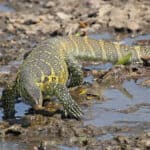
Nile monitor Varanus niloticus Co-occurs along riparian and wetland edges in parts of its range with the African dwarf crocodile (Osteolaemus tetraspis), consuming similar aquatic prey. Nile monitors also eat crocodile eggs and hatchlings, reducing recruitment of small crocodilians.

Classification and Evolution

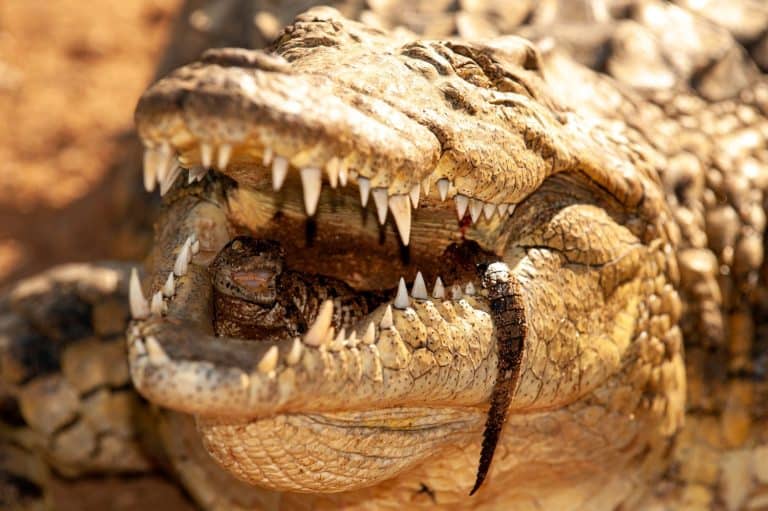
The Dwarf Crocodile is a small species of crocodile natively found in the rainforests of West Africa. The Dwarf Crocodile is the smallest species of crocodile in the world and is also one of the most distinctive with a short, broad snout and tough scales that cover their entire black body (most crocodiles do not have such armored scales on their underside). These characteristics have led to the Dwarf Crocodile being known by a number of different names including the Broad-Snouted Crocodile, the Bony Crocodile and the Black Crocodile.

Although Dwarf Crocodiles are commonly found in parts of their natural range, their numbers in others have declined mainly due to habitat loss and hunting.
Anatomy and Appearance

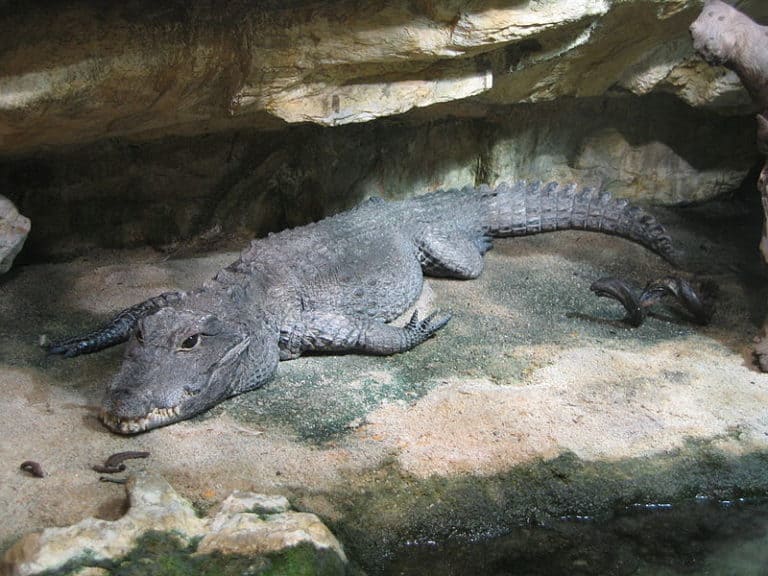
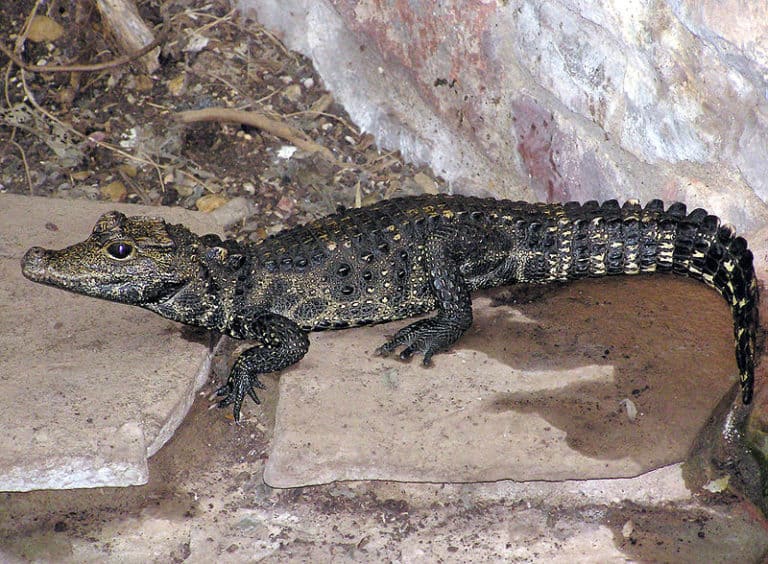
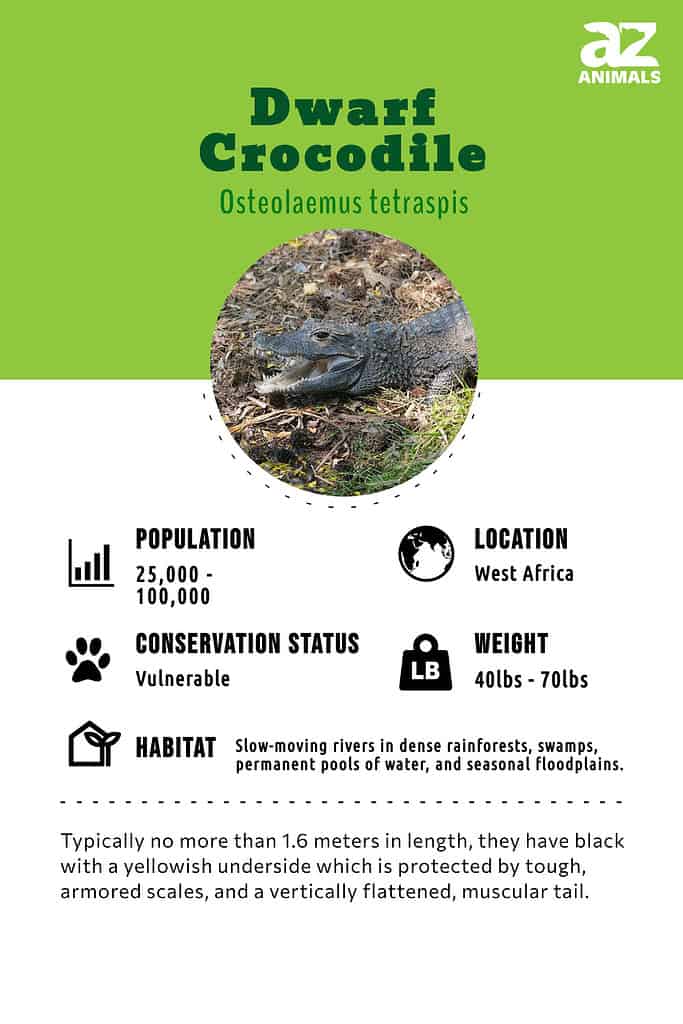
The Dwarf Crocodile rarely grows to more than 1.6 meters in length with the largest known individuals reaching a maximum length of 1.9 meters. The body of the Dwarf Crocodile is black with a yellowish underside and is protected by tough, armored scales, which are bony plates that not just protect it from injury but also prevent the animal from getting burnt by the hot sun.

The Dwarf Crocodile has a number of adaptations that aid it when in the water including their vertically flattened, muscular tail that is used to propel their bodies when swimming and webbing between their toes which helps them to negotiate the slippery banks. Their eyes and nostrils are located on the top of their heads to enable the Dwarf Crocodile to both see and breathe whilst the rest of its body is submerged, allowing it to both watch for prey and predators almost completely hidden.
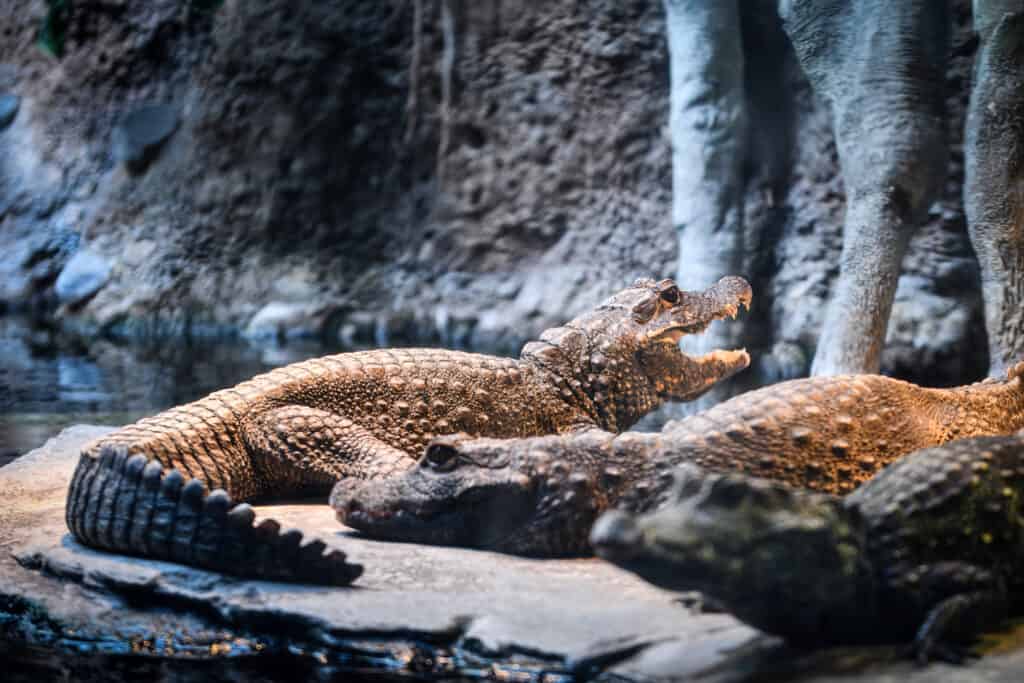
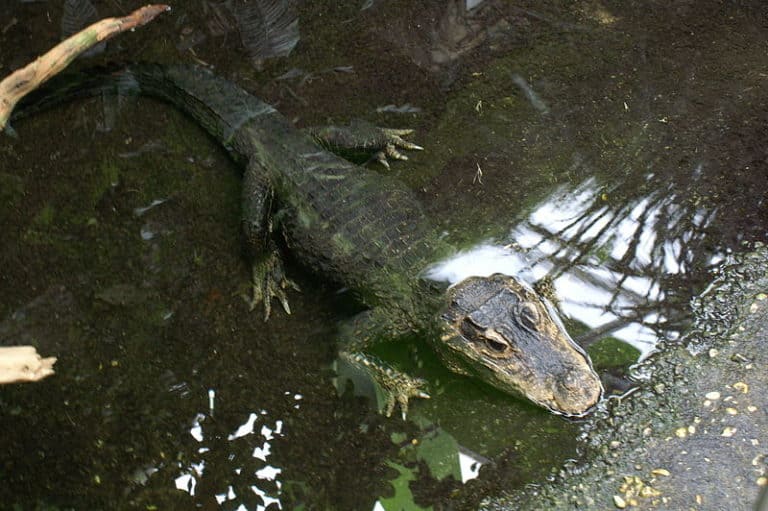
African Dwarf Crocodile

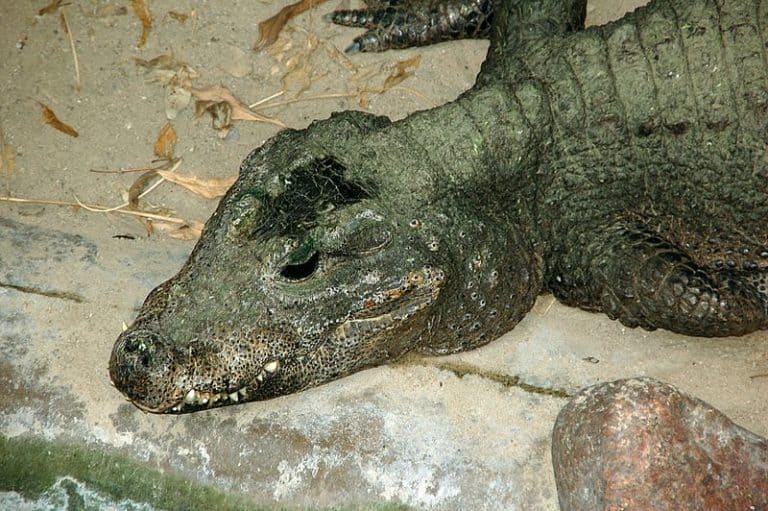
Dwarf Crocodiles rarely grows to more than 1.6 meters in length.

Types of Dwarf Crocodiles

There are two recognized species of Dwarf Crocodile which are the West African Dwarf Crocodile and the Congo Dwarf Crocodile which differ slightly in not just their location, but also in their appearance and behavior.

  • West African Dwarf CrocodileOsteolaemus tetraspis – These reptiles grow to be just under 6 feet long and are the smallest croc in the world.
  • Congo Dwarf CrocodileOsteolaemus osborni – Also known as “Osborn’s dwarf crocodile”, this subspecies is named after an American paleontologist Henry Fairfield Osborn.

Distribution and Habitat

The Dwarf Crocodile is found throughout a number of different countries in West Africa including Angola, Cameroon, Congo, Gambia, Ghana, Guinea, Liberia, Nigeria, Senegal, and Sierra Leone although the populations vary drastically in number between the regions. Dwarf Crocodiles tend to be found in slow-moving rivers in areas of dense rainforest along with swamps, permanent pools of water and seasonal floodplains.

Despite being specially adapted to life in the water, Dwarf Crocodiles also spend a lot of time on land where they dig burrows in the river bank to rest during the day. However, they are severely threatened by the loss of their habitats throughout much of their natural range primarily in the form of deforestation for logging, clearing land for agriculture, and making way for growing human settlements.
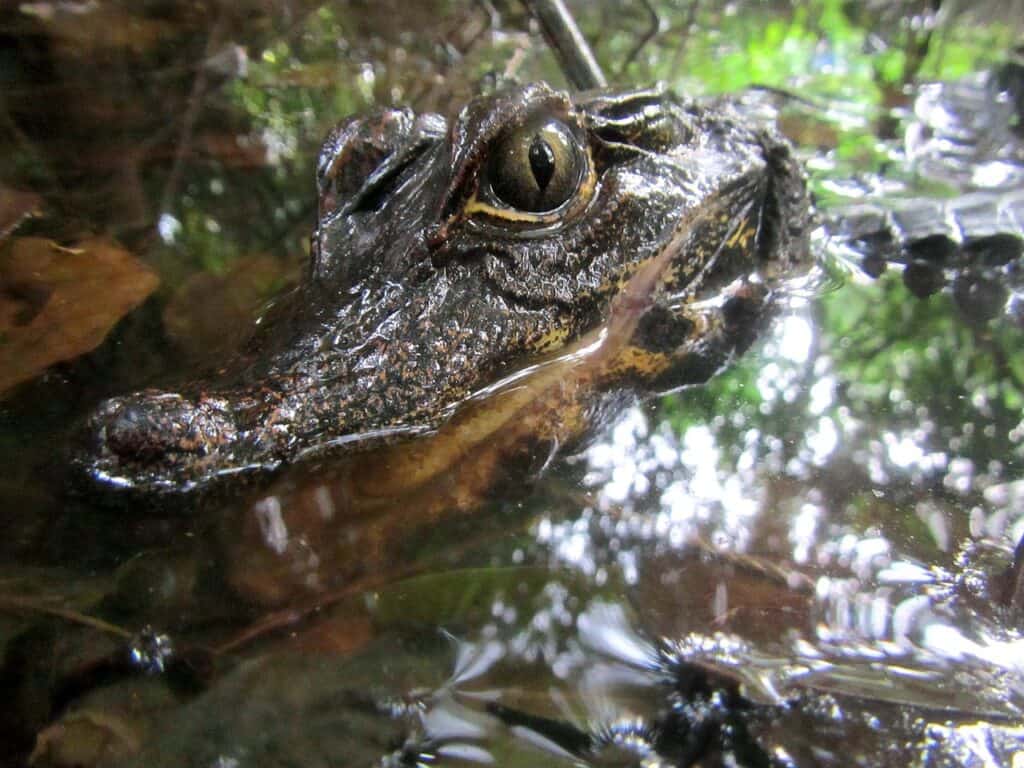
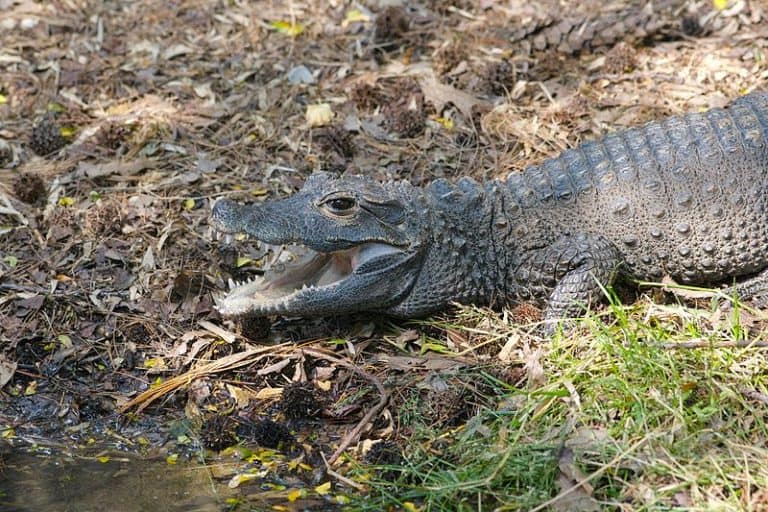
Osteolaemus osborni

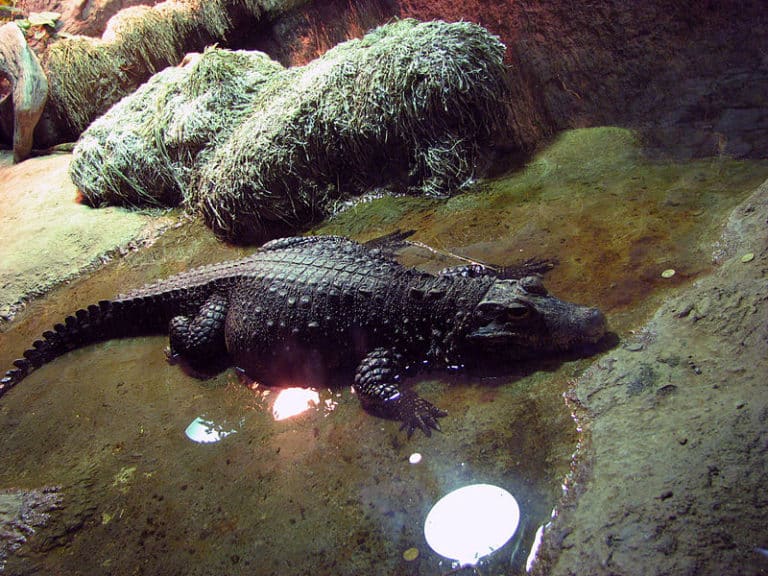
Dwarf Crocodiles tend to be in slow-moving rivers in dense rainforests, swamps, permanent pools of water, and seasonal floodplains.

Behavior and Lifestyle

Using the dark of night, Dwarf Crocodiles are nocturnal and hunt both in the water and on the banks in the dark looking for prey and usually solitary. During the day they rest in burrows which are dug into the ground of the river bank. These are accessed through small entrances and tunnels which can be several meters long. If they cannot find a good place, Dwarf Crocodile will hide amongst submerged tree roots that hang into the water.

The Dwarf Crocodile is a cold-blooded animal meaning that it has to sunbathe to warm its body up, give it the energy to hunt, and enter the water to cool it down. When in the water, Dwarf Crocodiles sink their bodies down below the surface so that only their eyes and nostrils are exposed so they are able to hide from potential predators and ambush unsuspecting prey.
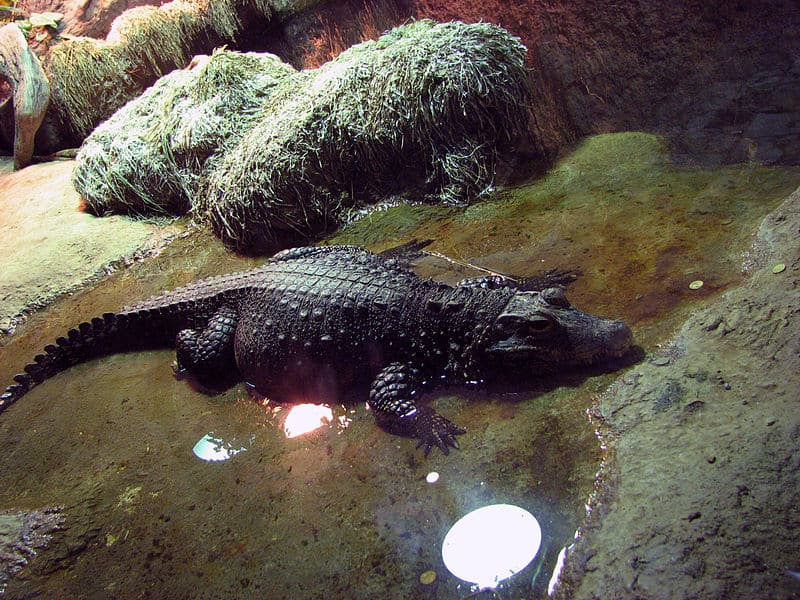
The Dwarf Crocodile has to sunbathe to warm its body up, give it the energy to hunt, and enter the water to cool it down.

Reproduction and Life Cycles

Dwarf Crocodiles tend to breed at the beginning of the wet season (May – June) when a male will mate with several females that share his territory. The female then builds a nest by dragging rotting vegetation together to create a mound where she lays up to 20 white, leathery eggs. As the vegetation decomposes it releases heat which helps to keep the eggs warm whilst incubating.

Female Dwarf Crocodiles will fiercely guard their eggs from predators until they hatch three months later, when the young call to her and she digs the them out of the mound to help them escape (they are even known to gently roll eggs that haven’t yet hatched around in their mouths to crack the shell). The mother then gently picks her young up in her mouth and carries them down to the water ensuring that they get there safely. Although Dwarf Crocodiles are usually independent of their mother very quickly, some are known to stay close to her for at least a few weeks for safety.
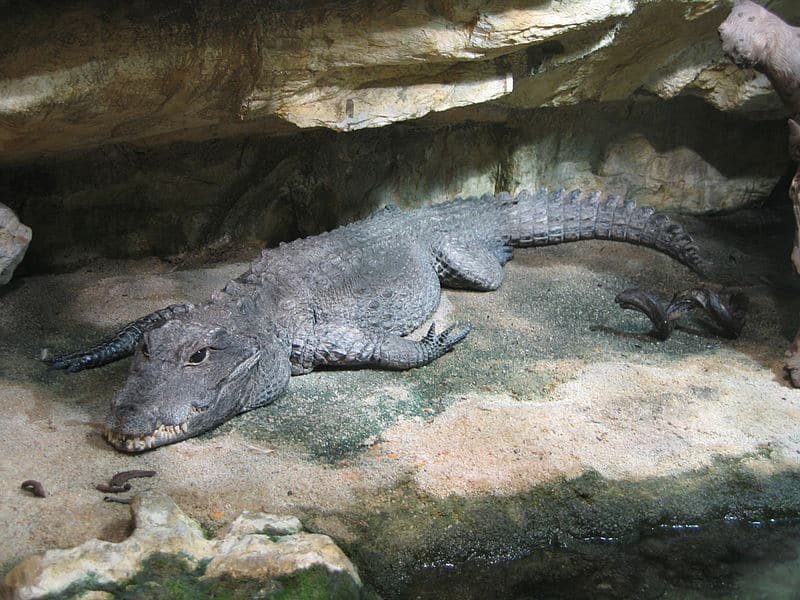
Female Dwarf Crocodiles will fiercely guard their eggs against predators until they hatch.

Diet and Prey

It may come as no surprise, but these diminutive crocs are carnivorous animals, and they usually look for fish, birds, crustaceans, frogs, and toads to make up the bulk of their diet along with the occasional small mammal. Dwarf Crocodiles snap their strong jaws shut to catch their prey, secured by a powerful bite from their cone-shaped, razor-sharp teeth.

Unlike a number of other animal species, Dwarf Crocodiles continuously regrow and replace their old teeth which are pushed out by the new ones that develop below. They are however, unable to chew food and so must rely on tearing their prey into pieces that can then be swallowed whole. In areas where seasonal flooding occurs they are known to change their diet depending on the rains, eating more fish that are readily available with the floods and feeding more on crustaceans during the dry season.
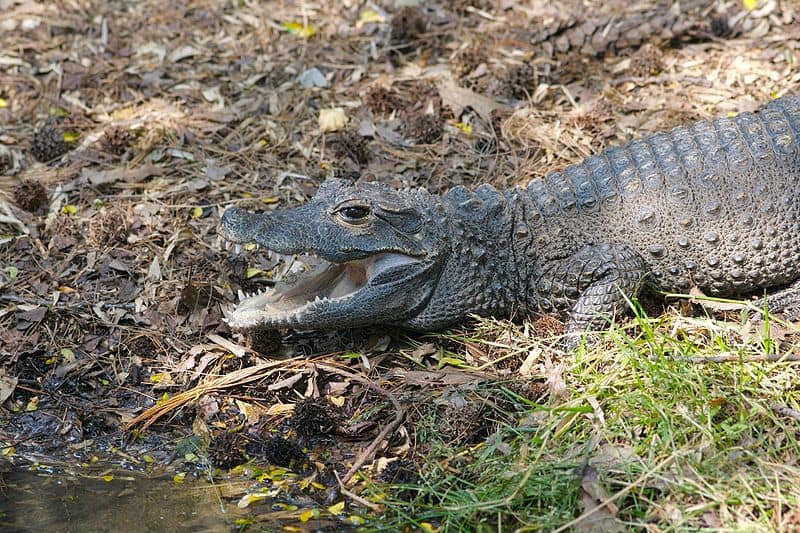
Dwarf Crocodiles continuously regrow and replace their old teeth which are pushed out by the new ones that develop below.

Predators and Threats

Despite being a powerful predator itself, the small size of the Dwarf Crocodile means that it is an easier target than its much larger relatives, with other crocodiles being the biggest threat to adults. The young and eggs, however, are preyed upon by a number of different animals including birds, mammals, and other reptiles despite the fierce guarding of them by their mother.

The biggest threat though to Dwarf Crocodiles throughout much of their natural range today is people, primarily in the form of habitat destruction for timber and use of the land for agriculture including creating large plantations of oil palms. Dwarf Crocodiles are also hunted by local people in certain areas for food, with their tough skins then being used in the making of certain local products.

History and Evolution

Like other members of the crocodile family, the Dwarf Crocodile is an ancient species that is thought to have changed very little in the last 65 million years. Their semi-aquatic nature means that they have a number of distinctive features that help them to live and feed in the water including a transparent third eyelid that can be closed to protect their eyes when under the water. They have flaps of skin that can be closed to cover the windpipe and ensure that water doesn’t enter their lungs (which means that water doesn’t go into their windpipe when they open their mouth to catch prey), along with similar flaps that cover their nostrils and ears. People once thought that Dwarf Crocodiles were cannibals because the mother carries the young in a throat pouch in her mouth, to get them to the water safely.
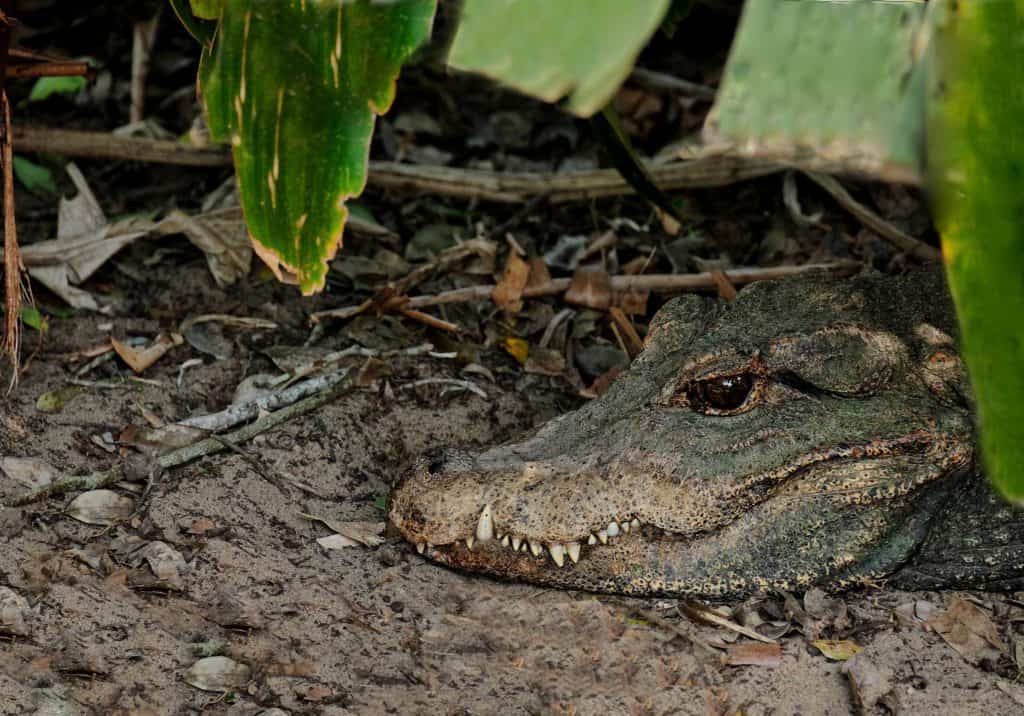
The Dwarf Crocodile is an ancient species that is thought to have changed very little in the last 65 million years.

Relationship with Humans

Unlike a number of their larger relatives, the tough, armored skin of the Dwarf Crocodile has meant that they are not hunted so frequently as other crocodile species, but they are often hunted for their meat by local people in certain areas. Dwarf Crocodiles are also affected heavily by growing levels of human activity throughout much of their natural range as they lose their habitats to forest clearance for the timber industry and to make way for agricultural plantations like palm oil. Along with the growing size of local settlements, the clearance of rainforest to produce grazing for livestock has also meant the loss of large chunks of their once vast natural range and can cause conflict between these reptiles and farmers that fear for their animals.
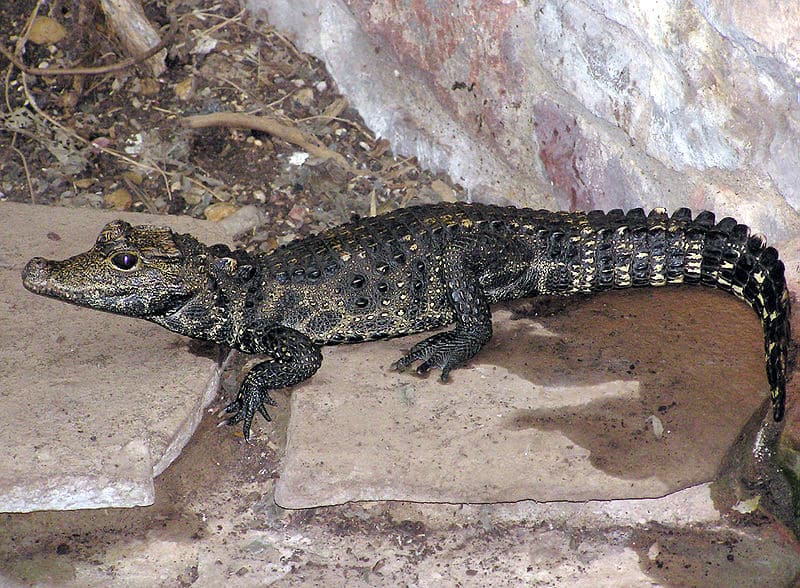
Dwarf Crocodiles are affected by human activity throughout much of their natural range as they lose their habitats to forest clearance.

Conservation Status and Life Today

Today, the Dwarf Crocodile is listed by the IUCN as being an animal that is Vulnerable in its natural environment with an estimated 25,000 – 100,000 individuals thought to be left in the wild. However, population data is often hard to collect and although they are heavily exploited in certain areas, the Dwarf Crocodile still has quite a wide distribution throughout a number of countries in West Africa. The Dwarf Crocodile is still known to be locally abundant in some areas including parts of Cameroon, however, there have been severe population declines in others primarily due to the drastic loss of vast regions of their natural habitats.

View all 451 animals that start with D
How to say Dwarf Crocodile in ...
Czech
Krokodýl čelnatý
German
Stumpfkrokodil
English
Dwarf crocodile
Spanish
Osteolaemus tetraspis
Finnish
Kääpiökrokotiili
French
Crocodile nain
Hebrew
תנין גמדי
Italian
Osteolaemus tetraspis
Japanese
ニシアフリカコビトワニ
Dutch
Breedvoorhoofdkrokodil
Polish
Krokodyl krótkopyski
Portuguese
Crocodilo-anão
Swedish
Dvärgkrokodil
Turkish
Cüce timsah
Chinese
侏儒鱷

Sources

  1. David Burnie, Dorling Kindersley (2011) Animal, The Definitive Visual Guide To The World's Wildlife / Accessed February 20, 2012
  2. Tom Jackson, Lorenz Books (2007) The World Encyclopedia Of Animals / Accessed February 20, 2012
  3. David Burnie, Kingfisher (2011) The Kingfisher Animal Encyclopedia / Accessed February 20, 2012
  4. Richard Mackay, University of California Press (2009) The Atlas Of Endangered Species / Accessed February 20, 2012
  5. David Burnie, Dorling Kindersley (2008) Illustrated Encyclopedia Of Animals / Accessed February 20, 2012
  6. Dorling Kindersley (2006) Dorling Kindersley Encyclopedia Of Animals / Accessed February 20, 2012
  7. About Dwarf Crocodiles / Accessed February 20, 2012
  8. Dwarf Crocodile Information / Accessed February 20, 2012
  9. Dwarf Crocodile Conservation / Accessed February 20, 2012
Heather Ross

About the Author

Heather Ross

Heather Ross is a secondary English teacher and mother of 2 humans, 2 tuxedo cats, and a golden doodle. In between taking the kids to soccer practice and grading papers, she enjoys reading and writing about all the animals!

Thank you for reading! Have some feedback for us?


Dwarf Crocodile FAQs (Frequently Asked Questions)

Dwarf Crocodiles are Carnivores, meaning they eat other animals.