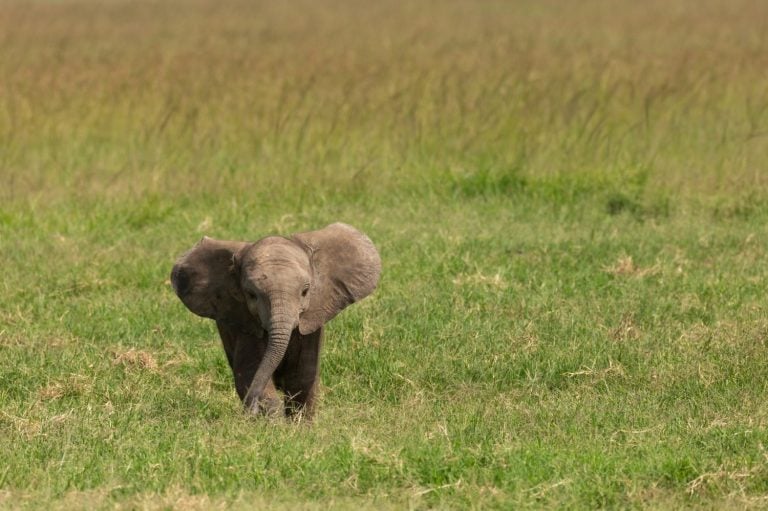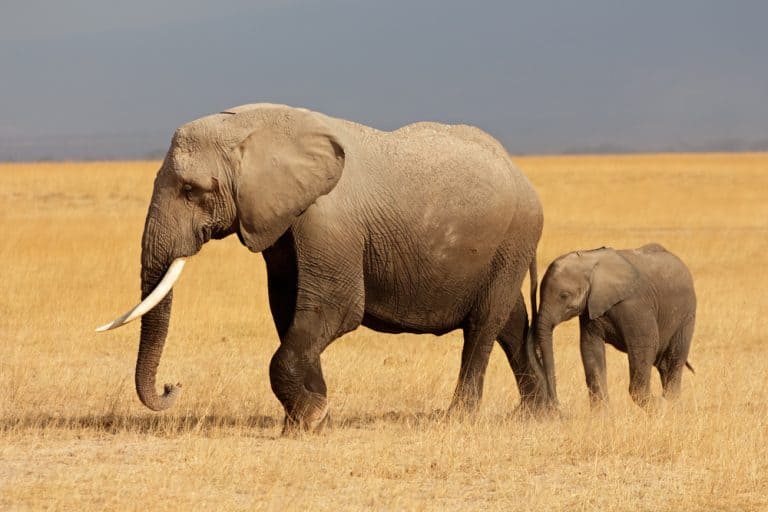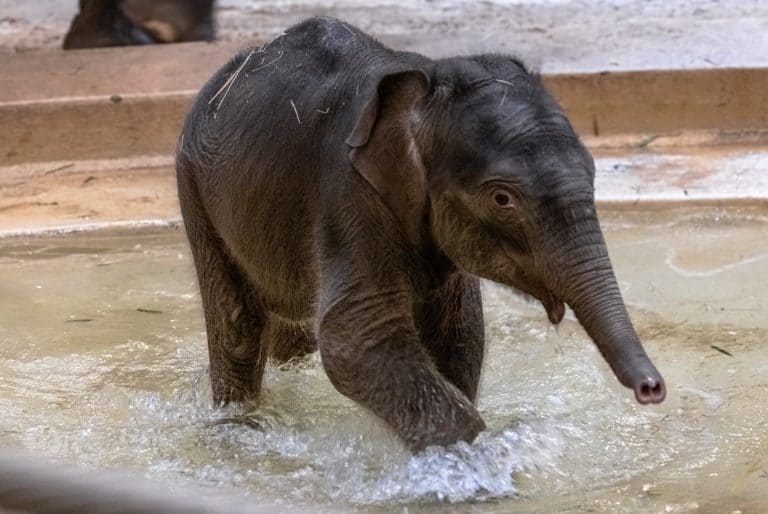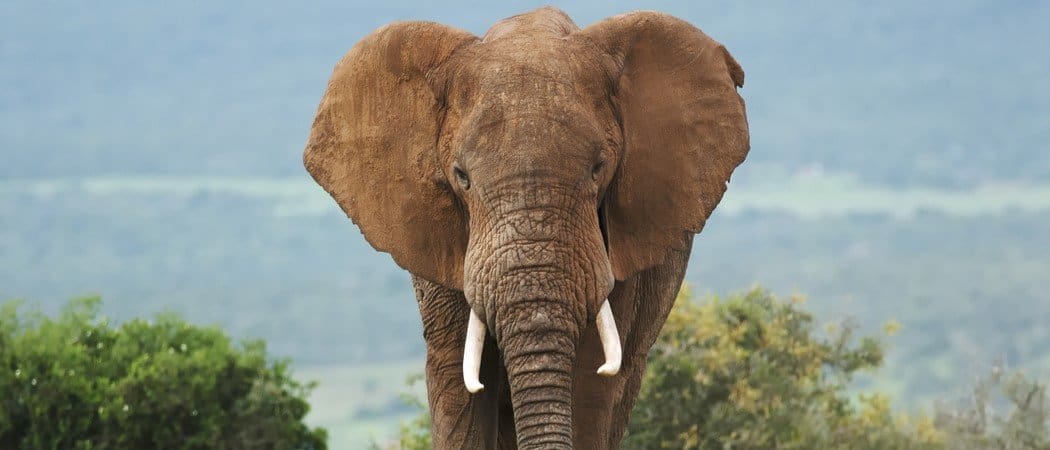
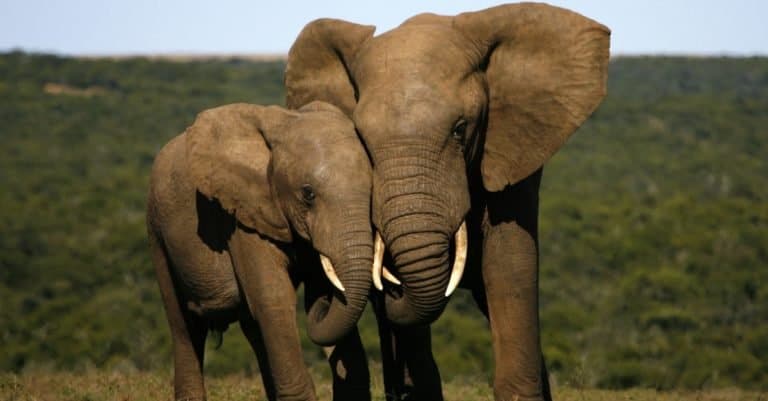
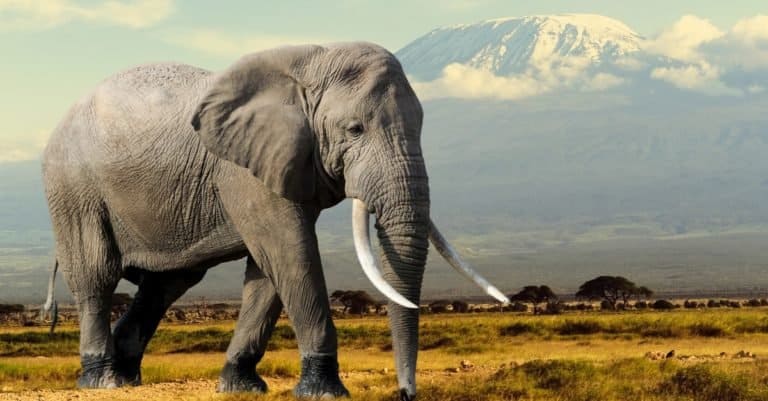








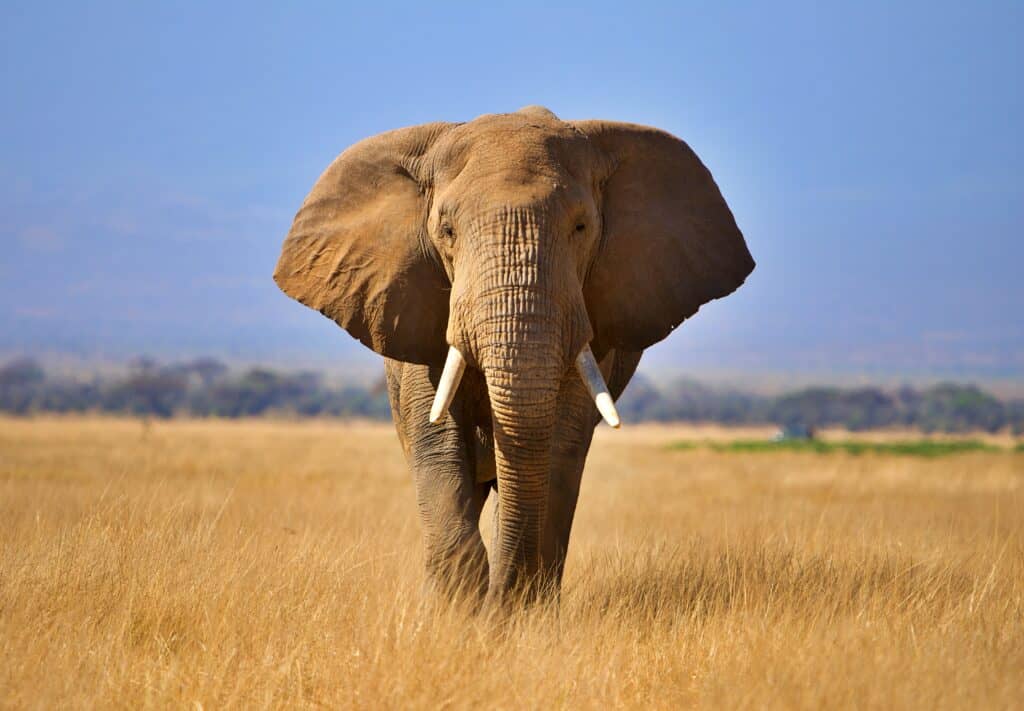
The elephant is the largest land animal in the world.
These massive giants exhibit all kinds of complex behavior that in some ways mirror our own behavior but in other ways are distinct and unique to them. This has made them the subject of rigorous behavioral, anatomical, and cognitive studies, as well as a source of continued fascination in human culture, particularly in Indian, Sumatran, and some African mythologies and tales. But after decades of decline from poaching and habitat loss, the elephant is in a perilous state, and unless more is done to protect them, they may be on a path toward extinction.
5 Incredible Elephant Facts!
- The elephant is one of the smartest animals on the planet. It is one of the few species that exhibit actual self-awareness and self-recognition. It appears to use tools, for example, as a fly swatter. And it has an excellent ability to learn and remember details. Scientists still debate whether elephants mourn their dead, but these creatures do appear to be capable of experiencing profound emotion.
- The elephant makes a low, rumbling sound that can be heard up to 5 miles away.
- The word pachyderm, which derives from the Greek term pachydermos, meaning “thick skinned,” refers to any mammal with a particularly tough hide, including the rhino, elephant, and hippo. None of these animals are closely related to each other, though.
- An elephant can carry up to 7 tons, making it one of the world’s strongest animals. Learn about the strongest animals in the world here.
- At one point, scientists believe there were 26 million elephants in Africa alone. Today the world population of elephants is estimated at less than half a million.
Make sure to give our ’10 Incredible Elephant Facts’ page a read if you’re looking for more facts on these amazing animals!
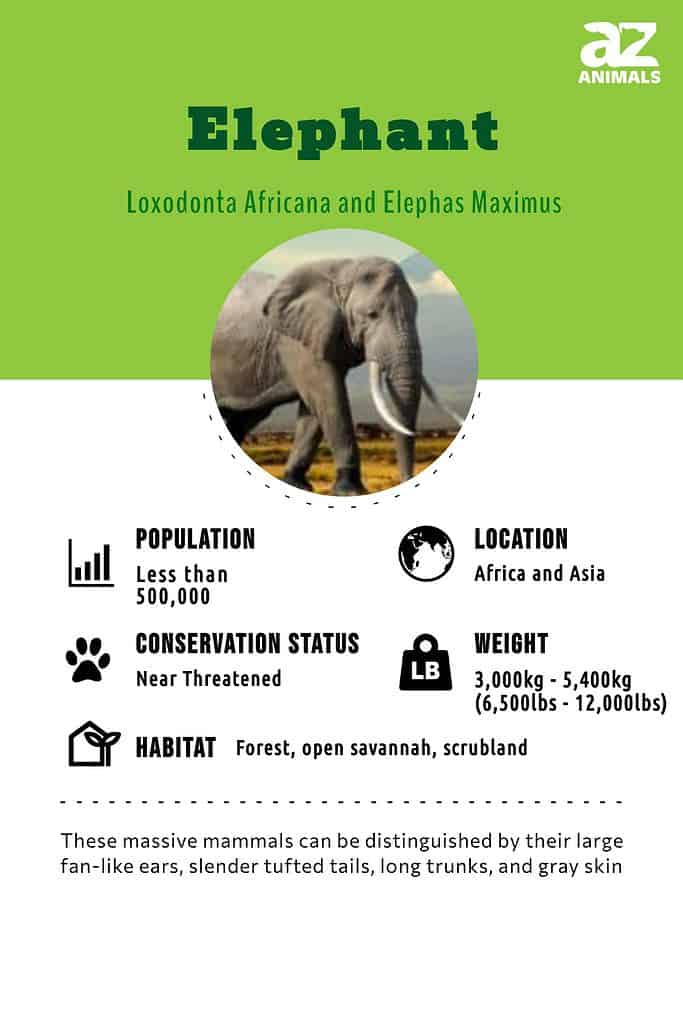
Scientific Name
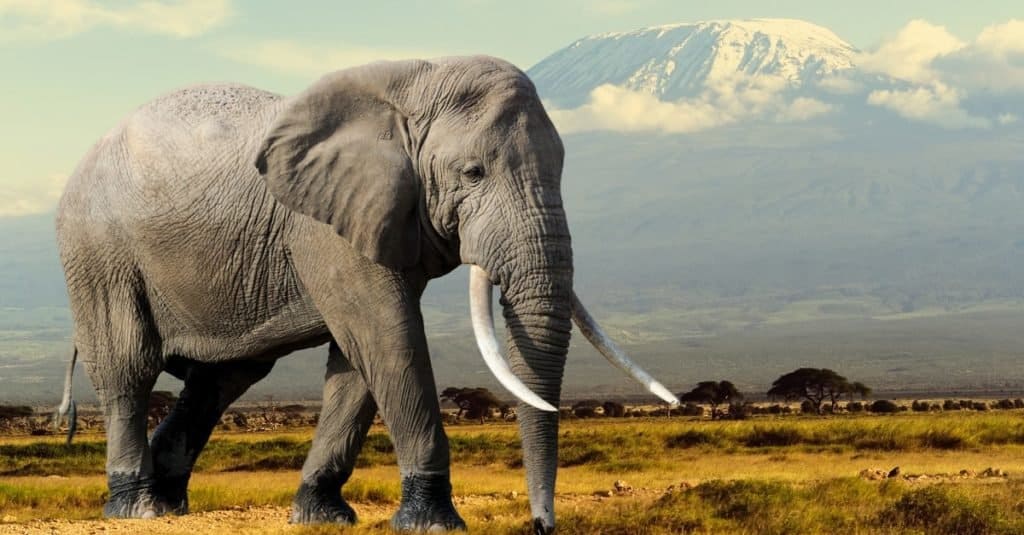
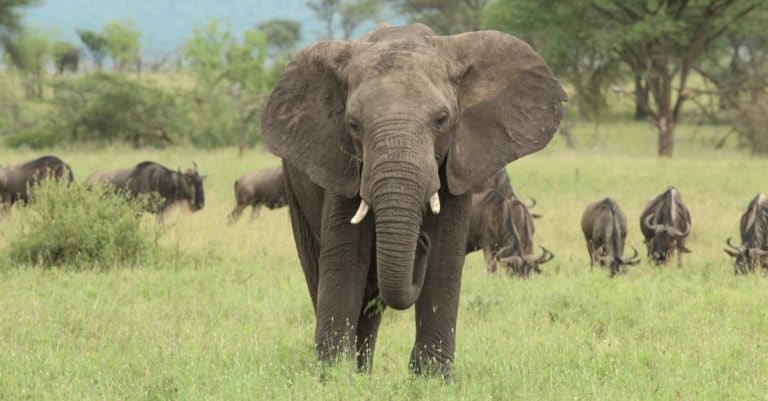
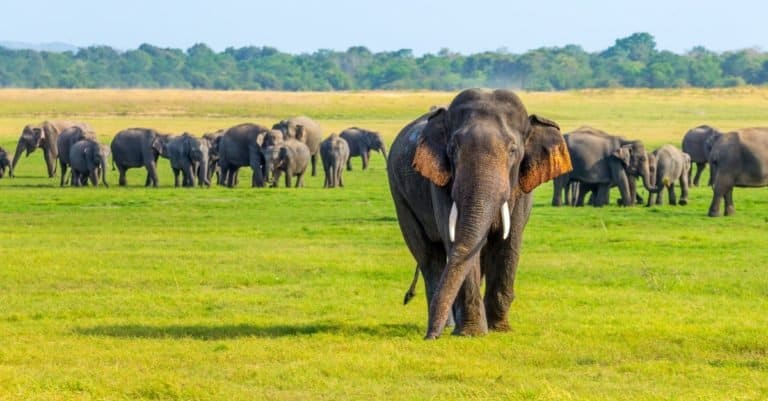
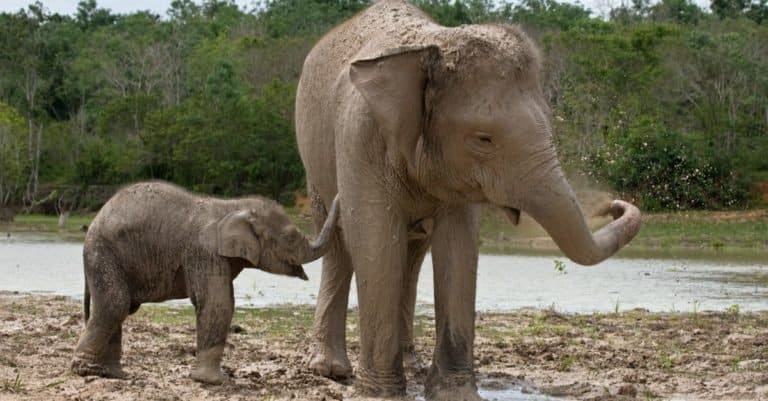
There are two main species of elephant: the African and the Asian
©Volodymyr Burdiak/Shutterstock.com
The scientific name for the family of elephants is Elephantidae. There are two living genera in this family. The genus of Loxodonta contains two species: the African bush elephant and the African forest elephant. The genus of Elephas contains only a single living species: the Asian elephant, which itself can be divided further into several distinct subspecies, including the Indian, Sumatran, Borneo, and Sri Lankan elephants. The fossil record contains many more species, including the woolly mammoth, which once walked the planet in the last ice age.
Types
- African Forest Elephant (Loxodanta cyclotis): Slightly smaller than its savannah-dwelling cousin, this massive herbivore also has rounder ears, straighter tusks, and more toenails, too. It roams through the forests of southern and central Africa.
- African Bush Elephant (Loxodanta africana africana): Capable of weighing 12,000lbs, these giant mammals roam the savannahs of western, central, eastern, and southern Africa.
- Borneo elephants (Elephas maximus borneensis): The smallest of all Asian elephants, this mammal evolved separately from all its relatives on Borneo and is known for having tusks which are straighter than usual and a longer tail on average.
- Indian elephants (Elephas maximus indicus): These elephants’ stomachs are proportionate to their body size and their females may occasionally have small tusks. They are also darker than Sumatran elephants but lighter than their Sri Lankan relatives.
- Sri Lankan elephants (Elephas maximus maximus): The largest of the three subspecies, these giants are also the darkest too. Like Indian elephants, they have 19 pairs of ribs.
- Sumatran elephants (Elephas maximus sumatranus): The lightest of Asian elephants, these herbivores have 20 pairs of ribs. They also have the least amount of discoloration out of all three subspecies.
Appearance
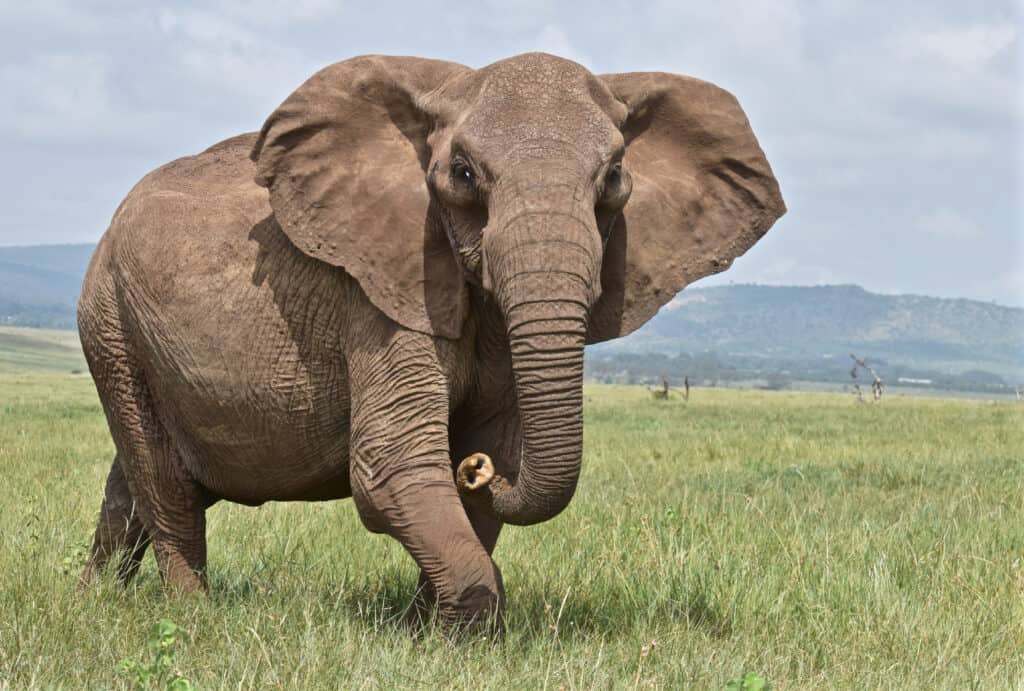
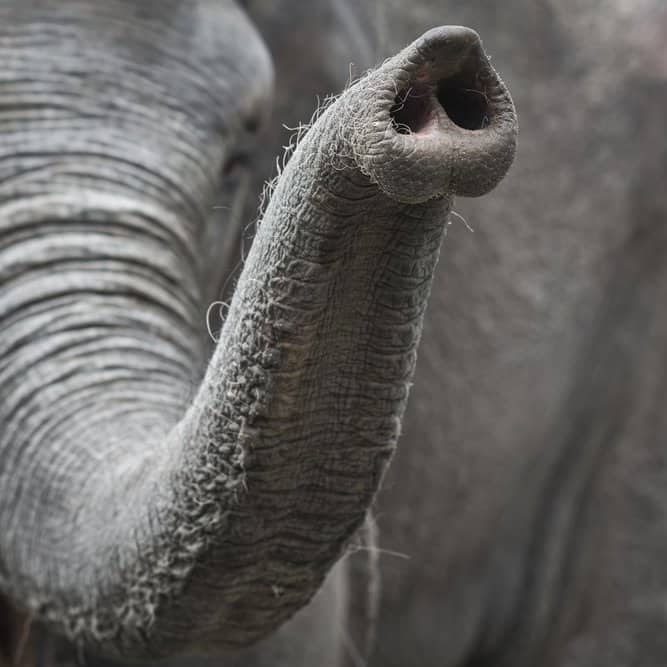
An elephant’s trunk is surprisingly nimble and strong and can contain up to 150,000 muscle fibers
©AndyElliott/Shutterstock.com
Elephants resemble no other animal on the planet. They are distinguished by the huge bodies, stout legs, thin tails, rounded ears, strong trunks, and in some elephants, the ivory tusks. These long tusks, which grow throughout the elephant’s life, are really just incisor teeth; they allow the elephant to dig for food and water, defend itself, and lift heavy objects with ease. Four molars, each one about the size of a brick, also line the mouth. Another important aspect of the elephant’s anatomy is the thick, wrinkled skin, which can retain about 10 times the amount of water as smooth skin.
Their eats are also a unique adaptation and give elephants some of the best hearing among all animals on Earth. On average, elephants can hear the calls from another elephant as far as 2.5 miles away!
The elephant is defined most of all by its size. These impressive creatures stand about 10 feet tall, reach about 18 to 24 feet long, and weigh between 4 and 8 tons. The largest specimen ever recorded stood 13 feet tall and weighed a massive 12 tons. Much of the skeletal structure is taken up by the huge skull, which supports the large ears, tusks, and trunk. The skull contains big cavities that reduce the weight without diminishing the strength. Apart from several other physical differences, Asian elephants differ from African elephants in their smaller size and the reduced chance of growing tusks. The Borneo elephant is the smallest subspecies of all; it’s sometimes called the pygmy elephant for this exact reason. Meanwhile, the Sri Lankan elephants appear to be the least likely of all species/subspecies to grow tusks from their skull.
Trunk
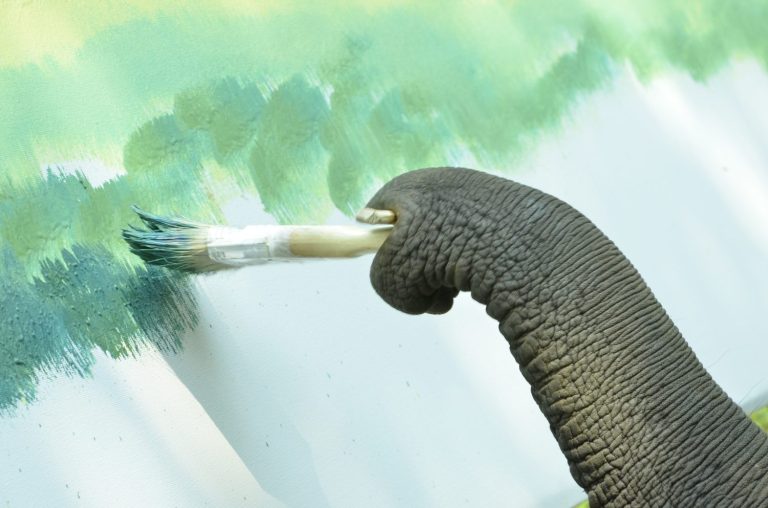
The elephant trunk, which actually derives from a fusion of the nose and upper lip, is an impressive instrument that has many useful functions related to touch, smell, and communication. The trunk contains finger-like projections on the tip (the Asian elephant has one and the African elephant two), which enable it to grasp objects as small as a piece of straw. The trunk contains around 150,000 separate muscle fibers with no bones or cartilage and very little fat. This enables it to perform very fine movements that somewhat belies the elephant’s rather hulking appearance.
Ears
The large, rounded ears appear to be a very effective organ for keeping the elephant cool. The size of the ears is a function of the number of blood vessels they contain. This allows an enormous amount of warm blood to flow through the capillaries and release excess body heat into the environment. This effect can be amplified when the elephant flaps its ears.
Evolution
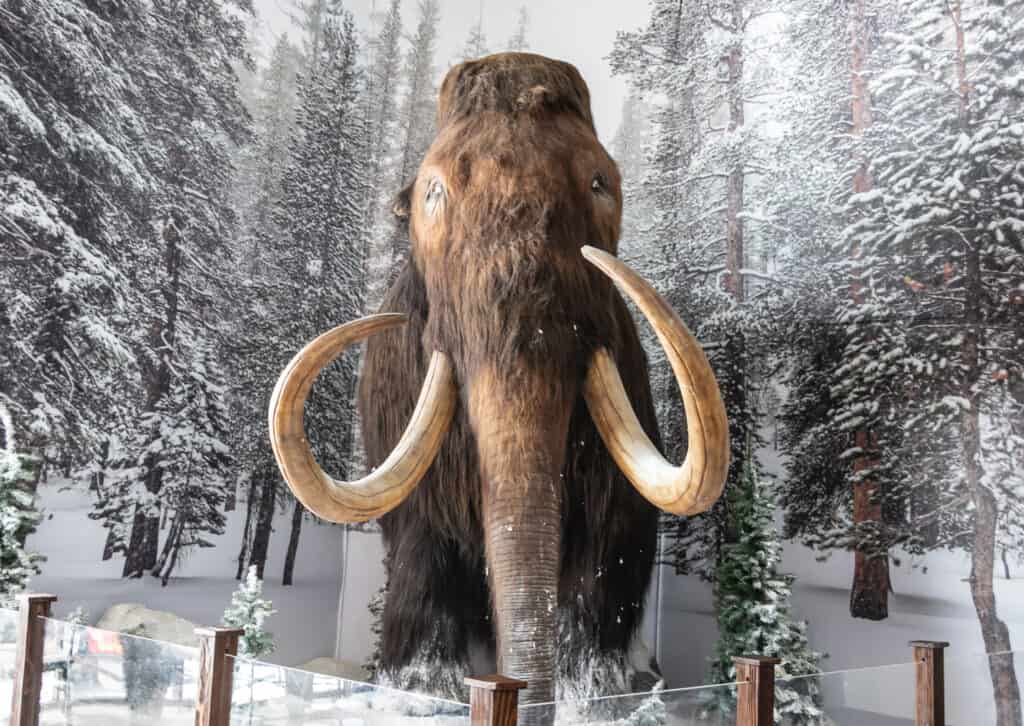
The woolly mammoth actually has a living relative today: the Asian elephant
©PradaBrown/Shutterstock.com
Before there were elephants, there were Gomphotheres, tusked, long-jawed herbivores which munched on vegetation in what is now Africa, Eurasia, and the Americas, during the Miocene, Pliocene, and Pleistocene.
By the early Pleistocene they were extinct. But they had already given rise to the elephantids. As the Miocene was morphing into the Pliocene about 5 million years ago, the Loxodonta came into being. It would be followed by the Elephas and Mammuthus shortly afterwards.
Of these three lineages, the Loxodonta remained in Africa, while the Mammuthus expanded to Eurasia.The Elephas not only spread to Eurasia, but even went as far as North America.
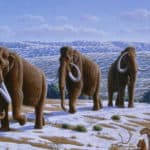
During the Pleistocene, the Elephas also gave rise to the Elephas platycephus, the ancestor of the Asian elephant, while the Mammuthus gave rise to the Mammuthus primigenius, more commonly known as the woolly mammoth. Fun fact: The Asian elephant is actually the closest living relative of this hairy pachyderm which became extinct 4,000 years ago.
The passage of time saw these creatures develop into the much loved lumbering mammals we know today. As their diets changed, their teeth also changed in size while their upper second incisors morphed into tusks.
Their necks became shorter to provide greater support to their enlarged heads. Which meant their trunks had to lengthen to make up for their necks.
And the result? The largest land mammals in Africa and Asia.
Behavior
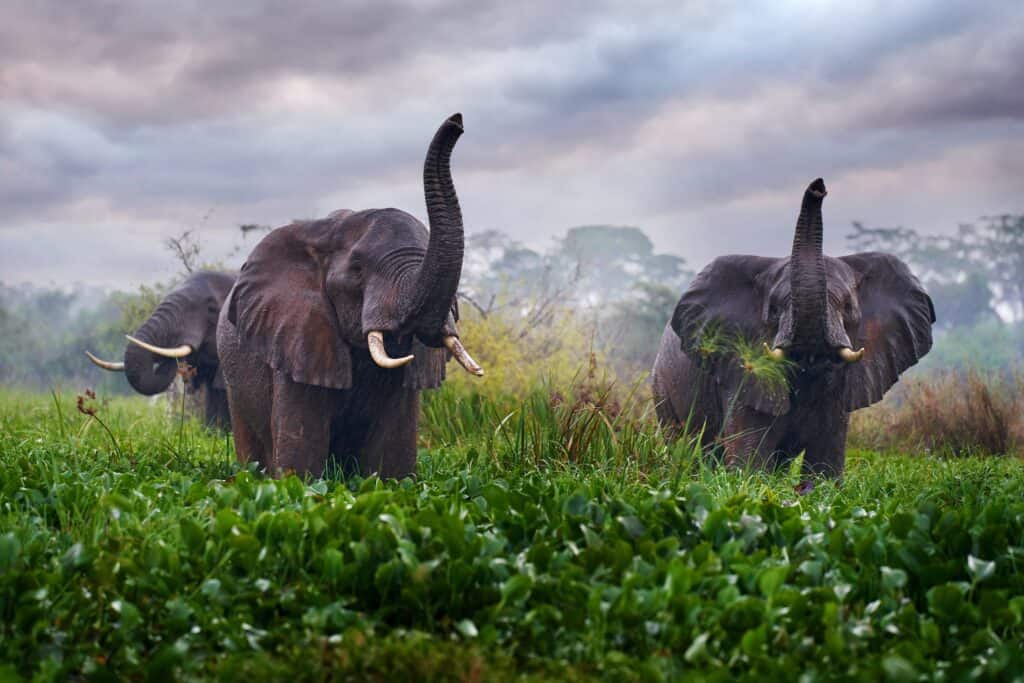
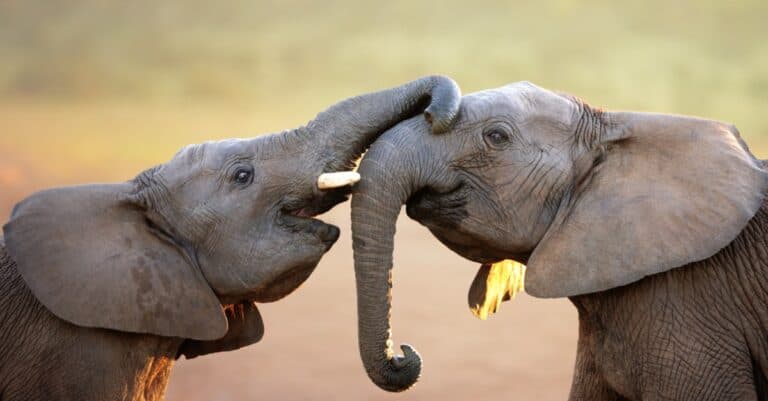
Elephants may use their trunks to communicate with each other
©Ondrej Prosicky/Shutterstock.com
The social life of many elephants revolves around herds and small groups. An elephant herd consists mostly of closely related female cows and their calves, which are led by a single matriarch who helps the entire group find food and water, avoid predators, and locate a shelter. The oldest daughter is almost always poised to inherit the matriarchal position upon the mother’s death. A typical herd consists of around 10 individuals. If the herd grows too large, then some elephants may split off and form a new semi-independent group. The male bulls, on the other hand, either wander alone or form bachelor groups with specific dominance hierarchies. The males are much more likely to gather together during times of scarcity or in the presence of threats. They only come into contact with females when they want to mate.
Elephants have all manner of ways to communicate with each other. The trunk seems to play a critical part in this. A raised trunk seems to indicate a greeting. A lower-ranked member of the herd will also place its tip into the mouth of a higher-ranked individual, perhaps as a conciliatory gesture. Despite the iconic trumpeting sound, many of the noises produced by the elephant to communicate over long distances are actually too low for the human ear to detect. They also produce a growling noise from the stomach that seems to signify to others they are okay.
Depending on the availability of food, the elephant may spend up to 18 hours a day feeding. The rest of the time is occupied by sleeping, bathing, cleaning itself, and bonding with the rest of the group. Playing and fighting are integral parts of their behavior. They tend to spar playfully with other elephants close to their own age.
In the wild elephants only sleep about two hours per day and prefer to sleep while standing up. In captivity, elephants will sleep closer to six hours per night and with no predators to worry about will sleep lying down.
Habitat
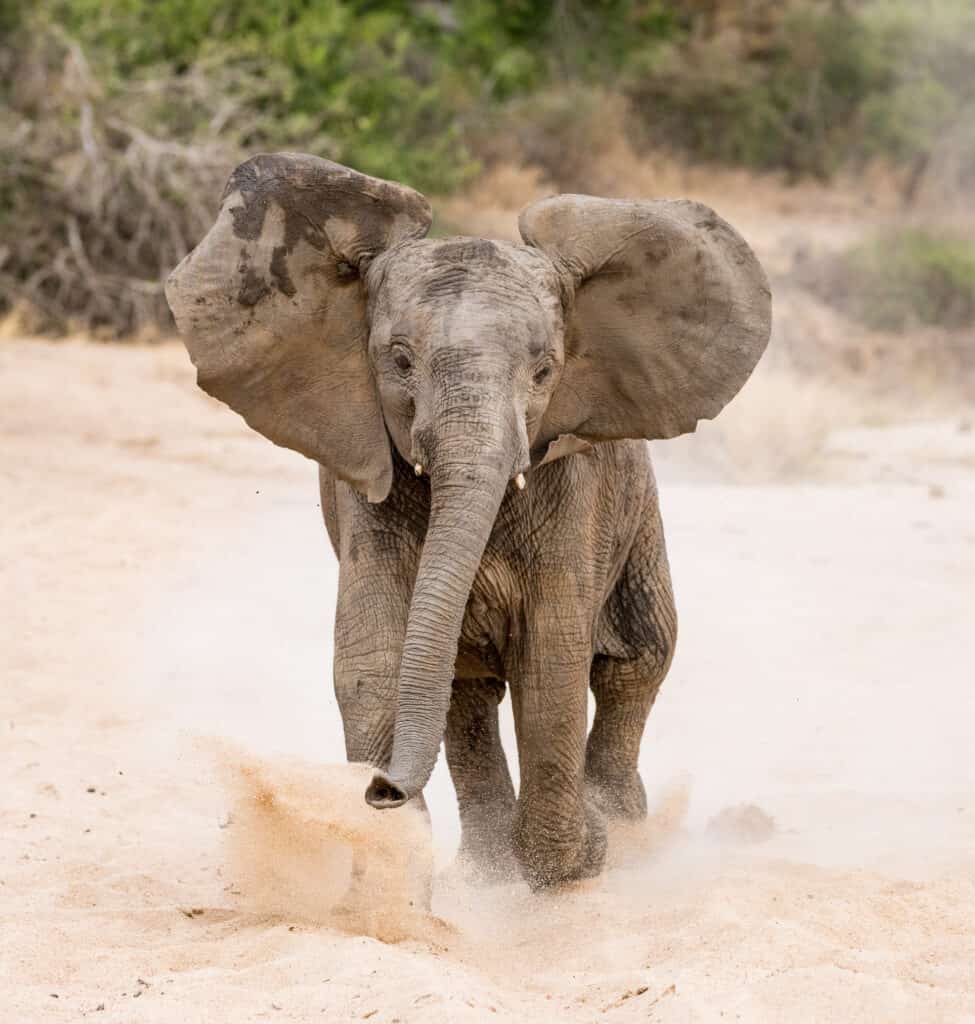
Elephants once lived in the Middle East and East Asia
©Stu Porter/Shutterstock.com
The elephant inhabits the savannas, deserts, marshes, and forests near rivers of sub-Saharan Africa and South Asia. The Indian, Sumatran, Borneo, and Sri Lankan elephants all generally correspond to those particular geographical regions. But this range is actually reduced from its greatest historical extent. The Asian elephant, for example, once had a much larger range stretching between Syria and China. The African forest elephant is now reduced to a small piece of land in the Congo basin of western Africa.
Diet
The elephant is an herbivorous mammal whose only source of nutrients is vegetation. It needs an enormous amount of food to sustain itself. A typical individual consumes up to 330 pounds of food in a single day, although up to half of this may pass through the body without being properly digested.
What does the elephant eat?
Elephants will eat almost any type of vegetation, including grasses, leaves, fruits, twigs, roots, and bark. The exact composition of its diet tends to vary based on location and season. Herbivores generally have two different strategies for obtaining food: browsing, in which they selectively feed on shrubs and trees above the ground, and grazing, in which they lightly feed on vegetation along the ground. Many elephants are both browsers in the dry season and grazers in the wet season. African forest elephants are primarily browsers but also mix in a lot of fruits.
(And no, in case you were wondering, elephants do not eat peanuts!)
Predators and Threats
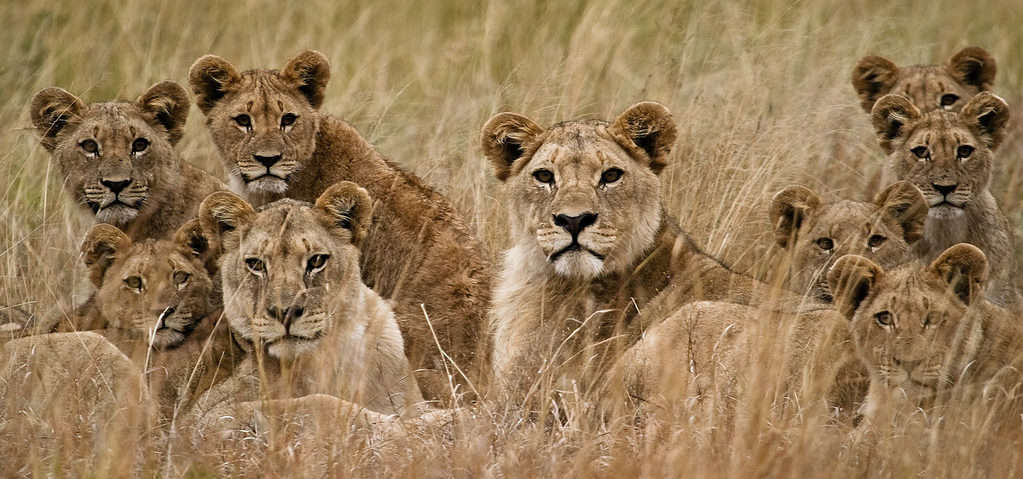
Lions are one of a young elephant’s greatest threats
©Riaan van den Berg/Shutterstock.com
Aside from natural predators, the animal is under threat from poaching (due to the value of their tusks), habitat loss, and growing conflict with people. Some of these threats are amplifying each other. As the animal’s natural habitat diminishes owing to the encroachment of humans on wild territory, it comes into contact with cultivated farmlands and settlements which can result in trampled crops and damaged properties. This in turn may cause people to retaliate against them.
What eats the elephant?
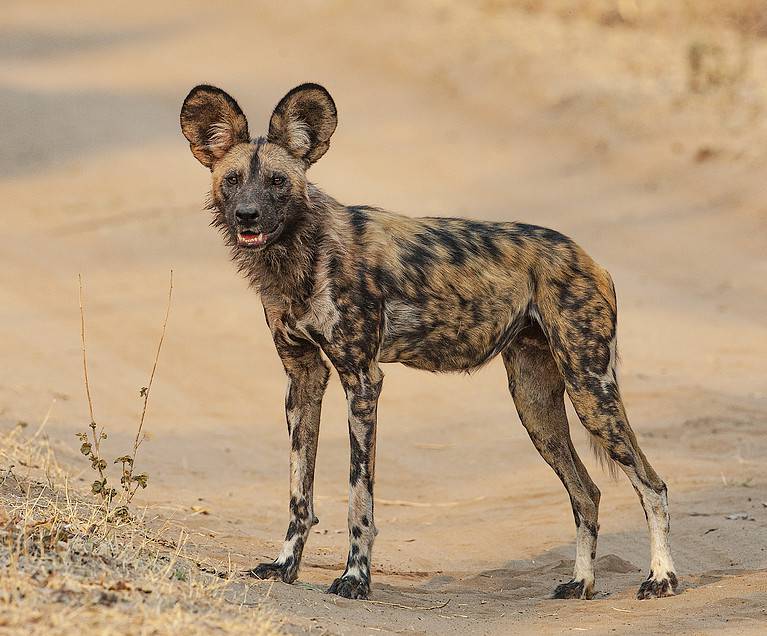
A full-grown adult elephant faces no consistent threats in the wild. Its massive size and thick hide make it almost impervious to attacks. However, a juvenile calf may be vulnerable to hyenas, lions, tigers, leopards, and African wild dogs, so it seeks protection from the group.
Reproduction, Babies, and Lifespan
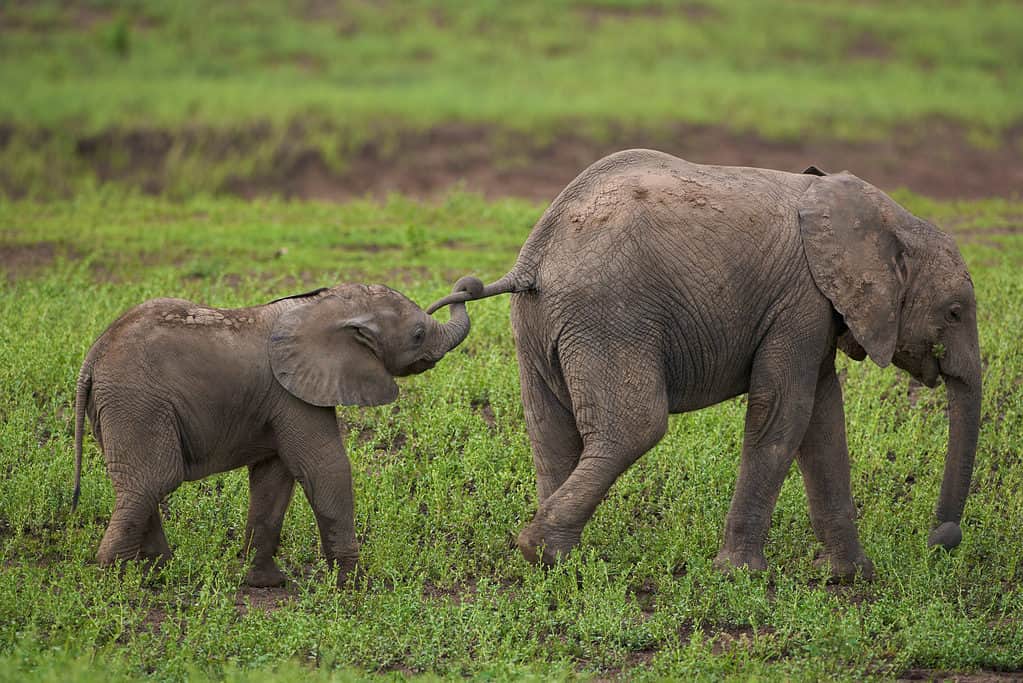
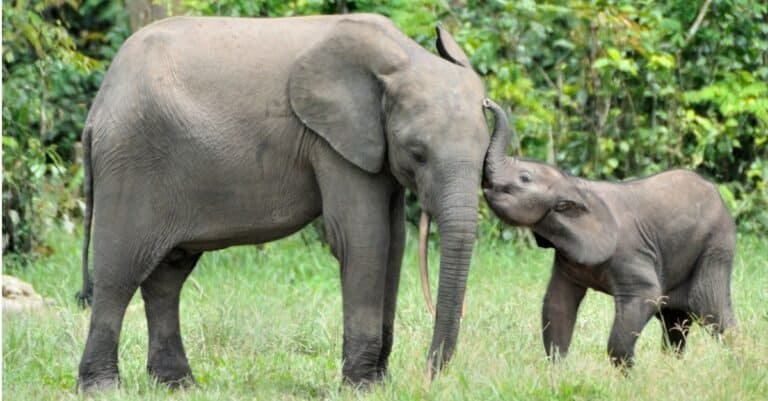
Depending on its gender, an elephant may maintain ties with its mother all its life
©Johan W. Elzenga/Shutterstock.com
As they reach sexual maturity, male bulls undergo a periodic transformation called musth in which their testosterone levels surge to 10 times their normal amount. This is characterized by aggressive behavior, enlarged temporal glands behind the eyes, and a continuous dribble of urine as they walk. The musth is intended to advertise the bull’s physical condition and shape, both to the females who may be looking for a mate and to the males who may be looking out for competitors. Males in musth are known to fight with each other, which rarely results in death. Females also release signals about their readiness to mate in various secretions. One male can have multiple female mates in his lifetime.
After mating, the female carries a single calf for about 22 months, longer than any other species of mammal. The baby is able to stand up and walk within an hour of its birth. However, it still requires the protection and care of the entire herd. If an adult senses danger, then it will make a loud trumpeting sound. The herd will then form a protective ring around the calves, facing outward to deter the predator. While the female herd may be doting caretakers, the father plays almost no role in the actual development of the offspring.
It takes a long time for a baby to master the nuances of elephant life. In the 13 to 20 years it takes to reach full maturity, these animals need to develop their coordination, learn social nuances, and develop bonds. It’s been suggested that a poorly-reared elephant may exhibit some anti-social behavior. Meanwhile, it takes a full five or six years before the baby is fully weaned from its mother’s milk. The calf packs on 2 to 3 pounds every day over the first year alone. Upon growing fully, the females tend to stay with the group, while the males tend to leave and forge their own path in life. They can easily live in excess of 50 years in the wild.
The oldest elephant to ever live reached 88 or 89 years old and lived in captivity in India. Indian elephants tend to live longer than their African counterparts.
Population
Less than 500,000 elephants of both species remain in the wild
©Pooja Prasanth/Shutterstock.com
According to the IUCN Red List, which publishes a list of threatened species, both the African bush elephant and forest elephant are considered to be vulnerable species. Only about 415,000 remain in the wild. This is a fall of some 90% since the early 20th century. The Asian elephant is in an even worse state. With only about 45,000 remaining and its population heavily fragmented, it is currently classified as endangered by the IUCN Red List.
Conservationists are focusing their efforts on habitat protection and the end of poaching. Following an international agreement in 1989 that banned the ivory trade, poaching rates did temporarily subside. This was further bolstered by China’s ban on its domestic ivory market in 2018. Conservation groups are also working with local people to reduce negative interactions and create elephant corridors and safe places for them to roam. However, due to low birth rates and long maturation times, it takes a while for elephant populations to replenish.
Elephants in the Zoo
Due to their food and space requirements, only a few zoos are privileged enough to harbor these animals. The San Diego Zoo has a unique area called the Elephant Odyssey habitat that contains both African and Asian elephants. These animals are also present at the Indianapolis Zoo, the Maryland Zoo, the Seneca Park Zoo, the North Carolina Zoo, the Los Angeles Zoo, the Cincinnati Zoo, and Zoo Atlanta.
Similar Animals
- Asian Elephants: Consisting of different subspecies, these elephants are smaller than their African relatives. Find out who they are truly related to and key differences between them and their cousins an entire ocean away.
- African Forest Elephants: They roam the dense thick forest with an ease which would be beyond their larger relatives. But what other differences set them apart from their African cousins? Find out here.
- African Bush Elephants: Extremely gregarious and social, these giant mammals prefer to roam the open savannah. Find out all there is to know about the largest land mammals on the planet.
Elephant Pictures
View all of our Elephant pictures in the gallery.

Peter Fodor/Shutterstock.com
Sources
- San Diego Zoo / Accessed March 14, 2021
- WWF / Accessed March 14, 2021
- WWF / Accessed March 14, 2021
- BBC Earth / Accessed March 14, 2021