

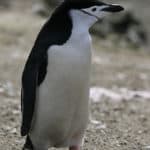

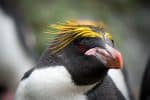
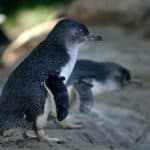

“The emperor penguin is the largest penguin species on Earth.”
The emperor penguin is the largest species of penguin in the world and also one of the most unique. Instead of breeding in the warmer summer months like other penguin species, emperor penguins lay and incubate their eggs during the winter in frigid Antarctica, where they live. Due to the fact that emperor penguins breed on the ice, they are believed to be one of the only bird species that can spend their entire life without actually walking on land.

The largest species of penguin, the emperor penguin lives its life in one of the harshest and coldest environments in the world—Antarctica.
©Midnight In Summer/Shutterstock.com
Despite having first been recorded by Captain Cook in the late 1790s, the first emperor penguin colony wasn’t discovered until 1902. Because they dwell in such extreme southern climes that are difficult to reach, new colonies were still being discovered as late as 1986.
Anatomy and Appearance
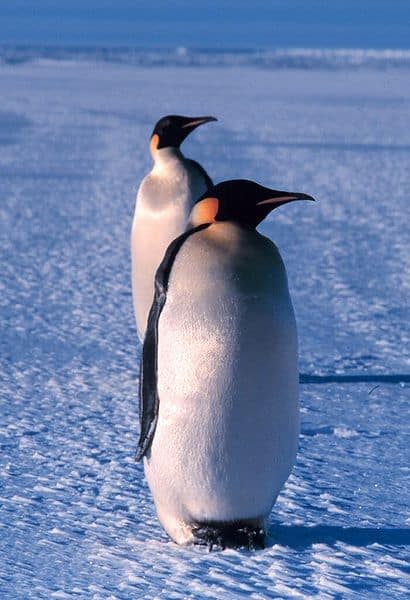
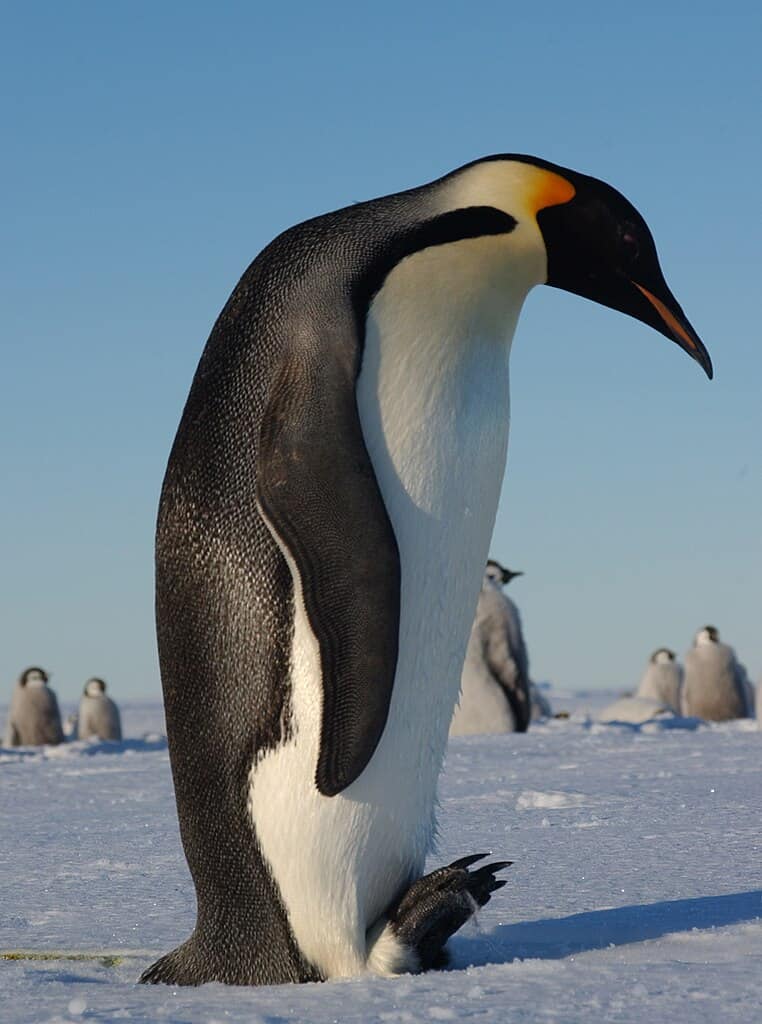
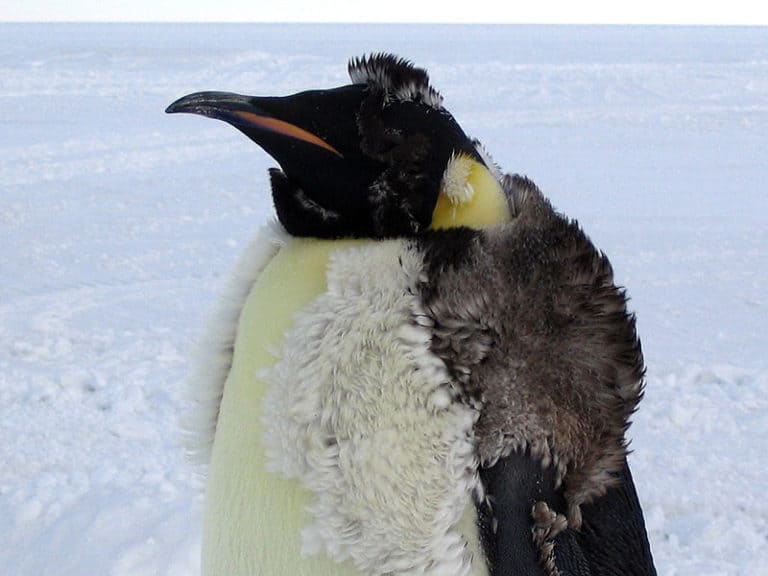
Emperor penguins are large birds that stand around 4 feet high and weigh up to 100 pounds. They have black feathers on the back, white feathers on the front, a yellow patch on the neck and an orange stretch along their beak. The black and white coloring is thought to be particularly important for camouflaging the emperor penguin from predators while they swim in the ocean. They also have webbed feet, which help with swimming but provide little assistance when traveling on land. They seemingly find it easier to slide along on their bellies. In order to keep themselves warm in such hostile conditions, they have a triple layer of dense, oily, and waterproof feathers and a thick layer of blubber under their skin. They are also well-adapted for swimming with their streamlined bodies gliding through the water, propelled by their small, rigid wings.

Evolution
Fossil records indicate that emperor penguins’ earliest common ancestor lived as long as 60 million years ago — soon after the dinosaur extinction. Later penguin ancestors are believed to have originated in New Zealand and Australia around 22 million years ago. Changes in climate and ocean currents enabled penguins to spread across the Southern Hemisphere. The modern emperor penguin likely evolved much later within the last few million years to adapt to the harsh arctic climate.
Distribution and Habitat
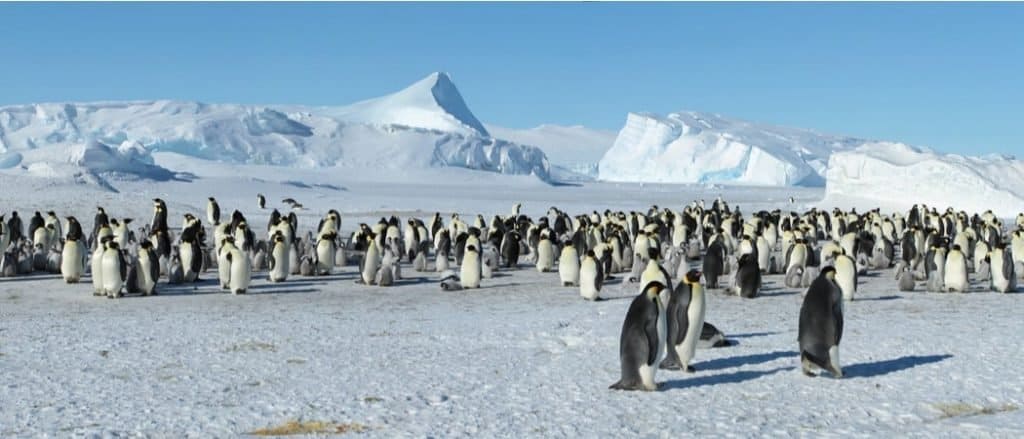
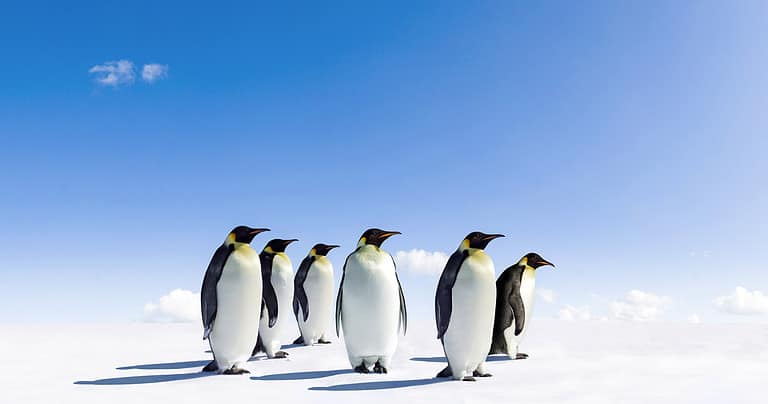
Emperor penguins can travel distances up to 125 miles across the ice to reach their breeding colony.
©Sergey 402/Shutterstock.com
Emperor penguins inhabit the compacted ice along the coast of Antarctica with some colonies established up to 11 miles inland. Unlike a number of other penguin species that may visit the continent from time to time, the emperor penguin does not migrate north and instead spends the whole year deep in the Antarctic Ocean.
Behavior and Lifestyle
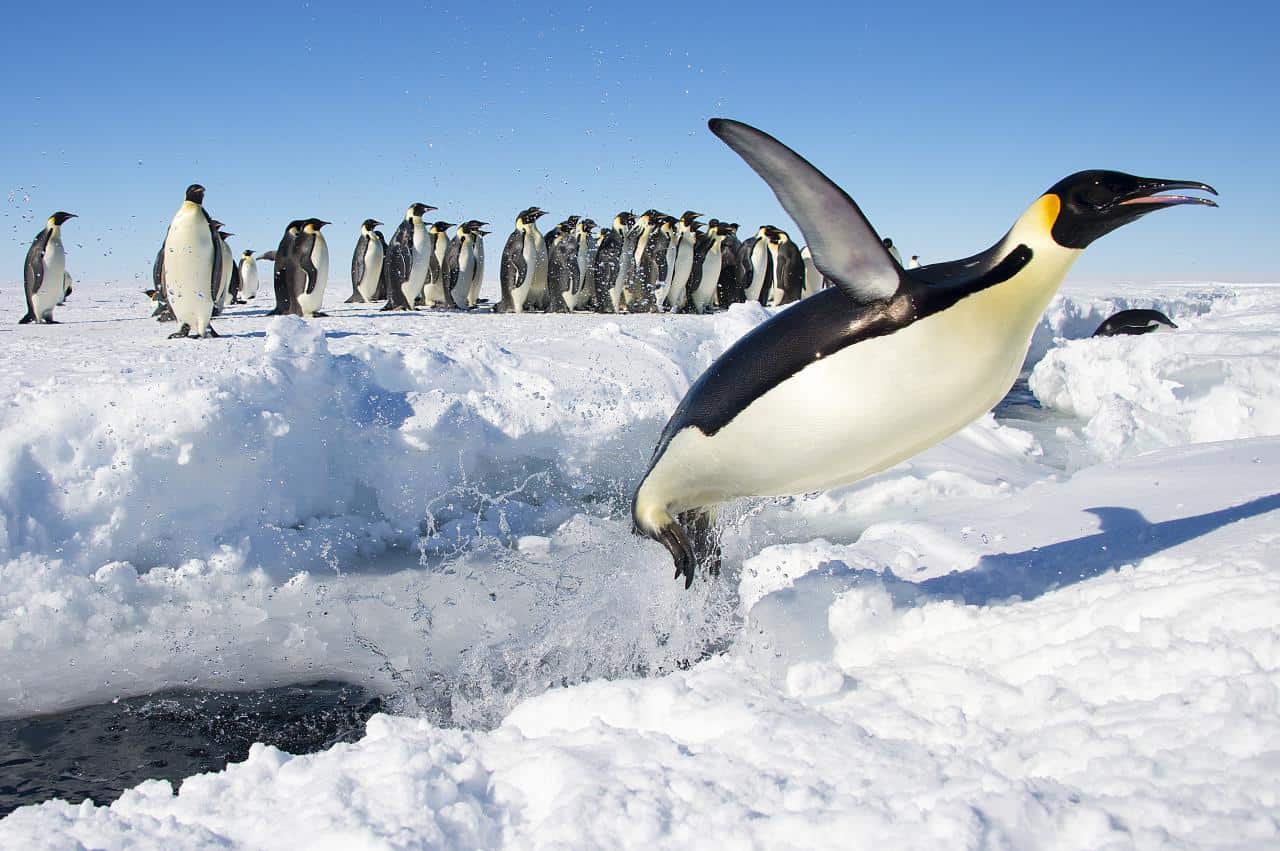
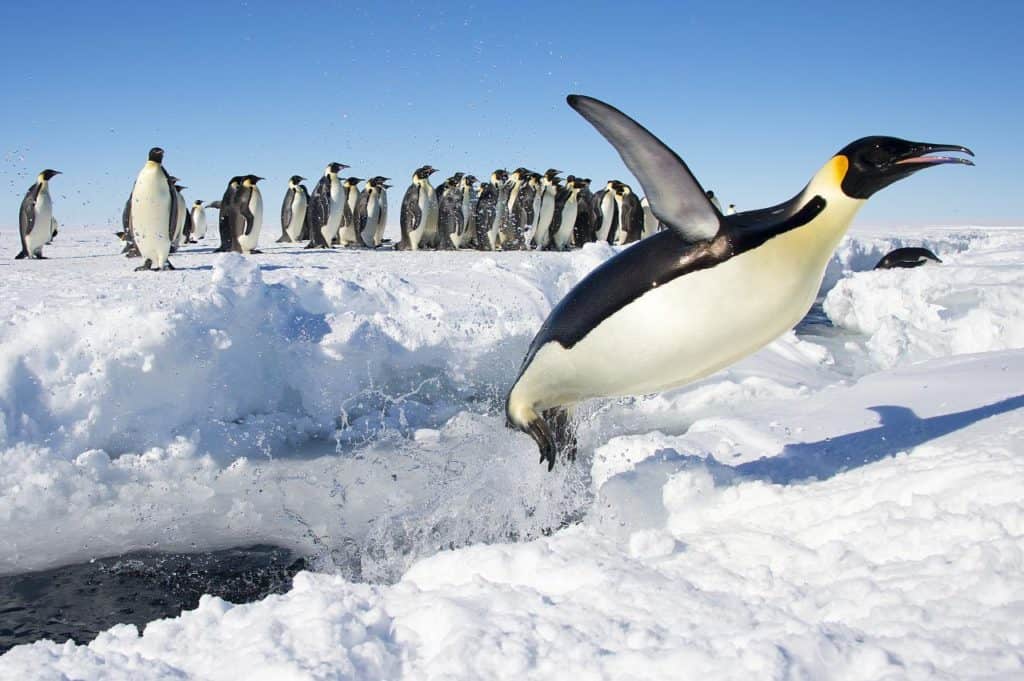
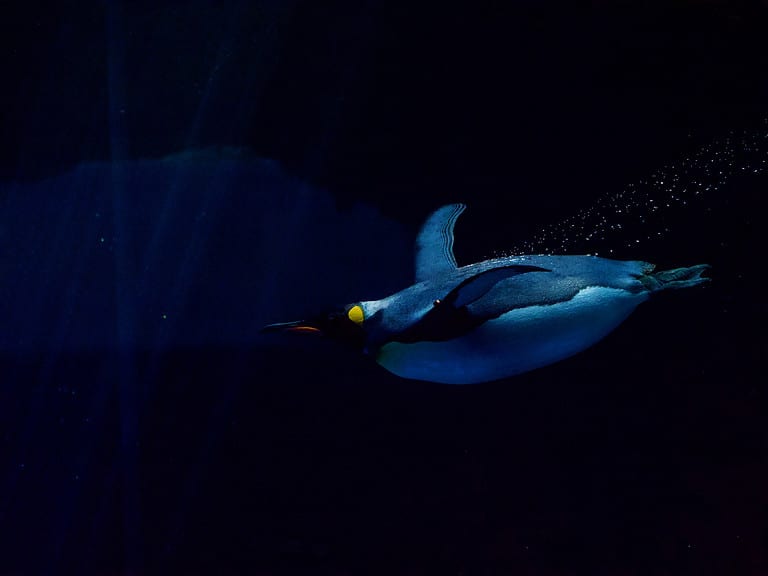
Emperor penguins are incredibly sociable birds that live together in colonies containing thousands of individuals. After finding a mate, emperor penguins remain true to each other for life and use vocal calls to find each other again when they return to the breeding site. They are excellent swimmers known to leap out of the water when traveling at a high speed in the same way dolphins do. Known as “porpoising,” it allows the emperor penguin to breathe without having to slow down.

Penguins are excellent swimmers capable of “porpoising” to the surface for a quick breath of air.
©Mathias Berlin/Shutterstock.com
Emperor penguins are also known to dive to depths of more than 1,640 feet (500 meters) making them the deepest diving birds in the world, where they are able to hold their breath for up to 20 minutes at a time. Usually traveling at speeds up to 6.2 mph but capable of swimming nearly 15 mph, emperor penguins can travel as far as 621 miles on a foraging trip.
Reproduction and Nesting
Emperor penguins breed during the cold, dark, harsh winter months. They begin arriving in their breeding colonies between March and April and once having found their mate, the females will lay a single egg sometime from May to June. The egg is quickly transferred to the male who rests it on his feet to keep it off the frozen ground. He covers it with a warm brood pouch that keeps the egg warm. Female emperor penguins then leave for the open ocean, where they forage for food for two whole months, leaving the males to look after the eggs during the winter months.
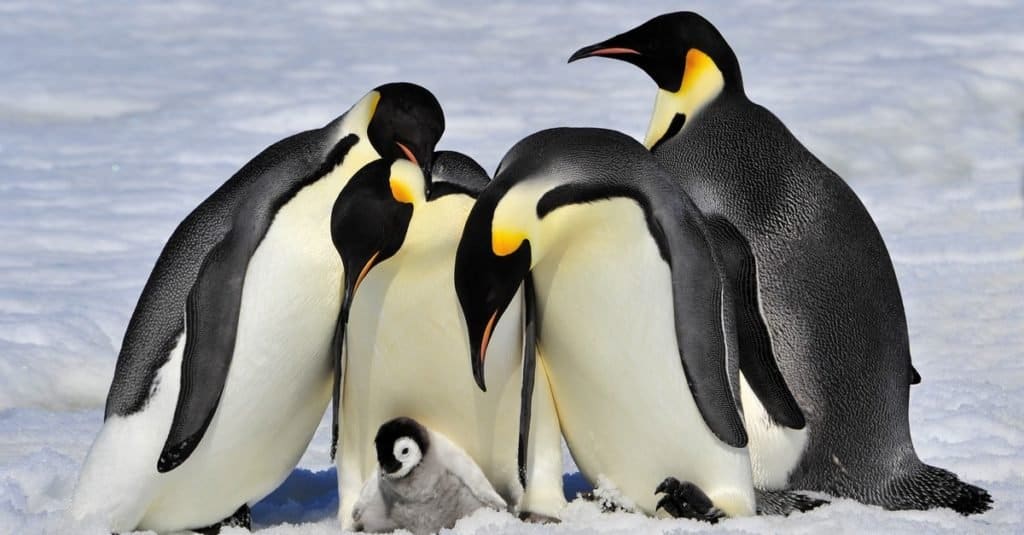
Emperor penguins are heavy birds with layers of blubber to protect them against the icy climate.
©vladsilver/Shutterstock.com
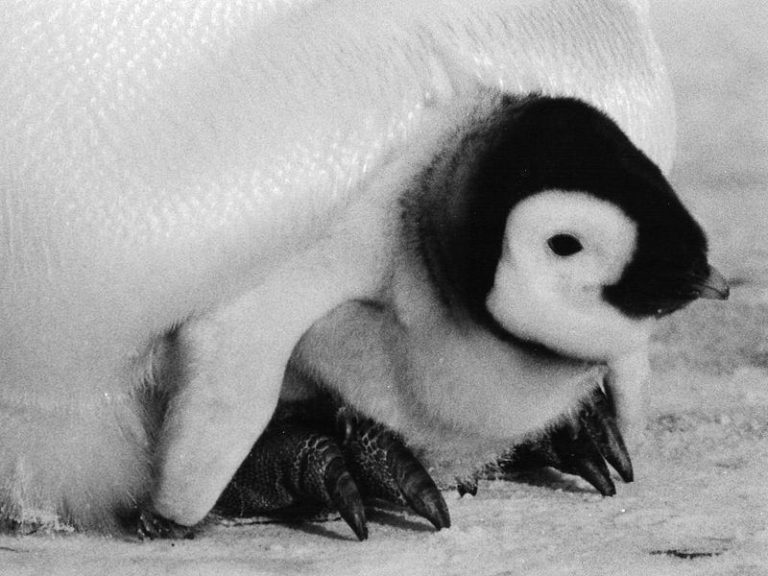
Temperatures can reach -76°F. With winds of up to 100 mph, the male emperor penguins huddle together for warmth, alternating between the outskirts and the middle to ensure all members of the colony keep warm. The eggs hatch in spring after approximately 70 days. This coincides with the return of the females, who feed the young and keep them warm using their brood pouch on their tummies, while the males then head off to find food.
Diet and Prey
The emperor penguin is a carnivorous animal that only hunts and eats animals in the surrounding water in order to survive. Emperor penguins eat mostly fish but also supplement their diets with krill, other crustaceans, and squid. Like other penguin species, emperor penguins are equipped with a spiky tongue for help when eating slippery fish. Chicks rely on their parents to collect food for them. Males and females feed the fast-growing chick by regurgitating a fishy paste from their stomachs into the chick’s mouth.
Predators and Threats
Emperor penguins are preyed upon by a number of large, marine carnivores, but their exact predators vary between geographic locations. Vulnerable emperor penguin chicks are preyed upon by the enormous Southern Giant Petrel, an animal thought to be responsible for more than 30% of chick deaths. Adult emperor penguins and chicks alike are preyed upon by leopard seals and killer whales.
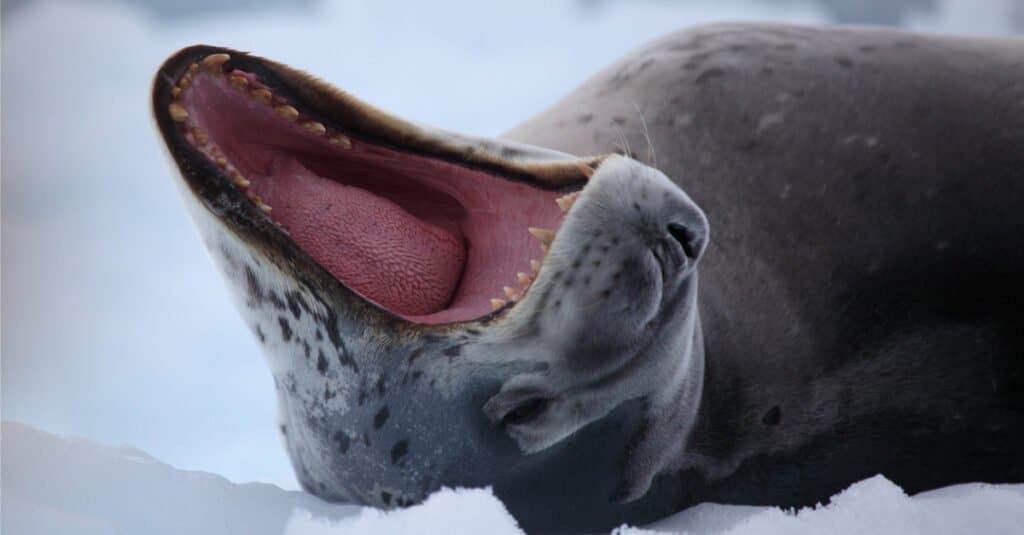
Leopard seals prey on adult emperor penguins.
©iStock.com/MogensTrolle
Conservation Status
Today, the emperor penguin is listed by the IUCN as a species that is Near Threatened to becoming extinct in the wild in the near future. There are thought to be around 595,000 emperor penguins in the Southern Ocean and although populations are relatively stable, they are being increasingly affected by the rapidly melting ice and the higher levels of human activity around Antarctica. The IUCN projects a 27% decrease in the population of emperor penguins over the next 61 years with all colonies living north of 67°S disappearing by 2052 due to the melting of sea ice.
Emperor Penguin Pictures
View all of our Emperor Penguin pictures in the gallery.

Michael Van Woert / Public Domain, from Wikimedia Commons, the free media repository
How to say Emperor Penguin in ...
Sources
- David Burnie, Dorling Kindersley (2011) Animal, The Definitive Visual Guide To The World's Wildlife / Accessed August 24, 2009
- Tom Jackson, Lorenz Books (2007) The World Encyclopedia Of Animals / Accessed August 24, 2009
- David Burnie, Kingfisher (2011) The Kingfisher Animal Encyclopedia / Accessed August 24, 2009
- Richard Mackay, University of California Press (2009) The Atlas Of Endangered Species / Accessed August 24, 2009
- David Burnie, Dorling Kindersley (2008) Illustrated Encyclopedia Of Animals / Accessed August 24, 2009
- Dorling Kindersley (2006) Dorling Kindersley Encyclopedia Of Animals / Accessed August 24, 2009
- Christopher Perrins, Oxford University Press (2009) The Encyclopedia Of Birds / Accessed August 24, 2009
- Emperor Penguin Facts / Accessed August 24, 2009
- Emperor Penguin Information / Accessed August 24, 2009
- Emperor Penguin Conservation / Accessed August 24, 2009