
F
Species Profile

Fin Whale

Balaenoptera physalus

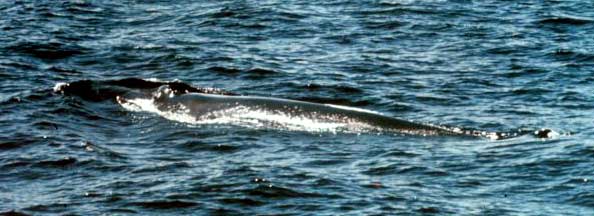
The fast rorqual with a split-color jaw
Neil916 - Public Domain

Fin Whale Ocean Range

Marine Species

Fin whales (Balaenoptera physalus) occur in temperate to subpolar waters of all major oceans, with a resident Mediterranean group. They migrate to higher latitudes to feed in summer and to lower latitudes to breed and calf in winter, though movements vary by ocean and population. Mostly pelagic, they often use continental shelf and slope waters, including fronts and upwelling.

Loading ocean map...

Ocean Regions 16

atlantic_ocean pacific_ocean indian_ocean arctic_ocean southern_ocean north_atlantic south_atlantic north_pacific south_pacific mediterranean_sea north_sea bering_sea sea_of_japan south_china_sea tasman_sea coral_sea

At a Glance

Ocean Species
Also Known As Finback, Finback whale, Common rorqual, Razorback, Herring whale
Diet Filter Feeder
Activity Cathemeral
Lifespan 85 years
Weight 120000 lbs
Status Vulnerable
Did You Know?

Size: adults commonly ~18-22 m; maximum reported ~27 m (females typically larger). Mass can reach ~70-80 t in the largest individuals.

Scientific Classification

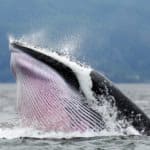
The fin whale is a large baleen whale (rorqual) known for its fast swimming, streamlined body, tall falcate dorsal fin, and distinctive asymmetrical jaw coloration (typically lighter on the right lower jaw).

Kingdom
Animalia
Phylum
Chordata
Class
Mammalia
Order
Cetacea
Family
Balaenopteridae
Genus
Balaenoptera
Species
physalus

Distinguishing Features

  • Very large rorqual with a tall, strongly curved dorsal fin set far back
  • Asymmetrical head/jaw coloration: right lower jaw often pale/white, left darker
  • Prominent longitudinal throat pleats (rorqual grooves) for lunge-feeding
  • Slender body compared with blue whales; typically faster and more agile

Physical Measurements

Males and females differ in size

Length
63 ft 12 in (55 ft 9 in – 72 ft 2 in)
68 ft 11 in (59 ft 1 in – 88 ft 7 in)
Weight
55.1 tons (33.1 tons – 88.2 tons)
Top Speed
23 mph
Up to 37 km/h

Appearance

Primary Colors
Secondary Colors
Skin Type Hairless, smooth, rubbery cetacean skin with a thick blubber layer; throat/belly has expandable ventral pleats (rorqual grooves; commonly reported ~56-100) enabling lunge-feeding engulfment.
Distinctive Features
  • Very large rorqual: typical adult length ~18-22 m; maximum reported ~24 m (females on average larger). Adult mass commonly ~40-70 metric tons (varies by population and condition).
  • Streamlined, fast-swimming body; noted as one of the fastest large whales (field reports commonly cite bursts around ~10 m/s, ~36 km/h).
  • Tall, falcate (sickle-shaped) dorsal fin set far back on the body; commonly ~0.6 m tall and conspicuous at the surface.
  • Asymmetrical head coloration: right lower jaw pale/white-to-cream, left lower jaw darker-one of the best field marks distinguishing Balaenoptera physalus from similar rorquals (e.g., blue, sei, Bryde's).
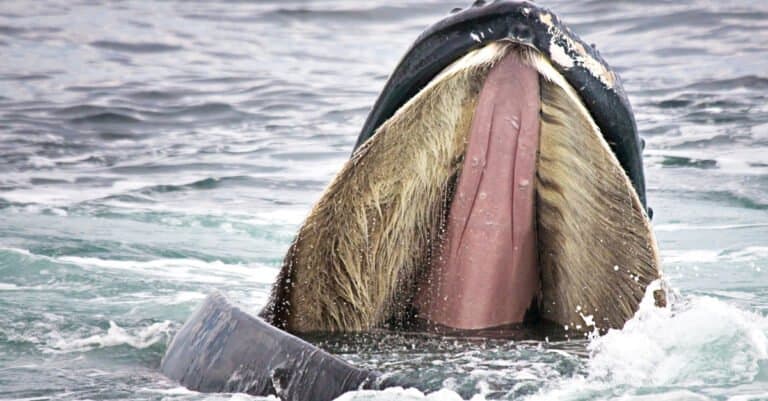
  • Lunge-feeding anatomy: expandable ventral pleats and a large buccal cavity; feeds by accelerating and engulfing prey-laden water, then filtering through baleen.
  • Baleen: typically ~260-480 plates per side; plates generally dark with lighter (often tan/yellowish-white) fringes used to filter krill and small schooling fish.
  • Blow (exhalation) typically tall and columnar, often cited around ~4-6 m under good conditions (height variable with sea state and observer distance).
  • Global distribution: primarily oceanic in temperate to polar waters with seasonal migrations-generally feeding at higher latitudes in productive seasons and moving toward lower latitudes in winter (patterns vary by ocean basin and population).
  • Acoustics (behavioral ID): produces powerful, low-frequency calls (often centered near ~20 Hz) that can propagate over long distances in deep ocean environments.
  • Conservation/status & threats (modern): IUCN Red List commonly listed as Vulnerable; key anthropogenic threats include ship strikes, fishing-gear entanglement, underwater noise, habitat/prey shifts linked to climate change, and legacy impacts from historical commercial whaling.

Sexual Dimorphism

Sexual dimorphism is present but subtle externally: females are generally longer and heavier than males of the same population/age class; otherwise body coloration/pattern and external morphology are broadly similar between sexes.

  • On average slightly shorter and lighter-bodied than females at maturity; no consistent, easily visible external color differences.
  • Reproductive anatomy not externally obvious at typical viewing distances; dimorphism mainly size-based.
  • On average larger (longer/heavier) than males; maximum lengths in populations are more often attained by females.
  • May appear more robust-bodied when pregnant or in good feeding condition; otherwise external appearance similar to males.

Did You Know?

Size: adults commonly ~18-22 m; maximum reported ~27 m (females typically larger). Mass can reach ~70-80 t in the largest individuals.

ID hallmark: the right lower jaw is usually pale/white while the left is dark-an unusual left-right asymmetry among mammals.

Built for speed: often called the "greyhound of the sea," with top speeds reported around ~37 km/h (≈20 kn).

Feeding hardware: typically ~260-480 baleen plates per side; longest plates can be ~70-76 cm, used to sieve small prey from seawater.

Rorqual "accordion throat": roughly ~56-100 ventral (throat) grooves allow the mouth to expand dramatically during lunge-feeding.

Signature sound: produces very low-frequency calls commonly centered near ~20 Hz that can propagate over long distances in the ocean.

Unique Adaptations

  • Ventral pleats (grooves) + expandable throat pouch: enables high-efficiency bulk feeding-anatomy characteristic of rorquals (family Balaenopteridae).
  • Asymmetrical jaw coloration (right side lighter): a key field mark; hypotheses suggest it may aid prey herding/visual contrast during feeding.
  • Streamlined, hydrodynamic body with a tall, falcate dorsal fin: reduces drag and supports unusually fast cruising for a baleen whale.
  • Baleen filtration system: keratin plates and frayed bristles trap prey while water is expelled-allowing feeding on small organisms without teeth.
  • Low-frequency hearing/vocal production: calls near ~20 Hz are well-suited to long-range transmission in seawater (useful for contact across oceanic distances).
  • Thick blubber layer: insulation and energy storage supporting migration and seasonal changes in feeding intensity.

Interesting Behaviors

  • Lunge-feeding (rorqual feeding): accelerates into dense prey patches, opens the mouth, and engulfs huge volumes of water; then filters prey through baleen as water exits.
  • Flexible diet by region: targets schooling fish (e.g., herring, capelin), krill, and other zooplankton-switching tactics depending on prey type and density.
  • Long-distance seasonal movements: many populations shift toward higher latitudes for summer feeding and lower latitudes for winter breeding, though some groups show partial residency.
  • Low-frequency calling: repeated ~20-Hz pulses are used for long-range communication; in some regions males produce patterned sequences often described as "song."
  • Social style: usually seen alone or in small, loose groups, but can form larger feeding aggregations when prey is abundant.
  • Diving: commonly makes dives on the order of ~5-15 minutes; recorded dives can be deeper/longer when foraging (limits vary by study and region).

Cultural Significance

Fin whale (Balaenoptera physalus) was heavily hunted in the 20th century and became a key symbol of whale conservation. Now a lead species for ocean care—reducing ship strikes, gear entanglement, and underwater noise. IUCN: Vulnerable; protected by IWC moratorium and CITES Appendix I.

Myths & Legends

Heather-back, from Old Norse and Icelandic tales, is a huge whale-like creature mistaken for an island. When sailors land or light fires, it dives and drowns them. Scholars link tales to large whales like rorquals.

Fin Whale (Balaenoptera physalus): In Icelandic sagas like The King's Mirror, a sea‑monster is described as a huge fish or whale that gapes at the surface to feed, compared to rorqual-style feeding.

Arctic Indigenous Sea Woman narratives: whales are gifts released from the sea spirit when proper respect is shown; while not fin-whale-specific, these stories reflect Arctic peoples' relationships with great whales encountered during migrations and hunts.

In Japanese coastal lore, fin whales (Balaenoptera physalus) were seen as lucky visitors; their arrival was treated as a blessing or source of community good fortune, shown in local festivals and whale memorials.

In North Atlantic stories from whaling times, large whales like the Fin Whale (Balaenoptera physalus) were seen as signs of weather and fishing; tales of 'island-whales' and sudden sea changes persist.

Conservation Status

VU Vulnerable

Facing a high risk of extinction in the wild.

Population Increasing

Protected Under

  • International Whaling Commission (IWC): commercial whaling moratorium in effect since 1986; fin whales remain subject to IWC management measures and monitoring.
  • CITES: Appendix I (international commercial trade generally prohibited, with limited exceptions).
  • CMS (Convention on Migratory Species): listed on Appendices I and II for many migratory cetaceans, supporting international conservation cooperation across range states.
  • United States: Listed as Endangered under the U.S. Endangered Species Act; additionally protected under the Marine Mammal Protection Act (take restrictions).
  • European Union: Protected under the EU Habitats Directive (strict protection for cetaceans) and regional agreements (e.g., ACCOBAMS in the Mediterranean where applicable).
  • HUBS (group-level conservation landscape-rorquals/Balaenopteridae): IUCN statuses span from Least Concern (e.g., some minke/humpback populations) through Vulnerable (fin whale) to Endangered (e.g., blue whale, sei whale), with some taxa Data Deficient (e.g., Omura's whale in parts of its range). Common cross-group threats include ship strikes, fishing-gear entanglement, underwater noise, prey depletion, pollution, and climate-driven ecosystem change; the most at-risk rorquals are generally those with smaller or slower-recovering populations and those concentrated in heavily trafficked or industrialized seas (IUCN Red List-multiple species assessments).

Life Cycle

Birth 1 calf
Lifespan 85 years

Lifespan

In the Wild
70–114 years

Reproduction

Mating System Promiscuity
Social Structure Aggregation Group
Breeding Pattern Transient
Fertilization Internal Fertilization
Birth Type Internal_fertilization

Fin whale (Balaenoptera physalus) mating is promiscuous (many males and females), with no long pair bonds. They breed in seasonal groups with brief encounters. Females alone care for calves. Maturity ~6–10 years; gestation 11–12 months; calving 2–3 years.

Behavior & Ecology

Social Pod Group: 3
Activity Cathemeral
Diet Filter Feeder Krill (euphausiids; where abundant, krill dominates the diet-e.g., Euphausia superba in the Southern Ocean and Meganyctiphanes norvegica/Thysanoessa spp. in the North Atlantic).
Seasonal Migratory 3,728 mi

Temperament

Generally non-aggressive toward conspecifics and vessels; typically avoids close approach and can be 'wary'/evasive in response to disturbance (common in rorqual field reports and NOAA summaries).
Fast, directed travel is common; groups/individuals may shift quickly between traveling and feeding modes depending on prey density.
Social cohesion is typically low (fission-fusion-like): individuals associate briefly, especially around prey patches, then separate.

Communication

Low-frequency tonal/pulsed calls centered near ~20 Hz Often termed '20-Hz pulses'), a hallmark of fin whale acoustic behavior; pulse trains repeated with regular inter-pulse intervals are widely reported (e.g., classic descriptions in Watkins et al.; McDonald et al.
Additional low-frequency components reported around ~40 Hz and higher-frequency energy in some call types; call structure and seasonality vary by population.
Song: stereotyped, repeating sequences of low-frequency notes Commonly dominated by ~20 Hz) produced primarily by males, showing seasonal peaks associated with breeding periods (reported across North Atlantic/North Pacific/Southern Ocean studies
Tactile contact between mother and calf at the surface (close positioning/parallel swimming) supporting coordination during travel and nursing.
Surface-generated signals (e.g., tail slaps, breaches, powerful surfacing/'blow' cues) that may function in short-range social signaling in addition to locomotor/foraging context.
Spatial positioning and synchronized diving/heading changes during feeding (especially lunge-feeding bouts) that facilitate temporary aggregation without strong social bonds.

Habitat

Open Ocean Coastal Deep Sea
Biomes:
Elevation: -18504 in

Ecological Role

Large pelagic planktivore/nekton-feeding predator that transfers energy from lower trophic levels (euphausiids/copepods and small schooling fish) to higher trophic levels; also functions as a major nutrient recycler in ocean ecosystems.

Top-down regulation of dense prey aggregations (krill/copepods/small pelagic fish) via bulk filtration predation Nutrient recycling and redistribution ("whale pump"): releases nitrogen/iron-rich fecal plumes that can stimulate primary productivity locally (broadly supported across baleen whales; e.g., Roman et al., 2014) Carbon pathways: contributes to biological carbon storage through long-lived biomass and, after death, "whale-fall" carbon transfer to deep-sea communities Links ocean basins and productivity zones through seasonal movements that transport nutrients/energy across regions

Diet Details

Main Prey:
Krill Large copepods Small schooling fish Squid
Other Foods:
Phytoplankton

Human Interaction

Domestication Status

Wild

Fin whale (Balaenoptera physalus) has never been domesticated and remains wild. Humans hunted it heavily in the 19th–20th centuries. Today interactions are research and whale-watching, plus harmful effects like ship strikes, fishing gear entanglement, ocean noise, and changes to habitat and prey. Adults are about 18–22 m long and live ~80–90 years.

Danger Level

Low
  • Accidental injury to people in small craft if a whale surfaces nearby or reacts to close approach (e.g., tail/fluke or body contact).
  • Capsize/collision risk during boat approaches in rough seas or at high vessel speeds (risk is primarily operational/boating-related).
  • Indirect risk via ship strikes: large vessels colliding with fin whales can create dangerous situations for crew and responders, though the primary harm is typically to the whale.

As a Pet

Not Suitable as Pet

Legality: Fin whale (Balaenoptera physalus) cannot be kept as a pet. They are protected; catching, keeping, moving, or selling one is usually banned without strict permits. International trade is limited (CITES Appendix I). U.S. capture or keeping needs narrow MMPA permits.

Care Level: Expert Only

Purchase Cost:
Lifetime Cost:

Economic Value

Uses:
Historical commercial whaling Subsistence/limited whaling in a few regions (not typical for this species today and generally regulated/contested) Eco-tourism/whale watching Scientific research and monitoring Ecosystem services (nutrient cycling and carbon sequestration via the 'whale pump' and biomass)
Products:
  • historically: whale oil (industrial and household uses), meat, and other rendered products
  • historically: byproducts from processing (e.g., meal) in industrial whaling contexts
  • non-consumptive: tourism revenue from sightings and associated services
  • non-consumptive: data value from biopsies, genetics, acoustics, and tracking (management and conservation applications)

Relationships

Related Species 9

Blue whale
Blue whale Balaenoptera musculus Shared Genus
Sei whale
Sei whale Balaenoptera borealis Shared Genus
Bryde's whale Balaenoptera brydei Shared Genus
Eden's whale Balaenoptera edeni Shared Genus
Common minke whale
Common minke whale Balaenoptera acutorostrata Shared Genus
Antarctic minke whale Balaenoptera bonaerensis Shared Genus
Omura's whale Balaenoptera omurai Shared Genus
Rice's whale Balaenoptera ricei Shared Genus
Humpback whale
Humpback whale Megaptera novaeangliae Shared Family

Ecological Equivalents 5

Animals that fill a similar ecological role in their ecosystem

The fin whale is one of the largest animals to ever exist on the earth.

Residing deep within the world’s great oceans, the fin whale cuts a majestic figure as it glides effortlessly through the water. Despite their enormous size, these whales are fast and agile swimmers that have adapted supremely well to their aquatic environment. Once highly endangered by human hunting, the whale is now making a slow comeback. They appear frequently enough for avid whale watchers to enjoy.

Fin Whale Facts

  • Instead of teeth, the typical fin whale has around 260 to 480 baleen plates on each side of its mouth for filtering out food from the water. The baleen is composed of keratin — the same substance as hair, feathers, hoofs, horns, and claws — with little fine hairs on the ends.
  • The fin whale is also known as the razorback, the finback, the common rorqual, and the herring whale.
  • With the ability to sustain speeds of almost 25 miles per hour, it has earned the nickname “the greyhound of the sea.”
  • Fin whales have a massive home range. They migrate all year round.
  • Fin whales have layers of fat under the skin called blubber that insulate them from the frigid waters and give them their buoyancy.

Fin Whale Scientific Name


Balaenoptera physalus is the official scientific name of the fin whale. Physalus is derived from the Greek word physa, which means ‘blows ‘or a ‘blowpipe.’ This is a reference to the whale’s blowhole.

The fin whale belongs to the genus Balaenoptera, which also includes the common minke whaleblue whale, and Sei whale. The taxonomical family of Balaenopteridae, also known as the rorquals, is the largest group of baleen whales in the world. The fin whale is a type of cetacean, encompassing all whales and dolphins.

There are currently two recognized subspecies of fin whales — the northern fin whale and the southern fin whale — that are obviously divided by geographical region. Some taxonomists also believe that there is a third subspecies of fin whales in the Pacific. These subspecies rarely mix together for long periods of time. They tend to have their own migration routes and social groups.
 

Fin Whale Appearance


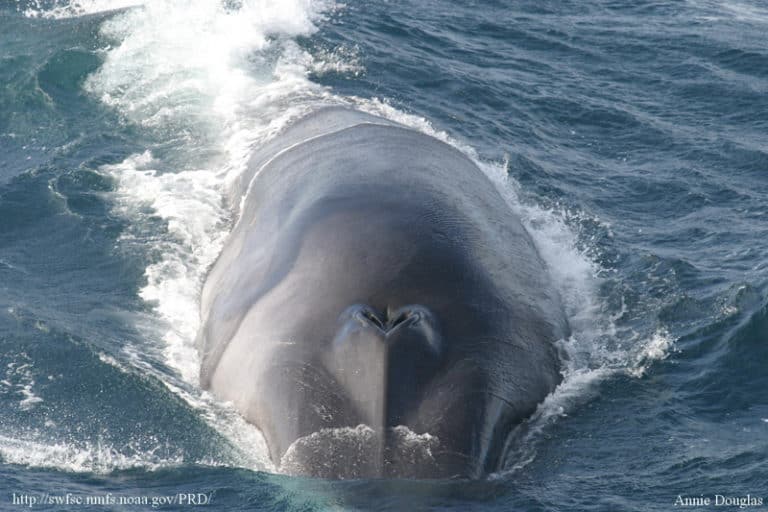
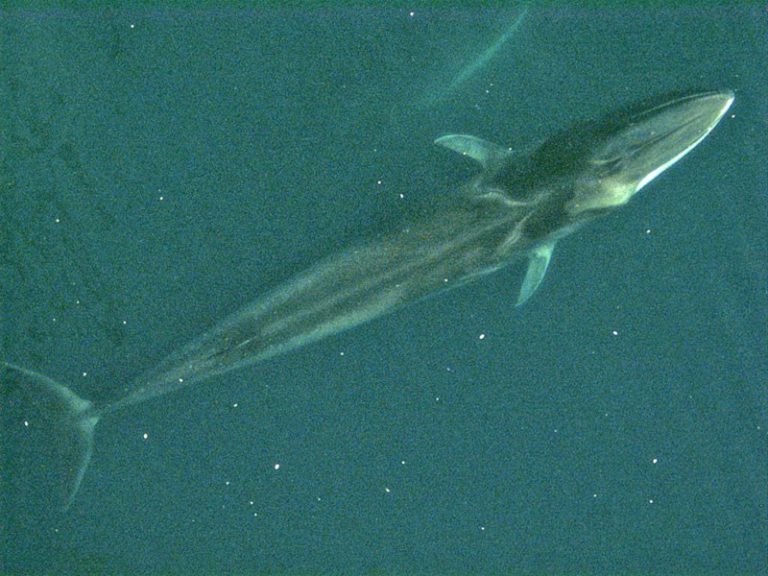
With its long, slender body, the fin whale can be distinguished from similar species by the presence of a large hooked dorsal fin on the back and a distinctive ridge running to its tail. It has a grayish or brownish coloration around its back and head, with white coloration around the belly. The markings around the head are asymmetrical – dark on the left side of the lower jaw and white on the right side. It also has two blowholes on its back.

The average fin whale is more than 65 feet in length and weighs up 80 tons, or about the weight of several semi-trucks stacked together. This makes it the second-largest whale species, eclipsed only by the truly massive blue whale. The female may be ever so slightly bigger than the male, but otherwise, they exhibit little sexual dimorphism (meaning differences between the sexes).
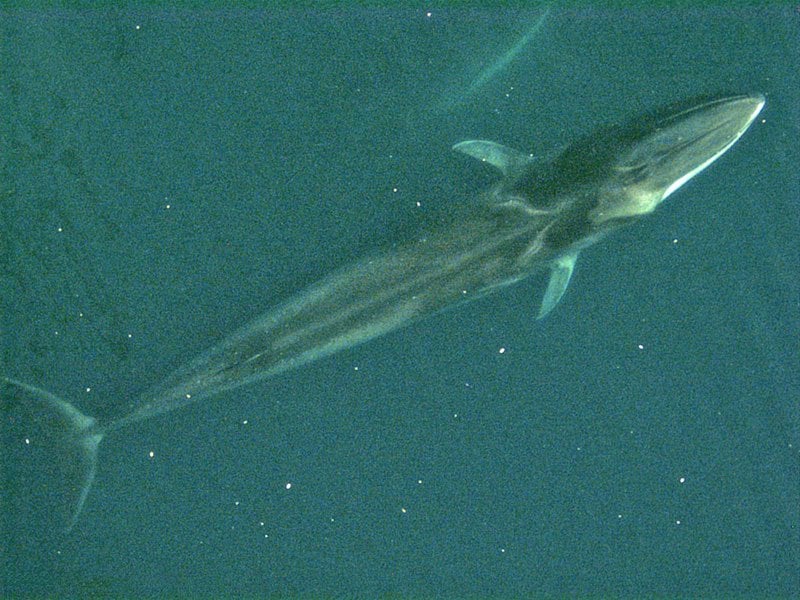
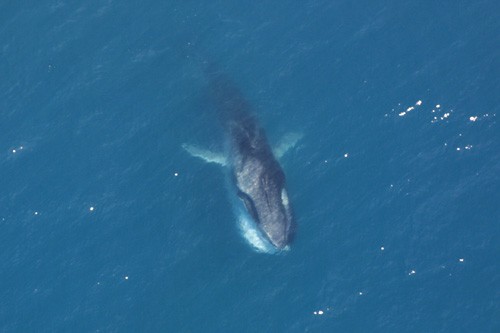
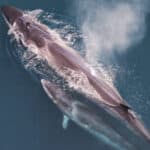
fin whale - Balaenoptera physalus - aerial photo of fin whale swimming

Fin Whale Behavior


Fin whales are highly social creatures that travel in pods. Although they are sometimes found alone, fin whales will normally cluster together in groups of up to ten at a time. A large number of fin whales may congregate at feeding grounds, even mixing with other species of whales and deep-sea predators. The fin whale relies heavily on low-pitched sounds to communicate with each other. These sounds range between 16 Hz and 40 Hz, well outside of a human’s normal hearing range. They also produce regular pulses and rumbles at around 20 Hz. This is one of the lowest-frequency sounds of any animal on the earth. Scientists believe the sound may be related to courtship and feeding. It may also help them gather information about their surroundings.

Fin whales are capable of displaying great intelligence, compassion, playfulness, and grief. Although it is difficult to study these characteristics in the wild, scientists know that whales have a relatively large brain to body size. In absolute terms, whales in general have the largest brains of any animal on the earth. They may also have complex brain structures necessary for social intelligence and a theory of mind.

Fin whales are specially adapted to live in the water. Many of their external organs, such as the ears, evolved into the internal parts of their body to reduce drag while they are swimming. Due to their remarkable adaptations, they can dive underwater up to 1,500 feet to feed. Most of the time, however, they will remain only a few hundred feet beneath the ocean while traveling.

Like all other cetaceans, they must surface and forcefully expel air through their blowhole to breathe. They will blow out several times before making a deep dive, during which they conserve as much oxygen as possible in their blood and muscles. Their physiology changes greatly to deal with the pressure and lack of oxygen deep underwater. Scientists surmise that they even shut down certain organs in their body that are non-essential while hunting.

Fin whales are surprisingly fast for their sizes — and also some of the fastest whales on the earth. They can maintain speeds of almost 30 mph for short bursts and normal speeds of up to 25 mph. This is why fin whales have earned the nickname “the greyhound of the sea.”

Fin whales are often an integral part of the local ocean ecosystem. Their enormous bodies are home to many aquatic life forms and parasites, and when they perish, their bodies are consumed by all kinds of deep-sea animals on the ocean floor.
 

Fin Whale Habitat


Except for the northern and southern extremities that remain covered in ice most of the year, the fin whale inhabits most of the world’s oceans and seas, including parts of the Mediterranean and Caribbean. It prefers cool and temperate waters, and it is somewhat less common in tropical regions. The fin whale also inhabits the coastal and shelf waters at least 200 meters or 650 feet deep.

Although some populations are in fact sedentary throughout most of the year, the fin whale is largely a migratory species, moving around the world in response to changes in the temperature and food availability. The whale’s migration patterns are not well understood, but they appear to prefer warmer climates in the fall and colder climates in the spring and summer.

Fin Whale Diet


The fin whale’s diet consists almost entirely of squids, crustaceans, and small fish. Tiny ubiquitous organisms such as krill and copepods are among its most common food. The fin whale has the amazing ability to expand its mouth to an immense size. When the whale begins to feed, it takes in a large amount of food and water. The whale then pushes the water back out through the baleen plates while trapping the food inside. It can eat up to two tons of food every day. Fin whales have several strategies for gathering food. One of the most common strategies is to swim around schools of fish and gather them into a single place so it can consume them all at once. It can spend several hours each day hunting.
 

Fin Whale Predators and Threats


Due to its immense size, there are almost no natural fin whale predators, but there have been a few reported anecdotes of groups of killer whale harassing or killing individuals. Without any real natural predators, fin whales are most susceptible to human activities.

Although they are now protected from whaling by international law in most places around the world, they are still in danger from vessel strikes and entanglements in nets. These accidents are fortunately rare. However, the noise of boats may confuse the whale’s communications with mates. Overfishing has also depleted vital reserves of prey from the ocean.
 

Fin Whale Reproduction, Babies, and Lifespan


Although some aspects of whale mating behavior are still poorly understood, fin whales appear to form pairs during breeding season. Scientists have determined that fin whales tend to mate in temperate waters around the winter months. They do not have specific mating grounds and rely on their voices to find each other. Males chase after females and emit a low-frequency sound that travels well in the water.

Once a pair has mated, the females will carry their young for about a full year before the calf is born. The newly born calf is about 20 feet long and weighs nearly 7,000 pounds, and it knows how to swim almost immediately upon emerging from the womb. It takes another six or seven months before the mother will fully wean the calf. Because the calf cannot suckle directly, the mother must squirt the milk into its baby’s mouth. The females of the species only produce about one offspring at a time every two to three years.

Fin whales have long maturation periods. Males tend to become sexually mature at six to ten years, while females become sexually mature at seven to 12 years of age. However, it takes about 25 to 30 years in total for a fin whale to fully mature. Like humans, the fin whale can live to be 80 to 90 years old, although longer lifespans of more than a hundred years have been recorded.
 

Fin Whale Population


Fin whales were once a common sight around the world. Hundreds of thousands of them roamed the oceans, and hunters largely ignored them because they were hard to catch. But once the appropriate technology was developed, heavy whale hunting in the 20th century greatly depleted their numbers. According to the University of Michigan’s Animal Diversity Web, more than 10,000 whales were hunted every year by the 1950s. Although protection was extended between 1976 and 1990, the whale populations dropped to a low of only 38,000 by 1997, placing it at danger of extinction.

According to the International Union for the Conservation of Nature (IUCN)‘s Red List, the current status of the fin whale is vulnerable. There are now currently about 100,000 mature individuals left in the world, and the population numbers appear to be increasing. However, it may take many more decades of careful conservation before the fin whale returns to its previous numbers.

View all 170 animals that start with F

Sources

  1. David Burnie, Dorling Kindersley (2011) Animal, The Definitive Visual Guide To The World's Wildlife / Accessed February 1, 2010
  2. Tom Jackson, Lorenz Books (2007) The World Encyclopedia Of Animals / Accessed February 1, 2010
  3. David Burnie, Kingfisher (2011) The Kingfisher Animal Encyclopedia / Accessed February 1, 2010
  4. Richard Mackay, University of California Press (2009) The Atlas Of Endangered Species / Accessed February 1, 2010
  5. David Burnie, Dorling Kindersley (2008) Illustrated Encyclopedia Of Animals / Accessed February 1, 2010
  6. Dorling Kindersley (2006) Dorling Kindersley Encyclopedia Of Animals / Accessed February 1, 2010
  7. David W. Macdonald, Oxford University Press (2010) The Encyclopedia Of Mammals / Accessed February 1, 2010
A-Z Animals Staff

About the Author

A-Z Animals Staff

AZ Animals is a growing team of animals experts, researchers, farmers, conservationists, writers, editors, and -- of course -- pet owners who have come together to help you better understand the animal kingdom and how we interact.
Connect:

Thank you for reading! Have some feedback for us?


Fin Whale FAQs (Frequently Asked Questions)

Since the fin whale’s diet consists of mainly small sea creatures, such as krill, fish, and squid, it is considered a carnivore.