

G
Species Profile

Gharial

Gavialis gangeticus

The long-snouted fisher of big rivers
Harsha K R / Creative Commons

Gharial Distribution

Click a location to explore more animals from that region

Loading map...

At a Glance

Wild Species
Also Known As Gavial, Ganges gavial, Indian gavial, Fish-eating crocodile
Diet Piscivore
Activity Cathemeral
Lifespan 45 years
Weight 250 lbs
Did You Know?

Snout specialization: the gharial's extremely long, narrow rostrum and needle-like teeth are adapted for catching fish with low water resistance (a classic fish-specialist crocodilian).

Scientific Classification

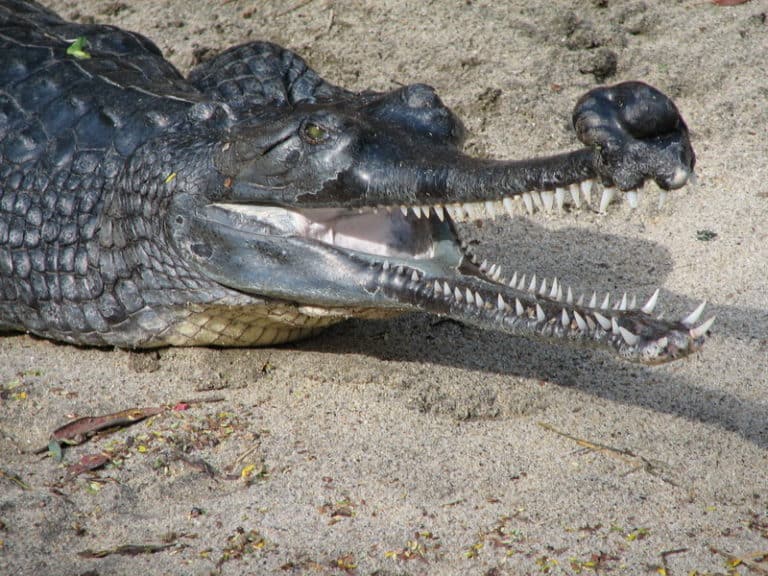
A large, primarily fish-eating crocodilian with an extremely long, narrow snout; adult males develop a bulbous nasal growth (the “ghara”) used in vocalization/display.

Kingdom
Animalia
Phylum
Chordata
Class
Reptilia
Order
Crocodylia
Family
Gavialidae
Genus
Gavialis
Species
Gavialis gangeticus

Distinguishing Features

  • Very long, slender snout with many interlocking sharp teeth (adapted for catching fish)
  • Male ‘ghara’ (bulbous nasal knob) in mature individuals
  • More aquatic and less capable of terrestrial locomotion than most crocodilians
  • Typically found in major rivers of northern India/Nepal (historical range broader across the subcontinent)

Physical Measurements

Males and females differ in size

Length
16 ft 5 in (13 ft 1 in – 20 ft 6 in)
11 ft 6 in (8 ft 6 in – 14 ft 9 in)
Weight
551 lbs (353 lbs – 661 lbs)
243 lbs (154 lbs – 353 lbs)
Tail Length
8 ft 2 in (4 ft 3 in – 10 ft 10 in)
Top Speed
8 mph
Gharial ~13 km/h on land

Appearance

Primary Colors
Secondary Colors
Skin Type Thick, keratinized reptilian skin with dorsal scutes (osteoderms) and granular lateral scales; overall armor is present but the body appears comparatively streamlined vs many other crocodilians-adapted for sustained swimming in large rivers.
Distinctive Features
  • Extremely long, narrow rostrum (snout) specialized for fish capture; the jaws are slender and elongate relative to other crocodilians and are not built for tackling large terrestrial prey (fish-specialist ecology).
  • Numerous long, slender, interlocking teeth suited to gripping slippery fish; teeth remain visible even when jaws are closed due to the narrow jaw profile.
  • Eyes and nostrils positioned dorsally for surface breathing/vision while the body remains submerged; a classic riverine ambush-swimmer profile.
  • Laterally compressed, powerful tail and extensively webbed hind feet-strongly aquatic morphology for propulsion in flowing freshwater.
  • Primarily freshwater, riverine crocodilian: typically associated with deep pools, confluences, and long sandbanks used for basking and nesting; nesting occurs in excavated nests on exposed sandbanks during the dry season (well documented in field studies).
  • Gharial (Gavialis gangeticus) adults are usually about 4–5 m long; large males may reach 5–6 m, while females are smaller, often about 3–4 m long.
  • Gharial (Gavialis gangeticus) is Critically Endangered. Threats: river dams and barriers, sand mining that removes nesting banks, fewer fish, and entanglement in fishing gear causing scars and injuries.
  • Generally not considered a typical man-eater; the very narrow snout and fish-based diet make predation on humans atypical compared with some other large crocodilians (field accounts consistently describe avoidance and low incidence of attacks).

Sexual Dimorphism

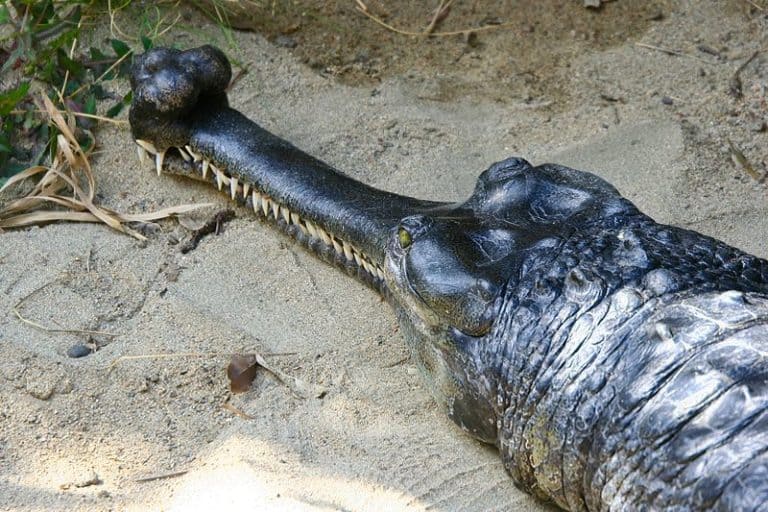
Marked sexual dimorphism: adult males develop a distinctive bulbous, pot-shaped nasal swelling at the tip of the snout and are larger overall. This nasal swelling functions in acoustic signaling (hissing/bubbling resonance) and visual display during courtship/territorial interactions; females lack it.

  • Bulbous, pot-shaped nasal swelling on the snout tip in mature males (a clear diagnostic sex trait in adults).
  • Generally larger body size and longer total length than females (commonly cited: males often ~4-6 m, with the largest individuals being males; IUCN species account notes maximum sizes around ~6 m).
  • More pronounced display behavior associated with the male's bulbous nasal boss at the tip of the snout (bubbling, snout-lifting, and audible vocalizations) during the breeding season-an appearance-linked behavioral cue when observed in the field.
  • No nasal swelling; snout tip remains narrow without a bulbous growth.
  • Smaller average adult size (often ~3-4 m) with a more gracile overall build compared to large males.
  • Heavily tied to sandbank nesting behavior: females excavate nest holes in sandbanks during the dry season and may show abrasion on the ventral body/scales from repeated nesting-site use.

Did You Know?

Snout specialization: the gharial's extremely long, narrow rostrum and needle-like teeth are adapted for catching fish with low water resistance (a classic fish-specialist crocodilian).

Teeth count is high for crocodilians: typically ~110 sharp, interlocking teeth for gripping slippery prey.

Size dimorphism is strong: adult males commonly reach ~5-6 m total length, while adult females are usually ~3-4.5 m (sources widely reported in field guides and IUCN accounts for the species).

Males develop a bulbous nasal growth at sexual maturity; it functions in sound production and vocal display and is used in visual signaling during breeding.

Reproduction is tied to river seasons: females nest on exposed sandbanks in the dry season and hatchlings typically emerge around the onset of monsoon flooding (timing varies by river).

Clutch size is large: females lay about 20-95 eggs (often ~30-50), buried in sand; incubation is roughly 70-90 days depending on temperature (reported across gharial breeding studies and husbandry records).

Conservation reality: the gharial is listed as Critically Endangered (IUCN), with remaining wild populations concentrated mainly in a few river systems of India and Nepal and threatened by fishing nets, sand mining, and river regulation.

Unique Adaptations

  • Ultra-narrow rostrum reduces hydrodynamic drag, enabling fast lateral strikes at fish-an extreme ecological specialization among living crocodilians.
  • Needle-like, interlocking teeth form an efficient "fish trap" for gripping slippery prey (fish-dominant diet), unlike the broader, crushing bites of many crocodiles.
  • Male ghara (nasal boss) helps produce resonant buzzing/"popping" calls and enhances visual signaling-an unusual sexual ornament among crocodilians.
  • Eyes, nostrils, and ears positioned high on the head allow breathing and scanning while most of the body remains submerged.
  • Strong tail-driven swimming and relatively weak limb-based locomotion reflect a life adapted to deep channels and strong currents more than to land travel.
  • Nesting strategy adapted to large rivers: eggs are placed in warm sandbanks that provide stable incubation temperatures when water levels are low.

Interesting Behaviors

  • Fish-hunting technique: often hunts by rapid sideways snapping of the head and jaws to seize schooling fish with minimal drag from its narrow snout.
  • Basking and thermoregulation: spends long periods hauled out on sandbanks to warm up, often returning to the same basking sites along a river stretch.
  • Breeding displays: adult males posture with head held high and use the ghara to amplify vocalizations and bubbling displays; they also perform jaw claps and water-splashing during courtship.
  • River-channel fidelity: adults commonly maintain home stretches of river, shifting seasonally with water levels and prey movement.
  • Sandbank nesting: females excavate nest chambers in sand above the waterline; suitable sandbanks are a critical, limiting resource where human disturbance or sand extraction occurs.
  • Limited terrestrial mobility: compared with other crocodilians, gharials move awkwardly on land and generally avoid long overland travel, keeping them strongly tied to riverine habitat.
  • Group tolerance: outside breeding interactions, they can be seen resting in loose groups at favored basking sites, especially in protected river reaches.

Cultural Significance

Gharial (Gavialis gangeticus) is linked to sacred rivers in North India and Nepal, shown in temple art as a mythical water guardian. It is a key species in efforts to save the Ganga River and a symbol of healthy rivers, sandbanks, and fish.

Myths & Legends

Mythical aquatic creature and the river goddess: South Asian tradition depicts the goddess Ganga riding a mythical aquatic creature-an aquatic, crocodilian-like being in Hindu art-tying crocodilian forms to the sanctity and power of great rivers.

Varuna's water-beast: in Hindu mythology, the god Varuna is associated with a mythical aquatic creature as a symbolic creature of the waters, reinforcing the idea of crocodilian-bodied beings as rulers and guardians of aquatic realms.

Mythical water creatures with crocodile-like jaws appear as temple doorway protectors in South Asia, showing the belief that powerful water animals—like the gharial (Gavialis gangeticus)—guard and mark sacred entrances.

People along the Ganga basin named the male Gharial (Gavialis gangeticus) after its pot-shaped snout. The big round nose looked like a clay pot and helped identify the species.

Along big rivers, people often treat Gharials and other large crocodiles with caution and respect, seeing them as powerful residents of deep channels and confluences—river places in oral tradition that must be respected.

Conservation Status

CR Critically Endangered

Facing an extremely high risk of extinction in the wild.

Population Increasing

Protected Under

  • CITES Appendix I (international commercial trade prohibited, with limited exceptions).
  • India: Wildlife (Protection) Act, 1972 - listed on Schedule I (highest level of legal protection).
  • Nepal: National Parks and Wildlife Conservation Act, 1973 (protected species framework; protection also occurs through riverine protected areas and conservation programs).
  • IUCN Red List: Gavialis gangeticus is assessed as Critically Endangered (CR) with an increasing population trend in the most recent Red List account used by IUCN (commonly cited assessment: Choudhury et al.).
  • HUBS (Crocodylia conservation landscape): crocodilians span statuses from Least Concern (e.g., widely recovered generalists) through Vulnerable/Endangered to Critically Endangered for highly range-restricted or habitat-specialist taxa. Common cross-group threats include river/wetland habitat loss and hydrological modification (dams, drainage), fisheries interactions and prey depletion, direct persecution/harvest and illegal trade, pollution, and increasing climate extremes. Notable high-risk crocodilians include the gharial (CR) and other narrowly distributed freshwater specialists; broad recoveries have occurred where strict protection, harvest controls, and habitat management were sustained over decades.

Life Cycle

Birth 40 hatchlings
Lifespan 45 years

Lifespan

In the Wild
30–60 years
In Captivity
40–70 years

Reproduction

Mating System Polygyny
Social Structure Aggregation Group
Breeding Pattern Seasonal
Fertilization Internal Fertilization
Birth Type Internal_fertilization

Gharial (Gavialis gangeticus) are seasonally polygynous: males attract and mate with several females in the dry season. Females nest on sandbanks, lay large clutches (~30–60 eggs), guard nests, but males do not help and hatchling aid is limited.

Behavior & Ecology

Social Bask Group: 12
Activity Cathemeral
Diet Piscivore Live freshwater fish captured in river channels and deep pools (the dominant prey across adult life stages; IUCN Red List species account: Gavialis gangeticus).

Temperament

Generally shy and non-aggressive toward humans compared with many other large crocodilians; aggression is most consistently expressed in male-male interactions linked to access to females and prime basking/display sites (Whitaker & Basu 1983; Thorbjarnarson 1992).
High social tolerance in non-breeding contexts: individuals can bask in close proximity with limited overt conflict, especially where sandbank space is ample (Hussain 1999).
Strong site fidelity to suitable river reaches and sandbanks is commonly reported; disturbance can shift basking from open banks to water or more concealed sites (Hussain 1999).

Communication

Low-frequency "buzzing" or humming calls by adult males, associated with the nasal boss and used in courtship/display; sounds can carry over river noise and are typically given from the water surface near females Described in gharial behavioral accounts; Whitaker & Basu 1983; Thorbjarnarson 1992
Hissing/snorts during close-range interactions General crocodilian agonistic repertoire reported for gharial; Thorbjarnarson 1992
Juvenile distress calls High-pitched calls typical of crocodilians; reported broadly and noted for gharial in natural history summaries; Thorbjarnarson 1992
Visual displays: head-raising, jaw-gaping, body posturing on sandbanks; adult males prominently present the nasal boss during displays Whitaker & Basu 1983
Water-surface signaling: jaw slaps and splash/'head-slap' type behaviors during excitement or agonistic encounters Reported in crocodilian display catalogs and gharial accounts; Thorbjarnarson 1992; Whitaker & Basu 1983
Chemical/tactile cues at close range during courtship and at nesting areas Inferred from crocodilian mating/nesting behavior syntheses; Thorbjarnarson 1992

Habitat

Biomes:
Freshwater Wetland Tropical Dry Forest Temperate Grassland
Terrain:
Riverine Sandy Muddy Plains Valley
Elevation: Up to 1640 ft 5 in

Ecological Role

Specialist riverine piscivorous predator (functional mesopredator/top aquatic predator depending on local fish community and human pressure) in large South Asian river systems.

Regulates freshwater fish community structure by predation, potentially reducing dominance of abundant mid-sized fishes and helping maintain balanced assemblages in large rivers Contributes to nutrient cycling and energy transfer within river ecosystems through prey processing and excretion Acts as an indicator/umbrella species for large, connected, free-flowing river habitats with adequate fish biomass (its presence implies relatively intact deep pools and channel habitat)

Diet Details

Main Prey:
River fishes Snakehead Prawns/shrimps Crab Amphibians

Human Interaction

Domestication Status

Wild

Gharial (Gavialis gangeticus) is a fully wild river crocodilian with no domestication history. Humans mostly help through conservation, research, and zoos and breeding centers after declines from river changes, fishing gear, and hunting. They eat fish; males (5–6 m) have a bulb-like nose. They nest on sandbanks (30–60 eggs); hatchlings ~0.35 m; live decades.

Danger Level

Low
  • Low documented predation risk to humans relative to many crocodilians because the extremely narrow snout and dentition are specialized for capturing fish; gharials are generally shy and avoid people.
  • Handling/close approach risk: a large adult can inflict serious injury if cornered, captured in nets, or handled (bite, tail strike, crushing injury).
  • Water-edge conflict risk: defensive encounters can occur near nesting sandbanks or when animals are entangled in fishing gear.

As a Pet

Not Suitable as Pet

Legality: Gharial (Gavialis gangeticus) is protected and not kept as a private pet. Listed on CITES Appendix I; trade is mostly banned. Only zoos, rescue centers, or government programs may hold them; local dangerous animal laws often ban keeping crocodilians privately.

Care Level: Expert Only

Purchase Cost:
Lifetime Cost: $100,000 - $500,000

Economic Value

Uses:
Conservation Ecosystem services Education Research Ecotourism
Products:
  • ecotourism and wildlife-viewing revenue in protected river systems
  • conservation breeding/head-starting and reintroduction program outputs (non-commercial)
  • research value (river ecology, crocodilian behavior/acoustics, fisheries interactions)
  • public education value via accredited zoos/aquaria and conservation centers

Relationships

Predators 6

Related Species 1

False gharial Tomistoma schlegelii Shared Family

Ecological Equivalents 5

Animals that fill a similar ecological role in their ecosystem

False gharial Tomistoma schlegelii A longirostrine (narrow-snouted) crocodilian that is fish-focused, uses many slender teeth to catch slippery prey, is poor at capturing large terrestrial prey, and ambushes from the water using rapid lateral jaw closure.
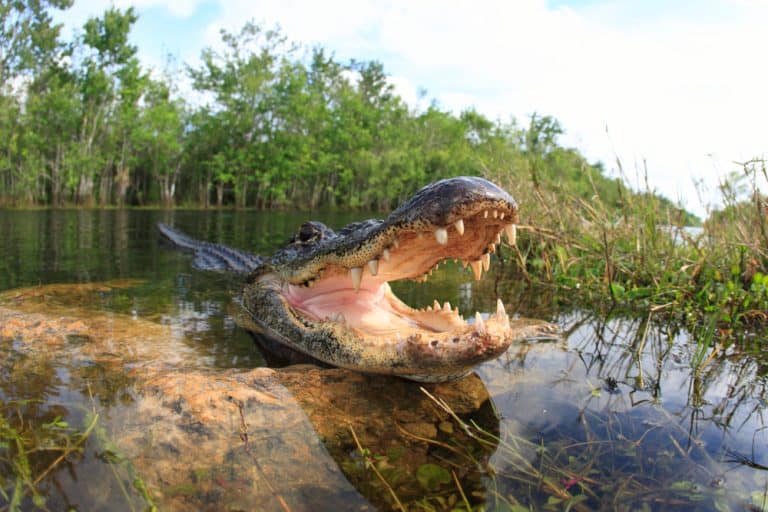
Mugger crocodile Crocodylus palustris Shares river and floodplain habitats, overlapping at basking sites, nesting banks, and fish-rich areas. The mugger has a wider snout and eats fish, mammals, and birds; it may eat gharial eggs and young and competes with gharials for nesting banks.
Saltwater crocodile Crocodylus porosus A large apex crocodilian that uses big rivers, including freshwater, and overlaps the gharial in parts of eastern India. A broad-snouted, generalist top predator that affects prey numbers and the distribution and movements of aquatic animals.
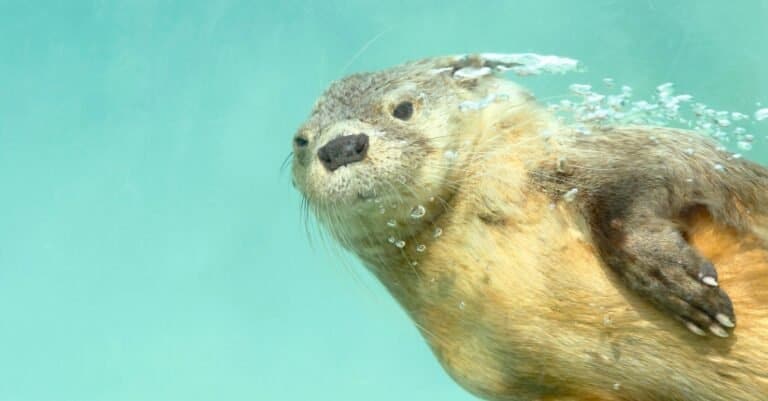
Smooth-coated otter Lutrogale perspicillata Not a crocodilian, but occupies the same riverine niche: feeds primarily on fish, uses sandbanks and river edges, and can compete for fish in shallow channels. Otters may also eat or steal eggs and young.
Ganges river dolphin Platanista gangetica Shares the same large-river corridors and relies heavily on fish. Both are sensitive to river fragmentation, altered flow regimes, and declining fish biomass. While direct interactions are limited, the two are ecological co-indicators of intact, fish-rich, free-flowing river habitat.

Gharials have existed on Earth for more than 200 million years and have changed little in their evolution since.

The gharial is a large-sized reptile that is one of the longest of all extant crocodilians at 11.8-21 feet and lives in slow-moving rivers’ murky waters on the Indian subcontinent. Also known as the Indian gharial, gavial, and fish-eating gharial, this member of the crocodilian family is considered Critically Endangered due to severe population declines over the past 100 years. While it shares part of its name and is in the same family, Gavialidae, as the false gharial (Tomistoma schlegelii), they are two separate species.
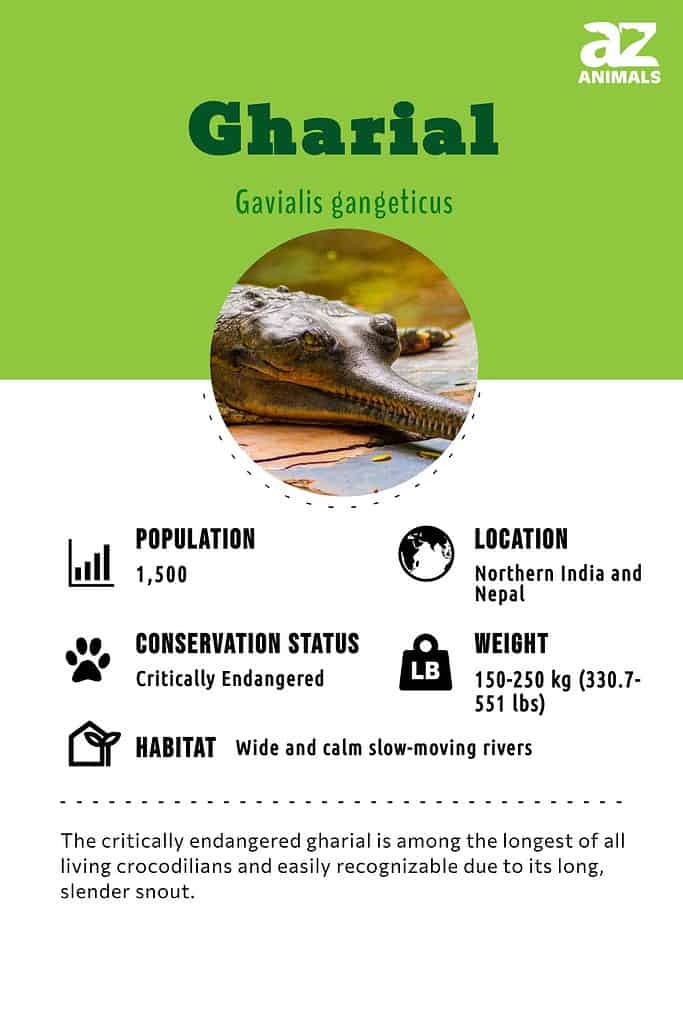
4 Fascinating Facts about Gharials!

  • Gharials have slit-like pupils that open wide during the darkness of night to allow them to see better. This night vision is also greatly improved by a special layer at the back of the eye, which reflects as much light as possible into their eyes.
  • Due to the fact that their eyes are set so close together and face forward, gharials are able to see in three dimensions which helps them to judge distances more accurately.
  • Gharials have a special, transparent third eyelid that they are able to cover each eye with to protect them when they fully submerge themselves in the water.
  • They have external flaps that close over their ears and nostrils to protect them from the incoming water, and a flap that closes at the back of their mouths to prevent water from entering their lungs.

Scientific Name

The gharial’s scientific name is Gavialis gangeticus, with gangeticus meaning “of the Ganges” in reference to the Ganges River. The animal’s original scientific name was Lacerta gangetica, described by Johann Friedrich Gmelin in 1789. Subsequent taxonomic changes by naturalists led to the current name.

The common name gharial is in reference to the resemblance of the adult male’s snout to an Indian clay pot called a “ghara.” The ghara helps the gharial’s vocalizations by creating a loud buzzing and also assists them in attracting females.

It’s also known as the Indian gharial, gavial, fish-eating gharial, and long-nosed crocodile.
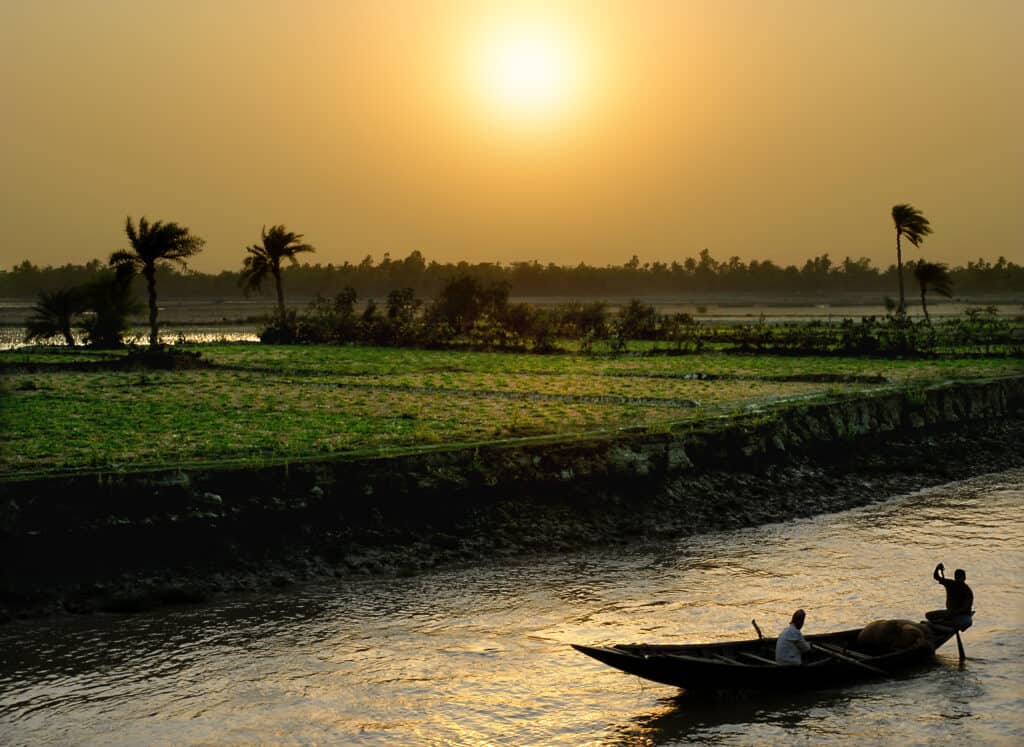
The Ganges River at sunset

The gharial’s scientific name Gavialis gangeticus refers to the Ganges River.

Evolution and Origins

Closely related to other crocodilians in the Crocodilia order that includes crocodiles, alligators, and caimans, gharials are animals that have existed on Earth for more than 200 million years and have changed little in their evolution since. Like the other members of Crocodilia, gharials are archosaurs, which is a group of reptiles that included the dinosaurs and are not closely related to other more modern reptile species that belong to a separate group completely.

However, unlike the dinosaurs which disappeared 65 million years ago, the adaptations that crocodilians possess mean that they are incredibly well adapted to their habitats and have therefore been able to continue to exist as a species.
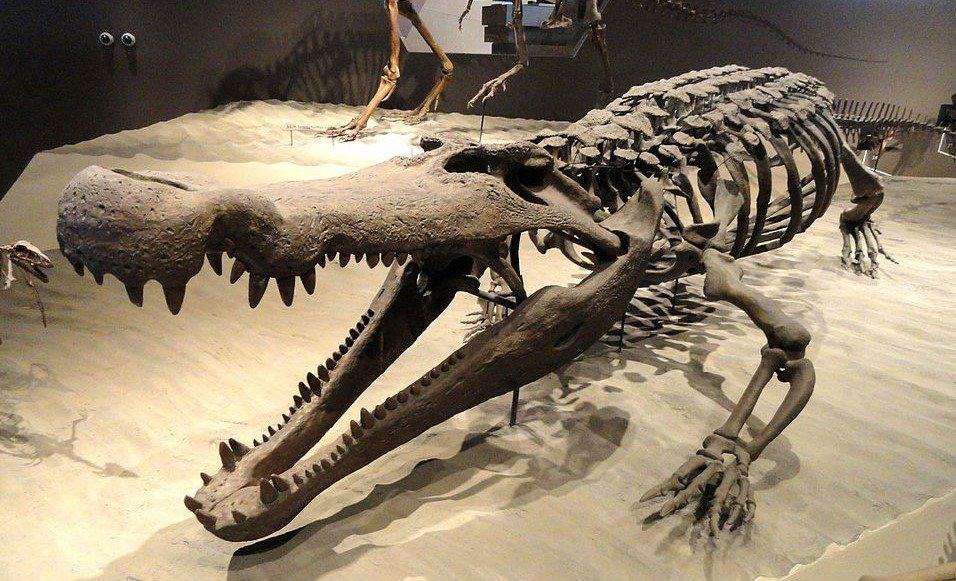
Largest Crocodiles Ever Deinosuchus

Gharials are part of the Crocodilia order, which includes the extinct genus Deinosuchus.

Appearance

Gharials share a number of characteristics with other crocodilian species including the hard, plate-like scales that protect their bodies from both sunburn and attack from predators. These olive or grey-colored toughened scales are also waterproof and help to prevent their body from drying out.

It is one of the longest of living crocodilians capable of growing 11.8 to 21 feet long and typically weighs around 330 to 551 lbs.

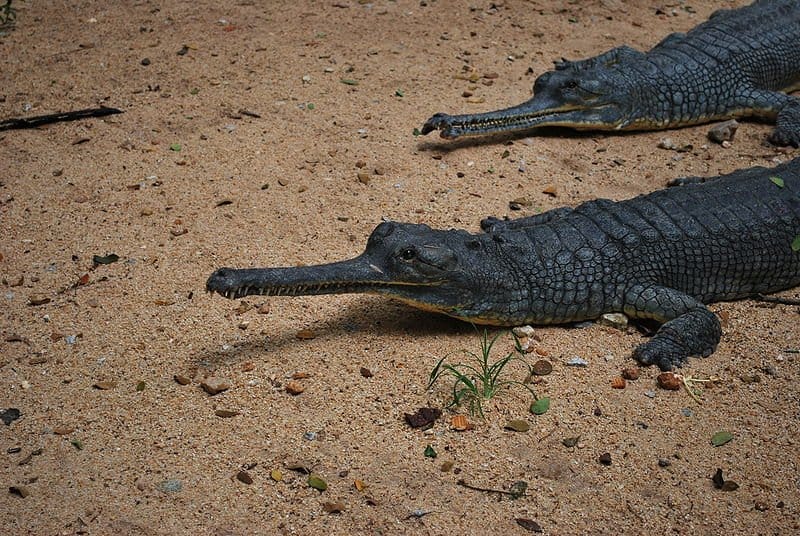
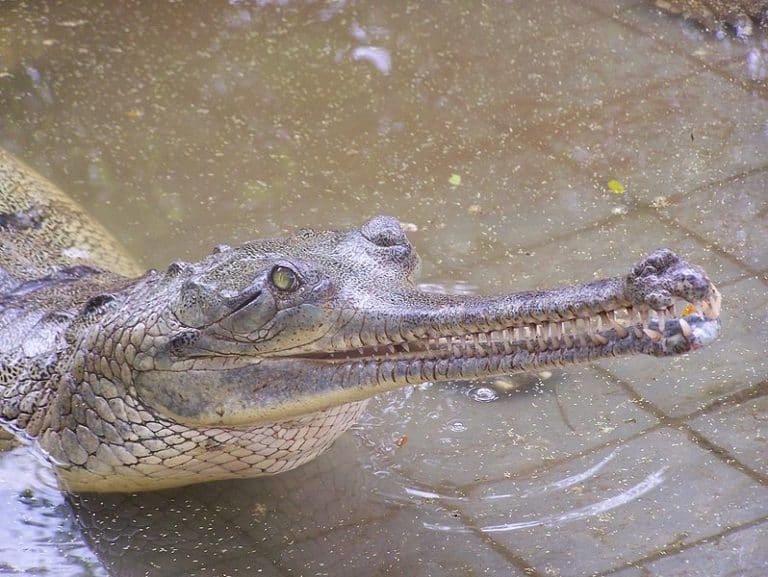
The gharial is easily recognizable among crocodilians due to its long, slender snout which is lined with small and incredibly sharp interlocking teeth. Male gharials have a bulbous growth on the end of their long snout which is used for making vocalizations and for blowing air bubbles in the water which are important in their mating displays.

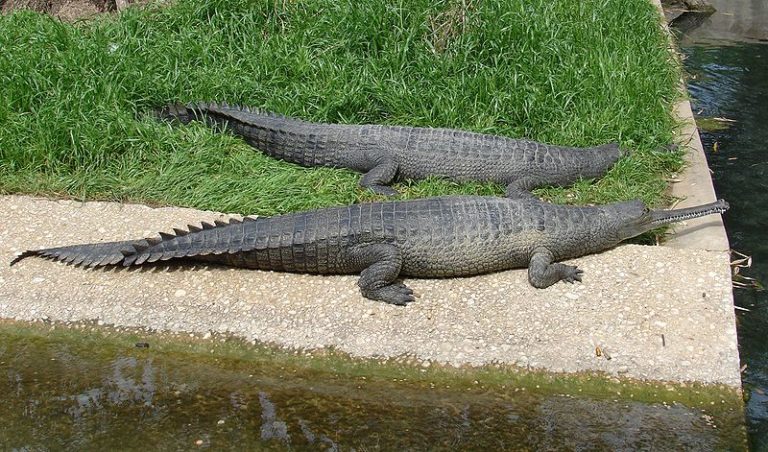
Unlike crocodiles and alligators that have strong hind legs and can move quickly on land, the legs of the gharial are comparatively weak and are not suitable for moving around on land. Gharials therefore spend most of their time in the water, only leaving to bask in the sun on the muddy banks and to lay their eggs.

Gharials are animals that have eyes that are situated on the very top of their head which allows them to remain submerged and unseen by both prey species and potential predators whilst still allowing them to keep watch on their surroundings. The same applies to their nostrils at the end of their long snout, which means that they can still breathe but can stay hidden for long periods of time.
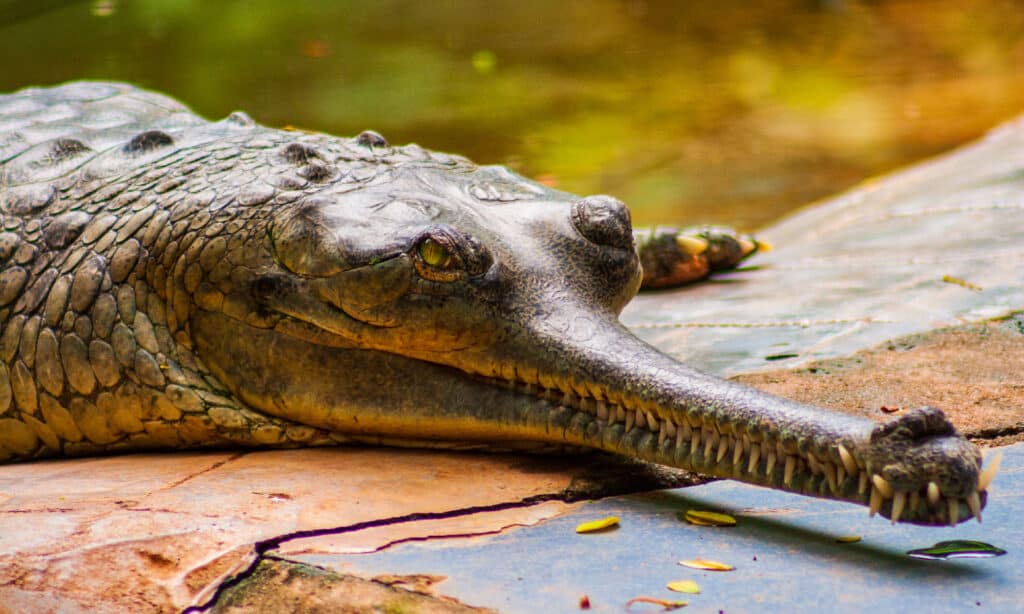
Arignar Anna Zoological Park

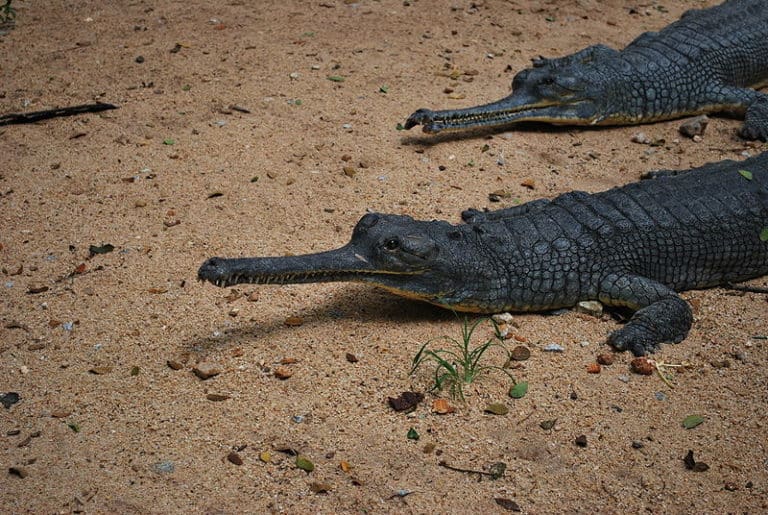
The gharial is easily recognizable among crocodilians due to its long, slender snout.

Behavior

Unlike other crocodilian species that are semiaquatic and even hunt on land in some cases, gharials spend almost all of their time in the water and only leave to warm their bodies up by basking in the sun and to make nests.

In the same way as similar species, gharials are unable to regulate their body temperature internally and instead rely on their surroundings to do it for them. Their weak leg muscles mean that gharials have to drag themselves onto the river banks. By basking in the sun, they are able to warm their bodies up in order to gain the energy that they need for hunting and are then able to cool them down when they are submerged in the water.

When they enter the water, gharials sink their bodies down leaving just their eyes and nostrils exposed on the surface. Their bodies and tail hang down when they are floating and their hind feet act as brakes to stop them from sinking completely. Gharials use their webbed toes which are spread widely and allow them to descend slowly down without disturbing the water when they are trying to remain hidden from predators.

Unlike other members of the crocodilian family that can (and do) pose a threat to human life as they are able to hunt people, the narrow shape of the gharial’s snout means that they are unable to hunt people and therefore don’t.
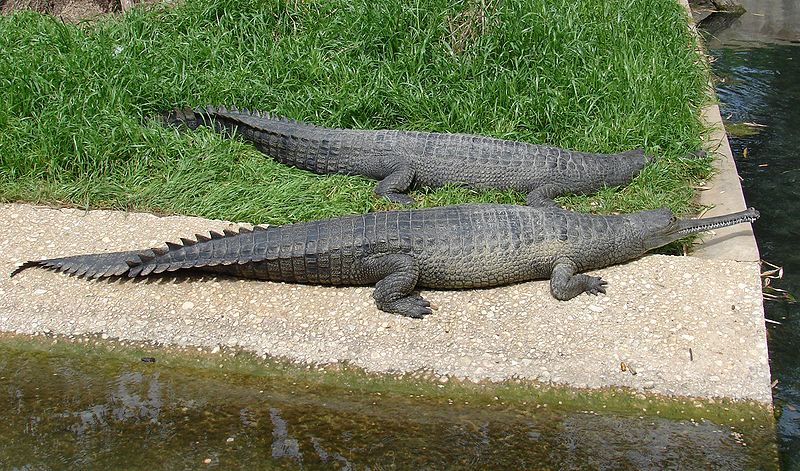
Gharials bask in the sun’s rays to warm up and gain energy.

Habitat

Historically, gharials had a wide distribution throughout the Indian subcontinent from Pakistan in the west, across to parts of Myanmar and south into India. Today however, they are confined to small and increasingly more isolated regions in Northern India and Nepal. They prefer the calmer, wide backwaters of slow-moving rivers where they are able to swim more easily using their flattened tails and webbed hind feet.

The degradation of their freshwater habitats has had enormous implications for gharials and has contributed to their severe population decline in modern times. Their almost solely aquatic lifestyle means that gharials are heavily dependent on healthy river systems, and when these decline so do the number of individuals that exist in them.
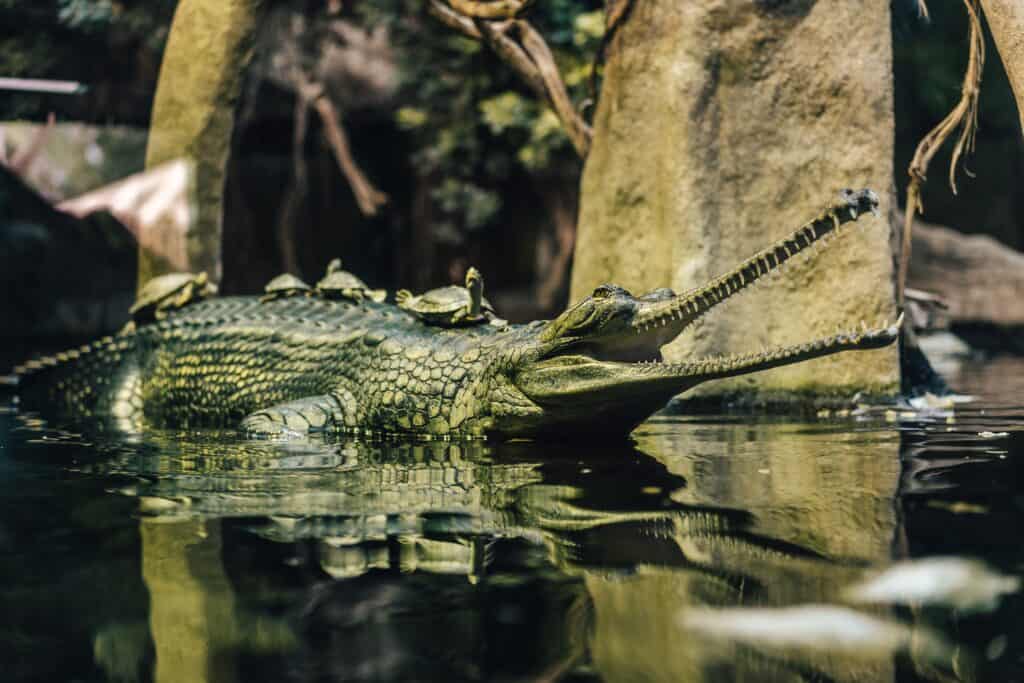
Gharials (and turtles) live in freshwater habitats.

Diet

Gharials are carnivorous reptiles that primarily feed on fish in the water but will also sometimes take aquatic birds should the opportunity arise. Their specially adapted long, thin snouts contain over 100 small, razor-sharp teeth which are used to sink into their prey when they snap their powerful jaws shut. Gharials, are unable to chew their food and instead swallow it whole.

Gharials use sensors to detect vibrations in the water that signalizes approaching prey. They catch fish in the water by lying in wait before quickly snapping them side-on and flicking them back into their mouths and swallowing them headfirst.

Juvenile gharials that haven’t refined their techniques at successfully catching the slippery fish, will also often feed on small crustaceans and frogs that they find in the water. The delicate shape of their narrow jaws means that gharials are unable to catch larger prey species.
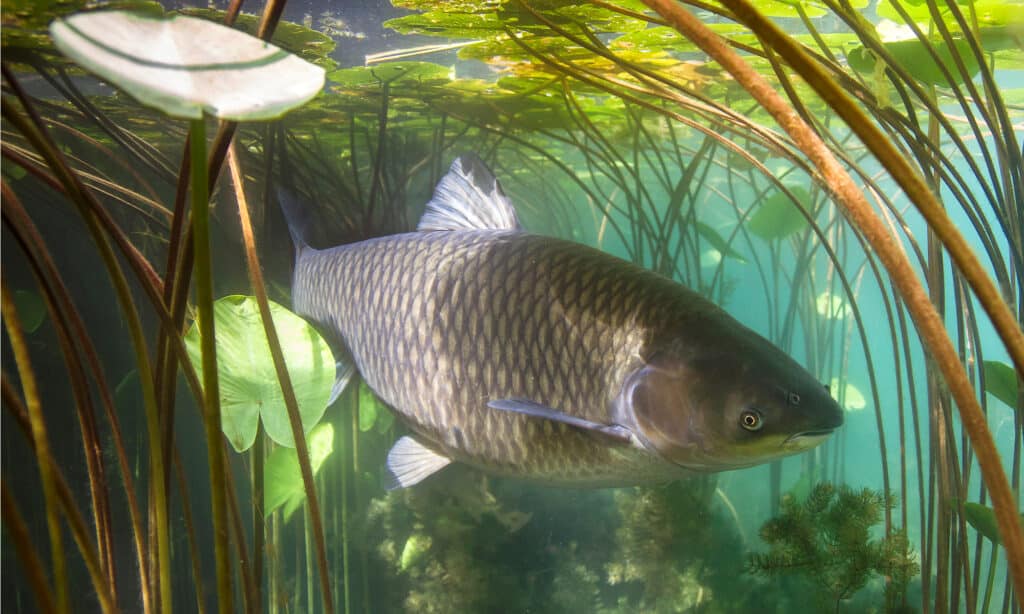
grass carp

Gharials are carnivorous and mainly feed on fish such as grass carp.

Predators and Threats

Due to their large size and aquatic nature, adult gharials have no real natural predators within their environments. The smaller and more vulnerable juveniles though are threatened by a number of animal species including birds of prey and large reptiles including snakes.

People are really the only threat to gharials in their natural environment. They have been excessively hunted for their skins and meat throughout their once wide range, and nests are often raided by people for their eggs. Gharials have also been hunted as their body parts are used in some traditional medicines.

Hunting aside, gharials are also heavily threatened by habitat loss which has played a major part in their demise as a species throughout much of their natural range. Not only have they been affected by the degradation in the quality of the water, but also human interferences such as mining, net fishing, and dams to create land for agriculture and grazing have had a severe impact on the abundance of these freshwater habitats and therefore, gharial population numbers. The increase in human activity in their native environments has pushed the remaining gharial populations into smaller and increasingly isolated regions and they are now therefore only found in two countries.
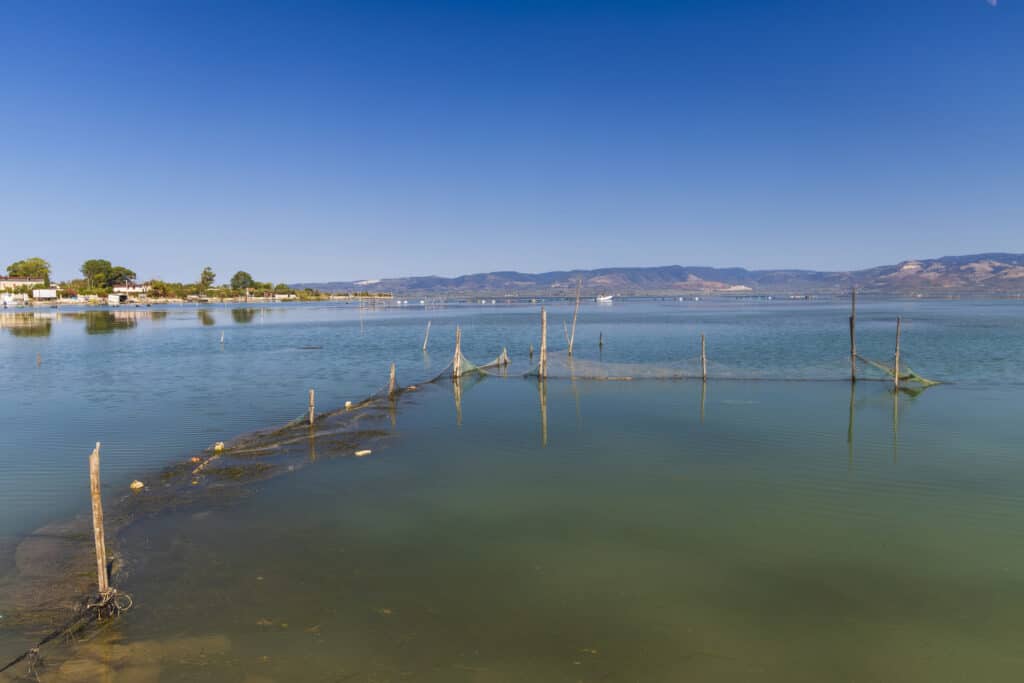
Human interferences such as net fishing create habitat loss.

Reproduction, Babies, and Lifespan

During the mating season, male gharials become fiercely territorial and use vocalizations and bubble displays created by the bulbous bump on the end of their snout to attract and assemble a harem of females which they mate with in the water. After mating, female gharials leave the water to lay their eggs in a nest that is a good distance away from the water to prevent it from becoming flooded. Between 30 and 50 hard, leathery eggs are laid between March and May that weigh around 150g each.

Female gharials protect their eggs and young when they emerge but unlike other crocodilian species that help their young into the water by carrying them in their mouths, female gharials are unable to do this because of the shape of their snouts. Juvenile gharials remain close to their mothers until they are large enough to defend themselves again predators, and are able to breed when they are around 10 years old.
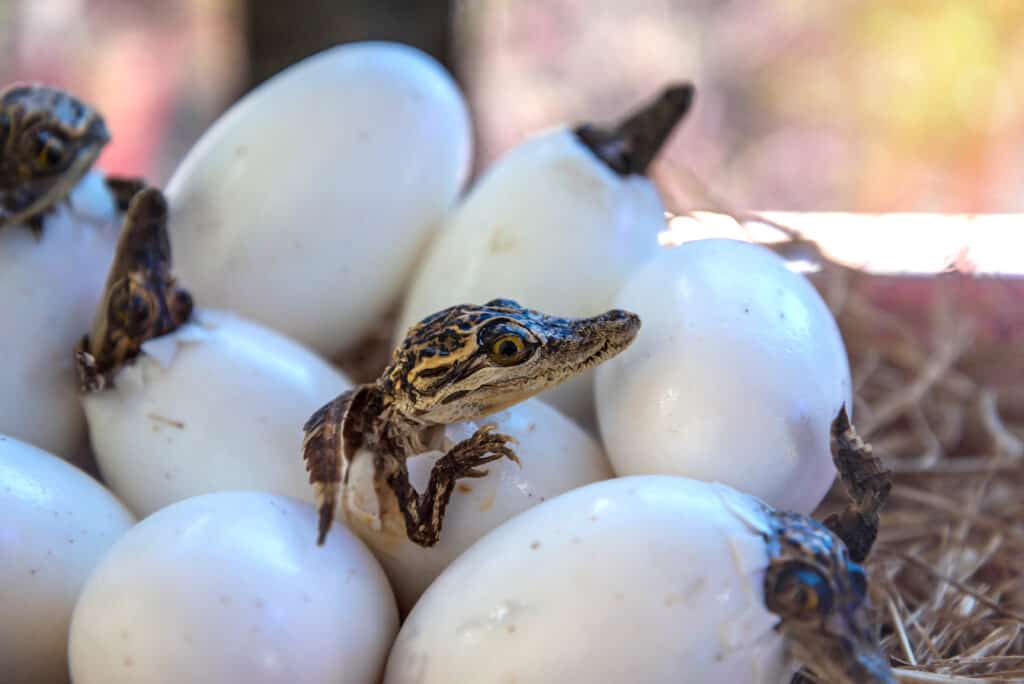
Like other crocodile species, the gharial leaves the water to lay eggs in a nest.

Population and Conservation

Today, the gharial is listed as Critically Endangered in its natural environment by the IUCN. It is estimated that their population numbers have declined by up to 98% over the past century, with gharials nearly becoming extinct in the 1970s due to the severity of hunting and habitat loss. It’s believed that around 1,500 gharials are existing in the wild in India and Nepal habitats.

Gharials are now a protected species and although hunting has certainly decreased, they are still heavily affected by the loss of their habitats and getting caught up in fishing nets, even in areas that are actually protected by law.

IUCN

The IUCN’s Red List classifies the gharial as Critically Endangered.

View all 261 animals that start with G

Sources

  1. David Burnie, Dorling Kindersley (2011) Animal, The Definitive Visual Guide To The World's Wildlife / Accessed May 9, 2018
  2. Tom Jackson, Lorenz Books (2007) The World Encyclopedia Of Animals / Accessed May 9, 2018
  3. David Burnie, Kingfisher (2011) The Kingfisher Animal Encyclopedia / Accessed May 9, 2018
  4. Richard Mackay, University of California Press (2009) The Atlas Of Endangered Species / Accessed May 9, 2018
  5. David Burnie, Dorling Kindersley (2008) Illustrated Encyclopedia Of Animals / Accessed May 9, 2018
  6. Dorling Kindersley (2006) Dorling Kindersley Encyclopedia Of Animals / Accessed May 9, 2018
  7. IUCN Red List / Published March 1, 2007 / Accessed May 9, 2018
Catherine Gin

About the Author

Catherine Gin

Catherine Gin has more than 15 years of experience working as an editor for digital, print and social media. She grew up in Australia with an alphabet of interesting animals, from echidnas and funnel-web spiders to kookaburras and quokkas, as well as beautiful native plants including bottlebrushes and gum trees. Being based in the U.S. for a decade has expanded Catherine's knowledge of flora and fauna, and she and her husband hope to have a hobby farm and vegetable garden in future.

Thank you for reading! Have some feedback for us?


Gharial FAQs (Frequently Asked Questions)

Gharials are carnivores, meaning they eat other animals.