





G
Species Profile

Gorilla

Gorilla

Gentle giants of the African forests
Jeff W. Jarrett/Shutterstock.com

Gorilla Distribution

Click a location to explore more animals from that region

Endemic Species
Loading map...

Size Comparison

Human 5'8"
Gorilla 4 ft 11 in

Gorilla stands at 87% of average human height.

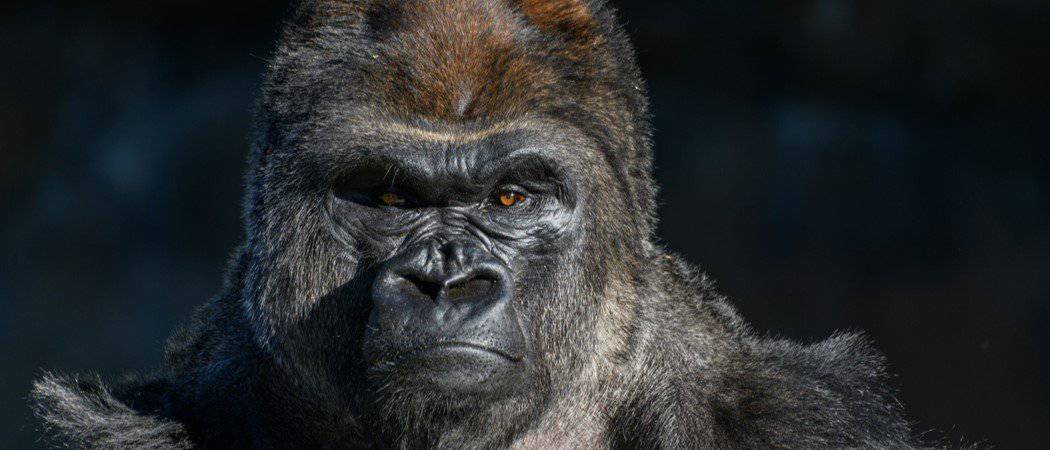
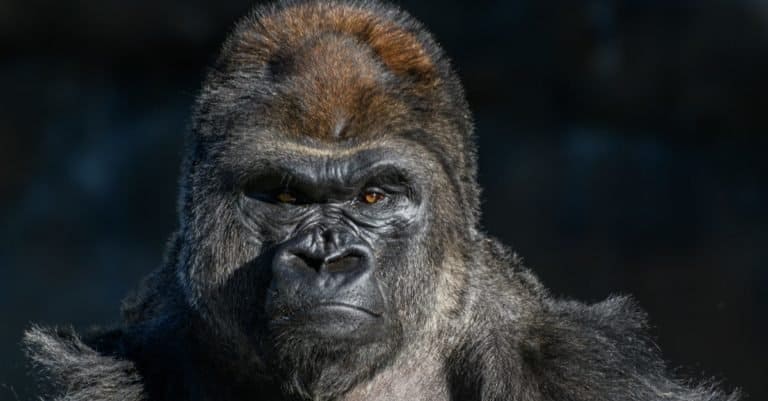
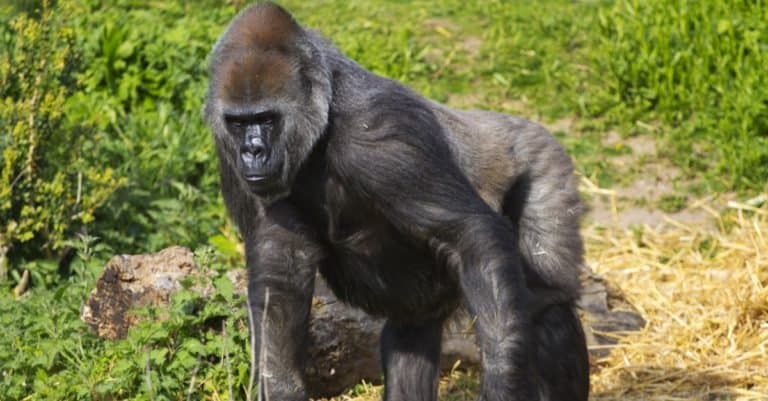
western Lowland Gorilla (Gorilla, gorilla, gorilla) with strong, angry look on face

At a Glance

Genus Overview This page covers the Gorilla genus as a group. Stats below are general traits shared across the genus.
Also Known As great ape, ape, silverback
Diet Herbivore
Activity Diurnal+
Lifespan 35 years
Weight 270 lbs
Status Endangered
Did You Know?

Size range across the genus: adult males ~135-220+ kg, females ~70-110 kg; standing height about ~1.2-1.8 m (females smaller, males larger).

Scientific Classification

Genus Overview "Gorilla" is not a single species but represents an entire genus containing multiple species.

Gorillas are the largest living primates and are one of the great apes (family Hominidae). They are primarily terrestrial, herbivorous/folivorous, highly social, and live in cohesive groups typically led by a dominant adult male (a "silverback"). The genus comprises two living species (western and eastern gorillas) with multiple subspecies.

Kingdom
Animalia
Phylum
Chordata
Class
Mammalia
Order
Primates
Family
Hominidae
Genus
Gorilla

Distinguishing Features

  • Very large-bodied great apes with long arms and predominantly knuckle-walking locomotion
  • Pronounced sexual dimorphism; mature males often develop a silver-grey saddle ("silverback")
  • Primarily plant-based diet with regional variation (more fruit in western lowland gorillas; more leaves/stems in mountain gorillas)
  • Complex social behavior and communication (vocalizations, gestures, chest-beating displays)

Physical Measurements

Males and females differ in size

Height
5 ft 7 in (4 ft 7 in – 6 ft 3 in)
4 ft 3 in (3 ft 9 in – 4 ft 11 in)
Length
5 ft 3 in (3 ft 7 in – 6 ft 3 in)
Weight
397 lbs (298 lbs – 485 lbs)
176 lbs (110 lbs – 265 lbs)
Top Speed
25 mph
Short sprints ~40 km/h

Appearance

Primary Colors
Secondary Colors
Skin Type Gorillas have dense, coarse hair over most of their bodies and mostly hairless, thick dark skin on face, ears, palms, and soles; some have sparse chest or belly hair. Color: dark gray to black.
Distinctive Features
  • Adult female gorillas usually weigh about 70–114 kg; adult males usually 136–227+ kg, with the largest (especially eastern gorillas) sometimes 200–270 kg. Body length about 1.1–1.7 m; standing height 1.4–1.8 m.
  • Robust, barrel-chested build with very long forelimbs adapted for knuckle-walking; massive shoulders/upper arms; broad hands and feet with strong grasping capability.
  • Large head with pronounced brow ridges; sagittal crest and very powerful jaw musculature especially in adult males (linked to a folivorous diet and chewing demands).
  • Highly variable pelage density and apparent 'shagginess' by region and altitude: montane/highland populations tend to show longer, thicker fur; lowland populations can appear sleeker.
  • Species differ: western gorillas (western lowland, Cross River) often have browner tones and eat fruit seasonally; eastern gorillas (mountain, Grauer's eastern lowland) are larger, eat more leaves, and have dense coats in montane areas.
  • Geographic distribution (genus-wide): disjunct populations across central Africa-from Nigeria/Cameroon (Cross River) through western equatorial forests (e.g., Gabon/Republic of the Congo/Equatorial Guinea) to the eastern range in the DRC and the Virunga/Bwindi region (Rwanda/Uganda/DRC).
  • Gorillas live in groups about 5–30, often led by one dominant male, the silverback, with females and young. Some groups have more than one male. They are usually shy and avoid people; aggression is defensive.
  • Lifespan range across the genus: commonly ~35-40 years in the wild; often ~45-50+ years in captivity (occasionally beyond), depending on care and individual health.
  • All living gorillas are threatened, from Endangered to Critically Endangered. Major threats include habitat loss and fragmentation, poaching (snares), disease outbreaks like Ebola, and conflict or instability in some areas.

Sexual Dimorphism

Gorillas have strong differences between males and females: adult males are much larger and more muscular, develop a sagittal crest, large canines, and often a silver 'saddle' on the back; females are smaller with less cresting and usually no silvering.

  • Much larger overall mass and shoulder breadth; extremely robust forelimbs and chest.
  • Prominent sagittal crest and broader, more massive head; more pronounced brow ridges.
  • Large canines (especially visible during displays) and thicker neck/shoulder musculature.
  • Silverback coloration (silver/gray hair across back/hips) in mature adult males; degree varies by individual and population.
  • More frequent conspicuous display behavior (e.g., chest-beating) associated with dominance and group defense; typically ritualized rather than injurious.
  • Smaller body size and lighter musculature than adult males; more streamlined head profile with less pronounced cresting.
  • Typically uniform dark coat without the extensive silver saddle seen in mature males (though subtle graying with age can occur).
  • Sexual swelling is not a prominent external visual feature compared with some other primates; reproductive status is less visually signaled by coloration.

Did You Know?

Size range across the genus: adult males ~135-220+ kg, females ~70-110 kg; standing height about ~1.2-1.8 m (females smaller, males larger).

The genus has two living species with distinct regional forms: western gorillas (incl. western lowland & Cross River) and eastern gorillas (mountain & Grauer's/eastern lowland).

Diet varies by habitat: all gorillas are mainly herbivorous, but western lowland gorillas often eat more fruit when it's in season, while mountain gorillas rely more on leaves, stems, and herbaceous plants.

All gorillas build sleeping nests daily-often a fresh nest each evening (on the ground or in vegetation depending on age, habitat, and safety).

Group size is flexible: many groups are roughly 5-30 individuals, but some can be much larger; composition changes as juveniles mature and females transfer between groups.

Each gorilla's nose print is individually distinctive and can be used like a natural "fingerprint" for identification in research and monitoring.

Every gorilla taxon is threatened (Endangered or Critically Endangered), with risks differing by region-habitat loss, hunting, disease (notably Ebola in parts of the west), and conflict/mining pressures in parts of the east.

Unique Adaptations

  • Powerful chewing anatomy: large jaws and molars, strong jaw muscles (often with a sagittal crest in adult males) support processing tough vegetation.
  • Hindgut fermentation: an enlarged gut and specialized digestion help extract nutrients from fibrous leaves and stems-key to a largely folivorous lifestyle.
  • High strength with energy-efficient movement: robust limb bones and knuckle-walking distribute weight while traveling on the ground.
  • Thermal adaptation varies within the genus: mountain gorillas have longer, denser fur suited to cooler high-elevation habitats, while lowland forms generally have shorter coats.
  • Manual dexterity: strong, flexible hands (with opposable thumbs) enable stripping stems, peeling, and selective feeding; fine manipulation supports complex foraging.
  • Individual identification traits: nose shape/prints and facial features are distinctive, aiding social recognition within groups and monitoring by researchers.

Interesting Behaviors

  • Cohesive group living: typically a dominant adult male ("silverback") leads a group with females and young; some groups include multiple adult males, and group structure can shift after takeovers or male dispersal.
  • Conflict management and displays: chest-beating, vocalizations, and ground/vegetation displays often serve to intimidate and avoid direct fighting; actual fights are relatively uncommon but can be severe.
  • Knuckle-walking with versatility: gorillas are mainly terrestrial, yet juveniles (and many western lowland gorillas) climb readily; terrestrial vs. arboreal time varies with forest structure and food availability.
  • Daily travel and foraging routines: movement patterns track food distribution-home ranges tend to be larger where fruit is patchier and smaller where abundant leafy foods are consistently available (variation across subspecies/habitats).
  • Social learning and gentle caregiving: youngsters play, wrestle, and learn feeding skills; adult males and females both show tolerance and protection toward infants, though caregiving styles vary by group.
  • Communication is multimodal: grunts, barks, roars, hoots, and softer contact calls combine with gestures and facial expressions; close-range "talk" is often quiet.
  • Tool use and problem-solving occur but are not universal: some populations have been observed using sticks or vegetation to test water depth or stabilize crossing-behaviors can be local and learned rather than genus-wide constants.

Cultural Significance

Gorillas are key symbols in Central Africa and worldwide, shown in stories and art. They shaped wildlife science and support ecotourism (e.g., mountain-gorilla trekking) that can fund protected areas and local jobs, while raising debates about forests, mining, and disease.

Myths & Legends

The word 'Gorilla' comes from a classical story said to be by Carthaginian sailor Hanno, later told by Greeks, who described meeting wild, hairy people — inspiring the modern scientific name.

Congo Basin forest-ape tales: in parts of Central Africa, traditional narratives and later retellings describe powerful, elusive forest apes that some outsiders associated with gorillas, blending local storytelling with traveler accounts.

19th-century explorers and missionaries wrote that gorillas were fearsome 'giants of the forest.' Those scary stories became modern folklore in the West until later scientific field studies changed that view.

Modern cultural mythology: films and literature (especially 20th-century adventure stories) turned gorillas into recurring archetypes-protector, monster, or misunderstood kin-creating widely shared contemporary legends that still influence public attitudes toward conservation.

Conservation Status

EN Endangered (genus-level summary; living Gorilla taxa span Endangered to Critically Endangered on the IUCN Red List)

Facing a very high risk of extinction in the wild.

Population Decreasing

Protected Under

  • CITES Appendix I (Gorilla spp.)
  • Protected under national wildlife laws across range states (enforcement strength varies)
  • Occurs in numerous protected areas and transboundary landscapes (e.g., Virunga, Bwindi, Volcanoes NP; and multiple Central African national parks/reserves such as Nouabalé-Ndoki, Odzala-Kokoua, Loango and others) with varying management effectiveness

You might be looking for:

Western gorilla

50%

Gorilla gorilla

The more widespread gorilla species in west-central Africa; includes western lowland and Cross River gorillas.

View Profile

Eastern gorilla

40%

Gorilla beringei

Eastern-central African gorilla species; includes mountain and eastern lowland (Grauer's) gorillas.

View Profile

Mountain gorilla

7%

Gorilla beringei beringei

High-altitude subspecies of eastern gorilla from the Virunga Massif and Bwindi; famous conservation icon.

View Profile

Western lowland gorilla

3%

Gorilla gorilla gorilla

Most numerous gorilla subspecies, inhabiting lowland tropical forests of west-central Africa.

View Profile

Life Cycle

Birth 1 infant
Lifespan 35 years

Lifespan

In the Wild
25–45 years
In Captivity
35–60 years

Reproduction

Mating System Polygyny
Social Structure Harem Based
Breeding Pattern Long Term
Fertilization Internal Fertilization
Birth Type Internal_fertilization

Gorilla (genus) are mostly polygynous: one dominant male (silverback) leads a long-term harem of several breeding females and young. Some groups have multiple males; mothers give primary care while silverbacks protect the group.

Behavior & Ecology

Social Troop Group: 12
Activity Diurnal, Crepuscular
Diet Herbivore Seasonally available ripe fruit where abundant; otherwise tender leaves and pith from herbaceous plants

Temperament

Generally calm, deliberate, and socially tolerant within the group, with extensive affiliation (resting in proximity, play among young, gentle caregiving)
Strongly protective leadership by dominant males; threat displays (including charges) can escalate to aggression during intergroup encounters, predator/human disturbance, or male-male competition
Females and males typically disperse at maturity (patterns and timing vary among species/subspecies), which can shape troop cohesion, mating competition, and rates of instability
Shyness/avoidance vs tolerance of close approach varies substantially by habitat type, hunting pressure, and degree of habituation (notably in some research/tourism populations)

Communication

Grunts Contact/foraging, reassurance
Barks Alarm/alert, agitation
Roars High-intensity threat
Screams Distress, aggression
Whines/whimpers Appeasement, infant contact
Hoots/chuckles/laughter-like sounds Social excitement, play; usage varies by context and population
Chest-beating Long-range display; intensity and use vary by male status and context
Body postures and locomotor displays Standing tall, charging, ground-slapping, vegetation throwing
Facial expressions Stare threats, lip retraction, relaxed open-mouth play face
Gestural communication Reach, present, push/pull, directed arm/hand gestures; flexible use varies among groups
Tactile communication Grooming is less frequent than in some other apes but includes touching, embracing, and infant handling; play contact is common in young
Proximity/spacing and following behavior Leading, herding, regrouping cues

Habitat

Biomes:
Tropical Rainforest Wetland Alpine
Terrain:
Mountainous Hilly Plateau Plains Valley Riverine Volcanic Muddy Island +3
Elevation: Up to 13123 ft 4 in

Ecological Role

Large-bodied herbivorous browser and ecosystem engineer in African tropical forests (and adjacent montane habitats), influencing plant communities through selective feeding and movement patterns.

Seed dispersal (especially for fleshy-fruited plants; effectiveness varies with fruit availability and seed survival through gut passage) Vegetation structure modification via browsing and stem breakage, shaping understory composition Nutrient cycling through dung deposition and redistribution of plant material across the landscape Creation/maintenance of trails and small clearings that can affect plant regeneration and provide access routes for other animals Potential facilitation of plant germination via deposition of seeds in nutrient-rich dung in disturbed microsites

Diet Details

Other Foods:
Leaves Herbaceous vegetation Pith Bark and cambium Fruits Flowers Roots and tubers Seeds Fungi Soil and clay +4

Human Interaction

Domestication Status

Wild

Gorillas (genus Gorilla) are not domesticated and never were. Human interactions include hunting and poaching (bushmeat and infant capture), conservation actions like protected areas and anti-poaching patrols, scientific research and limited habituation for study or tourism, and care in accredited zoos and sanctuaries, with disease and welfare risks.

Danger Level

Moderate
  • Severe injury if a gorilla is threatened, cornered, habituated improperly, or defending infants (bites, crushing blows).
  • Risk increases with close approach, illegal capture attempts, or keeping individuals in captivity/private settings.
  • Zoonotic disease transmission in both directions (e.g., respiratory viruses) during close contact, tourism, research, or caregiving.
  • Human-safety incidents associated with habitat encroachment, snares, and conflict situations near settlements.

As a Pet

Not Suitable as Pet

Legality: Gorillas are generally illegal or very strictly restricted as pets worldwide. They are protected under CITES Appendix I and most laws; only approved zoos, research centers, or licensed sanctuaries may have them.

Care Level: Expert Only

Purchase Cost:
Lifetime Cost: $1,000,000 - $5,000,000

Economic Value

Uses:
Ecotourism (guided viewing, permits, local employment) Conservation funding and ecosystem services (flagship/umbrella species) Scientific and educational value (behavior, cognition, ecology, public education) Cultural significance (local and global heritage) Illegal economic activity (poaching, bushmeat, trafficking of infants) - harmful and prohibited
Products:
  • non-consumptive tourism services (permits, guiding, lodging spillover)
  • education and conservation programming
  • research outputs (data, publications) rather than commercial products
  • no legitimate commodity products; any trade in live gorillas or parts is illegal

“The gorilla is one of the closest living relatives to humans.”

The name gorilla actually refers to four different subspecies of animals. They share 98 percent of their DNA with humans, and they are smart enough to learn sign language and use tools. Gorillas are far from the wild, violent beasts portrayed in entertainment, and they could even be considered rather shy. The wild population of gorillas is in rapid decline, and they are critically endangered. The average gorilla is as much as four times as strong as a human.
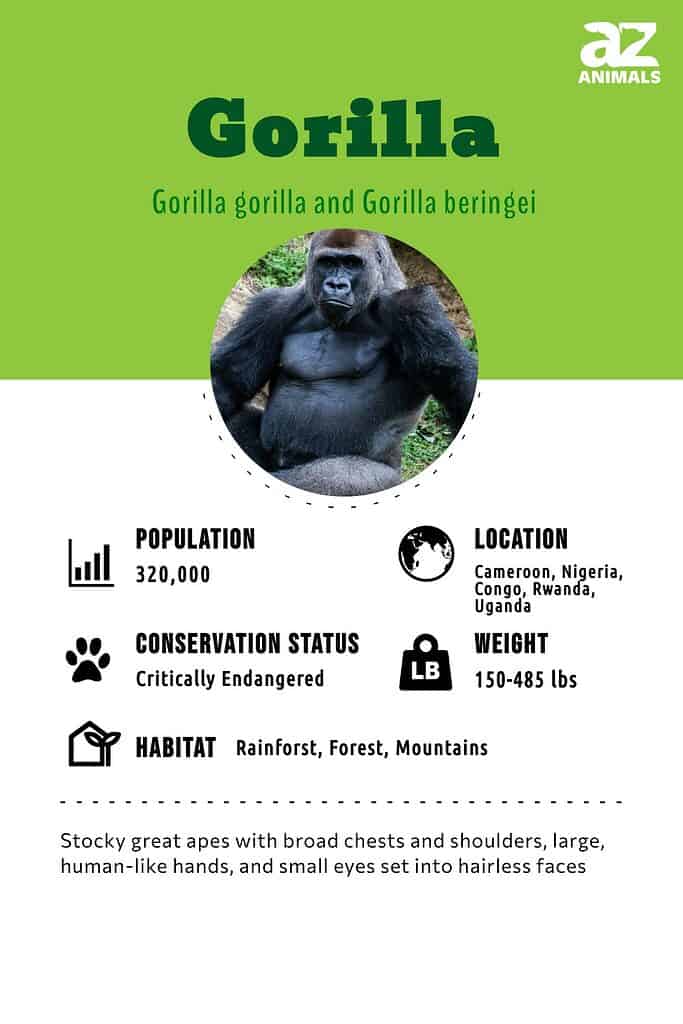
Gorilla Infographic
There are only 320,000 gorillas left in the wild.

6 Incredible Gorilla Facts!

  • Despite their massive size and impressive strength (learn about the strongest animals in the world here), these great apes are primarily vegetarians.
  • Wild gorillas live only 35 years, but the oldest captive gorilla lived until the age of 63.
  • An adult is capable of bending an iron bar with only their hands.
  • These animals are actually quite shy, and they will normally choose to flee if given the opportunity when threatened.
  • Healthy adults have no natural predators.
  • Ape vs. Gorilla: Gorillas are larger than other ape species and can weigh twice as much as the largest orangutans and more than five times the size of mandrills!

You can check out more incredible facts about gorillas.

Scientific Name

Gorilla is the genus that is commonly used to refer to two species of great apes that are divided further into four total subspecies. The western gorilla (Gorilla gorilla) is split into the western lowland gorilla with the scientific name Gorilla gorilla gorilla and the Cross River gorilla (Gorilla gorilla diehli). The eastern gorilla (Gorilla beringei) is comprised of the eastern lowland gorilla (Gorilla beringei graueri), which is also known as the Grauer’s gorilla, and the mountain gorilla with the scientific name Gorilla beringei beringei. These scientific names are typically abbreviated with initials for the genus and species while the subspecies are spelled out like G. g. gorilla.

These animals are members of the class Mammalia, the order Primates, and the family Hominidae. The term gorilla itself originates from a word in the ancient African local dialect along the west coast of the continent that translates roughly into a hairy person. This was first recorded by an explorer in the region over 2,500 years ago.
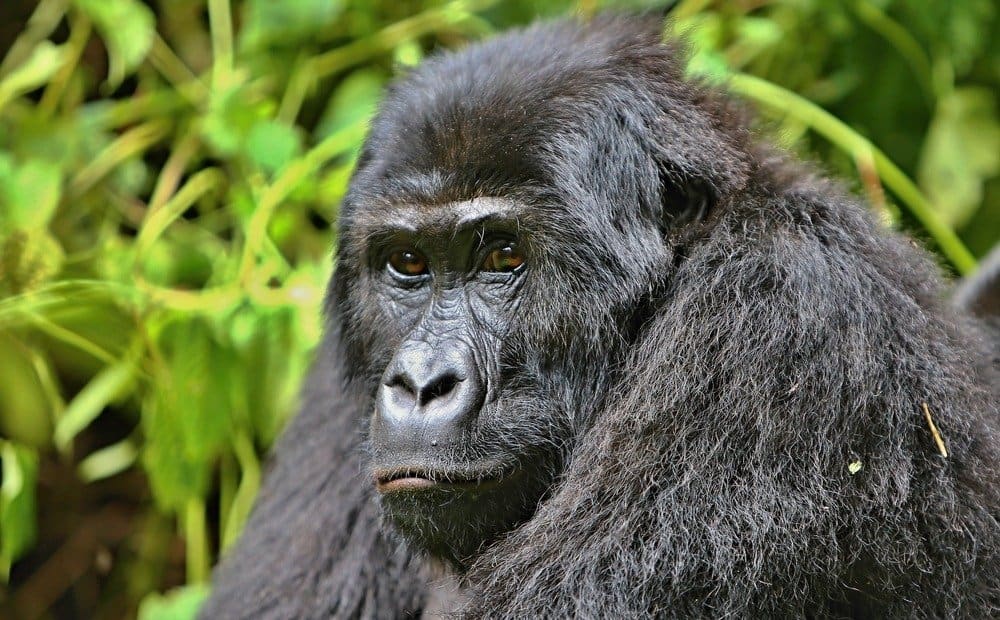
Eastern lowland gorilla — silverback male

Gorillas are members of the class Mammalia, the order Primates, and the family Hominidae.

Evolution and Origin

The evolutionary history of gorillas is not well understood. However, population genetic data has helped researchers better understand the evolution of this species. Molecular geneticists have determined that the population of gorillas split into two groups (western and eastern gorillas) around 77,700 years ago.

The closest relatives of gorillas are humans and chimpanzees. They all diverged from a common ancestor about 7 million years ago. Human gene sequences differ from gorilla sequences by only 1.6% on average. Gorillas were previously thought to be a single species with three subspecies (western lowland, eastern lowland, and mountain gorillas), but it is now agreed that there are two main species, and they each have two subspecies. They all developed from a single type of gorilla during the Ice Age when their forest habitats shrank and became isolated from each other.
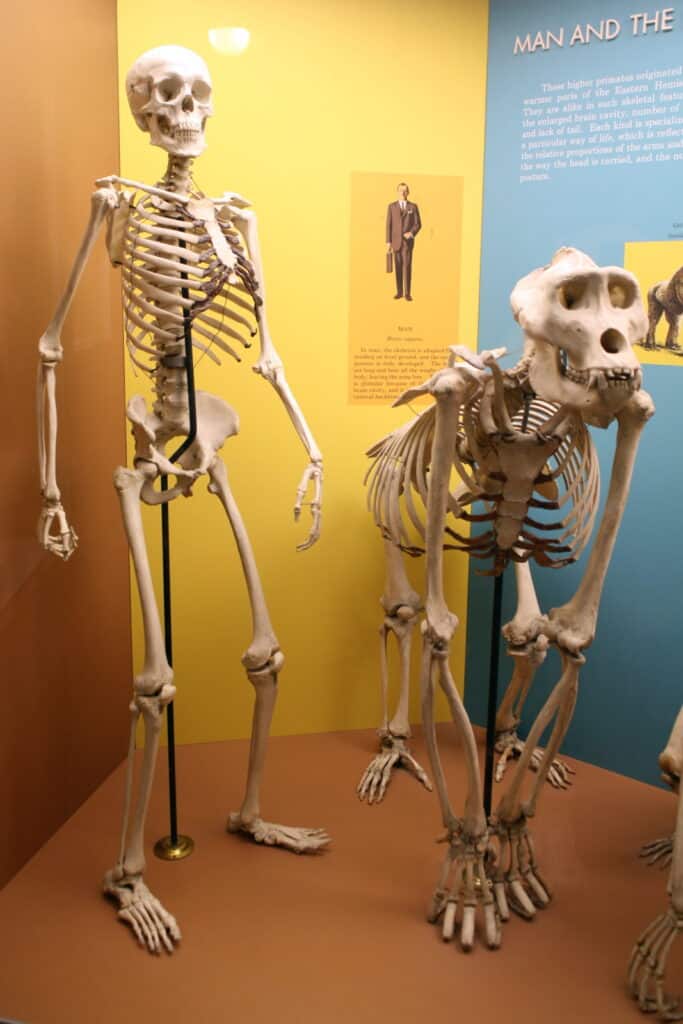
Not the left, a human Skelton, on the right a gorilla Skelton. Three walls (L-r, brown,yellow,blue) are behind the display which appears to be in a museum. On the yellow wall is a poster with a photograph of a male presenting human in a business suit (jacket, trousers,tie) carrying a brief case in his right hand,, with indecipherable verbiage underneath. The blue wall has raised white letters that spell MAN AND THE - rest out of frame. A paragraph of white letters below with information regarding the display.

Human gene sequences differ from gorillas by only 1.6 percent!

Appearance and Behavior

This is an impressively strong animal, and its appearance backs that up. They possess thick chests with wide shoulders and an abdomen that is pushed forward. Adults have long, heavily muscled arms that they use to help propel themselves on their knuckles. Gorillas are covered in black fur except for their faces, hands, and feet; older males also have bare chests. Adult males develop gray or silver hairs in a saddle pattern on their lower back which is why mature males are often referred to as silverbacks. Mountain gorillas have noticeably longer hair than the other three species. Gorillas have truly unique skulls within the animal kingdom.

Male gorillas can grow to nearly five and a half feet tall, with their weight ranging between 300 and 485 pounds. Females generally stay below five feet tall and weigh 150 to 200 pounds. Gorillas living in captivity tend to grow fat and may be much heavier than their wild cousins. The largest recorded gorilla in captivity was Phil of the St. Louis Zoo, who died weighing 776 pounds; that’s bigger than a grizzly bear!

Despite their reputation in the entertainment industry as aggressive, gorillas are actually quite shy unless threatened or harassed. They live in family groups ranging from six members up to 30 that are led by one or two related silverbacks. Generally, the leadership pair are father and son, but it is not uncommon for brothers to lead a troop. The remainder of the group is comprised of females, infants, and juveniles. They are active during the day and primarily move to feed.

Learn more about the toughest animals in the world here.
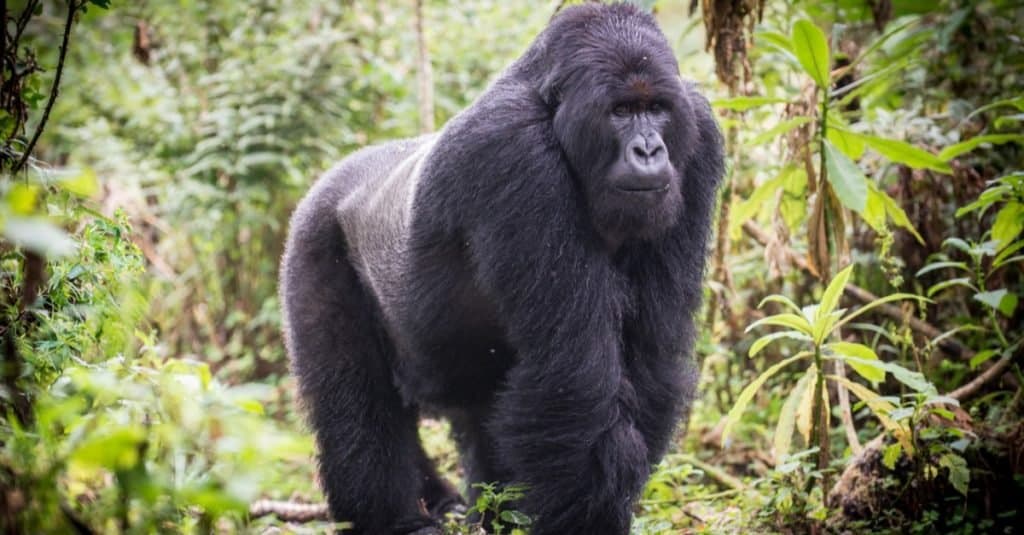
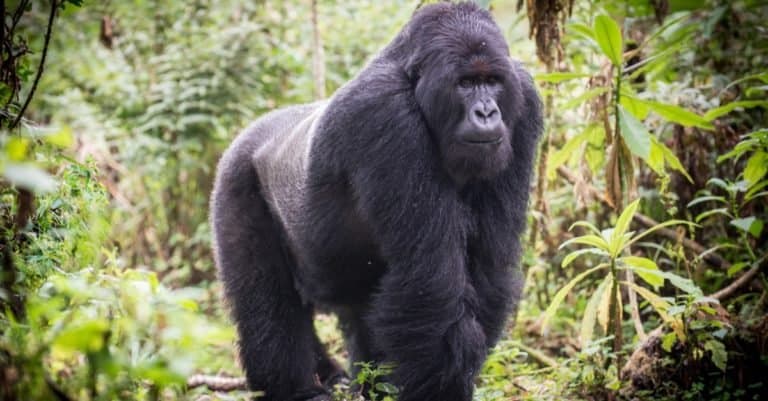
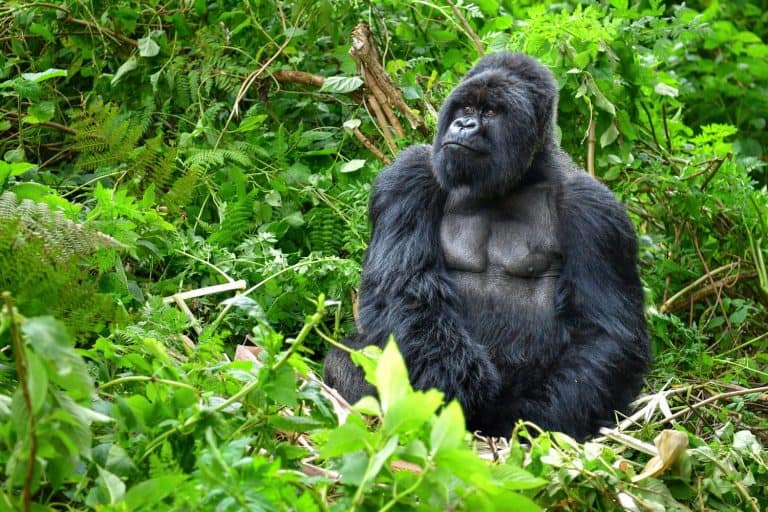
A male silverback mountain gorilla in the Volcanoes National Park, Rwanda

Male gorillas can grow to nearly five and a half feet tall, with their weight ranging between 300 and 485 pounds. Females generally stay below five feet tall and weigh 150 to 200 pounds

Habitat

While all gorillas inhabit the tropical forests of Africa, the specific habitat of gorillas varies widely depending on which of the subspecies you are talking about. The western lowland gorilla lives in the rainforests between Cameroon and the Congo River. The Cross River gorilla resides in only a small forest area between Nigeria and Cameroon, directly on the Cross River. Grauer’s gorilla lives in the rainforests of Congo, and the mountain gorilla lives in the mountain forests of the border region of Rwanda, Uganda, and Congo.

A group of gorillas is called a troop or a band. A troop claims an area between one and 16 square miles, and they will walk short distances throughout that territory to feed. Several bands may inhabit the same area without conflict. They will build nests of vegetation every night, either on the ground or in trees.
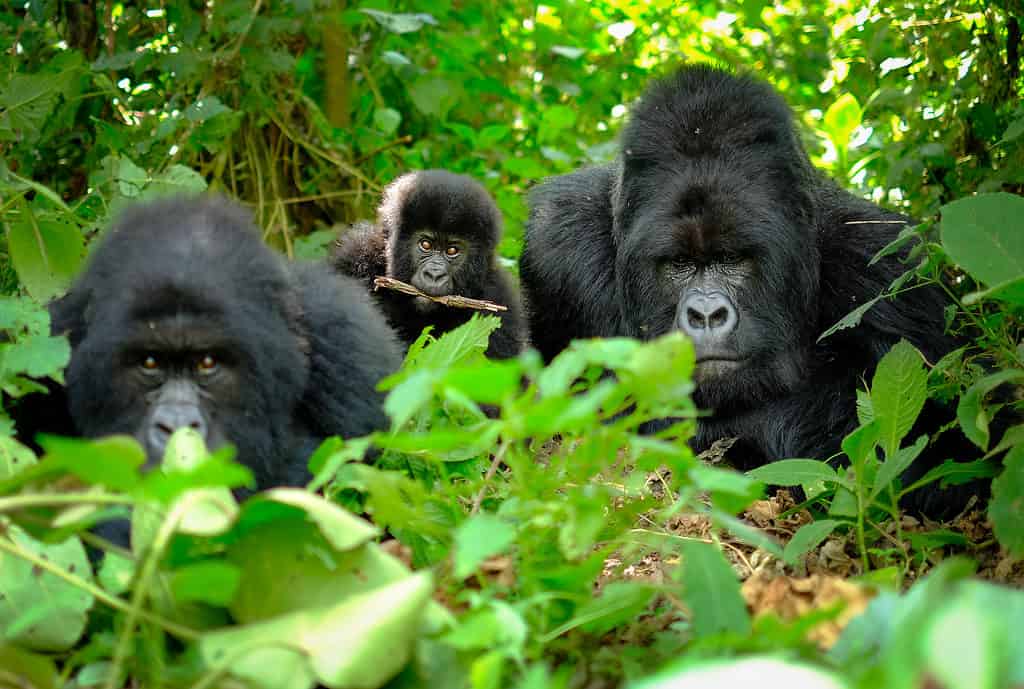
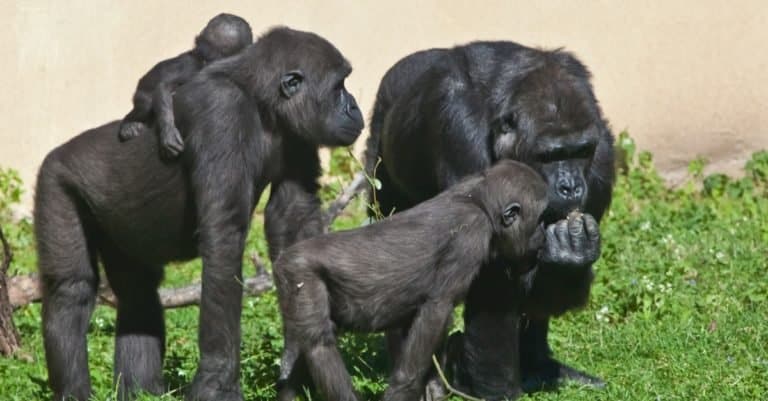
Family of gorillas

A group of gorillas is called a troop or a band. A troop claims an area between one and 16 square miles, and they will walk short distances throughout that territory to feed.

Diet

Most of these animals are vegetarian, but the western lowland gorilla also eats insects.

What eats gorillas?

The short answer is not much. Leopards possess the ability to kill young animals, but they do not have many opportunities since the young rarely stray far from the adults. Scavengers will eat these animals who die from natural causes or injury, but there are no true predators for healthy gorillas.

What does a gorilla eat?

Eastern gorillas thrive on leaves, shoots, and stalks of many different plants, while western gorillas eat more fruit. The western lowland gorilla will smash open termite and ant mounds to eat the insects inside and has been known to eat snails as well. These animals can eat as much as 40 pounds of plant matter per day.

If you’re looking for the full details on what gorillas eat, check out our ‘What Do Gorillas Eat’ guide!
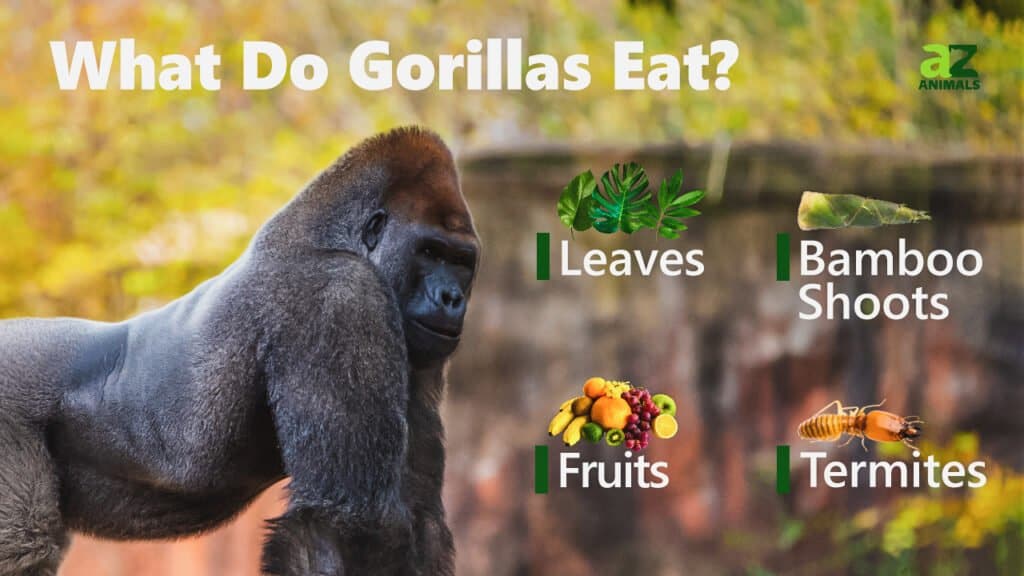
What Do Gorillas Eat
Gorillas eat leaves, bamboo shoots, fruits, and termites.

Predators and Threats

As mentioned earlier, the only true predator of these animals is a leopard. Leopards don’t commonly hunt gorillas due to their sheer size and strength. It makes much more sense for them to focus on less dangerous prey.

Sadly, the greatest threat to these animals comes from humans. Exposure to disease, deforestation, trophy hunting, and even subsistence hunting to feed logging crews have all taken a terrible toll on the gorilla population. Since they share 98 percent of their DNA with humans, many of the diseases that affect our race are also faced by gorilla populations. That is why conservation efforts have focused on eliminating physical contact between humans and wild gorilla populations, as their immune systems can’t handle the diseases that humans transmit.
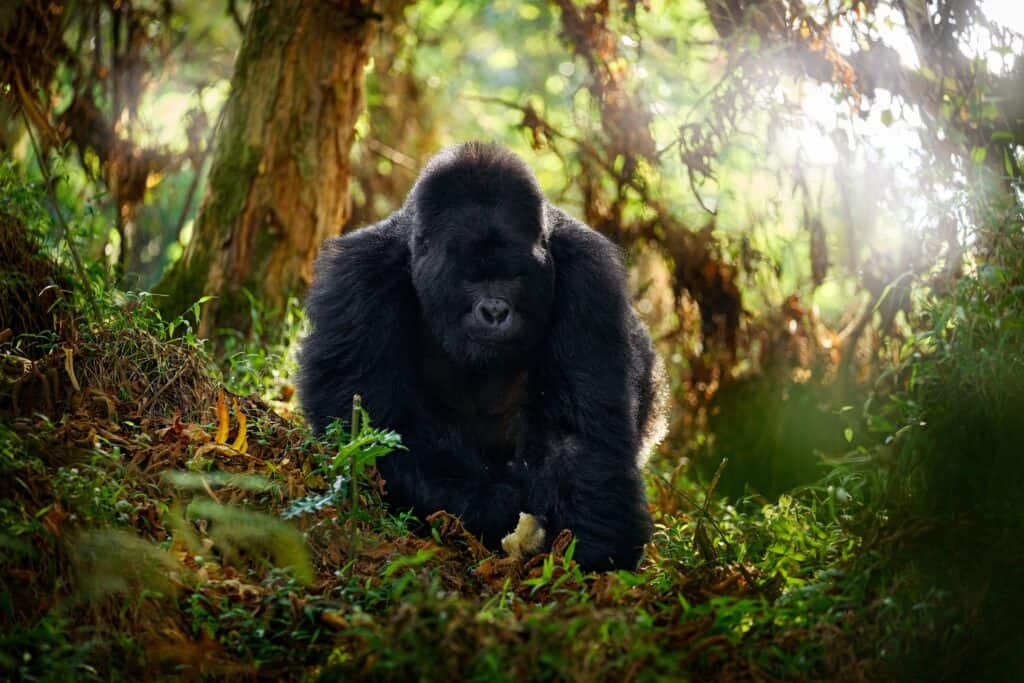
Mountain Gorilla

The greatest threat to gorillas is humans. Exposure to disease, deforestation, trophy hunting, and even subsistence hunting to feed logging crews have all taken a terrible toll on the gorilla population.

Reproduction, Babies, and Lifespan

Females reach sexual maturity around the age of seven or eight years old. Their gestational period is approximately eight and a half months long. On average, they give birth to a sole baby every four years or so. Males mature more slowly, and they attain maturity between 12 and 13 years. Upon reaching maturity, males leave the troop and form their own with adult females that they kidnap from other bands during raids. The juveniles of the troop are all fathered by the one or two silverbacks that lead the group.

A baby is entirely helpless from birth to around three months and spends a good amount of time being carried in its mother’s arms. They also possess the ability to fiercely cling to their mother’s chest or back, but they are not able to care for themselves or walk during that time. A baby gorilla weighs only four to five pounds at birth.

Wild gorillas live anywhere between 20 and 40 years, while captive animals have been known to live well into their 40s. Until recently, the oldest known gorilla living in captivity was a female western lowland gorilla named Trudy. She died at the age of 63 in Little Rock Zoo in 2019. She was also believed to be the last captive gorilla in North America that was captured in the wild. As of 2021, a gorilla named Fatou is believed to be 64 years old. This makes Fatou the oldest gorilla in the world.
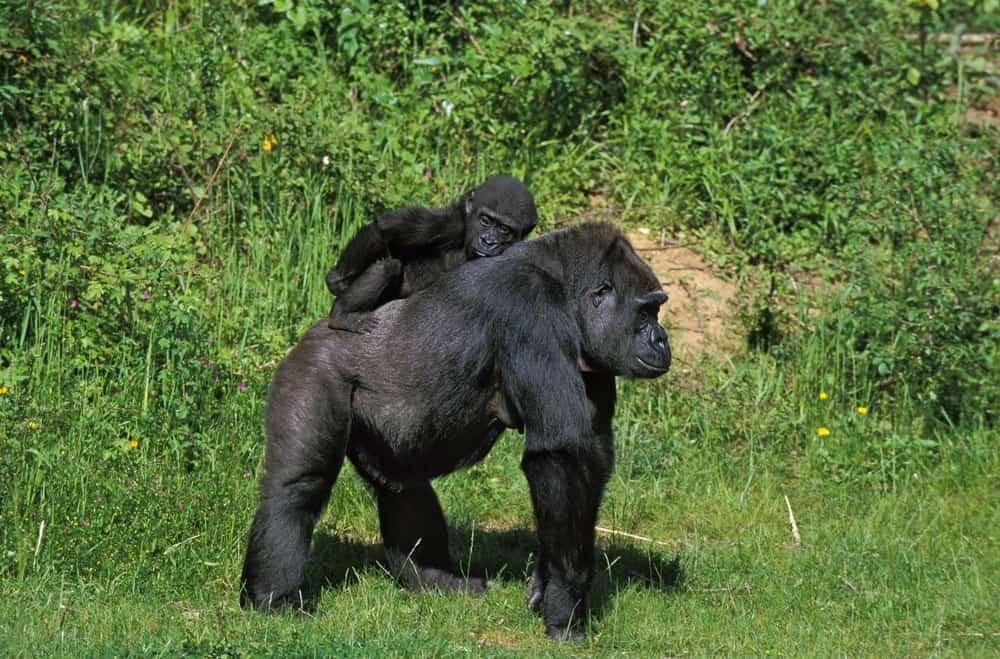
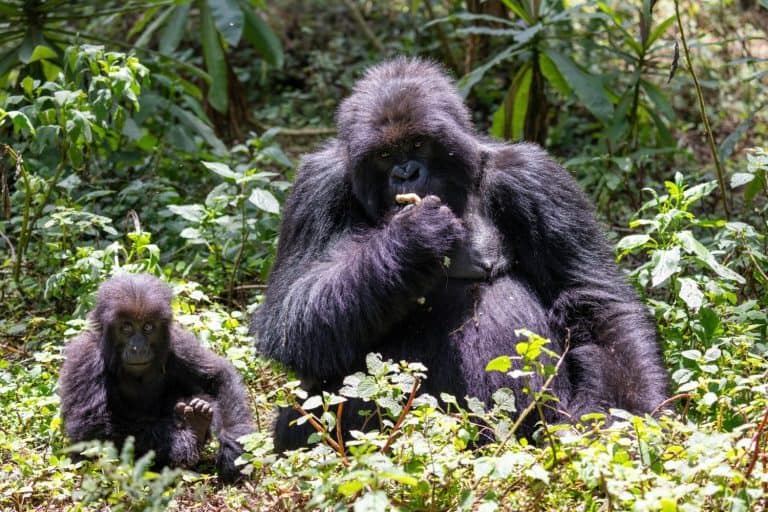
Eastern lowland gorilla adult and baby

Gorillas give birth to a sole baby every 4 or 5 years.

Population

All species are currently considered to be critically endangered, and their populations are all in decline. Only 4,000 eastern lowland gorillas and 880 mountain gorillas are estimated to be in the wild. Of both of those groups, only 2,600 are mature adults. Approximately 300,000 western lowland gorillas are living, but they are experiencing a double-digit percentage population decline. Only 250 to 300 Cross River gorillas remain in a small region surrounding the Cross River.

Gorillas In the Zoo

These animals can be found in almost any major zoo. All gorillas in zoos in the United States are western lowland gorillas, and they were all born in captivity. None of these animals were captured in the wild. Both the Detroit Zoo and the Bronx Zoo are well-known for their gorillas.
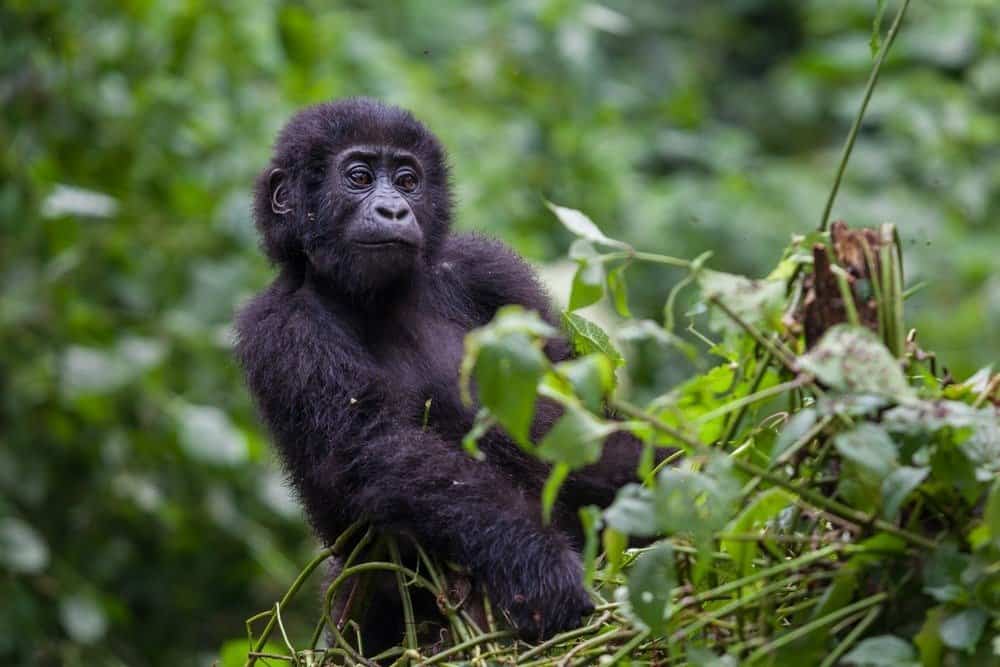
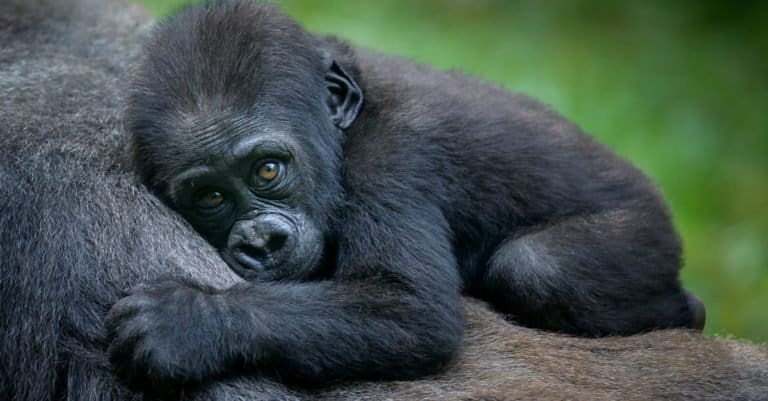
Baby Eastern gorilla in Congo rainforest

All species of gorillas are critically endangered.

4 Types of Gorillas

There are two main types of gorillas in the world- eastern and western species. Both of these species contain subspecies. Eastern gorillas include the mountain and eastern lowland subspecies. Western gorillas include the Cross River and western lowland subspecies. All of these gorillas live in tropical and subtropical regions of Africa. The key difference between them is size, with eastern gorillas typically being larger than western gorillas. However, both types of gorillas are endangered due to the destruction of their natural habitats.

  • Cross River Gorilla – Only 200-300 Cross River gorillas are left in the world, making them critically endangered. They live in the forests and rainforests of Cameroon and Nigeria, an area of about 3,000 square miles. However, their habitat is being destroyed by humans who clear the forests for timber and create fields for agriculture and livestock. Additionally, poaching is a problem in the area, which further contributes to the decline in the Cross River gorilla population.
  • Mountain Gorilla – The mountain gorilla is a subspecies of gorilla that lives in forests at high altitudes, between 8,000 and 13,000 feet. They are found in Rwanda, Uganda, and the Virunga Mountains in the Democratic Republic of Congo. Mountain gorillas are slightly larger than other gorilla subspecies and can weigh up to 440 pounds. They have thick fur, which helps them stay warm in colder temperatures. However, as humans move into their habitat, the gorillas are forced to move to higher and more dangerous ground. The mountain gorilla is critically endangered, with a population of only 880 remaining.
  • Western Lowland Gorilla – The Western Lowland is the most numerous of all gorillas. They are found throughout the region from Cameroon to the Republic of Congo. Most of these gorillas live in isolated swamps and the Republic of Congo. Compared to other subspecies, they are smaller and have brown-grey coats and auburn chests, wider skulls, and smaller ears. However, they also are about 4 to 5 1/2 feet tall and weigh 440 pounds. Due to poaching, the population has decreased by more than 60% within the last 20-25 years. They are considered critically endangered.
  • Eastern Lowland Gorilla – The Eastern Lowland is the largest of the gorilla subspecies and inhabits the tropical rainforests of the Democratic Republic of Congo. In the last 50 years, their historical range has decreased significantly, and they now only occupy about 13% of their original range. They are also critically endangered due to factors such as poaching.
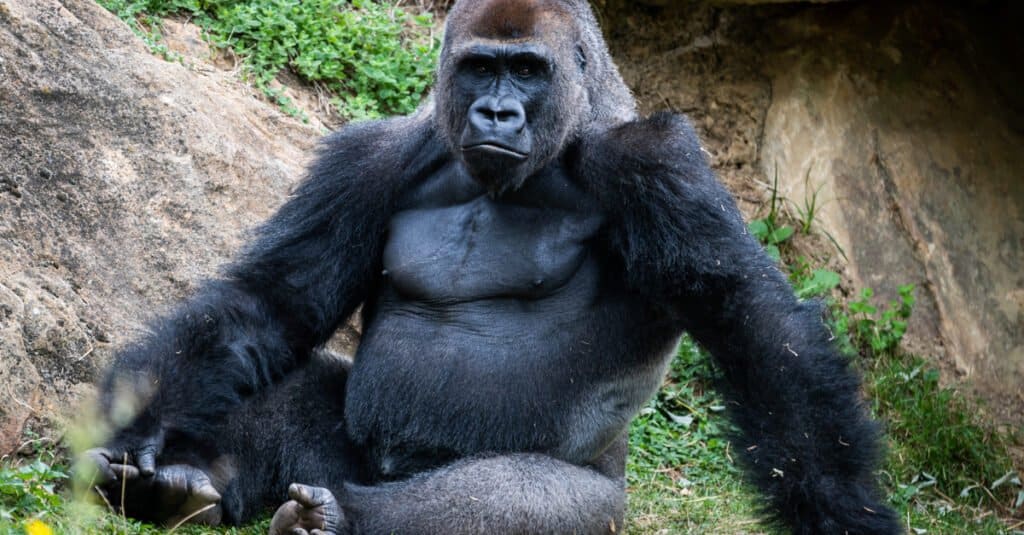
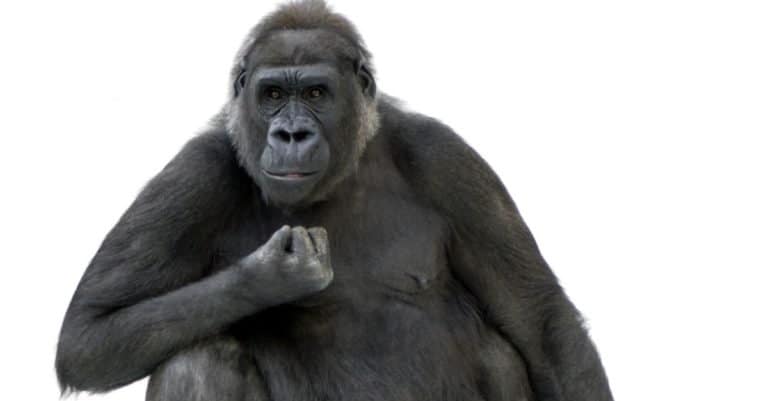
Gorilla bite force - gorilla resting

There are four subspecies of gorilla, all crucially endangered.

View all 261 animals that start with G

Sources

  1. Britannica / Accessed March 3, 2021
  2. Sea World / Accessed March 3, 2021
  3. Reference / Accessed March 3, 2021
  4. National Geographic / Accessed March 3, 2021
  5. BBC Earth / Accessed March 3, 2021
  6. ABC News / Accessed March 3, 2021
Heather Hall

About the Author

Heather Hall

Heather Hall is a writer at A-Z Animals, where her primary focus is on plants and animals. Heather has been writing and editing since 2012 and holds a Bachelor of Science in Horticulture. As a resident of the Pacific Northwest, Heather enjoys hiking, gardening, and trail running through the mountains with her dogs.

Thank you for reading! Have some feedback for us?


Gorilla FAQs (Frequently Asked Questions)

Most gorillas eat a mostly vegetarian diet; however, their occasional intake of insects, worms, and snails makes them technically omnivorous.