G
Species Profile

Green Bee-Eater

Merops orientalis

Green flash of the open country
Sanjay M Dalvi/Shutterstock.com

Green Bee-Eater Distribution

Click a location to explore more animals from that region

Loading map...
Green Bee-Eater with Green & Blue background

At a Glance

Wild Species
Also Known As Little Green Bee-eater, Oriental Green Bee-eater, Indian Green Bee-eater, Asian Green Bee-eater, Common Green Bee-eater, Greenie
Activity Diurnal
Lifespan 5 years
Weight 0.022 lbs
Status Least Concern
Did You Know?

Small for a bee-eater: typically 16-18 cm long (incl. tail streamers) and ~15-20 g in mass (HBW/Fry et al.; Rasmussen & Anderton).

Scientific Classification

A small bee-eater characterized by bright green plumage, slender slightly downcurved bill, and aerial insect-hunting behavior; commonly perches on wires or low branches before sallying out to catch flying insects.

Kingdom
Animalia
Phylum
Chordata
Class
Aves
Order
Coraciiformes
Family
Meropidae
Genus
Merops
Species
Merops orientalis

Distinguishing Features

  • Predominantly green body with contrasting darker flight feathers
  • Long, pointed bill adapted for catching flying insects
  • Often shows elongated central tail feathers (streamers) in adults
  • Aerial hawking from exposed perches; frequently seen on wires
  • Burrow-nesting in sandy banks or flat ground

Physical Measurements

Length
11 in (9 in – 11 in)
Weight
0 lbs (0 lbs – 0 lbs)
Tail Length
4 in (4 in – 5 in)
Top Speed
28 mph
About 45 km/h

Appearance

Primary Colors
Secondary Colors
Skin Type Feathered body; small areas of bare skin limited to legs/feet and around the eye. Bill keratinous, slender, and slightly decurved (adapted for aerial insect capture).
Distinctive Features
  • Small bee-eater: total length typically ~16-18 cm including tail (reported in major field references such as Rasmussen & Anderton, 2012; also summarized in HBW/BirdLife accounts).
  • Streamlined aerial-insectivore morphology: long pointed wings and a slim, slightly downcurved black bill suited to capturing flying insects on the wing.
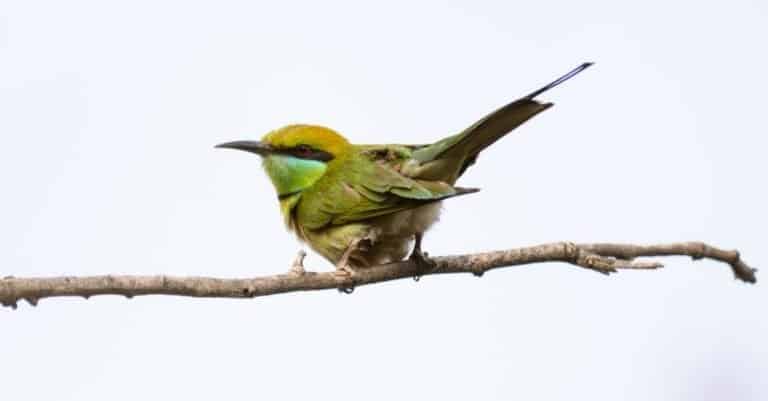
  • Elongated central tail feathers ("streamers"), usually evident in adults and contributing to a tapered rear profile even when perched.
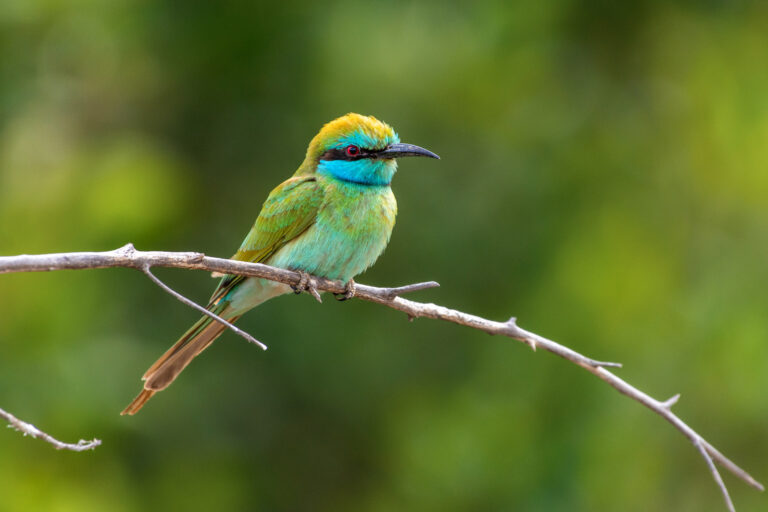
  • Diagnostic head pattern: bold black eye-stripe (mask) and a contrasting blue throat patch, often edged below by a narrow dark (black) gorget line.
  • Frequent perch-and-sally behavior that shapes 'appearance in context': often sits upright on wires/low branches with bill angled slightly down, then launches into fast, direct flights to seize insects mid-air.
  • Burrow-nesting lifestyle typical of bee-eaters: adults excavate horizontal tunnels in sandy banks or flat ground; this is characteristic for the group and is often associated with worn bill tips during active excavation (seasonal).
  • Diet is not exclusively bees: takes a wide range of flying insects (commonly bees and wasps, plus dragonflies, flies, butterflies and moths), which aligns with the bill and wing morphology and wide gape.

Did You Know?

Small for a bee-eater: typically 16-18 cm long (incl. tail streamers) and ~15-20 g in mass (HBW/Fry et al.; Rasmussen & Anderton).

Often catches stinging insects (bees/wasps) and disables them by repeatedly beating the prey on a perch, then wiping to remove the sting before swallowing (Fry et al., HBW).

Nests underground: excavates a tunnel (commonly ~0.5-2 m) ending in a chamber-classic Meropidae engineering (Fry et al., HBW).

Clutch is commonly 4-7 eggs; incubation about 14-15 days and fledging roughly ~20-22 days (regional studies summarized in HBW; Ali & Ripley).

Frequently perches conspicuously on wires or low branches, then "sallies" out to snatch insects mid-air and returns to the same lookout (field studies; HBW).

Taxonomy varies by authority: some checklists split western forms (e.g., Arabian populations) from Merops orientalis sensu stricto, so 'Green Bee-eater' may have different range limits depending on treatment (IOC/BirdLife treatments).

Regurgitates pellets of indigestible insect parts (chitin, wing cases)-a useful clue at roosts and nest sites (general Meropidae biology; HBW).

Unique Adaptations

  • Streamlined aerial insectivore build: long pointed wings and a slender, slightly downcurved bill suited to seizing fast-flying insects (Meropidae morphology; HBW).
  • Rictal bristles around the bill: help protect the eyes/face and assist in handling spiny or stinging prey during capture and beating (reported for bee-eaters generally; HBW).
  • Prey-safety processing: specialized behavioral 'tool use' (beating/wiping) reduces risk from venomous/stinging insects-key for a species that regularly targets Hymenoptera (HBW).
  • Subsurface nesting strategy: burrow nesting buffers eggs/chicks from heat and many predators in open landscapes, and is a defining adaptation of bee-eaters (Meropidae; HBW).
  • Cryptic-at-distance coloration: vivid green can blend with foliage at medium range while the bird remains motionless on a perch-useful for ambush-style sallying.

Interesting Behaviors

  • Perch-and-sally hunting: waits on exposed perches (wires, shrubs), launches in a quick aerial pursuit, snaps prey with the bill, then returns to the same or nearby perch (HBW).
  • Stinger-handling routine: for bees/wasps, repeatedly strikes prey against a hard perch and wipes it to remove/neutralize the sting apparatus before ingestion (HBW).
  • Communal tendencies: often forages in loose groups and may roost socially; many bee-eaters show varying degrees of colonial nesting, especially where suitable banks/flat sandy ground occur (Meropidae overview; reported locally for M. orientalis).
  • Burrow excavation: both sexes (reported in regional accounts) dig using the bill and feet, pushing soil out of the tunnel; nest sites include earthen banks, flat ground, and sandy embankments (HBW; Ali & Ripley).
  • Aerial agility: performs rapid turns and short chases to intercept agile insects (e.g., dragonflies), taking advantage of open habitats and clear flight paths.
  • Vocal contact: uses repeated rolling/pronounced calls to keep contact between mates or group members in open country (field descriptions in standard handbooks).

Cultural Significance

In South Asia, the Green Bee-eater (Merops orientalis) is a common farm and village-edge bird. Bright green and an insect eater, it is often seen as helpful though beekeepers may call it a honeybee predator. Used in guides as an example of perch-and-sally insectivory and burrow nesting (Meropidae).

Myths & Legends

Green Bee-eater (Merops orientalis): the name Merops comes from Greek, used by ancient writers for a bee-eating bird. Aristotle and Pliny tied Merops to beekeeping and seasonal visits to apiaries.

In South and West Asia, rural beekeeping lore calls the Green Bee-eater (Merops orientalis) a "bee thief." People watch hives more closely because the bird eats bees and other Hymenoptera.

Green Bee-eater (Merops orientalis) is linked in some regions to spring: local names and its loud perching and calls in farm fields signal fair weather returning and more insects, part of folk seasonal stories.

Conservation Status

LC Least Concern

Widespread and abundant in the wild.

Population Stable

Protected Under

  • Protected under general wild-bird protections in multiple range states (varies by country and jurisdiction); the species is also present in numerous protected areas across its broad range in South and Southeast Asia.

Life Cycle

Birth 5 chicks
Lifespan 5 years

Lifespan

In the Wild
2–8 years
In Captivity
3–12 years

Reproduction

Mating System Monogamy
Social Structure Socially Monogamous
Breeding Pattern Seasonal
Fertilization Internal Fertilization
Birth Type Internal_fertilization

Green Bee-eaters (Merops orientalis) form seasonal pairs of males and females, with flying courtship displays and males offering prey. They nest in self-dug burrows in sandy banks or ground, mate, and both parents dig, sit on eggs, and feed chicks; helpers are rare.

Behavior & Ecology

Social Flock Group: 6
Activity Diurnal
Diet Insectivore Bees and wasps (Hymenoptera), taken on the wing

Temperament

Generally gregarious outside breeding; tolerant of conspecifics at shared perches/roosts
Territorial and defensive around the nest burrow and immediate nesting area
Bold aerial forager; frequently returns to exposed perches (wires/low branches) and may allow close approach in habituated landscapes
Opportunistic and locally aggressive over high-value perches or dense insect swarms, especially when feeding young

Communication

Common contact call described as a soft rolling/pronounced 'prree'/'prrit' given in flight or from perches HBW species account
Excited/agitated chatter during chases, prey transfers, or near colonies; calls often increase in rate and intensity during disturbance
Alarm calls: sharper, more insistent notes during predator approach or human disturbance near nest banks Field descriptions in standard accounts
Visual displays: perch-posturing, tail and wing movements, and aerial display flights around mates and nest sites General Meropidae/HBW descriptions applied to this species
Courtship feeding Prey-gifting) as a signal maintaining pair bond and stimulating nesting (noted for Merops orientalis in species accounts
Social spacing via perch choice: individuals line up on wires/branches with small inter-bird distances; displacement and short chases communicate dominance/priority access to perches or prey swarms
Nest-site signaling: repeated visits to burrow entrance, excavation behavior, and coordinated partner attendance function as cues to mates and potential competitors

Habitat

Biomes:
Savanna Tropical Dry Forest Temperate Grassland Freshwater
Terrain:
Plains Valley Riverine Coastal Sandy Rocky
Elevation: Up to 6561 ft 8 in

Ecological Role

Aerial insect predator (mid-trophic-level consumer) in open and semi-open habitats

Regulates populations of flying insects (including agricultural pest taxa such as termites and orthopterans during outbreaks) Links aerial insect biomass to higher trophic levels (serves as prey for raptors and other predators) Can locally affect pollinator abundance near nesting/foraging areas by predation on bees/wasps, including around apiaries

Human Interaction

Domestication Status

Wild

Green Bee-eater (Merops orientalis) is a wild insect-eating bird, not domesticated or bred. It hawks insects and nests in burrows in earthen banks. Human contact is accidental; the species is not kept by people. Bee-eaters (Meropidae) help farms by eating pests, may take honey bees, lose nesting banks, and draw birdwatchers.

Danger Level

Low
  • No known inherent danger to humans; not venomous and not a predator of vertebrates.
  • Minor risk of scratches/pecks during handling (e.g., rescue/rehab) and stress-related injury to the bird.
  • Occupational risk is mainly from handling its prey (stinging Hymenoptera) rather than from the bird itself.
  • Zoonotic risk is typical of wild birds (e.g., ectoparasites, general avian pathogens) but no species-specific high-risk profile is documented.

As a Pet

Not Suitable as Pet

Legality: Green Bee-eater (Merops orientalis) is usually illegal to keep as a pet without government permits. Wild birds are protected; private keeping is rare and often allowed only for rehab or education by law.

Care Level: Expert Only

Purchase Cost:
Lifetime Cost: $5,000 - $25,000

Economic Value

Uses:
Ecosystem services (insect predation) Ecotourism/birdwatching Human-wildlife conflict (apiculture)
Products:
  • Non-consumptive value: birdwatching/photography interest; no standard commercial products. Potential indirect economic effects include reducing some flying insect populations (benefit to agriculture) and occasional localized losses perceived by beekeepers when birds take Apis spp. near hives.

Relationships

Predators 6

Shikra Accipiter badius
Eurasian Hobby Falco subbuteo
Oriental Magpie-Robin Copsychus saularis
House Crow Corvus splendens
Indian Rat Snake Ptyas mucosa
Bengal Monitor Varanus bengalensis

Related Species 6

European Bee-eater
European Bee-eater Merops apiaster Shared Genus
Blue-cheeked Bee-eater Merops persicus Shared Genus
Blue-tailed Bee-eater Merops philippinus Shared Genus
Blue-bearded Bee-eater Nyctyornis athertoni Shared Family
Red-bearded Bee-eater Nyctyornis amictus Shared Family
Chestnut-headed Bee-eater Merops leschenaulti Shared Genus

Ecological Equivalents 4

Animals that fill a similar ecological role in their ecosystem

Barn Swallow
Barn Swallow Hirundo rustica Shares the feeding niche of an open-country aerial insectivore, capturing small flying insects in midair near farmland, wetlands, and settlements. Green bee-eaters similarly fly from exposed perches (wires or low branches) to catch insects.
Asian Palm Swift Cypsiurus balasiensis Shares the aerial insect‑hawking niche in warm, lowland landscapes. Swifts feed on small aerial plankton (flying insects) and often forage over villages and cultivated land where green bee-eaters also hunt, especially during insect emergences.
Black Drongo Dicrurus macrocercus Perch-and-sally insectivore in open country: both species frequently use exposed perches (wires, shrubs) and launch short aerial sallies to catch flying insects. They often overlap in foraging grounds such as agricultural fields and grasslands.
Indian Roller Coracias benghalensis Occupies similar open habitats (scrub, farmland edges) and frequently hunts insects by perch-based sallies. Although larger and more generalist than the Green Bee-eater, it overlaps in prey types (large flying insects) and hunting settings.

Quick Take

  • Reaching a 12 to 18 year lifespan requires navigating specific wild habitat decline.
  • The 80% diet of honeybees triggers a critical vulnerability due to prey population instability.
  • This bird displays a counter-intuitive theory of mind previously attributed almost exclusively to primates.
  • Constructing 5-foot-long tunnels is necessary to protect the 3 to 8 egg clutches.

The green bee-eater, or little green bee-eater, is one of the smallest birds in the bee-eater family. It is known for its small size, unique sound, slender body, and bright plumage, as well as for being one of the most beautiful birds. It is found in a variety of wooded areas throughout sub-Saharan Africa, western Arabia, and eastern Asia. Although it is in no danger of extinction, the green bee-eater’s population is currently stable or increasing in many areas, as agricultural expansion and irrigation have created new suitable habitats. However, local declines in honeybee populations could pose future risks.

An educational infographic about the Green Bee-Eater featuring illustrations of the bird, its nesting habits, a world map of its habitat, and icons representing its diet and intelligence.
It thinks like a primate, digs 5-foot tunnels, and eats almost nothing but honeybees. Discover why this emerald gem’s extreme specialization is its greatest strength—and its biggest threat. © A-Z Animals

Green Bee-Eater Amazing Facts

  • True to its name, 80% of its diet consists of honeybees.
  • Although it is not known to migrate, it does travel seasonally due to rainfall.
  • The green bee-eater is a natural-born bee-killer.
  • It has predator-avoidance behavior with “theory of mind” awareness, usually only found in humans and other primates.

Where To Find Green Bee-Eaters

Green bee-eaters find several habitat types from Mauritania to central China, including the Nile River and the Himalayas. Other countries include Greece, Senegal, Gambia, Egypt, Iran, India, Pakistan, Nepal, Bhutan, Afghanistan, Bangladesh, Cambodia, Thailand, Laos, Myanmar, and Vietnam. Its habitat is forest, grassland, and thin scrub.

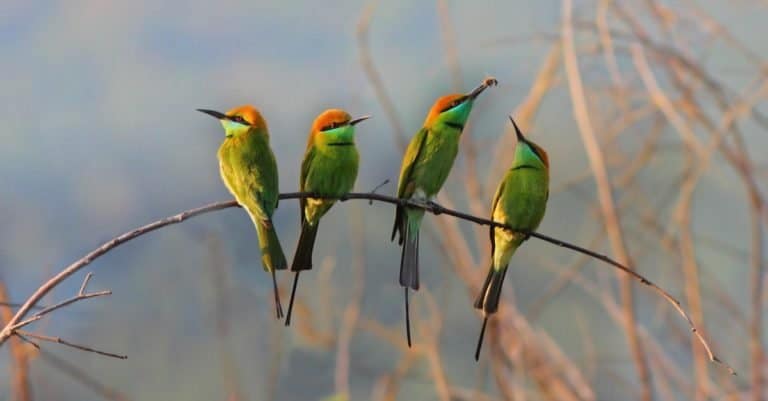
The best place to find green bee-eaters is arid areas, plains, savannahs, scrub, grasslands, open forests, fields, and farmlands in parts of Africa and Asia. They can even be seen perched on television antennas in urban and suburban neighborhoods. They are also visitors in some parts of Pakistan, flying there during the summer, making riverside habitats in southern India or high ones in the Himalayas. The social birds roost in numbers from 30 to 300 and usually dust-bathe in groups of 20. Remember that they roost high in trees and have a unique sound.

Nests

Green bee-eaters typically nest in May or June. Their nests are in the hollows of sandbanks or mud banks, which both sexes create by digging tunnels or burrows, which are 2 to 3 feet deep and can be up to 5 feet long (1 to 2 m). The tunnels in Africa are dug into flat ground or gentle slopes, while in Asia, they are dug into low shores. The females lay 3 to 8 eggs on the bare ground at the end of the tunnel, in a cavity measuring about 15 cm (5.9 in).

Classification and Scientific Name

There are three to four subspecies of green bee-eater. Its scientific name is Merops orientalis. The bee-eater family Meropidae has three genera, one of them being the large genus Merops.

Size, Appearance & Behavior

The little green bee-eater has a size of about 9 inches (16 to 19 cm), including 2 inches of long central tail feathers. It has a wingspan of 29 to 49 cm (11.4 to 19.3 in) and a weight of 15 to 25 g.

Bright emerald green is its main color, but several subspecies have partial red, yellow, blue, or purple coloring depending on the region. There are also variations such as a rusty crown and bright blue throat, as well as leucistic individuals. A similar species based on grouping by plumage features is Merops leschenaulti, with subspecies Merops orientalis ferrugeiceps being most similar.

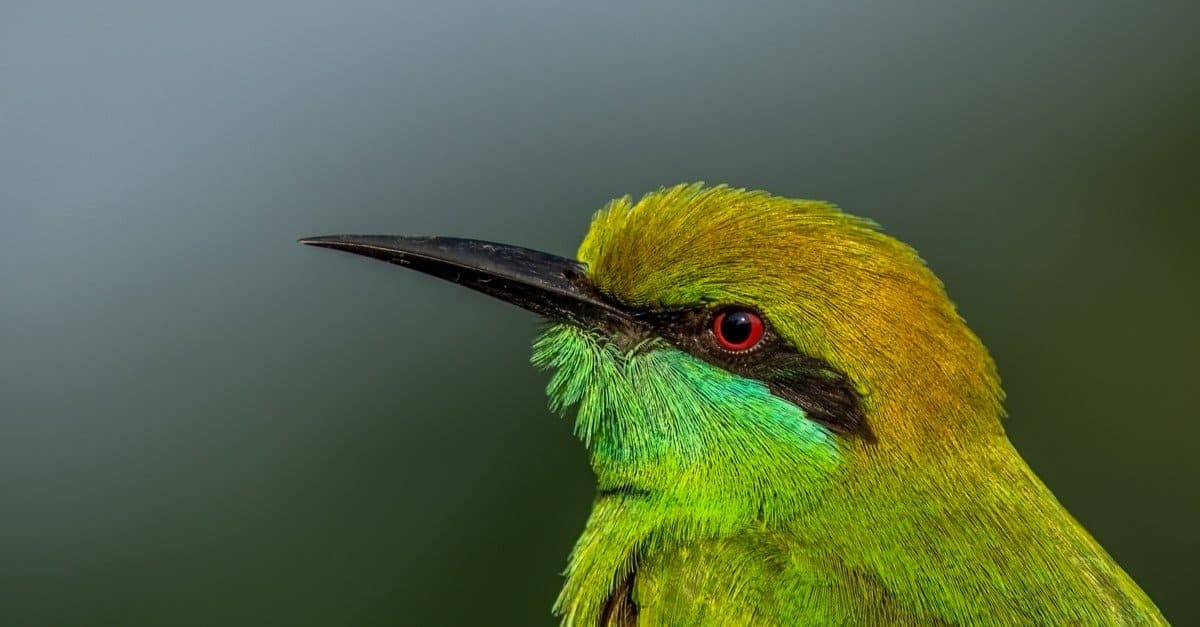
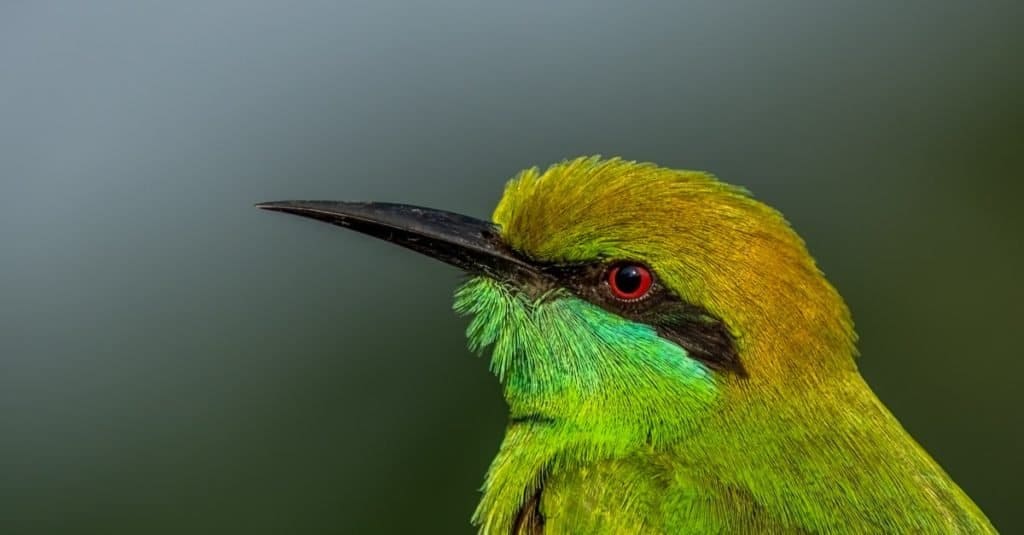
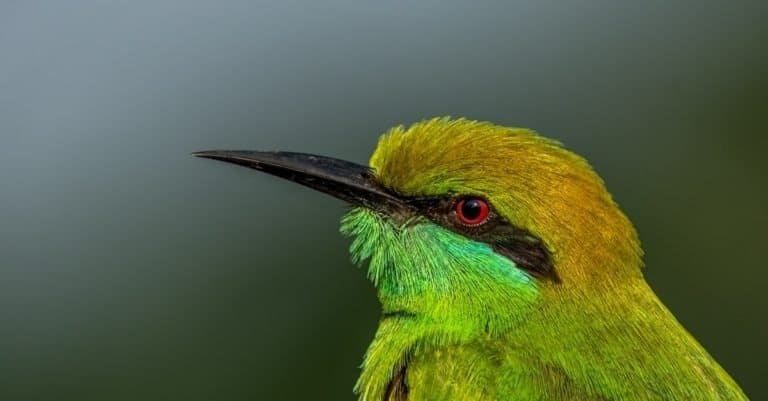
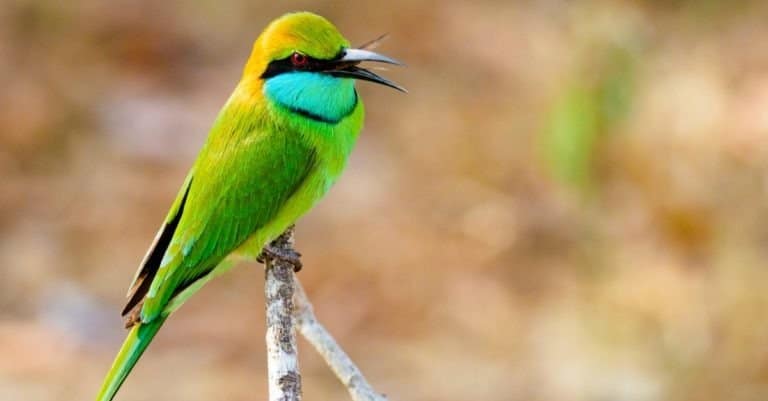
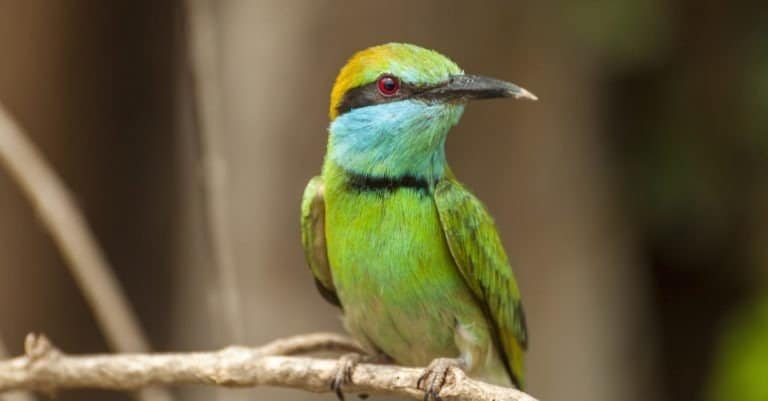
Generally, however, there is blue on the chin and throat, with golden rufous on the crown and back. Its flight feathers are rufous and green. It has a long, slightly curved black bill ending in a sharp point, a narrow black stripe called a “gorget” on its throat, a black mask through its crimson eyes, and two central, narrow, long black tail streamers. Its legs are dark gray, and it has weak feet with three toes.

The juvenile’s colors are dull in comparison. It does not have the long tail feathers unique to adults. The female has similar coloring and physical measurements as the male, but with a duller throat, narrower half-collar, and shorter tail streamers.

The green bee-eater sand-bathes more than other bee-eater species and dips in the water while flying. Usually calling in flight, its sound is a gentle, pleasant, nasal tree-tree-tree-tree that is long and repetitive. It is graceful and makes a zigzag movement when returning to its perch to consume its prey. Most active during the day, it starts hunting after 7:00 or 8:00 am and again around 4:00 pm.
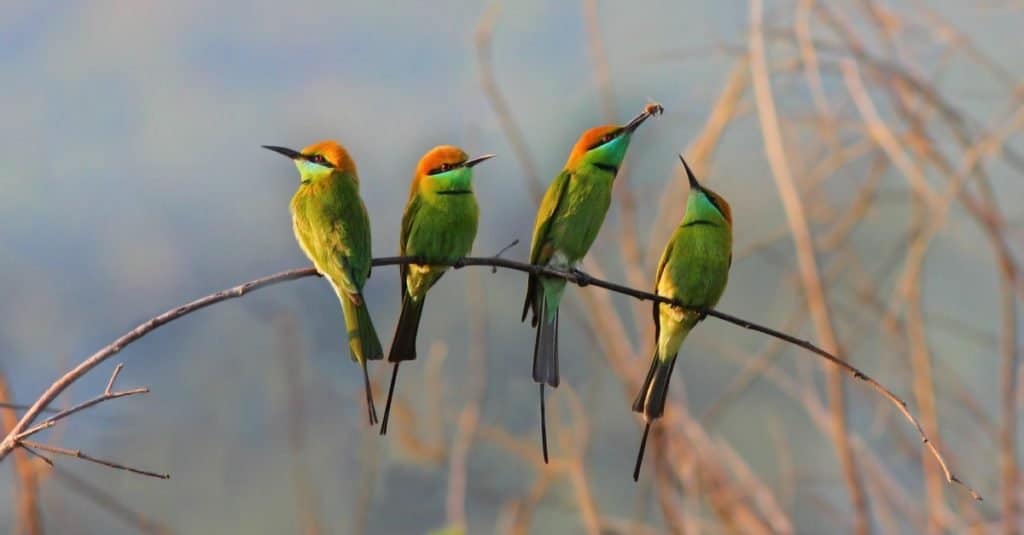
Green Bee-eater/ little green bee-eater

The diet of Green Bee-Eaters is mainly insectivorous.

Diet

The green bee-eater has an omnivorous diet that is primarily insectivorous.

What do green bee-eaters eat?

80% of the green bee-eater’s diet is honeybees. The rest are other bee species, wasps, ants, flies, butterflies, moths, dragonflies, beetles, and other flying insects. It supplements its diet with ground-dwelling insects, such as termites, caterpillars, and spiders, along with fruits and berries. It avoids insects from the order Orthoptera, which includes grasshoppers, locusts, crickets, katydids, and weta.

Predators and Threats

The green bee-eater has a unique predator-avoidance behavior in which it does not enter its nest as long as a predator is looking at it. This type of awareness of a predator’s mental state shows “theory of mind”, typically shared only by primates. Although the IUCN lists the green bee-eater as “Least Concern“, it is still vulnerable to native habitat destruction and decline of its primary prey of bees.

What eats green bee-eaters?

Green bee-eaters and their eggs are preyed upon by larger birds as well as smaller reptiles and mammals. They sometimes get gizzard infections from the endoparasitic nematode (Torquatoides balanocephala). In India, they have been known to get a protozoan parasite in their blood (Haemoproteus manwelli).

Reproduction, Babies, and Lifespan

Green bee-eaters have a breeding season from either March to June or July to August.

Although both sexes participate in incubation, it is primarily done by the female. They are monogamous and mate for life. In Africa and Asia, they are solitary nesters with helpers, which include juvenile and adult young. They create small colonies in India, with larger ones in Myanmar and Pakistan, ranging from 10 to 30 breeding pairs. Both parents feed the young, known as chicks, while they stay in the nest for 22 to 31 days. The juveniles do not need to be taught how to handle stinging insects, as the birds are born with the ability to kill bees.

Population

Green bee-eaters are common in their habitat range and do not migrate. Although their bright plumage and small size attract many larger predators, they display predator-avoidance behavior when seeing predators near their nests. With 26 species, habitats in several countries, and listed as “least concern” by the IUCN, their exact numbers have not been assessed. However, the populations of the African green bee-eater, the Asian green bee-eater, and the Arabian green bee-eater are increasing.

View all 261 animals that start with G

Sources

  1. eBird / Accessed January 3, 2021
  2. Animalia / Accessed January 3, 2021
  3. Wikipedia / Accessed January 3, 2021
  4. Nature Conservation / Accessed January 3, 2021
A-Z Animals Staff

About the Author

A-Z Animals Staff

AZ Animals is a growing team of animals experts, researchers, farmers, conservationists, writers, editors, and -- of course -- pet owners who have come together to help you better understand the animal kingdom and how we interact.
Connect:

Thank you for reading! Have some feedback for us?


Green Bee-Eater FAQs (Frequently Asked Questions)

Mostly honeybees, followed by other bee species and other flying insects, then ground-dwelling insects along with fruits and berries.