



Guinea fowls are often seen roaming the plains of Africa and picking at the ground for food. The guinea fowl family consists of about 7 to 10 species, each with its own unique appearance and behavior. Together, they fill a similar ecological niche to many other big-bodied fowl elsewhere.
3 Amazing Facts
- The helmet guinea fowl is the only species in the family to be domesticated by humans as a source of food, fulfilling a similar role as the chicken. It is sometimes mixed in with other fowl because its naturally harsh sounds serve as a warning against predators or because it keeps in check Lyme disease-carrying ticks and other pests.
- There have been rare reports of guinea fowl attempting to mate with chickens or peafowl, but there is no scientific evidence that they can produce viable offspring together.
- Most guinea fowl can go long periods without water.
Classification and Scientific Name
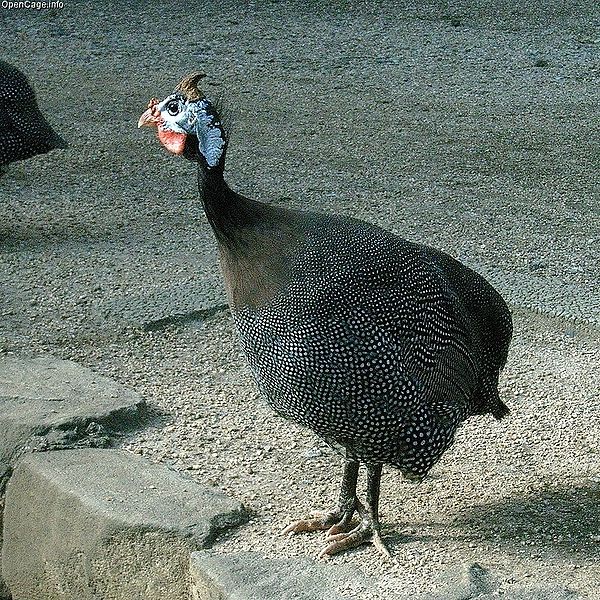
The Guinea Fowl is a member of the Family Numididae, named after Numidia, the old Roman region of Africa that is now Algeria.
©OpenCage / Creative Commons – Original
The scientific name for the family of guinea fowl is Numididae. This is the Latin name for the ancient region of Numidia, which used to be part of the Roman Empire and is now covered by the country of Algeria. Today, therefore, the scientific name is a bit of a misnomer because all species are native to sub-Saharan Africa and not Algeria. These birds belong to the order of Galliformes along with quail, partridges, pheasants, peacocks, chickens, and turkeys.
The family Numididae contains four genera and six recognized species:
- genus Agelastes, species White-breasted guineafowl (Agelastes meleagrides) and Black guineafowl (Agelastes niger)
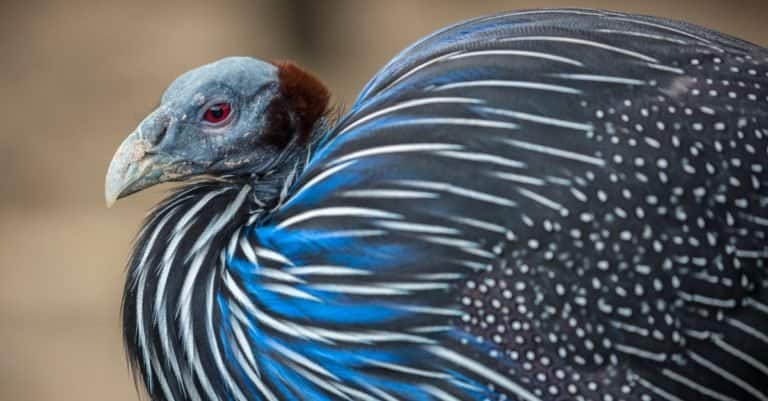
- genus Acryllium, species Vulturine guineafowl (Acryllium vulturinum)
- genus Numida, species Helmeted guineafowl (Numida meleagris)
- genus Guttera, Plumed guineafowl (Guttera plumifera) and Crested Guineafowl (Guttera pucherani)
These birds are called guinea fowl (or guineafowls) because they were first domesticated on the Guinea Coast of West Africa. As a food source, the wild guinea fowl has been hunted for 2,000 years or more, according to records of the ancient Romans and Egyptians.
Appearance
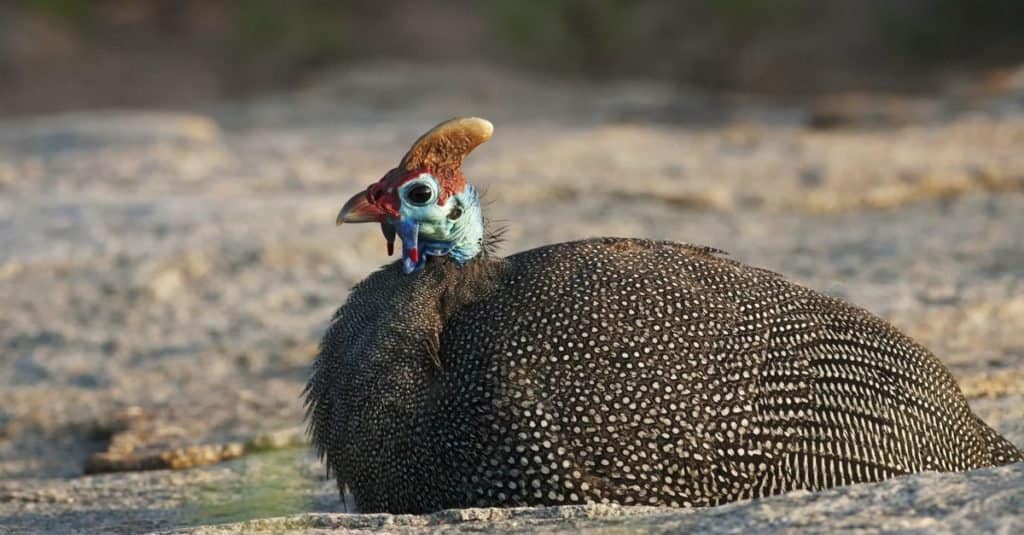
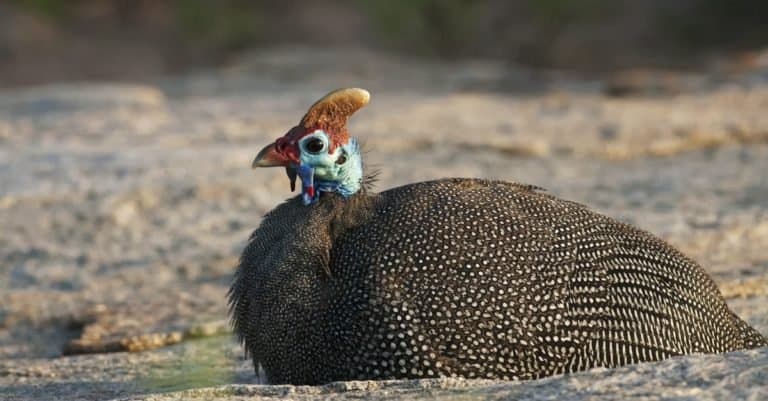
These birds have almond-shaped bodies, a very long neck, and a very small, featherless head (which probably serves the purpose of releasing excessive heat) with a short beak. They measure around 16 to 28 inches in length and weigh up to 4 pounds, although the average is 2.8 pounds. Most species have black or brown feathers with white spots on them, but the white-breasted guinea fowl has, of course, a white breast.
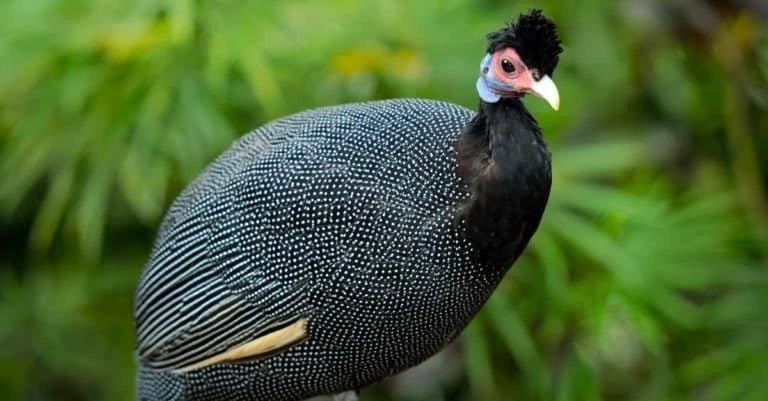
The head is usually covered by some combination of red, blue, brown, or tan leathery skin. However, a few species exhibit some exotic tops. Both the plumed and crested guinea fowl carry a black crest on the head, while the vulturine guinea fowl has a series of lance-shaped feathers that stick out visibly from the body. Despite the name, the vulturine guinea fowl bears only a superficial resemblance to the vulture. This species is in all other respects a pure guinea fowl.
Behavior
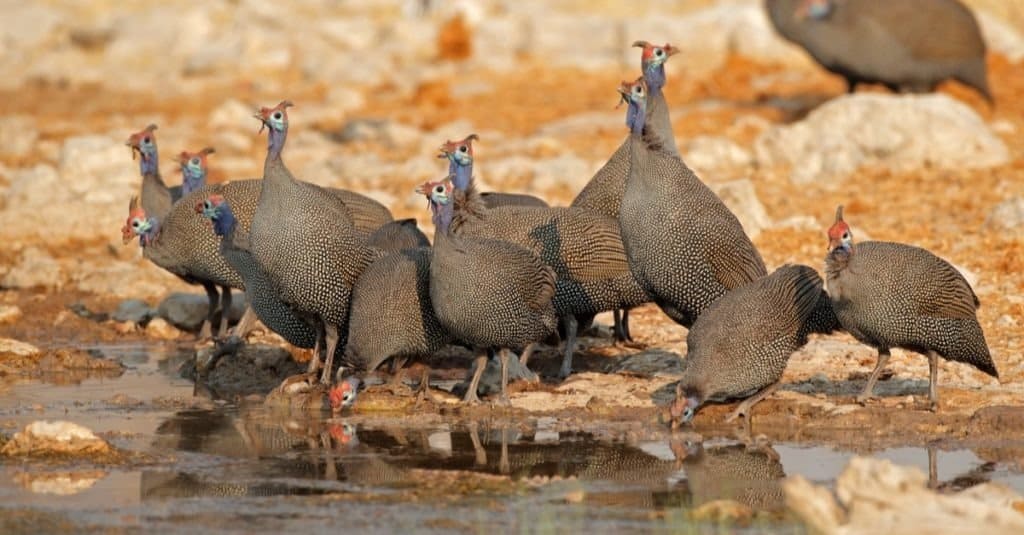
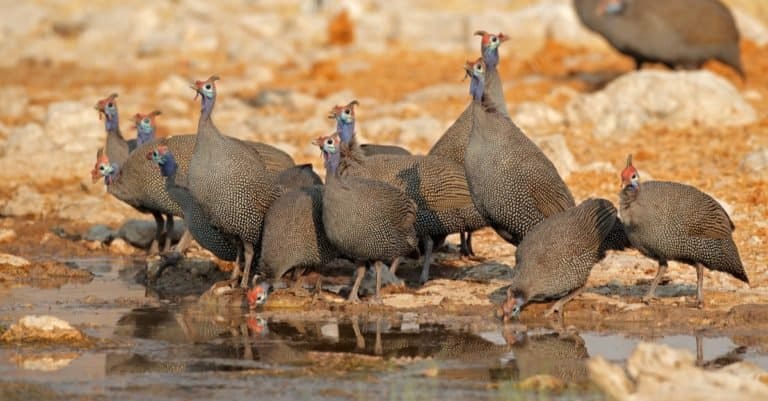
Guinea fowls are gregarious, social birds that congregate in communal flocks.
©EcoPrint/Shutterstock.com
These birds are very gregarious, social birds that organize themselves into flocks of varying sizes. These communal flocks usually spend the day pecking the ground for food and using their strong claws to dig through the dirt. They are most active in the morning and late afternoon hours when the heat is more tolerable, but at night they take to the trees for sleep. The flock sticks closely together and sometimes moves in a single-file line.
The birds communicate with each other through harsh and repetitive sounds that are distinctive to their sex. They are generally a friendly bunch, but sometimes interactions between males can turn into serious fights. To make themselves appear bigger, the males will stretch out their wings, bristle their feathers, and make aggressive sounds. They will also sometimes charge at each other with the intention to injure or harm.
Although its breasts and wings are very strong, the guinea fowl is not a migratory bird or much of a flyer at all. It is a terrestrial bird that would rather stick to the ground and outrun its predators, but the wings do enable it to escape from particularly tough situations with short bursts of flight.
Habitat and Location
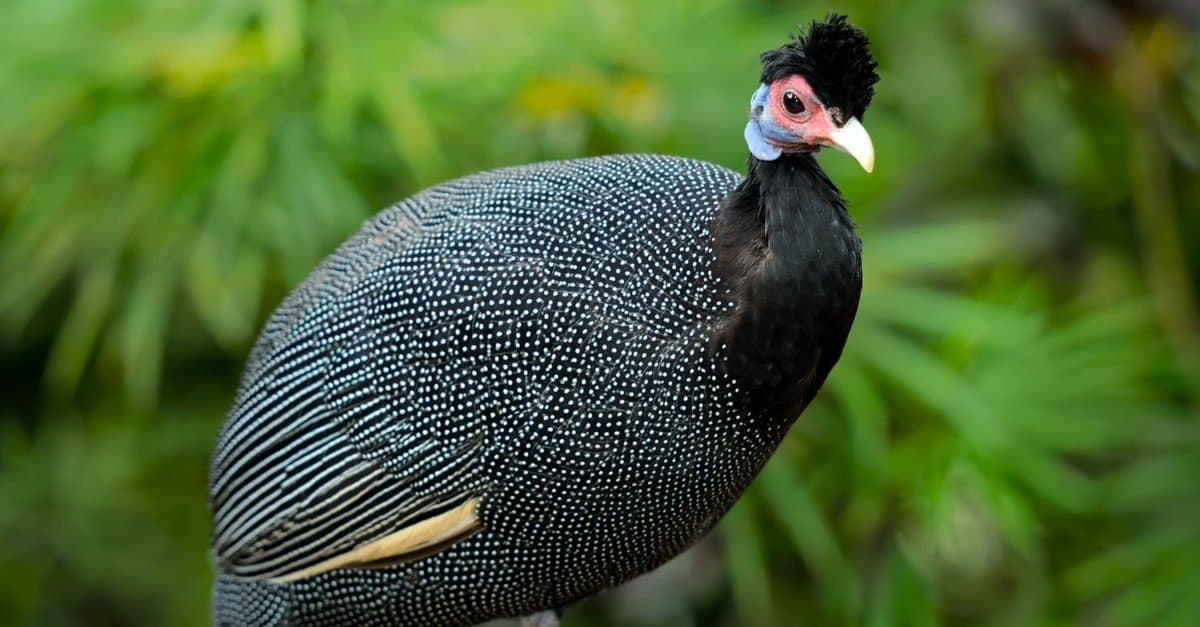
This crested guinea fowl is one of several types of guinea fowl that live in sub-Saharan Africa.
©tristan tan/Shutterstock.com
Guinea fowl are birds that are completely endemic to the warm and tropical forests, savannas, scrublands, farmlands, and even semi-deserts of sub-Saharan Africa. Flocks of these birds will sometimes roam in urban areas as well. They have several adaptations to deal with the harsher African climate.
The helmeted guinea fowl is probably the most widespread among all the guinea fowl species. Occupying a massive stretch of territory south of the Sahara, the helmeted guinea fowl has nine recognized subspecies, plus a domesticated variant.
The domesticated helmeted guinea fowl is the only species in this family to be widely introduced elsewhere in the world. It has been introduced to North and South America, Europe, and India.
Prey and Predators
These birds occupy an intermediate part of the food chain. They consume vast quantities of small prey and vegetation (sometimes even helping to disperse seeds around the environment), but in turn, the guinea fowls are also a common source of food for many of Africa’s more voracious predators.
What does the guinea fowl eat?
The guinea fowl is an omnivorous bird that consumes roots, tubers, seeds, reptiles, rodents, insects, and fruit. The helmeted guinea fowl is known for its voracious appetite and therefore makes for a very good domestic pest killer.
What eats the guinea fowl?
These birds have a long list of potential predators, including crocodiles, snakes, leopards, and other big cats. In a domestic setting, any predator that would attack a chicken would also attack them, including foxes, wolves, coyotes, and bears. These birds do have a few defenses, such as their ability to fly, but head to head it is no real match for a dangerous carnivore.
Reproduction, Young, and Lifespan
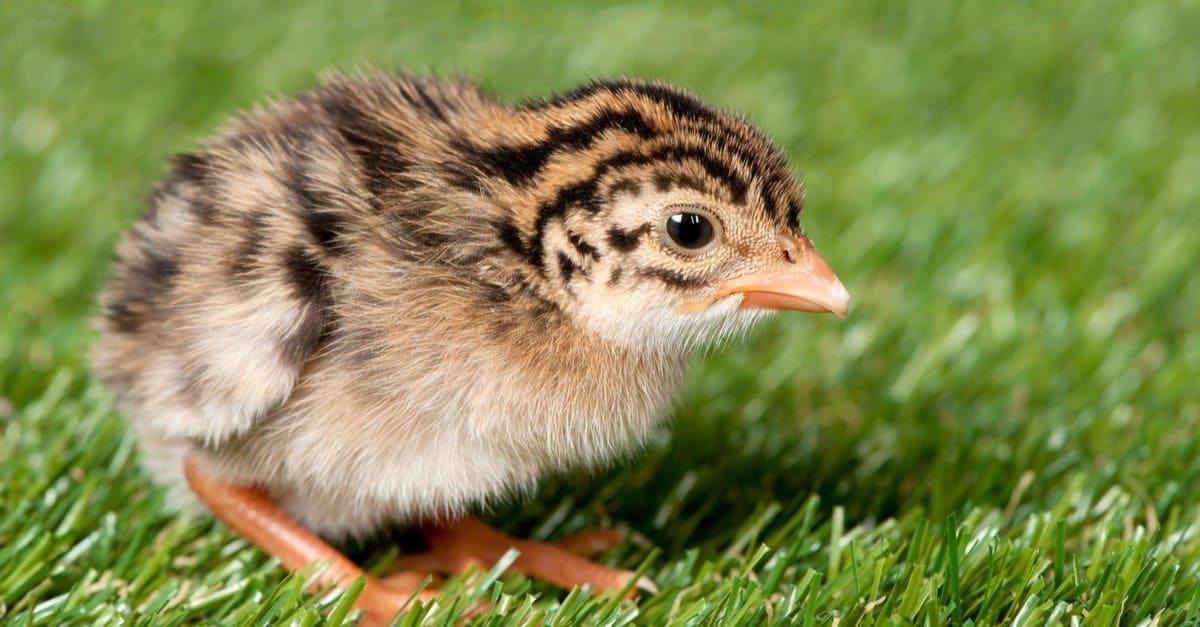
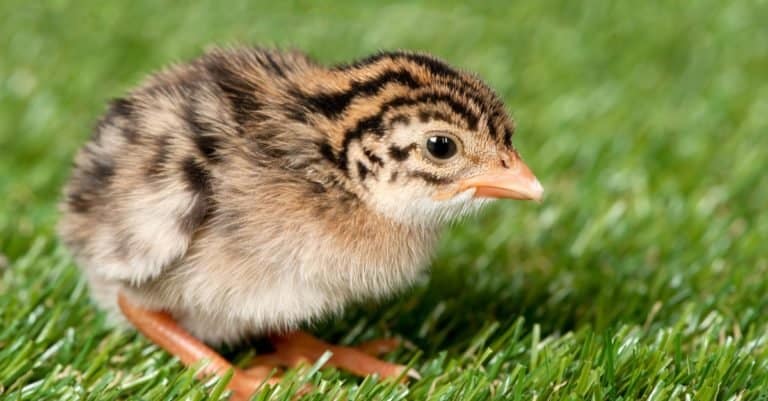
Guinea fowls are born with downy feathers but will grow into their adult feathers in several months.
©Howard Klaaste/Shutterstock.com
The helmeted guinea fowl, which is the most closely studied and well-understood species, forms a close monogamous bond with a single mate over its lifetime.
When the breeding season arrives, the guinea fowls build communal nests in isolated and shallow depressions. Lined with light vegetation, these nests are usually hidden in cover to prevent predators from consuming the eggs. A couple’s nest may contain up to 20 eggs at a time, but since the nest is communal, it may contain eggs from multiple pairs.
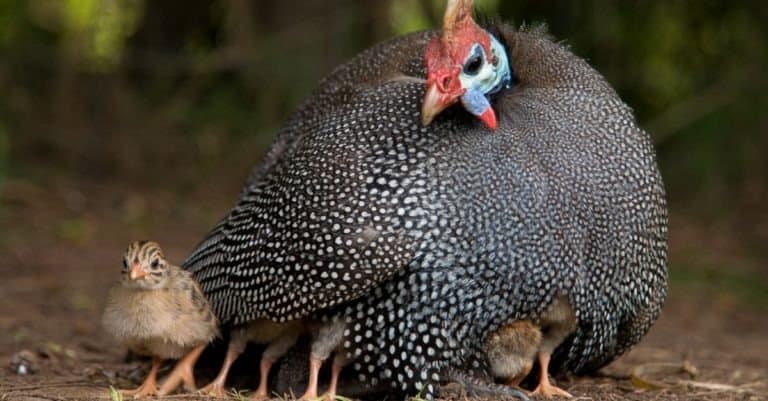
As seasonal breeders, these birds usually lay eggs in the spring and summer, right after the height of the annual rainfall when resources are most abundant. The young chicks or keets, as they’re often called, emerge from the eggs after about four weeks of incubation. Born with downy feathers, the birds can start walking around with their parents immediately, but they still require about four months to grow, learn the ropes, and develop their full flight feathers.
The parents are highly involved in the care of their offspring to give them the best chance of success. They are naturally inclined to split duties: the mother incubates the eggs, while the father stands guard and provides protection.
After some eight months to a year, the offspring are ready to begin a new, independent life of their own. They will reach sexual maturity then, but the female has only a limited time to reproduce. Her egg production ability often slows down by the age of five and stops completely at eight. The life expectancy of the guinea fowl is between 10 and 15 years.
Population
These birds are a very common family and widely distributed across most of sub-Saharan Africa. According to the IUCN Red List, which tracks their conservation status, seven species are classified as least concern, the best possible ranking. Only the white-breasted guinea fowl is vulnerable to extinction. Population numbers are hard to come by, but just to take one species, it’s believed there are at least 10,000 mature vulturine guinea fowl left in the wild.
These birds have a few advantages over other animals. First, they can adapt to a variety of different habitats and circumstances, from forests to plains. Second, since domesticated birds are raised for meat, the wild guinea fowl are hardly disturbed by humans. In fact, human activity may actually benefit them, since we hunt and eliminate their larger predators.
Guinea Fowl Pictures
View all of our Guinea Fowl pictures in the gallery.

Peter Fodor/Shutterstock.com
Sources
- Britannica / Accessed December 24, 2020
- Sea World / Accessed December 24, 2020
- Guinea Fowl / Accessed December 24, 2020