
I
Species Profile

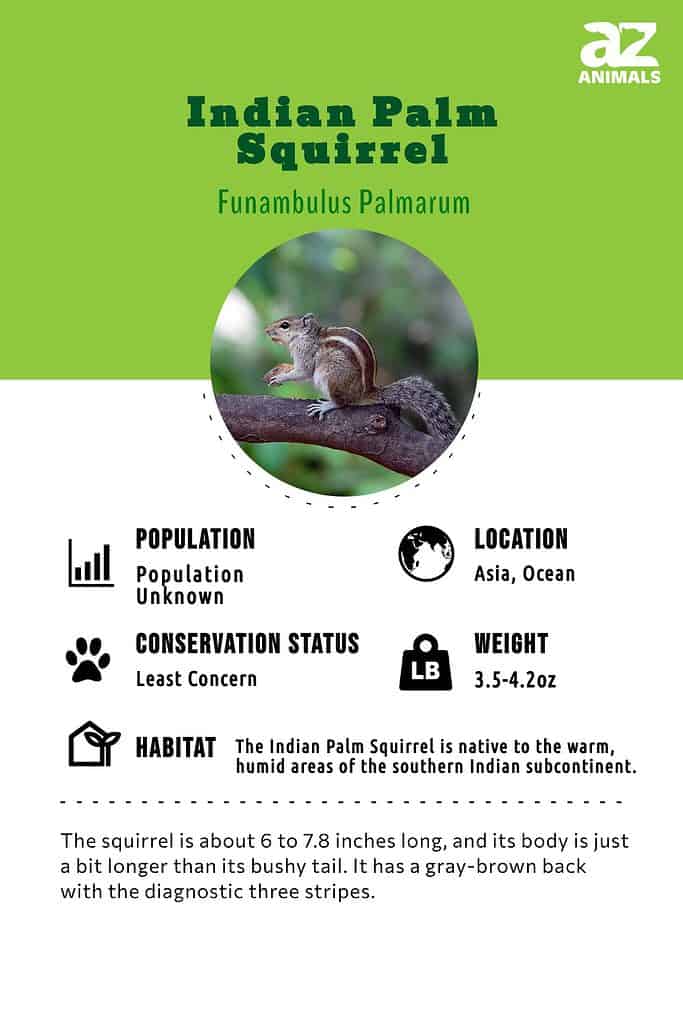
Indian Palm Squirrel

Funambulus palmarum

Three stripes. Big city attitude.
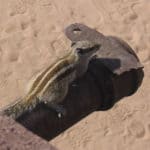
SmokeySteve - Public Domain

Indian Palm Squirrel Distribution

Click a location to explore more animals from that region

Endemic Species Invasive Species
Loading map...

At a Glance

Wild Species
Also Known As Three-striped palm squirrel, Palm squirrel, Three-striped squirrel, Striped palm squirrel, Common palm squirrel
Diet Omnivore
Activity Diurnal+
Lifespan 3 years
Weight 0.16 lbs
Status Least Concern
Did You Know?

Its hallmark is three pale longitudinal stripes on the back-typical of palm squirrels (genus Funambulus).

Scientific Classification

A small diurnal squirrel native to southern India and Sri Lanka, commonly found in urban gardens, parks, and around human habitation. It is a ground- and tree-foraging rodent with characteristic longitudinal striping and a bushy tail.

Kingdom
Animalia
Phylum
Chordata
Class
Mammalia
Order
Rodentia
Family
Sciuridae
Genus
Funambulus
Species
Funambulus palmarum

Distinguishing Features

  • Small, slender palm squirrel with multiple pale longitudinal stripes along the back
  • Diurnal (active by day), often seen in pairs or small groups near people
  • Bushy tail; quick, bounding movement on ground and tree trunks
  • Omnivorous diet: seeds, nuts, fruits, insects; often raids bird feeders or kitchen scraps

Physical Measurements

Length
1 ft (10 in – 1 ft 2 in)
Weight
0 lbs (0 lbs – 0 lbs)
Tail Length
6 in (5 in – 7 in)

Appearance

Primary Colors
Secondary Colors
Skin Type Fur-bearing mammalian skin with dense short body fur and a long, bushy tail; small naked areas limited to nose, lips, paw pads, and ear margins.
Distinctive Features
  • Size/measurements (adult): head-body length commonly reported about 12-15 cm; tail length about 14-16 cm (tail typically as long as or slightly longer than head-body); body mass often about 0.10-0.14 kg (Prater, 1971; Nowak, 1999).
  • Back pattern: three distinct pale stripes running from shoulder region toward rump; stripes are the most diagnostic visual feature at typical viewing distances (Prater, 1971).
  • Tail: long and bushy, used for balance during climbing and as a visual signal; tail hairs often show mixed dark and pale banding, giving a frosted appearance in motion (Nowak, 1999).
  • Head: large dark eyes and small rounded ears; short muzzle with prominent vibrissae for close-range navigation and foraging.
  • Feet/claws: sharp curved claws suited to climbing and clinging to bark as well as ground foraging; forepaws used to manipulate food.
  • Funambulus palmarum is strongly diurnal and often seen in urban gardens, parks, and around houses in southern India and Sri Lanka, searching for food on the ground and in trees.
  • Diet (common observations): omnivorous-feeds on fruits, seeds, nuts, buds/flowers and also insects/other small animal matter; readily exploits human-associated foods in towns and gardens (Prater, 1971; IUCN Red List account).
  • Native range emphasis: southern India and Sri Lanka (not the more northerly Funambulus pennantii), with frequent commensal presence in human-modified landscapes (IUCN Red List account).
  • Longevity: reported to live several years; captive longevity is commonly cited at up to ~5-6 years in standard mammal references (Nowak, 1999; corroborating regional handbooks such as Phillips, 1980 report multi-year survival).

Did You Know?

Its hallmark is three pale longitudinal stripes on the back-typical of palm squirrels (genus Funambulus).

Typical size: head-body ~125-185 mm; tail ~110-160 mm; mass ~70-140 g (reported in regional mammal handbooks).

Diurnal and bold around people-common in gardens, parks, campuses, and even rooftops.

Omnivorous: eats fruits, seeds, nuts, buds, flowers, and readily takes insects and human food scraps.

Builds leaf nests ("dreys") and also uses tree holes and crevices in buildings.

Breeding can occur much of the year in warm climates; gestation is reported around ~40-45 days, with small litters (often 2-3).

Despite being a "tree squirrel" (Sciuridae), it frequently forages on the ground-showing the flexible lifestyle common across palm squirrels.

Unique Adaptations

  • Three-stripe dorsal pattern: breaks up body outline in dappled light (palms, scrub, garden trees), a recurring adaptation across Funambulus palm squirrels.
  • Long, bushy tail: improves balance during fast climbs/leaps and can act as a visual signal during alarms and chases.
  • Strong curved claws and flexible ankles: aid rapid vertical climbing and controlled descents on bark and rough walls.
  • Rodent incisors (ever-growing): enables gnawing hard seeds/nuts and accessing tough plant parts; must continually wear them down through feeding.
  • Behavioral plasticity: readily shifts diet and nesting sites in human-dominated landscapes-key to its success in South Indian and Sri Lankan cities.

Interesting Behaviors

  • Urban foraging circuits: individuals often run repeated routes between fruiting trees, bins, and human handouts, pausing to scan and tail-flick.
  • Food handling: sits upright to hold items in the forepaws, rotating seeds/fruit to bite efficiently with continuously growing incisors (a rodent trait).
  • Alarm communication: gives sharp, high-pitched calls and performs rapid tail flicks when spotting cats, raptors, or snakes.
  • Scatter-hoarding: may cache seeds/food in multiple small spots; this behavior varies across squirrels and can aid seed dispersal when caches are forgotten.
  • Drey building: constructs leaf nests in palms and other trees; in towns, will also exploit eaves and roof spaces for shelter.
  • Sun-basking and thermoregulation: often seen warming in morning sun, then retreating to shade during peak heat-common in diurnal tropical squirrels.
  • Edge-habitat agility: moves quickly between ground and trunks, using short bursts and abrupt direction changes to evade predators.

Cultural Significance

The Indian palm squirrel (Funambulus palmarum) is a common temple, home, and market animal in South India. People often feed it as an act of worship; its three stripes link it to a Ramayana story.

Myths & Legends

In a South Indian Ramayana tale, the small Indian Palm Squirrel (Funambulus palmarum) helped build Rama's bridge by carrying sand and pebbles. Rama stroked its back, leaving three holy stripes.

Temple-side tradition (South India): squirrels are commonly fed near temple precincts; in local devotional practice this is treated as a small act of religious merit and kindness linked to the Ramayana association.

In South India, the Indian Palm Squirrel (Funambulus palmarum) appears in local names, sayings, and children's tales as quick, clever, and hardworking—traits seen when it searches for food and stores it.

Conservation Status

LC Least Concern

Widespread and abundant in the wild.

Population Stable

Protected Under

  • India: Wildlife (Protection) Act, 1972 (species occurs under the general wildlife-protection framework; enforcement and state-level provisions may vary)
  • Sri Lanka: Fauna and Flora Protection Ordinance (general protection framework)

Life Cycle

Birth 3 kits
Lifespan 3 years

Lifespan

In the Wild
1–6 years
In Captivity
3–10 years

Reproduction

Mating System Polygynandry
Social Structure Solitary
Breeding Pattern Transient
Fertilization Internal Fertilization
Birth Type Internal_fertilization

Indian palm squirrels (Funambulus palmarum) are mostly solitary. Mating is polygynandrous (promiscuous): females mate with multiple males during short chases. Males do not help raise young; females alone care for young in nests. No cooperative breeding.

Behavior & Ecology

Social Scurry Group: 1
Activity Diurnal, Matutinal, Vespertine
Diet Omnivore coconut kernel/soft endosperm; also readily takes peanuts/groundnuts where available

Temperament

Generally alert and wary in natural settings but commonly becomes habituated and bold around humans in urban hubs; individuals will approach people and forage in open areas where food is predictable (Menon 2014).
Competitive at food sources: frequent chasing, short pursuits, and displacement behavior at feeders/fruiting trees; aggression is typically brief and resource-focused rather than prolonged social conflict (Prater 1971).
Indian Palm Squirrel (Funambulus palmarum) is a small squirrel (body 15–19 cm, tail 14–17 cm, mass 0.09–0.14 kg) and short-lived; wild ones rarely live as long as in captivity.

Communication

Alarm calls: sharp, repeated staccato notes Often rendered as 'chik/chit' sequences) given to aerial/terrestrial threats; can trigger freezing or rapid retreat to cover in nearby squirrels (Prater 1971
Agonistic chatter/squeals during chases and conflicts at food or near nest sites Prater 1971
Visual signals: tail flicking/flagging, upright postures, rapid directional changes and trunk-hugging on trees that function as threat/alert displays to conspecifics and predators General sciurid signaling; described for palm squirrels in Prater 1971
Olfactory cues: scent marking via urine and glandular/skin scent deposition is used for individual recognition and spacing in sciurids; for Funambulus palmarum this is inferred from typical sciurid behavior and field descriptions of territorial spacing rather than quantified marking rates Nowak 1999; Menon 2014
Tactile: nose-to-nose investigation and brief physical contact during mating encounters and mother-young interactions at the nest Prater 1971

Habitat

Biomes:
Tropical Dry Forest Tropical Rainforest
Terrain:
Plains Hilly Plateau Valley Coastal Riverine Island +1
Elevation: Up to 6561 ft 8 in

Ecological Role

Omnivorous small-bodied seed/fruit consumer and insect predator in urban, agricultural, and dry-to-mesic woodland mosaics; both a seed disperser and occasional seed predator, and a common prey item for small carnivores and raptors.

seed dispersal via carrying/dropping fruits and seeds away from parent plants local seed burial/caching that can aid germination of some cached seeds invertebrate suppression through predation on insects (including termites/ants and larvae) trophic support as prey for raptors, snakes, and small carnivores in peri-urban ecosystems

Diet Details

Main Prey:
Fruit Ants Beetles and beetle larvae Caterpillars Grasshoppers and crickets Bird eggs Small nestlings +1
Other Foods:
Seeds and grains Nuts and oil-rich seeds Coconut kernel and flesh Fruits Flower parts and buds Nectar and pollen Young shoots and leafy material Human food scraps +2

Human Interaction

Domestication Status

Wild

Funambulus palmarum (Indian palm squirrel) is not domesticated but often lives near people in southern India and Sri Lanka. It lives in gardens, temples, plantations and roofs, eats fruit, grains and scraps, and is diurnal, arboreal and forages on the ground. Adults ~12–15 cm body, tail 13–16 cm, 0.10–0.14 kg; wild life a few years, captive up to 8–10 years.

Danger Level

Low
  • Bites and scratches when cornered or handled (notably during rescue/hand-feeding); small but real risk of wound infection
  • Potential zoonotic/ectoparasite concerns typical of small urban rodents (e.g., fleas/ticks/mites; bacterial contamination of stored food); specific pathogen prevalence varies locally and is not well-quantified for this species in most cities
  • Allergic reactions in some people to dander/urine or ectoparasites
  • Property damage risk: gnawing of wiring/wood/plastics and contamination of stored foods in homes/shops when squirrels enter buildings

As a Pet

Not Suitable as Pet

Legality: Laws for Indian Palm Squirrel (Funambulus palmarum) vary by place. In India and Sri Lanka capturing wild squirrels often needs permits or is illegal. Some places allow only captive-bred with permits; others ban. Check local laws before keeping or moving.

Care Level: Experienced

Purchase Cost: Up to $150
Lifetime Cost: $2,500 - $8,000

Economic Value

Uses:
Urban commensal wildlife (high cultural/amenity value in gardens/parks/temples) Minor crop/household pest (fruit, nuts, grains; gnawing damage) Ecosystem services (seed dispersal; insect consumption) Education/outreach (common species used for informal nature learning) Limited/irregular local pet trade (typically informal; not recommended)
Products:
  • non-consumptive amenity/ecotourism value (wildlife watching/feeding in parks and temple grounds)
  • no major commercial products; occasionally implicated in economic loss via fruit/plantation damage and household gnawing

Relationships

Predators 10

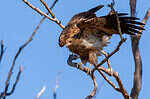
Shikra Accipiter badius
Black kite
Black kite Milvus migrans
Crested serpent eagle Spilornis cheela
Domestic cat
Domestic cat Felis catus
Small Indian mongoose Herpestes auropunctatus
Indian grey mongoose Herpestes edwardsii
Small Indian civet Viverricula indica
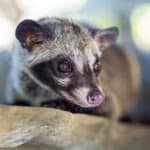
Common palm civet
Common palm civet Paradoxurus hermaphroditus
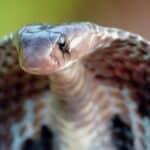
Spectacled cobra
Spectacled cobra Naja naja
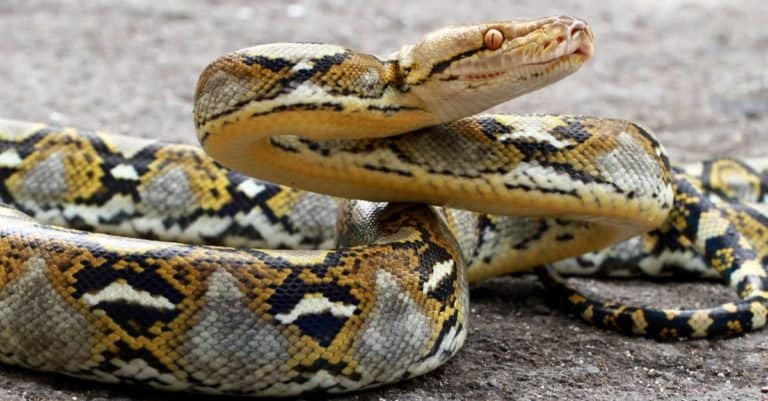
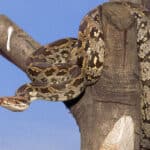
Indian rock python
Indian rock python Python molurus

Related Species 8

Northern palm squirrel Funambulus pennantii Shared Genus
Three-striped palm squirrel
Three-striped palm squirrel Funambulus palmarum Shared Genus
Layard's palm squirrel Funambulus layardi Shared Genus
Jungle palm squirrel Funambulus obscurus Shared Genus
Nilgiri striped squirrel Funambulus sublineatus Shared Genus
Indian giant squirrel
Indian giant squirrel Ratufa indica Shared Family
Pallas's squirrel Callosciurus erythraeus Shared Family
Eurasian red squirrel
Eurasian red squirrel Sciurus vulgaris Shared Family

Ecological Equivalents 5

Animals that fill a similar ecological role in their ecosystem

Northern palm squirrel Funambulus pennantii A very similar commensal, diurnal palm squirrel that occupies gardens, parks, orchards, and buildings. It strongly overlaps in diet (fruits, seeds, and insects) and in foraging behavior (on the ground and in trees). It is often compared directly in field identification and urban ecology studies across the Indian subcontinent.
Jungle palm squirrel Funambulus obscurus Closest ecological analogue in Sri Lanka's lowland/wet-zone habitats. Similar size class, diurnal activity, and omnivorous diet, but more associated with forest edges and plantations than dense urban cores.
Plantain squirrel Callosciurus notatus Small-to-medium, diurnal, omnivorous tree squirrel that thrives around human habitation in South and Southeast Asian towns; fills a similar 'garden squirrel' niche, feeding on fruits and seeds as well as invertebrates, and frequently using buildings and ornamental trees.
Black rat
Black rat Rattus rattus Overlaps in urban and peri-urban settings and in food resources (fruits, grains, household refuse). It is primarily nocturnal and more dependent on human food waste, but competes for similar plant foods in gardens and markets.
Asian house shrew Suncus murinus Both are common near houses and gardens, use human structures, and eat many of the same invertebrates. They are a different group (soricid insectivores) and are often active at dawn, dusk, or night, yet their activity overlaps when foraging.

Considered sacred in India, this Indian squirrel species has become an invasive threat in countries like Australia

It’s not just cows that are considered sacred in India. In Hindu texts, a powerful deity named Lord Rama was building a bridge over the sea to help him find his kidnapped wife when a squirrel helped by moving tiny pebbles to the construction area. When Rama thanked the squirrel by petting its back, his fingers left stripes.

Today, Indian palm squirrels have considered sacred to many Indians thanks to that story. However, it’s also become an invasive species that threatens new habitats far from India’s borders.   

Incredible Palm Squirrel Facts!
ATTRIBUTION NOT FOUND

Indian Palm Squirrel is different from other squirrels because it doesn’t hibernate.

  • The Indian Palm Squirrel escaped from the Perth Zoo in Australia and rapidly began expanding across the city’s suburbs. While its population in Australia peaked at over 1,000, it’s believed that fewer than 10 survive as an invasive species in Australia today.  
  • The Indian Palm squirrel is different from other squirrels because it doesn’t hibernate.
  • The species is known for its distinctive three stripes across its back. However, it’s far from the only squirrel species in India with unique markings. For example, the Indian giant squirrel is known to have a “rainbow coat!”

Scientific Name and Classification
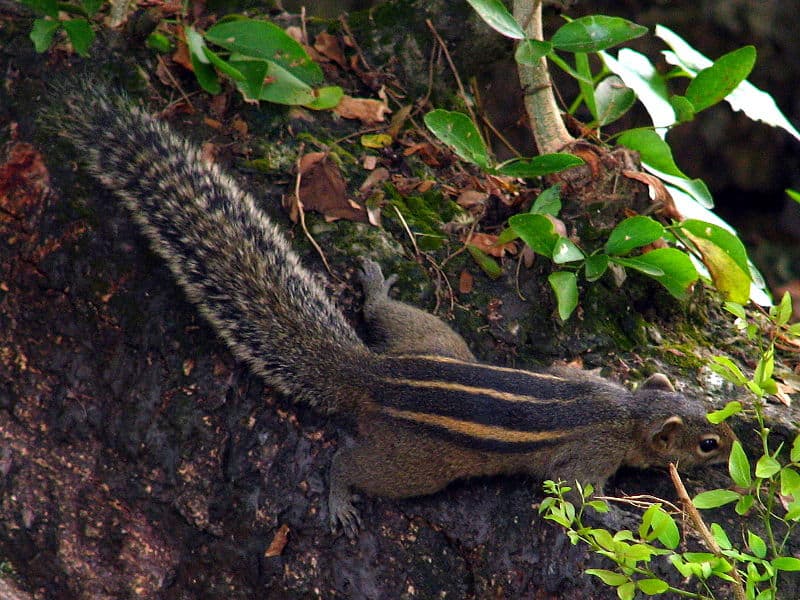
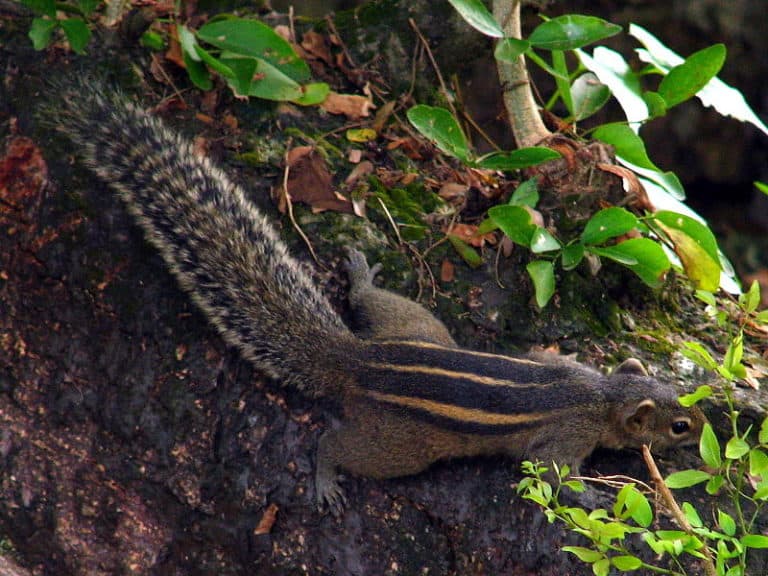
Three-striped palm squirrel (Funambulus palmarum) in Panadura, Sri Lanka

The squirrel’s scientific name is Funambulus palmarum. Funambulus is Latin for the tightrope walker, which describes the squirrel’s agility. Palmarum means that it is of palm trees. Another name for the squirrel is the three-striped palm squirrel.

Because of its stripes, the Indian Palm Squirrel looks very much like a large chipmunk, but chipmunks belong to an entirely different genus.

List of Indian Palm Squirrel Sub-Species

While there are over 40 different species of squirrels in India, and about 280 different species of squirrels in the entire world there are only four subspecies of Indian Palm Squirrels.

These include the following:

  • Funambulus palmarum bellaricus (Wroughton, 1916)
  • Funambulus palmarum palmarum (Linnaeus, 1766)
  • Funambulus palmarum brodiei (Blyth, 1849)
  • Funambulus palmarum robertsoni (Wroughton, 1916)

Evolution and Origins

The earliest known fossilized squirrels that have been found to date are from the Eocene epoch. Among other living rodent families, the squirrels are most closely related to the mountain beaver as well as the dormice.

The Indian Palm Squirrel was artificially introduced in the last century, to several other areas of the world such as Australia although they originated in Asia.

Appearance and Behavior
Young squirrels are lighter in color than adults, and sometimes albino squirrels are born.

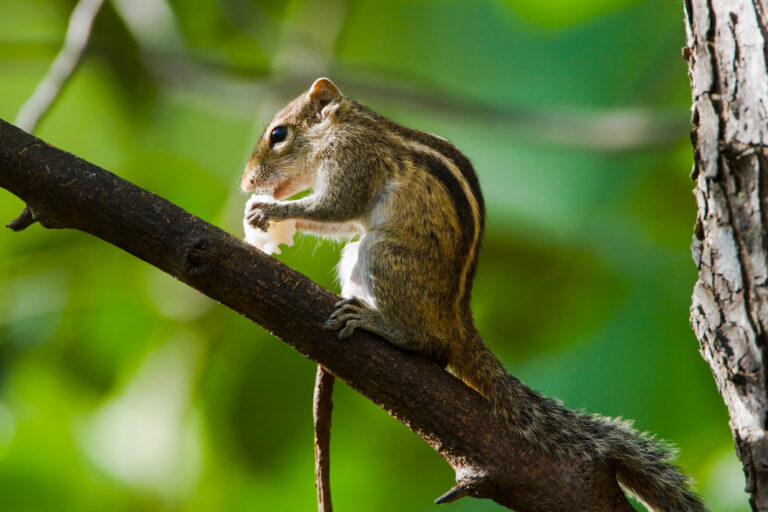
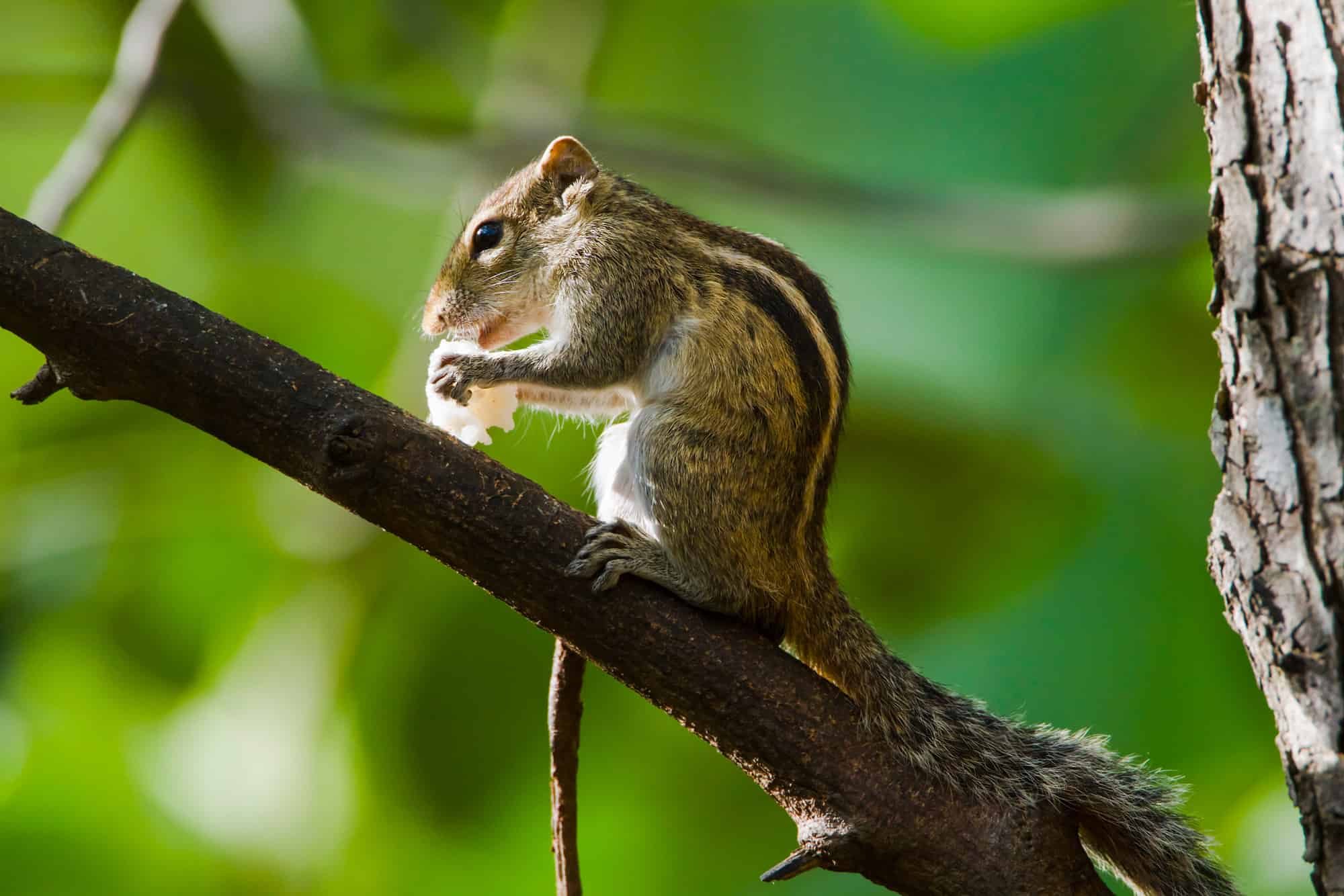
The squirrel is about 6 to 7.8 inches long, and its body is just a bit longer than its bushy tail. It has a gray-brown back with the diagnostic three stripes. Interestingly, these stripes can even be seen on newborn squirrels even before they grow fur.

Young squirrels are lighter in color than adults, and sometimes albino squirrels are born. These are squirrels that lack the pigment that gives other squirrels their color, so their fur is white, and their eyes are red.

The middle of the three stripes runs from the squirrel’s head to its tail, but the outer stripes begin at the squirrel’s front legs and stop at its hind legs. The belly is cream-colored, and the tail has long black and white fur. The texture of the fur overall is soft and silken. The Indian Palm Squirrel has tiny, triangular ears and large dark eyes found on the sides of its head. This gives the squirrel nearly 360-degree vision and helps it avoid predators.

An average Indian Palm Squirrel weighs about 3.5 to 4.2 ounces (100 to 120 grams) and is surprisingly fast for its size. It can run about 10 miles per hour (16 km/hr). They not only have whiskers on their faces, like cats but have them on their legs. These whiskers give the squirrel a superb sense of touch.

The Indian Palm Squirrel has four toes on each of their paws, including a rudimentary thumb. The paws have claws that help the squirrel climb, and the ankles on its back legs can rotate 180 degrees. This helps it go down a tree or telephone pole head first because its back paws are able to firmly grip the wood.

A squirrel is a type of rodent, so its teeth keep growing. Gnawing on its food keeps its teeth, especially two pairs of long front teeth called incisors, a reasonable size and keeps them healthy. The typical arrangement of teeth is two pairs of incisors that gnaw their food, and cheek teeth that grind their food. There’s a big gap between the incisors and cheek teeth called the diastema.

Squirrel Habitat
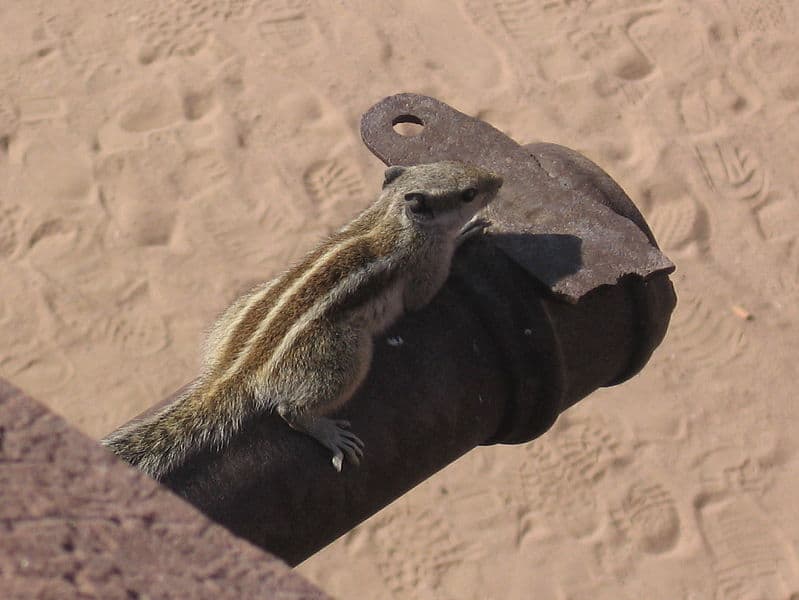
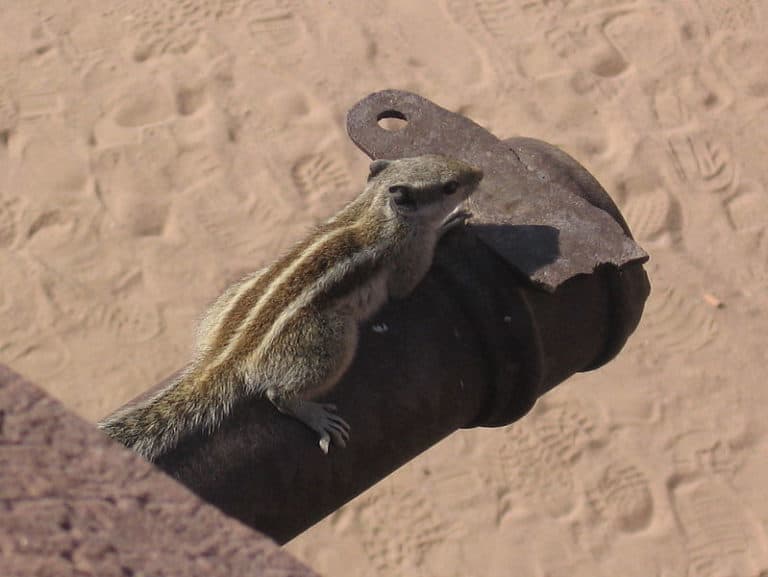
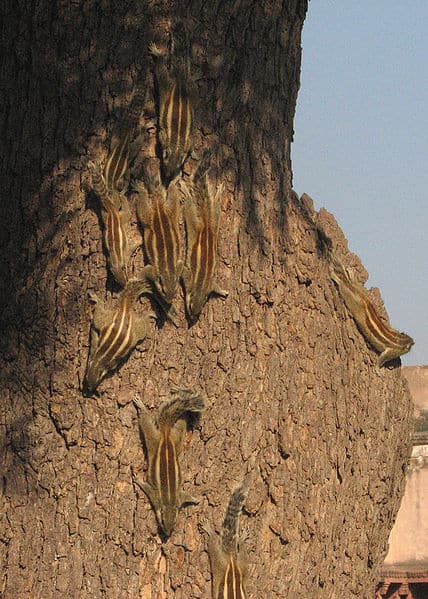
An Indian Palm Squirrel at the Mehrangarh Fort in Jodhpur, India.

The Indian Palm Squirrel is native to the warm, humid areas of the southern Indian subcontinent. It nests at the top of the trees found there, and not just palm trees.

The nest of a squirrel is called a dray and is woven from grass. Instead of hibernating during the winter, the Indian Palm Squirrel just stays in its nest until the day grows warm enough for it to emerge. If it must, the squirrel will even live in a house.

Squirrel Diet
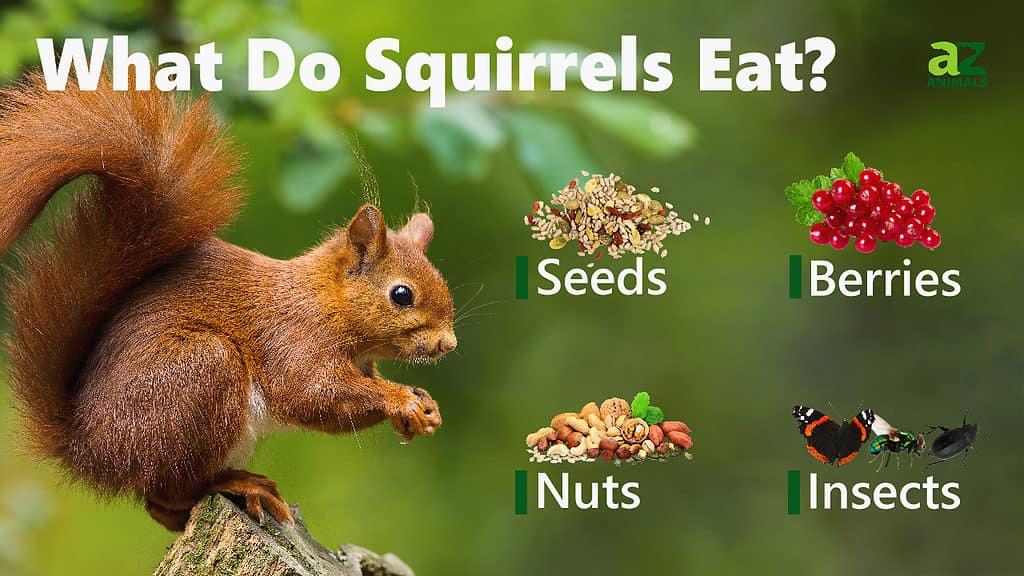
Squirrels eat seeds, berries, nuts, insects

The squirrel is an omnivore. This means it will eat just about anything though it prefers fruit and nuts. In India, palm squirrels prefer crops such as nuts, sugarcane, grapes, mangoes, and apples.

In addition, Indian palm squirrels won’t hesitate to eat crops as well as eggs and even chicks found on poultry farms. This makes them especially dangerous as an invasive species. On the other hand, it eats insects such as caterpillars that also damage crops.

In its natural habitat, the Indian Palm Squirrel will eat other, smaller mammals such as mice, small reptiles, insects, and birds as well as fruit, nuts, eggs, and seeds. Like humans, squirrels can’t digest cellulose.

Because the squirrel is revered in India, people also feed it. As a result, some Indian Palm Squirrels have become quite tame and come to expect handouts from human friends.

Like many other types of squirrels, the Indian Palm Squirrel is fairly aggressive when it comes to protecting its cache of food and will see off any other animal that tries to pilfer it. It’s a busy and noisy animal and gives off a distinctive chipping alarm call when it senses danger.

Squirrel Predators and Threats
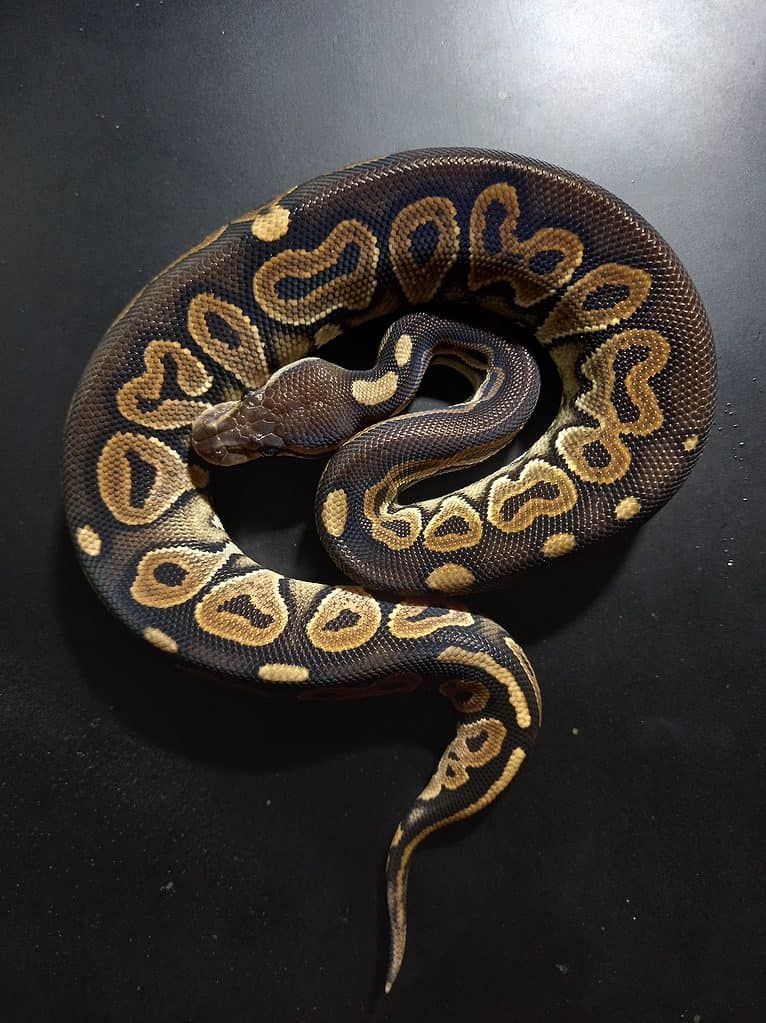
Cinnamon ball python

Cinnamon ball pythons are beautiful snakes with very little yellow coloration.

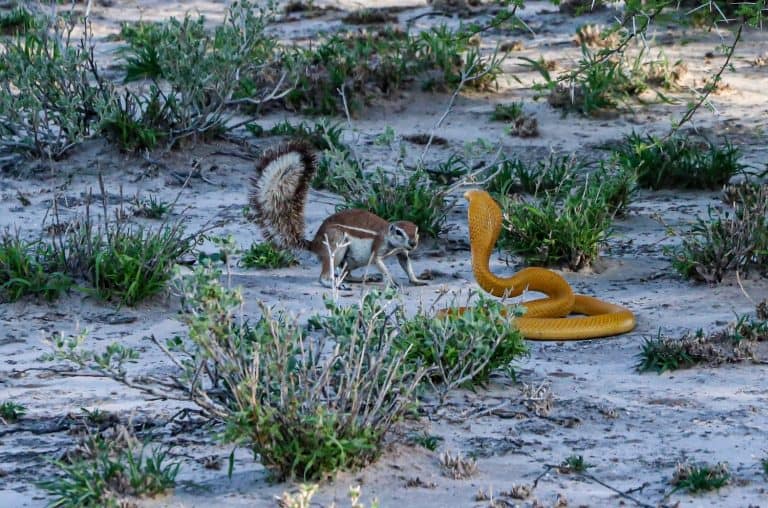
Because it is small, Indian palm squirrels are favored prey for any sort of carnivore, including mammals like wild cats, birds such as hawks or eagles, and reptiles such as snakes. Outside of India, humans do hunt and kill Indian Palm Squirrels, especially in those regions where they have become invasive.

In Western Australia, after Indian palm squirrels escaped from the Perth Zoo, an exclusion zone was set up around the Perth area to prevent the spread of Indian palm squirrels. However, after they continued escaping, a pest control program was put in place to limit their numbers.

Reproduction, Babies, and Lifespan
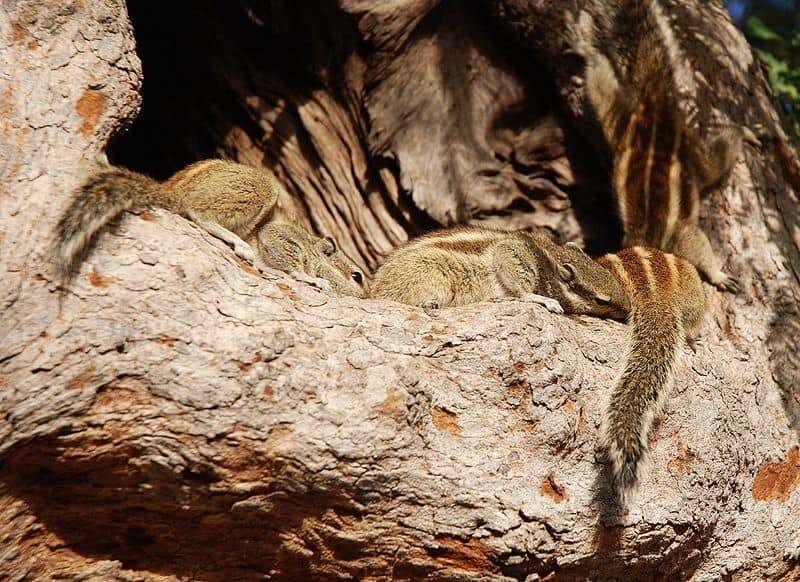
Indian Palm Squirrels are solitary, and they only come together to mate in the fall.

Indian Palm Squirrels are solitary, and they only come together to mate in the fall. They chase each other, and the males have a mating call. The male’s sense of smell can tell him if the female is ready to mate.

Only the mother cares for the babies. She gives birth after a pregnancy of 34 days to two or three babies. They are born blind and hairless. They are weaned after 10 weeks and are ready to reproduce when they are nine months old. A male squirrel is a buck, the female is a doe, and the baby is a pup, kitten, or kit.

Indian Palm Squirrels live about two to four years, though like many squirrels most who live in the wild die during their first year. The oldest Indian Palm Squirrel lived to be about five and a half years old.

Population: How many Indian Palm Squirrels are Left?

Biologists don’t really know how many Indian Palm Squirrels live in the wild, but it is a very abundant animal, and its population trend is moving upward. The species is classified as “Least Concern.” However, in environments where the squirrel has been introduced to

View all 59 animals that start with I

Sources

  1. David Burnie, Dorling Kindersley (2011) Animal, The Definitive Visual Guide To The World's Wildlife / Accessed November 10, 2008
  2. Tom Jackson, Lorenz Books (2007) The World Encyclopedia Of Animals / Accessed November 10, 2008
  3. David Burnie, Kingfisher (2011) The Kingfisher Animal Encyclopedia / Accessed November 10, 2008
  4. Richard Mackay, University of California Press (2009) The Atlas Of Endangered Species / Accessed November 10, 2008
  5. David Burnie, Dorling Kindersley (2008) Illustrated Encyclopedia Of Animals / Accessed November 10, 2008
  6. Dorling Kindersley (2006) Dorling Kindersley Encyclopedia Of Animals / Accessed November 10, 2008
  7. David W. Macdonald, Oxford University Press (2010) The Encyclopedia Of Mammals / Accessed November 10, 2008
  8. Queensland Department of Agriculture and Fisheries / Published January 1, 2016 / Accessed January 4, 2020
  9. Ann Jones / Published July 6, 2017 / Accessed January 4, 2020
Rebecca Bales

About the Author

Rebecca Bales

Rebecca is an experienced Professional Freelancer with nearly a decade of expertise in writing SEO Content, Digital Illustrations, and Graphic Design. When not engrossed in her creative endeavors, Rebecca dedicates her time to cycling and filming her nature adventures. When not focused on her passion for creating and crafting optimized materials, she harbors a deep fascination and love for cats, jumping spiders, and pet rats.
Connect:

Thank you for reading! Have some feedback for us?


Indian Palm Squirrel FAQs (Frequently Asked Questions)

There’s another squirrel species found across India that looks very similar to the Indian palm squirrel. It’s named the Northern palm squirrel, and its defining characteristic is that it has five stripes across its back (compared to the Indian palm squirrel’s three).

In addition, India is also home to the Indian giant squirrel, or Malabar giant squirrel. This species of squirrel can weigh about 15 times more than the Indian palm squirrel and measure up to three feet (1 meter) in length! The Indian giant squirrel has a coat that can appear “rainbow” with heavy amounts of magenta, deep blues, and a tail with an orange tip.