


J
Species Profile

Jackal

Canidae

Small canids, big survival skills
Hans Hillewaert / Creative Commons

Jackal Distribution

Click a location to explore more animals from that region

Loading map...

Size Comparison

Human 5'8"
Jackal 1 ft 5 in

Jackal stands at 25% of average human height.

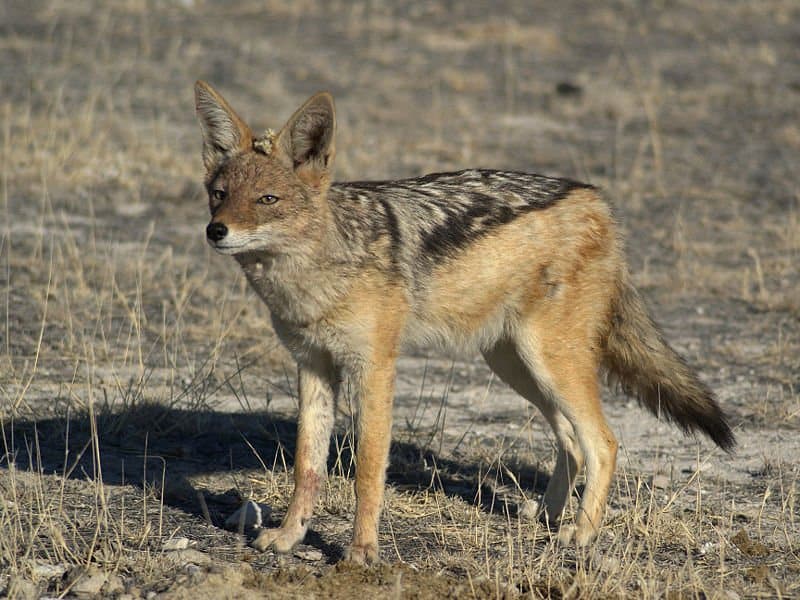
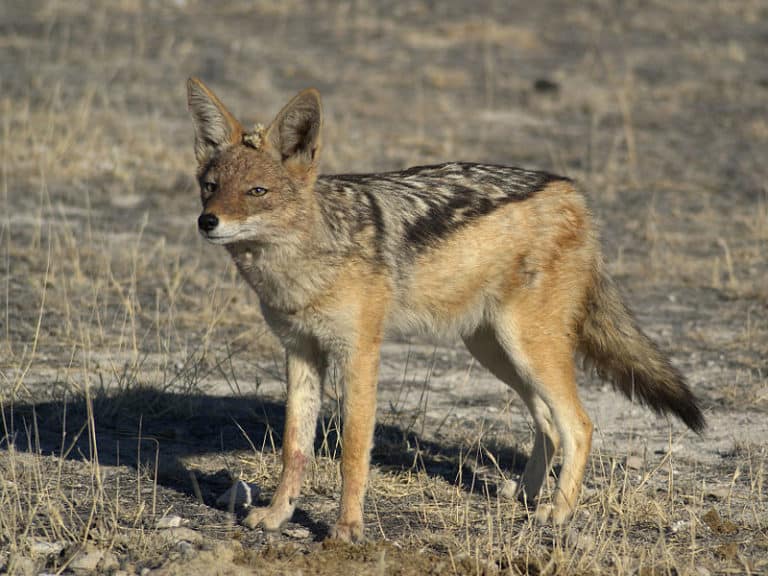
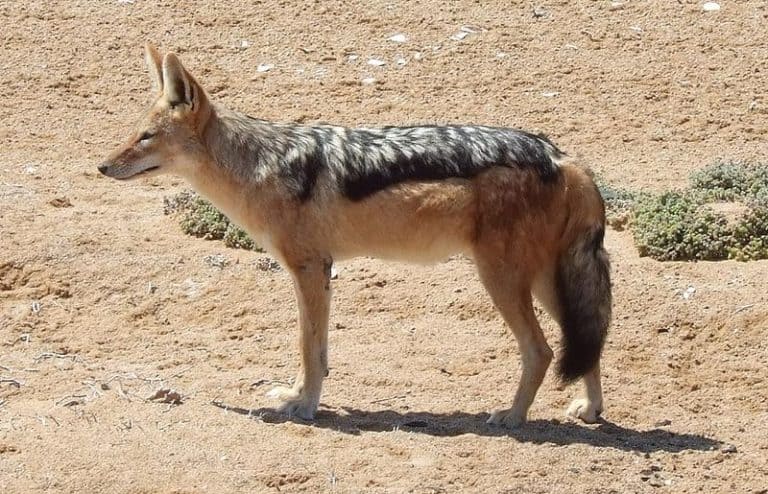
Black-backed Jackal (Canis mesomelas), Namibia.

At a Glance

Family Overview This page covers the Jackal family as a group. Stats below are general traits shared across the family.
Also Known As Golden jackal, Common jackal, Black-backed jackal, Side-striped jackal, Reed wolf, Indian jackal
Diet Omnivore
Activity Nocturnal+
Lifespan 9 years
Weight 15 lbs
Status Least Concern
Did You Know?

"Jackal" is a common-name grouping, not a formal taxonomic rank within Canidae.

Scientific Classification

Family Overview "Jackal" is not a single species but represents an entire family containing multiple species.

Jackals are small-to-medium, omnivorous canids characterized by slender builds, long legs, pointed muzzles, and adaptable diets. The term most commonly applies to the Golden Jackal (Eurasia) and the African jackals (Black-backed and Side-striped), but it is not a formal taxonomic rank.

Kingdom
Animalia
Phylum
Chordata
Class
Mammalia
Order
Carnivora
Family
Canidae

Distinguishing Features

  • Small-to-medium canid with a fox-like profile but generally more robust/long-legged than many foxes
  • Opportunistic omnivore (small vertebrates, invertebrates, fruit, carrion, and human-associated foods)
  • Often forms monogamous pairs; social structure varies by species and food availability
  • Vocal and behaviorally adaptable across a wide range of environments

Physical Measurements

Males and females differ in size

Height
1 ft 6 in (1 ft 2 in – 1 ft 8 in)
1 ft 5 in (1 ft 3 in – 1 ft 8 in)
Length
3 ft 9 in (2 ft 11 in – 4 ft 5 in)
3 ft 7 in (2 ft 11 in – 4 ft 6 in)
Weight
22 lbs (13 lbs – 31 lbs)
22 lbs (13 lbs – 33 lbs)
Tail Length
1 ft 1 in (8 in – 1 ft 4 in)
12 in (8 in – 1 ft 4 in)
Top Speed
40 mph
About 50–65 km/h

Appearance

Primary Colors
Secondary Colors
Skin Type Jackal-like canids have thick fur, often a double coat with stiff hairs over soft underfur. Coat thickness and length change with climate and season. Paws have tough, dark pads for long trotting on varied ground.
Distinctive Features
  • Informal common-name grouping within Canidae (not a formal taxonomic rank): commonly refers to three 'true jackals'-Golden Jackal (often placed in Canis) and the African Black-backed and Side-striped jackals (placed in Lupulella by many authorities).
  • Overall build generalized across 'jackal-like' canids: small-to-medium size, long legs, narrow chest, and a relatively pointed muzzle; large, upright ears are typical.
  • Typical size range across the commonly recognized 'true jackals' (smallest to largest): body mass ~6-15 kg; head-body length ~60-105 cm; tail length ~20-40 cm; shoulder height roughly ~35-50+ cm (varies by species, sex, and region).
  • Common craniofacial look: narrow rostrum (pointed muzzle), alert ear carriage, and a lean silhouette; eyes typically forward-facing with a predatory canid profile.
  • Tail usually moderately bushy with a contrasting darker tip in many individuals; carried low to level during travel, raised in display.
  • Dentition and jaws typical of medium canids-suited to mixed diets (small vertebrates, carrion, invertebrates, and plant matter).
  • Behavior/ecology generalizations (with variation): frequently omnivorous and opportunistic; scavenging common, but active hunting of small prey also widespread. Many populations exploit human-modified landscapes; degree of synanthropy varies by region and persecution pressure.
  • Social structure often features pair-bonding and territoriality; pairs may be accompanied by offspring or 'helpers' in some populations. Activity pattern commonly crepuscular/nocturnal near humans but can be more diurnal in less disturbed areas.
  • Habitat breadth across 'jackals': from semi-arid savannas and open scrub to woodland edges and agricultural mosaics; different lineages and regions emphasize different habitats (e.g., some more open-country, others more cover-associated).
  • Lifespan range across this grouping: commonly ~8-12 years in the wild (highly variable with mortality pressures), with captive longevity often reaching ~14-16 years.

Sexual Dimorphism

Sexual dimorphism is generally mild in 'jackal' canids: males average slightly larger/heavier with somewhat more robust heads/neck musculature, but coat colors and patterns are broadly similar between sexes and overlap strongly among individuals and populations.

  • Slightly larger average body mass and shoulder height; more robust head/neck in some populations.
  • May show more pronounced musculature in shoulders/neck, especially in prime adults (variation substantial).
  • Slightly smaller average size; otherwise similar coat patterning and coloration.
  • Mammary development during breeding/lactation; seasonal condition changes tied to reproduction.

Did You Know?

"Jackal" is a common-name grouping, not a formal taxonomic rank within Canidae.

The three widely recognized "true jackals" are the Golden Jackal (Canis aureus) and two African species: Black-backed and Side-striped (often placed in Lupulella).

Across jackals, adult body size spans roughly ~60-105 cm head-body length, ~20-40 cm tail length, and ~5-16 kg in weight (smallest to largest species/sexes).

Jackals readily shift diets with season and opportunity-prey, carrion, insects, fruit, and human-associated foods all feature in different places.

Black-backed jackals are known for loud, far-carrying vocalizations (including yelps/howls) used in territorial advertising and pair coordination.

By eating fruit and passing seeds, jackals can act as seed dispersers in some ecosystems.

Golden jackals have expanded their range in parts of Europe in recent decades, taking advantage of mixed farmland/woodland and abundant food sources.

Unique Adaptations

  • Generalist digestive strategy for omnivory: can process mixed diets (meat, insects, and plant foods), aiding survival in variable environments.
  • Long legs and efficient gait: built for trotting over large areas to patrol territories and locate scattered food.
  • Highly developed scent communication: scent glands and urine/feces marking help maintain territories and convey reproductive status.
  • Behavioral adaptability to human-altered landscapes: capable of living near farms, villages, and roads where risk and reward are both high.
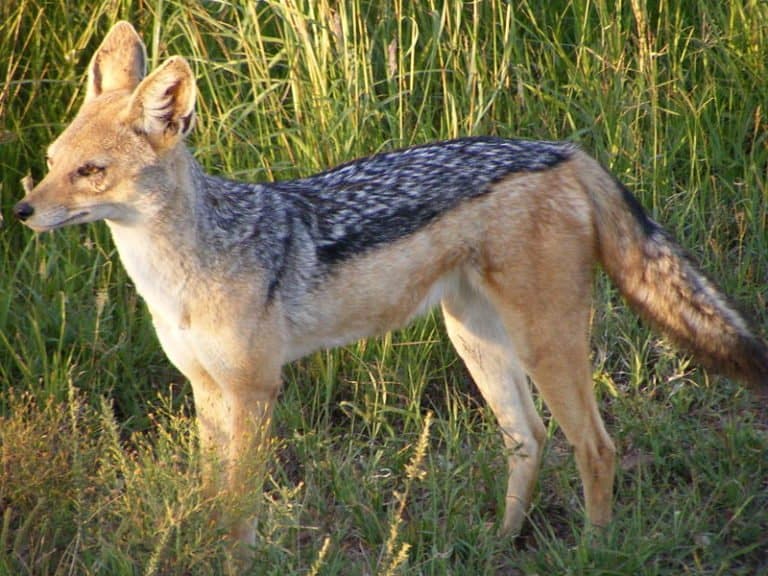
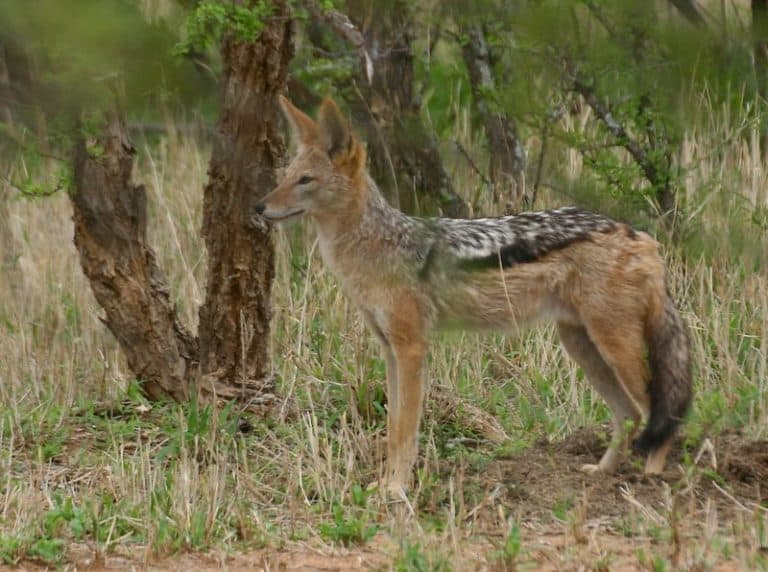
  • Cryptic coloration and regional variation: coats (e.g., black "saddle" in black-backed, muted striping in side-striped) help concealment in different African/Eurasian habitats.

Interesting Behaviors

  • Flexible social lives: commonly seen in mated pairs, but also solitary foragers and family groups-variation depends on food density and pup-rearing needs.
  • Strong pair-bonding and territoriality: pairs often maintain territories with scent marking and vocal duets; intensity varies by habitat and population.
  • Opportunistic hunting: from grabbing insects and rodents to coordinated chasing of larger prey (more likely where pairs/families cooperate).
  • Scavenging and "following" behavior: frequently exploit carcasses (sometimes after larger predators), balancing boldness with caution around competitors.
  • Seasonal diet switching: more fruit and invertebrates when abundant; more vertebrate prey or carrion when conditions are harsh.
  • Den use and pup care: dens (burrows, thickets, rocky crevices) are used especially during breeding; in some populations, older offspring may assist with pup care (cooperative tendencies vary among species and sites).

Cultural Significance

Jackals (jackal-like canids) are symbols of cleverness, taking chances, and the border between life and death across Africa and Asia. In Egypt they link to Anubis and Wepwawet at graves. In South Asia and the Middle East they appear in proverbs as smart scavengers in rural areas.

Myths & Legends

Ancient Egypt: Anubis and Wepwawet-jackal-headed gods linked to funerary rites, guiding and guarding the dead, and protecting tombs.

India (Panchatantra): the jackals Karataka and Damanaka (names vary slightly by transliteration) serve as cunning advisers whose schemes drive moral lessons about politics, trust, and unintended consequences.

Middle Eastern/Persian tradition (Kalila wa Dimna): derived from the Panchatantra, its frame tales preserve jackal characters as clever courtiers and plotters used to teach statecraft and ethics.

South Asian folktale cycles: "The Blue Jackal" (retold in the Panchatantra and related traditions) tells of a jackal dyed blue who briefly becomes a false 'king' of animals until exposed-warning against deceit and pride.

African folktales (southern and eastern Africa, widely collected): Jackal is a recurring trickster figure-e.g., stories where Jackal outwits stronger animals like Lion or Hyena, emphasizing intelligence over strength.

Southern African tale type: "The Jackal and the Crow/Raven" appears in multiple regional variants, commonly featuring Jackal using flattery or trickery to steal food-used as a cautionary story about vanity and gullibility.

Conservation Status

LC Least Concern (as a broad "jackal-like canids" hub, most constituent taxa are LC; conservation status across this group ranges from LC to EN, notably the Ethiopian wolf-formerly "Simien jackal"-EN)

Widespread and abundant in the wild.

Population Unknown

Protected Under

  • Protection and management vary substantially by country: some jackal-like canids are legally protected, while others are classified as vermin/game and subject to culling or unregulated take.
  • At-risk taxa receive stronger legal protection and conservation action (e.g., Ethiopian wolf is strictly protected nationally in Ethiopia and listed on CITES Appendix I).
  • Many populations occur within protected areas to varying degrees; effectiveness depends on enforcement, disease management (especially domestic-dog vaccination), and conflict mitigation.

You might be looking for:

Golden Jackal

42%

Canis aureus

Widespread jackal of Eurasia; the species most often meant by “jackal” without qualifiers.

View Profile

Black-backed Jackal

22%

Lupulella mesomelas

Common African jackal with a dark ‘saddle’ on the back.

View Profile

Side-striped Jackal

18%

Lupulella adustus

African jackal typically associated with more wooded habitats; faint side stripes.

View Profile

African Golden Wolf (sometimes historically called a jackal)

10%

Canis lupaster

North/East African canid formerly lumped with golden jackal in some regions and older sources.

Coyote (occasionally called “American jackal” in older writing)

8%

Canis latrans

North American canid; not typically called a jackal in modern usage.

View Profile

Life Cycle

Birth 4 pups
Lifespan 9 years

Lifespan

In the Wild
6–12 years
In Captivity
10–16 years

Reproduction

Mating System Monogamy
Social Structure Socially Monogamous
Breeding Pattern Long Term
Fertilization Internal Fertilization
Birth Type Internal_fertilization

Jackal-like canids (e.g., golden, black-backed, side-striped jackals) are small (6–14 kg) and live about 8–10 years in the wild. They are mostly socially monogamous: strong pair bonds, both parents help pups, and helpers may assist.

Behavior & Ecology

Social Pack Group: 5
Activity Nocturnal, Crepuscular, Diurnal, Cathemeral
Diet Omnivore Meat from mammals (especially readily available small-to-medium prey and carrion), with fruit taken heavily when seasonally abundant in many species.

Temperament

Highly adaptable and opportunistic (diet and foraging tactics shift with local resources)
Territorial (space use often defended via scent marks and vocal displays; intensity varies by species and density)
Socially bonded (strong pair/family cohesion is common; larger-group reliance varies across the family)
Wary of threats but capable of bold, risk-tolerant behavior in human-dominated landscapes (variation is population- and context-dependent)
Competitive at concentrated food sources (aggression and tolerance both occur, depending on kinship, rank, and food abundance)

Communication

howls Long-range contact, territorial advertisement; prominence varies among species
barks Alarm, short-range alerting, human-associated disturbance contexts
yips/yelps Excitement, social cohesion, group calling in some canids
growls Threat and resource defense
whines/whimpers Appeasement, solicitation, parent-offspring contact
scent marking with urine, feces, and gland secretions Territorial boundaries, reproductive status, individual identity
scratching/ground marking near scent posts Visual enhancement of scent signals
body postures and facial expressions Tail carriage, ear position, piloerection for dominance/submission and threat display
tactile behaviors Greeting rituals, muzzle licking, grooming, huddling-especially within pairs/families
play signals (e.g., play bows) that reinforce bonds and practice hunting/competitive skills

Habitat

Biomes:
Savanna Temperate Grassland Tropical Dry Forest Temperate Forest Mediterranean Desert Hot Desert Cold Wetland Freshwater +3
Terrain:
Plains Hilly Plateau Valley Coastal Riverine Rocky Sandy Muddy Mountainous Island +5
Elevation: Up to 11482 ft 11 in

Ecological Role

Widespread predator guild members (mesopredators to apex predators) and facultative scavengers; some populations function as key seed dispersers when fruit intake is high.

Regulation of prey populations (rodents to ungulates), with strength depending on species/body size and sociality Carcass removal and nutrient recycling via scavenging (important in many fox/jackal-like canids and also wolves) Seed dispersal from fruit consumption in several genera (e.g., many foxes and some jackal-like populations) Trophic cascades and community structuring (strongest where large canids act as apex predators) Disease ecology interactions (can reduce some prey/mesopredator densities but can also act as reservoirs/vectors for pathogens like rabies and canine distemper; varies by region)

Diet Details

Main Prey:
Small mammals Medium-to-large mammals Birds and eggs Reptiles and amphibians Fish and aquatic prey Insects and other invertebrates Carrion +1
Other Foods:
Fruits and berries Other plant matter Seeds and nuts Roots and tubers Fungi Human-associated foods

Human Interaction

Domestication Status

Wild

Jackals (Canidae: Golden Jackal, Black-backed and Side-striped) are not domesticated and have no dog-like domestication history. People treat them as wild carnivores—tolerated or killed depending on livestock, hunted as pests, and part of folklore and ecosystems. Hand-raised jackals may become tame but keep wild behavior and breeding.

Danger Level

Moderate
  • Rabies exposure risk in endemic areas (the primary human-safety concern; risk varies strongly by region and vaccination programs)
  • Bites/scratches when cornered, trapped, or when habituated animals approach people (generally uncommon compared with larger canids)
  • Other zoonoses depending on geography (e.g., leishmaniasis, echinococcosis, canine distemper involvement in animal outbreaks)
  • Indirect risk via livestock predation leading to conflict (often focused on poultry/small stock; intensity varies by species and local prey availability)

As a Pet

Not Suitable as Pet

Legality: Varies widely by country/state/province; commonly restricted or prohibited as a private pet and often requires wildlife/exotic permits, specialized caging standards, and veterinary documentation. Even where legal, local ordinances, rabies/vector rules, and animal welfare regulations frequently make private ownership difficult.

Care Level: Expert Only

Purchase Cost: Up to $5,000
Lifetime Cost: $15,000 - $60,000

Economic Value

Uses:
Ecosystem services (scavenging and rodent control) Wildlife tourism/photography Conflict costs (livestock depredation and disease management) Research and education (behavior, disease ecology, carnivore coexistence) Cultural value (folklore, symbolism)
Products:
  • pelts/fur (historically and locally variable; not universal)
  • taxidermy specimens (limited/regulated contexts)
  • non-market value from ecotourism and biodiversity conservation

Relationships

Types of Jackal

4

Explore 4 recognized types of jackal

Golden Jackal
Golden Jackal Canis aureus
Black-backed Jackal
Black-backed Jackal Lupulella mesomelas
Side-striped Jackal
Side-striped Jackal Lupulella adusta
African Golden Wolf (historically often treated as an African "golden jackal" form) Canis lupaster

Jackals communicate with members of their pack using howls, growls, yipping, and even hooting sounds.

Jackals are animals that make their home in different parts of Africa as well as in European countries such as Greece, Romania, Italy, and Bulgaria along with others. They are omnivores eating both plants and meat.

A male and female jackal are monogamous meaning they stay together throughout their lives and the pair raises their pups together. These canines can live up to 12 years in the wild.

5 Incredible Jackal Facts!
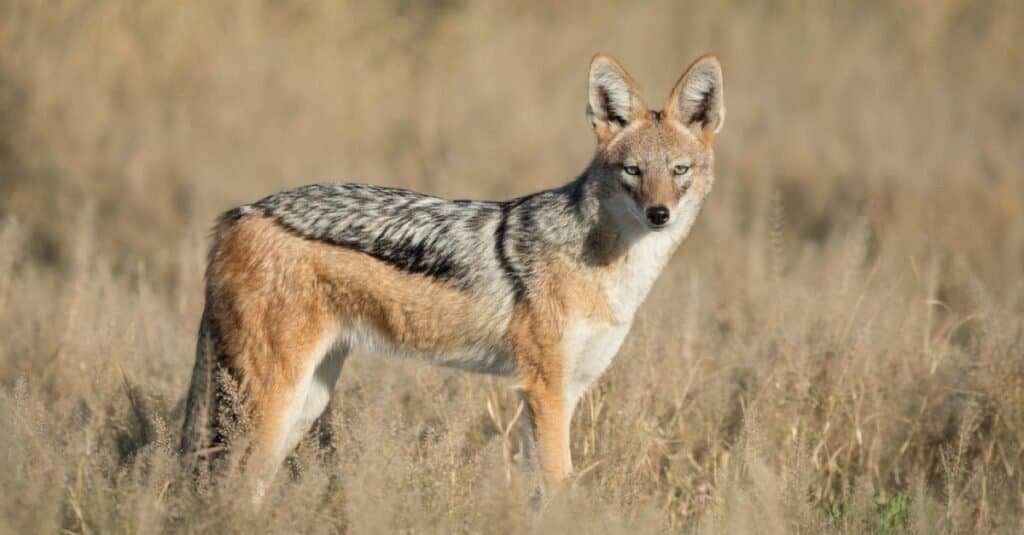
Types of Wild Dogs

A group of jackals is sometimes called a pack or a tribe.


• Jackals in captivity can live as long as 16 years.

• Jackals are animals that hunt in pairs instead of looking for prey alone.

• A group of jackals is sometimes called a pack or a tribe.

• Jackal animals usually have from two to four pups in a litter.

• These creatures are canines with relatives that include coyotes, foxes, and wolves.

Evolution and Origins

The origin of the Jackal can be traced back 5 million years to the West Coast of South Africa. In fact, a new discovery of fossils from a new species found on the West Coast of South Africa has unearthed the African origins of the jackal. That means that scientists can trace its history on the continent back 5 million years ago.

List of Jackal Types

There are four representative species of Jackal. Those species are:

Scientific Name

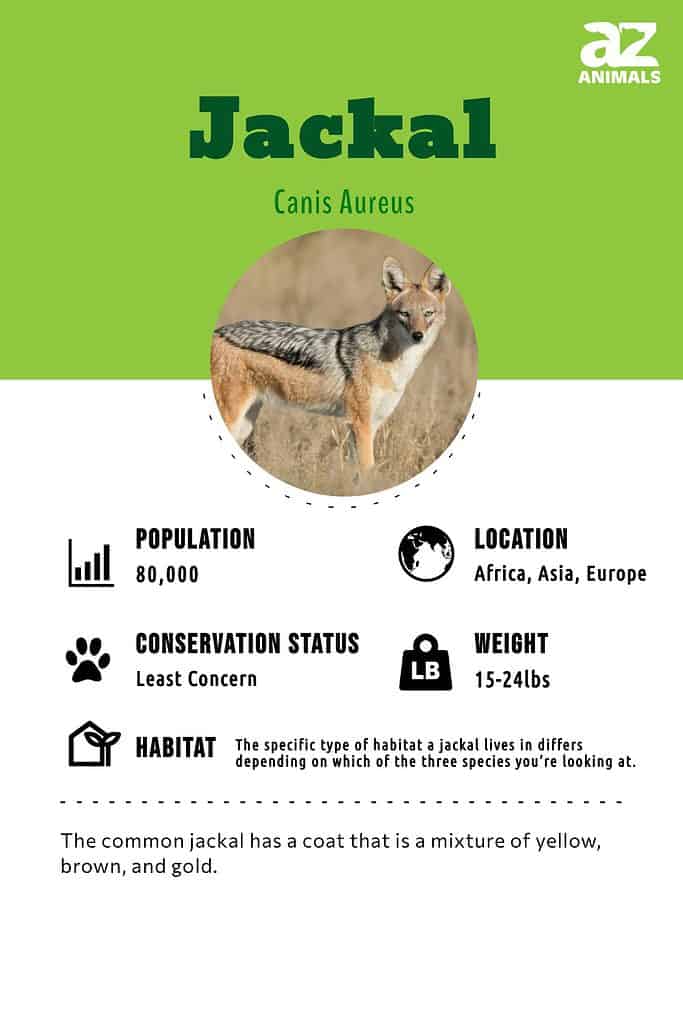
The scientific name of a common jackal is Canis aureus.

The scientific name of a common jackal is Canis aureus. The word Canis is Latin for dog and aureus means golden. So, it makes sense that another name for the common jackal is the golden jackal. Its family is Canidae and its class is Mammalia.

Along with the common jackal animal, there are two other species including the side-striped jackal and the black-backed jackal. The only difference between these three species is the color of their coat and the specific habitat they prefer to live in.

Appearance and Behavior
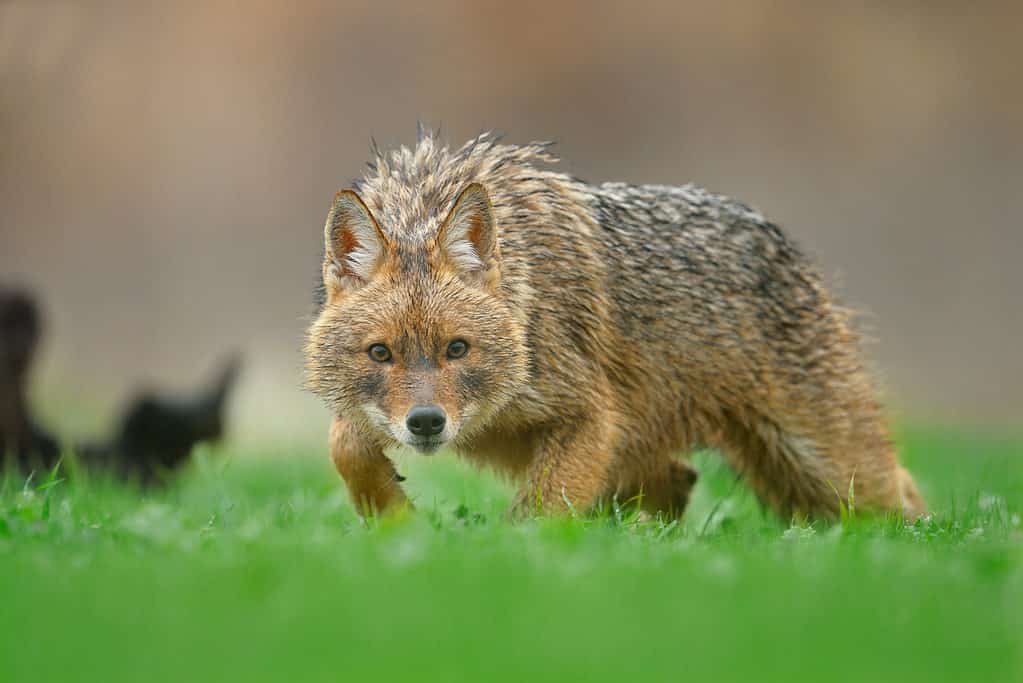
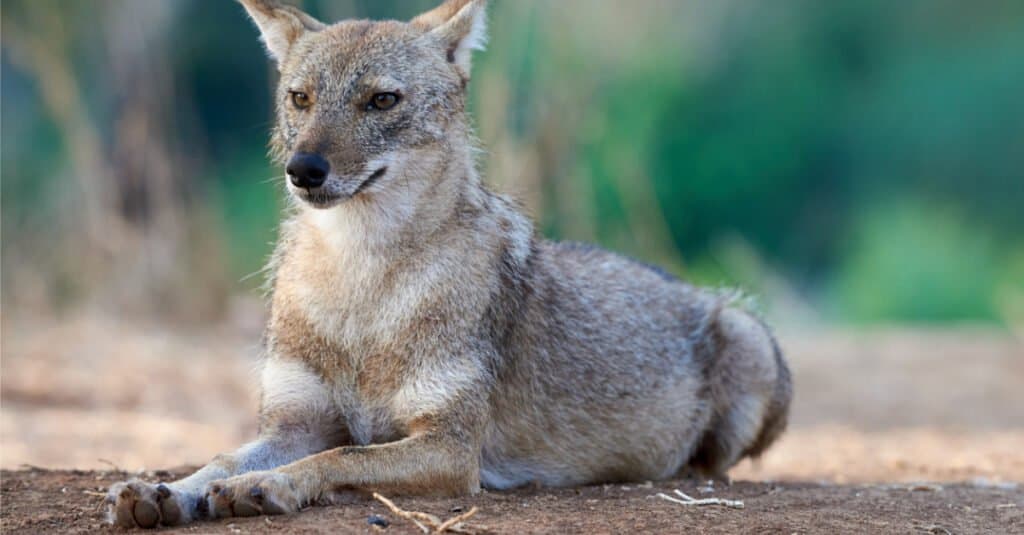
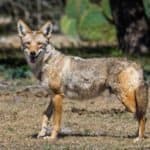
A golden jackal.

The common jackal has a coat that is a mixture of yellow, brown, and gold.

The common jackal has a coat that is a mixture of yellow, brown, and gold. The appearance of a jackal’s coat can become darker or lighter with the change of seasons. If you have a dog, you may notice that its coat gets thicker or changes color a little bit with the seasons. A similar process happens with these animals.

The jackal animal has a long slim nose, large ears, and even a bushy tail that makes it look very similar to a fox. Remember, foxes and jackals are close relatives! Jackals have four slender legs, trim bodies, and dark eyes that are always keeping watch on their surroundings.

A jackal measures around 16 inches tall from its shoulder and weighs from 11 to 26 pounds. If you put one number two pencil on top of another, then you are looking at about the height of a common jackal. Alternatively, a 26-pound jackal weighs about the same as an average-sized dachshund.

These canines are fast runners, with the fastest speed for a jackal being 40 mph. They can run in short bursts of tremendous speed or for longer periods of time at a lower rate of speed. This speed helps them catch their prey and can keep them safe from some predators.

The color of their coat helps them to blend in with their territory. Just think of how easily a common jackal would disappear into the light brown grass on the African savanna! This camouflaging helps to protect it if predators are in the area.

A jackal that is walking alone is likely to run away from a threat while a large group of jackals may stand their ground against a predator. A pack of jackals may even be able to overwhelm a leopard or a hyena. At the very least, a large pack may be able to chase the predator away.

These canines are known to defend their territory using their sharp teeth and claws to drive any intruders away. A jackal’s fierce protection of its territory is a characteristic it shares with its wolf, fox, and coyote cousins. Not only is it protecting its home, but it’s also protecting any pups in the area.

Jackals live in groups that can number anywhere from 10 to 30. They are called packs or tribes. These animals are normally shy and try to stay out of sight by taking cover in tall grass, in crevices of rocks, or behind trees. The only time they show aggression is when their territory is threatened by an intruder.

One of the most interesting things about jackal animals is their form of communication. In short, not all howls, growls, and yips are alike in the world of jackals. The members of a pack or tribe have unique sounds they make in order to deliver a message to the rest of their family. All packs of jackals have their own sounds, so families in the area don’t receive mixed messages!

One howling sound may mean that a jackal has killed prey and wants everyone in the family to eat. A yipping sound may warn other members of a pack there’s a predator in the area. The side-striped jackal is said to make a hooting sound similar to an owl. This unique sound has earned it the nickname ‘o loo’ in Uganda.
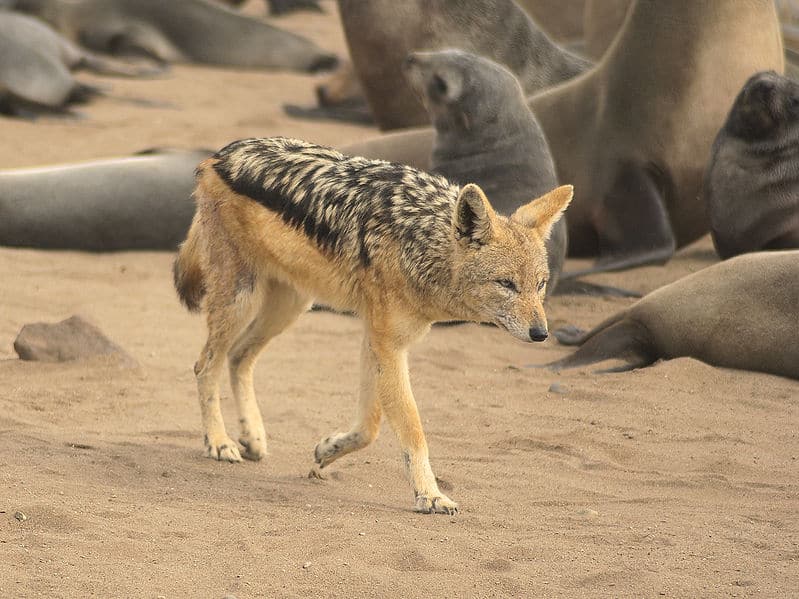
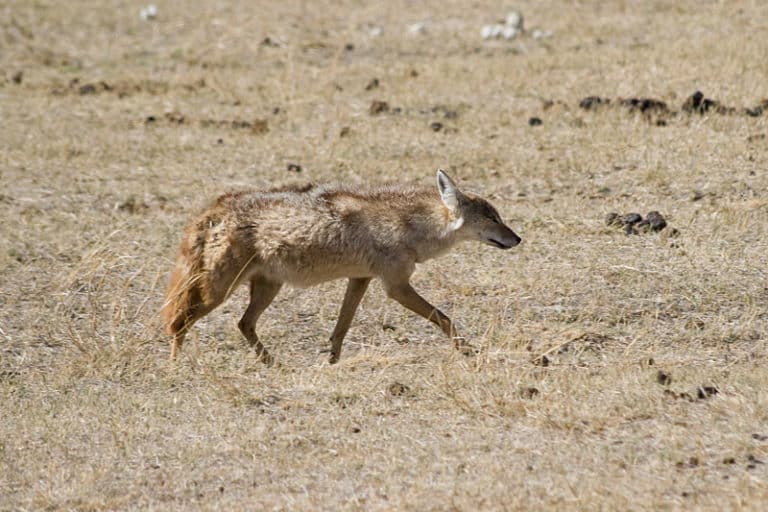
jackal (Canis aureus) jackal walking on sand
While jackals typically travel in packs and will stand their ground against a predator, a lone jackal animal will run away from a threat.

Habitat

maritime pine

Maritime pines are invasive in South Africa.

These animals live in Africa and some European countries. In Africa, they’re found in the western and central parts of the continent in Senegal, Nigeria, and South Sudan. They also live further south in Zambia and Zimbabwe.

The specific type of habitat a jackal lives in differs depending on which of the three species you’re looking at. Common or golden jackals live in savannas and deserts while side-striped jackals prefer wetter habitats like marshes, bushlands, and even the mountains. The black-backed jackal lives in woodlands and savannas. Though the regions are different, all three species can be found in Africa.

The long legs and sturdy feet of these canines allow them to easily travel the lengthy stretches of land while hunting. Their paws can withstand heat as well as rough dry ground. They use their sense of hearing and smell more than their vision to find prey.

They are active mostly at dusk and dawn. This is so they can avoid moving around in the hottest part of the day. Like domesticated dogs, they sleep a lot in the daytime.

Diet

What do these canines eat? These canines are omnivores eating birds, berries, plants, rabbits, frogs, fruits, snakes, and small antelopes. Some scientists refer to jackals as opportunistic feeders. This means that they may steal leftover meat from prey killed by another animal. They take the opportunity to eat whenever they find food even if they didn’t hunt or kill it.

Usually, these canines hunt in pairs. This is so they can work together to trap and take down their prey. Though they have sharp teeth, these creatures are small, so it helps for two jackals to be cooperating as they hunt – especially if they’re going after larger prey.

Predators and Threats

These canines have a few predators including eagles, leopards, and hyenas. All of these predators have great speed, strength, or both, making it fairly easy to capture a young jackal. It’s not unusual for an eagle to fly down and capture a pup that’s playing outside its den.

Sometimes when their food sources are scarce, these animals make their way onto a farmer’s property to kill livestock. Some jackals are shot by farmers for this reason. Another human threat to them is the loss of habitat due to land development and construction.

The official conservation status of these animals, according to the International Union for the Conservation of Nature (IUCN), is least concern. In fact, their population is believed to be on the rise.
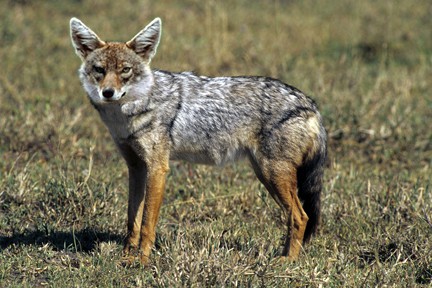
Golden Jackal

A Golden Jackal

Reproduction, Babies, and Lifespan

This canine has just one mate throughout its life. The mating season for the common jackal goes from October to March. The gestation period is 57 to 70 days. Coyotes, foxes, and wolves have a gestation period of about the same number of days.

A male and female work together to find or make an underground den where the babies will be born. A female gives live birth to two to four babies, also called pups. Newborn pups are very small weighing less than a pound. They are born blind and nurse from their mother as well as consuming small amounts of soft food. At ten days old, the pups’ eyes open and at two months they begin to eat solid food.

Because they are so small, pups are vulnerable to attacks from eagles, leopards, and hyenas. In fact, many of these pups don’t survive until 14 weeks old. As a way to protect her pups, a mother moves her litter to different underground dens every few weeks. This makes it challenging for a predator to pick up and stay with the scent of the pups.

Both the mother and father care for the pups teaching them how to hunt when they are about six months old. A pup may leave its parents at 11 months of age to strike out on its own. Or it may stay with its parents to help care for other pups in other litters.

Jackals living in the wild live to be 10 to 12 years old. Wild jackals are vulnerable to many of the same ailments that a dog might face. For instance, they can contract rabies. A jackal that is old or injured is also more likely to be targeted by a predator than a young, healthy animal.

Of course, these canines that are well cared for in a zoo or wildlife preserve can live longer, up to 16 years old.

Population
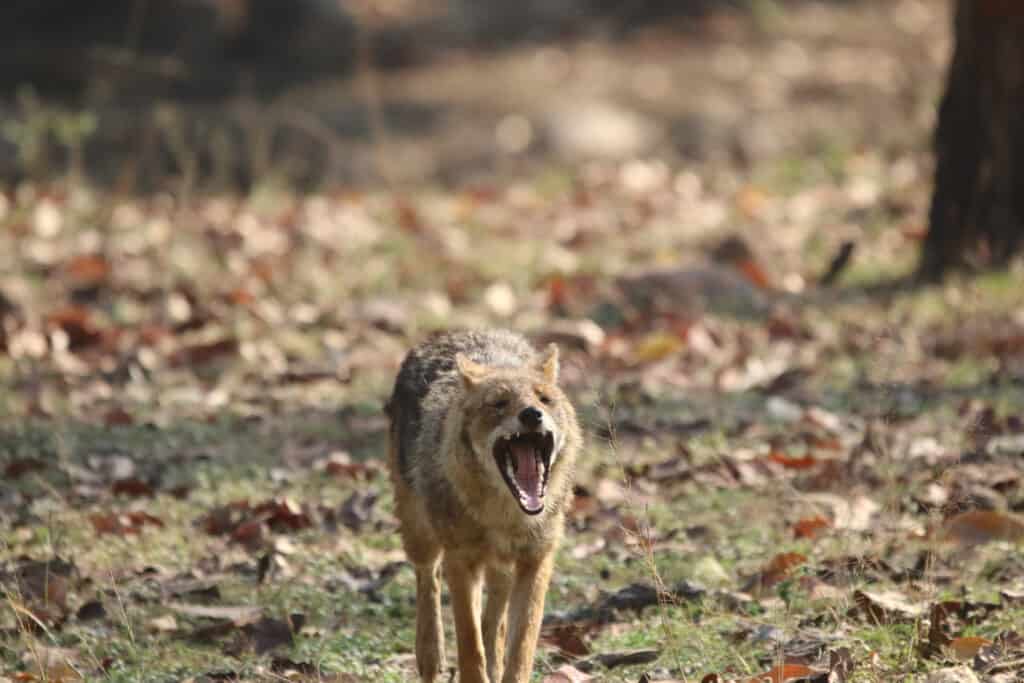
jackal laughing

The population of common jackals in India is more than 80,000.

The population of common jackals in India is more than 80,000. However, scientists are unsure of the population of these animals in Africa.

The population of this species of jackal is believed to be increasing. Its official conservation status is the least concerning.

View all 52 animals that start with J

Sources

  1. David Burnie, Dorling Kindersley (2011) Animal, The Definitive Visual Guide To The World's Wildlife / Accessed November 10, 2008
  2. Tom Jackson, Lorenz Books (2007) The World Encyclopedia Of Animals / Accessed November 10, 2008
  3. David Burnie, Kingfisher (2011) The Kingfisher Animal Encyclopedia / Accessed November 10, 2008
  4. Richard Mackay, University of California Press (2009) The Atlas Of Endangered Species / Accessed November 10, 2008
  5. David Burnie, Dorling Kindersley (2008) Illustrated Encyclopedia Of Animals / Accessed November 10, 2008
  6. Dorling Kindersley (2006) Dorling Kindersley Encyclopedia Of Animals / Accessed November 10, 2008
  7. David W. Macdonald, Oxford University Press (2010) The Encyclopedia Of Mammals / Accessed November 10, 2008
Rebecca Bales

About the Author

Rebecca Bales

Rebecca is an experienced Professional Freelancer with nearly a decade of expertise in writing SEO Content, Digital Illustrations, and Graphic Design. When not engrossed in her creative endeavors, Rebecca dedicates her time to cycling and filming her nature adventures. When not focused on her passion for creating and crafting optimized materials, she harbors a deep fascination and love for cats, jumping spiders, and pet rats.
Connect:

Thank you for reading! Have some feedback for us?


Jackal FAQs (Frequently Asked Questions)

A jackal is a mammal in the canine family with close relatives that include coyotes, foxes, and wolves. And, of course, dogs. They are omnivores known for their habit of hunting in pairs and eating whatever they can catch or steal.