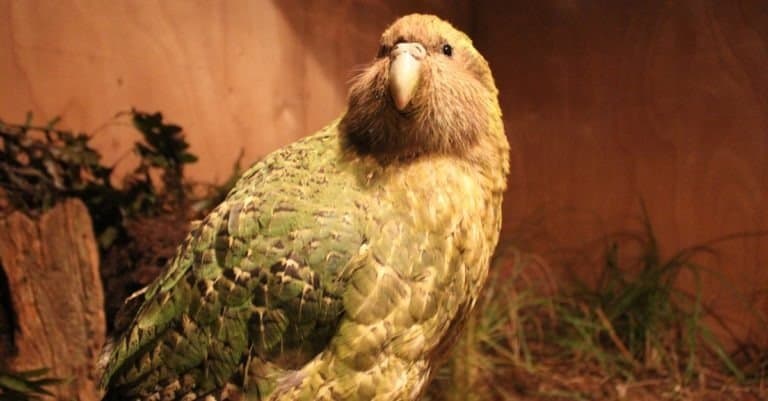
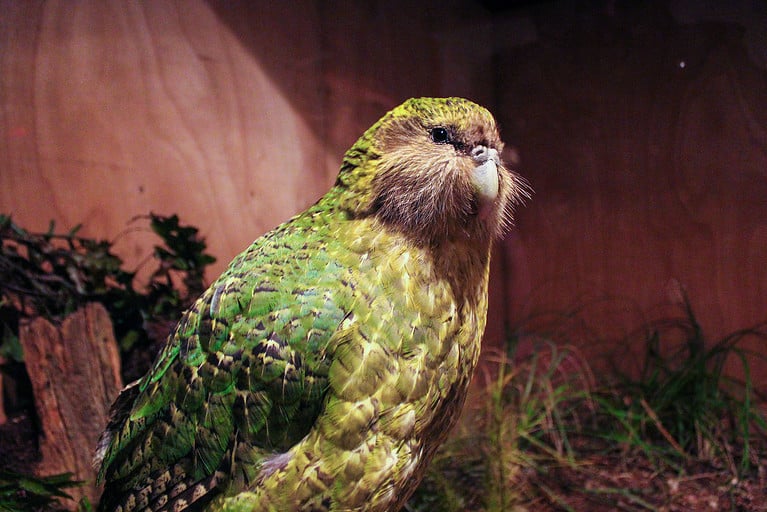






Originating on the island of New Zealand, the kakapo is a large flightless bird that has evolved to fill a similar ecological niche as land mammals in the way that it roams the forest floor in search of food at night.
Though it was largely free of predators for millions of years, the introduction of actual mammals from outside the island had a devastating impact on kakapo bird numbers, since the birds were unprepared to deal with the threat of carnivores. Today, the kakapo bird has become something of a minor conservation celebrity around the world.
An Amazing Bird: 4 Kakapo Facts
- Among the more unique facts, the kakapo bird walks around in a horizontal position with its bill nearly touching the ground. If it’s threatened, then the kakapo may stand upright to defend itself.
- The kakapo bird is the only nocturnal and flightless parrot species in the world.
- Polynesian settlers used kakapo feathers to make decorative cloaks and adornments. Their meat also provided a steady source of food.
- In their native country, these parrots have won the New Zealand Bird of the Year competition twice in 2008 and 2020. This bird has also drawn some international curiosity. An infamous BBC video of the bird featuring British actor Stephen Fry has amassed almost 20 million views on YouTube.
- Kakapos are the largest parrots in the world. They can weigh up to 8.8 pounds (4 kg), which makes them significantly larger than other parrot species, such as the hyacinth macaw, which can reach up to about 3.5 pounds (1.6 kg).
Where to Find the Kakapo

Kakapo can only be found in their native New Zealand.
©iStock.com/stockphoto52
These parrots are forest-dwelling birds that evolved entirely in their original native habitat of New Zealand.
Scientific Name
The scientific name of the kakapo is Strigops habroptilus. The genus Strigops (of which the kakapo appears to be the only living member) is derived from two separate Greek words: Strix, meaning owl, and ops, meaning appearance or face. The species name habroptilus is also the combination of two Greek words: habros, meaning soft, and ptilon, meaning feather. The closest living relatives of the kakapo are the fellow New Zealand birds, the kea and the kaka. Together, all three species belong to the wider order of parrots known as the Psittaciformes.
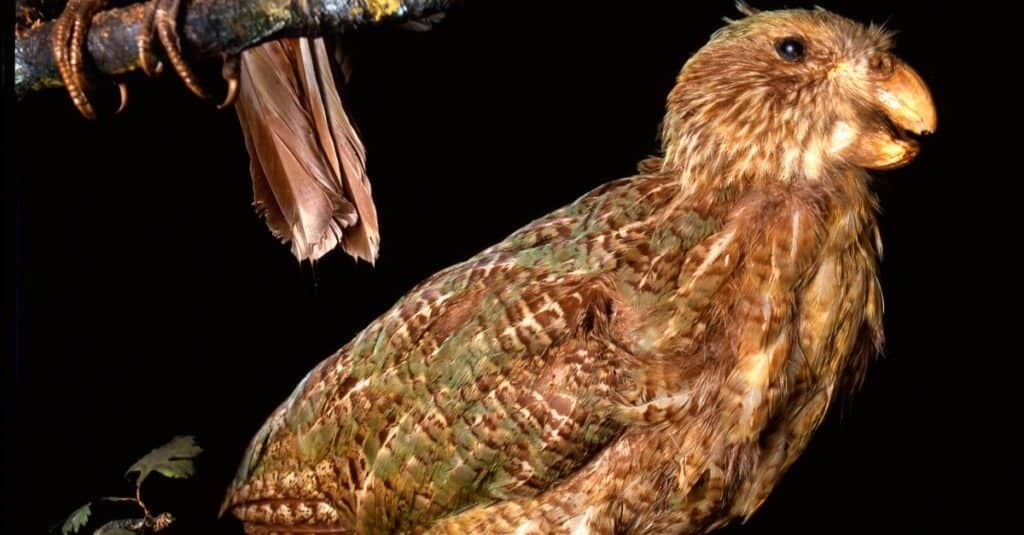
The kakapo shared a common ancestor with the kaka and the kea around 82 million years ago.
©COULANGES/Shutterstock.com
Evolution
The kakapo once shared a common ancestor with the kaka and the kea, both birds belonging to the New Zealand parrot genus, Nestor. The birds became isolated after New Zealand separated from Gondwana around 82 million years ago. Around 30 million years ago, the kakapo diverged from the genus Nestor. Kakapo was once thought to be related to the ground parrots and night parrots of Australia due to their similar coloration, but this has been disproven. The color seems to be an adaptation to terrestrial habits that evolved in the birds convergently.
Size, Appearance & Behavior
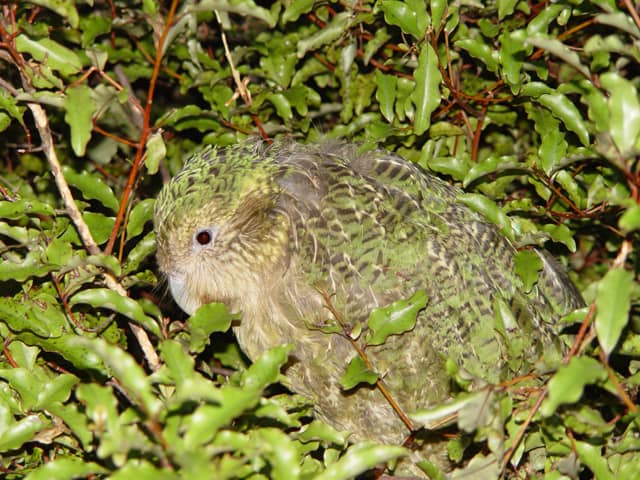
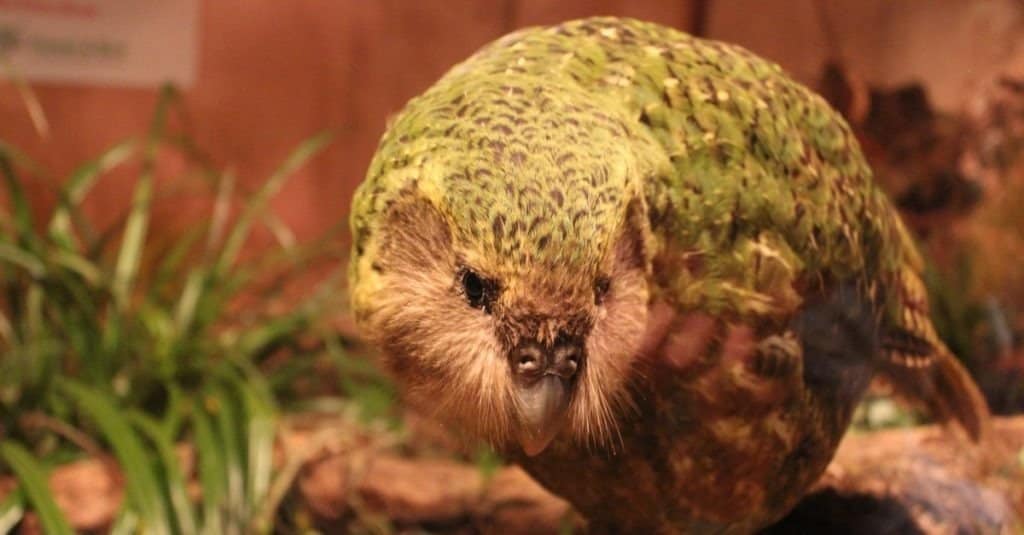
The kakapos’ plumage has evolved to blend in with its native habitat perfectly.
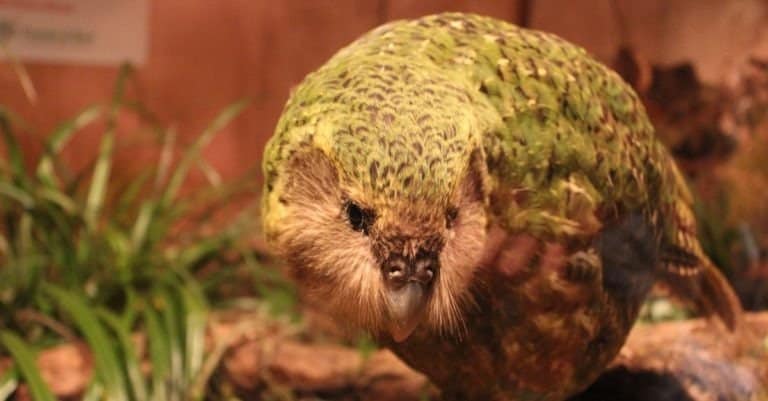
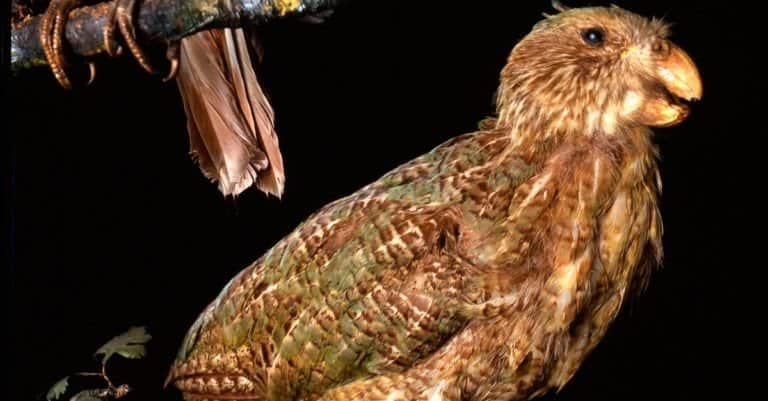
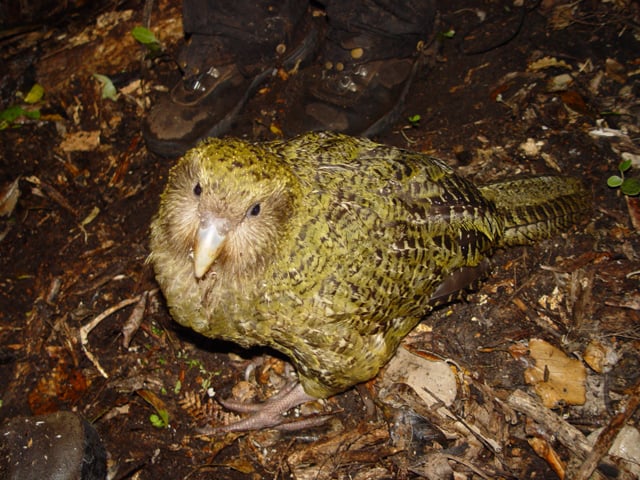
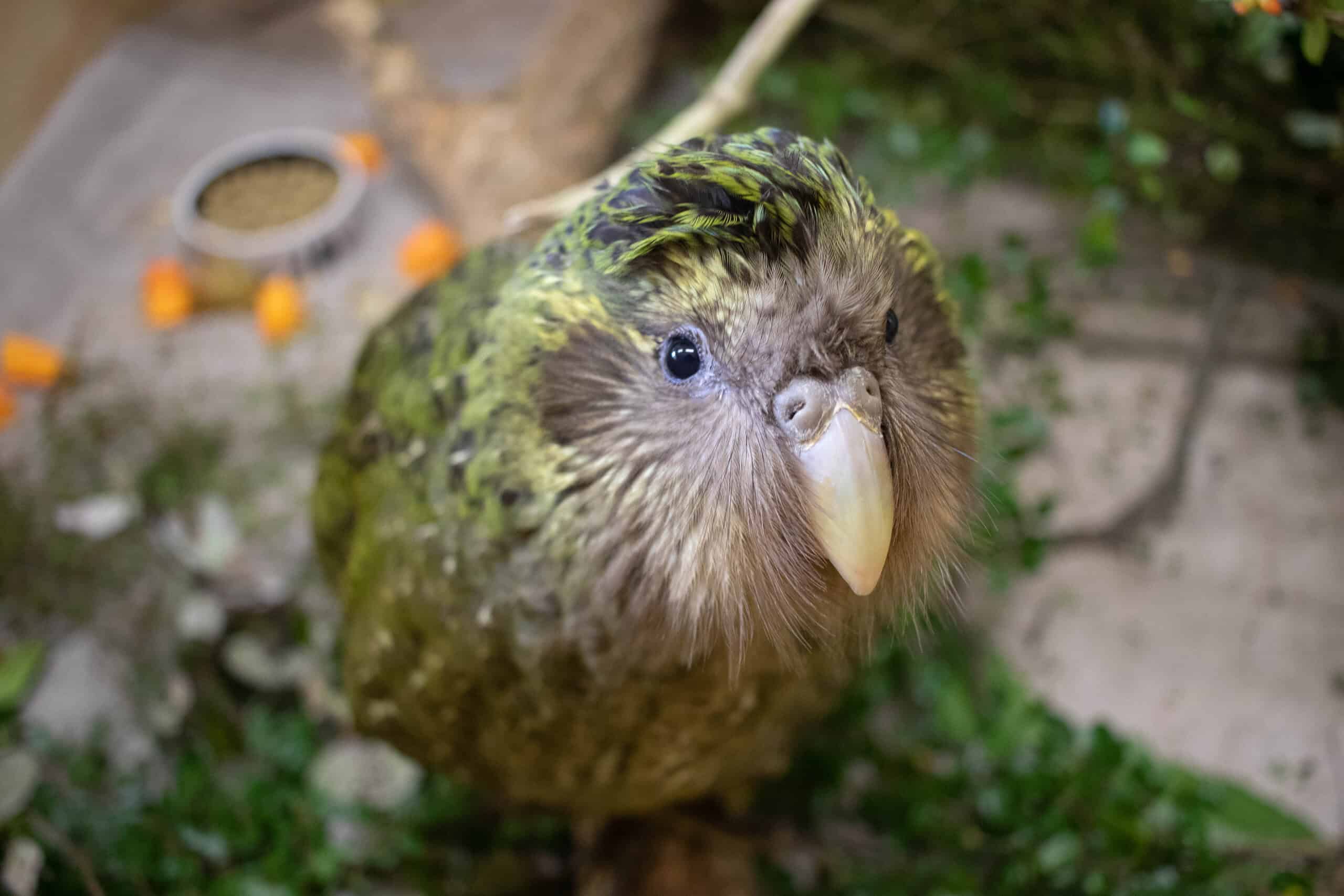
The kakapo has a long, round tail, a large, short beak (surrounded by delicate, whisker-like feathers), and a robust body with green and brown plumage. Resembling the owl from which its scientific name derives, the kakapo has forward-facing eyes and disc-like feathers on the face that redirect sound toward the ears. These adaptations allow the kakapo to perceive its surroundings very well in low-light conditions.
Like many other island-specific birds, the kakapo’s anatomy has evolved entirely in the absence of many serious predators. This means, most importantly, it can afford to be big. Measuring up to 25 inches in size and weighing up to 8.8 pounds (4 kg), the kakapo is one of the largest parrot species in the world. As a consequence of this ground-based lifestyle, the kakapo has evolved smaller wings that cannot possibly support its large weight.
Although it cannot fly, the kakapo does have the amazing ability to climb up trees with its strong feet. Among the more amazing facts, this bird will utilize its wings as a parachute to float safely to the ground. The wings also provide balance as it’s walking or running. The kakapo is not a social species, per se, except in the mating season. They are highly territorial birds that warn away trespassers with a loud “Kraak” sound. But each bird is intelligent and appears to exhibit a unique personality.
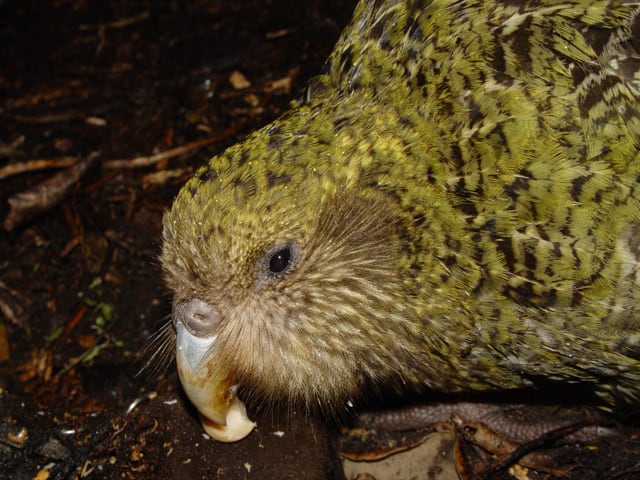
Kakapo eats fruits, seeds, leaf buds, shoots, tubers, rhizomes, pollens, mosses, and fungi.
Diet
The kakapo is an herbivorous animal that grinds up food with its beak and mouth. Unlike many other bird species, it lacks the specialized organ known as the gizzard that normally grinds up food. It’s also one of the few land birds that can store large amounts of energy as body fat.
What does the kakapo bird eat?
The kakapo consumes fruit, seeds, leaf buds, shoots, tubers, rhizomes, pollen, moss, and fungi, all of which vary by season and location.
Predators, Threats, and Conservation Status
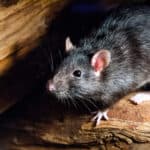
For millions of years, the kakapo encountered few natural predators in the wild. But the first wave of Polynesian settlers also brought rats and other mammals that fed on vulnerable chicks left alone in their nest for hours as the mother went in search of food. The arrival of European settlers completely transformed New Zealand’s ecosystem with the destruction of forests and the introduction of cats, ferrets, and stoats. By the 1950s, the kakapo was almost completely extinct. Only heroic conservation efforts succeeded in saving the kakapo, but the species is still considered to be critically endangered by the IUCN Red List.
What eats the kakapo bird?
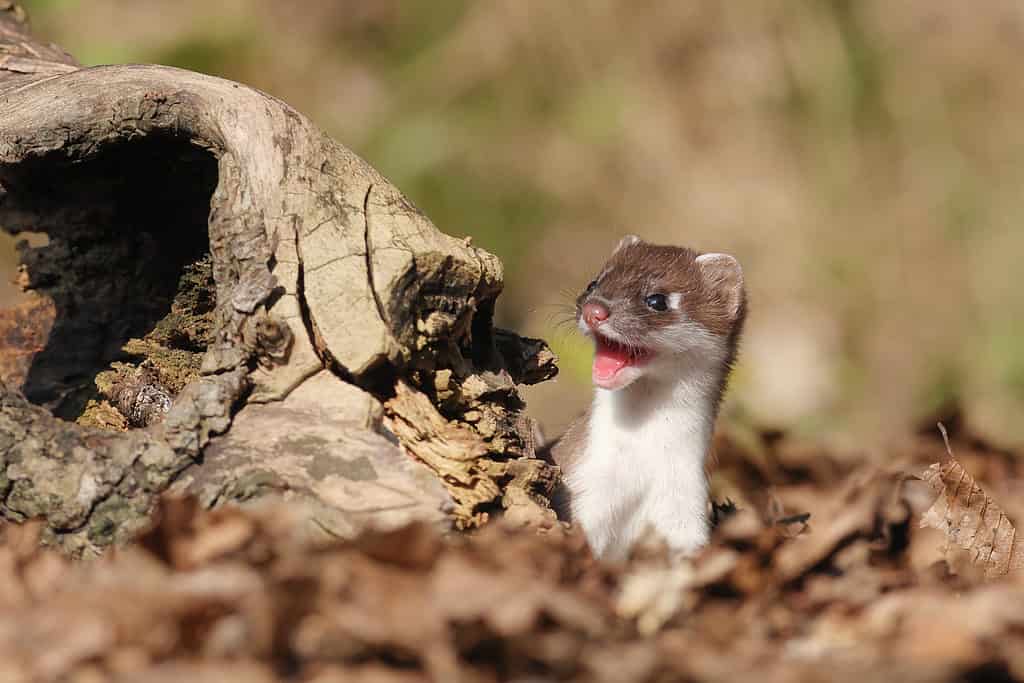
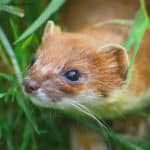
Stoats are aggressive and ambitious hunters able to bring down animals that would seem too large, like the kakapo.
©Petr Muckstein/Shutterstock.com
Before large carnivorous mammals were introduced to New Zealand, the kakapo’s main predators were large birds of prey. It could usually fool other birds by freezing in place to blend in with the forest surroundings. But carnivorous mammals proved to be a more effective predator by hunting the kakapos with their scent. Because the kakapos did not have the time to evolve formidable defenses against land mammals, this had a devastating effect on population numbers.
Reproduction, Babies, and Lifespan
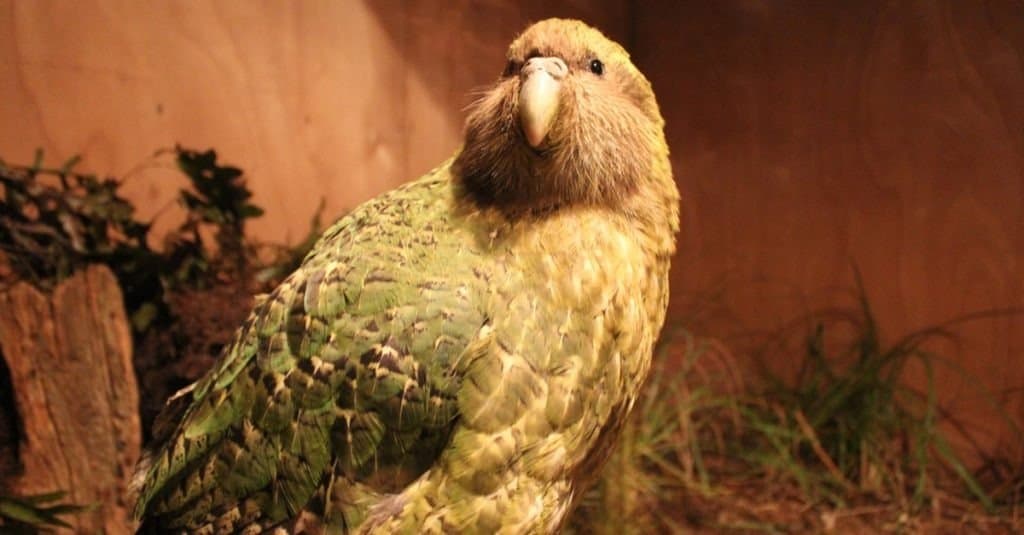
Male kakapos have an elaborate and rather noisy courtship ritual.
©Imogen Warren/Shutterstock.com
It’s perhaps no exaggeration to say that the kakapo has one of the most elaborate and fascinating courtship rituals in the entire animal kingdom. As the reproduction period approaches (between December and February or March), male kakapo will leave their home territory and establish a mating area on the hilltops. These leks, as they’re called, consist of a hollow bowl carefully trimmed of all vegetation. An entire system of leks is linked together by long tracks running more than 100 feet in any direction.
These leks serve as a convenient place from which they can court females. This courtship involves an exuberant display in which the male will inflate his chest, bobbing his head, and broadcast a massive sound throughout the night that can carry for half a mile in all directions on the wind. Males produce these sounds from a unique air sac in their thorax.
Female kakapo are responsible for building the nest, incubating eggs, and raising chicks on their own.
Once he attracts interest from a potential mate, the male will seal the deal with a brief courtship dance. After fulfilling his reproductive duty, he will depart the scene, leaving the female with the full responsibility for building the nest, incubating the eggs, and raising the chicks. The female kakapo constructs its nest under the cover of plants, within rock crevices, or inside hollow tree trunks. The mother will produce only a few eggs, sometimes spaced months apart. After about 30 days of incubation, the chicks emerge from the eggs undeveloped and helpless (the technical term for this undeveloped state is altricial). As mentioned previously, the mother leaves the chicks unattended for long periods to search for food. The chicks are most vulnerable at this point in their lives.
If they survive this initial stage, the chicks will leave the nest after about 3.5 months, when they have fully developed their feathers. The typical kakapo has a long lifespan of 45 to 60 years in the wild. The female reaches sexual maturity at around nine years of age and reproduces on average only once every two to four years, which may contribute to their slow population growth.
There are only around 200 kakapo left in the wild.
Population
Once widespread across most of New Zealand, the bird began a rapid decline after the arrival of European settlers until it hit a low of around 50 or 60 individuals by the late 20th century. Only well-planned conservation efforts saved them from ultimate extinction. The remaining individuals were relocated to three offshore island sanctuaries, where they were free of predators. From this low population, conservationists have made some inroads toward reviving the species. Today, about 200 kakapos remain in the wild. But because of the low genetic diversity, modern kakapos have problems with disease resistance and infertility. DNA sequencing allows conservationists to construct a kakapo family tree to help minimize inbreeding.
Kakapo Pictures
View all of our Kakapo pictures in the gallery.

Imogen Warren/Shutterstock.com
Sources
- Britannica / Accessed January 16, 2021
- Animal Diversity Web / Accessed January 16, 2021