

Quick Take
- The bill exceeds 1/3 of the Keel-billed Toucan’s entire 16.5-inch body length.
- The 59.8-inch wingspan creates a technical flight limitation within the dense leaves.
- These rainbow birds are omnivores that actively hunt snakes and lizards.
- A roosting cycle requires 6 individuals to occupy the same tree hole simultaneously.
Keel-billed toucans are also known as “rainbow” toucans due to their large, colorful bills. They are also called “sulfur-breasted toucans” because they have a bright yellow patch on their breasts. These tropical birds thrive in the humid climates of Central and South America. They are not very good fliers and prefer to hop among the dense leaves of the canopy. Because they live very high up and do not fly often, they can be hard to spot despite their rainbow bills.

Keel-Billed Toucan Amazing Facts
- The sound that these birds make has been likened to that of a frog. The sound can be heard from very far away, as it is quite loud.
- Because their bills are so large and curved, they are known as “the flying banana.”
- Their two nicknames are “rainbow-billed toucan” and “sulfur-breasted toucan.”
- Both parents help raise the eggs and young toucans.
Where To Find the Keel-Billed Toucan
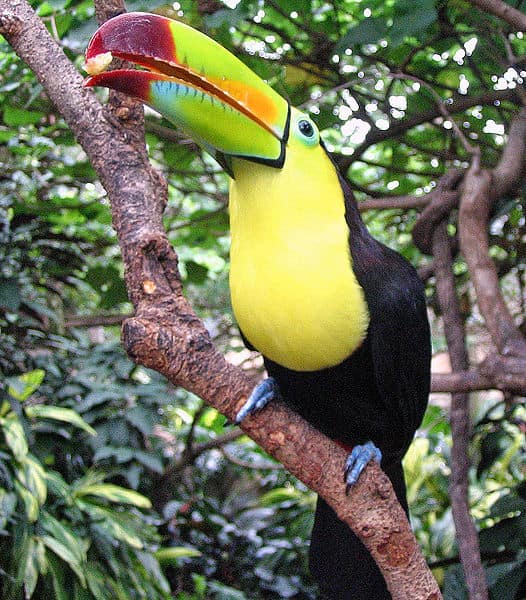
A Keel-billed Toucan can be found in Central and South America.
©eric / Creative Commons – Original
These colorful birds live in Central and South America. They range from Southern Mexico to Colombia and Venezuela and prefer tropical dry and moist forests, as well as mangrove forests.
They dwell in the high canopies of rainforests, where they can easily hop from branch to branch. The dense leaves also provide shelter and protection.
At night, these birds can be found roosting in the holes of trees. Several toucans nest together in the small space, up to 5 or 6 individuals per nest.
Classification and Scientific Name
The keel-billed toucan’s scientific name is Ramphastos sulfuratus. This name means “large yellow beak,” with sulfuratus specifically referencing its sulfur-breasted appearance. There is currently one subspecies, whose scientific name is R. s. brevicarinatus. This subspecies is found in Guatemala, Colombia, and Venezuela. Its name means “short keel,” referring to its shorter beak.
Evolution And History
While there have been no toucan fossils of the Ramphastidae genus that are known, there have been specific remains found of the toco toucan, which is in the same genus as the keel-billed toucan. These remains, found in Southeastern Brazil, were more than 20,000 years old and are from the Pleistocene era. It is widely believed that the different species of toucans developed due to the quick formation and changing of the habitat in the region. Toucans were forced to adapt to the changing environment or die.
Size, Appearance And Behavior
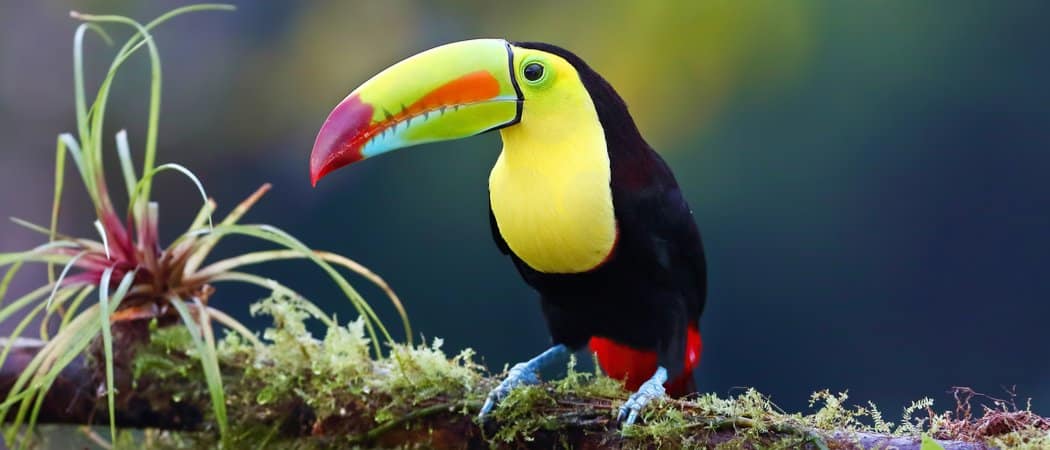
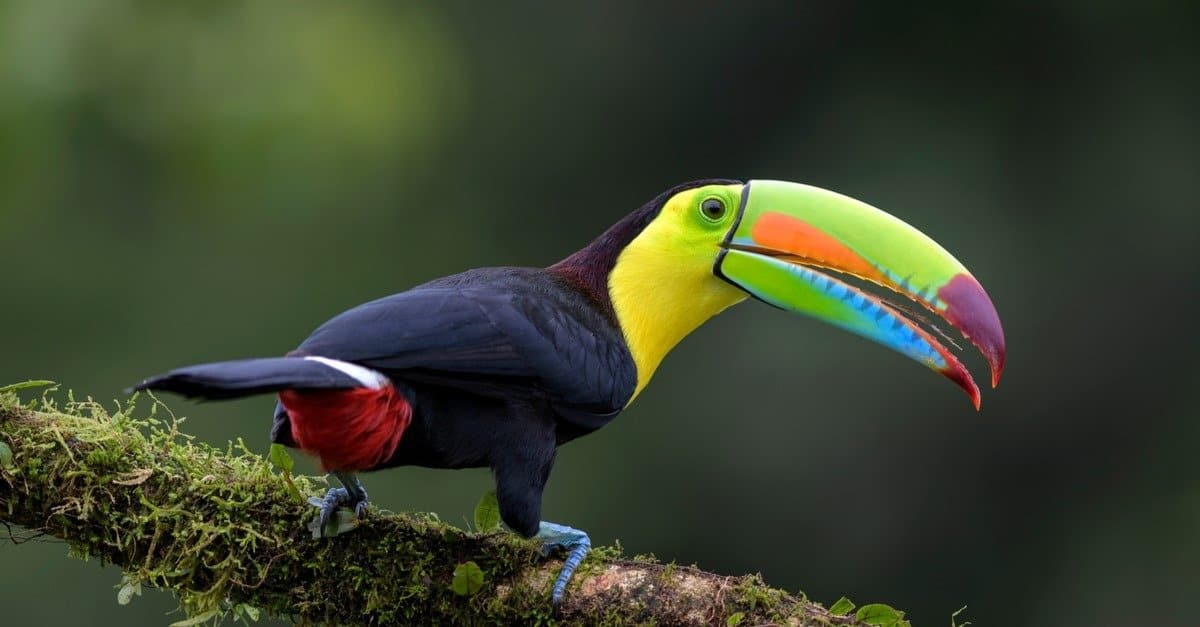
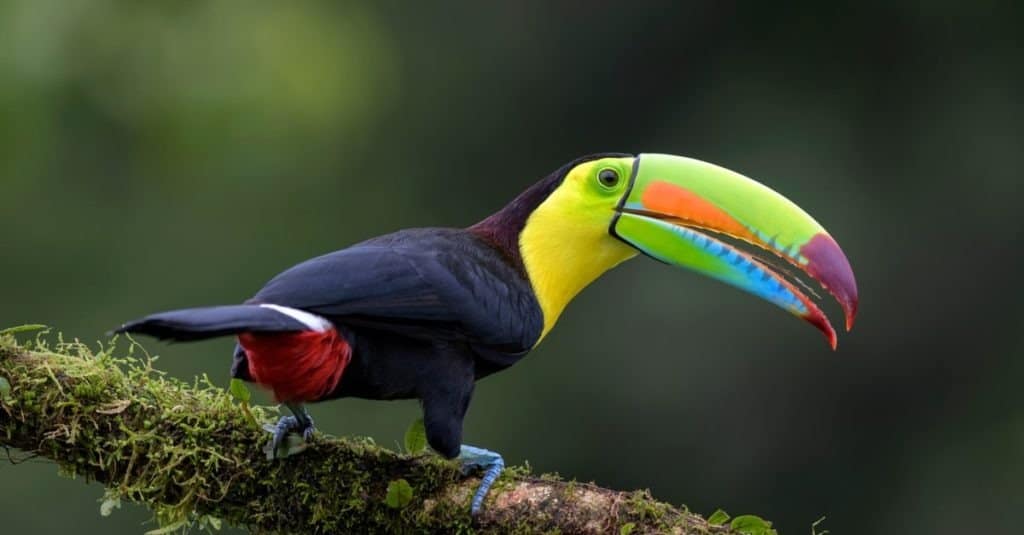
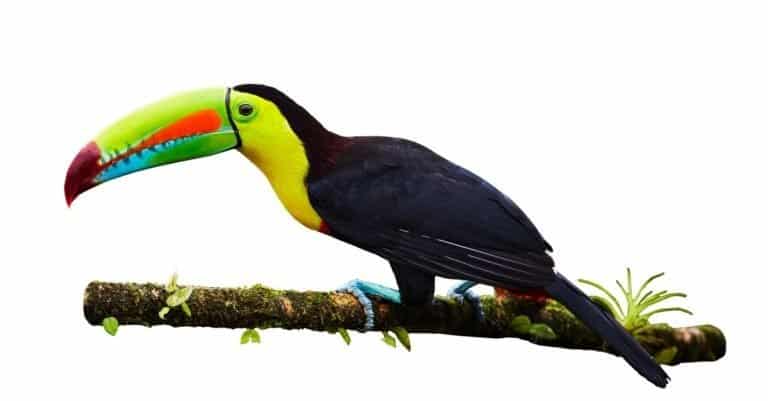
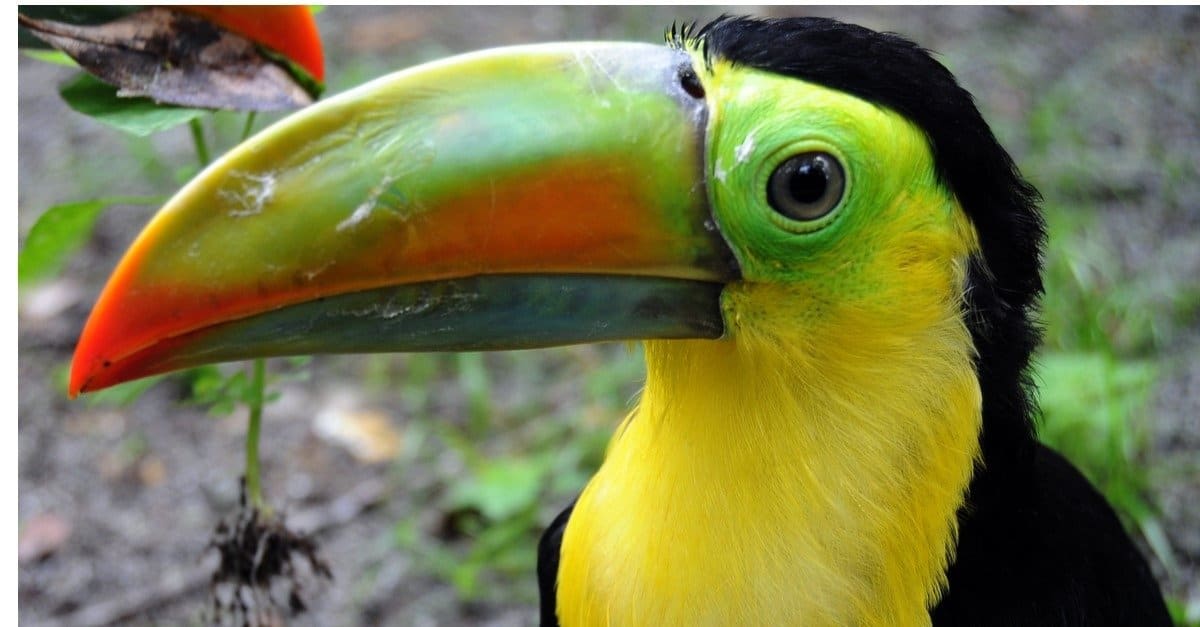
These toucans have small, dark bodies with large, colorful beaks.
©Jim Cumming/Shutterstock.com
The bill of the keel-billed toucan is over 1/3 of its entire length, which is anywhere from 16.5 to 21.7 inches long. They weigh between 4 and 8 pounds or 2.1 to 4 kilograms. Their wingspan is 42.9 to 59.8 inches in length.
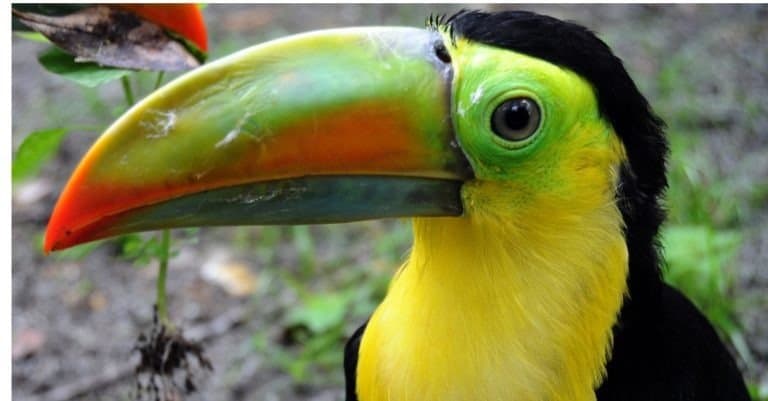
These birds have small, dark bodies with a bright patch of yellow on their breasts. They have blue feet and greenish skin around their eyes. Their feet have two toes on the front and two on the back, making it easy for them to grip the branches in the canopy of the rainforest. Their tails are tipped with red feathers.
These birds are known for their loud calls that sound like frog calls and can be heard up to half a mile away.
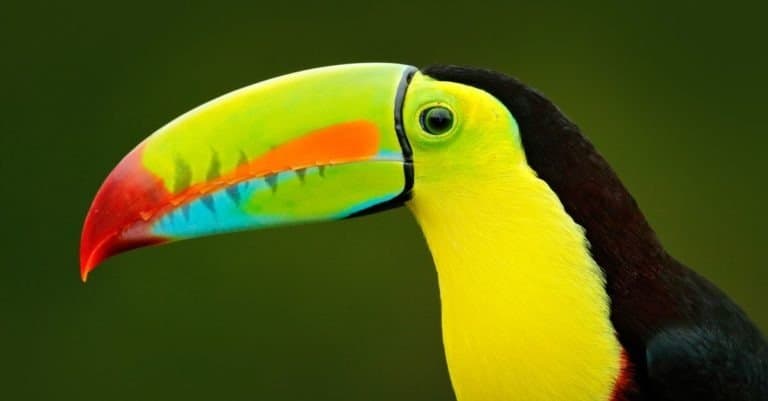
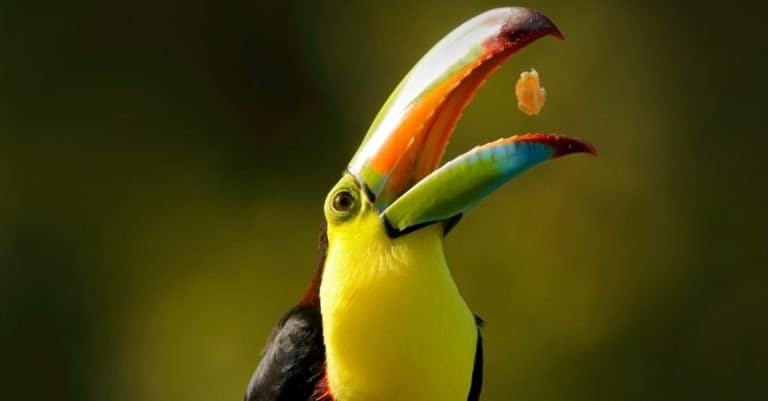
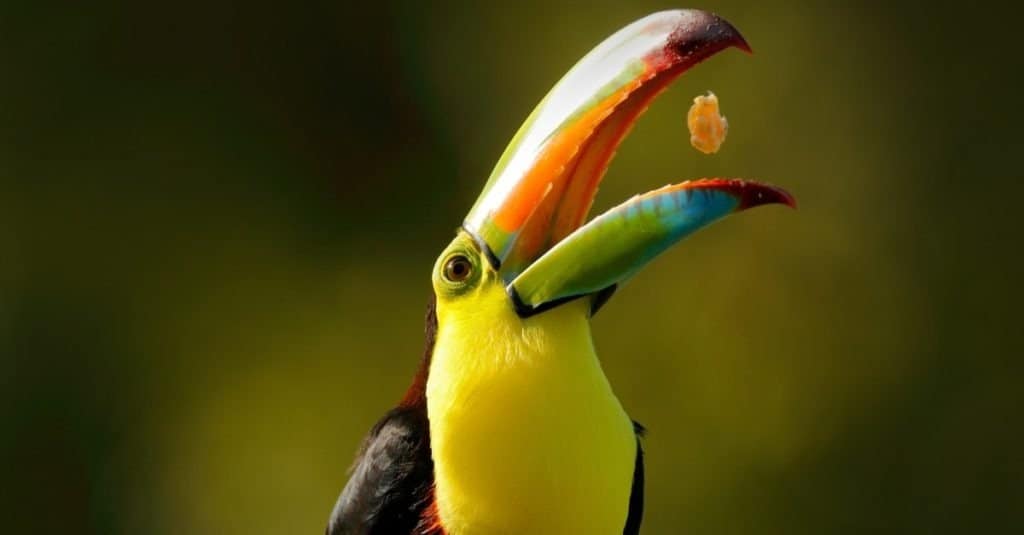
Though their beak looks like it might be cumbersome, it is hollow and light. The toucan’s large beak may be one of the adaptations that aid them in defense, as they can swing and peck with it. Another one of the positive adaptations of the toucan’s beak is that it allows them to reach for and pluck berries quite dexterously.
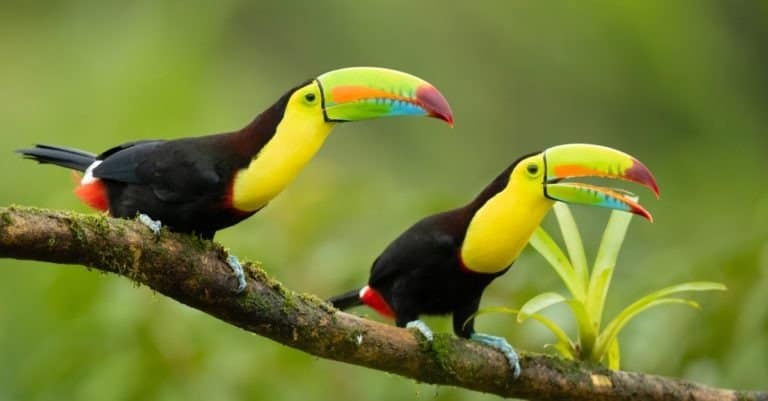
The keel-billed toucan is diurnal, which means it is awake during the day and sleeps at night. These birds are social animals that nest and flock together in familial groups. They like to playfully sword-fight and fence with their beaks, as well as toss fruit to one another.
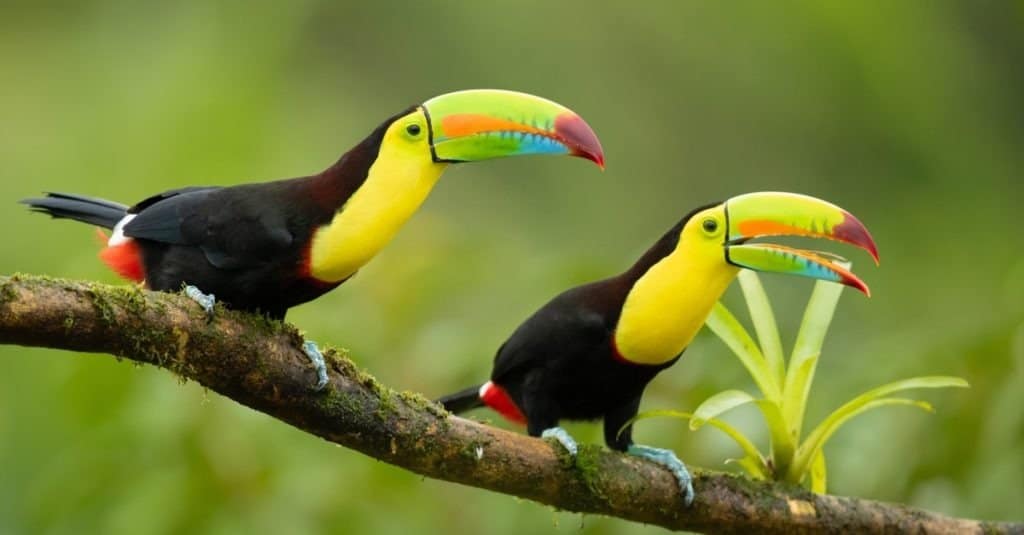
These are social birds and flock together in familial groups.
©Milan Zygmunt/Shutterstock.com
Diet
These birds primarily eat fruit and berries. However, they are technically omnivores. Keel-billed toucans fill out their berry diet by occasionally eating insects, lizards, and snakes.
One of the adaptations of many rainforest trees is that their seeds survive the digestive process in various bird species. In this way, toucans and other rainforest fliers help distribute new seedlings so the trees can sprout and grow.
Keel-billed toucans feed primarily on berries.
©Ondrej Prosicky/Shutterstock.com
Predators And Threats
Grown keel-billed toucans are preyed upon by large carnivorous birds such as hawks. Young toucans and eggs are threatened by weasels, snakes, and monkeys.
According to recent assessments, the keel-billed toucan is now considered Near Threatened on the IUCN Red List due to ongoing population declines and habitat loss. They have experienced a decline in population over recent years. Most of this can be attributed to habitat loss, making humans a threat to the keel-billed toucan.
Reproduction, Babies, And Lifespan
When chicks first hatch, they don’t have a fully developed beak.
©Josanel Sugasti/Shutterstock.com
These social birds are monogamous for at least the year they decide to mate, if not subsequent years. In a tree cavity, a female keel-billed toucan will lay anywhere from 2 to 4 eggs. These eggs hatch into chicks after 15 to 20 days of incubation.
When keel-billed toucan chicks first hatch, their beaks are not fully developed. Like most birds, they hatch with their eyes closed and with no feathers on their body. After 8 to 9 weeks, the young have strong and developed bills and are ready to leave the nest.
Keel-billed toucans have a lifespan of about 15-20 years.
Population
Though not yet considered endangered, these toucans are threatened by habitat loss. They are also hunted for their meat and beaks. Finally, toucans make for popular illegal exotic pets. These factors mean that their population is steadily decreasing, though they remain widespread throughout their habitat.
Most recent population estimates place these birds between 50,000 and 500,000 individuals.
Keel-Billed Toucan Pictures
View all of our Keel-Billed Toucan pictures in the gallery.

David Havel/Shutterstock.com
Sources
- Seaworld Parks & Entertainment / Accessed January 4, 2021
- Animalia / Accessed January 4, 2021
- American Bird Conservancy / Accessed January 4, 2021
- Word Sense / Accessed January 4, 2021