


Quick Take
- Certain species must achieve the digestion of prey larger than their entire body.
- A 6.5-foot depth burrow forces parents into a week of high-risk excavation.
- Internal nanostructures reveal that vivid blue plumage is surprisingly not caused by pigment.
- Executing aerial chases is a vital scouting event to secure a mate for life.
Kingfishers are a family of brightly colored and unusual-looking birds that live near rivers and bodies of water all over the world. With their vivid plumage and loud, shrill calls, the kingfisher bird really stands out from the crowd. You can often catch sight of them perched in a tree, barely moving. But upon sighting prey, they spring quickly into action and swoop down to catch it. The amount of variation in the kingfisher family is truly impressive.

3 Amazing Kingfisher Facts
- The ancient Greeks wove many elaborate myths about the kingfisher bird. One of the most well-known is the myth of the “Halcyon days,” which refers to the calm period of light weather on the winter solstice. The Greeks believed that the god of winds calmed the weather so that a kingfisher called Halcyon could lay her eggs in peace. The source of this myth is unclear since the kingfisher doesn’t actually breed in the winter.
- Kingfisher birds have very strong legs since they spend the vast majority of their time perched within trees.
- The kingfisher’s eggs are colored almost pure white.
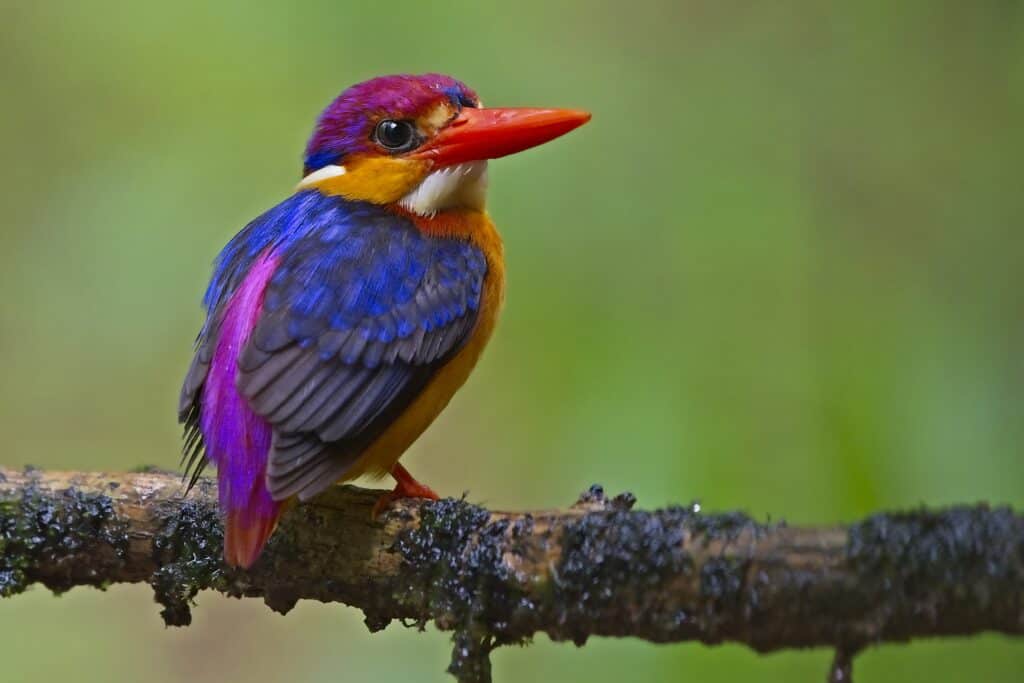
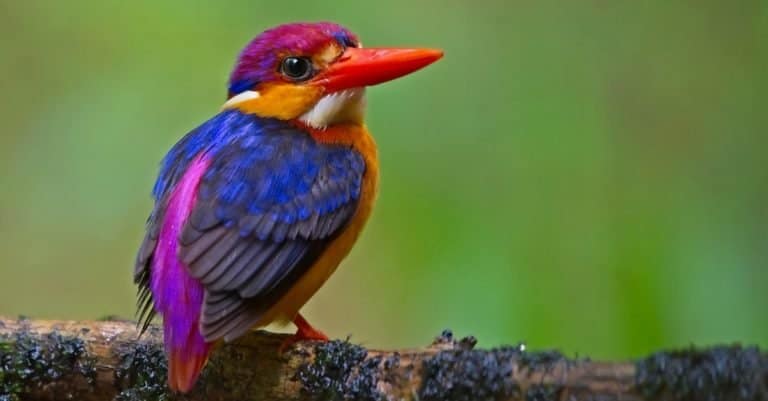
ODKF or Three Toed kingfisher or black-backed kingfisher breeds during monsoons, and will feed its hatchlings continuously for their growth, as metabolism is extremely high.
©iStock.com/lensalot
Evolution and Origins
The earliest fossilized kingfishers have been discovered in Lower Eocene sediments, which are quite recent and date to roughly 40 million years ago. These Wyoming deposits are complemented by even more recent deposits from Germany and France, as well as by Australian material that is younger than 25 million years.
Due to a modification in their lenses, they are able to accurately determine the depth of their prey even when they are underwater. As it dives in, a piece of membrane slides over its eyes to block the water from getting in. This is called the nictitating membrane.
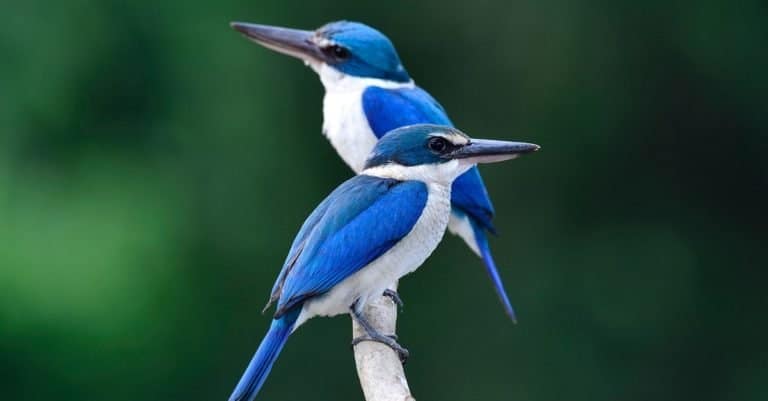
Science discovered that the cyan and blue barbs of its feathers had spongy nanostructures of various sizes, which alter how light reflects and result in the colors that are seen. Little changes in the barbs’ structural makeup cause minor variances in colors.
Where to Find the Kingfisher
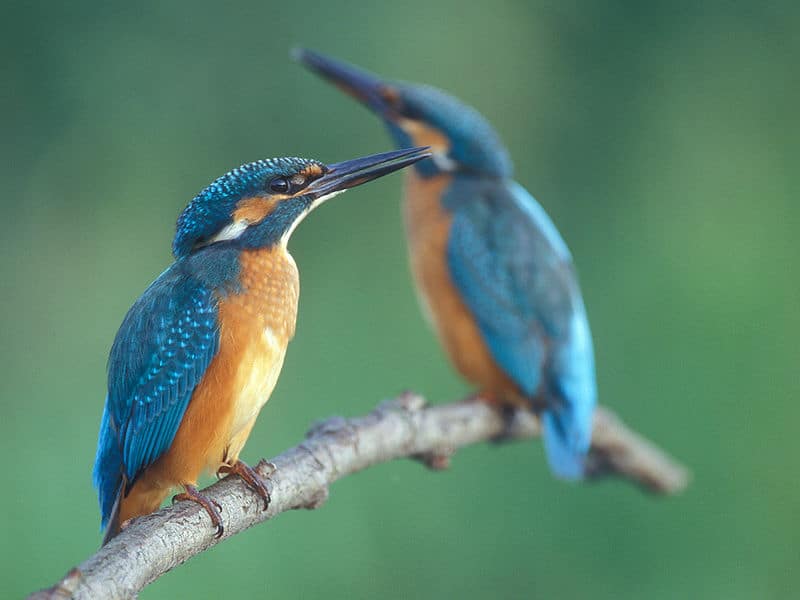
Common Kingfisher, Alcedo atthis, sitting on a branch, looking for prey.
©Lukasz Lukasik / Creative Commons – License
These birds are found in almost every region of the world except for the most extreme polar and desert climates. The greatest concentration seems to occur in tropical regions such as Africa, South Asia, Australia, and the rest of the Pacific. Most species live near rivers and lakes.
Nests
The kingfisher has the habit (which is very unusual for birds) of digging burrows into banks, tree cavities, or termite mounds. After about a week of digging out dirt with their feet, the parents will have created a burrow about 3 to 6.5 feet long with a nesting chamber at the end.
Classification and Scientific Name
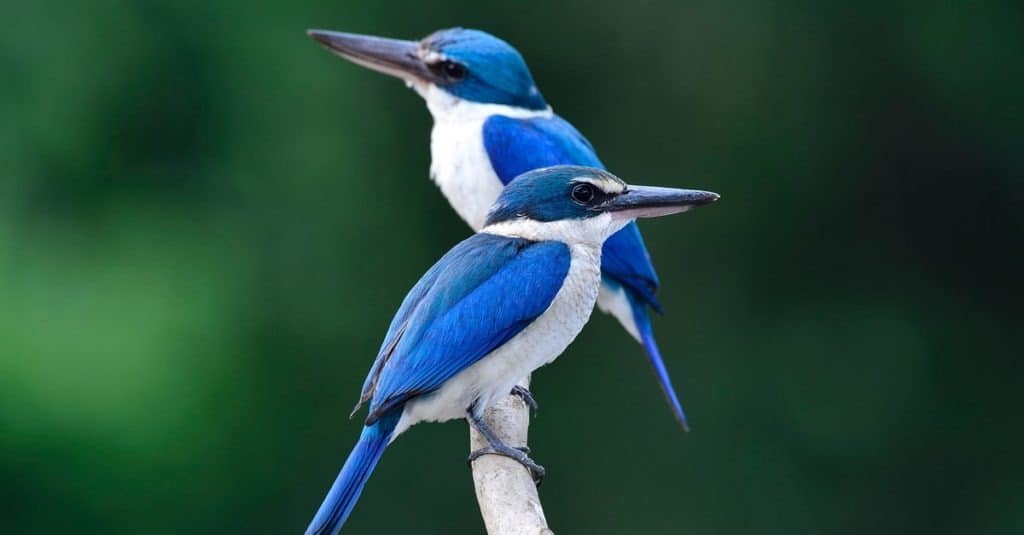
Kingfishers belong to the family Alcedinidae.
©Anusak Thuwangkawat/Shutterstock.com
The kingfisher family is Alcedinidae. This name derives from the Latin name for the bird, alcedo. There are some 90 species currently recognized, each one classified into three distinct types: the true fishing kingfishers, the forest kingfishers, and the New World kingfishers. The entire kingfisher family is closely related to the bee-eaters, rollers, and motmots in the order of Coraciiformes.
Size, Appearance & Behavior
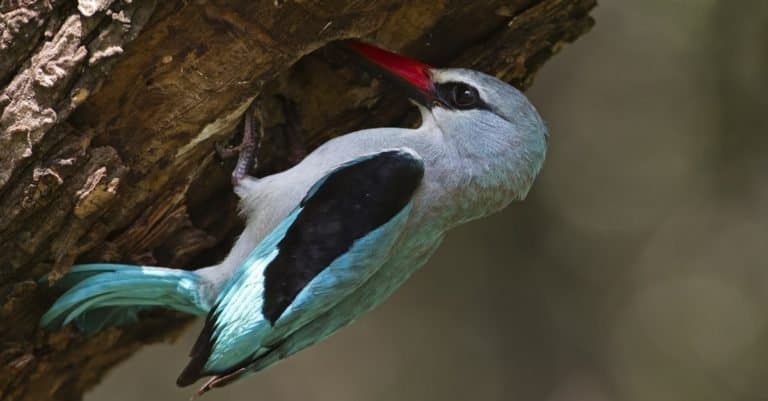
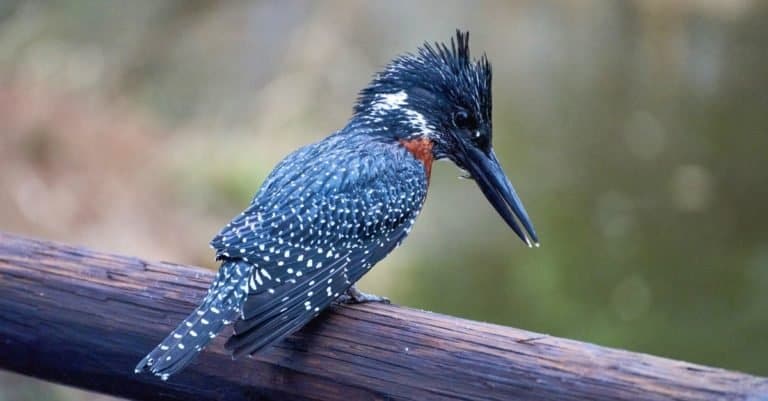
The kingfisher looks like it was strangely put together in a lab. It has a relatively large head, thick feet, and a dagger-like bill attached to a rather small, compact body and stubby tail. The smallest species is the 4-inch long African dwarf kingfisher, while the largest species are the giant kingfisher and laughing kookaburra with a 2-foot wingspan and 18-inch body. The plumage is usually some combination of bright blue, green, orange, or red with all manner of different patterns and stripes adorning it. Some species also sport a prominent crest on the head.
These birds prefer small social organizations that consist of mating pairs or families. It relies on a suite of different vocalizations (including clicks, whistles, screams, and chirps) to communicate with each other. The laughing kookaburra, which is native to Australia, has the most mirthful sound of all species. As the name suggests, this call resembles a loud laugh. The kingfisher also invests a great deal of time into remaining clean. It will dive into the water to wash off and rub its bill against a branch to keep it in pristine condition.
Migration Pattern and Timing
These birds, as a general rule, rarely stray far from their home territory. The home range is so important to them that they will aggressively defend their territory from intruders. Only a few types of kingfishers break this rule. For instance, the belted kingfisher is a long-range migratory species. It breeds as far north as Alaska and Canada and travels as far south as Mexico and Central America in the winter. The belted kingfisher also occupies the continental United States all year round.
Diet
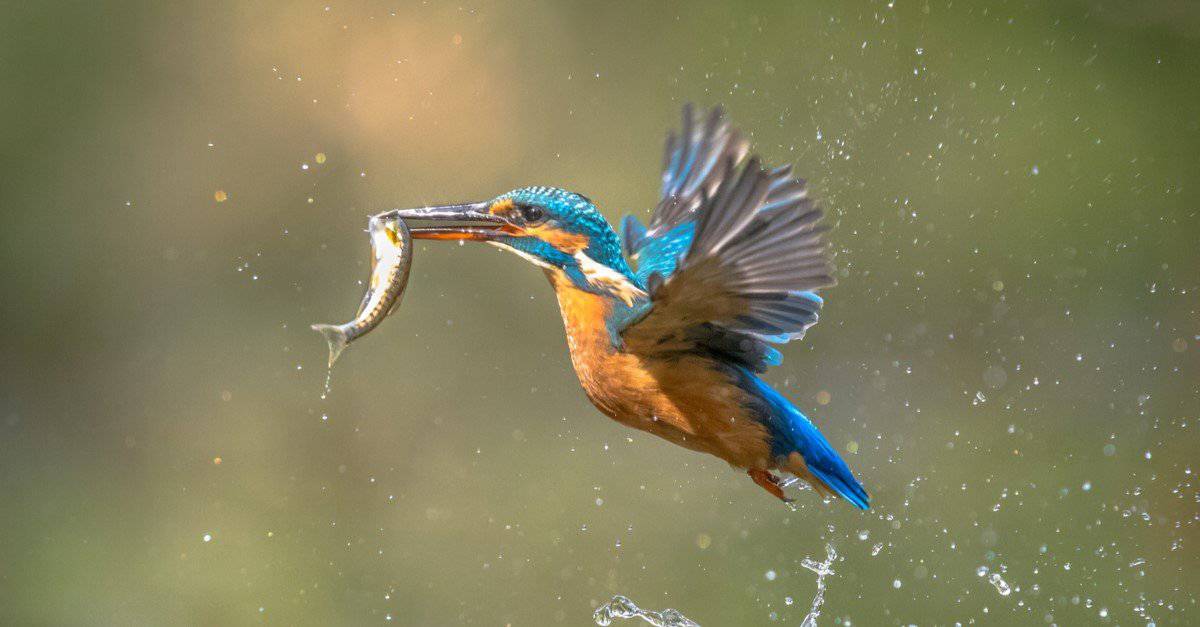
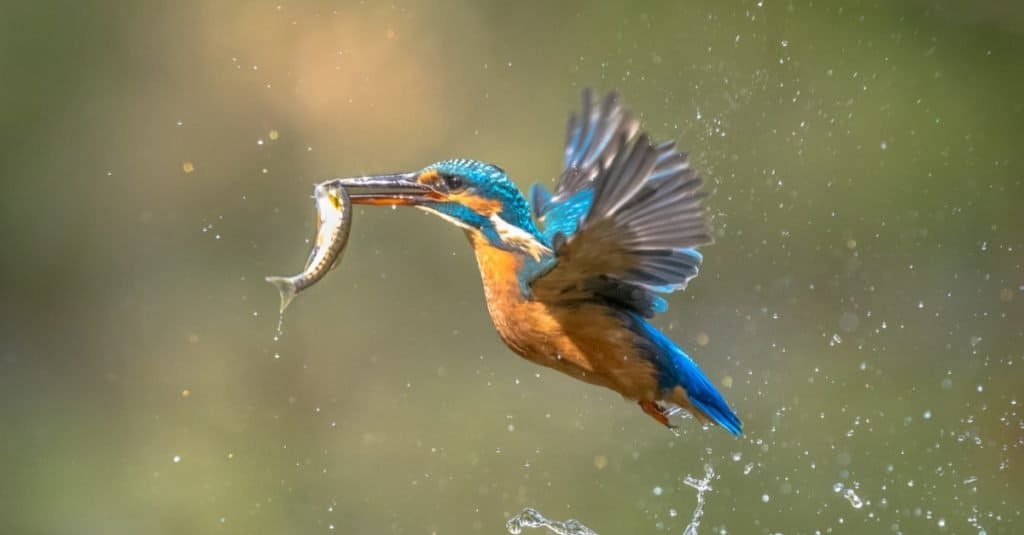
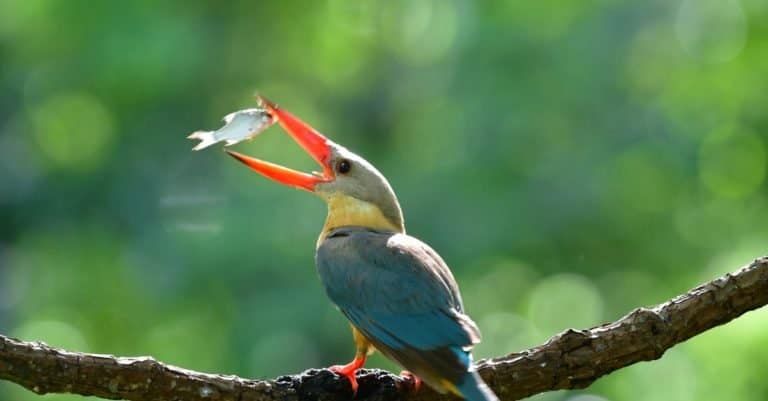
Although this bird is omnivorous, they seem to be adapted most of all for hunting and consuming meat. Its favorite hunting strategy is to observe the environment around it from a stalk or tree branch and then swoop down on unsuspecting prey. If the prey is still alive and squirming, then the kingfisher may beat it against the perch to subdue it. With its voracious appetite, the kingfisher has the ability to digest prey even bigger than its entire body. The prey will sometimes stick out of the mouths as part of it is being digested in the stomach.
What does the kingfisher eat?
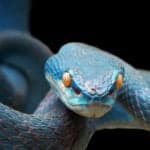
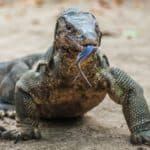
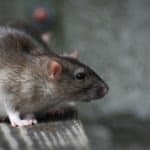
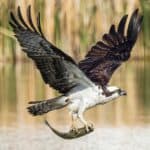
Despite the name, most types do not specialize in fish alone. They are highly opportunistic hunters that will consume insects, snakes, skinks, spiders, crabs, mice, scorpions, berries, and even smaller birds. The exact diet depends on the local availability of food.
Predators and Threats
These birds face a few threats in the wild from natural predators, habitat loss, and introduced non-native predators.
What eats the kingfisher?
An adult bird has only a few natural predators in the wild. It can evade most animals by flying around trees or diving into the water. Only birds of prey are usually fast and agile enough to keep up with it in the air. Raccoons, skunks, dingoes, foxes, snakes, mongooses, and chimpanzees are all known predators of the far more vulnerable kingfisher eggs.
Reproduction, Babies, and Lifespan
These birds’ mating seasons can take place at any time of the year (but spring and summer are more common for temperate kingfisher species). Courtship involves an elaborate process of aerial chases, mutual feeding, and attention-getting displays of affection.
This helps to strengthen their bond because once they find a mate, these birds will often pair for life. After the mate copulate, the female will lay one egg per day until she’s produced between two and 10 eggs in the nest. Couples can produce up to four broods in a single year, depending on favorable conditions.
Because the young chicks emerge from the eggs blind and helpless, the parents invariably play a significant role in the development of their offspring. Older children of the laughing and blue-winged kookaburra species may also help their parents with caretaking duties.
After three to eight weeks, the chicks will finally grow their flight feathers. They do not have long to learn the nuances of flight before the parents will eventually force the chicks to leave the nest. Depending on the species, the life expectancy is some six to 14 years in the wild.
Population
The kingfisher family, as a whole, is in excellent health. Most species are generally regarded by conservation organizations to be least concern. The common kingfisher is perhaps the most widespread species with some 700,000 to 1.4 million mature individuals in the wild.
The giant and belted kingfisher are also quite robust. However, some of the rarest kingfishers in the world, including the Marquesas kingfisher and the Tuamotu kingfisher, both of which inhabit small Pacific Islands, are critically endangered. The Micronesian kingfisher, in the worst shape of all, is completely extinct in the wild. Only about 150 individuals exist in captivity, some of which are kept at the San Diego Zoo.
Kingfisher Pictures
View all of our Kingfisher pictures in the gallery.

Rudmer Zwerver/Shutterstock.com
Sources
- Animal Diversity Web / Accessed December 30, 2020
- San Diego Zoo / Accessed December 30, 2020