
The koala is one of the most loved mammals in the world with its adorable round face, unique nose, and gentle demeanor. The name “koala” actually comes from the language of the Aborigines, and believed to mean “no drink.” Ironically, koalas don’t need to consume much water like most animals because the eucalyptus leaves they eat hydrate them naturally. These are just a few of multiple interesting characteristics of the koala.
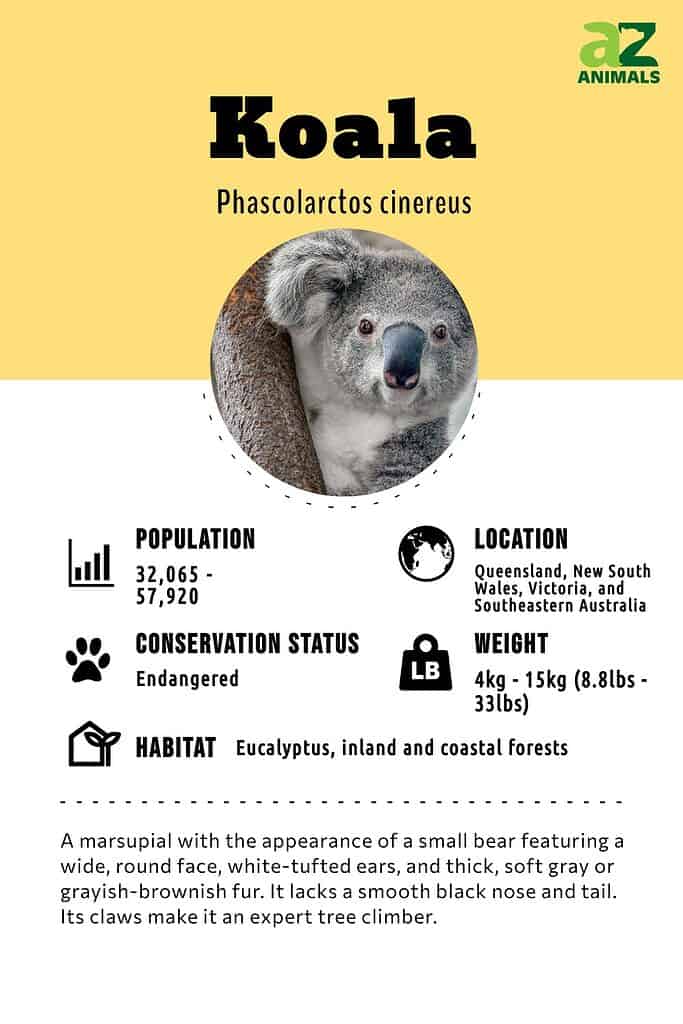
Classification
The Koala is a small to medium-sized mammal that is found inhabiting a variety of different types of forest in south-eastern Australia. Despite its appearance and the fact that it is also known as the Koala Bear, Koalas are in fact marsupials but are so distinctive amongst this specially adapted family of mammals that they are classified in a scientific group of their own.
Although they are now considered to be one of Australia’s most iconic mammal species, when European settlers first arrived things were very different, with millions of Koalas known to have been killed every year for their pelts (fur). The Koala is a unique animal that famously feeds only on the leaves of the eucalyptus trees which they inhabit. However, this diet is very hard to digest and lacks many of the vital nutrients that are key to the survival of most animal species. Today, the Koala is affected by habitat loss as vast areas of land are cleared every year to support growing development.
Evolution
Scientists claim that koalas evolved over a span of 25 million years in forests on the Australian continent which was thicker and wetter than today’s. Their chewing apparatus evolved as the forests became drier and full of leaves and plants that were tougher to chew. It’s thought that the bite force of the Koala adapted to this challenge, allowing the koala to shred tough eucalyptus leaves.
Types of Koalas
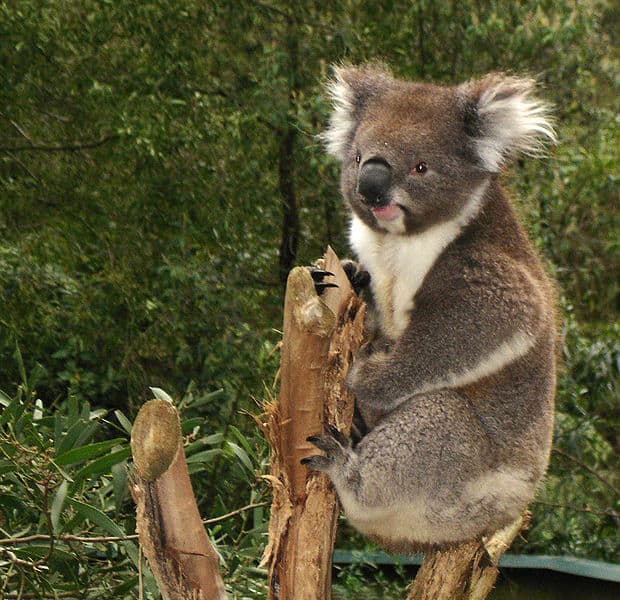
There are three distinct types of koalas based on the region of Australia they inhabit and the color of their fur:
- Brown Koalas – Native to the Victorian Region of Australia. Other names: Victorian koala and Southern koala. Brown koalas have the thickest coats of the species to keep them warm in a cooler climate. They’re also the largest type of koala. There are up to 28,000 Brown koalas in Victoria and 19,000 in Southern Australia.
- Gray Koalas – Native to Queensland, Australia, the Gray koalas have thin gray fur and are the smallest type. Other names: Northern koala and Queensland koala. This type is the most threatened.
- Gray-Brown Koalas – Native to New South Wales, Australia. These koalas have gray-brown fur and face extinction with only 16,000 left in the wild. Other names: koalas of New South Wales, Grayish-Brown koalas.
Anatomy and Appearance
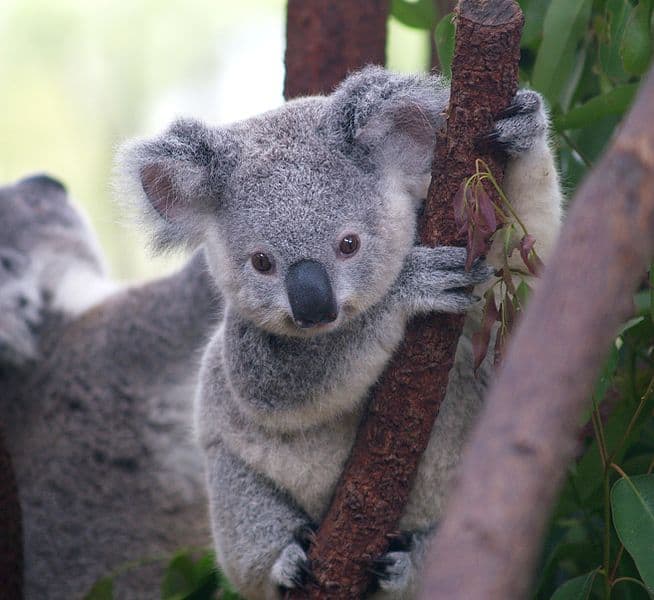
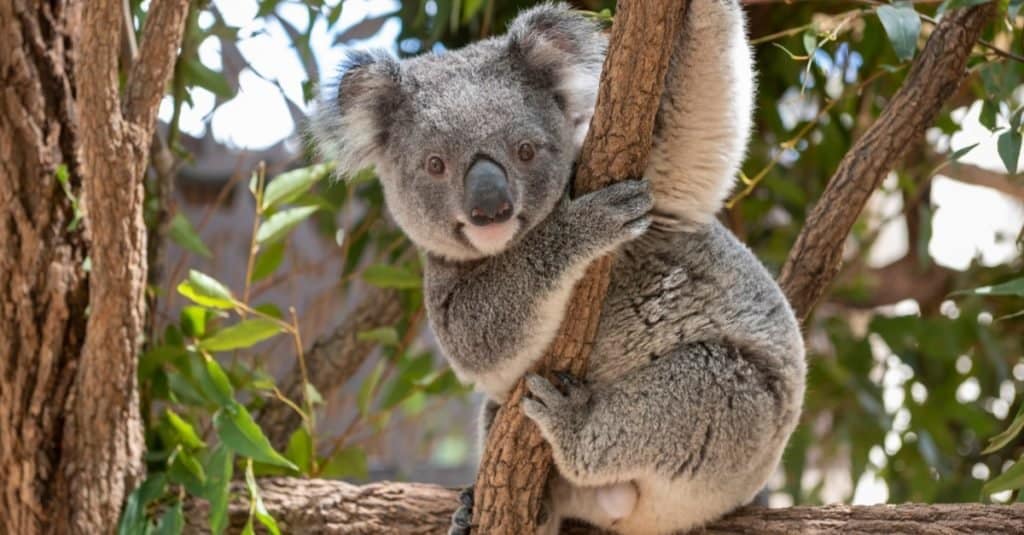
The Koala is one of the most charismatic of all marsupials with its large, wide face and round, white-tufted ears giving it the appearance of a small bear, along with its lack of a visible tail and smooth, black nose. The Koala has dense and soft grey or grey-brown fur which is lighter on its underside and mottled on the rear. Because Koalas spend almost all of their lives in the trees, they have evolved several adaptations to help them with their arboreal lifestyle including having short, powerful limbs tipped with sharp claws.
Having two opposable thumbs and three fingers on each hand means that Koalas can grip even the smoothest of bark when climbing and feeding in the trees. Koalas also have human-like fingerprints! Learn more amazing animal fun facts here.
Koalas move about in the trees by jumping, first gripping the trunk with their front paws (helped by their rough paw pads and claws) before then moving both their back legs up the tree together, allowing them to get higher up.
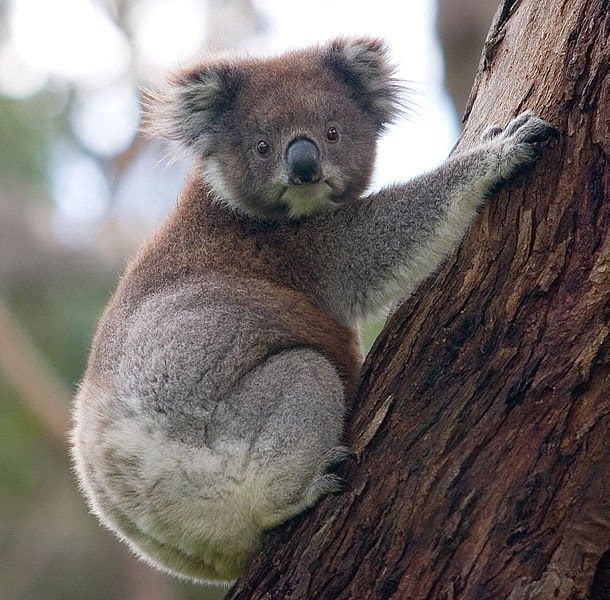
Koalas are able to grip onto smooth bark when climbing and feeding in the trees due to two opposable thumbs and three fingers on each hand.
©Diliff, CC BY-SA 3.0, via Wikimedia Commons – Original / License
Distribution and Habitat
The Koala would have once been widespread throughout south-eastern Australia and on a number of its surrounding islands but populations (particularly in the south) were wiped out in some areas due to hunting. They are, however, surprisingly resilient and adaptable animals that are known to inhabit various types of forest from the tall eucalyptus forests to coastal regions and even low-lying woodlands further inland. Even though they are common in much of their natural range today, land clearance has not only meant a loss of their habitats but also separates populations from one another making them more and more isolated. It is not just the loss of habitat to Human activity though that has led to population declines in certain areas, as quick-spreading forest fires can devastate vast areas of land in minutes and severely affect the local Koala populations in the process.
Koalas inhabit various types of forests from coastal regions to low-lying woodlands further inland.
©Brian Dell Bdell555, Public domain, via Wikimedia Commons – Original / License
Behavior and Lifestyle
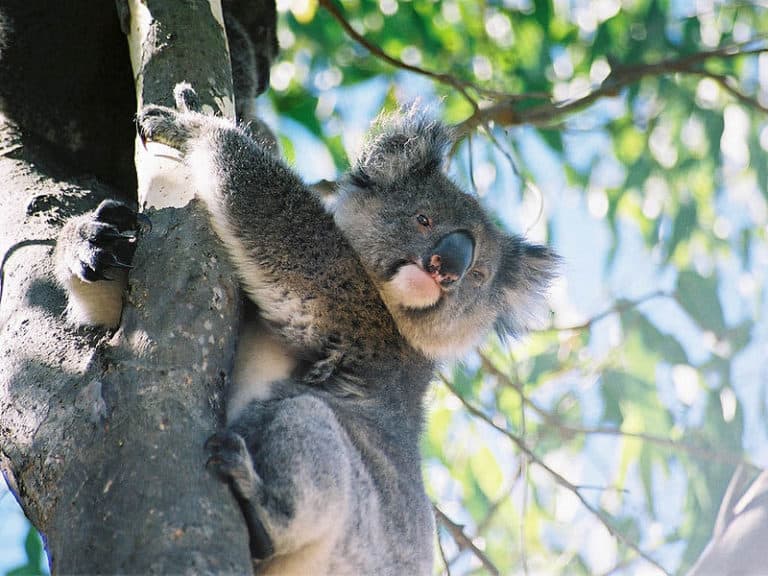
The Koala is a solitary and nocturnal animal that spends most of the daytime hours sleeping in the fork of a eucalyptus tree. Their low-energy diet (that is comprised only of the fibrous leaves of the eucalyptus) leads to Koalas leading a largely inactive lifestyle as they can happily spend up to 18 hours a day sleeping or simply just sit in the trees to conserve energy. Everything from sleeping to eating and even breeding is done in the trees as although Koalas are known to come down to the ground quite frequently, it is only so they can move to another tree. Koalas are also sedentary animals which means that they occupy a fixed home range that can vary in size depending on the abundance of food available (home ranges are smaller in areas with more food as there is no need to travel as far). Although the home ranges of males and females do overlap, males will not tolerate rival males intruding on their territory and fight viciously by scratching and biting.
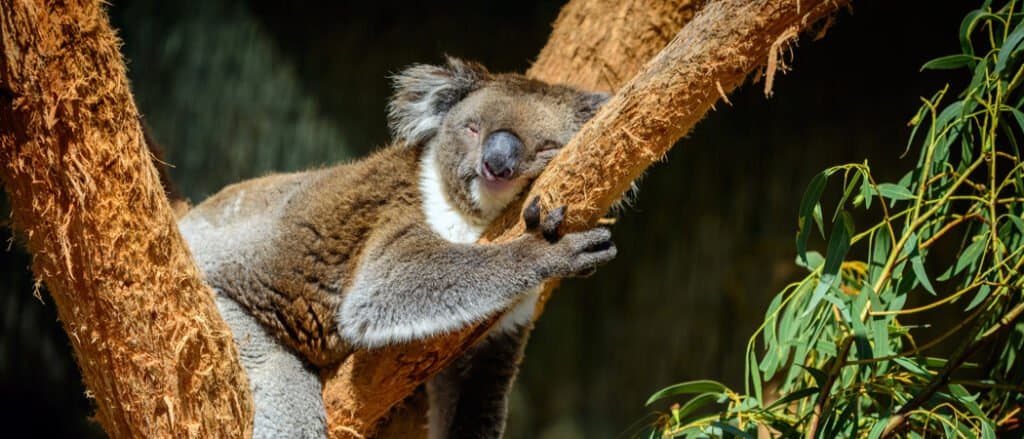
Koalas lead a largely inactive lifestyle, spending up to 18 hours a day sleeping or sitting in the trees to conserve energy.
©myphotobank.com.au/Shutterstock.com
Reproduction and Life Cycles
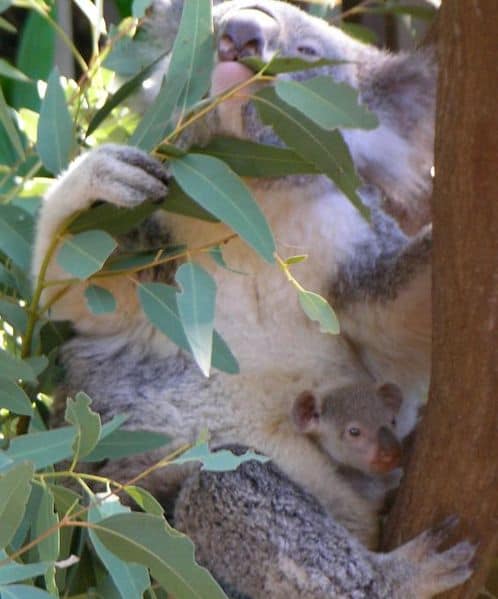
During the breeding season, males can be heard producing loud booming calls through the forest which are to both attract a female mate and also to deter any potential rivals. In Koala society it is the dominant male that gets to mate with the most females meaning that although males (like females) are able to reproduce from the age of two, breeding is not normally successful until the male Koala is between 4 and 5 years old and has established his dominance. After a gestation period that lasts for a mere 35 days, a single joey is born that is about the size of a bee and very underdeveloped, and immediately crawls unaided into the pouch on its mother’s belly. Here it attaches itself to one of the two teats and remains in the safety of the pouch until it is weaned at between 6 and 7 months old after having grown dramatically. The young Koala then clings onto its mother’s back where it tends to remain for another few months or until the next season’s young has developed and is ready to leave the pouch.
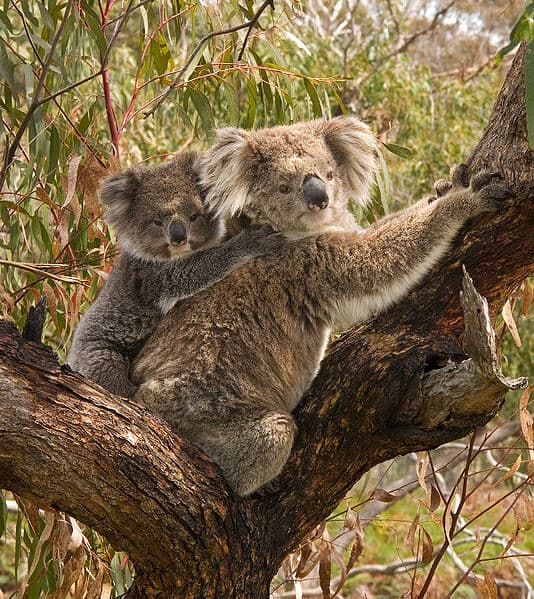
At 6-7 months old, the baby koala clings onto its mother’s back where it will remain for another few months
©Benjamint444, CC BY-SA 3.0, via Wikimedia Commons – Original / License
Diet and Prey
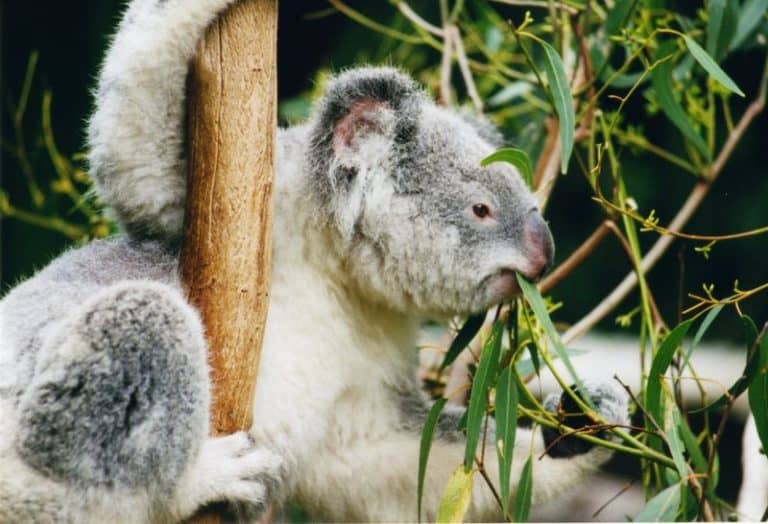
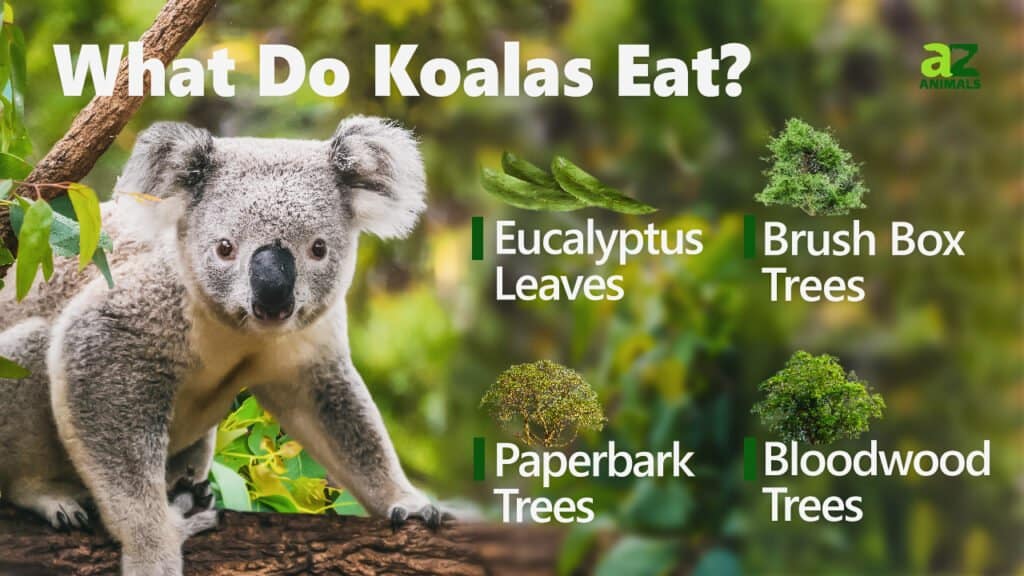
The Koala is a herbivorous animal that only feeds on the leaves of the eucalyptus (gum) tree in order to survive. Despite there being around 600 different species of eucalyptus, Koalas only seem to feed on 30 of them which depends on the surrounding habitat. Eucalyptus leaves are tough and fibrous and often toxic making them inedible to other herbivorous animals but the Koala has evolved to fill this gap in the ecosystem and has large cheek pouches where the leaves are stored. Once full, the Koala then begins to grind the leaves down into a pulp using their flat cheek teeth with some of the toxins then being detoxified by the liver. The Koala also has an incredibly long digestive tract to help it to break down the tough leaves which is more than three times its body length. To help the process Koalas are also known to occasionally eat soil, bark, and gravel to aid the digestion of such a fibrous plant.
Predators and Threats
Despite being relatively small, the lack of native mammalian predators in Australia means that adult Koalas have very few natural predators except large birds of prey. Young Koalas are more vulnerable however and are preyed on by several different animals including snakes, but both are most threatened by domestic animals, particularly dogs, that not only attack Koalas but are also known to spread disease into local populations. This is one of the biggest threats to Koalas in certain areas as large numbers of individuals have been affected particularly by the Chlamydia bacterium, which can be treated with antibiotics. Other threats to the current Koala populations include habitat loss to growing Human settlements, tourist developments, and forest fires that can spread rapidly in semiarid regions. The Koala populations on several islands have also been affected by over-population as the increasing number of individuals means that there is less food to go around.
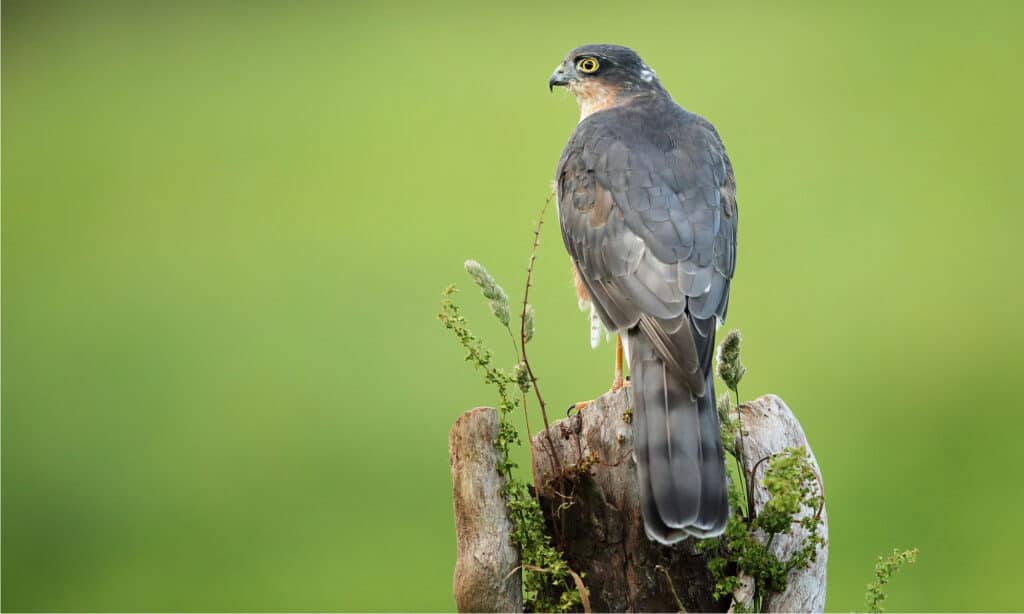
Koalas are vulnerable to birds of prey such as hawks.
©Edwin Godinho/Shutterstock.com
Interesting Facts and Features
Due to the fact that Koalas sustain themselves on a diet that is only comprised of leaves they have little need to drink as they get almost all of the water that they need through their food. However, living on a diet that is so low in nutrients has led to the Koala evolving a very small brain for its body size as this organ can drain the body’s energy supplies. After having spent their first six months of life developing in their mother’s pouch suckling milk, baby Koalas must then attempt to eat solid foods with the first one being the soft droppings of their mother. Young Koalas are thought to do this as it contains a number of microbes that help the young to both fight off disease and to begin digesting the tough, fibrous leaves of the eucalyptus.
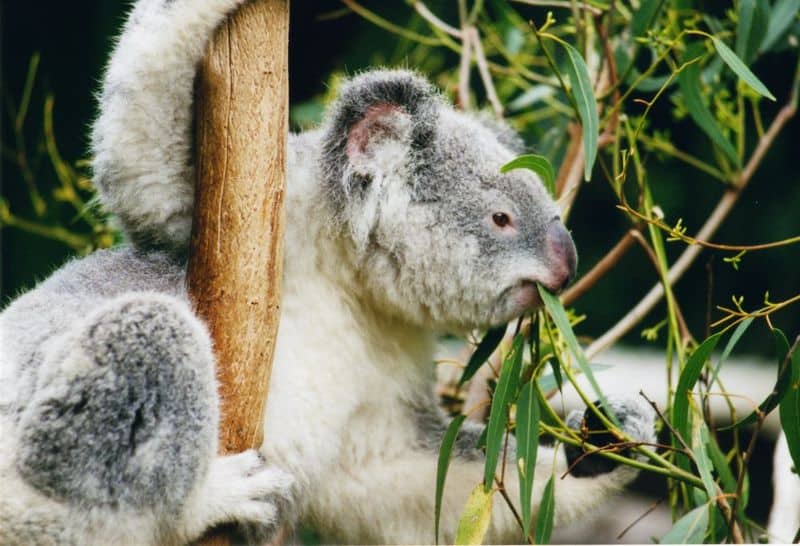
Koalas have little need to drink water because their diet of leaves hydrates them adequately.
©Arnaud Gaillard (arnaud () amarys.com), CC BY-SA 4.0, via Wikimedia Commons – Original / License
Koala Relationship with Humans
The Koala would have once been abundant throughout the forests of south-eastern Australia but intense hunting of them for their soft fur in the early 20th Century led to drastic population declines and even local extinction in some areas. When the industry peaked in 1924 two million pelts were traded and eventually led to public outcry over the situation. Since then, the hunting of Koalas has been banned and management of populations has seen them increase once again. Despite their rising population numbers though, Koalas are affected by Human activity throughout much of their natural range mainly in the form of habitat loss as vast areas of land are cleared annually for development and agriculture. However, the Koala today is one of Australia’s most famous and treasured species of mammal and is found on numerous emblems and in stories not just in Australia but worldwide.
The status of koala bears has recently been changed from vulnerable to endangered.
©whitejellybeans/Shutterstock.com
Conservation Status and Life Today
Today, the Koala is listed by the IUCN as an animal that is Endangered in the wild. In the recent past, population numbers were stable and widespread, in fact too high in some areas with 10,000 individuals having been relocated back to mainland Australia over the past 75 years to prevent island populations from growing out of control. They are, however, becoming more and more remote and isolated from one another due to habitat loss, bushfires, road accidents, and domestic dog attacks. In fact, in December 2020, the bushfires killed an estimated 60,000 koalas. The Australian Koala Foundation now estimates there are less than 57,920 Koalas left in the wild, maybe as few as 32,065.
Some have also been introduced to diseases in certain areas. Where possible though, infected Koalas (and particularly those that have been attacked by domestic dogs) are given veterinary first aid to try and help them in the future and prevent a large outbreak spreading through entire populations.
Koala Pictures
View all of our Koala pictures in the gallery.

How to say Koala in ...
Sources
- David Burnie, Dorling Kindersley (2011) Animal, The Definitive Visual Guide To The World's Wildlife / Accessed November 7, 2008
- Tom Jackson, Lorenz Books (2007) The World Encyclopedia Of Animals / Accessed November 7, 2008
- David Burnie, Kingfisher (2011) The Kingfisher Animal Encyclopedia / Accessed November 7, 2008
- Richard Mackay, University of California Press (2009) The Atlas Of Endangered Species / Accessed November 7, 2008
- David Burnie, Dorling Kindersley (2008) Illustrated Encyclopedia Of Animals / Accessed November 7, 2008
- Dorling Kindersley (2006) Dorling Kindersley Encyclopedia Of Animals / Accessed November 7, 2008
- David W. Macdonald, Oxford University Press (2010) The Encyclopedia Of Mammals / Accessed November 7, 2008
- About Koalas / Accessed November 7, 2008
- Koala Information / Accessed November 7, 2008