


Key Facts
- Komodo dragons are apex predators in their environment.
- They prefer to ambush their prey and attack with great speed and ferocity.
- Their young are independent of the time they hatch and take to tree branches for safety.
Classification
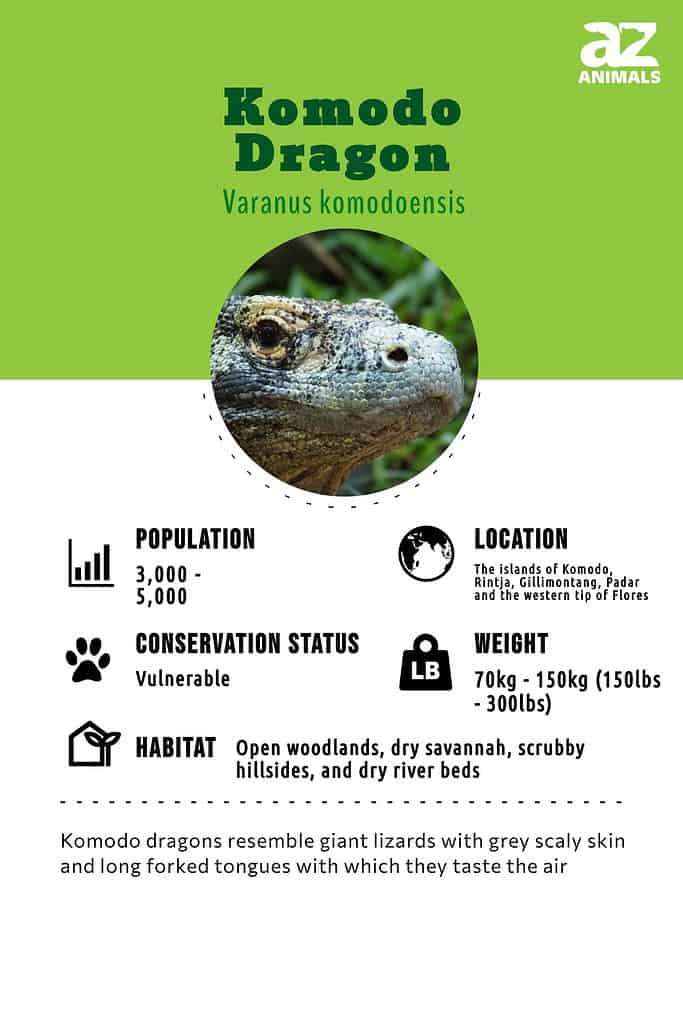
The Komodo Dragon is a large species of lizard that is only found on a handful of islands in the Indonesian archipelago. Not known to the world until the First World War, the Komodo Dragon is actually a species of Monitor Lizard that evolved in isolation for millions of years. These lizards are not only the largest in the world but are also one of the most aggressive and dangerous. They are so powerful that they are able to take down prey many times their own size. Komodo Dragons are in severe danger of extinction in their natural environments due to climate change, habitat loss, and a shortage of prey. Population decline has led to these lizards being listed on the IUCN’s Red List, providing this species with legal protection.
Evolution
The komodo’s very own evolutionary branch made the move to Asia from Australia as a result of the collision of the two continents 15 million years ago.
The presence of the komodo dragon on the southernmost continent is further supported by evidence that it also mated with the sand monitor’s forbears.
However, its true origins began 40 million years ago when its ancestors made their way from Asia to Australia, where its ancestors grew to immense sizes, with the Varanus priscus being the largest of all at 23 feet long.
Anatomy and Appearance
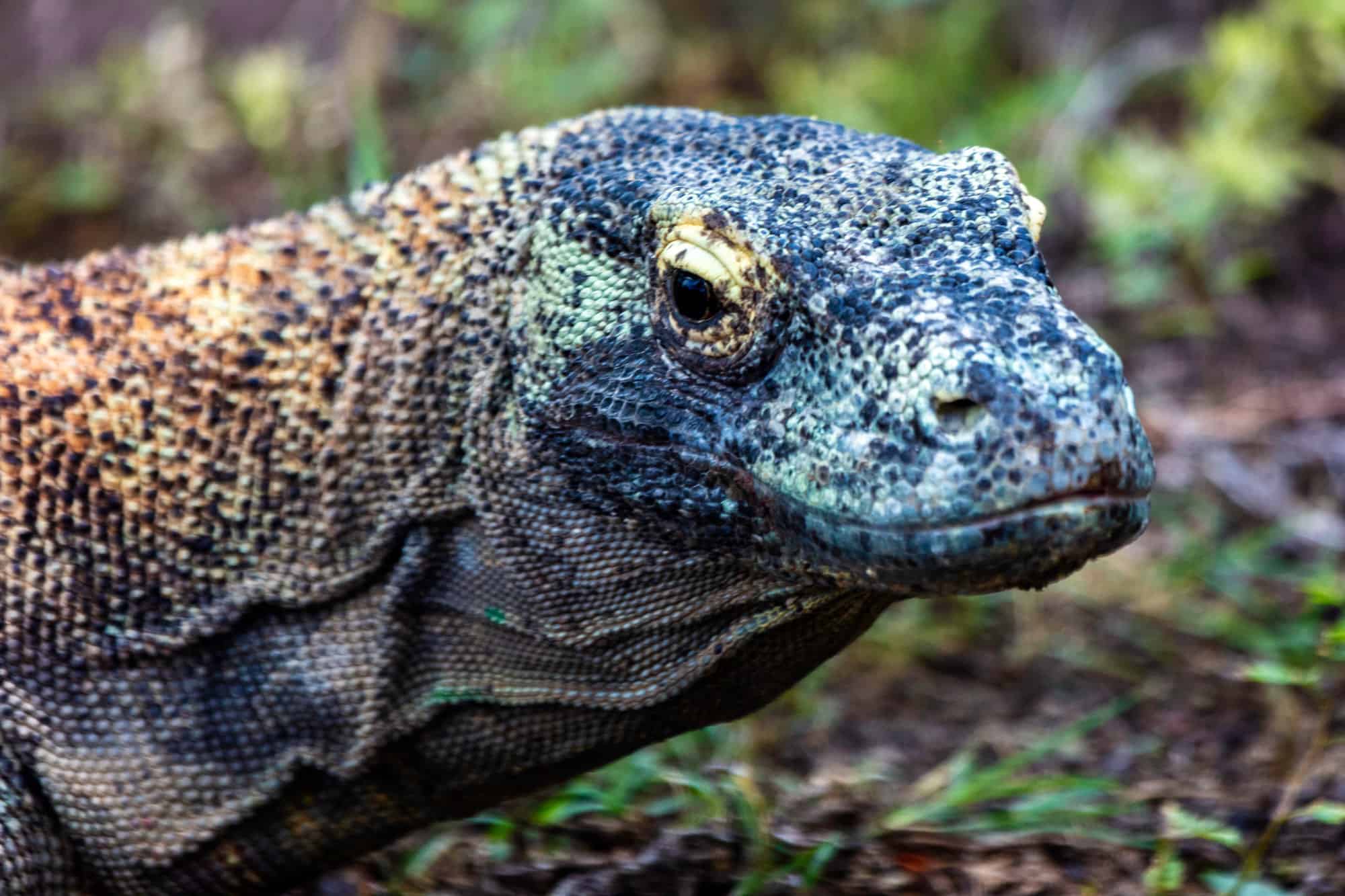
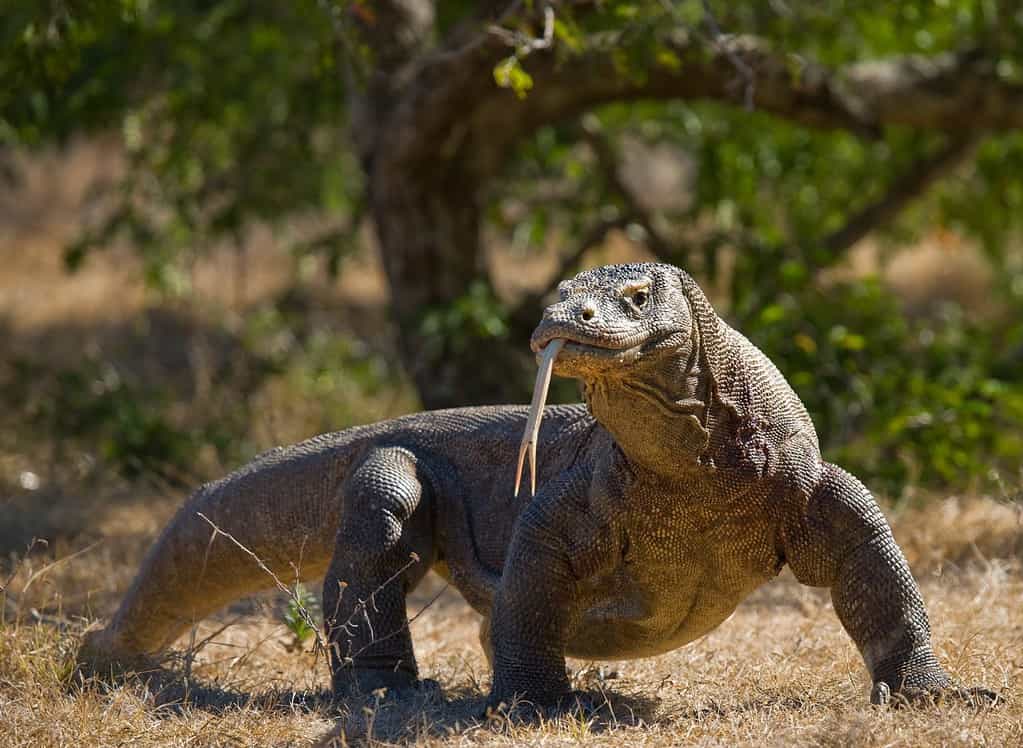
Komodo Dragons have excellent eyesight and powerful jaws
©iStock.com/desertsolitaire
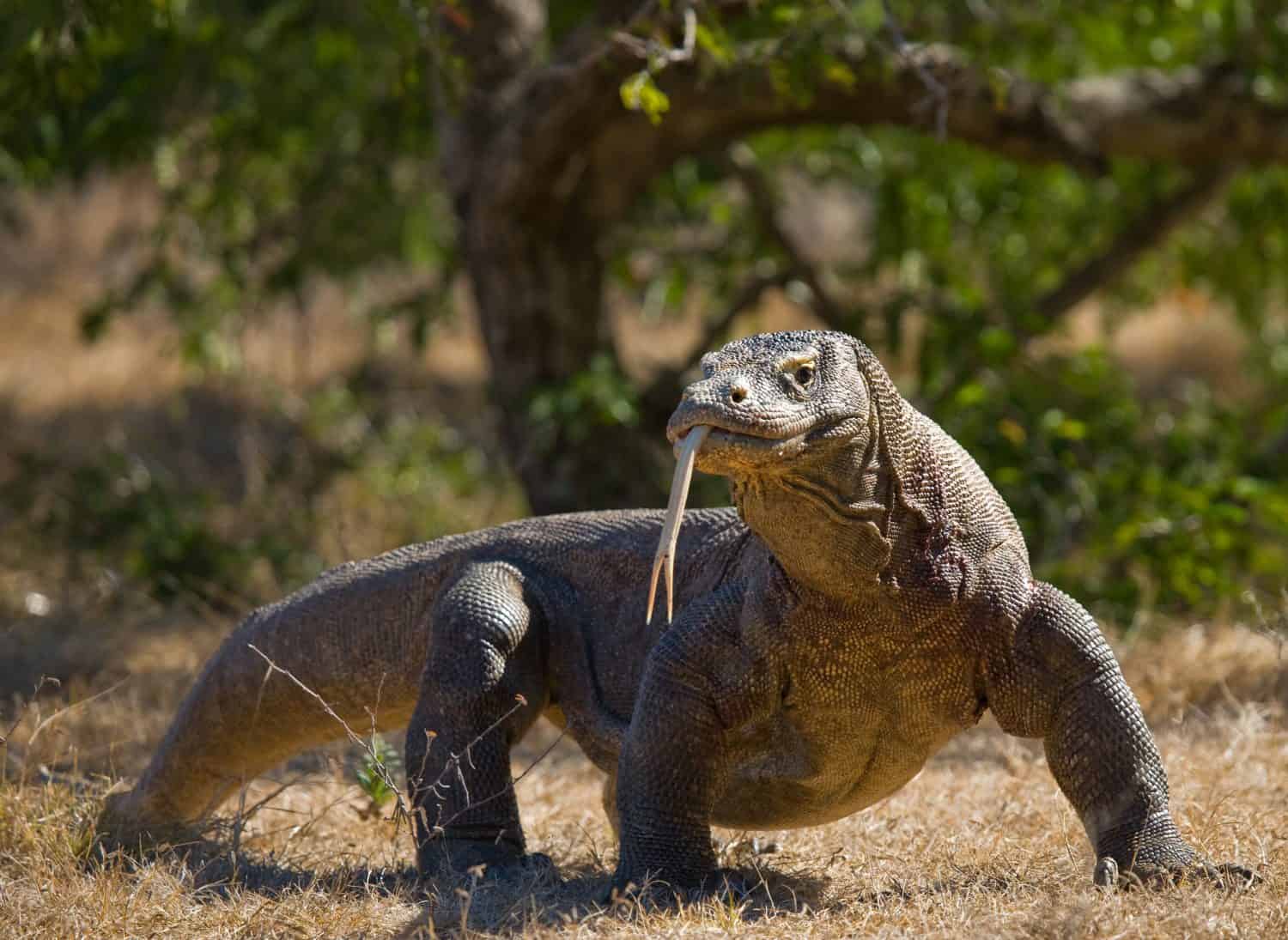
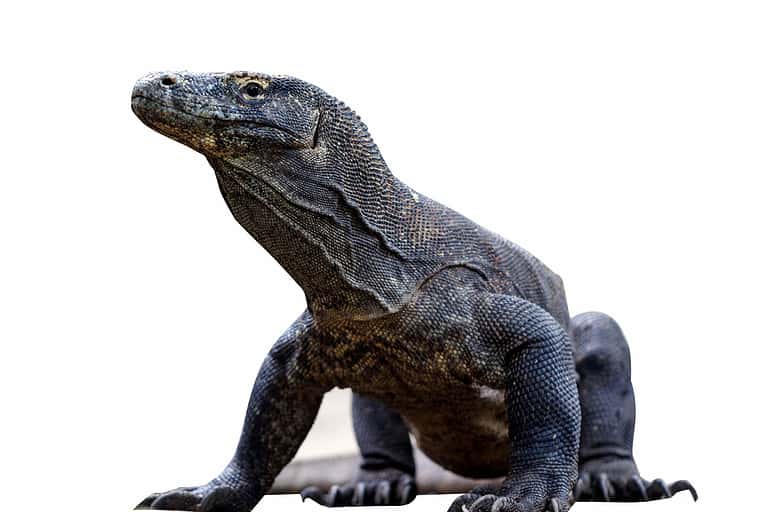
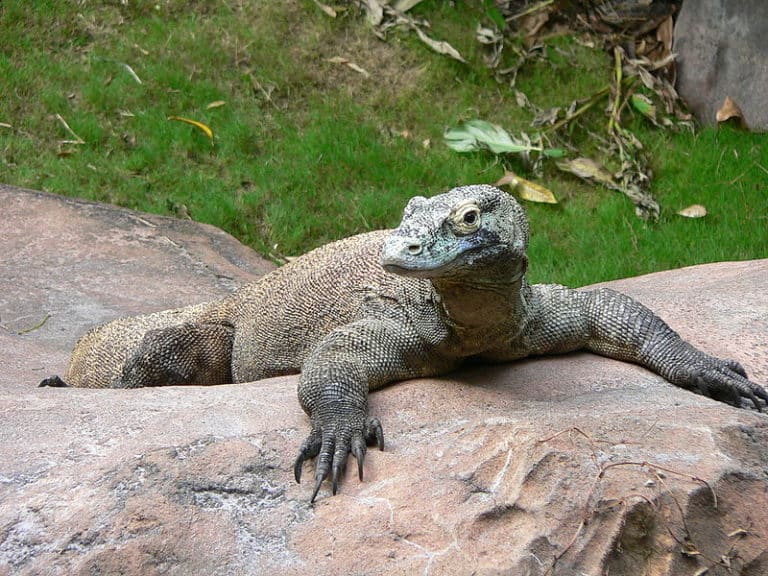
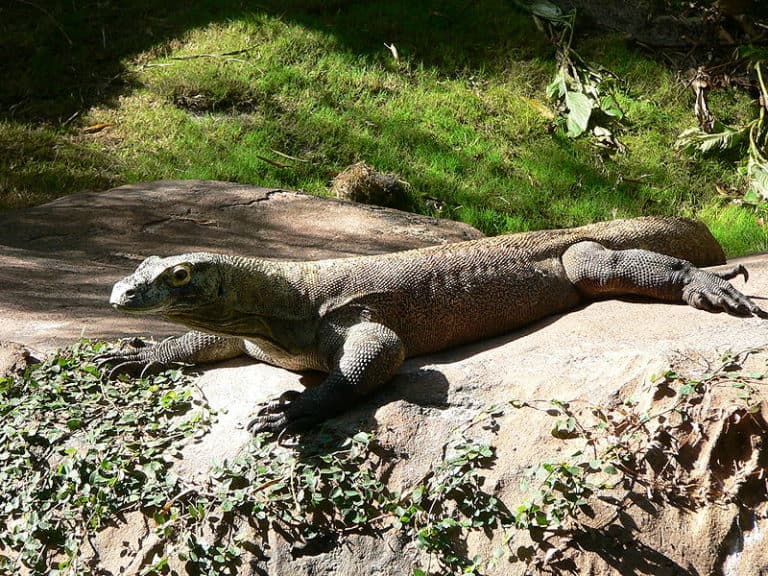
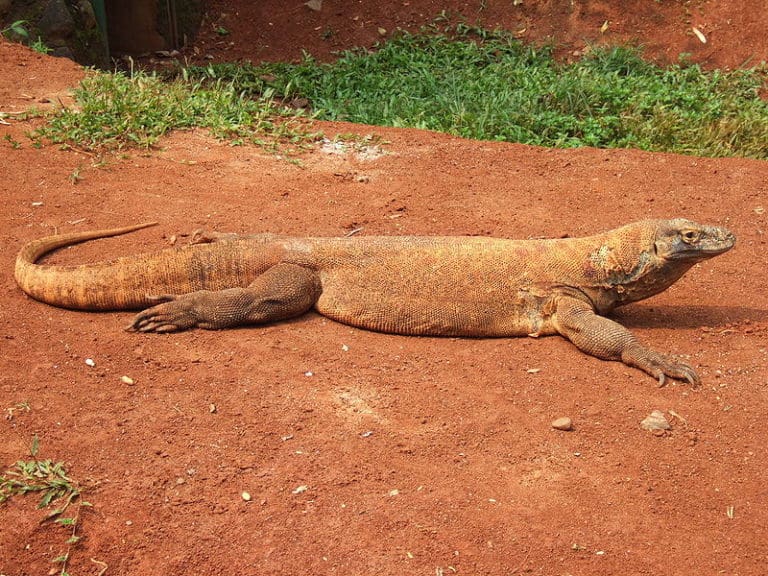
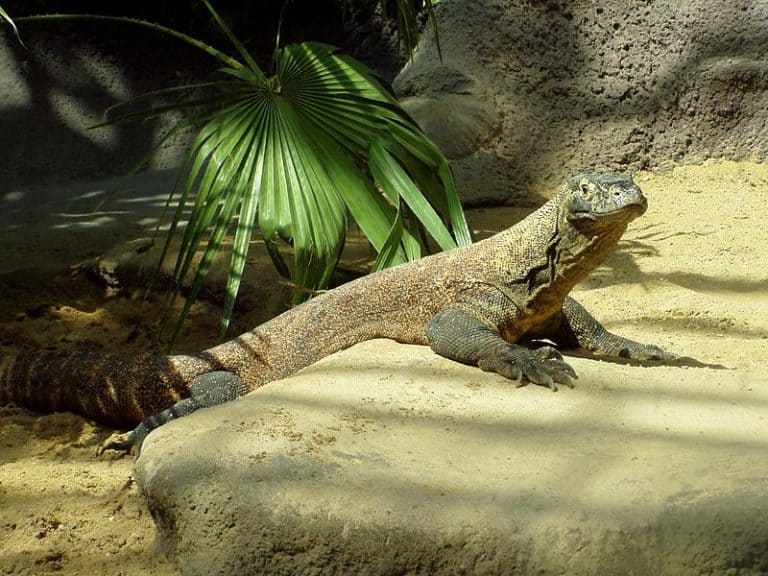
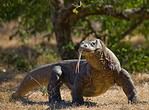
Komodo Dragons are enormous reptiles that can grow up to three meters long and weigh 150kg. They are incredibly aggressive with long, thick bodies, short, muscular legs, and a powerful tails. Their tail is used for both fightings and for propping the animal up when it is standing on its hind legs. The Komodo Dragon is an animal with long, sharp, curved claws that are often used for digging. Greyish brown skin is covered in small scales and folds around the neck. Komodo Dragons have relatively small heads compared to their large body size and wide, powerful jaws concealing a mouth filled with deadly bacteria and sharp teeth. Although Komodo dragons have good eyesight, they mainly rely on their forked tongue to smell their environments. By flicking its tongue out of its mouth, the lizard is able to “taste” scent particles in the air and locate live or dead prey up to 8km away.
The largest Komodo Dragon ever recorded weighed 365 pounds!
Distribution and Habitat
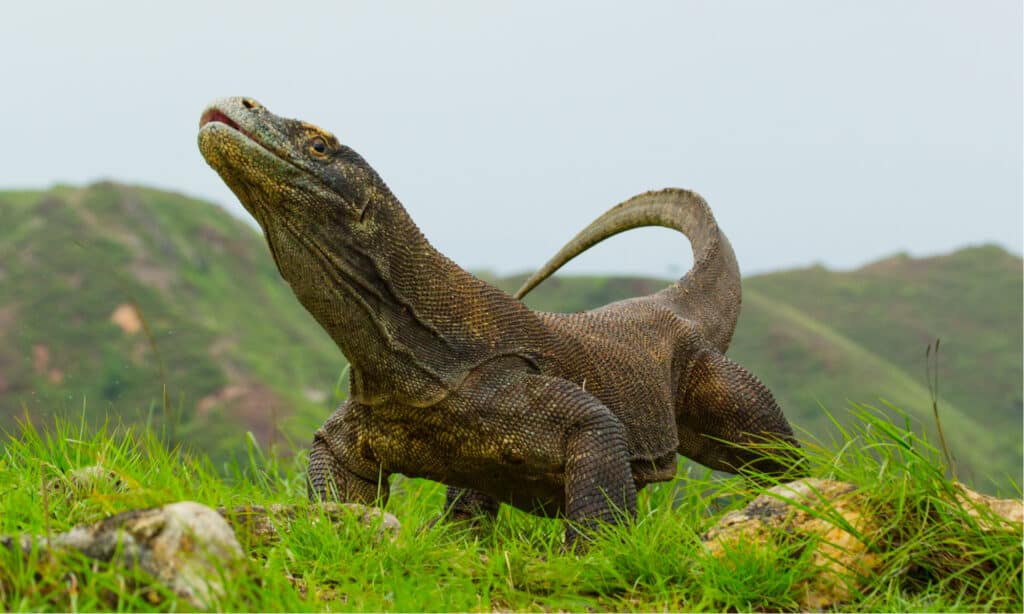
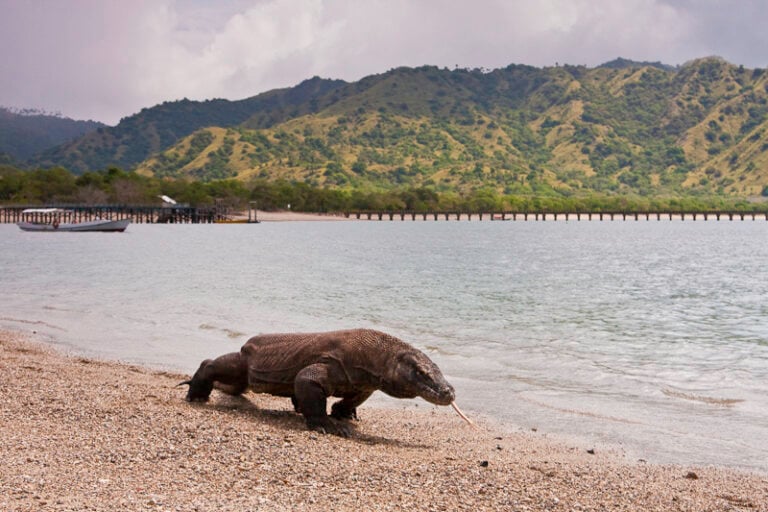
Komodo dragons can only be found on five Indonesian islands
©GUDKOV ANDREY/Shutterstock.com
Although the Komodo Dragon was once been widespread across many Indonesian islands, they are confined to just five today, all within Komodo National Park. The islands of Komodo, Rintja, Gillimontang, Padar and the western tip of Flores are the last remaining homes for these enormous animals. Habitats include open woodlands along with dry savannah and scrubby hillsides, occasionally dried-up river beds. Komodo Dragons are thought to have evolved to be so big due to the presence of a number of large mammalian species that are now extinct and the lack of other large predators.
Behavior and Lifestyle
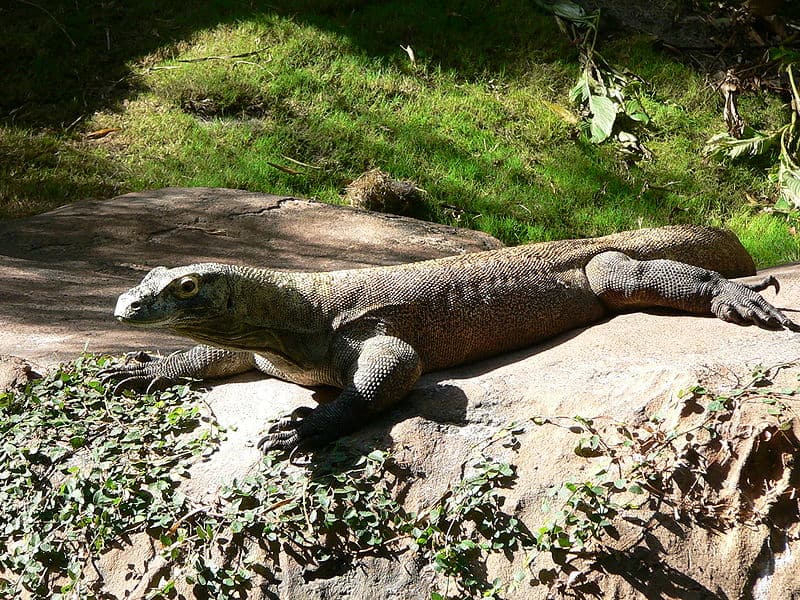
Komodo Dragons are ambush predators and prefer to lie in wait for their prey
©Raul / Creative Commons – Original
Komodo dragons are solitary and powerful predators, roaming territories dependent on the individual’s size, covering a distance of around 2km every day. They are also known to be excellent swimmers, traveling from one island to another over a relatively long distance. Although they are solitary animals, a number of Komodo Dragons will often gather around a single kill. In order to catch large animals, these lizards sit for hours, hidden in the vegetation, camouflaged by grey-brown skin. They then ambush the victim with incredible speed and force.
Reproduction and Life Cycles
Besides feeding on a large carcass, Komodo Dragons reside in groups during the breeding season, around September, when nearby males fight standing on their hind legs, propped up by their tails, vying for breeding rights. After mating, females lay up to 25 leathery eggs in a hole made of soft sand. The young hatch after an incubation period between 8 and 9 months and have distinguishing cream bands (which they lose as they get older). Young Komodo dragons are completely independent of the time they leave their shell. However, until they grow to a larger size, this young venture up into the trees, spending most of their time there until they are large enough to fend for themselves on the ground. These reptiles live for an average of 30 years in the wild.
Diet and Prey
The Komodo Dragon is a carnivorous predator that relies on large animals, such as pigs, goats, deer, and even horses and water buffalo, as prey. Komodo dragons have the ability to attack prey much larger than them. Even if unsuccessful upon ambush, they will follow the injured prey for miles, waiting until it dies from sepsis caused by deadly bacteria in the reptile’s mouth. Young will prey on smaller animals mainly in the trees such as snakes, lizards, or birds. The teeth of this animal are sharp and serrated, good for the kill and tearing meat, but useless for chewing. Instead, Komodo dragons tear bits off the carcass, and throw it back into their mouths, swallowing it whole aided by their flexible neck muscles.
Predators and Threats
Due to the fact that the Komodo Dragon is the most dominant predator in its environment, mature adults have no natural predators in their native habitats. Upon the first arrival of people on the islands, the Komodo dragon’s lifestyle changed dramatically. Humans hunt these lizards and encroach into their native habitats to establish settlements and clear forests for timber and agriculture. Volcanic activity also threatens these animals, as the islands are geologically active. Events such as this lead to declines in prey species, in turn affecting the local Komodo Dragon populations.
Komodo Dragons were Unknown Until Recently
Although Komodo Dragons have thrived in this part of the Indonesian archipelago for millions of years, they were unknown to the world until around a century ago. Initial reports came from a pilot stranded on Komodo Island after his plane crashed into the ocean. A species of Pygmy Elephant, thought to have now been extinct for thousands of years now, may have been a main source of food for Komodo dragons at one point. The main prey sources of Komodo dragons today were introduced by human settlers.
Komodo Dragons are Venomous
The Komodo Dragon has fifty different types of toxic bacteria in their saliva that thrive on traces of flesh, causing bite wounds to quickly become infected. However, recent studies indicate that the real reason for such a high success rate in killing prey could be down to the fact that a venom gland exists in this reptile’s mouth.
Researchers in Australia had the rare opportunity to examine two Komodo dragons that were put down in zoos due to terminal illnesses. The team found that the animal does possess a venom gland with venom capable of rapidly decreasing blood pressure and blood loss – sending the victim into shock and making it too weak to fight. Some compounds in the venom that reduce blood pressure were as potent as the world’s most venomous snake, the inland Taipan of Western Australia.
Komodo dragons also possess a venom delivery duct system that is more complex than the ones employed by snakes. While snakes have a single venom duct behind their fangs – Komodos have multiple ducts between their teeth. This means that instead of simply injecting venom with a bite – Komodo dragons bite and pull their victims to ooze the venom into wounds during a long, frenzied attack. This finding makes the whole bacteria theory almost laughable compared to this nightmarish means of killing. Read Are Komodo Dragons Poisonous or Dangerous? for more information.
Relationship with Humans
Since their discovery on the islands around 100 years ago, Komodo Dragons fascinate and honestly terrify people as we deduce more about them. Habitat loss on the islands not only means that Komodo Dragons face being pushed into isolated regions, but they are also coming into closer contact with human activity, leading to negative wildlife-livestock interactions. Despite their seemingly slow and docile nature, Komodo Dragons run at speeds of up to 11mph in short bursts and are actually one of the world’s known “man-eaters.” People have not only been ambushed but also bitten and then tracked by Komodo Dragons.
Conservation Status and Life Today
Today, the Komodo Dragon is listed by the IUCN as a species that is “vulnerable in its natural environment” and potentially faces extinction in the near future due to loss of habitat mainly from human activity, such as agricultural expansion. Although once widespread on numerous Indonesian islands, they are now confined to just a few with between 3,000 and 5,000 individuals thought to be left roaming the rich, volcanic forests. However, increasing interest in these creatures from tourists gives locals more reason to protect them and their critical habitats.
Similar Animals
- Iguana: Large and colorful, they’re considered an invasive species in some regions and a favorite among pet enthusiasts in others. Find out about this reptile which is capable of growing up to 7 feet.
- Monitor Lizard: Highly intelligent with a voracious appetite, they’re cousins to the Komodo dragon. Read about these lizards which have a metabolism that is similar to a mammal’s.
- Skink Lizard: Some are aquatic, and others are arboreal. And they’re found all over the planet. Here’s all you need to know about these reptiles capable of laying eggs and birthing live young at the same time.
Komodo Dragon Pictures
View all of our Komodo Dragon pictures in the gallery.

iStock.com/MikeLane45
How to say Komodo Dragon in ...
Sources
- David Burnie, Dorling Kindersley (2011) Animal, The Definitive Visual Guide To The World's Wildlife / Accessed December 5, 2008
- Tom Jackson, Lorenz Books (2007) The World Encyclopedia Of Animals / Accessed December 5, 2008
- David Burnie, Kingfisher (2011) The Kingfisher Animal Encyclopedia / Accessed December 5, 2008
- Richard Mackay, University of California Press (2009) The Atlas Of Endangered Species / Accessed December 5, 2008
- David Burnie, Dorling Kindersley (2008) Illustrated Encyclopedia Of Animals / Accessed December 5, 2008
- Dorling Kindersley (2006) Dorling Kindersley Encyclopedia Of Animals / Accessed December 5, 2008
- Komodo Dragon Information / Accessed December 5, 2008
- Komodo Dragon Facts / Accessed December 5, 2008
- Komodo Dragon Conservation / Accessed December 5, 2008