
L
Species Profile

Lionfish

Pterois

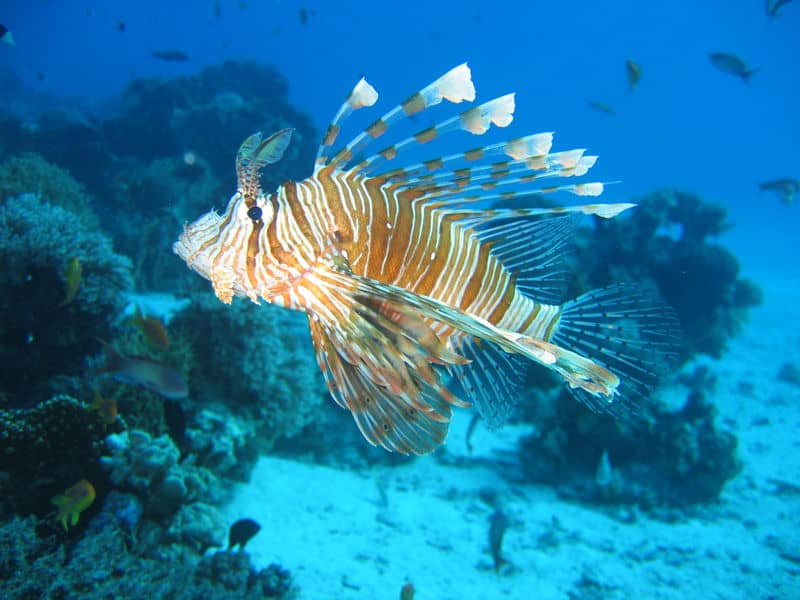
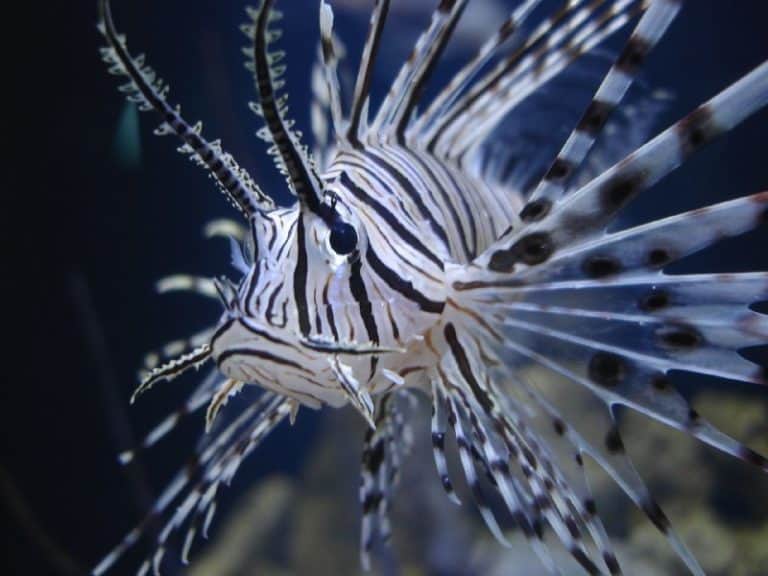
Beauty with a sting.
janderk - Public Domain

Lionfish Distribution

Click a location to explore more animals from that region

Invasive Species

This map shows coastal regions where Lionfish are found.

Loading map...
Lionfish

At a Glance

Genus Overview This page covers the Lionfish genus as a group. Stats below are general traits shared across the genus.
Also Known As Turkeyfish, Firefish, Scorpionfish
Diet Carnivore
Activity Crepuscular+
Lifespan 10 years
Weight 1.5 lbs
Status Not Evaluated
Did You Know?

Across Pterois, adults typically span ~12-38 cm total length, with some species staying compact while others become large, showy reef hunters.

Scientific Classification

Genus Overview "Lionfish" is not a single species but represents an entire genus containing multiple species.

Lionfishes (genus Pterois) are ornate, reef-associated marine ray-finned fishes with long venomous fin spines used for defense. Several species are popular in aquaria; some (notably P. volitans and P. miles) are major marine invaders outside their native ranges.

Kingdom
Animalia
Phylum
Chordata
Class
Actinopterygii
Order
Scorpaeniformes
Family
Scorpaenidae
Genus
Pterois

Distinguishing Features

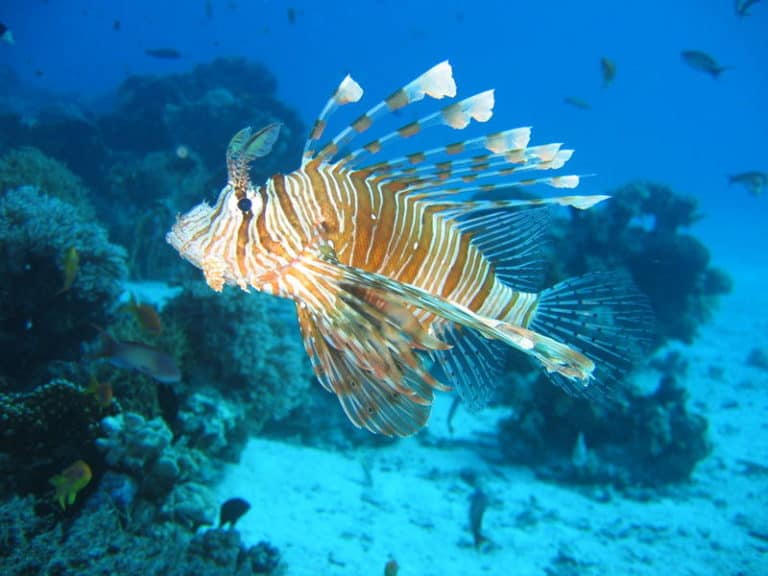
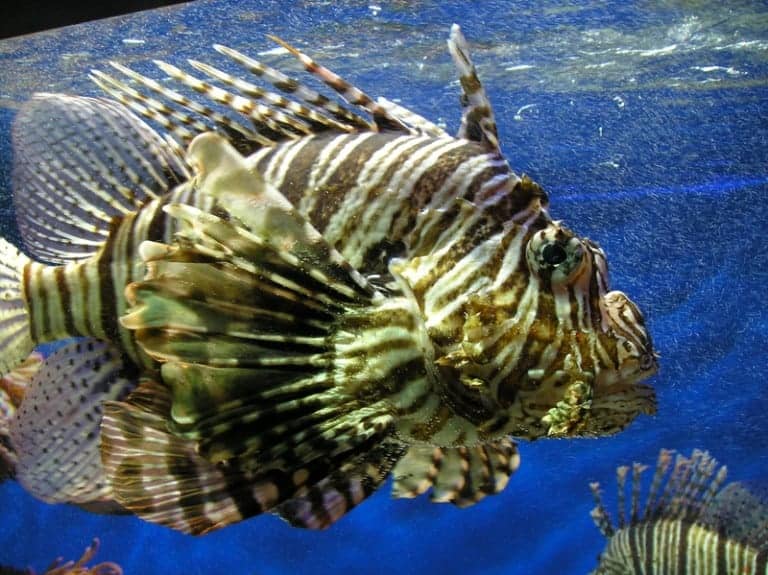
  • Elongated, feathery pectoral fins and conspicuous dorsal fin spines
  • Bold vertical striping (often red/brown/white)
  • Venom glands associated with dorsal, anal, and pelvic spines (defensive envenomation risk)
  • Ambush predatory behavior; can herd prey using fins

Physical Measurements

Males and females differ in size

Length
11 in (5 in – 1 ft 6 in)
10 in (5 in – 1 ft 6 in)
Weight
1 lbs (0 lbs – 3 lbs)
Top Speed
4 mph
swimming
Venomous

Appearance

Primary Colors
Secondary Colors
Skin Type Scaly, mucus-coated marine fish skin; large fin membranes supported by elongated, venomous spines.
Distinctive Features
  • Adult total length across genus typically ~15-45 cm (smallest species to largest).
  • Typical adult mass roughly ~0.2-1.2 kg, varying with species and condition.
  • Lifespan commonly ~5-15+ years; some individuals can reach ~20 years in captivity.
  • Ornate, elongated dorsal, pelvic, and anal spines bearing venom glands; used defensively.
  • Flesh is not poisonous; injury risk is from spine envenomation, usually very painful but rarely fatal.
  • Very large, fanlike pectoral fins used for display, maneuvering, and herding prey.
  • Reef-associated ambush predators; often crepuscular/nocturnal but may hunt by day, varying by location.
  • Diet broadly overlaps across species: small reef fishes and crustaceans; juveniles take smaller invertebrates.
  • Often hover and "corner" prey against reef/sand using pectoral fins before rapid suction strikes.
  • Habitats vary by species: coral/rocky reefs, lagoons, rubble and sand edges; shallow to deeper reef slopes.
  • Pelagic larvae enable wide dispersal; some species show strong site fidelity as adults.
  • Invasion ecology: P. volitans and P. miles form dense populations outside native ranges (e.g., Atlantic).
  • Both P. volitans and P. miles have 13 dorsal spines. P. volitans usually has 11 dorsal soft rays and 7 anal soft rays; P. miles often has 10 and 6.

Sexual Dimorphism

Sexual dimorphism is generally subtle across Pterois. Males in some species/populations may grow slightly larger or show longer fin rays and head appendages, while gravid females show a fuller abdomen; differences are often inconsistent and seasonally variable.

  • May attain slightly larger maximum size in some species/populations.
  • Fin rays/spines can appear longer or more filamentous in some individuals.
  • During courtship, males may display more actively and flare fins more frequently.
  • Gravid females often show a noticeably distended abdomen.
  • Body profile may appear deeper when carrying eggs.
  • External visual differences outside breeding condition are typically minimal.

Did You Know?

Across Pterois, adults typically span ~12-38 cm total length, with some species staying compact while others become large, showy reef hunters.

Lionfish are venomous (spines inject venom) rather than poisonous-properly handled, the flesh is generally eaten in some regions.

Many Pterois hunt by spreading their oversized pectoral fins to corner prey and strike with a rapid suction gulp.

They're mostly crepuscular/nocturnal ambush predators, often resting in caves and under ledges by day-though activity patterns can vary by habitat and local pressure.

Pterois can tolerate a wide range of reef and near-reef conditions (reefs, rocky areas, lagoons), helping explain why some species establish easily when introduced.

The major Atlantic invasion is driven chiefly by P. volitans and P. miles, two very similar-looking species that can be hard to separate in the field.

Key ID clue (with overlap): P. volitans often has 11 dorsal soft rays and 7 anal soft rays, while P. miles often has 10 dorsal soft rays and 6 anal soft rays; counts are used because color patterns are extremely similar.

Unique Adaptations

  • Venom-delivering fin spines (dorsal, pelvic, anal) for defense-effective deterrence against many would-be predators.
  • Extreme fin ornamentation: elongated rays and wide pectoral fins aid both defense display and hunting tactics.
  • Cryptic striping and disruptive patterns that break up body outline among coral branches, rock shadows, and seagrass edges (pattern intensity varies by species).
  • Robust ambush toolkit: large mouth, fast buccal expansion, and precise strike control for suction-feeding on agile prey.
  • Broad habitat tolerance (reef to near-reef hard bottoms and lagoons), supporting persistence across varied coastal environments.

Interesting Behaviors

  • Fin-assisted prey herding: many species flare pectoral fins to funnel small fishes/shrimps against structure before striking.
  • Sit-and-wait predation: individuals commonly perch motionless on reef outcrops, then lunge with rapid suction feeding.
  • Flexible daily schedule: while often most active at dawn/dusk or night, some populations show more daytime hunting where prey is abundant or competition differs.
  • Site fidelity and sheltering: many individuals repeatedly use the same crevices/overhangs, especially during daylight hours.
  • Group tolerance varies: lionfishes may be seen near one another where food and shelter are plentiful, but spacing/territoriality differs among species and contexts.
  • Reproductive output is generally high across the genus, with repeated spawning events possible in warm seasons/regions; timing and frequency vary by species and locality.

Cultural Significance

Lionfish (Pterois), with showy fins and bold stripes, invaded the western Atlantic (mainly P. volitans and P. miles). This led to derbies, targeted removals, "eat lionfish" campaigns, aquarium displays, photography, and education on invasive species, safe handling, and venom.

Myths & Legends

Name lore in English: "lionfish" and "turkeyfish" arose from the mane-like fin rays and flamboyant look, echoing a long tradition of naming marine animals after familiar land animals to convey danger or grandeur.

Scientific naming origin: the genus name Pterois is rooted in Greek for "winged/fin," a reference to the wing-like spread of the pectoral fins-an etymological 'story' often shared in natural history exhibits.

An Atlantic legend says that early in the invasion, Caribbean and western Atlantic divers and fishers found reefs suddenly filled with striped, floating‑maned Pterois. This story is now part of local conservation and derby culture.

You might be looking for:

Red lionfish

28%

Pterois volitans

The most widely recognized “lionfish”; prominent invasive in the western Atlantic/Caribbean/Gulf of Mexico.

Common lionfish / Devil firefish

24%

Pterois miles

Very similar to P. volitans; invasive in the Mediterranean and parts of the Atlantic; native to the Indian Ocean/Red Sea region.

Spotfin lionfish

12%

Pterois antennata

Distinctive spotted pectoral fins; Indo-Pacific reefs.

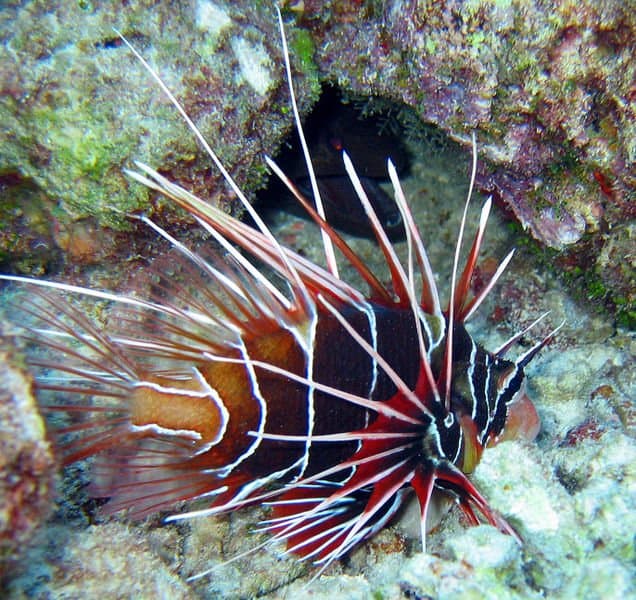
Clearfin lionfish

10%

Pterois radiata

Notable banding and clearer fin membranes; Indo-Pacific.

Dwarf lionfish

8%

Dendrochirus brachypterus

Sometimes also called “lionfish” in the aquarium trade, but belongs to a different genus within Scorpaenidae.

Life Cycle

Birth 20000 frys
Lifespan 10 years

Lifespan

In the Wild
5–15 years
In Captivity
7–20 years

Reproduction

Mating System Polygyny
Social Structure Harem Based
Breeding Pattern Serial
Fertilization Broadcast Spawning
Birth Type Broadcast_spawning

Territorial males may associate with multiple females and court at dusk; pairs rise in the water column to release pelagic egg masses. Spawning repeats frequently in warm seasons/year-round; no pair bond or parental care.

Behavior & Ecology

Social Shoal Group: 2
Activity Crepuscular, Nocturnal, Cathemeral
Diet Carnivore Small reef fishes (particularly juvenile/cryptic fishes such as gobies, blennies, and juvenile damselfishes)

Temperament

Ambush-oriented and relatively sedentary; spend long periods resting under ledges or in cover.
Generally non-social but often tolerant of nearby conspecifics where prey or shelter is abundant.
Territoriality is variable across species and contexts; interactions are usually spacing displays rather than fights.
Bold toward prey and often indifferent to divers; defensive posture escalates when threatened.

Communication

No consistent vocalizations documented across the genus; sound production is not a primary channel.
Visual displays: fin-spreading, erecting venomous spines, and lateral presentation to deter threats or rivals.
Spatial signaling: approach-retreat and positioning around shelter sites to maintain distance.
Reproductive signaling likely includes synchronized swimming/courtship rises and chemical cues associated with spawning.

Habitat

Coral Reef Coastal Rocky Shore Seabed/Benthic Cave Mangrove Estuary +1
Biomes:
Terrain:
Coastal Island Rocky Sandy Muddy
Elevation: Up to 656 ft 2 in

Ecological Role

Reef mesopredator (sometimes functionally apex in invaded systems) exerting strong top-down pressure on small fishes and mobile invertebrates; venomous spines primarily for defense reduce predation risk and can increase survival/impact where predators are naïve.

Regulation of small-reef-fish and crustacean populations (native range; strength varies by habitat and predator guild) Energy transfer within reef food webs via predation on juvenile fishes and motile invertebrates In invaded ranges (notably Atlantic/Caribbean for some species), substantial restructuring of reef communities through high predation on recruits, potentially reducing biodiversity and altering ecosystem function

Diet Details

Main Prey:
Small reef fishes Crustaceans Cephalopods

Human Interaction

Domestication Status

Wild

Lionfish (Pterois) are wild reef fishes with no domestication history. Many species have been kept in aquariums for decades, so people know how to care for them, but no domesticated breeds exist. Outside the Indo‑Pacific and Red Sea, some became invasive after escapes or releases (western Atlantic, Caribbean, parts of the Mediterranean), prompting culls and promotion as food.

Danger Level

High
  • Venomous dorsal/anal/pelvic fin spine punctures causing intense pain, swelling, and temporary disability
  • Secondary infection risk from puncture wounds (marine bacteria)
  • Rare severe systemic reactions (nausea, dizziness, breathing difficulty) and heightened risk for allergic individuals
  • Handling/cleaning/aquarium maintenance injuries; risk persists even with dead specimens until spines are removed/secured

As a Pet

Suitable as Pet

Legality: Lionfish (Pterois) are legal as pets in many places, but laws vary. Some areas limit import or require permits for venomous types. Releasing them is often illegal, and owners must keep and dispose of them safely.

Care Level: Expert Only

Purchase Cost: $25 - $1,000
Lifetime Cost: $2,000 - $25,000

Economic Value

Uses:
Marine aquarium trade (ornamental fish) Food fish (especially where invasive) Invasive-species control programs and fisheries development Tourism and dive industry (reef wildlife viewing; also impacts from invasions) Scientific research (venom, ecology, invasion biology)
Products:
  • Live aquarium specimens
  • Edible fillets/meat (after safe spine removal)
  • Educational displays for public aquaria
  • Byproducts/curios in some markets (e.g., fins/spines for crafts), where permitted

Relationships

Related Species 9

Red lionfish Pterois volitans Shared Genus
Common lionfish Pterois miles Shared Genus
Spotfin lionfish Pterois antennata Shared Genus
Radial firefish Pterois radiata Shared Genus
Russell's lionfish Pterois russelii Shared Genus
Shortfin lionfish Dendrochirus brachypterus Shared Family
Zebra lionfish Dendrochirus zebra Shared Family
Tassled scorpionfish Scorpaenopsis oxycephala Shared Family
Reef stonefish
Reef stonefish Synanceia verrucosa Shared Order

Ecological Equivalents 4

Animals that fill a similar ecological role in their ecosystem

Scorpionfish
Scorpionfish Scorpaenopsis spp. Reef-associated, sit-and-wait predators of small fishes and crustaceans; rely heavily on camouflage and possess defensive fin spines. Generally more cryptic and less likely to display prominent pelagic fins than Pterois.
Frogfishes Antennariidae Occupy a similar ambush-predator niche on reefs and seagrass edges; differ by using a lure and extreme camouflage rather than prominent venomous fin spines and herding behavior.
Moray eel
Moray eel Gymnothorax spp. Overlap in habitat (reef crevices and ledges) and both are nocturnal/crepuscular predators of small fishes. They differ in body plan and hunting mode (pursuit/crevice hunting vs. fin-assisted cornering/ambush).
Groupers Epinephelus spp. Occupy the same reef food-web level as meso- to top predators and can co-occur on similar structures. Groupers are also among the few fishes that may prey on lionfishes despite the lionfishes' venomous spines.

Types of Lionfish

10

Explore 10 recognized types of lionfish

Andover lionfish Pterois andover
Spotfin lionfish Pterois antennata
Banded lionfish Pterois cincta
Lunartail lionfish Pterois lunulata
Common lionfish / Devil firefish Pterois miles
Mombasa lionfish Pterois mombasae
Radial firefish / Tailbar lionfish Pterois radiata
Russell's lionfish Pterois russelii
Hawaiian lionfish Pterois sphex
Red lionfish Pterois volitans

Quick Take

  • Lionfish venom is potent enough to send humans to the hospital, but conservationists are actively urging people to eat them. There's a specific reason this strategy might actually work. See the eating strategy →
  • Lionfish have so few natural predators that the Atlantic Ocean may be largely defenseless against them, yet one unlikely predator keeps showing up on the list. See their natural predators →
  • A single female lionfish's annual reproductive output is staggering enough to explain why their Atlantic invasion went from rare sightings to ecological crisis within just a few decades. Explore their reproductive output →
  • Lionfish are far more active and calculated hunters than most ambush predators, and they don't simply wait for prey to swim by. In fact, one of their techniques is genuinely bizarre. See their hunting techniques →

Lionfish are a group of carnivorous fish species that are native to the Indian and Pacific oceans. While there is plenty of diversity among the different species, all of them are characterized by striking skin color and pronounced venomous spines protruding from their body. The venom conveyed by their sting is a powerful deterrent to predators and is even a health concern for humans.

Several types of lionfish have become established off the coast of the United States and elsewhere in the Atlantic Ocean as invasive species that present a significant ecological threat.

A comprehensive infographic about lionfish showing their physical appearance, migration patterns, and rapid reproduction rates alongside a picture of a cooked lionfish meal.
It lays 2 million eggs a year and has almost no natural enemies—making this beautiful predator a literal nightmare for our oceans unless we start putting it on the menu. © A-Z Animals

3 Lionfish Facts

Lionfish

Lionfish “corner” their prey by using their pectoral fins, which resemble fans.

  • Vicious venom: Their venom deters most predators and can cause serious symptoms in humans, especially young children. Lionfish are among the deadliest fish in the world.
  • Active anglers: Some lionfish use the tentacle on their head to lure prey closer.
  • Eating Lionfish campaign: Some conservation groups have actively educated the public and encouraged commercial consumption of lionfish as a way to control invasive species.

Evolution and Origins

Lionfish are native to the Indo-Pacific but have spread to other regions of the world as a result of human activity. Lionfish are indigenous to the warm, tropical waters of the Red Sea as well as the South Pacific and Indian Oceans (i.e., the Indo-Pacific region).

Long, vivid spines and a fin structure resembling a fan give these unusual fish their remarkable appearance. Lionfish belong to the family Scorpaenidae, which has ancient origins, but the modern lionfish species are believed to have evolved in the Indo-Pacific region over millions of years.

These fish eventually evolved into other species, including the lionfish we are familiar with, by adapting to changing environments over time. Despite their long history, lionfish populations have recently increased dramatically in some places, raising concerns about the effects they may have on regional ecosystems.

Classification and Scientific Name
Lionfish

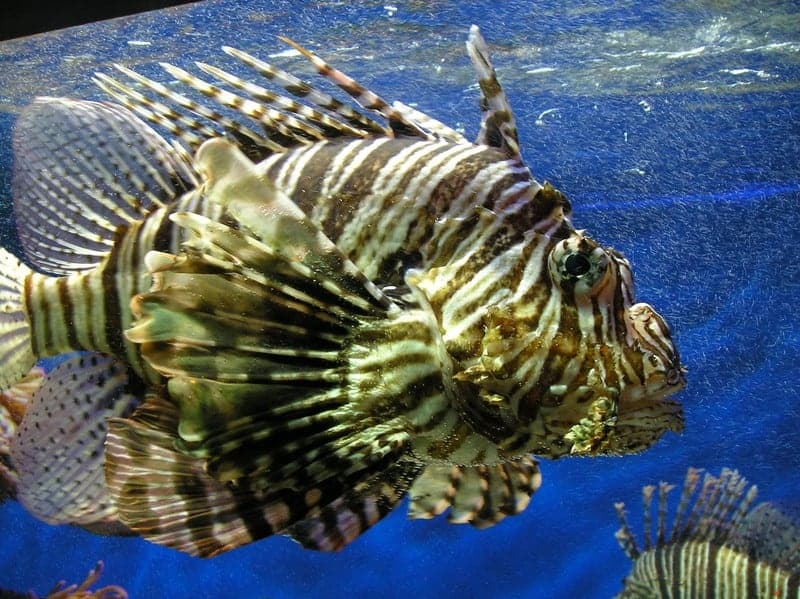
This species’ spines have the ability to sting with venom.

Lionfish also go by many other names, including tasty fish. They are divided into two genera: Pterois and Dendrochirus. The scientific name of Pterois is thought to originate from the Greek word “pteron,” which means feather or wing.

The scientific name for Dendrochirus also has Greek origins and can be loosely translated as “having tree-like markings.” Both lionfish genera belong to the taxonomic family Scorpaenidae in the Actinopterygii class.
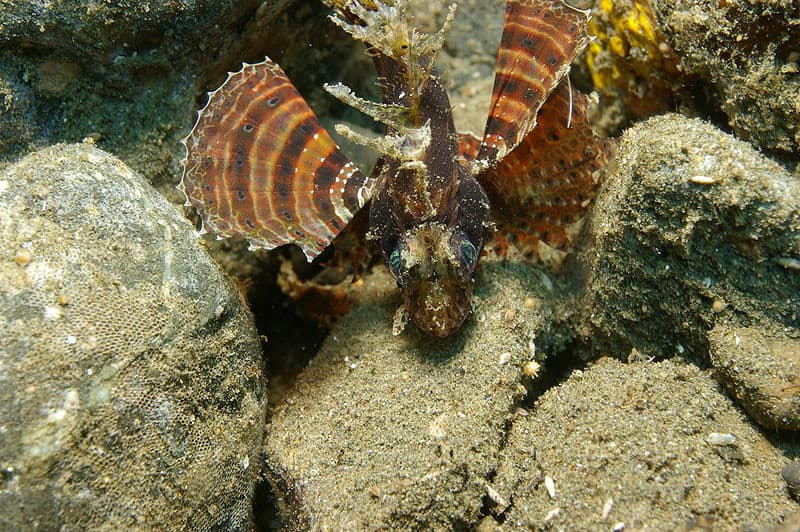
Lionfish

Lionfish have spread to areas where they are not native.

There are about 9 to 12 species in the genus Pterois, which are conventionally labeled as lionfish, while the genus Dendrochirus contains about 7 to 8 species commonly referred to as dwarf lionfish. Lionfish have many colloquial or common names, including firefish, turkeyfish, butterfly-cod, and tasty fish.

Many of these names are typically used to describe a specific species. For example, the species P. miles is known as devil firefish, P. volitans is the red lionfish, and D. biocellatus is called two-spot turkey fish.

Species

With about 18 species across two genera, there is plenty of diversity in coloration and size among lionfish. However, all of them trace their origins to the Indo-Pacific region and are considered invasive elsewhere. Both the classic and dwarf varieties typically pursue a diverse range of prey in relatively shallow coastal waters.

  • Red lionfish (Pterois volitans): One of the two species responsible for the Atlantic invasion and one of the most studied types of lionfish.
  • Hawaiian turkey fish (Pterois sphex): A cave-dwelling fish with a small native range that is limited to the coastal waters around Hawaii.
  • Red Sea lionfish (Pterois miles): A species native to the Red Sea and western Indian Ocean, but also found along the eastern coast of Africa and as an invasive species in the western Atlantic.

Appearance
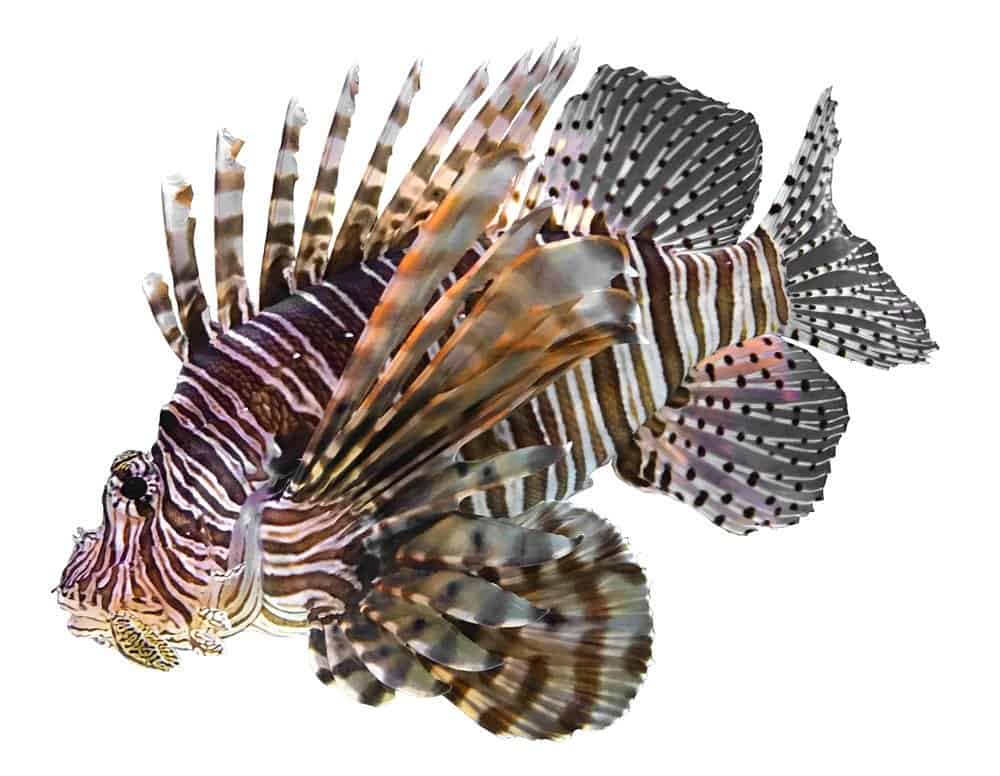
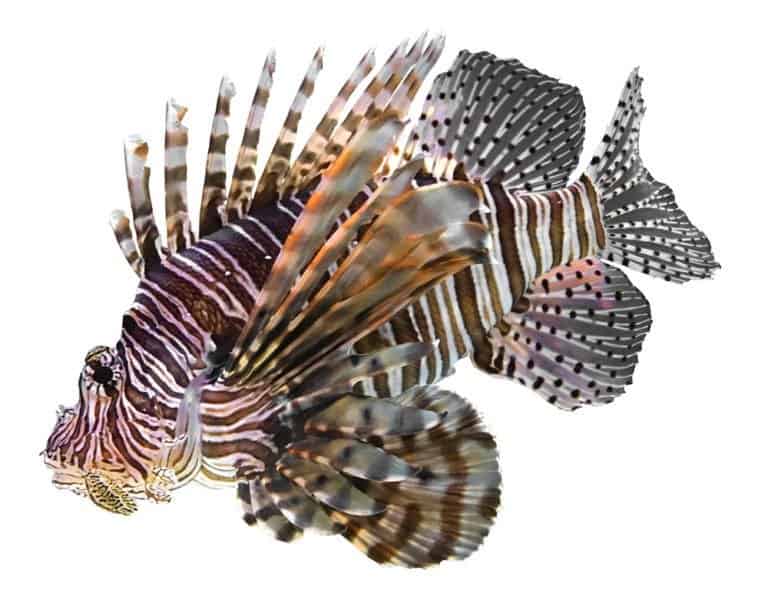
lionfish isolated on white background

A female lionfish can produce over 2 million eggs annually.

With brilliant colors and interesting patterns, lionfish certainly have a unique aesthetic. Their coloration, combined with numerous spines, gives them a striking visual display and is the main reason they are sought after as an aquarium species.

In their natural environment, these colors serve to warn potential predators that the fish has hazardous venom and is not a desirable target.

All lionfish are equipped with a collection of spines along the top of their body and most have spines protruding from their sides or rear as well.

Many species also have fleshy tentacles above their eyes and mouth, which may help lure prey closer before the prey is eaten. In general, lionfish have a compact form with a thick body and a shorter tail. Adult fish can range in length up to 18 inches, while some dwarf varieties only reach about 6 inches long.

Distribution, Population, and Habitat
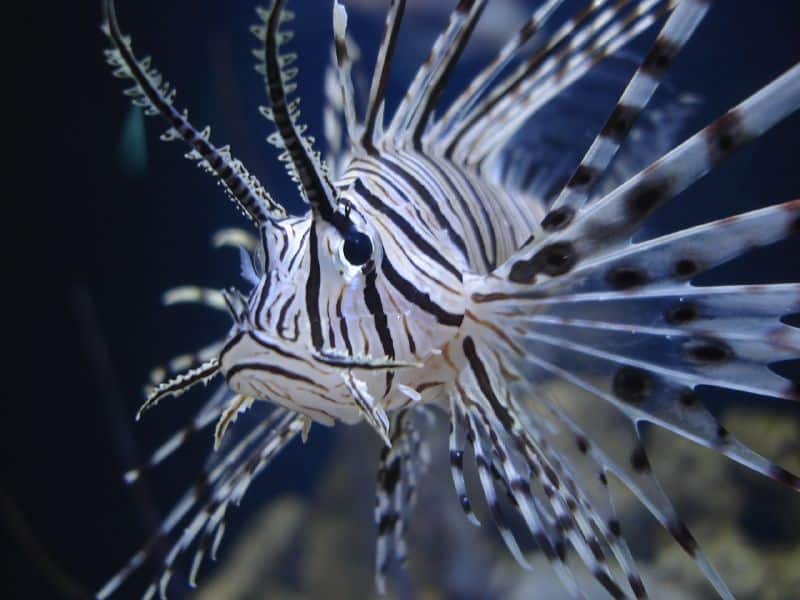
Lionfish

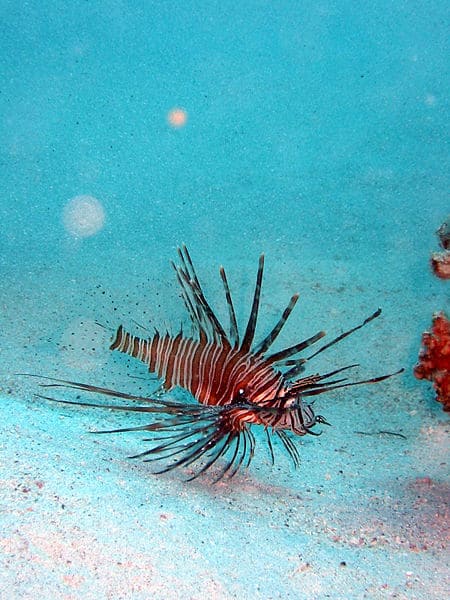
Lionfish are often most active at dawn and dusk (crepuscular), but can also be seen hunting during the day.

All lionfish species are native to saltwater environments and prefer to inhabit shallower waters less than 500 feet in depth. Some species linger around rocky coastlines or seek harbor in lagoons. Others seek sheltered habitats like coral reefs and submerged wrecks that provide a rich hunting ground to satisfy their voracious appetite.

These fish have a vast natural geographic range, although individual species are typically confined to regional waters. The warm, tropical waters between Australia and China are rich in diversity and population. However, various lionfish species find their origin across most of the Indo-Pacific coast, stretching from Japan to Madagascar.

Lionfish are a significant invasive threat to the Mediterranean, Caribbean, and Atlantic Oceans. Divers and ecologists began reporting occasional sightings off the coast of the United States in the 1990s. Within a few decades, population numbers exploded due to their fast reproductive rates and effective defense mechanisms. Total population numbers are unknown but are generally considered to be of least concern in terms of conservation.

The resistance to predators and incredible reproduction rate mean that lionfish are at low risk of endangerment. In fact, their ability to rapidly increase their numbers in new environments is a cause for concern for many endangered species around the entire Atlantic Ocean.

Predators and Prey

Lionfish are voracious eaters and prey on all kinds of marine creatures. They are typically ambush predators that take an active role in surprising and cornering prey. Some species also propel water currents towards prey to disorient them and prevent escape. They have few natural predators due to their poisonous spines, although there are a few carnivorous species that can eat them.

What eats lionfish?

Humans are actually one of the few species that successfully hunt and eat lionfish, although it’s not without its risks. Natural marine predators include moray eels, blue-spotted cornetfish, and several types of groupers. Other types of ocean predators, like sharks and Bobbit worms, may also be able to eat lionfish.

What do lionfish eat?
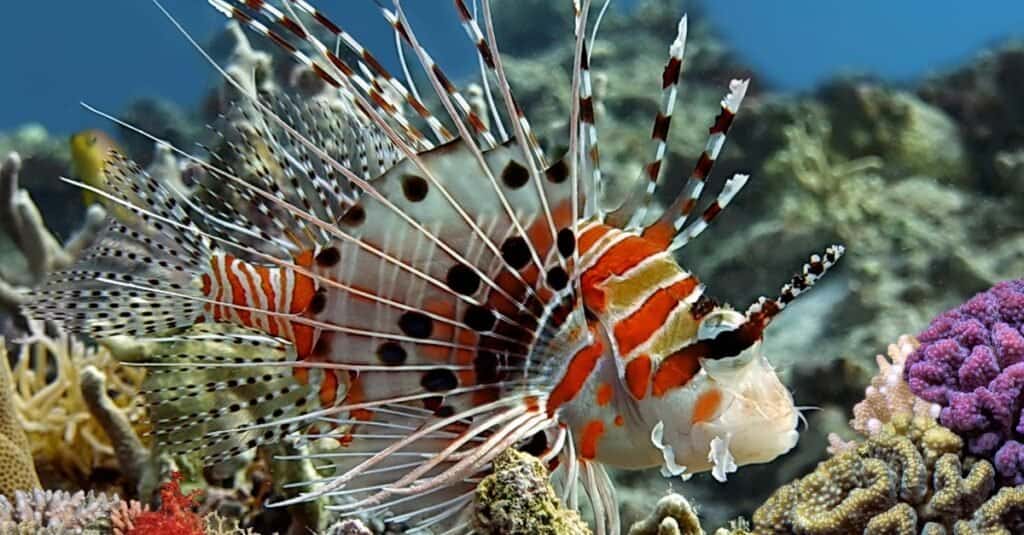
Animals That Live in Coral Reefs: Lionfish

Spotfin lionfish (Pterois antennata) on a reef. Lionfish are known for their venomous fin rays, an uncommon feature among reef-dwelling fish along the American East Coast and the Caribbean.

These carnivores aren’t all that picky about what they eat. They are capable of decimating local populations of small fish species as well as various invertebrates and mollusks. Creole fish, yellowtail snappers, and shrimp are among the many possible items on their menu.

Reproduction and Lifespan

Lionfish have astounding reproductive capabilities, which only contribute to their ecological threat as an invasive species. Even though they can live for up to 20 years, they typically reach sexual maturity in less than one year. They can reproduce every few days and continue to lay eggs throughout the entire year. Some females have been reported to release more than 2 million eggs in a single year.

Fishing and Cooking

While lionfish don’t have a strong history as a menu item for humans, this has been changing in recent years. Since there are few natural predators for lionfish, conservationists and other organizations throughout the Americas have been advocating consumption of the fish as a means of population control. While fishermen do need to be cautious of the sting from their spines, the venom does not impact the safety or taste of the meat when properly prepared.

Lionfish meat is actually considered quite suitable for regular consumption. Its flavor can be described as delicate and mild with a moist and tender texture. Its taste has been compared to that of lobster and shrimp. Preparation often involves breading the meat to keep it from falling apart, although there are plenty of viable cooking methods. However, preparation should always involve careful removal of spines and applying enough heat to neutralize any toxins.

View all 131 animals that start with L

Sources

  1. National Ocean Service / Accessed November 8, 2019
  2. Smithsonian Magazine / Accessed November 8, 2019
  3. Brittanica / Accessed November 8, 2019
  4. Sailors for the Sea / Accessed November 8, 2019
  5. Ocean Support Foundation / Accessed November 8, 2019
  6. Wikipedia / Accessed November 8, 2019

Rebecca Bales

About the Author

Rebecca Bales

Rebecca is an experienced Professional Freelancer with nearly a decade of expertise in writing SEO Content, Digital Illustrations, and Graphic Design. When not engrossed in her creative endeavors, Rebecca dedicates her time to cycling and filming her nature adventures. When not focused on her passion for creating and crafting optimized materials, she harbors a deep fascination and love for cats, jumping spiders, and pet rats.
Connect:

Thank you for reading! Have some feedback for us?


Lionfish FAQs (Frequently Asked Questions)

Lionfish spines convey venom to animals that touch them, creating an effective defense against the vast majority of predatory ocean animals. Their venom is a leading reason for their success as an invasive species since new ecosystems have few natural predators that are adapted to get around this mechanism. Their toxin can cause numerous health issues in humans, ranging from localized pain to digestive symptoms, and may cause a lethal reaction in small children or individuals with a sensitivity to the chemical.