
M
Species Profile

Macaw

Psittacidae (New World and African parrots)

Big beaks. Long tails. Loud lives.
Bildagentur Zoonar GmbH/Shutterstock.com

Macaw Distribution

Click a location to explore more animals from that region

Loading map...
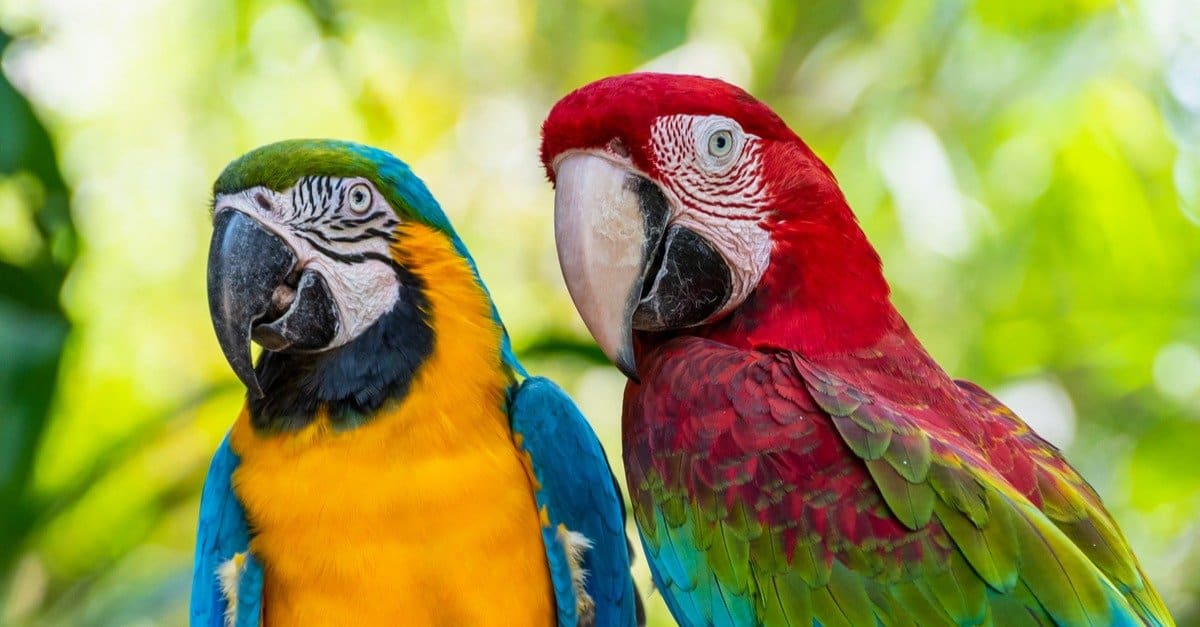
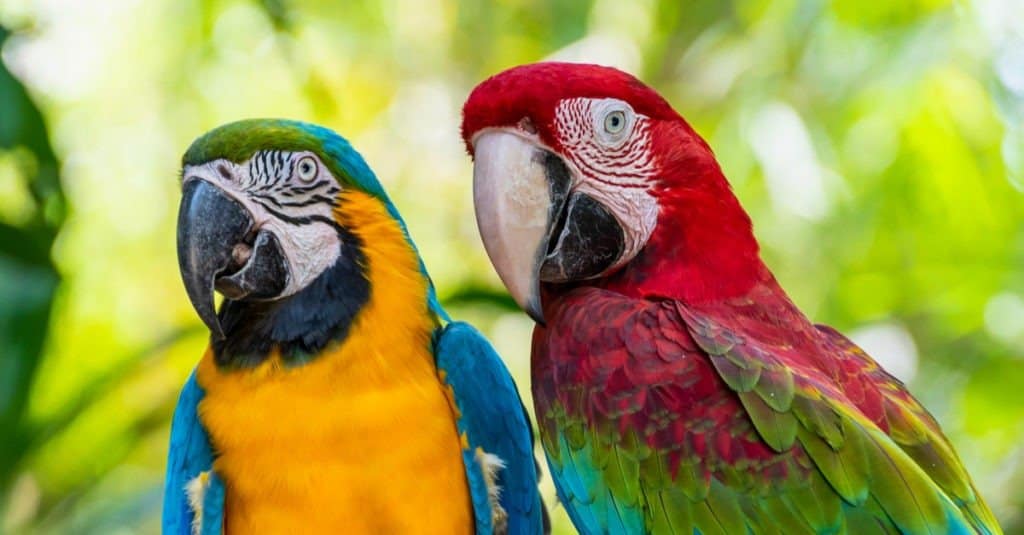
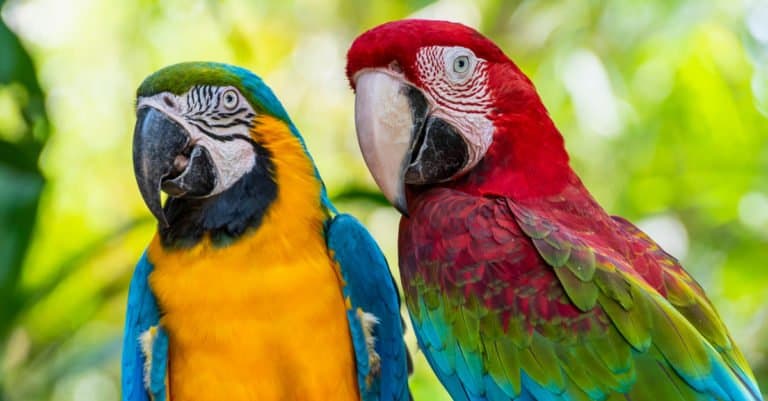
Blue and Gold Macaw or Ara Ararauna and Green Winged Macaw

At a Glance

Tribe Overview This page covers the Macaw tribe as a group. Stats below are general traits shared across the tribe.
Also Known As Guacamayo, Guacamaya, Ara, Arara, New World parrot, Large parrot
Diet Omnivore
Activity Diurnal+
Lifespan 30 years
Weight 1.7 lbs
Status Not Evaluated
Did You Know?

Size spans from "mini-macaws" ~30 cm to the ~100 cm hyacinth macaw-one of the world's longest parrots.

Scientific Classification

Tribe Overview "Macaw" is not a single species but represents an entire tribe containing multiple species.

Macaws are large, strongly beaked, long-tailed parrots best known from the Neotropics. They are highly social and vocal, often forming pairs or flocks, and many specialize on hard seeds and nuts using powerful bills and dexterous feet.

Kingdom
Animalia
Phylum
Chordata
Class
Aves
Order
Psittaciformes
Family
Psittacidae

Distinguishing Features

  • Large body size relative to many parrots
  • Very long graduated tail
  • Massive curved bill adapted for cracking nuts/seeds
  • Often bare facial skin with fine feather lines (in many species)
  • Bright plumage with bold color blocks
  • Zygodactyl feet (two toes forward, two back) for climbing and handling food

Physical Measurements

Males and females differ in size

Length
2 ft 4 in (12 in – 3 ft 3 in)
2 ft 4 in (11 in – 3 ft 3 in)
Weight
2 lbs (0 lbs – 4 lbs)
Tail Length
1 ft 2 in (6 in – 1 ft 10 in)
1 ft 2 in (5 in – 1 ft 10 in)
Top Speed
34 mph
flying

Appearance

Primary Colors
Secondary Colors
Skin Type Feathered body (plumage) with conspicuous bare facial skin; scaly legs/feet (zygodactyl) and a thick keratin bill.
Distinctive Features
  • Size range across macaws: about 30-100 cm total length; mass about 0.15-1.45 kg; wingspan roughly about 55-140 cm (smallest to largest).
  • Long, graduated tail (often > body length in large species) and broad wings suited for strong, direct flight.
  • Very large, deep, strongly hooked bill with powerful bite; adapted to cracking hard nuts and seeds.
  • Zygodactyl feet with high dexterity; frequent use of feet to hold and manipulate food.
  • Bare facial skin patch common; may show fine black feather lines, varying by species/individual.
  • Behavior/ecology generalizations: strongly social and vocal; commonly pair-bonded within flocks, with communal roosting and coordinated flight.
  • Diet generalizations: hard seeds, nuts, and fruits common; variation includes more fruit/seed emphasis, seasonal shifts, and use of clay licks in some regions.
  • Habitat generalizations: mainly lowland rainforest, river edges, and woodland; variation includes drier forests/savannas and differing degrees of canopy specialization.
  • Lifespan range: commonly ~20-50+ years; large species often 40-70+ years in captivity, generally shorter in the wild.
  • Common pressures: habitat loss/fragmentation and capture for trade; sensitivity varies by species and range size.

Did You Know?

Size spans from "mini-macaws" ~30 cm to the ~100 cm hyacinth macaw-one of the world's longest parrots.

Many macaws form long-term pair bonds and may fly, feed, and roost closely with their mate for years.

Their massive bills can crack extremely hard palm nuts; the tongue helps position food like a built-in "third hand."

Flocks may travel long distances daily between feeding areas and communal roosts, especially along rivers and forest edges.

Clay-licking (geophagy) is common in several Amazonian macaws-large gatherings can form at riverbank clay licks.

The term "macaw" mostly refers to New World parrots (often the tribe Arini); African parrots in Psittacidae aren't macaws.

Several species are conservation icons (e.g., Spix's macaw, Lear's macaw), highlighting both recovery efforts and ongoing pressures.

Unique Adaptations

  • Powerful hooked bill with strong jaw muscles: specialized for cracking hard seeds/nuts, stripping palm fruits, and even opening tough pods-degree of specialization varies by species.
  • Zygodactyl feet (two toes forward, two back): excellent grip for climbing and for manipulating food like a hand.
  • Long tail and broad wings: support efficient commuting flights between scattered feeding trees and roosts; proportions vary from small, agile "mini-macaws" to heavy, soaring large macaws.
  • Bare facial skin with fine feather lines in many species: may aid heat dissipation and displays; extent of bare skin differs among genera.
  • Robust social learning: young birds learn diet choices, safe foods, and movement routes by following experienced flock members.
  • Coloration used in signaling: bold reds, blues, greens, and yellows are common; species differ widely in patterning and may use color for mate recognition and flock communication.

Interesting Behaviors

  • Fission-fusion flocking: groups split and merge through the day; flock size varies from small family parties to large roost aggregations depending on species, season, and food supply.
  • Strong pair coordination: mates often preen each other (allopreening), stay close in flight, and give contact calls to maintain cohesion.
  • Communal roosting: many species gather at traditional roost trees or cliff/river-edge sites; roost choice can shift with disturbance or resource changes.
  • Clay-lick visits: some populations regularly eat mineral-rich clays-patterns vary by region and season and are not universal across all macaws.
  • Nut-handling "parrot dexterity": macaws commonly hold food in one foot while rotating and shaving it with the bill; techniques differ with nut type and bill size.
  • High vocal activity: loud calls help keep flocks together over long distances; call structure and "dialects" can vary among populations.
  • Nest-site competition: many nest in large tree cavities; in some areas, competition with other cavity nesters (and loss of old trees) strongly shapes breeding success.

Cultural Significance

In the Neotropics, macaws are important in Amazonia and Mesoamerica: feathers used in ceremonial clothes, headdresses, and art; birds appear in pre‑Columbian art and trade as symbols of color, life, and status. Today they help ecotourism but face habitat loss, tree removal, fragmentation, and illegal capture for the pet trade.

Myths & Legends

Maya tradition: Seven Macaw is a proud, dazzling bird-being who boasts like a false sun and moon; the Hero Twins ultimately defeat him, a story about arrogance and rightful order.

Amazonian fire-bringer tales: in several Indigenous South American traditions, a macaw appears as a keeper or thief of fire; humans gain fire through the bird's actions-stories explaining fire's origin and macaws' bright colors.

Mesoamerican associations with scarlet macaws: in traditions tied to the tropical lowlands, scarlet macaws are linked with the sun, brilliance, and powerful messengers-appearing in ceremonial narratives and iconography as beings of vivid light and voice.

Conservation Status

NE Not Evaluated (hub-level taxon; individual macaw species span multiple categories, commonly from Least Concern to Endangered/Critically Endangered, reflecting wide variation in range size, habitat dependence, and exploitation pressure).

Has not yet been evaluated against the criteria.

Population Unknown

Protected Under

  • CITES Appendix I (some macaw species)
  • CITES Appendix II (many Psittacidae taxa; international trade regulated)
  • National wildlife protection and anti-poaching laws across range states (varies by country)
  • Protected areas and Indigenous/community-managed lands providing habitat safeguards (coverage and enforcement vary)

You might be looking for:

Blue-and-yellow Macaw

22%

Ara ararauna

Large blue-and-yellow macaw widespread in northern South America; common in aviculture.

Scarlet Macaw

20%

Ara macao

Bright red macaw with yellow/blue wings; Central America and Amazon basin; iconic species.

View Profile

Green-winged Macaw

14%

Ara chloropterus

Very large red macaw with green wing coverts; Amazonian forests.

Hyacinth Macaw

13%

Anodorhynchus hyacinthinus

Largest parrot; cobalt-blue; threatened; associated with palm nuts (e.g., Pantanal).

View Profile

Red-and-green Macaw (often treated as Green-winged Macaw)

6%

Ara chloropterus

Alternative common name usage for A. chloropterus.

Spix’s Macaw

6%

Cyanopsitta spixii

Critically endangered; famous from conservation breeding and reintroduction efforts in Brazil.

View Profile

Military Macaw

5%

Ara militaris

Mainly green macaw of Mexico and northern South America; vulnerable in parts of its range.

Red-shouldered Macaw

5%

Diopsittaca nobilis

Smaller macaw often called ‘noble’ or ‘Hahn’s’ macaw in aviculture (subspecies complex).

Life Cycle

Birth 2 chicks
Lifespan 30 years

Lifespan

In the Wild
15–60 years
In Captivity
25–85 years

Reproduction

Mating System Monogamy
Social Structure Socially Monogamous
Breeding Pattern Lifelong
Fertilization Internal Fertilization
Birth Type Internal_fertilization

Behavior & Ecology

Social Flock Group: 20
Activity Diurnal, Matutinal, Vespertine
Diet Omnivore Hard nuts and large, energy-rich seeds (especially palm nuts) when available.

Temperament

Highly social; strong pair affiliation and frequent affiliative contact
Bold to cautious depending on hunting pressure and human disturbance
Curious, manipulative, and persistent when accessing hard foods
Territorial and more aggressive near nest cavities during breeding
Juveniles often more playful and gregarious than breeding adults
Can be noisy and excitable; also capable of calm, sustained social resting

Communication

loud contact calls for cohesion during flight and canopy foraging
alarm calls and mobbing screams in response to raptors or humans
pair duets/antiphonal calling, especially near roosts and nests
begging calls from chicks and fledglings; food-related calls within families
grumbles, growls, and softer chattering at close range during social contact
visual displays: wing droops, tail fanning, crest/feather raising, posture changes
allopreening and bill touching to reinforce pair and family bonds
regurgitative feeding within pairs and from parents to young
bill clicking and beak fencing during disputes; threat lunges at close range
synchronized flight movements and follow-the-leader flocking for coordination

Habitat

Biomes:
Tropical Rainforest Tropical Dry Forest Savanna Temperate Forest Temperate Grassland Wetland
Terrain:
Plains Valley Riverine Hilly Mountainous Coastal Island +1
Elevation: Up to 11482 ft 11 in

Ecological Role

Primarily seed predators and fruit/seed consumers, with many species also functioning as seed dispersers (especially for fleshy fruits) and occasional insect consumers; overall impact varies by species, habitat, and season.

Seed dispersal for many fleshy-fruited plants (variable by species and fruit type) Regulation of plant recruitment via seed predation (selectively reducing some seed cohorts) Influencing forest composition by preferential feeding on particular fruiting/seed-bearing trees Nutrient redistribution via movement between feeding sites, roosts, and clay licks Occasional suppression of some herbivorous insects through opportunistic insect consumption

Diet Details

Main Prey:
Fruits Nuts Seeds Flowers and buds
Other Foods:
Fruits Hard nuts Seeds and grains Flowers, buds and blossoms Nectar Young leaves and shoots Bark, cambium, and unripe pods Clay +2

Human Interaction

Domestication Status

Wild

Macaws (family Psittacidae; genera Ara, Anodorhynchus, Primolius, Diopsittaca, Orthopsittaca) are wild, not truly domesticated, though they can be tamed or bred in captivity. Indigenous peoples kept them for feathers, ceremonies, and trade. Many pet macaws are captive-bred, but trapping for the pet trade and habitat loss have cut populations. Many species are regulated under CITES.

Danger Level

Moderate
  • Severe bites and crushing injuries from powerful beaks (highest risk during fear, hormonal periods, or mishandling)
  • Noise exposure/hearing risk from sustained loud vocalizations
  • Allergies/asthma exacerbation from dander and feather dust (varies by species and individual bird)
  • Zoonotic disease risk (e.g., psittacosis/Chlamydia psittaci) without proper hygiene/quarantine
  • Property damage from chewing and destructive foraging behavior leading to secondary hazards (wires, toxic plants/materials)

As a Pet

Not Suitable as Pet

Legality: Laws differ by country, state and macaw species. Many are under CITES (some Appendix I, some II). Keeping often allowed only for captive-bred birds with permits, ID or bands; local rules can also restrict this.

Care Level: Expert Only

Purchase Cost: $1,000 - $25,000
Lifetime Cost: $25,000 - $120,000

Economic Value

Uses:
Companion animal/aviculture (legal trade) Ecotourism and birdwatching Cultural and ceremonial uses (historical/Indigenous; often regulated today) Conservation funding and NGO programs Illegal wildlife trade (black market) Local agriculture conflict mitigation (costs and interventions)
Products:
  • Captive-bred live birds (regulated)
  • Veterinary, boarding, grooming and training services
  • Specialized cages/aviaries and enrichment products
  • Bird-safe pelleted diets and supplemental foods
  • Educational programs and ecotourism services (guided tours, lodge revenues)

Relationships

Predators 6

Related Species 6

Blue-fronted Amazon Amazona aestiva Shared Family
Monk parakeet Myiopsitta monachus Shared Family
Sun conure Aratinga solstitialis Shared Family
Green-cheeked conure Pyrrhura molinae Shared Family
African grey parrot
African grey parrot Psittacus erithacus Shared Family
Senegal parrot
Senegal parrot Poicephalus senegalus Shared Family

Ecological Equivalents 5

Animals that fill a similar ecological role in their ecosystem

Toco toucan Ramphastos toco Shares a canopy frugivore niche in Neotropical forests and savannas; overlaps in fruiting-tree use and contributes to seed dispersal, though toucans differ in bill mechanics and diet breadth.
Keel-billed toucan
Keel-billed toucan Ramphastos sulfuratus Occupies similar forest-canopy feeding strata and uses large tree cavities. Ecological overlap is strongest where both exploit seasonal fruit crops.
Red howler monkey Alouatta seniculus Another large arboreal consumer of fruits and seeds. Overlaps in habitat and feeding trees but differs in mobility, digestion, and seed-handling outcomes.
Red-rumped agouti Dasyprocta leporina A terrestrial, habitat-level analogue that is a hard-seed and nut specialist; both influence seed fate (predation vs. dispersal) but operate in different forest layers.
Sulphur-crested cockatoo Cacatua galerita Ecological analogue outside the Americas: large, social, loud parrots that use strong bills to process hard foods and depend on tree cavities. They represent a convergent lifestyle despite belonging to different families.

Types of Macaw

17

Explore 17 recognized types of macaw

Blue-and-yellow macaw Ara ararauna
Scarlet macaw
Scarlet macaw Ara macao
Green-winged macaw Ara chloropterus
Military macaw Ara militaris
Great green macaw Ara ambiguus
Severe macaw (chestnut-fronted macaw) Ara severus
Red-fronted macaw Ara rubrogenys
Blue-throated macaw Ara glaucogularis
Hyacinth macaw
Hyacinth macaw Anodorhynchus hyacinthinus
Lear's macaw Anodorhynchus leari
Glaucous macaw Anodorhynchus glaucus
Spix's macaw
Spix's macaw Cyanopsitta spixii
Red-bellied macaw Orthopsittaca manilatus
Blue-headed macaw Primolius couloni
Illiger's macaw (blue-winged macaw) Primolius maracana
Yellow-collared macaw Primolius auricollis
Red-shouldered macaw Diopsittaca nobilis

There are approximately 17 unique species of Macaw birds in the wild and in captivity today. All these birds are part of the Psittacidae family, which translates to “true parrots.” This parrot family further splits into two subfamilies: the Psittacinae and the Arinae, or Old World and New World parrots, respectively.

Old World parrots include the Grey Parrot, the Cape Parrot, and the Senegal Parrot, which are found primarily in Africa. In contrast, New World Parrots include six genera of Macaw birds that live and roam in Mexico, Honduras, Brazil, and other nations in Central America and South America. These birds include the scarlet Macaw, the blue and gold Macaw, the green-winged Macaw, the red-shouldered, or Hahn’s, Macaw, and the harlequin Macaw.

Unlike their Old-World cousins, these all have bright feathers in varying shades of green, blue, yellow, gold, and red. While these colors are very vibrant and attractive to humans, these colors allow Macaw birds to camouflage themselves in the green leaves of the Amazon rainforest and other forests that they call home.

An Amazing Bird: 4 Macaw Facts

  • These birds are long-lived; their lifespan can reach up to 60 years or more, even in the wild.
  • They are playful birds and will use their feet, beaks, and tongues to explore new objects.
  • The Hyacinth Macaw is the largest of all flying parrot species. It can reach up to three feet long and weigh up to four pounds.
  • There are over 17 different species of this bird, many of which are at risk for extinction.
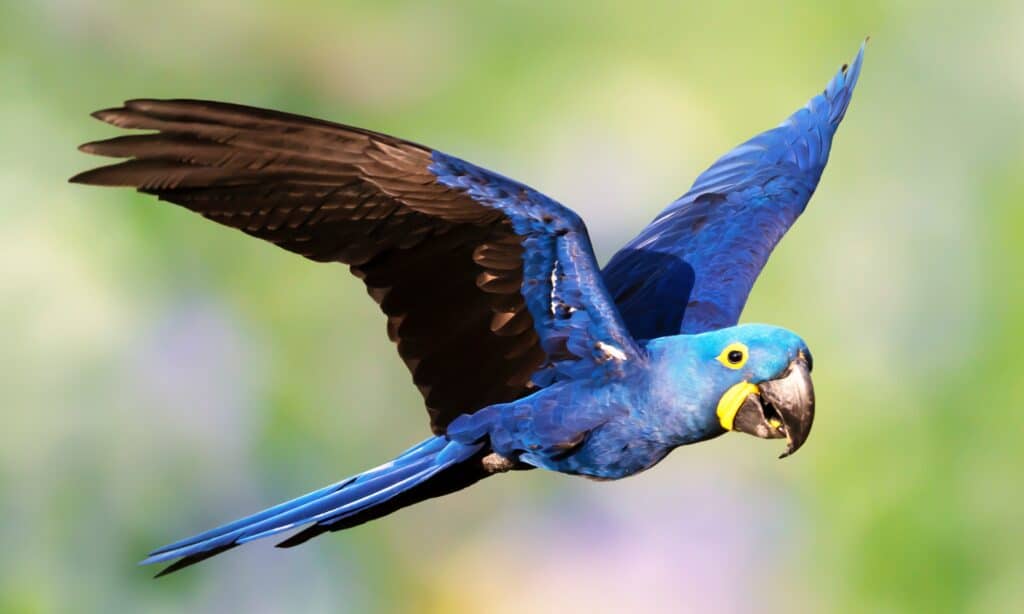
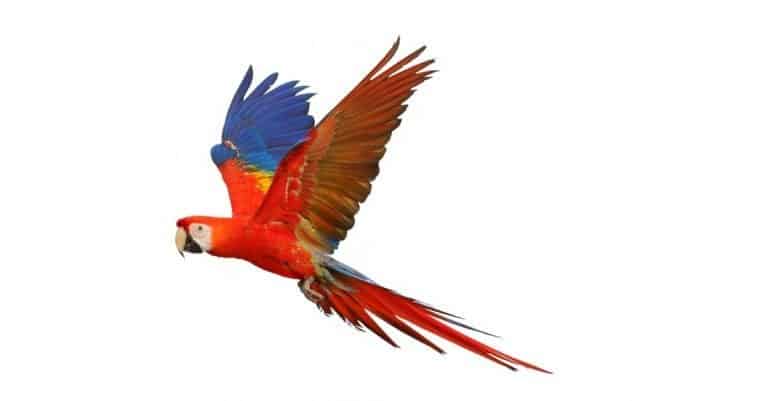
Hyacinth Macaw flying

The Hyacinth Macaw is the largest of all flying parrot species.

Where to Find Them

The blue and gold and hyacinth species of these birds are native to Central America and South America. They can be seen in the wild in such countries as Mexico, Honduras, and Brazil. Their unique feathers and bright coloring help them blend into the Amazon rainforest and their other natural habitats.

These birds generally live in monogamous pairs but also form families of up to 30 in one flock. They generally settle into the crevices within tall trees or live on cliffsides for protection. They have also been known to dig out depressions in riverbanks or other hills made from soft earth.
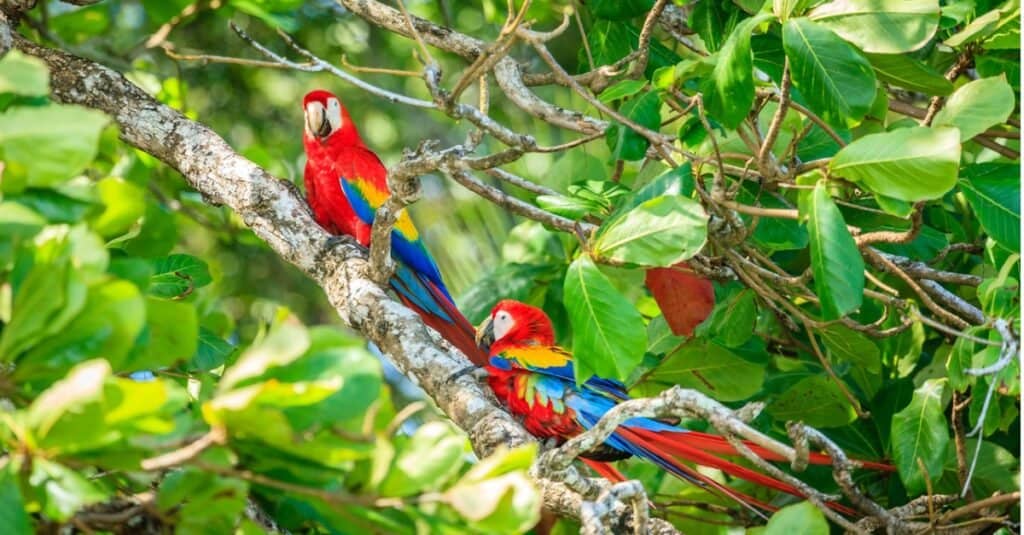
scarlet macaws sitting together in a tree

Macaws’ unique feathers and bright coloring help them blend into the Amazon rainforest and their other natural habitats.

Scientific Name

In general, all 17 of these species are found in the Psittacidae, or true parrot family. Further, they are part of the Arinae, or New World parrots, subfamily, and the Arini tribe of Macaws and parakeets.

The six genera of living Macaws are as follows:

  • Ara, which includes the scarlet (Ara macao) and the green-winged Macaws (Ara chloropterus).
  • Primolius, a genus that includes smaller, mostly green Macaws such as the blue-headed (Primolius couloni) and the yellow-collar Macaws (Primolius auricollis).
  • Orthopsittaca, the genus of which the red-bellied Macaw (Orthopsittaca manilatus) is a part.
  • Diopsittaca, a genus that contains only the red-shouldered Macaw (Diopsittaca nobilis). This species has two subspecies, including the noble Macaw and the Hahn’s Macaw.
  • Anodorhynchus, which includes the Hyacinth Macaw (Anodorhynchus hyacinthinus).
  • Cyanopsitta, a genus of which the Spix’s Macaw (Cyanopsitta spixii) is the only living member.

Due to their cheerful nature, their vibrant coloring, and their ability to learn words, many birds of this species are popular pets. This status has led breeders to create some hybrid species in captivity. For example, the harlequin is a new breed that is a cross between the blue and gold and the green-winged species. Harlequins generally have personality and coloring elements from both species.
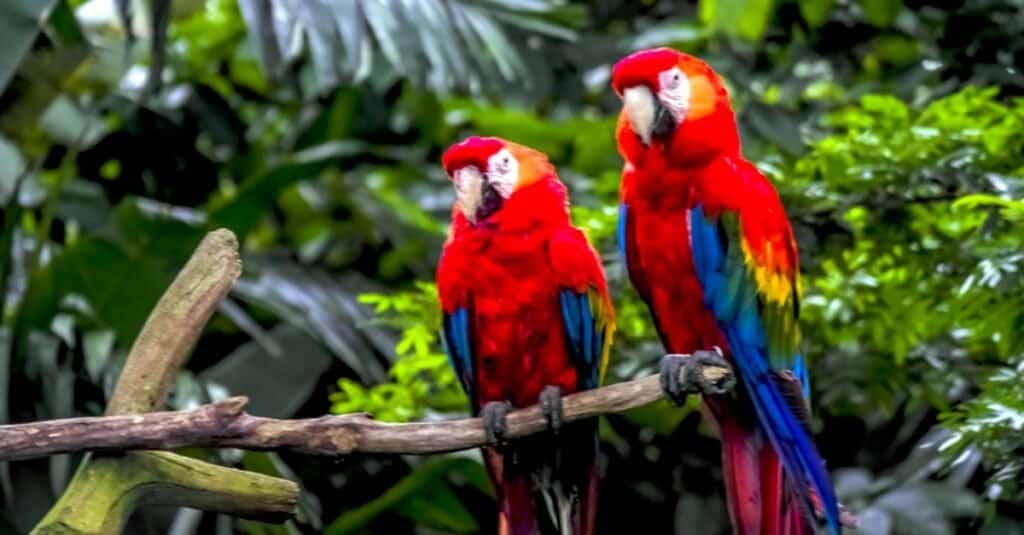
Red Animals - Scarlet Macaw

Scarlet Macaws are curious, strong-willed, and highly trainable. It is one of the most intelligent bird species in the world and is able to mimic words and sounds and learn tricks in captivity.

Size, Appearance & Behavior

These are generally playful and happy birds. Their owners have described them as clowns or jokers. They are highly social creatures both in the wild and in captivity. Many do well with families where they have more humans to interact with regularly. If they are hand-fed from an early age, then they will become attached to their owners.

In the wild, these are curious birds. Scientists and enthusiasts have observed these birds playing with new objects. They will often toss new things into the air and catch them with their beaks or their feet. They will also lick and taste the object to try and get more information about it.

While these birds bond in pairs, they also typically seek to form larger flocks of 30 to 40 or more birds. Increased numbers serve to protect themselves from humans, snakes, larger birds, jaguars, and other threats. Macaws often shriek or let out loud noises to communicate with or to warn their flock mates. In captivity, they like to learn words and will practice new vocabulary until they master it.

As you can imagine, the average size, weight, and wingspan vary widely from species to species. The largest macaws include species from the Ara genus, such as the green-winged macaw, as well as the hyacinth macaw from the Anodorhynchus genus, which has a wingspan between three and four feet and weighs up to 3.7 pounds.

The smallest species is the red-shouldered Macaw (scientific name Diopsittaca nobilis), which is also known as the mini-Macaw. These birds weigh only 5.8 ounces and are only 12 inches long. The Hahn’s Macaws and noble Macaws that make up this species are almost identical in appearance. However, the Hahn’s has a black upper mandible.
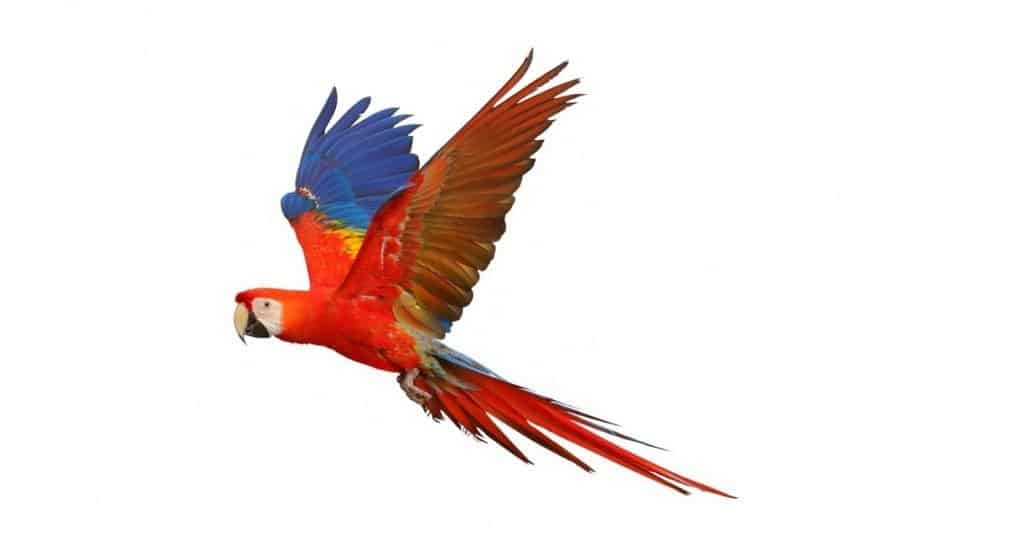
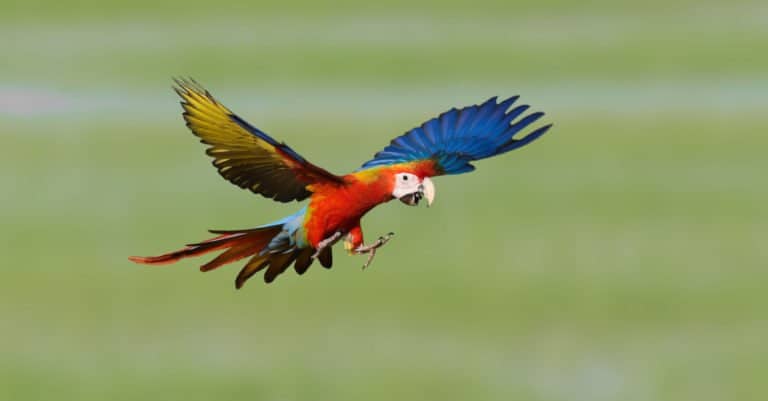
macaw bird in flight

The hyacinth Macaw has a wingspan between three and four feet and weighs up to 3.7 pounds.

Nests

These birds normally nest in the knots or crevices in tall rainforest trees. Some species also make their homes in rotted-out trees on the savannas and plains in South America. Other species will opt to nest on rocky cliffs for protection, while some will choose to dig out an area in a riverbank.
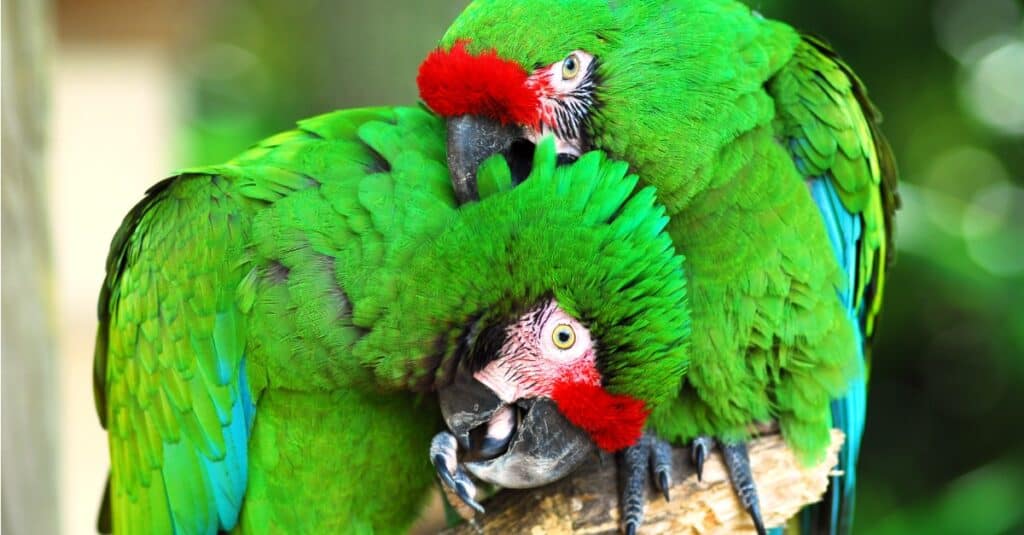
Largest Parrots - Military Macaw

Macaws normally nest in the knots or crevices in tall rainforest trees.

Diet

Macaws primarily eat fruit as their main source of nutrition. However, they do also fly to grassy areas in search of seeds or nuts. Their strong beaks are capable of cracking almonds, Brazil nuts, and other similar nuts. Nuts’ higher caloric value and fat content are important to larger species like the hyacinth Macaw.
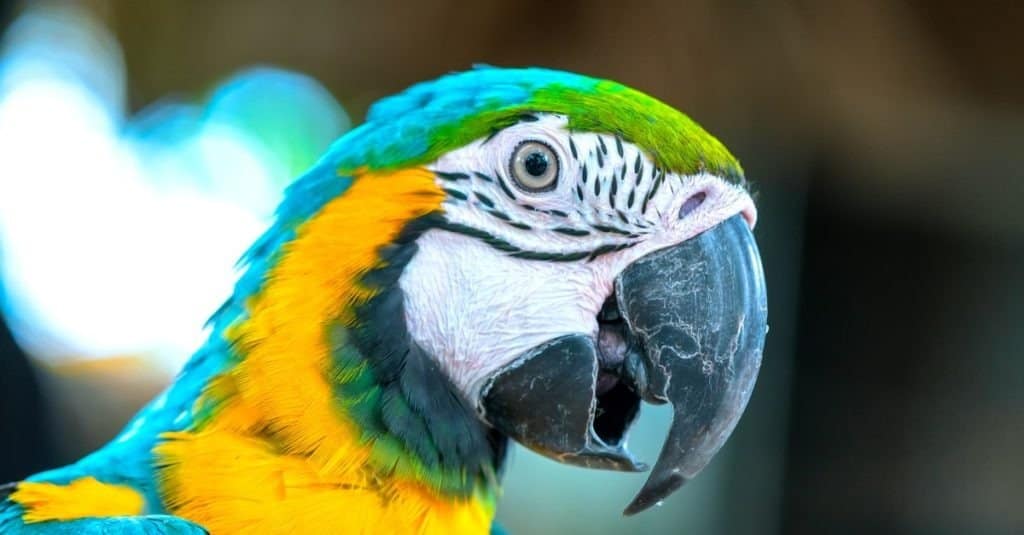
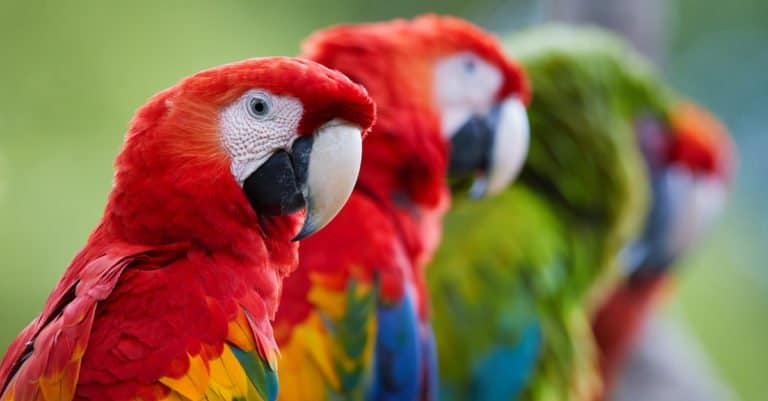
Portrait colorful Macaw parrot on a branch.
Their strong beaks are capable of cracking almonds, Brazil nuts, and other similar nuts.

Types of Macaws

There are many types of macaws, and here are several of the most popular:

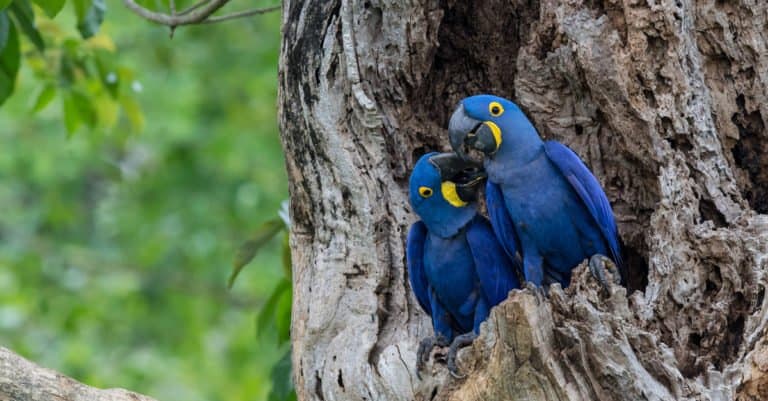
  • Hyacinth Macaw (Anodorhynchus hyacinthinus): The Hyacinth Macaws are blue with black beaks and yellow eyerings. They are found in South America. These are the largest types of this bird species, and they are notorious for being difficult to manage as a pet. Therefore, they are not suggested for pet owners who do not know exactly what they are getting themselves into.
  • Military Macaw (Ara militaris): Despite how their name sounds, the Military Macaw can be curious, social, and pleasant; however, they still need a lot of attention and are not for the novice pet owner. They have green feathers with a red head, and they can be found from Mexico south to Argentina.
  • Scarlet Macaw (Ara macao): The Scarlet Macaw is large with a strong, curved beak and brightly colored plumage. It consists of three distinctive color bands: red on the head and shoulders, yellow on the back and mid-wing feathers, and blue on the wingtips and tail. The face has a patch of black and white skin as well. They can be found in South and Central America.
  • Spix’s Macaw (Cyanopsitta spixii): The Spix’s Macaw can be identified by its striking blue plumage. The exact color of the body varies from the brilliant turquoise blue along its breast and abdomen to the duller bluish gray of the head. It also features gray skin, pale yellow eyes, and a black curved bill. From head to tail, an average member of the species measures around 22 inches; the elegant tail feathers are about as long as the rest of the body. This makes it slightly smaller than the typical macaw species. They can be found in Brazil.
  • Hahn’s Macaw (Diopsittaca nobilis): Hahn’s Macaws are the smallest of the macaws and are known for their keen intelligence. They can learn some speech from a moderate amount of training. They can be found in South America. Their stomachs are a darker green, while their tails and wings are a lighter green color. They have orange irises.
  • Hybrid Macaw: Hybrid Macaws are birds that have been bred from mixed macaw parents for their different qualities and traits. This gives them differing color patterns and temperaments. Only owners with a lot of knowledge about the species should take one of these home.
  • Severe Macaw (Ara severus): The Severe Macaw is sort of a funny bird that can be very social. They form a tight bond with owners who provide the correct amount of attention and training. They also have great speech capability. They can be found in South America and also in Panama. They have chestnut-colored heads and green feathers with red feathering where their wings meet their chests.
  • Yellow-collared Macaw (Primolius auricollis): The Yellow-collared Macaw is also known as the Golden-collared Macaw. These particular birds are known to be very intelligent, which also makes them very good at escaping and contributing to all kinds of avian mischief. While they are mostly green, they have a yellow band that wraps around their necks. They can be found in South America.

Predators and Threats

These birds are at risk from several native species in the Amazon rainforest and the forests of Central and South America. These predators include snakes, monkeys, and larger birds. Specific threats include pythons, boa constrictors, jaguars, ocelots, eagles, and falcons.
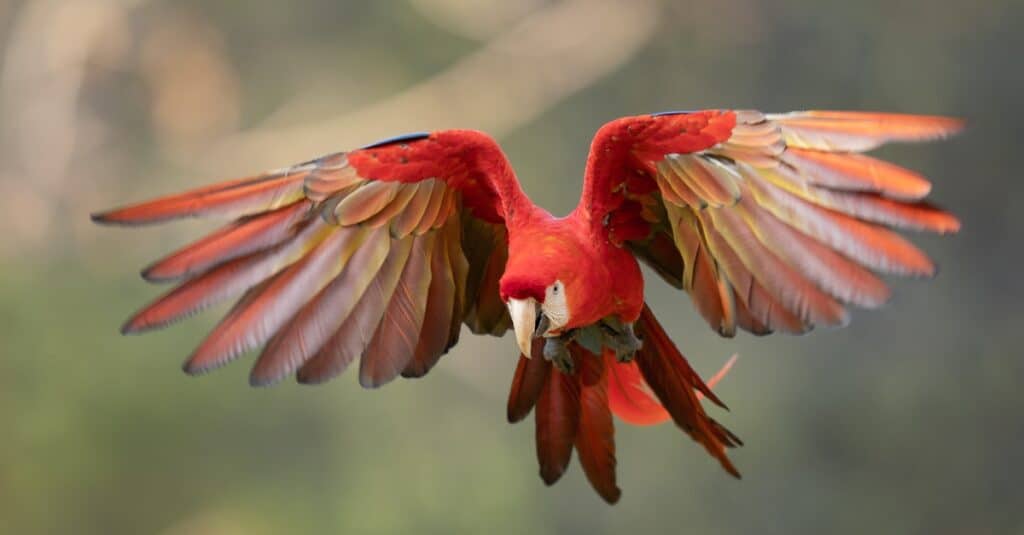
Macaws are at risk from several native species in the Amazon rainforest and the forests of Central and South America.

Reproduction, Babies, and Lifespan

Macaws reach sexual maturity between two and 10 years, depending upon the species. At that time, they will typically pair up and bond with another bird in their flock. Most clutches have between one and four eggs. If reproduction is successful, then females will generally wait two years to mate again.

The eggs normally incubate anywhere between 24 and 28 days, depending upon the type of Macaw. Chicks will typically remain in the nest under their parents’ protection for up to three months after hatching. At that point, they will often stay with their parents and siblings for a year and then head off to find their place in a flock.

A Macaw’s lifespan varies significantly based on its species. For example, the blue and gold Macaw will live up to 35 years in the wild. In comparison, the green-winged and scarlet Macaws have a lifespan between 70 and 75 years. Overall, these birds average 60 years in the wild, but some individuals do survive into their 80s and beyond.
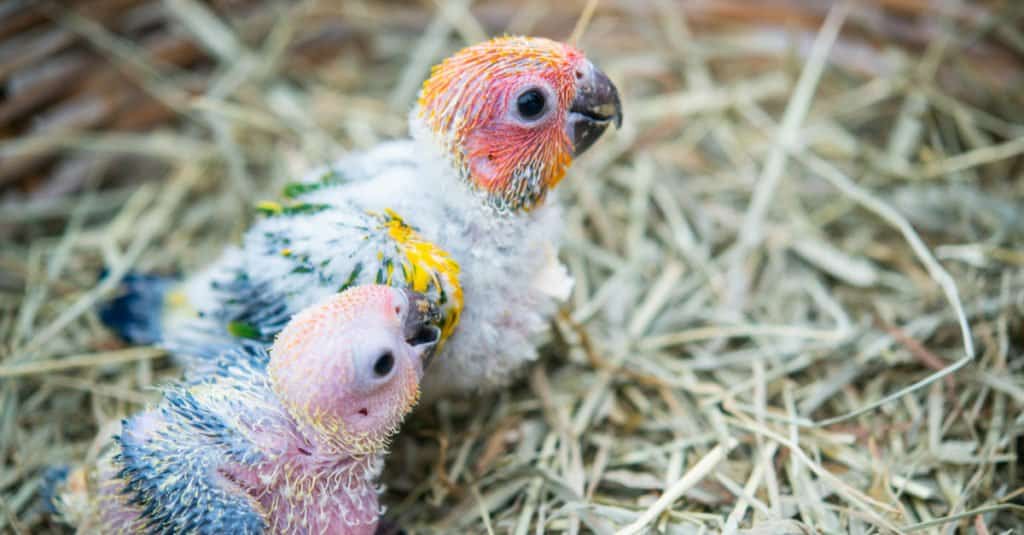
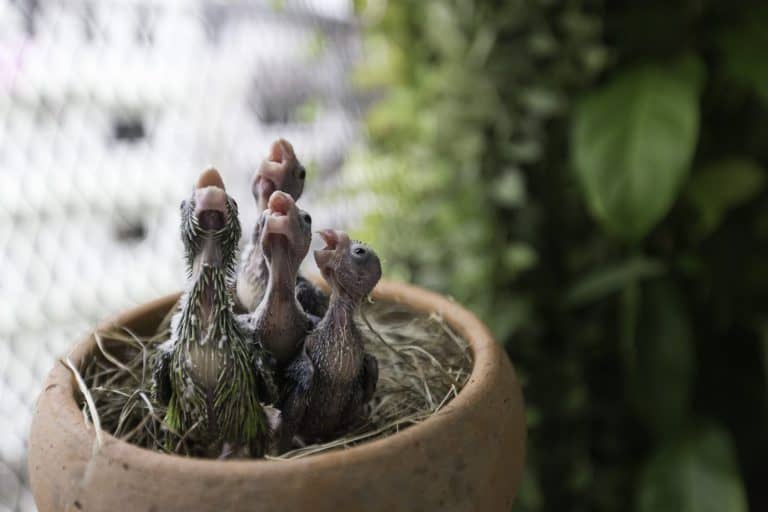
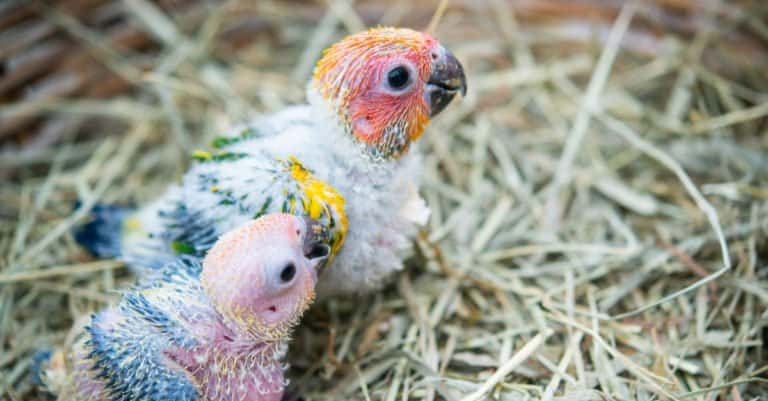
Two baby macaw birds

Chicks will typically remain in the nest under their parents’ protection for up to three months after hatching.

History and Evolution

Macaws are known for their brilliant plumage and striking color. But what makes them so colorful?

Many other types of brightly colored birds derive their coloration from their diet within their environment. Macaws are also that way. They can produce those colors through chemical pigments within their bodies and also through structural adaptations of spaced microscopic layers within their feathers.

The bright colors are part of their defensive strategy and work well because macaws tend to stay within their flocks for protection. Would-be predators have a hard time visibly discerning body shapes because of the bright plumage.

Population

The Macaw population varies significantly depending upon which species you evaluate. Some species, like the Spix Macaw, are extinct in the wild. In fact, fewer than 200 of these birds are left in captivity worldwide.

In contrast, there are believed to be at least 10,000 blue and gold Macaws left in the wild. This species is labeled as least concern because its numbers, while still declining, have remained relatively stable over the last decade.

Other species, like the hyacinth Macaw, are endangered and considered “Vulnerable“. There are only an estimated 6,500 specimens of these birds left in the wild. Similarly, there are only about 2,000 scarlet Macaws left in the world.

View all 330 animals that start with M

Sources

  1. San Diego Zoo / Accessed November 8, 2019
  2. Wikipedia / Accessed November 8, 2019
  3. Amazon Aid Foundation / Accessed November 8, 2019
  4. Sea World Parks & Enterainment / Accessed November 8, 2019
  5. National Geographic / Accessed November 8, 2019
  6. See the Wild / Accessed November 8, 2019
  7. Federal Register / Accessed November 8, 2019
Heather Ross

About the Author

Heather Ross

Heather Ross is a secondary English teacher and mother of 2 humans, 2 tuxedo cats, and a golden doodle. In between taking the kids to soccer practice and grading papers, she enjoys reading and writing about all the animals!

Thank you for reading! Have some feedback for us?


Macaw FAQs (Frequently Asked Questions)

Macaws are Omnivores, meaning they eat both plants and other animals.