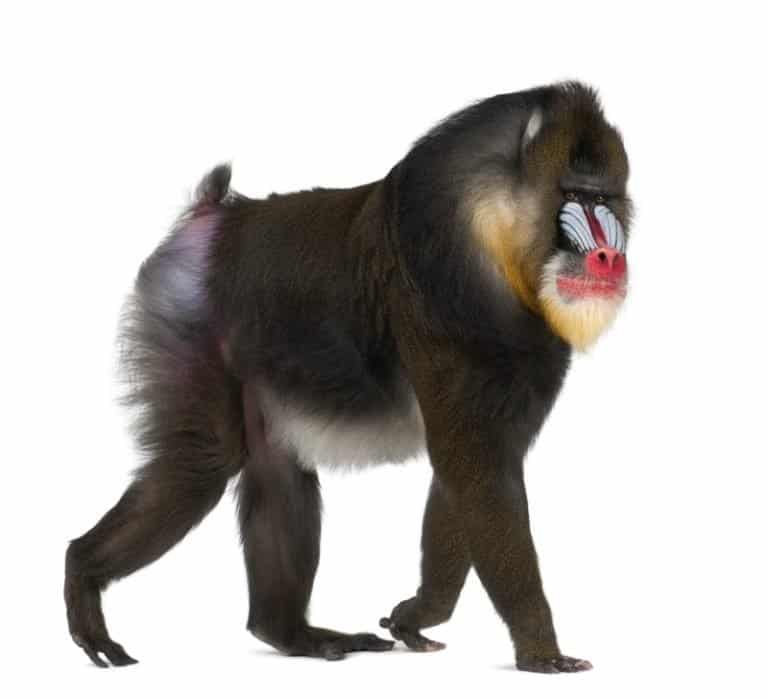


“The mandrill has a truly unique appearance that sets it apart from other primates.“
Although nearly weighing as much as an ape, the mandrill is actually a type of monkey, splitting its time between the ground and trees. Its bright facial colors and oddly shimmering fur are instant head turners for gawking tourists and zoo-goers alike. However, the spread of human civilization has threatened the survival of the species throughout its native habitat in Africa.
3 Incredible Mandrill Facts
- The mandrill is an animal that displays a vivid and striking coloration around the body that defies easy description. This feature once led Charles Darwin to write, “No other member in the whole class of mammals is colored in so extraordinary a manner as the adult male mandrills.”
- Mandrills store food in their extra-large cheek pouches.
- The character of Rafiki from The Lion King, though described as a baboon, appears to have the colorful face of the mandrill.
Scientific Name
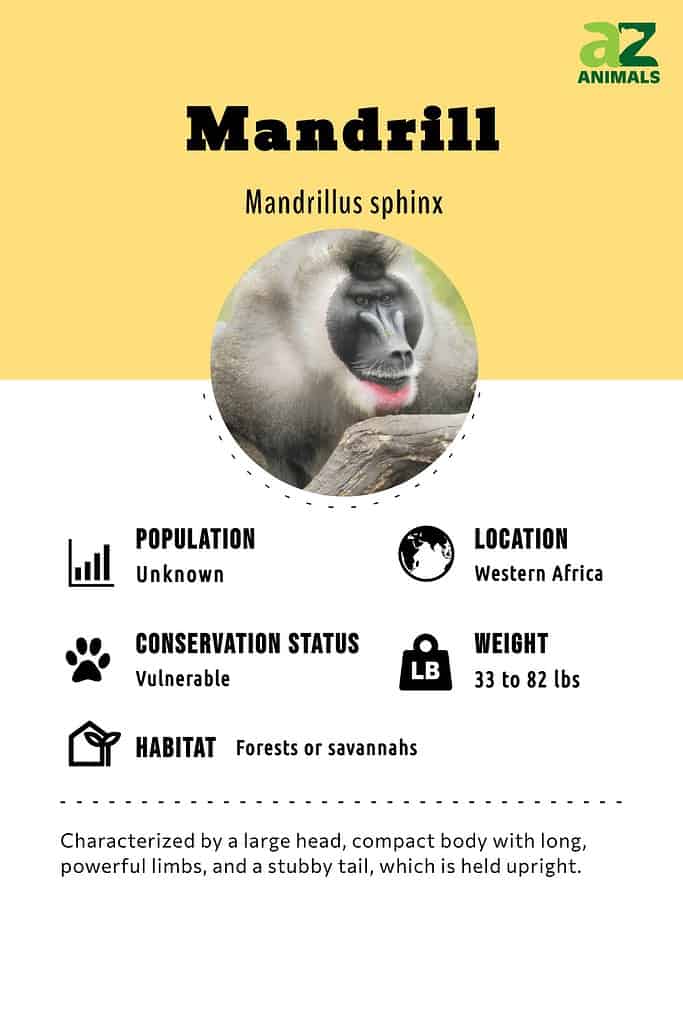
The scientific name for the mandrill is Mandrillus sphinx. It is named after the ancient Greek mythological figure that had the head of a human and the body of an animal, perhaps reflecting its strange appearance.
The mandrill is part of the family Cercopithecidae, which includes all Old World monkeys. As the name implies, the Old World monkeys live exclusively in Africa and Asia. This distinguishes them from the New World monkeys, which live in the Americas. The physical differences between them are subtle, but Old World monkeys lack a prehensile tail and have a more prominent nose.
Evolution And Origin
As a result of convergent evolution, which is when a species inhabits similar ecological areas and adapts similarly to the same selective pressures, the mandrill, as well as the drill, was originally classified as a forest baboon as they had many baboon-like traits. While the exact history of the mandrill is not well known due to a lack of fossil findings, the first monkey appears around 34 million years ago, during the Eocene era, which then led to the evolution of the Old World Monkey, in the Miocene era, 24 million years ago.
Types Of
The mandrill is only one of two living species in the genus Mandrillus sphinx. The other living species is the Mandrillus leucophaeus, commonly known as just the drill. Both of these species have similar social structures, habitats, and appearances, but the drill is also far less colorful than its vivacious sibling.
Appearance
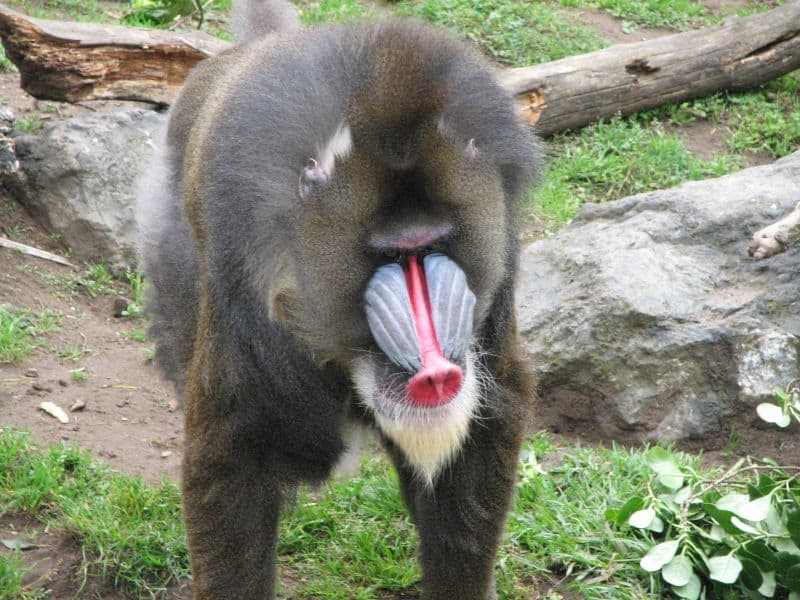
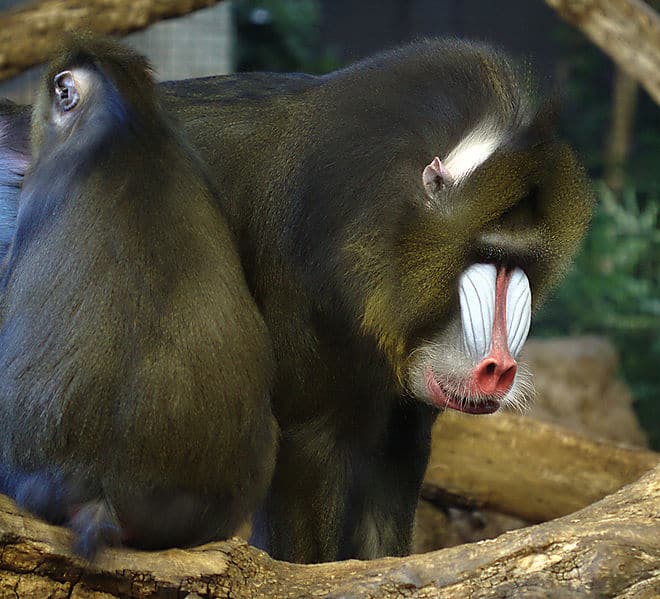
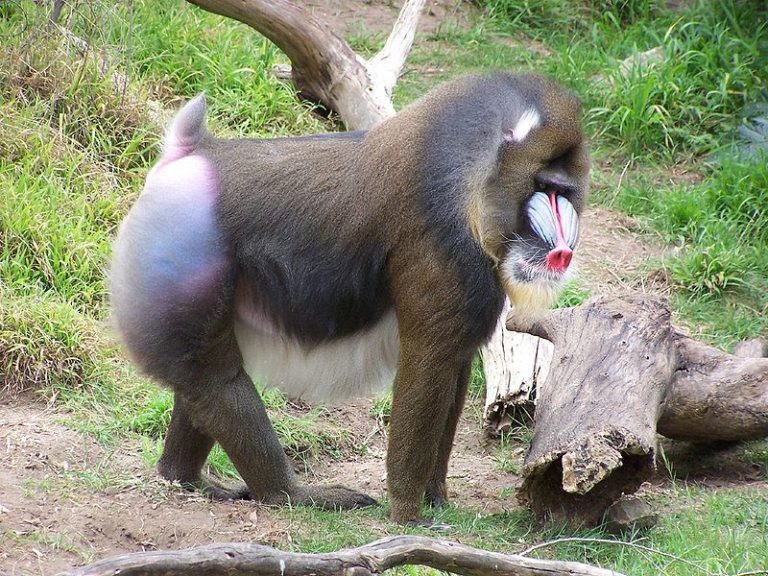
Mandrills are most recognized by the bright red markings on certain parts of their bodies.
©Just chaos / Creative Commons – Original
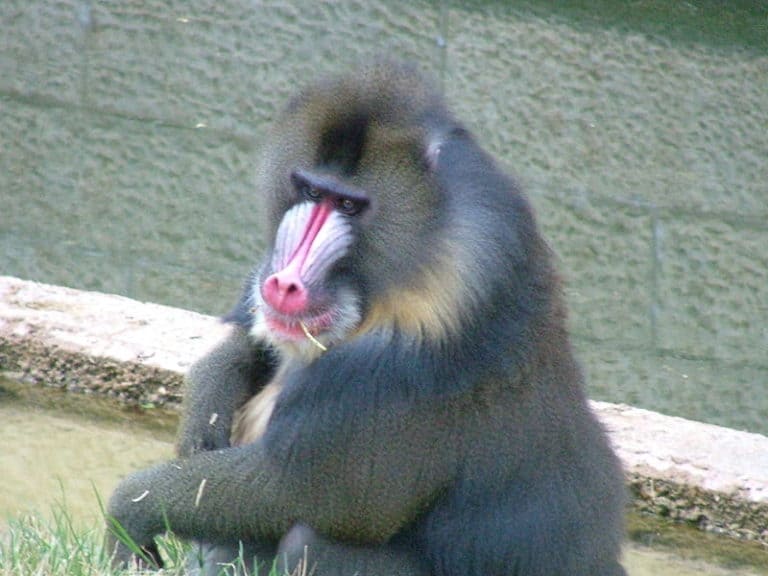
Unique in appearance, the mandrill is an animal that features a very long muzzle, a prominent brow, and a short, almost nonexistent tail. This is complemented by an elegant coat of dark green and gray fur with tufts of white hair on its stomach and a long, yellow beard. Combined with its long, muscular limbs, compact body, and enlarged head, the mandrill looks a bit unusual to the human eye, as if it was put together from various parts. But the species is actually quite adept and agile with a large range of movements and postures. Though normally walking on all four limbs, the mandrill can also sit or lay down on its rather thick rear end. It also has opposable thumbs and big toes for grasping objects and climbing trees. The animal spends part of its life above ground, jumping from branch to branch.
The most recognizable aspect of the mandrill’s appearance is the exotic markings on certain parts of the body, including the bright red ridges of the nose and mouth, light blue cheeks, and colorful rear end. These markings actually serve an important social function. When incensed or worked up, some of the colors on the body will become more intense. A display of the rump may also demonstrate submissiveness or female mating availability.
In sheer size, the mandrill is perhaps the largest of the Old World monkeys. The male of the species can weigh around 70 pounds and possibly more than 100 pounds while reaching a height of more than 30 inches. The mandrill size is about the same as a large dog. However, the female is significantly smaller than the male; it weighs only around 30 pounds. This extreme difference between the mandrill size in sexes is one of the largest among primates. Another important sexual distinction is that males tend to sport brighter colors. This has important implications for the mating behavior of the species, since brighter colors may signify dominance.
Teeth
Mandrill
©Ryan E. Poplin / Creative Commons
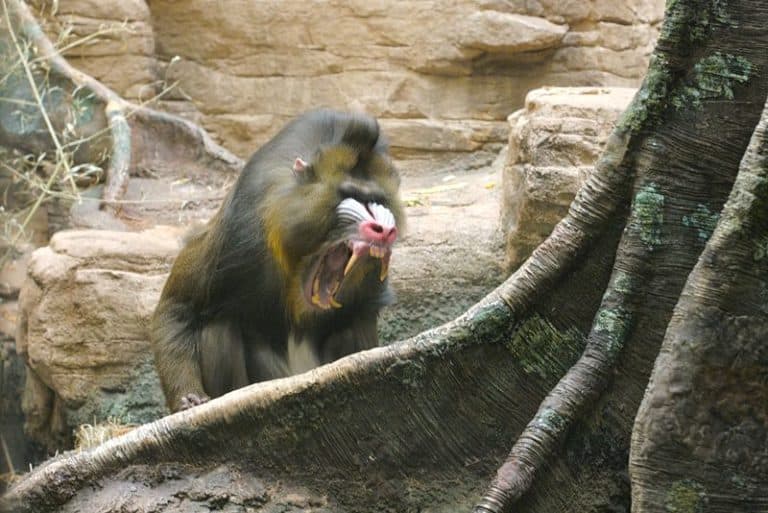
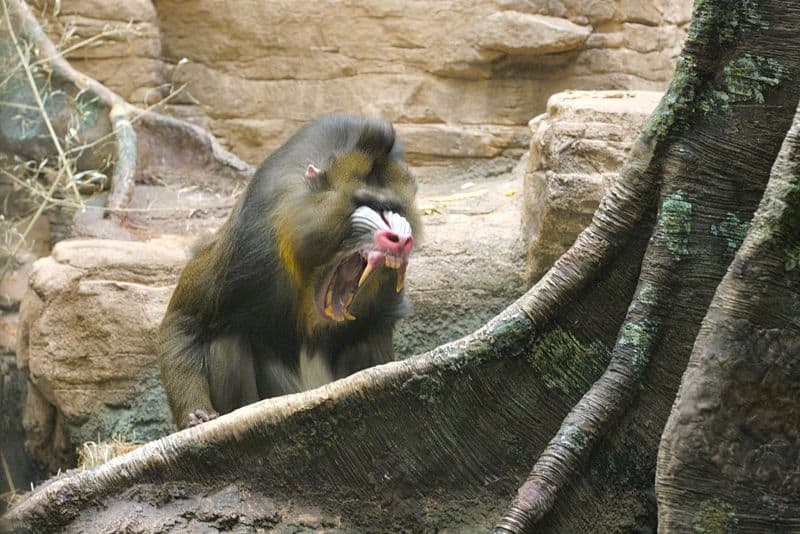
The massive canine teeth are normally hidden from view, but when the mandrill opens its mouth, they become very apparent.
Behavior
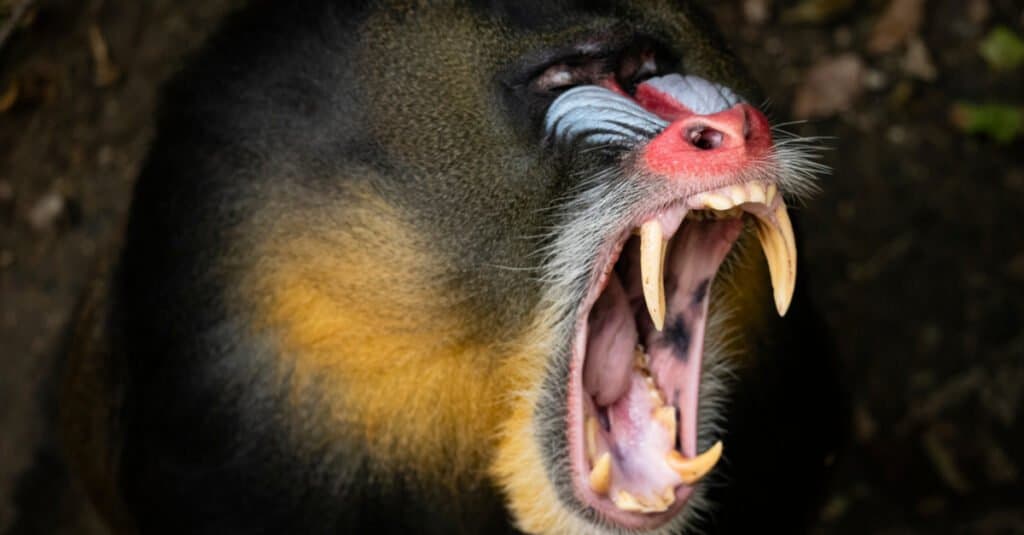
Mandrills expose their teeth as one of their communication strategies.
©Maciej Kopaniecki/Shutterstock.com
Coloration is only one aspect of the mandrill’s vast array of communication strategies. Visual signals, body posture, scent markers, and vocalizations are used to convey all sorts of information for mating, playfulness, warnings, and other behavior. For example, the exposure of teeth is one of the most common signals. It is actually a sign of friendliness and joviality rather than an aggressive action. If the mandrill does become angered, then it will visibly slap the ground with its hands and stare with intensity at its target. Grooming is another common behavior that helps to reinforce bonds between members of the group. They will also use various vocal sounds such as grunts and howls to communicate mood, especially if they lose visual contact with each other. And the presence of a scent gland on the chest enables them to signal their presence by rubbing various chemicals on objects.
Because social relations are such an important aspect of their behavior, mandrills seek safety in large numbers. A single group, known as a troop or horde, can consist of around 50 members, though some groups may join together for short periods of time. The largest group ever recorded was around 1,200. The horde has a distinct social hierarchy in which every member has a place. At the top of the hierarchy is a single dominant male who has exclusive breeding rights and the responsibility to defend the group from outside threats. The health and stability of the entire horde can often depend on the actions of the leader.
Male and female mandrills exhibit very different relationships within and to the group. Males tend to wander away from the group after reaching full maturity and will sometimes form all-male bachelor groups. The females stay within the same group of their birth, which often allows them to form strong lifelong bonds with each other.
Mandrill intelligence isn’t quite as well-explored by scientists as gorillas and chimpanzees, but observations in captivity and the wild have documented a variety of different tool uses, both to hunt for food and for grooming. Studies also suggest that they are capable of displaying decent long-term memory, facial recognition, and problem-solving.
Habitat
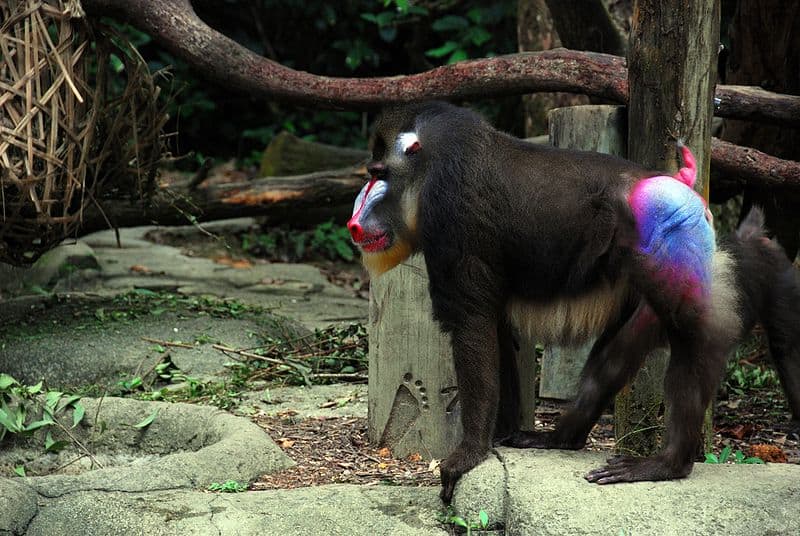
Mandrills live mostly in forests in Western Africa.
©Robert Young / Creative Commons – Original
Mandrills primarily live in the forests of Western Africa, often adjacent to rivers, wetlands, or savannahs. The animal’s main range straddles the countries of Congo, Gabon, Cameroon, and Equatorial Guinea. Although primarily adapted for a terrestrial lifestyle, this species actually gathers together at night in the trees for safety and comfort. They have a tendency to switch between different trees every night within their range.
Population
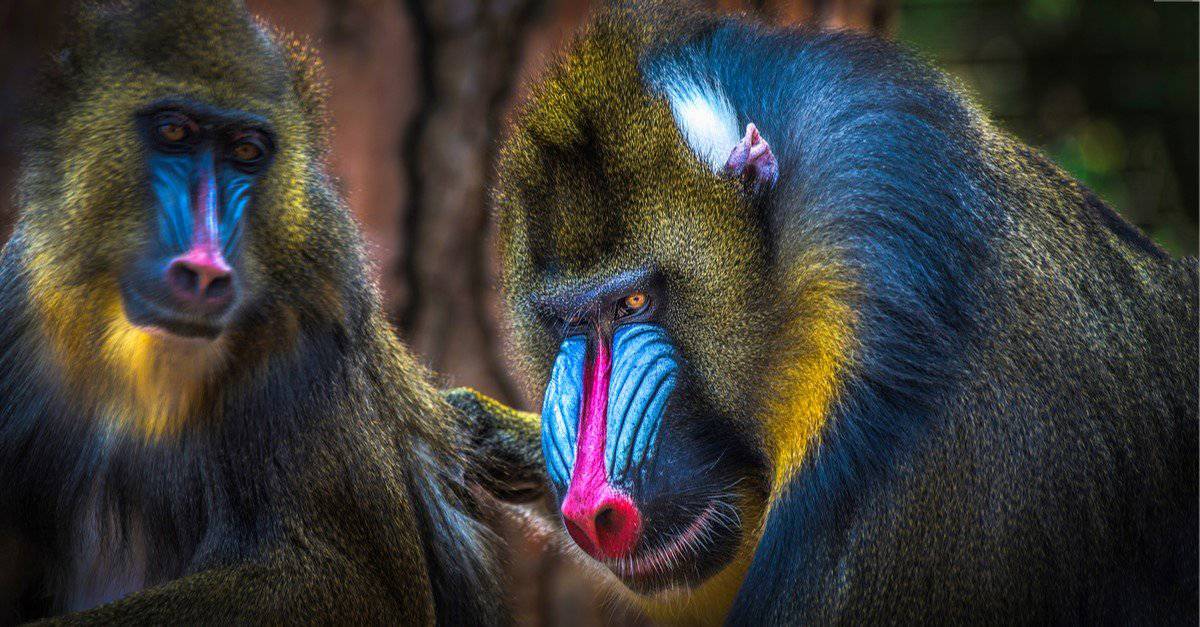
Mandrills are threatened by destruction in their habitat and hunting for their meat.
©Nikolay 007/Shutterstock.com
According to the IUCN Red List, which classifies the conservation status of many species, mandrills are currently vulnerable to extinction. Exact population numbers are unknown, but habitat destruction from agriculture, industry, and human settlements appears to be the leading cause of their slow decline. Mandrill bushmeat, or the hunting of wildlife for food, is still an ongoing practice in 21st-century Africa as well. In order to prevent their extinction, conservation efforts are focused on the institution of anti-poaching and surveillance measures to prevent excessive hunting. Conservationists also need to work with local governments to halt the decline of natural habitats. Mandrills don’t yet need emergency measures to survive, but the downward trend in numbers is worrying.
Diet
Mandrills are expert foragers that hunt both plants and small animals such as fungi, roots, seeds, fruit, insects, worms, amphibians, lizards, snakes, snails, eggs, and small mammals. Their diet is truly prolific and may include as many as a hundred different species. The mandrill sexes pursue different hunting strategies. Adult males tend to forage on the ground, whereas females and children tend to forage in the trees. The mandrills play an important ecological role by helping to disperse seeds around the local forest environment.
Predators And Threats
Because of their large size, mandrills have few natural predators in the wild, except for leopards and, of course, humans, who have traditionally hunted them for food. Mandrills may be killed by accidental contact with venomous snakes too. The size of the group alone provides plenty of protection against danger, but if an individual is cornered, then the large canine teeth also provide a suitable defense. More recently, habitat loss has been another significant danger to their continued existence.
Reproduction, Babies, And Lifespan
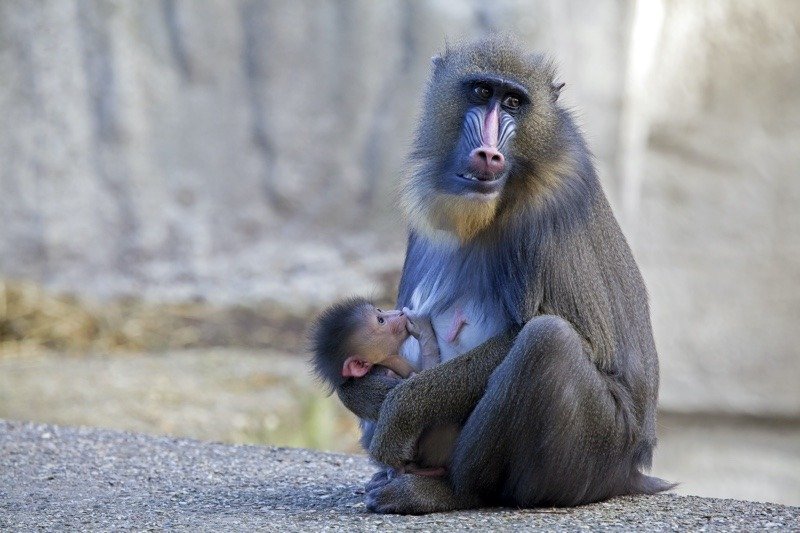
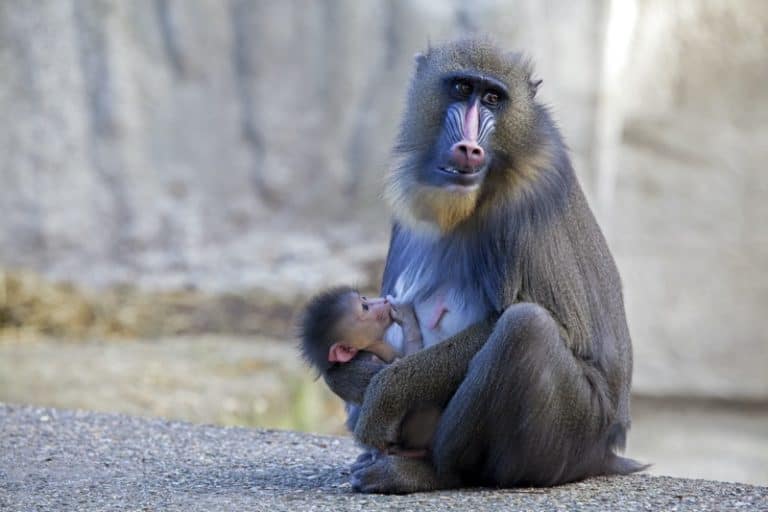
Females only birth one baby at a time, although twins have been observed in captivity.
©Edwin Butter/Shutterstock.com
Mandrills form a harem-type society in which a single male has exclusive mating rights with a group of females. In an interesting twist, the females actually choose which males they will breed with. One theory is that the females select the male with the brightest colors because the intensity of the colors is a direct reflection of the male’s testosterone level, which denotes its health and physical viability. This is an example of sexual selection in which one sex develops exaggerated features to convey information and help the opposite sex choose an appropriate mate. Another possibility is that male coloration becomes brighter only after being selected by females. Either way, male aggression does occur and sometimes turns deadly, but it’s not as pronounced as you might expect.
The timing of the breeding season varies based on food supply, but it tends to occur every two years between the months of July and October. The female will carry the young for about six months from around January to March before finally giving birth. Only one mandrill is produced at a time, while twins have only been observed in captivity. For the first two months of its life, the young mandrill sports a black coat and pink skin, which will develop into its regular coat over the ensuing months and years. The mother provides the vast majority of the protection, feeding, and grooming, while the father contributes very little directly but may help indirectly by protecting the group.
After achieving independence, the young mandrill must find food on its own and work its way through the ranks of the group hierarchy. A female mandrill will reach sexual maturity after a minimum of four years. Males, on the other hand, take a full nine years to reach sexual maturity. Mandrills typically live more than 20 years in the wild. The highest lifespan ever recorded was 46 years in captivity.
In The Zoo
Mandrills are a regular fixture at the San Diego Zoo. The first pair of mandrills, Peter and Suzy, arrived in 1923 but never reproduced with each other. The zoo later established a breeding program in 1938 and maintained a consistence presence of mandrills ever since, even welcoming a new child in 2016. Mandrills are also a regular sight at the Denver Zoo, the San Francisco Zoo, and the Columbus Zoo and Aquarium.
Mandrill Pictures
View all of our Mandrill pictures in the gallery.

Edwin Butter/Shutterstock.com