





Quick Take
- Reaching 600 pounds and a 30-foot span remains the peak Giant Pacific octopus achievement.
- The Blue-ringed genus induces a 15-hour paralysis using a specific neurotoxin constraint.
- New Avalon Peninsula fossils surprisingly suggest cephalopods existed 30 million years earlier than assumed.
- The hectocotylus transfer is necessary for reproduction but results in immediate biological senescence.
With the highest brain-to-body-mass ratios of all invertebrates — higher even than those of some vertebrates — the octopus is regarded as the smartest of all invertebrate animals. These cephalopods are intelligent enough to engage in deceitful activities, including pretending to be “moving rocks” to outwit predators. More than 300 species of octopus exist, and they are mostly found in tropical and temperate seas around the world. Octopuses are animals that have existed for many millennia; the first known octopus fossil, Pohlsepia, is believed to have lived more than 296 million years ago.

5 Amazing Octopus Facts
- Some species of octopus engage in what is known as the “moving rock” trick. An octopus may slowly inch its way across open space, allowing them to mimic the appearance of a rock. They do so at the same speed as the surrounding water, creating the illusion that they aren’t moving at all. This allows them to essentially move while in plain sight of predators.
- Maze and problem-solving experiments have suggested that octopuses have both short- and long-term memory capabilities. They can find their way back to their dens without any trouble, even after traveling far distances.
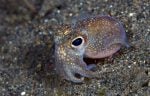
- The deepest living genus of octopus is known as the dumbo octopus. Although it is very small, it lives roughly 13,100 feet below the surface of the water.
- Thanks to their highly developed pigment-bearing cells, octopuses are animals that can change the color of their skin significantly and very quickly. This camouflaging is a common defense tactic that is used to help octopuses to evade predators.
- Contrary to popular belief, the plural form of the word octopus is octopuses — not octopi. However, the term octopi is popularly used to describe more than one octopus.
Classification and Scientific Name
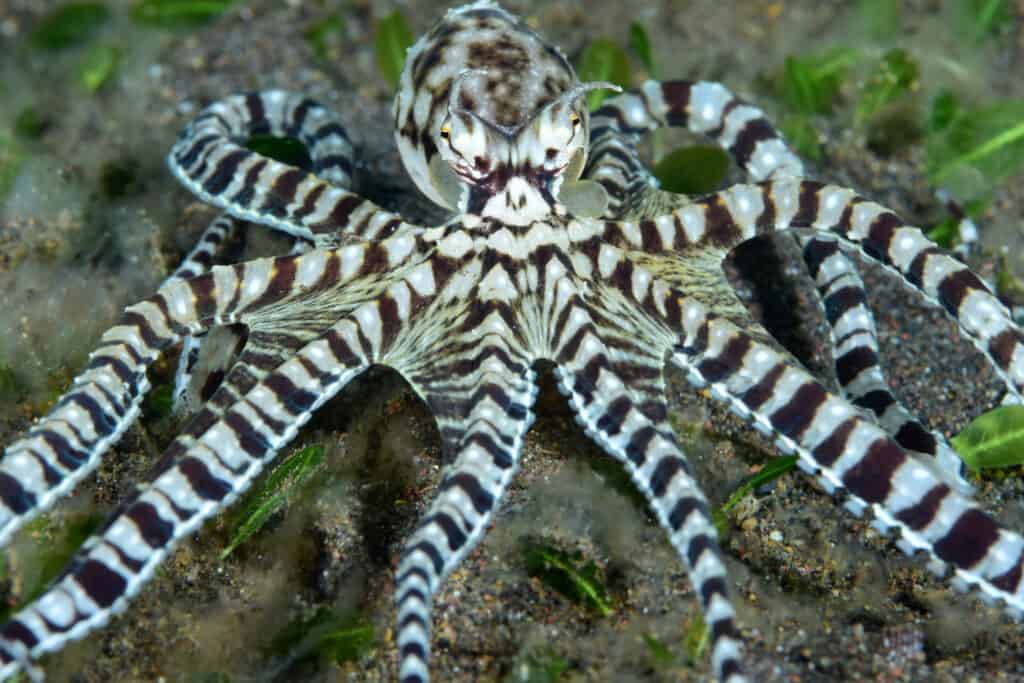
This Latin term Octopus vulgaris is derived from the Ancient Greek words okto, which means “eight,” and pous, which means “foot.”
©DiveIvanov/Shutterstock.com
Octopuses belong to the Mollusca order. They fall under the classification of Cephalopoda and the order Octopoda. The term Octopoda was first coined by English biologist William Elford Leach in 1818.
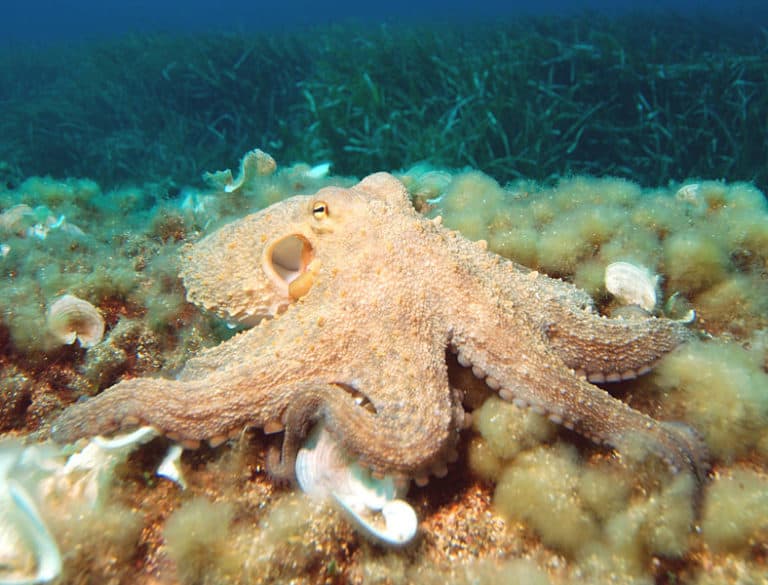
The scientific name for the common octopus is Octopus vulgaris. This Latin term is derived from a couple of Ancient Greek words — okto, which means “eight,” and pous, which means “foot.” Therefore, the term “octopus” means “eight feet,” which reflects the fact that these creatures have eight “feet,” which are more commonly referred to as arms.
Evolution of the Octopus
Some fossils were recently discovered in the Avalon Peninsula, Newfoundland, and scientists believe them to be cephalopods. These fossils date back approximately 522 million years, providing the possibility that cephalopods are 30 million years older than originally believed.
Either way, these ocean animals are some of the oldest in the world. Their evolution is thought to have begun in the late Cambrian Era, based on fossils of nautiloids that have been studied, found in areas of China, Kazakhstan, and even Texas. But if these recent fossils are verified as being cephalopods, the date would be pushed back to the early Cambrian Era.
During the Ordovician period, cephalopods diversified and eventually dominated the seas during the Paleozoic and Mesozoic seas. Their habitat was in more shallow waters, and they are believed to have been predatory creatures at the top of the food chain.
Species: The Types of Octopus
There are 13 families in the order Octopoda, which contains approximately 300 species. Octopuses are incredibly diverse, with some species living in the deep sea, some species reaching 30 feet, and others not even reaching an inch!
Below are some of the most fascinating species of octopus.
Giant Pacific Octopus (Enteroctopus dofleini)
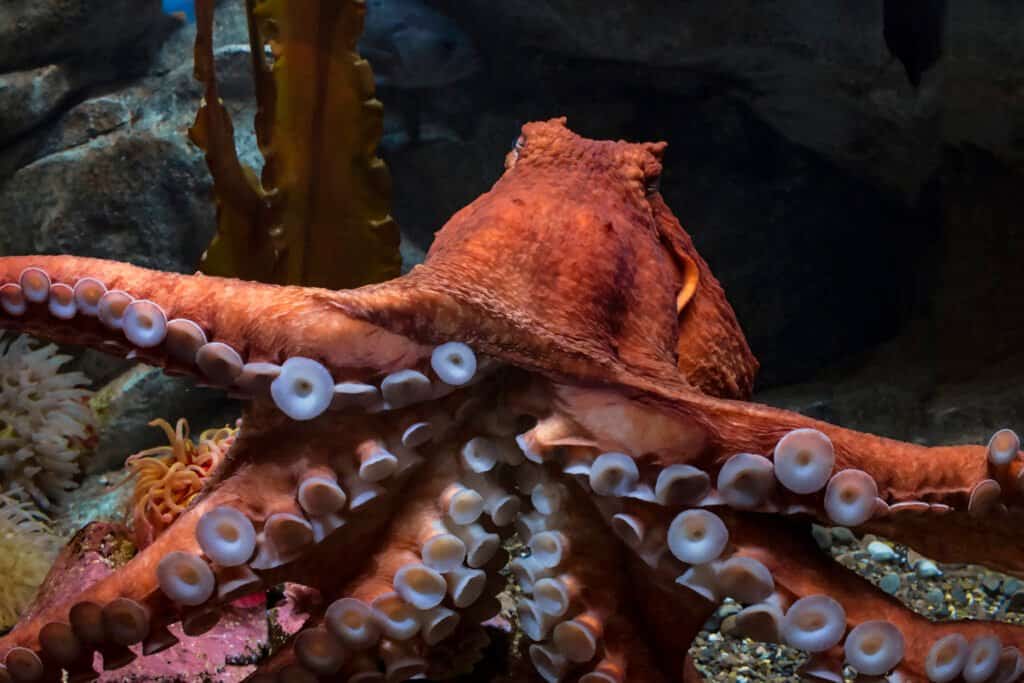
The largest Giant Pacific octopus ever found weighed 600 pounds and had a 30-foot arm span.
©karen crewe/Shutterstock.com
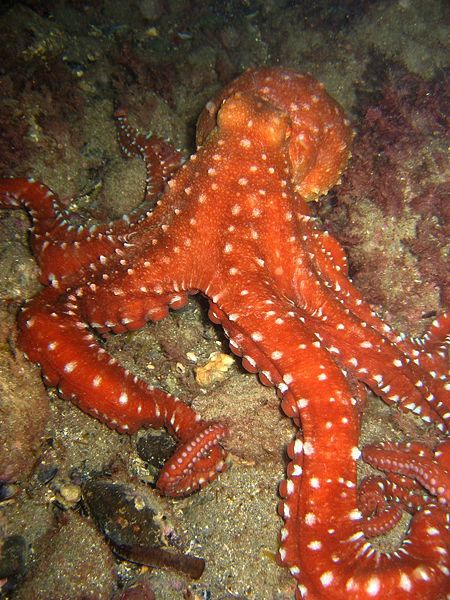
Octopuses don’t get bigger than the giant Pacific octopus. The largest specimen ever weighed a reported 600 pounds and had an arm span of 30 feet! The species ranges along the Pacific’s “ring of fire”, stretching from the Gulf of California into Alaska, and down past Japan and into China’s coastline.
Flapjack Octopus (Opisthoteuthis californiana)
Flapjack octopuses are a species of umbrella octopus, which means they have a web of skin between tentacles. In the case of the flapjack octopus, it gets its name because its webbing connects outward to the ends of its tentacles, giving the bottom of its body an almost ‘flapjack appearance.’ Flapjack octopuses live up to a mile below the ocean’s surface, and little is known of their behavior. Popularity in flapjack octopuses soared after the character Pearl in Finding Nemo was modeled after the species.
Atlantic Pygmy Octopus (Octopus joubini)
The Atlantic pygmy octopus’s arms reach just under 4″, making it one of the smaller species of octopus. They’re especially abundant in the Gulf of Mexico and are known for their ability to rapidly change colors to mimic their surroundings.
Blue-ringed Octopus
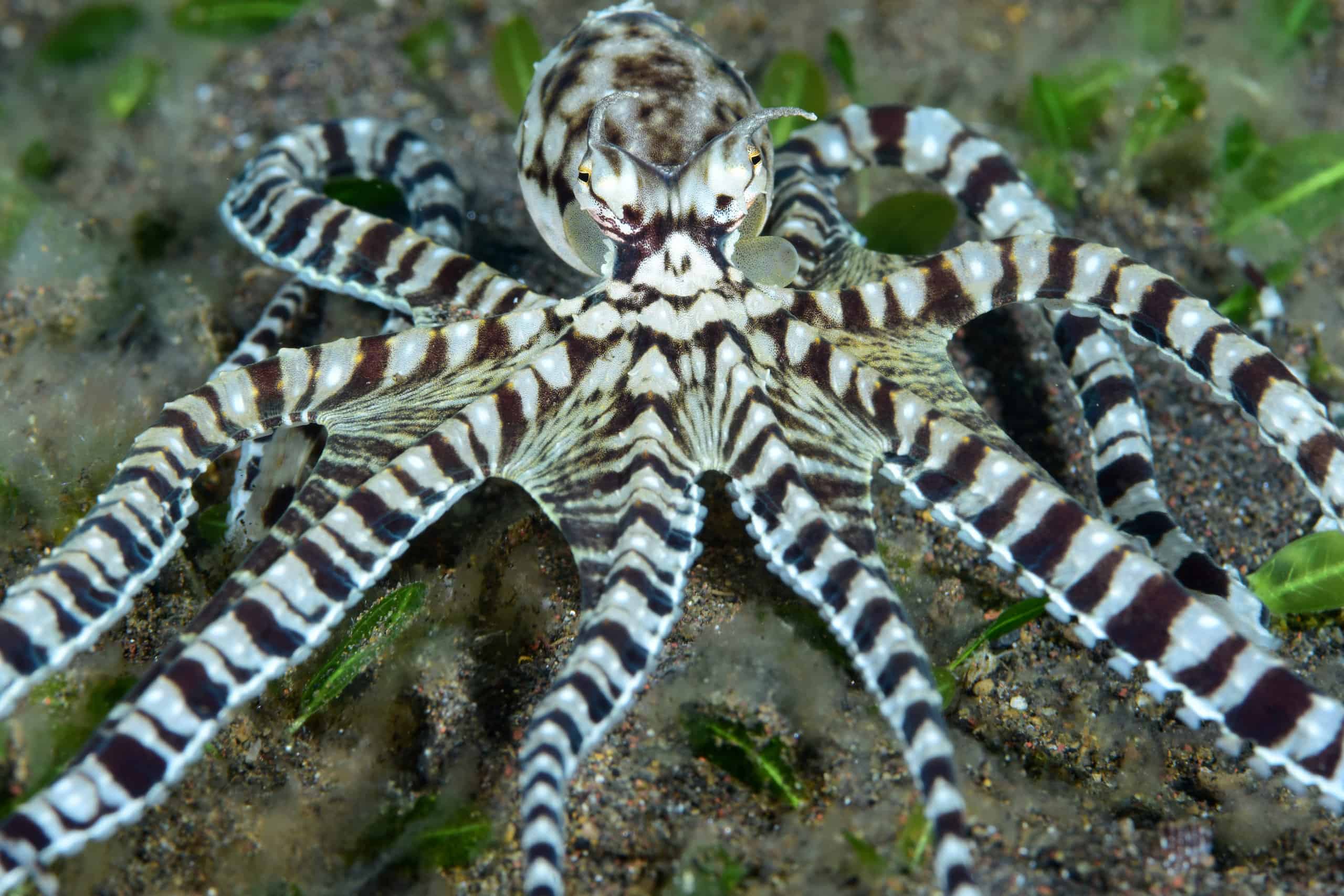
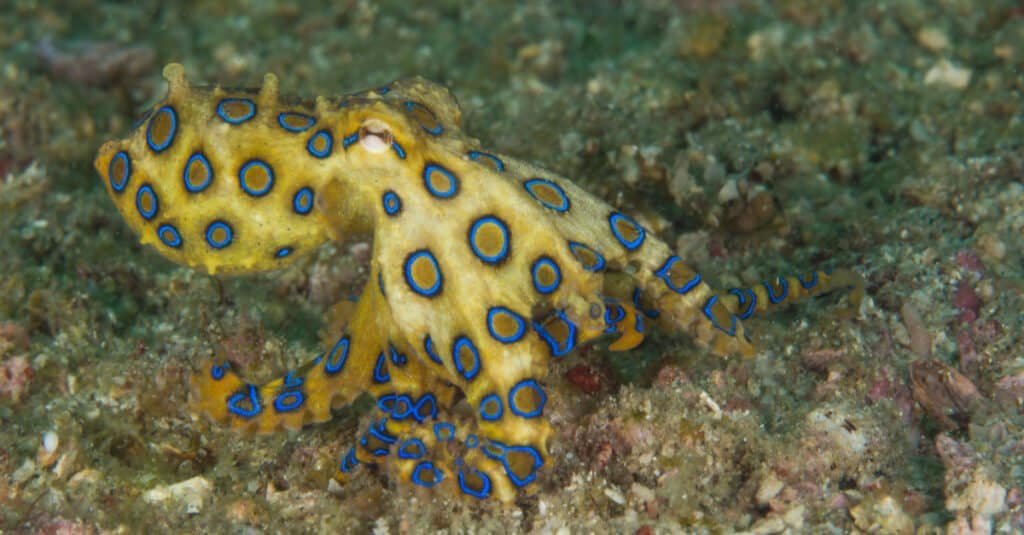
The blue-ringed octopus isn’t a species, but rather a genus. The genus is notable for its color, with blue rings across its body that are extremely bright. In addition, blue-ringed octopus species are extremely venomous, and their bite contains the neurotoxin tetrodotoxin. There is no known antidote to this toxin, which causes temporary paralysis. If bitten by a blue-ringed octopus, the paralysis lasts approximately 15 hours and may require intubation for survival. However, the blue-ringed octopus is not aggressive, and a 2008 study found just 3 known fatalities linked to the species.
Appearance and Behavior
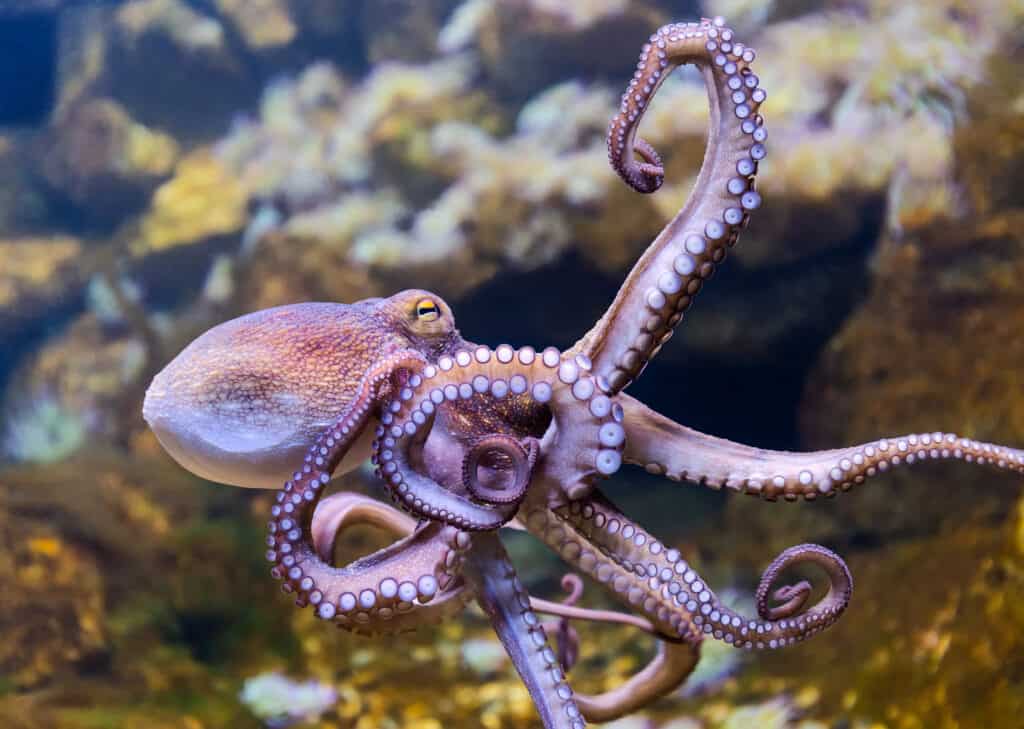
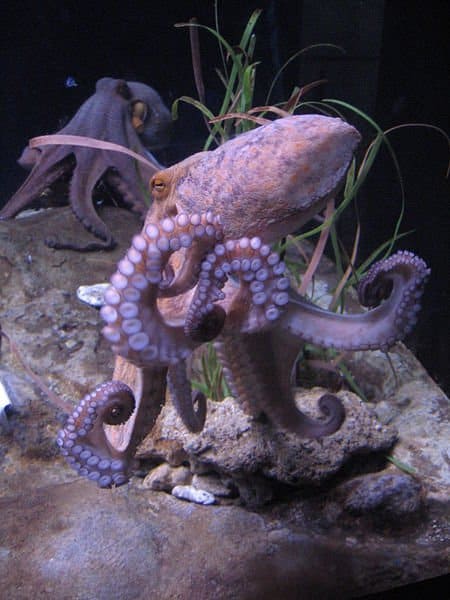
Octopuses have eight contractile arms, with each one containing two rows of fleshy suckers.
©Henner Damke/Shutterstock.com
An octopus is defined as any eight-armed cephalopod mollusk of the order Octopoda. True octopuses belong to the genus Octopus, a massive group of broadly distributed shallow-water cephalopods. Squids and cuttlefish are related cephalopods but belong to different genera.
The typical octopus has a saccular body, which means that its head is only slightly defined from its body. They have eight contractile arms, and each one contains two rows of fleshy suckers. Their arms are joined at their bases by a web of tissue that’s known as a skirt; their mouth is found in the center of the skirt and doesn’t contain teeth, but instead has a pair of sharp beaks and a file-like organ known as a radula.
Octopuses’ soft bodies can change shape rapidly, allowing them to squeeze through very small spaces. Even the largest species of octopus can pass through openings as small as 1 inch in diameter. They also have a hollow, bulbous mantle that is fused to the back of their head; it contains most of the creature’s vital organs, including its gills, and it connects to the exterior through a funnel or siphon. Their large, complex eyes are located on the top of their head.
As noted earlier, the largest specimen of the giant Pacific octopus on record had a 30-foot arm span and weighed approximately 600 pounds. The smallest octopus species weigh less than one gram and measure only about 1 inch in length.
Octopuses engage in respiration by drawing water into their mantles through an aperture. It then passes through the gills before being expelled by the siphon. Octopuses’ thin skin also absorbs some oxygen from the water. Another distinctive feature is that octopuses have three hearts. Two hearts pump blood through their gills while a third pumps blood throughout the body of octopuses.
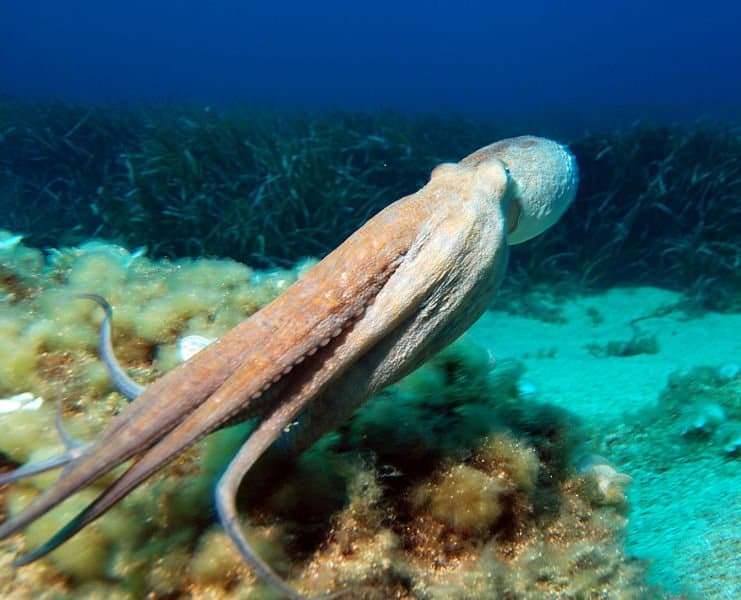
These creatures move in a variety of ways. They crawl using their front two arms, using the other six for foraging. They swim by moving water through their siphons; when doing so, their arms trail behind them. They can also move backwards rapidly by ejecting jets of water from their siphons.
Octopuses are also known for ejecting ink. They do this to evade predators; the cloud of ink, which is black in color, masks them so that they can move away quickly. In some species, the ink contains a venom that paralyzes the sensory organs of the attacker. Only species within the blue-ringed octopus genus (Hapalochlaena) are known to be dangerously venomous to humans.
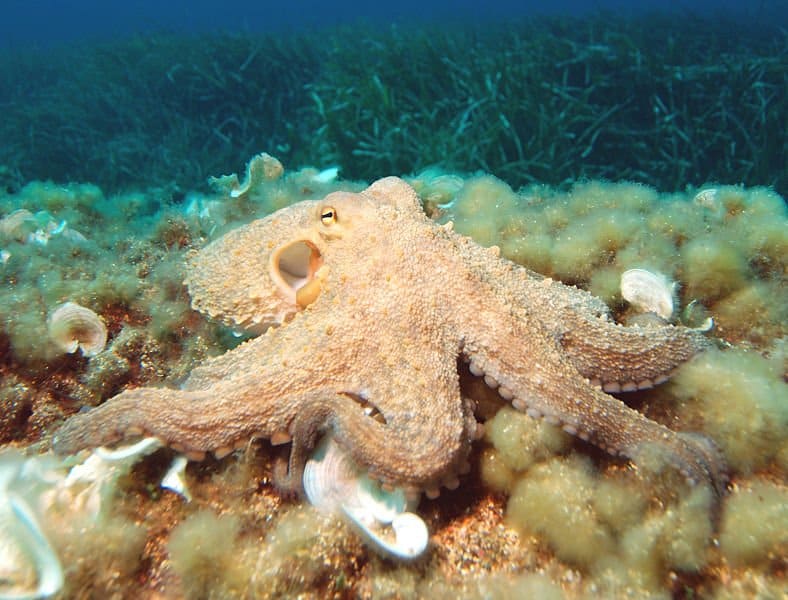
Octopuses have an excellent sense of touch and can taste whatever they touch with the chemoreceptors on their suction cups.
©albert kok, CC BY-SA 3.0, via Wikimedia Commons – Original / License
Most octopuses are solitary and spend roughly 40 percent of their time hiding in dens. However, some are social and may live in groups of up to 40 other individuals. They are not territorial, but they typically stay within a defined home range. They aren’t migratory, so they spend their whole lives in the same general area.
Octopuses also have an excellent sense of touch. Thanks to chemoreceptors on their suction cups, they can taste whatever they touch. Their skin also contains highly developed pigment-bearing cells called chromatophores that allow them to change the color, opacity, and even reflectivity of their skin quickly.
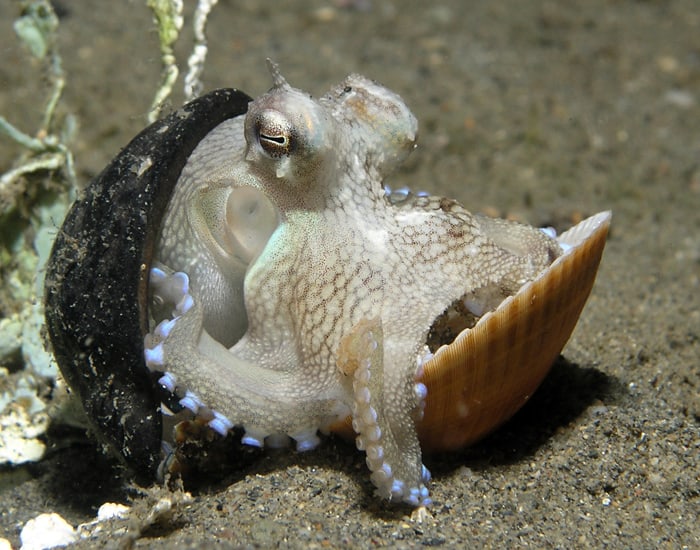
Finally, octopuses are the most intelligent of all invertebrate animals. The veined octopus, Amphioctopus marginatus, was observed in 2009 excavating coconut half shells from the ocean floor and using them as part of its den. This was the first documented use of tools by an invertebrate and is further evidence of how intelligent these creatures are.
Habitat
Various species of octopus are found in places like coral reefs, seabeds, and pelagic waters.
©JumKit/Shutterstock.com
The common octopus, Octopus vulgaris, primarily lives in tropical and temperate seas around the world. These creatures typically live in dens that are found in holes or crevices along the rocky bottom of the sea, which is in line with their retiring and secretive nature. Various species of octopus are found in places like coral reefs, seabeds, and pelagic waters. However, some are found in intertidal zones, and others are found in abyssal depths. The dumbo octopus, for example, lives an average of 13,100 feet below the surface.
Do Octopuses Make Good Pets?
Octopuses have become increasingly popular pets for aquarium enthusiasts. However, it needs to be noted that they’re only for experienced hobbyists. There are several challenges for keeping octopuses in tanks that include needing large tanks, feeding them a specialized diet (octopuses can be picky eaters), and maintaining pH levels that don’t harm the skin of any pet octopuses.
Diet
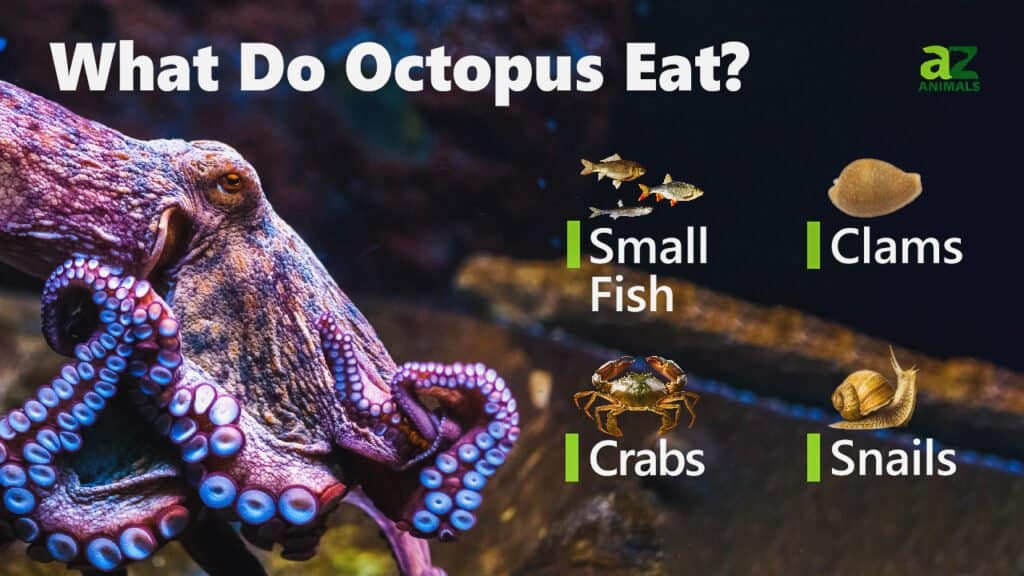
Octopuses are carnivores because they subsist solely on other creatures. In particular, they mostly feed on crabs and other crustaceans. Lobsters are also popularly consumed, and some species of octopus are known to eat plankton. Predatory, bottom-dwelling species of octopus primarily live off crustaceans, Polychaeta worms, clams, and other mollusks. Open-ocean species of octopus primarily consume other cephalopods, prawns, and fish. When feeding, they bring prey back to their dens and use their radula to drill shells and rasp away flesh. They use their very sharp beaks to tear apart prey.
Predators and Threats
According to the IUCN, most species of octopus are not endangered. Recent studies have suggested that populations may be booming. However, these creatures do face numerous threats. Considered a delicacy by many cultures, they are hunted regularly by humans. Therefore, humans are among the octopus’s top predators.
In the wild, octopuses are preyed upon by many other creatures. A variety of marine fish are known to consume octopuses, for example. Other common predators include seabirds, other cephalopods, and sea otters.
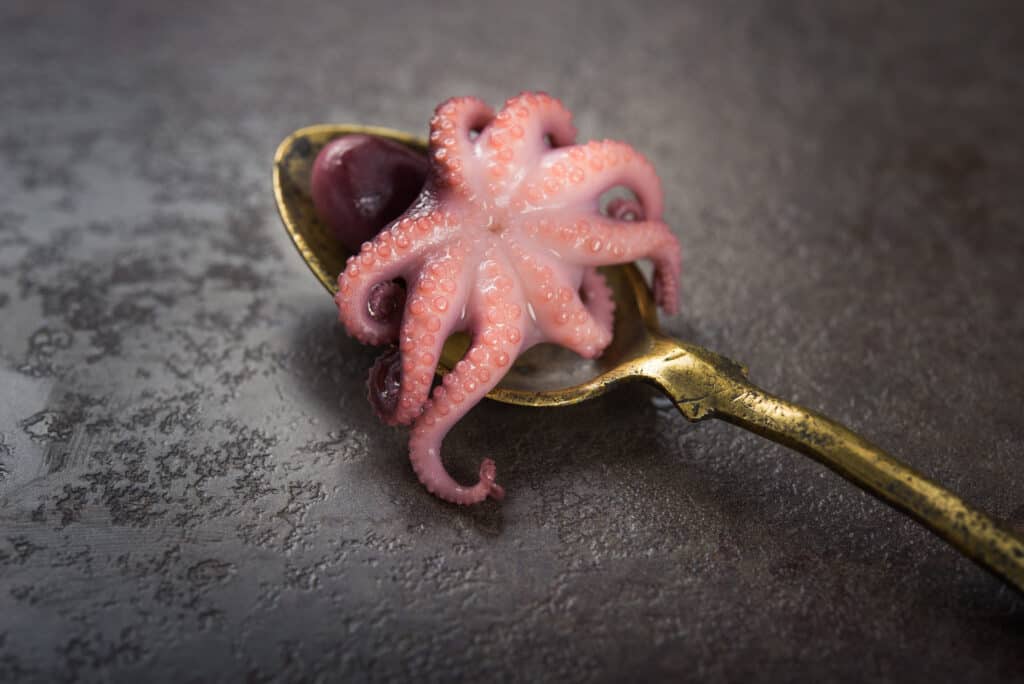
One of the top predators of the octopus is humans.
©Dima Sobko/Shutterstock.com
Reproduction, Babies, and Lifespan
There are separate sexes of octopuses. The male octopus has a specialized arm called a hectocotylus. This appendage inserts packets of sperm, which are known as spermatophores, directly into the mantle cavity of female octopuses. During reproduction, the male typically clings to the top or side of the female or hovers beside her. After delivering the spermatophores, males become senescent, which means that they gradually deteriorate before dying. Most die within about two months.
Eggs, which are about 1/8th of an inch long, are laid by female octopuses in holes and under rocks. On average, females lay around 100,000 eggs at one time, and it takes between four and eight weeks for them to hatch. During this period, the female octopus guards the eggs and cleans them with her suckers. She also agitates them with water. Once they hatch, miniature versions of the parents — tiny octopuses — emerge. They spend several weeks drifting in the plankton before taking refuge at the bottom of the sea. No parental care is provided beyond the care that is given by the female while waiting for eggs to hatch, so baby octopuses are on their own.
Most species of octopus, including the common octopus, mate during the winter. Unless they are mating, they are typically solitary. Octopuses have fairly short lifespans, with some species only living for an average of six months. However, the giant Pacific octopus is known to live for up to five years. These creatures’ lifespans are limited by reproduction since males only live for a few months afterward and females typically die shortly after eggs are hatched.
Population
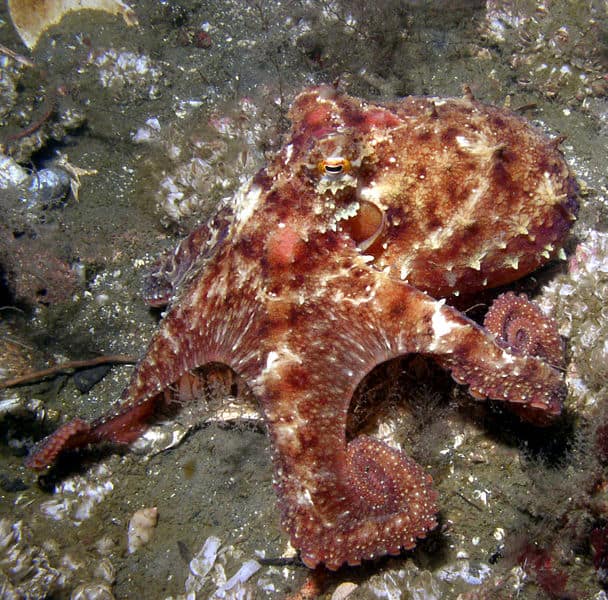
There’s not enough tracking data for scientists to estimate how many octopuses inhabit the oceans of the world.
©Kirt L. Onthank / Creative Commons – Original
Unfortunately, scientists have no precise idea about how many octopuses exist in the world. They aren’t easy to track, not only because they can’t be tagged but also because they are so solitary and reclusive. However, it is believed that the population of cephalopods, including octopuses, has boomed significantly since the 1950s. There are various pieces of evidence to support this, but again, specific numbers are not available.
Why are cephalopod — and, by extension, octopus — populations growing? Researchers believe that a few different factors are at work. For one, these creatures are known to be highly adaptable to changing environments. As climate change occurs and, for example, ocean temperatures rise, they may be better able to cope than other creatures. Human activity is also believed to play a role in population increases. In particular, human fishing removes large numbers of octopuses’ natural predators from the sea. This creates a gap in the food chain that may be advantageous to these eight-armed creatures.
Octopus Pictures
View all of our Octopus pictures in the gallery.

Sources
- David Burnie, Dorling Kindersley Animal, The Definitive Visual Guide To The World's Wildlife / Accessed December 5, 2008
- Tom Jackson, Lorenz Books The World Encyclopedia Of Animals / Accessed December 5, 2008
- David Burnie, Kingfisher The Kingfisher Animal Encyclopedia / Accessed December 5, 2008
- Richard Mackay, University of California Press The Atlas Of Endangered Species / Accessed December 5, 2008
- David Burnie, Dorling Kindersley Illustrated Encyclopedia Of Animals / Accessed December 5, 2008
- Dorling Kindersley Dorling Kindersley Encyclopedia Of Animals / Accessed December 5, 2008