
“One of the Largest Animals in New Zealand”
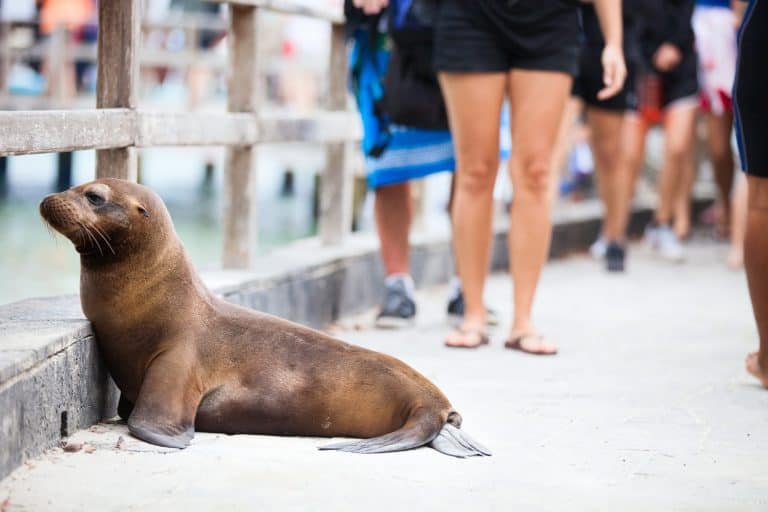
They can dive too deep depths, they can walk on all fours, and they love to frolic and play! They’re sea lions, an amphibious species of marine mammals.
Sea lions can survive in disparate climates and have well-developed social structures that often mimic that of humans.
In some locations, like New Zealand, sea lions make the list of the largest regional animals.
Four Amazing Sea Lion Facts
©Marcos del Mazo/Shutterstock.com
- Six Subspecies: Currently, there are six subspecies of sea lions: Australian sea lions, California sea lions, Galapagos sea lions, New Zealand sea lions, South American sea lions, and Steller sea lions.
- Smart Sea Lions: Sea lions are smart. They understand rudimentary sign language, and some even serve in the United States Navy to help with counterespionage missions!
- Subspecies Extinction: In the not-too-distant past, seven subspecies of sea lions glided through the world’s waters. Unfortunately, the Japanese sea lion went extinct in the 1950s due to overhunting and commercial fishing.
- Big and Small Cousins: Sea lions are marine mammals and close cousins with walruses and seals.
You can check out more incredible facts about sea lions.
Evolution and Origin
The pinniped’s ancestors loved the ocean and appeared to be drawn to the ocean regions due to its abundance of food. Additionally, over time they evolved to life in the water and have evolved into the sea lions we know and love today. Pinnipeds evolved from the ancestors of the musteloids. This also includes everything from the red panda to skunks, badgers weasels, and even raccoons.
Furthermore, the sea lion group, are thought to have descended from a terrestrial bear-like ancestor.
Scientific Names and Meanings
There are six subspecies of sea lions, all with different scientific names.
©Alexander Machulskiy/Shutterstock.com
Common-Use Language Roots
There are six subspecies of sea lions, all with different scientific names. As you’ve probably guessed, their common-use name means “lion of the sea,” but what do they have in common with their land-dwelling namesakes?
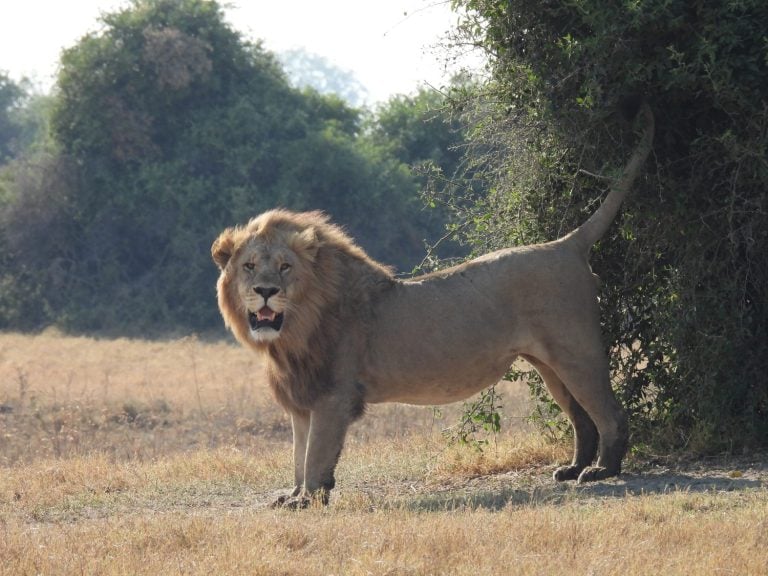
In short, both lions and sea lions sport manes and roar loudly.
The word “lion” comes to the Modern English language through several linguistic streams, including Old French and Latin. Its Greek linguistic roots are connected to a Spartan king named Leonidas.
Scientific Name
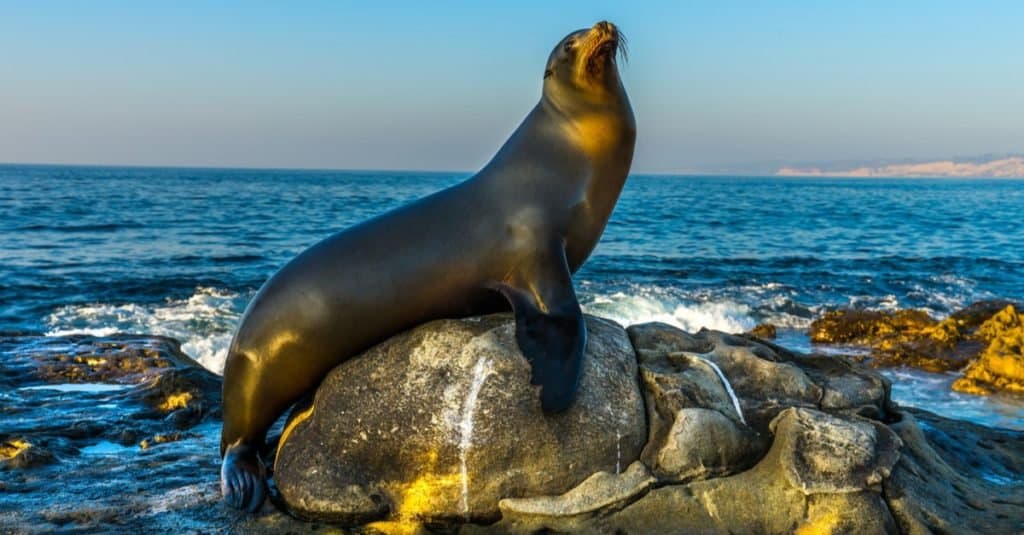
All sea lions belong to the taxonomic family of Otariidae, which means “little ear.”
©Daniel Avram/Shutterstock.com
All sea lions belong to the taxonomic family of Otariidae, which means “little ear.” Currently, 13 Otariidae species are roaming the planet, including sea lions.
Below are the scientific names for the six subspecies of sea lions.
- Australian Sea Lions – The Scientific name for Australian sea lions is Neophoca cinerea. Sometimes, the name is styled “Australian sea lion” and “Australian sea lion.”
- California Sea Lions – The scientific name for California sea lions is Zalophus californianus. Zalophus comes to us from Greek and translates to “intensive crest.” Californianus reflects the region of the world in which most of the species live. René Primevère Lesson first described the species in 1828.
- Galapagos Sea Lions – The scientific name for Galapagos sea lions is Zalophus wollebaeki. Zalophus is derived from Greek and translates to “intensive crest.” E. Sivertsen first described the subspecies in 1953.
- New Zealand Sea Lions – The Scientific name for New Zealand sea lions is Phocarctos hookeri. They’re also known as “whakahao” and “kautakoa” in the indigenous Māori language. Hookeri is in honor of several notable naturalists, including Joseph Dalton Hooker and William Jackson Hooker.
- Steller Sea Lions – The scientific name for Steller sea lions is Eumetopias jubatus. Eumetopias translates to “broad forehead,” and jubatus means “mane.” Indigenous language speakers in Australia call sea lions either “mawak” or “tl’ixin.” Steller comes from Wilhelm Steller, a naturalist who first described the animal in 1741. Occasionally, they’re referred to as “northern sea lions.”
- South American Sea Lions – The scientific name for South American sea lions is Otaria flavescens. Otaria derives from Otariidae, which means “little ear,” and flavescens is Latin for “becoming yellow.” They are also known as “Patagonian sea lions” and “southern sea lions.” In Spanish, South American sea lions go by “lobo marino” and “leon marino.”
Appearance and Behavior
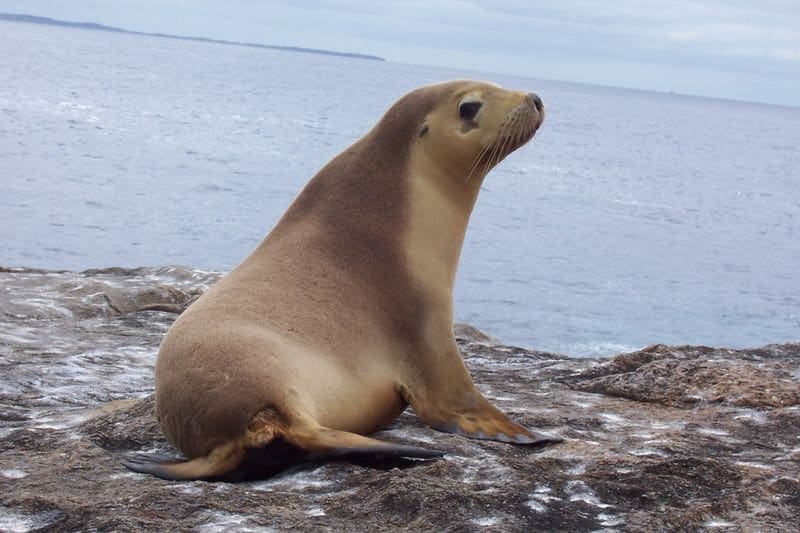
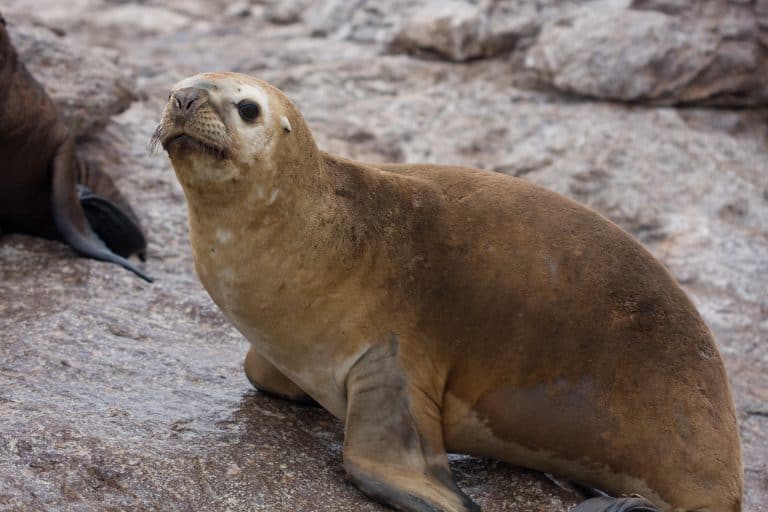
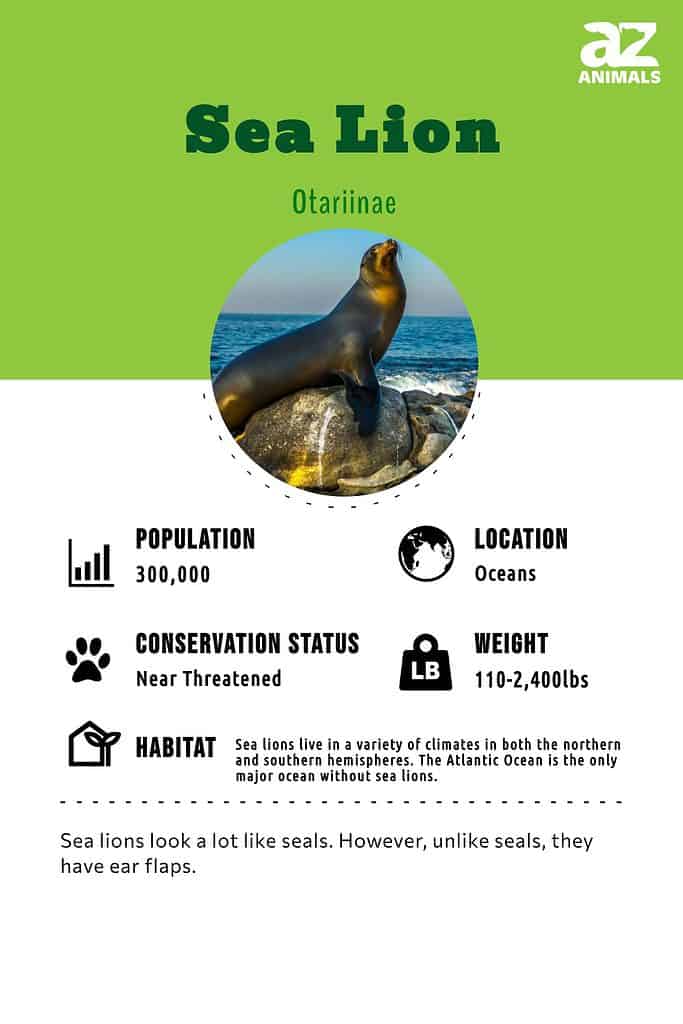
Sea lions look a lot like seals. However, unlike seals, they have ear flaps.
Sea lions look a lot like seals. However, unlike seals, they have ear flaps.
Though all sea lions are equipped with similar skeletal structures and four flippers, which double as feet when on land, their sizes and colors vary among subspecies.
All sea lions have coarse, short fur, and the males of each subspecies have manes of varying lengths. Additionally, they’re equipped with five claws on each front flipper that they use for hunting and gripping when on land.
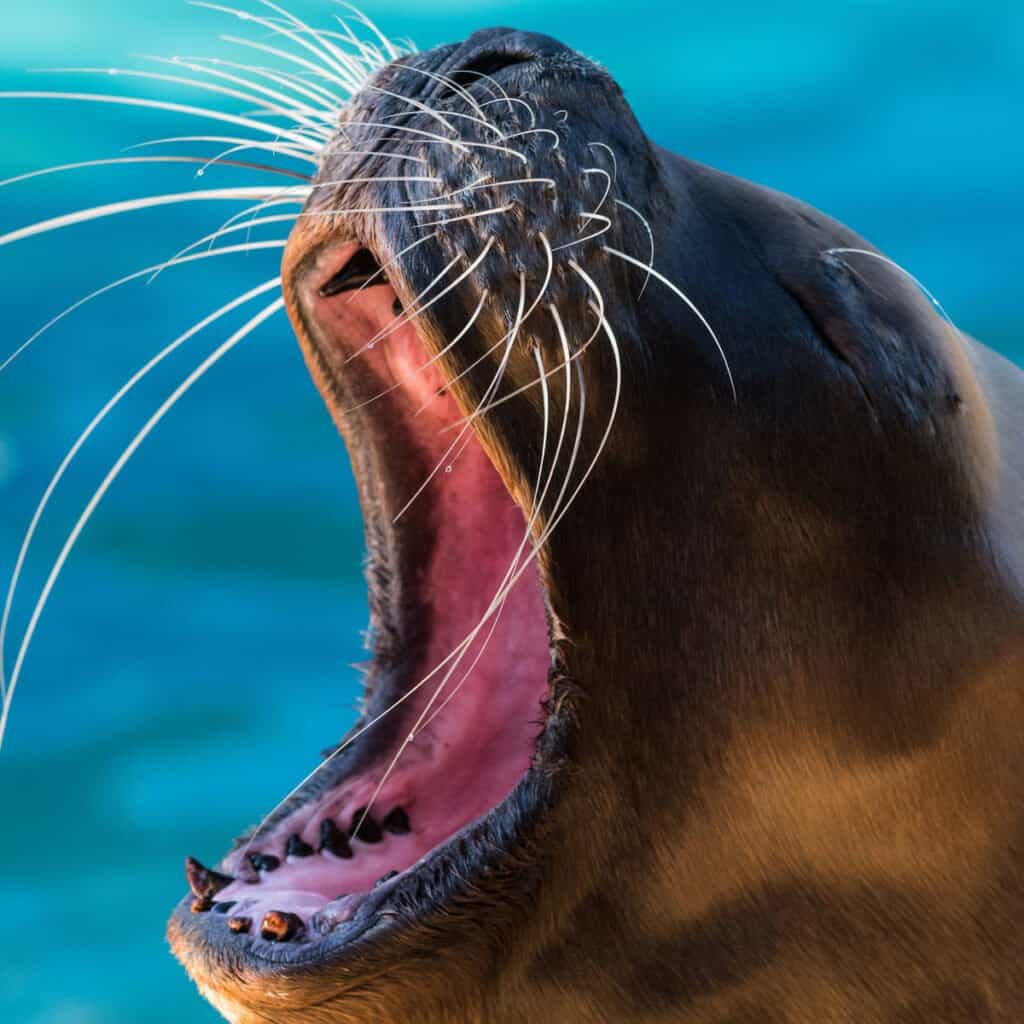
Sea lions have between 34 and 38 teeth, depending on the subspecies and sex. Incisors, canines, premolars, and molars make up sea lions’ teeth structures. Baby sea lions develop milk teeth in the womb but shed them before they’re born.
Sea lions are the second largest species of otariids, and some subspecies can reach 10 feet long, which is about as long as one-and-a-half king-sized beds. Walruses are the only other otariids that best sea lions in size.
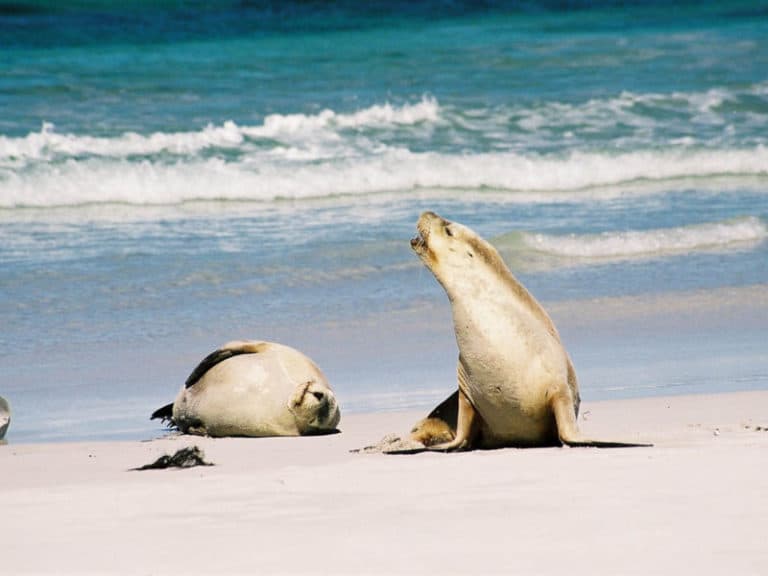
- Australian Sea Lions – Female Australian sea lions are either silver- or fawn-colored with a cream underbelly. Males are dark brown with yellow manes. Males grow to about 2.5 meters (8.2 feet) and weigh about 300 kilograms (661 pounds). Females are a bit smaller, usually weighing in at about 105 kilograms (231 pounds) with a length of approximately 1.8 meters (5.9 feet).
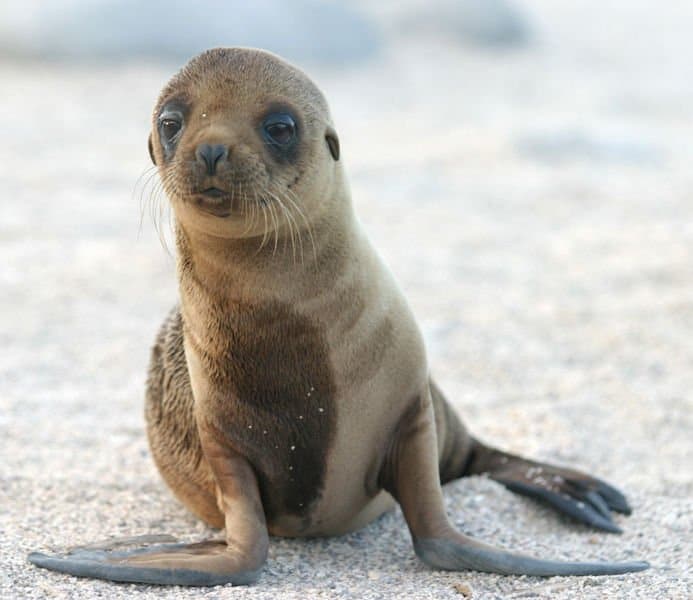
- California Sea Lions- Male California sea lions’ coloring ranges from light brown to black. Females’ fur is usually a tawny brown. Baby California sea lions are dark brown at birth. In terms of size, males, on average, are 2.4 meters (7.9 feet) long, and females are 1.8 meters (5.9 feet). Males weigh about 350 kilograms (770 pounds) and females 100 kilograms (220 pounds). Male California sea lions have barely visible manes and high-domed foreheads.
- Galapagos Sea Lions – Galapagos sea lions range in length from 1.5 meters (4.9 feet) to 2.5 meters (8.2 feet), and males are typically larger than females. Weight-wise, they tip the scales between 50 and 250 kilograms (110 and 550 pounds). Galapagos sea lions are distinguishable by their pointy, whiskered noses and long, narrow muzzles. Galapagos sea lions are the smallest subspecies of animals.
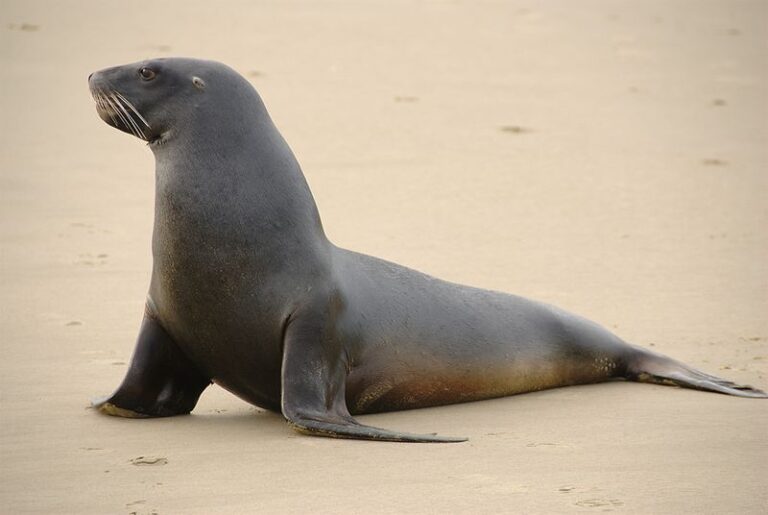
- New Zealand Sea Lions – New Zealand sea lions are on the larger side of the species. Males typically weigh between 320 and 450 kilograms (710 and 990 pounds) and are between 240 and 350 centimeters (7.9 and 11.5 feet) long. Females are a tad tinier, with 180 to 200 centimeters (5.9 to 6.6 feet) in length. Babies are born with brown fur. Adult females sport creamy gray coats while males are black or brown with black manes.
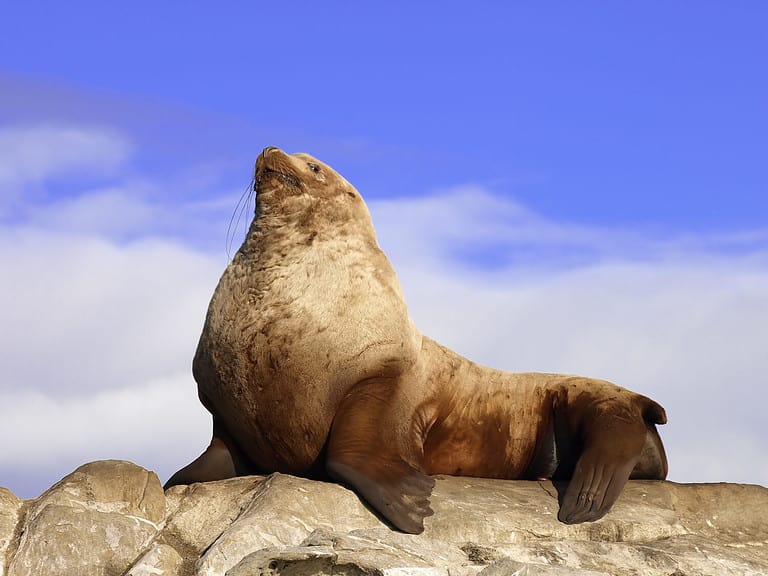
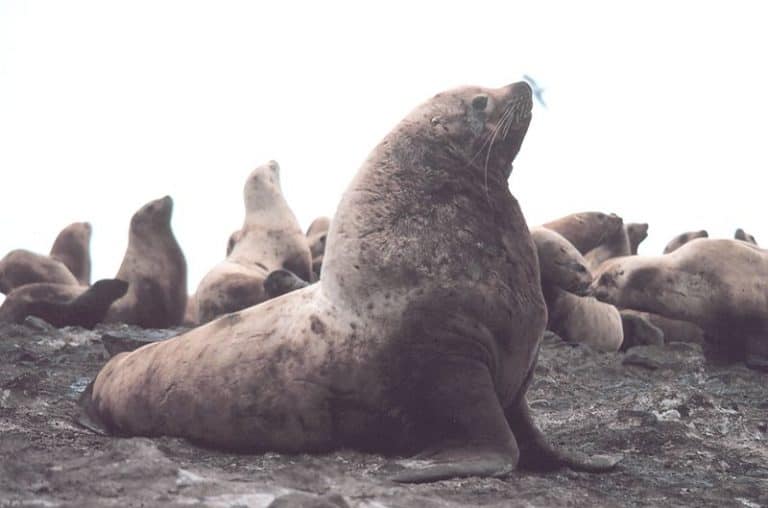
- Steller Sea Lions – Steller sea lions have different coloring than the other subspecies and sport a lighter tawny or reddish fur. Babies, however, are born with very dark hair, which grows lighter after a few months. Female Steller sea lions are between 2.3 and 2.9 meters (7.5 and 9.5 feet) long. Males, on the other hand, are between 2.8 and 3.3 meters (9.3 and 10.7 feet). Females weigh between 240 and 350 kilograms; males are 450 to 1,120 kilograms (990 to 2,470 pounds). The males’ manes are very thick. Steller sea lions are the largest subspecies of animals.
- South American Sea Lions – Male South American sea lions grow up to 2.7 meters (9 feet) in length and weigh an average of 350 kilograms (770 pounds). Females are a bit smaller and usually grow to about 1.8 to 2 meters (6 to 7 feet) in length. They weigh about 150 kilograms (330 pounds) on average. Both males and females can be either orange or brown, and babies are born a greyish color. Males of the species have huge heads and large manes.
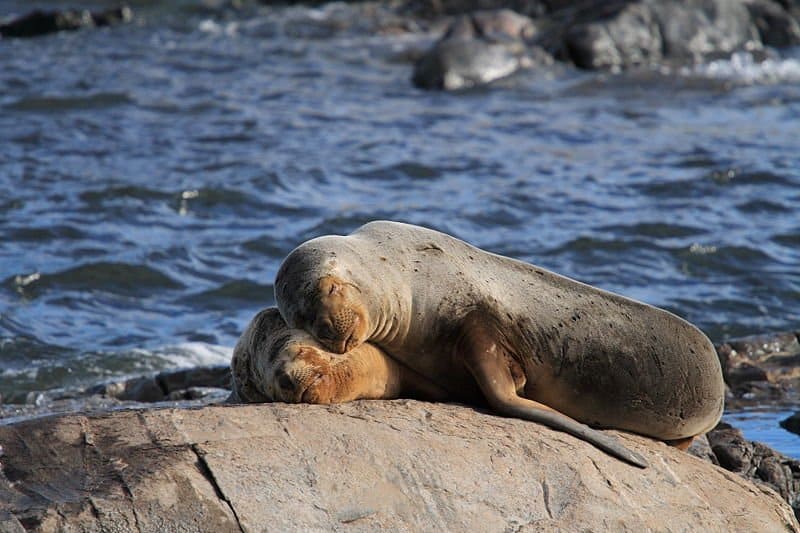
Sea lions are very smart, bursting with personality, and frolic with each other for hours — just like human children! California sea lions are the smartest subspecies, and you can often find them at aquatic centers and zoos doing tricks on command. Sea lions are so intelligent that the United States Navy trains and uses them in missions.
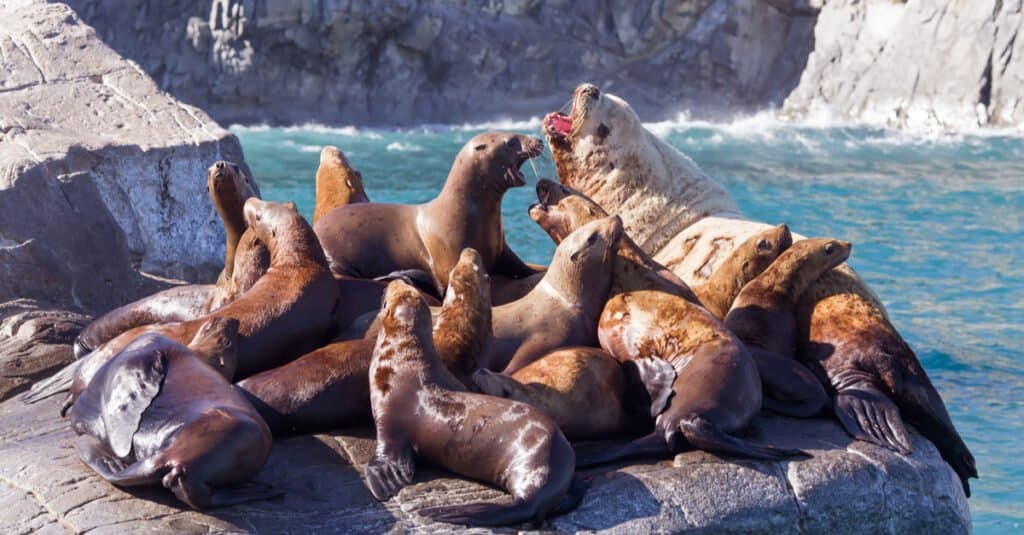
They typically live in groups, but the names of their groups depend on what they’re doing. When sea lions are hanging out on land, they’re called a “colony.” When they’re in the water, the proper term is “raft.” During mating season, sea lions are called a “rookery.”
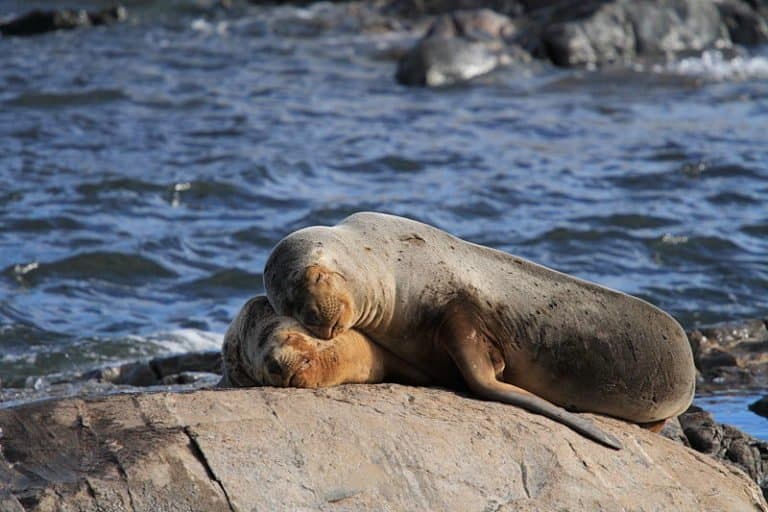
Since sea lions are polygynous, during mating season, the females in a given rook are referred to as a “harem.” Sea lions feed and migrate in water, but breed and rest on land. In the non-mating season, male and female rafts generally go their separate ways, but all the pups stay with the female colonies and rafts.
When sea lions transfer from water to land, it’s called “hauling out.” And when they haul out, they get loud and communicate through rhythmic barking, growling, and even belching! Amazingly, mothers and their babies can recognize each other’s vocalizations, even in a pack of 30 or more howling sea lions.
Sea lions are also great divers and can stay underwater for up to nine minutes at a time. Even more impressively, they can dive to great depths. The deepest recorded seal dive was 274 meters (900 ft)!
Sea lions are generally docile and playful, except during mating season. And though aggression with humans is exceptionally rare, it does happen.
Habitat
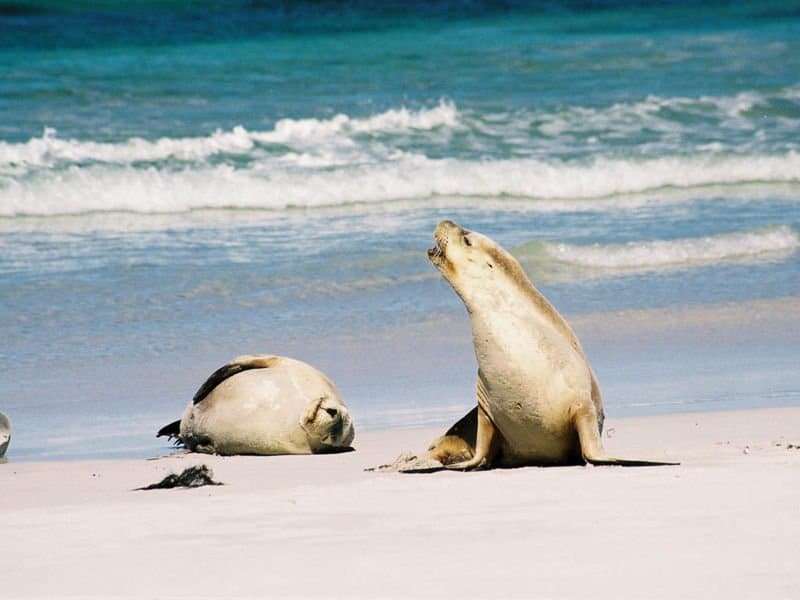
Sea lions live in a variety of climates in both the northern and southern hemispheres. The Atlantic Ocean is the only major ocean without sea lions.
©Cody Pope, CC BY-SA 2.5, via Wikimedia Commons – Original / License
Sea lions live in a variety of climates in both the northern and southern hemispheres. The Atlantic Ocean is the only major ocean without sea lions.
Being amphibious — meaning they live part-time on land and part-time in water — sea lions stick to coastal regions. Plus, coastal areas usually have better food sources.
- Australian Sea Lions – Australian sea lions can be found on the south and west coasts of Australia, especially around the Houtman Abrolhos Islands in Western Australia and the Pages islands in southern Australia.
- California Sea Lions – California sea lions make their homes in the Pacific Ocean, from Alaska down to Mexico. Comfortable with humans, California sea lions will haul out on human-made marinas and piers.
- Galapagos Sea Lions – As their name suggests, Galapagos sea lions call the Galapagos Islands home, and they only breed in that region, including Isla de la Plata, another area landmass. Galapagos sea lions are graceful and playful and dazzle tourists who visit the famed lands. They’re so gregarious that locals consider them the islands’ official “welcoming party.”
- New Zealand Sea Lions – New Zealand sea lions congregate in the sub-antarctic islands, including Auckland and Campbell Islands, in addition to the South and Stewart Islands.
- Steller Sea Lions – Steller sea lions inhabit the North Pacific Ocean and can be found off coasts in Russia, Alaska, and central California. A more solitary subspecies, Steller sea lions seem to prefer isolated locales.
- South American Sea Lions – Southern sea lions stick to the west coast of South America off the shores of Ecuador, Peru, Chile, the Falkland Islands, Argentina, Uruguay, and southern Brazil.
Diet
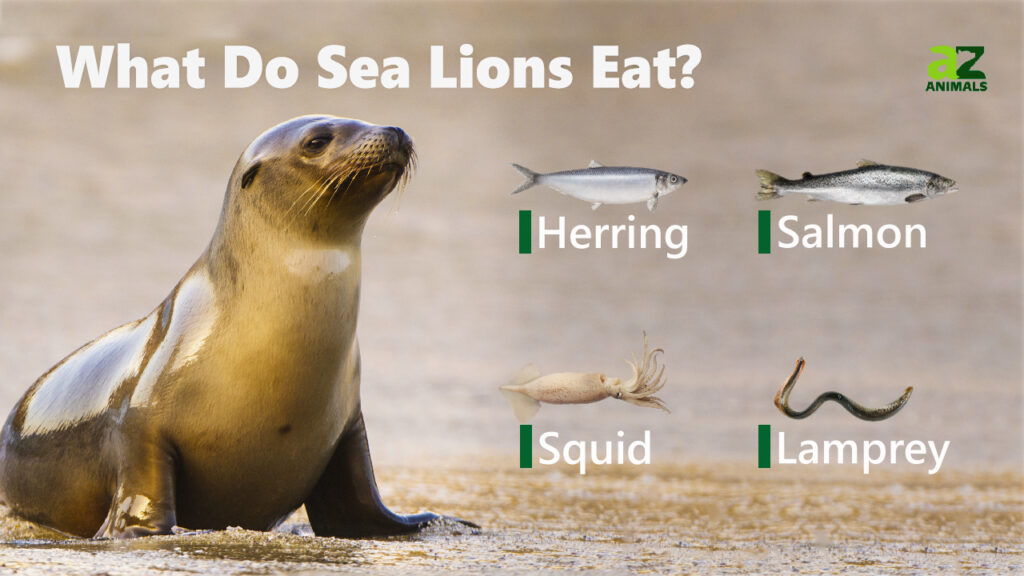
Sea lions are primarily carnivores, meaning they eat mostly meat. However, they occasionally dine on marine plant life and seaweed. Some species of sea lions are so smart that they coordinate with dolphins, porpoises, and seabirds for large-pack hunts.
Below is a chart outlining the different species of fish and other fowl on which each sea lion subspecies feeds.
| Sea Lion SubspeciesDietAustralian sea lionsteleast, squid, cuttlefish, octopus, sharks, rock lobster, penguins, crustaceansCalifornia sea lionssalmon, hake, Pacific whiting, anchovies, herring, rockfish, lamprey, dogfish, squid, clamsGalapagos sea lionssardines, yellowfin tunaNew Zealand sea lionsAntarctic horsefish, Patagonian toothfish, squid, octopus, seabirds, crustaceans, fur sealsSteller Sea Lionswalleye, pollock, Atka mackerel, halibut, herring, capelin, flatfish, Pacific cod, rockfish, sculpins, salmon, squid, octopusSouth American sea lionshake, anchovies, squid, octopus, penguins, pelicans, baby American fur seals |
Predators and Threats
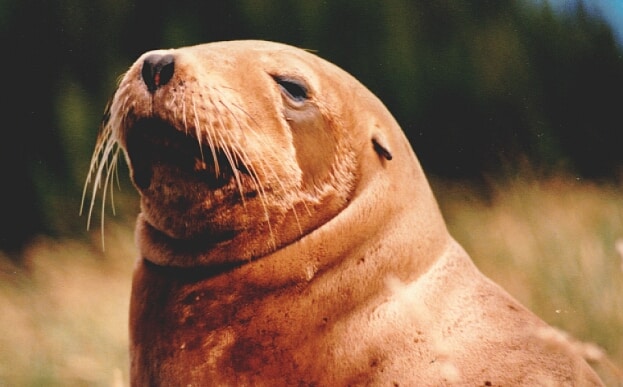
Disease and human encroachment threaten sea lion populations.
In the past, humans hunted sea lions for meat, hides, and blubber. In the 1800s, you could buy Steller sea lion whiskers for a penny each, and people used them as pipe cleaners. Today, some native communities are still allowed to hunt sea lions for sustenance purposes.
Disease and human encroachment threaten sea lion populations, in addition to food stress and natural predators. Fishing nets prove especially fatal to sea lions, as they get tangled in their webs and thrash about in an attempt to get loose.
However, since the nets stay submerged underwater for long periods, the sea lions often can’t escape in time and drown. Fishing hooks present another danger to marine mammals.
Currently, teams of specialists are studying ways to develop human communities along coasts that nourish the surrounding biodiversity, including sea lions.
Great white sharks and killer whales are natural predators of sea lions. The Galapagos subspecies must also worry about stray dog packs.
El Niño, a cyclical warming of the Pacific Ocean, has also proved devastating for sea lions, as it greatly diminishes their food supplies and increases diseases.
Reproduction, Babies, and Lifespan
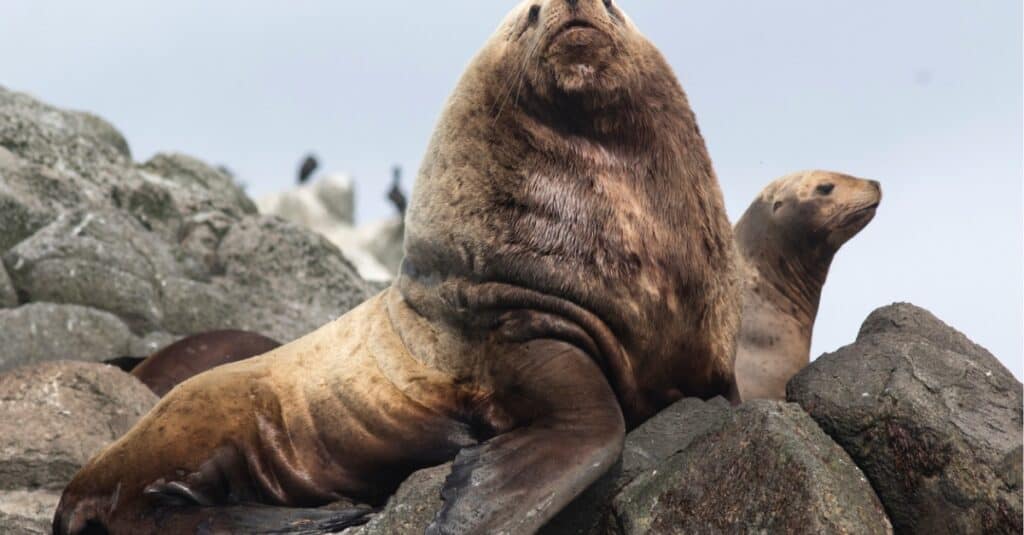
Breeding season for sea lions is subspecies dependent, but all have a gestation period of about 12 months.
©iStock.com/pilipenkoD
Breeding season for sea lions is subspecies dependent, but all have a gestation period of about 12 months. Below is a chart outlining the mating seasons, breeding habitats, and average lifespans for each type.
Note that all sea lions live longer in captivity. The age ranges listed below apply to wild animals. Additionally, all sea lions are polygynous, meaning one male will mate with many females, but females typically only mate with one male.
Arguably like humans, males make an effort to secure the best rookery — or mating spot — to attract females. The best breeding habitats have safe access to nearby water and a pupping area, where the young ones — or pups — can be safeguarded from predators. Males left empty-handed and retreat to a “bachelor colony” where they beef up in the hopes of better luck in the future.
Depending on the subspecies, sea lions breed on either rocky coasts or sandy beaches. Females of the species, or cows, typically have one child, or pup, at a time. Very rarely, a cow will birth twins. In most instances, the ladies perform their deliveries on land, but some have been known to do it in water.
Mothers produce milk and, depending on the subspecies, will nurse their offspring for 6 to 12 months. Swimming and hunting lessons start at around 2 to 3 months old.
| Subspecies | Mating Season | Breeding and Nurturing Habitats | Average Lifespans |
| Australian sea lions | The mating season for Australian sea lions isn’t fixed and can last up to nine months. | Cows raise and nurture their pups for about three years. Females also take turns babysitting each others’ pups while they go foraging for food. Also, females adopt the babies of cows who die. | 25 years |
| California sea lions | May-August | Females freely hop from territory to territory to find the one they like best and typically steer clear of overly aggressive males. They breed on both sand and rocky shores. | 15 to 20 years |
| Galapagos sea lions | May – January | Males must work to keep females in their rooks. Female Galapagos sea lions are very community-oriented and establish playgroups and babysitting schedules. | 15 to 24 years |
| New Zealand sea lions | December – February | New Zealand sea lions are territorial and work to keep cows in their rooks. | 23 years |
| Steller sea lions | May-August | Like California sea lions, females choose their mates and move freely between rookeries. | 15 to 20 years |
| South American sea lions | August – December | Males establish breeding territories and aggressively herd females. Males will even go so far as to kidnap pups to lure females into their harems. | 20 years |
Population
Some species of sea lions are stable; others are not. California sea lions are the most populous subspecies, and New Zealand sea lions are endangered. Below is a table detailing the populations of each subspecies.
| Subspecies | Estimated Population | International Union for Conservation of Nature (IUCN) Status | Other Population Classifications |
| Australian sea lions | 14,730 | Endangered | The Wildlife Conservation Act of Australia lists Stellers as “in need of special protection.” |
| California sea lions | 357,000 | Least Concern | The species is protected under the Marine Mammal Protection Act of 1972, which outlaws hunting, capture, and harassment. |
| Galapagos sea lions | 20,000 – 50,000 | Endangered | Their habitat is part of the protected Ecuadorian National Park. |
| New Zealand sea lions | 10,000 | Endangered | The New Zealand Threat Classification System lists sea lions as Nationally Critical. |
| Steller sea lions | 39,000 | Near Threatened | NA |
| South American sea lions | 265,000 | Least Concern | NA |
Sea Lion Pictures
View all of our Sea Lion pictures in the gallery.

Sources
- David Burnie, Dorling Kindersley (2011) Animal, The Definitive Visual Guide To The World's Wildlife / Accessed November 10, 2008
- Tom Jackson, Lorenz Books (2007) The World Encyclopedia Of Animals / Accessed November 10, 2008
- David Burnie, Kingfisher (2011) The Kingfisher Animal Encyclopedia / Accessed November 10, 2008
- Richard Mackay, University of California Press (2009) The Atlas Of Endangered Species / Accessed November 10, 2008
- David Burnie, Dorling Kindersley (2008) Illustrated Encyclopedia Of Animals / Accessed November 10, 2008
- Dorling Kindersley (2006) Dorling Kindersley Encyclopedia Of Animals / Accessed November 10, 2008
- David W. Macdonald, Oxford University Press (2010) The Encyclopedia Of Mammals / Accessed November 10, 2008