

S
Species Profile

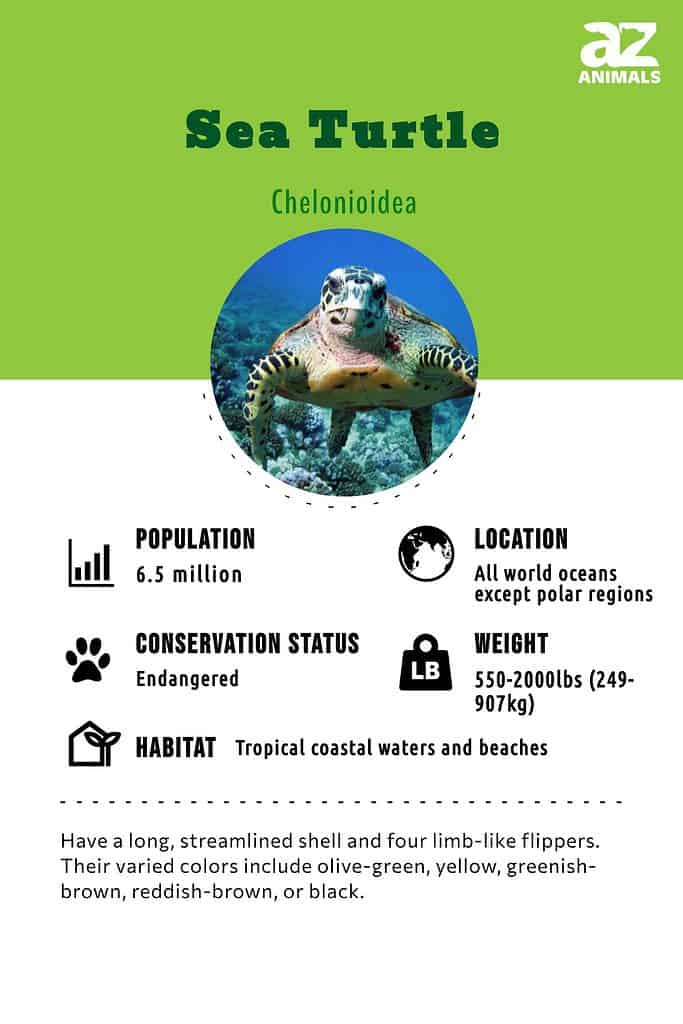
Sea Turtle

Testudines (informal subgroup: marine turtles, superfamily Chelonioidea)

Ancient shells, modern survivors
Isabelle Kuehn/Shutterstock.com

Sea Turtle Distribution

Click a location to explore more animals from that region

Invasive Species

This map shows coastal regions where Sea Turtle are found.

Loading map...
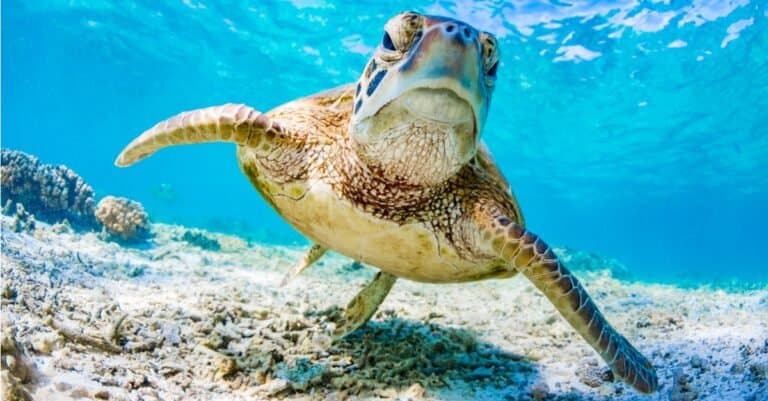
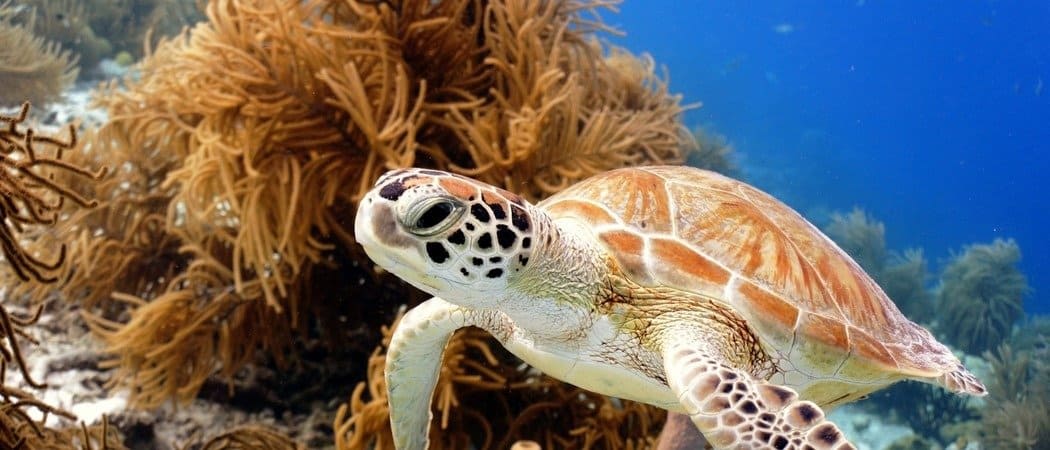
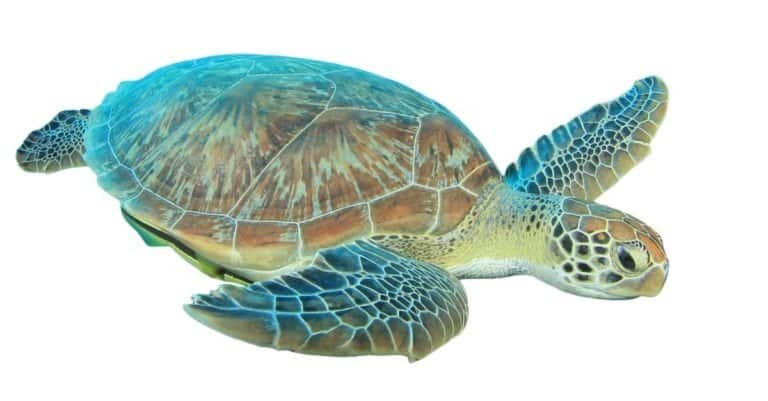
Green Sea Turtle swimming along tropical coral reef, Bonaire

At a Glance

Order Overview This page covers the Sea Turtle order as a group. Stats below are general traits shared across the order.
Also Known As Sea turtle, Marine turtle, Chelonians, Sea tortoise
Diet Omnivore
Activity Diurnal+
Lifespan 40 years
Weight 700 lbs
Status Not Evaluated
Did You Know?

Turtles are the only vertebrates with a true shell made of bone fused to the ribs and backbone, covered by scutes or skin.

Scientific Classification

Order Overview "Sea Turtle" is not a single species but represents an entire order containing multiple species.

Sea turtles are large, primarily marine-adapted turtles (the Chelonioidea lineage within the order Testudines) characterized by streamlined bodies, flipper-like forelimbs, long-distance migrations, and life cycles tied to sandy nesting beaches. Living sea turtles comprise two families: Cheloniidae (hard-shelled sea turtles) and Dermochelyidae (leatherback).

Kingdom
Animalia
Phylum
Chordata
Class
Reptilia
Order
Testudines

Distinguishing Features

  • Flipper-like limbs adapted for open-water swimming
  • Salt glands near the eyes to excrete excess salt
  • Long-distance migrations between feeding and nesting areas
  • Temperature-dependent sex determination in eggs
  • Two major lineages: hard-shelled sea turtles (Cheloniidae) vs leatherback (Dermochelyidae)

Physical Measurements

Males and females differ in size

Height
39 ft 4 in (9 ft 10 in – 229 ft 8 in)
10 in (1 in – 2 ft 7 in)
Length
1 ft 1 in (3 in – 7 ft 3 in)
Weight
4 lbs (0 lbs – 1,984 lbs)
11 lbs (0 lbs – 1,984 lbs)
Tail Length
2 in (0 in – 12 in)
4 in (0 in – 1 ft 8 in)
Top Speed
22 mph
swimming

Appearance

Primary Colors
Secondary Colors
Skin Type Marine-adapted skin: keratinized scales on head/flippers; Cheloniidae have hard scutes, Dermochelyidae have thick leathery skin over osteoderms.
Distinctive Features
  • Order-level range includes tiny hatchlings to the largest turtle, leatherback (~1.5-2 m).
  • Mass ranges from tens of grams (hatchlings) to ~900+ kg (largest leatherbacks).
  • Streamlined body with flipper-like forelimbs; reduced ability to retract head/limbs in marine forms.
  • Cheloniidae: hard, scuted carapace; Dermochelyidae: leathery shell with longitudinal ridges.
  • Horny beak; diet varies widely (herbivory to omnivory to gelatinous prey specialists).
  • Large salt glands near eyes; may appear as "tears" when excreting excess salt.
  • Life cycle generalization: beach nesting, hatchlings enter oceanic stage, juveniles/adults migrate long distances.
  • Lifespan spans decades; many species commonly 50+ years, some potentially approaching a century.
  • Ecology varies: coastal foraging, pelagic roaming, deep diving (extreme in leatherbacks).
  • Major threats across Chelonioidea: fisheries bycatch, nesting beach loss, lighting, plastics, egg poaching, climate-driven sex ratio shifts.
  • Common conservation actions: protected nesting beaches, turtle excluder devices (TEDs), bycatch mitigation, lighting management, marine protected areas.

Sexual Dimorphism

Dimorphism is common but variable: adult males typically have longer, thicker tails and may show longer foreclaws, while females are often larger-bodied in several species. Differences are most evident in mature individuals.

  • Longer, thicker tail with cloaca positioned farther from shell edge.
  • Often longer foreclaws (notably in some Cheloniidae).
  • May have slightly more concave plastron in some populations.
  • Often larger body size and deeper body cavity for egg production.
  • Shorter tail with cloaca closer to shell edge.
  • Nesting-related abrasions/calluses may appear on flippers in breeding seasons.

Did You Know?

Turtles are the only vertebrates with a true shell made of bone fused to the ribs and backbone, covered by scutes or skin.

Testudines range from palm-sized species (~10 cm shell length) to the leatherback sea turtle, which can exceed ~2 m in total length and weigh several hundred kilograms.

Sea turtles (Chelonioidea) are not one species but a marine lineage within Testudines; living members fall into two families: Cheloniidae and Dermochelyidae (leatherback).

Many turtles can navigate long distances; several sea turtle species migrate between feeding grounds and natal nesting beaches across ocean basins.

Temperature during incubation influences sex in many turtles (temperature-dependent sex determination), making nests sensitive to climate.

Some freshwater turtles can absorb oxygen through the lining of the throat and/or cloaca, helping them survive long, cold winters underwater.

Turtles occupy almost every aquatic habitat type (freshwater, brackish, marine) and many are fully terrestrial; diets range from strict herbivory to active predation and scavenging.

Unique Adaptations

  • The shell (carapace + plastron): a protective bony structure integrated with the skeleton; many species can withdraw head/limbs, though sea turtles cannot fully retract.
  • Two main neck-folding designs: cryptodires tuck the neck straight back; pleurodires fold the neck sideways-showing deep diversity within the order.
  • Salt glands in sea turtles: specialized glands near the eyes excrete excess salt, allowing marine life and often giving the appearance of "tears."
  • Flipper-driven swimming (Chelonioidea): sea turtles have enlarged foreflippers and streamlined bodies for efficient long-distance travel; hind limbs act as rudders.
  • Cheloniidae vs Dermochelyidae: hard-shelled sea turtles (Cheloniidae) have keratin scutes; the leatherback (Dermochelyidae) lacks scutes and has a leathery skin over a mosaic of small bones plus longitudinal ridges.
  • Deep-diving and breath-hold physiology: many sea turtles can make long dives with slowed heart rate and efficient oxygen use; diving capacity varies with species, size, and water temperature.
  • Temperature-dependent sex determination: common across many turtle species; small shifts in nest temperature can bias sex ratios.
  • Defense without speed: terrestrial tortoises often rely on thick shells and sturdy limbs; softshell turtles trade armor for flexibility and rapid bursts in water.

Interesting Behaviors

  • Basking and thermoregulation: many freshwater species sun themselves to raise body temperature; others stay submerged and surface periodically to breathe.
  • Seasonal dormancy: temperate turtles often brumate; some aquatic species overwinter under ice using extremely low metabolic rates (varies widely by species and region).
  • Diverse feeding strategies: herbivores graze aquatic plants; omnivores scavenge; predators ambush fish/invertebrates; specialized species crush mollusks or nip sponges/jellyfish (notably among sea turtles).
  • Navigation and homing: sea turtles use multi-cue navigation (e.g., geomagnetic cues plus local signals) to return to nesting regions; precision and distances vary among species.
  • Nesting rituals: females (especially sea turtles) typically nest on land, digging a chamber, laying dozens to 100+ eggs depending on species, then leaving; hatchlings often emerge in coordinated bursts.
  • Oceanic "lost years": many sea turtles spend a juvenile stage in pelagic habitats, drifting with currents and associating with floating seaweed like Sargassum (common but not universal).
  • Cleaning symbioses: marine turtles may visit reef "cleaning stations" where fishes pick off algae/parasites; frequency varies by habitat and species.
  • Territoriality and sociality: most turtles are not strongly social, but some show aggression over basking sites, mates, or food; courtship behaviors are diverse across lineages.
  • Predator avoidance: many rely on armor and withdrawal; softshells and sea turtles instead emphasize speed, camouflage, and aquatic agility.

Cultural Significance

Turtles (Testudines; marine turtles, Chelonioidea) stand for endurance, protection, patience, and life’s continuity because of their long life and protective shell. Sea turtles appear in art and stories, were used for food and materials, and now stand for protecting nesting beaches, cutting bycatch and light pollution, and saving foraging habitats.

Myths & Legends

In some Indigenous North American stories, a great turtle carries the world on its back after animals bring up earth from under the water, making the land people live on.

In Hindu tradition, a god becomes a turtle (or tortoise) and holds up the mountain used in the "churning of the ocean," keeping it steady so treasures and the nectar of immortality appear.

A giant turtle in Chinese mythology: Its legs are used as pillars to support the sky after a catastrophe, restoring order to the world.

A long-lived turtle in Japanese folklore: An auspicious turtle sometimes depicted with a trailing 'seaweed tail,' associated with longevity and good fortune.

The Turtle and the Hare (Aesop's fable): A slow turtle wins a race through perseverance, becoming a lasting lesson about humility and steady effort.

African and Afro-Caribbean trickster tales: In many West African traditions (and their diasporic descendants), Turtle is a cunning trickster who uses wit to outmaneuver stronger animals, sometimes to comic or cautionary effect.

Conservation Status

NE Not Evaluated at the order level (Testudines is not assessed as a single IUCN unit). Across the order, species span from Least Concern (LC) to Critically Endangered (CR), with many Data Deficient (DD) taxa; several marine turtles are globally threatened (e.g., hawksbill CR, Kemp's ridley CR).

Has not yet been evaluated against the criteria.

Population Unknown

Protected Under

  • CITES: many Testudines species are listed in Appendix I or II (trade regulated; Appendix I largely prohibits commercial international trade).
  • CMS (Convention on Migratory Species): multiple marine turtles are listed; supported by regional instruments such as the IOSEA Marine Turtle MoU and the Inter-American Convention for the Protection and Conservation of Sea Turtles (IAC).
  • Widespread national and subnational protections: harvest bans/limits, protected nesting beaches, wetland protections, fisheries bycatch mitigation requirements, and protected areas/MPAs (coverage and enforcement vary).
  • Group range & ecology notes (order-wide generalization): body size spans ~6-8 cm carapace length and ~0.1-0.2 kg (smallest tortoises) to ~1.5-1.8 m carapace and up to ~900 kg (leatherback). Lifespans commonly ~20-30 years in small species to 80-150+ years in large tortoises; many species show delayed maturity and high juvenile mortality. Ecology ranges from fully marine long-distance migrants (Chelonioidea) to riverine/pond specialists and terrestrial grazers; diets vary from herbivory to carnivory/omnivory, and many rely on specific nesting substrates (sandbanks/beaches).

You might be looking for:

Green Sea Turtle

20%

Chelonia mydas

Large herbivorous-adult sea turtle; common on tropical/subtropical seagrass beds and reefs.

Loggerhead Sea Turtle

18%

Caretta caretta

Robust head and jaws; often feeds on hard-shelled invertebrates; wide temperate–tropical distribution.

Leatherback Sea Turtle

16%

Dermochelys coriacea

Largest sea turtle; leathery carapace; deep-diving jellyfish specialist; family Dermochelyidae.

View Profile

Hawksbill Sea Turtle

14%

Eretmochelys imbricata

Narrow pointed beak; associated with coral reefs; historically targeted for tortoiseshell trade.

Olive Ridley Sea Turtle

12%

Lepidochelys olivacea

Smaller, often mass-nesting (arribadas) in some regions.

Kemp's Ridley Sea Turtle

10%

Lepidochelys kempii

Rarest sea turtle; primarily Gulf of Mexico/Atlantic; strong conservation focus.

Flatback Sea Turtle

10%

Natator depressus

Mainly Australian/northern waters; relatively flat carapace; restricted range.

Life Cycle

Birth 20 hatchlings
Lifespan 40 years

Lifespan

In the Wild
10–150 years
In Captivity
15–200 years

Reproduction

Mating System Polygynandry
Social Structure Aggregation Group
Breeding Pattern Transient
Fertilization Internal Fertilization
Birth Type Internal_fertilization

Across Testudines, mating is typically promiscuous/polygynandrous: breeding is brief and often centered on seasonal aggregations (especially in sea turtles). Males mate with multiple females; females commonly mate multiply and store sperm; parental care is minimal beyond nesting.

Behavior & Ecology

Social Bale Group: 1
Activity Diurnal, Nocturnal, Crepuscular, Cathemeral
Diet Omnivore Highly variable across Testudines: many freshwater turtles commonly favor aquatic invertebrates and tender aquatic vegetation; within marine turtles, diets range from jellyfish/gelatinous prey to seagrasses/algae depending on species and life stage.
Seasonal Migratory, Hibernates 6,214 mi

Temperament

Generally wary and non-social; most interactions are avoidance-based rather than cooperative.
Defensive responses vary: withdrawal, biting, clawing, musk release, and vigorous escape swimming.
Territoriality ranges from minimal to pronounced, especially among males in some freshwater species.
Seasonal tolerance increases at high-density sites (basking logs, feeding areas, nesting beaches).
Across Testudines, size and lifespan are highly variable: ~8-10 cm to >1.5 m; decades to >100 years.
Marine turtles often show strong natal homing and long migrations, but social bonds remain weak.

Communication

Hatchling and embryo squeaks/chirps used in nest emergence coordination
Occasional hisses, grunts, or clicks during handling, courtship, or underwater interactions
Chemical cues (skin/cloacal odors) likely aid mate recognition and reproductive readiness
Visual postures and movements: head-bobbing, circling, biting, and mounting during courtship
Tactile contact during mating; physical displacement and shell-ramming in competitive encounters
Environmental cue use (e.g., beach/nest-site cues) concentrates individuals without true group coordination

Habitat

Forest Rainforest Deciduous Forest Coniferous Forest Woodland Grassland Savanna Shrubland Desert Alpine Meadow Mountain Lake River/Stream Pond Wetland Swamp Marsh Bog Mangrove Estuary Coastal Beach Rocky Shore Coral Reef Kelp Forest Open Ocean Deep Sea Seabed/Benthic Urban Suburban Agricultural/Farmland Plantation +26
Biomes:
Tropical Rainforest Tropical Dry Forest Savanna Desert Hot Desert Cold Mediterranean Temperate Grassland Temperate Forest Temperate Rainforest Boreal Forest (Taiga) Alpine Freshwater Marine Wetland +8
Terrain:
Coastal Island Riverine Plains Valley Hilly Mountainous Plateau Sandy Muddy Rocky Karst Volcanic +7
Elevation: Up to 11482 ft 11 in

Ecological Role

Mixed-function consumer guild (primary consumer to mesopredator) spanning terrestrial, freshwater, and marine food webs; includes grazers, omnivores, and predators with strong life-stage and habitat-driven variation.

Controls and redistributes invertebrate biomass (predation on aquatic invertebrates; in some marine turtles, consumption of gelatinous prey) Grazing on aquatic vegetation/seagrass and algae, influencing plant community structure and productivity Nutrient cycling and cross-ecosystem nutrient transport (e.g., marine-to-beach via nesting; freshwater via foraging/excretion) Scavenging of carrion in some species, aiding decomposition pathways Seed dispersal for some terrestrial/freshwater species that consume fruits Supports food webs as prey (especially eggs and hatchlings), indirectly shaping predator populations

Diet Details

Main Prey:
Aquatic invertebrates Crustaceans Worms Jellyfish and other gelatinous zooplankton Sponges and soft-bodied reef invertebrates Fish and fish eggs Amphibians Carrion +2
Other Foods:
Aquatic plants and macrophytes Algae and seaweed Seagrasses Grasses, leaves, and herbs Fruits, berries, flowers, and succulent pads

Human Interaction

Domestication Status

Wild

Turtles and tortoises (Testudines) are wild, with no true domestication like dogs or farm animals. Many are kept as pets or farmed; some (pet turtles, Asian softshells) are bred intensely, forming semi-domesticated farms and trade. Marine turtles (Chelonioidea) are not domesticated, mostly protected, and managed to cut fishing bycatch; in some places they were taken for meat, eggs, or shell.

Danger Level

Moderate
  • Zoonotic disease risk, especially Salmonella from handling turtles, contaminated water, or surfaces (notably with small pet turtles)
  • Bites and crushing injuries from large freshwater species (e.g., snapping turtles) if handled improperly
  • Scratches and punctures from claws/beaks during capture/handling or when rescuing entangled animals
  • Boating/diving interactions: accidental collisions or defensive movements can cause minor injuries; risk generally low in open-water encounters
  • Indirect hazards from human activities around turtles (e.g., night driving/ATVs on nesting beaches, unsafe wildlife handling, illegal trade enforcement conflicts)

As a Pet

Suitable as Pet

Legality: Laws differ by place and species. Many small, captive-bred freshwater turtles and some tortoises may be legal, but some are banned. Marine turtles (Chelonioidea) are almost always illegal. Check local, CITES, and health rules.

Care Level: Moderate

Purchase Cost: $20 - $10,000
Lifetime Cost: $1,000 - $100,000

Economic Value

Uses:
Pet trade (legal and illegal) Food and aquaculture (regionally important; often regulated/illegal for threatened species) Materials and crafts (historical/illegal in many places) Ecotourism Research/education Cultural/traditional uses Ecosystem services (e.g., grazing, seed dispersal, nutrient transport)
Products:
  • live animals (pets; captive-bred stock)
  • meat (freshwater turtles and some softshells in aquaculture; sea turtle harvest largely illegal)
  • eggs (historically harvested; generally illegal for sea turtles; regulated for most species)
  • shell/keratin products (e.g., historical tortoiseshell; now widely banned)
  • traditional medicine/tonics in some markets (often regulated/illegal depending on species)
  • tourism services (nesting beach tours, snorkeling/diving encounters with sea turtles)

Relationships

Related Species 10

Hard-shelled sea turtles Cheloniidae Shared Family
Leatherback sea turtle
Leatherback sea turtle Dermochelyidae Shared Family
Tortoises
Tortoises Testudinidae Shared Family
Pond and marsh turtles Emydidae Shared Family
Old World pond turtles Geoemydidae Shared Family
Side-necked turtles Chelidae Shared Family
Softshell turtles Trionychidae Shared Family
Snapping turtle
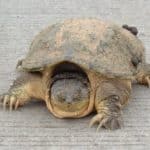
Snapping turtle Chelydridae Shared Family
Mud and musk turtles Kinosternidae Shared Family
Pig-nosed turtle
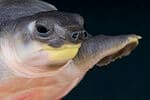
Pig-nosed turtle Carettochelys insculpta Shared Family

Ecological Equivalents 6

Animals that fill a similar ecological role in their ecosystem

Crocodiles and alligators Crocodylia They share semi-aquatic to aquatic lifestyles with many freshwater turtles, overlap in basking sites and prey (fish and invertebrates), and serve as ambush-predator/mesopredators in rivers, lakes, and wetlands.
Marine iguana
Marine iguana Amblyrhynchus cristatus Ecological analogue to herbivorous or algae-grazing marine turtles in nearshore zones: dives to forage on marine algae and uses coastal haul-out/rest sites.
Dugong
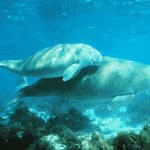
Dugong Dugong dugon Overlaps spatially with grazing sea turtles in seagrass meadows; both strongly influence seagrass community structure through herbivory.
Manatee
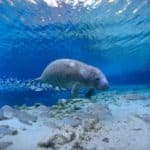
Manatee Trichechus spp. Similar ecological niche to herbivorous aquatic turtles in warm waters: slow-moving, primarily herbivorous foragers that use seagrass beds, rivers, and estuaries.
Seals and sea lions Pinnipedia Share marine diving, long-distance movements, and predator–prey dynamics with sea turtles, especially on coastal shelf habitats, though diets and thermoregulation differ.
Large freshwater fish Siluriformes In many rivers and lakes, large freshwater fish occupy similar benthic-foraging niches as aquatic turtles, consuming invertebrates and carrion and strongly affecting egg and juvenile survival.

Types of Sea Turtle

25

Explore 25 recognized types of sea turtle

Green sea turtle Chelonia mydas
Loggerhead sea turtle Caretta caretta
Leatherback sea turtle
Leatherback sea turtle Dermochelys coriacea
Hawksbill sea turtle Eretmochelys imbricata
Olive ridley sea turtle Lepidochelys olivacea
Kemp's ridley sea turtle Lepidochelys kempii
Flatback sea turtle Natator depressus
Red-eared slider
Red-eared slider Trachemys scripta
Painted turtle
Painted turtle Chrysemys picta
Diamondback terrapin Malaclemys terrapin
Common snapping turtle
Common snapping turtle Chelydra serpentina
Alligator snapping turtle Macrochelys temminckii
Chinese softshell turtle Pelodiscus sinensis
Spiny softshell turtle Apalone spinifera
Matamata Chelus fimbriata
Pig-nosed turtle
Pig-nosed turtle Carettochelys insculpta
Mary River turtle Elusor macrurus
Bog turtle Glyptemys muhlenbergii
Galápagos giant tortoise
Galápagos giant tortoise Chelonoidis niger
Aldabra giant tortoise
Aldabra giant tortoise Aldabrachelys gigantea
Leopard tortoise
Leopard tortoise Stigmochelys pardalis
African spurred tortoise (sulcata tortoise) Centrochelys sulcata
Radiated tortoise
Radiated tortoise Astrochelys radiata
Hermann's tortoise Testudo hermanni
Russian tortoise
Russian tortoise Testudo horsfieldii

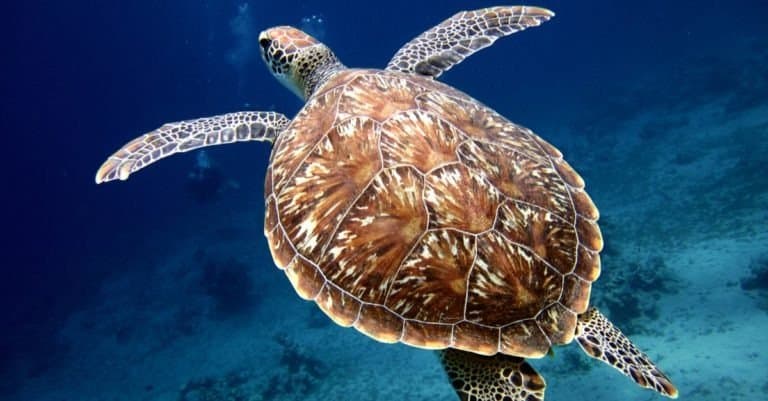
The great migratory sea turtle roams the world’s open oceans, supremely well-adapted for an aquatic lifestyle.

From the first moment it hatches, the life of the sea turtle is a constant struggle for survival. Even if it survives the formidable odds on its journey to the sea, it must then navigate a treacherous world of predators, pollution, and human activity. Despite conservationists’ efforts to bolster numbers, the sea turtle is in danger. It will require a worldwide international conservation effort to save this creature.
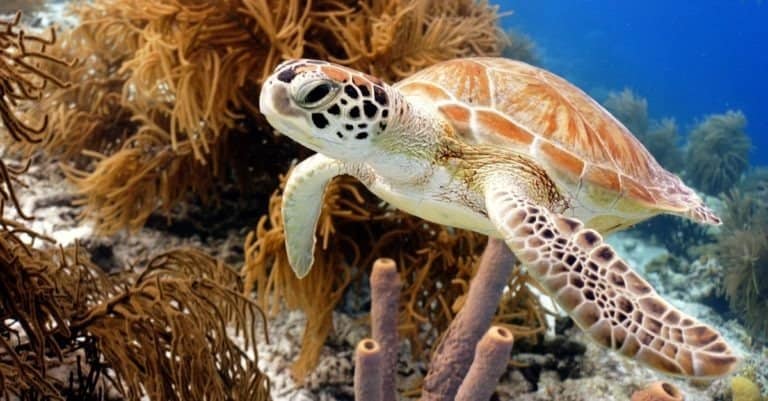
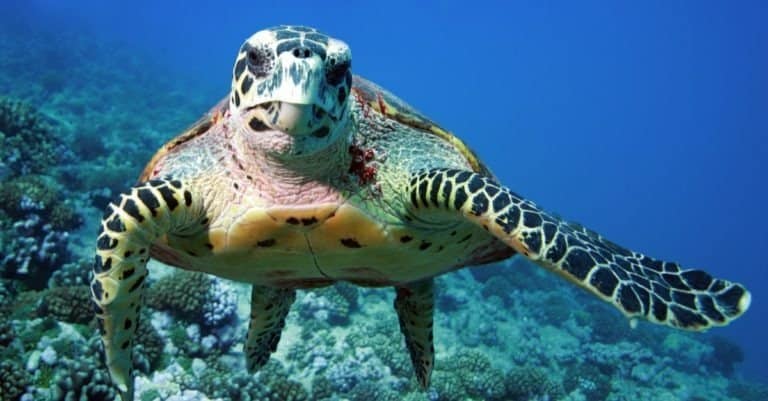
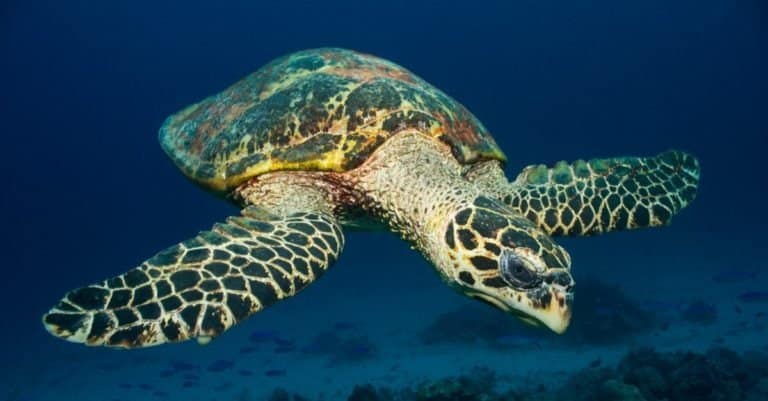
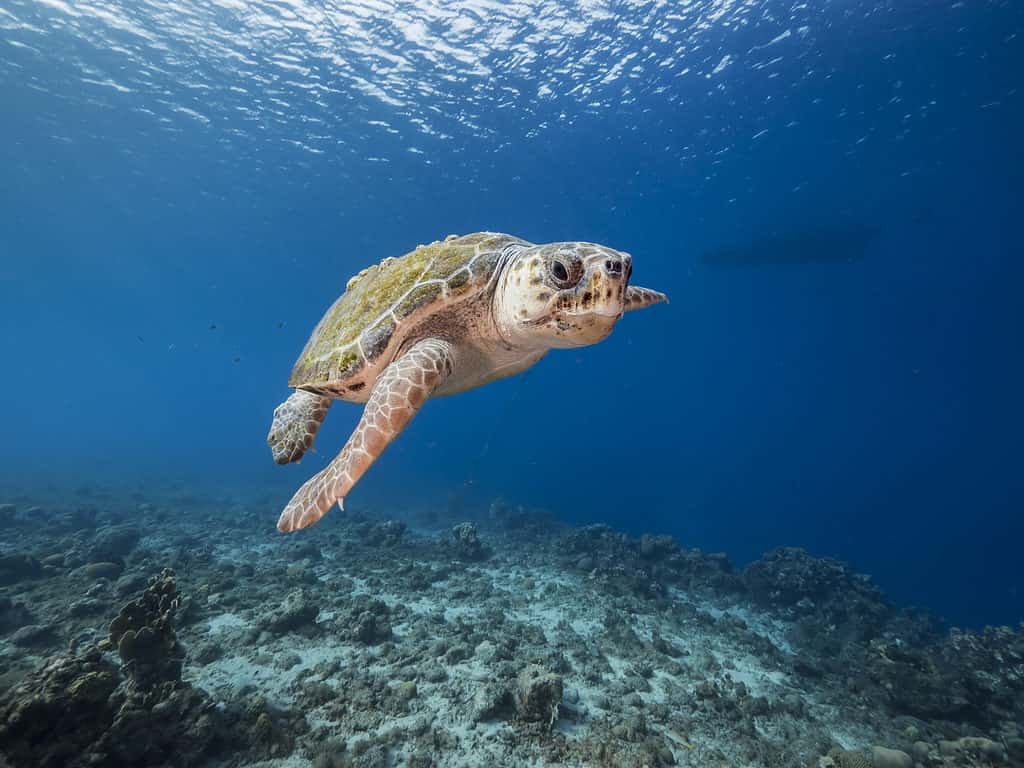
Sea turtle swimming on a reef.

5 Incredible Sea Turtle Facts!

  • Sea turtles lack the ability to withdraw inside of their shells when they are threatened.
  • To navigate the world’s oceans, sea turtles possess the ability to sense the planet’s magnetic field.
  • Sea turtles first evolved in the Late Jurassic Period some 150 million years ago, but the evidence suggests that modern sea turtles have descended from a more recent lineage, probably dating back around 110 million years. Leatherback turtles lived at the same time as the dinosaurs and have changed only modestly since then.
  • One of the more amazing facts is that the leatherback sea turtle can dive up to a depth of 4,000 feet. This is deeper than any other mammal or reptile in the world.
  • Sea turtles can reach incredible sizes. The largest sea turtle ever recorded was a loggerhead that weighed 2,019 pounds! Prehistoric sea turtles were even larger, with the ancient genus Archelon reaching 4,900 pounds.

You can check out more incredible facts about sea turtles.

Scientific Name

The sea turtle is a recognized taxonomical group with two living families. The family of Dermochelyidae, whose scientific name derives from Ancient Greek words meaning skin (derma) and the tortoise (khelus), only include the leatherback sea turtle. The family of Cheloniidae, whose scientific name simply derives from khelone (turtle), has six different species: the loggerhead, Kemp’s ridley, green, flatback, olive ridley, and hawksbill sea turtles. The primary difference between them lies in the composition of their shell. Both families belong to the order Testudines, which includes all known turtles, within the phylum of Chordata.
Sea Turtle

Both families of sea turtles belong to the order of Testudines, which includes all known turtles, within the phylum of Chordata.

Evolution

 Sea turtles are descended from ancestors that date back as far as 230 million years. The fossil remains of the ancient species “Odontochelys semitestacea” date back to the Triassic period. Sea turtles evolved from freshwater and land turtles, and survived the last ice age, when many other animals became extinct.

Other fossils that date back 75 million years belong to the species Archelon Ischyros, an enormous reptile estimated to be 5 meters long and weigh 4,850lbs. It most closely resembles the leatherback turtle.

Types of Sea Turtles

There are two families of sea turtles, Cheloniidae and Dermochelyidae, which contain seven species, described below: 

  • Green Sea Turtle  (Chelonia mydas) – One of the largest species, it inhabits tropical and subtropical waters, is migratory, and is a herbivore.
  • Loggerhead Sea Turtle (Caretta caretta) – Primarily carnivorous species with very large head. It feeds mostly on shellfish.
  • Kemp’s Ridley Sea Turtle (Lepidochelys kempii) – It’s the rarest and most vulnerable species of sea turtles in the world. They are mostly found in the Gulf of Mexico and named after named after Richard M. Kemp, the man who first submitted the species for identification in 1906.
  • Olive Ridley Sea Turtle (Lepidochelys olivacea)– It’s olive green in color with a heart-shaped shell, and the most common of all sea turtle species. It’s found worldwide but listed as endangered.
  • Hawksbill Sea Turtle (Eretmochelys imbricata) – Listed critically endangered. They have a unique beak-like mouth resembling a hawk’s for finding food in cracks and crevices. Diet mainly consists of sponges.
  • Flatback Sea Turtle (Natator depressus) – Native to the beaches and coastal waters of the Australian continental shelf. Its shell is very flat with no ridges.
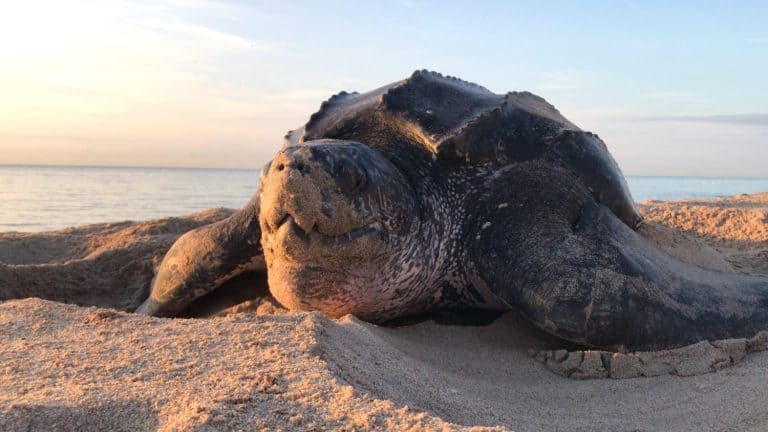
  • Leatherback Sea Turtle (Dermochelys coriacea) – The largest turtle in the world, it lacks a shell and has tough, rubbery skin. Listed as endangered.

Appearance

In order to cope with the harsh life at sea, this turtle has evolved several unique adaptations, including a streamlined body to reduce friction and drag, flippers that allow it to navigate in the water, and rough projections in the throat to prevent food from slipping back up into the mouth. The most prominent feature, the shell, is composed of tough scales known as scutes that offer protection against deadly predators. The leatherback is the only species with a softer shell made from thin rubbery skin and fortified by thousands of small bony plates. Regardless of species, the shells consist of two major parts: the upper carapace and a lower section called a plastron. Each species has an identifiable number and arrangement of scales. However, it is not possible to identify the turtle’s age from its appearance alone.

The sea turtle comes in an enormous range of different sizes. The olive Ridley sea turtle, as the smallest species, can weigh as little as 50 pounds, while the gigantic leatherback sea turtle can reach almost 7 feet long and weigh nearly 2,000 pounds. Both males and females grow to approximately the same size; there are few physical differences between them.
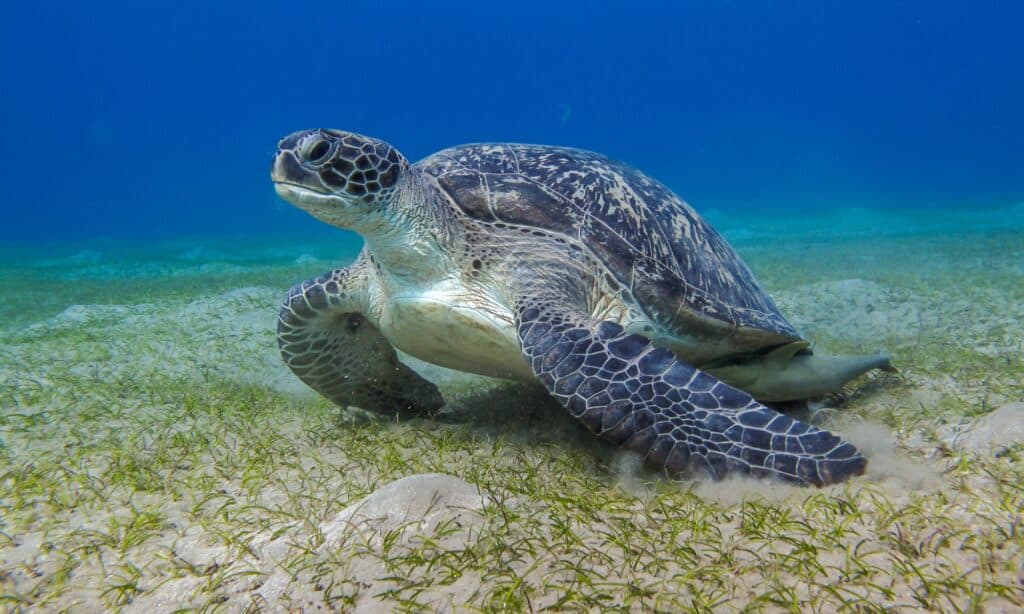
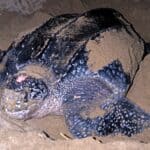
leather-back sea turtle

leatherback sea turtle

Behavior

Sea turtles spend the vast majority of their lives in the ocean. Except when females come ashore to nest, they eat, rest, and copulate almost exclusively in the water. Although they do need to come up for air, sea turtles can remain submerged for up to seven hours at a time by slowing their heartbeat to conserve oxygen. They can go up to nine minutes in between heartbeats. However, stressful situations can cause the turtle to deplete its oxygen quickly, which can lead to drowning.

The sea turtle is not particularly fast (the top speed is only 22 mph), but it is always on the move. It completes an epic annual migration from feeding grounds to breeding areas and then back again. The length of the trip can vary by species, but most travel thousands of miles every year in large groups.

To navigate its underwater environment, the sea turtle has a good sense of smell and sight. And although it lacks visible ear flaps, it does have the ability to hear low-frequency sounds. The eyes also contain special glands that expel the excess salt from the body.

As a cold-blooded reptile, the turtle’s internal body temperature varies considerably in response to environmental conditions. The green sea turtle is the only species known to come up on the beach and soak in the sun outside of the breeding season. Most other species depend on the ambient temperature of the surrounding water to stay warm. However, unlike almost every other species of reptile, the leatherback sea turtle has the ability to maintain a consistent internal body temperature, which allows it to swim in colder waters. This also gives it a higher metabolism than other reptiles.
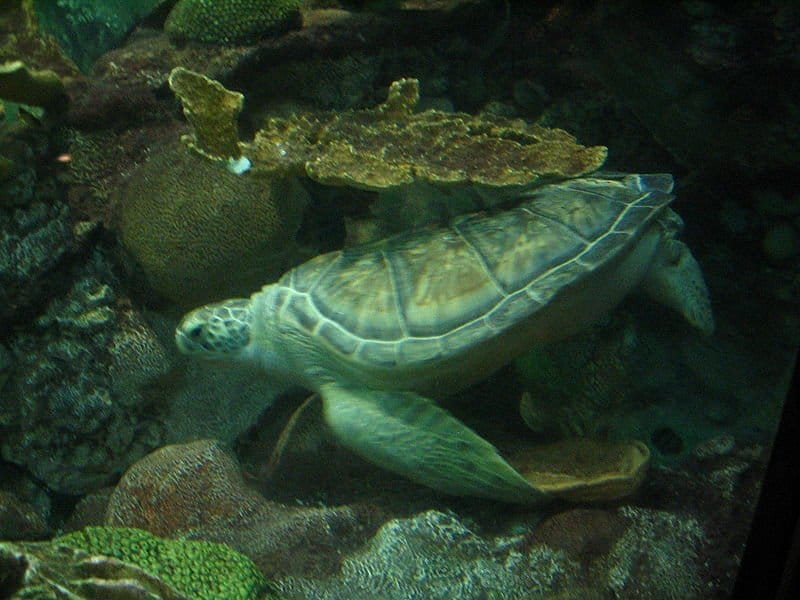
Sea turtles can remain submerged for up to seven hours at a time by slowing the heartbeat to conserve oxygen.

Habitat

These turtles inhabit almost every marine environment on the planet except for the most extreme polar regions, but it is most common around the tropics and subtropics. Two species in particular have a more localized distribution. The flatback sea turtle is found around the marine waters of Australia, while Kemp’s ridley turtle inhabits the Gulf of Mexico and the East Coast of the United States. Except for some populations of green sea turtles, the male spends his entire life at sea, while the female comes up on the beach to give birth in the breeding season.
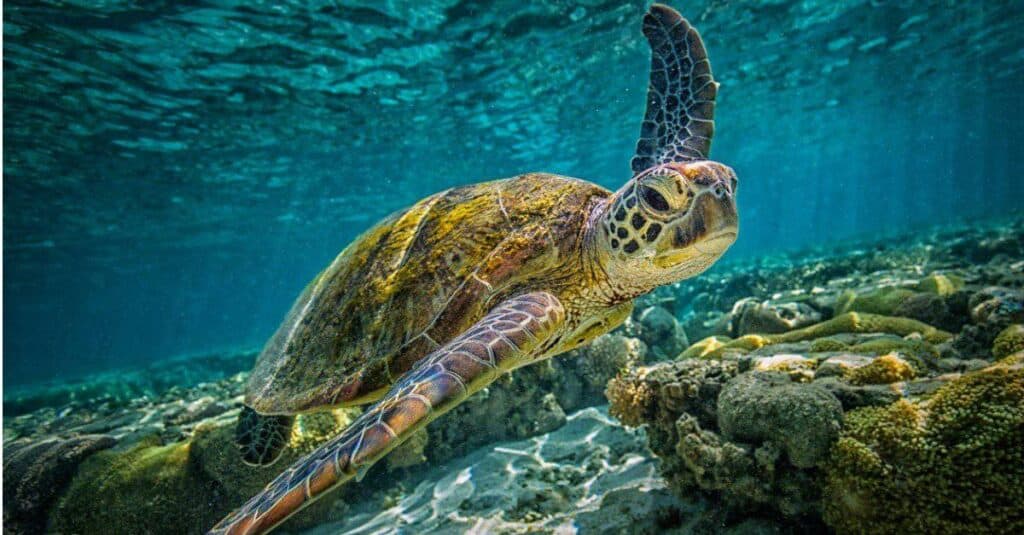
Turtles breathe out of their butts

The most common habitat for sea turtles is marine environments around the tropics and subtropics.

Diet

These turtles have a remarkably diverse diet which can vary by species, location, and age. Some are specialized to feed only on certain foods, while others are generalists that feed on whatever they happen to find.

What does the sea turtle eat?

The loggerhead, olive ridley, hawksbill, and Kemp’s ridley sea turtles all share an omnivorous diet that consists of seaweed, seagrasses, sponges, mollusks, worms, fish, and much more. Most species have a sharp beak and mouth that’s specially adapted for reaching into the narrow crevices of coral reefs and extracting food. The leatherback turtle is slightly different since it tends to specialize in jellyfish. As a result, it has evolved immunity to the jellyfish’s sharp sting. The green turtle starts life as an omnivorous species, feasting on jellyfish and invertebrates, and then becomes a pure herbivore as an adult. With a serrated mouth, it feeds on a selection of seagrasses and algae, which give its body (though not the shell) a prominent green color.
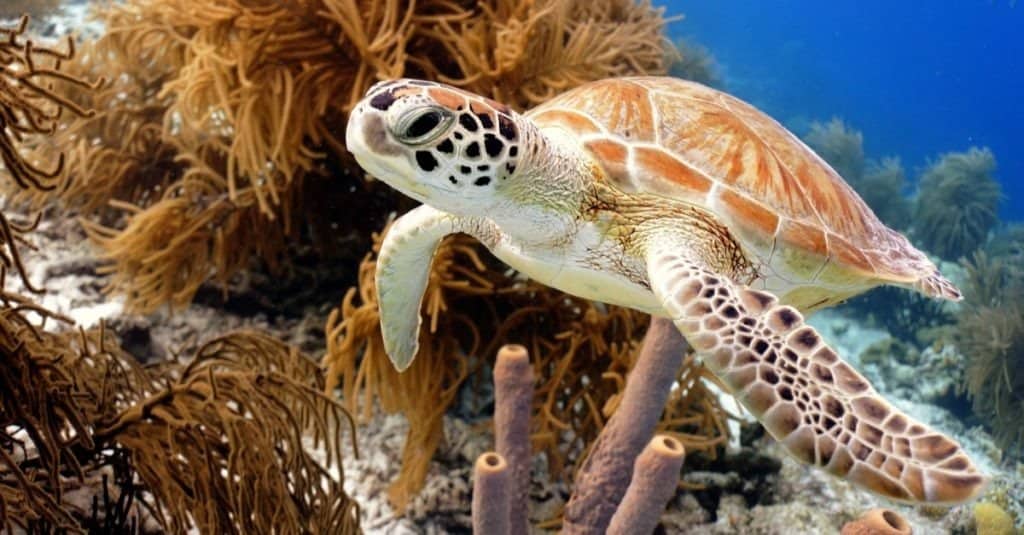
Green Sea Turtle swimming along tropical coral reef, Bonaire

Most sea turtles feed on seaweed, seagrasses, sponges, mollusks, worms, fish, and more.

Predators and Threats

Life for a sea turtle is filled with many dangers and threats, not all of which come directly from predators. Coastal development, habitat loss, and pollution have all limited the turtle’s natural range, while deaths from human activity, either due to intentional hunting or bycatch, are still prolific. Climate change is also a threat, though not just in the way you might expect. Because the surrounding ambient temperature determines the sex of the offspring, climate change is also tilting the sex ratio in favor of females.

What eats the sea turtle?

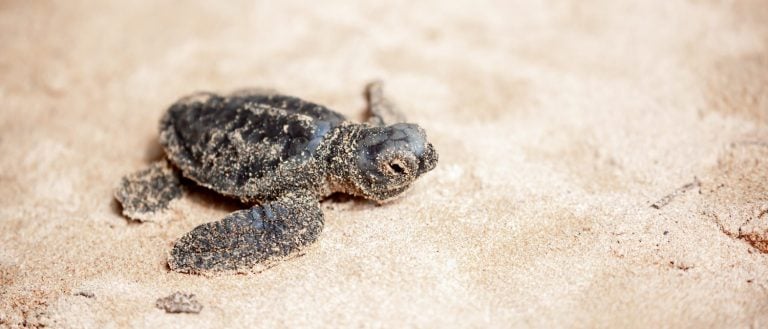
An adult turtle only has a few predators in the wild, including sharks, crocodiles, and in its nesting phase, large land mammals like jaguars. A newly born baby turtle has much to fear from raccoons, foxes, seabirds, and other predators on its journey back to the sea. But the water offers no respite either, since it may be preyed upon by seabirds, fish, and larger sea turtles.
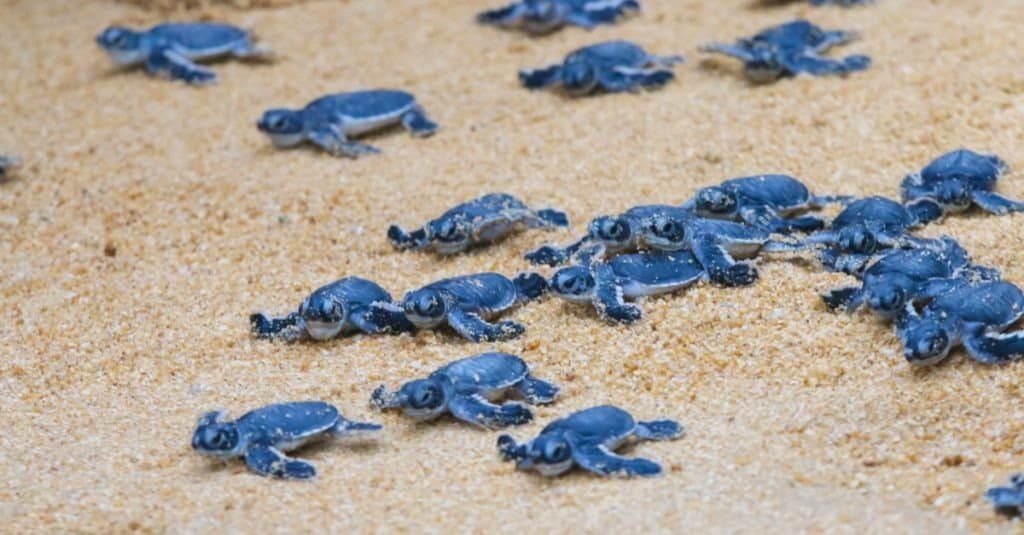
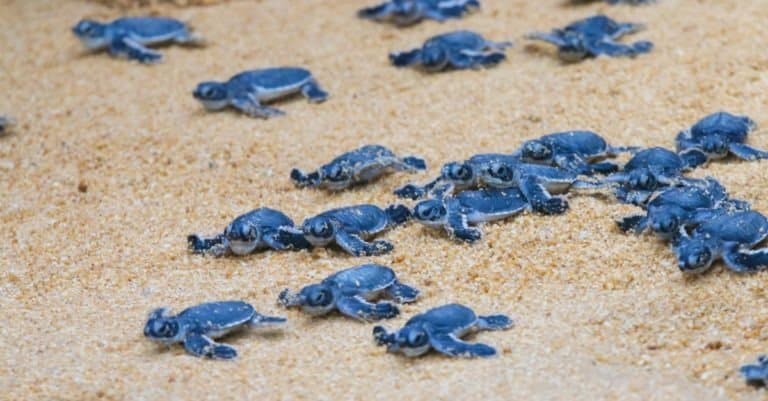
Sea turtle hatchlings on the sand

Baby sea turtles are preyed on by seabirds, raccoons, foxes, and other predators as they try to make their way to the ocean.

Reproduction, Babies, and Lifespan

These turtles mate in the open ocean at some point in the breeding season. Once she’s impregnated, the female comes to the shore and then digs a hole in the sand to lay about 65 to 180 eggs per nest. Each nest is laid about two weeks apart over the course of several months. In total, this can result in two to eight clutches of eggs per breeding season. One of the more unusual facts is that the temperature of the surrounding environment determines the sex of the turtle. As temperatures climb, more females are produced.

Most turtles nest at night. Only Kemp’s Ridley turtles nest during the day. The eggs take about 60 days to hatch, during which time they receive no explicit protection from the mother. As the hatchlings emerge from the eggs, they begin the long, dangerous journey back to the sea. At this stage, many baby turtles fall victim to birds, mammals, and other voracious predators. Coastal lights might also cause the turtle to head in the wrong direction.

Once it reaches the sea, the baby turtle probably spends the early part of its life floating among giant beds of weeds or grasses, feeding and growing. After achieving the size of about a dinner plate, it moves to the more traditional feeding grounds. These turtles take an exceptionally long time to develop. They don’t reach sexual maturity until at least 15 years of age, sometimes much more. Depending on the species, the lifespan is usually somewhere between 50 and 100 years, but most young don’t survive the first few years of life.
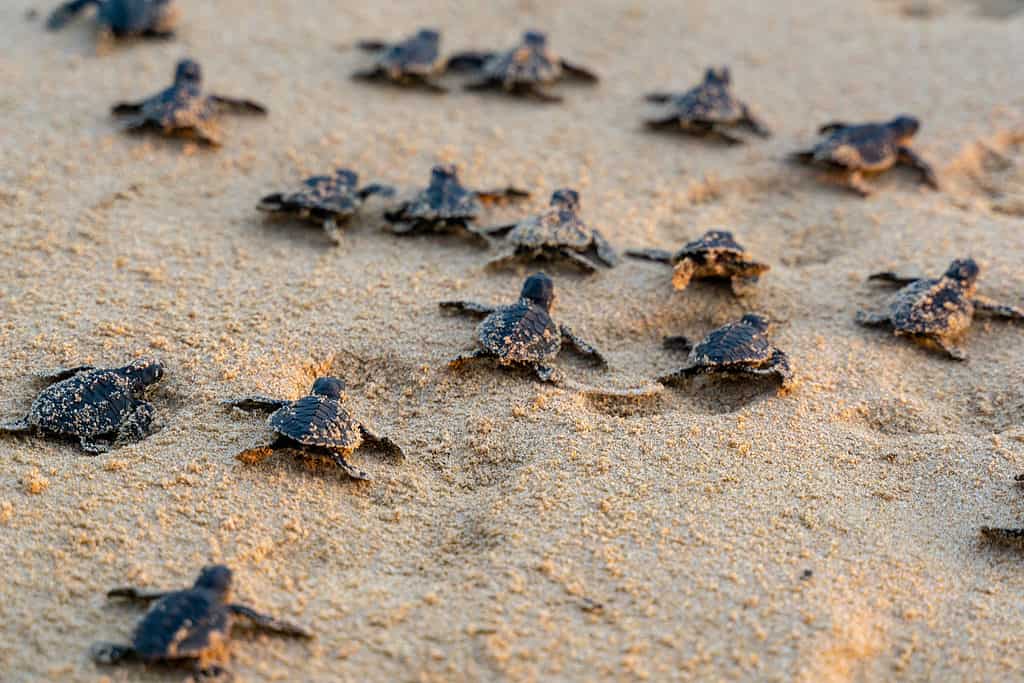
Baby sea turtles running towards ocean

As sea turtle hatchlings emerge from their eggs, they begin the long, dangerous journey back to the sea.

Population

According to the IUCN Red List, three species are classified as endangered or critically endangered: the hawksbill turtle (which has more than 8,000 nesting females), Kemp’s ridley turtle (which has about 22,000 mature individuals), and the green turtle. Three more species are classified as vulnerable: the olive ridley turtle (with up to 800,000 nesting females), the leatherback turtle (which may have 30,000 to 100,000 mature individuals), and the loggerhead turtle. The flatback sea turtle is data deficient and not classified properly.

Learn more about the most endangered species in the world here.

Because there are so many threats, most conservancy efforts take a multi-pronged approach: reducing the incidence of hunting and poaching, altering fishing methods to end bycatch, restoring the natural habitat of the beach, minimizing the amount of trash and pollution in the marine environment, and mitigating the worst effects of climate change. According to the World Wildlife Fund, fishers can reduce bycatch by 60% to 70% alone just by putting lights in their gill nets to deter turtles. Circle hooks also seem to be an effective means to reduce bycatch. But it will take many people working on multiple fronts to improve conservancy efforts.

Sea Turtles in the Zoo

It may be an uncommon exhibit, but these turtles can be found in specialized aquariums across the country. The Houston Zoo rescues and rehabilitates injured or distressed sea turtles at its Kipp Aquarium, while the Columbus Zoo keeps a hawksbill sea turtle at its shores and aquarium section. The National Aquarium in Baltimore was once home to a fan favorite three-flippered green sea turtle named Calypso, who passed away in February of 2020.

View all 390 animals that start with S

Sources

  1. National Geographic / Accessed February 3, 2021
  2. NOAA Fisheries / Accessed February 3, 2021
  3. Sea Turtle Conservancy / Accessed February 3, 2021
  4. Smithsonian / Accessed February 3, 2021
  5. WWF / Accessed February 3, 2021
Abby Parks

About the Author

Abby Parks

Abby Parks has authored a fiction novel, theatrical plays, short stories, poems, and song lyrics. She's recorded two albums of her original songs, and is a multi-instrumentalist. She has managed a website for folk music and written articles on singer-songwriters, folk bands, and other things music-oriented. She's also a radio DJ for a folk music show. As well as having been a pet parent to rabbits, birds, dogs, and cats, Abby loves seeking sightings of animals in the wild and has witnessed some more exotic ones such as Puffins in the Farne Islands, Southern Pudu on the island of Chiloe (Chile), Penguins in the wild, and countless wild animals in the Rocky Mountains (Big Horn Sheep, Mountain Goats, Moose, Elk, Marmots, Beavers).
Connect:

Thank you for reading! Have some feedback for us?


Sea Turtle FAQs (Frequently Asked Questions)

Sea Turtles are Omnivores, meaning they eat both plants and other animals.