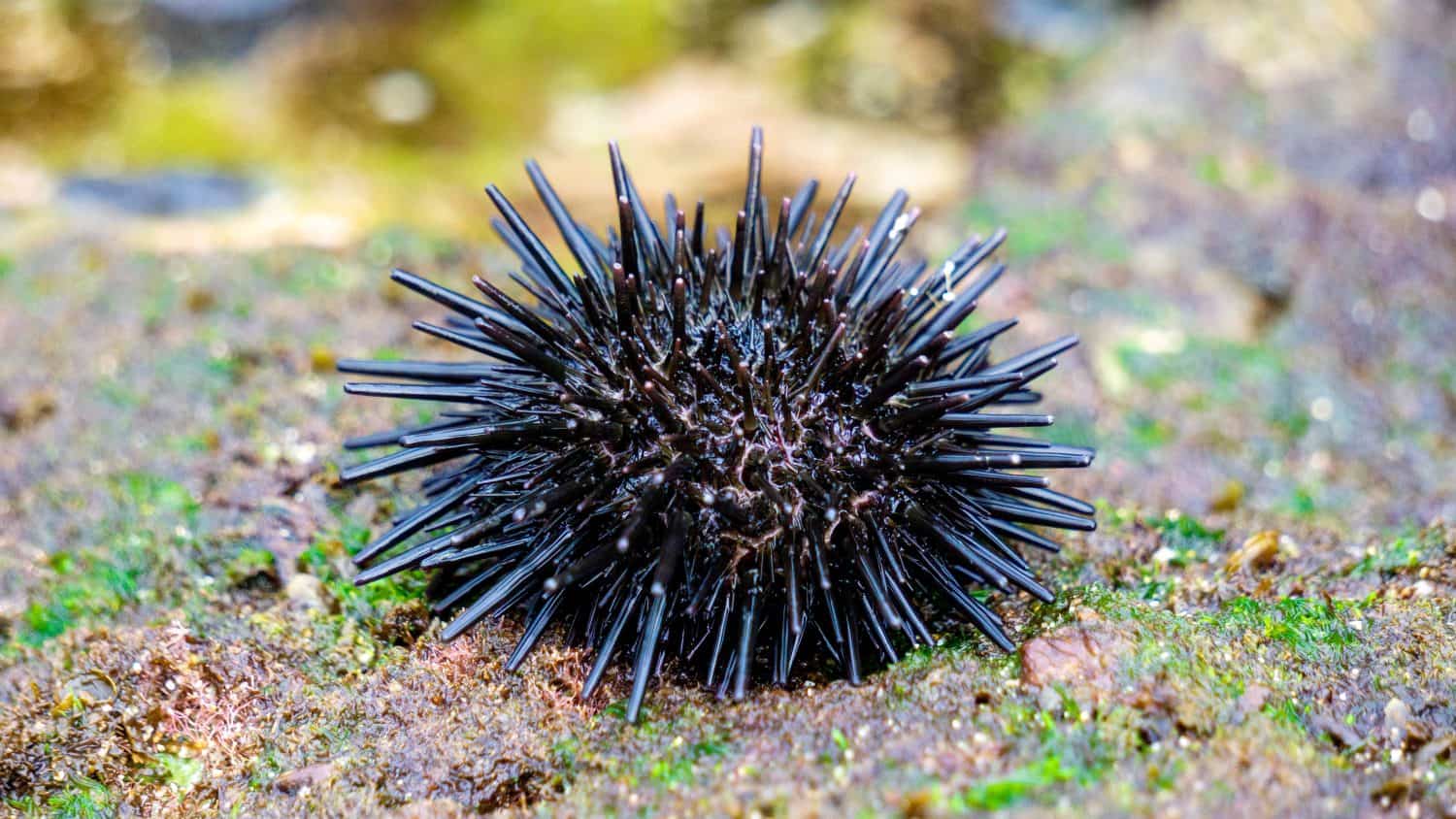
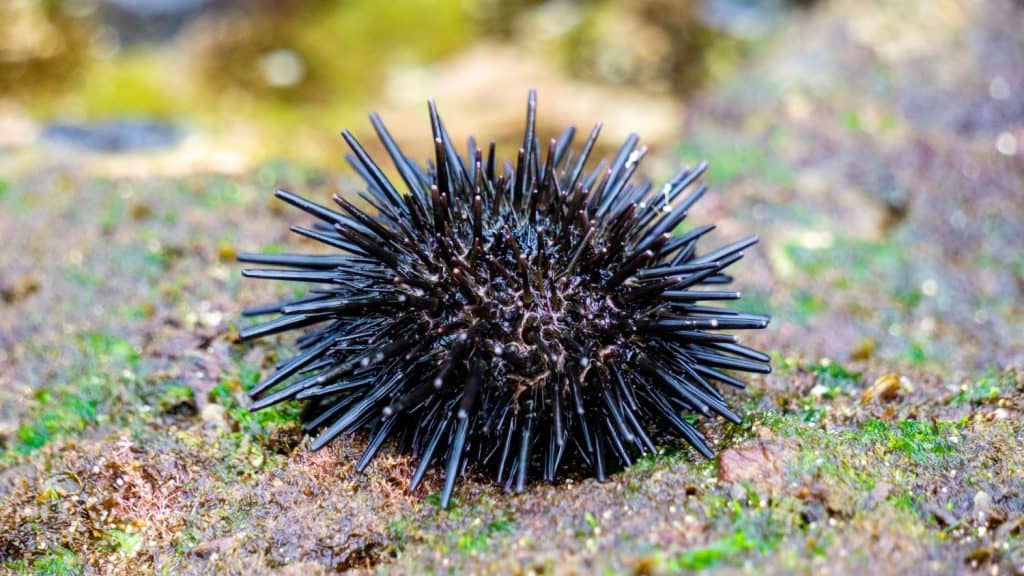
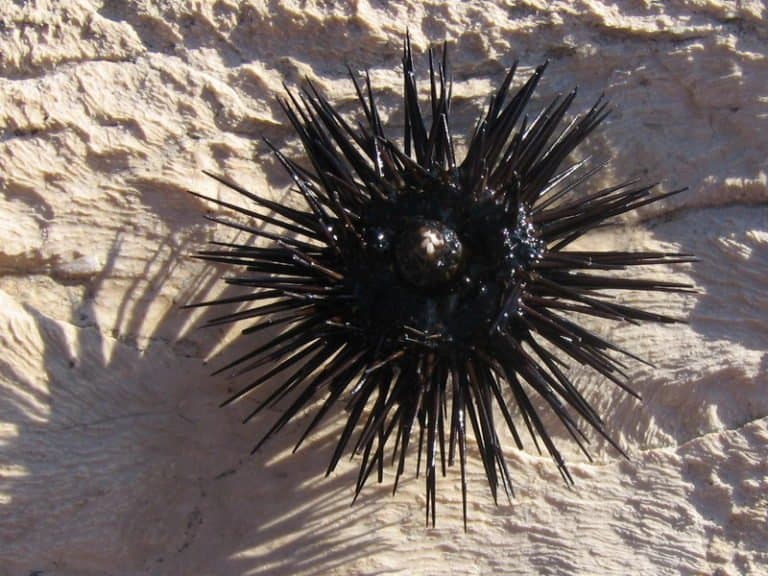
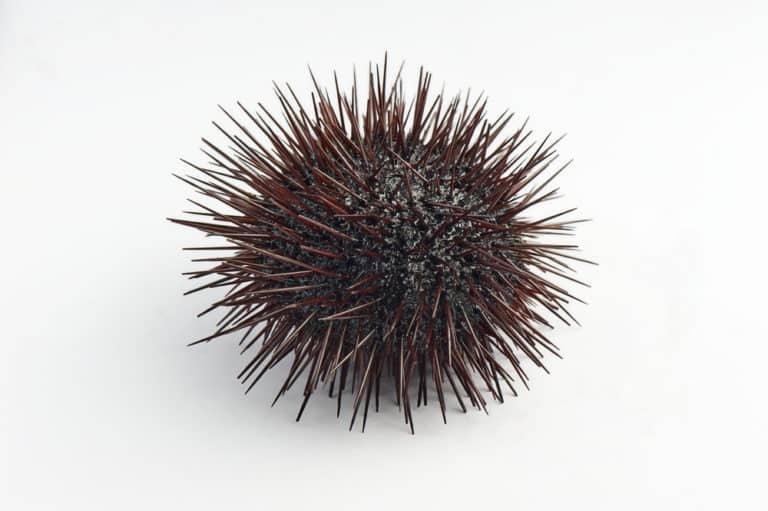
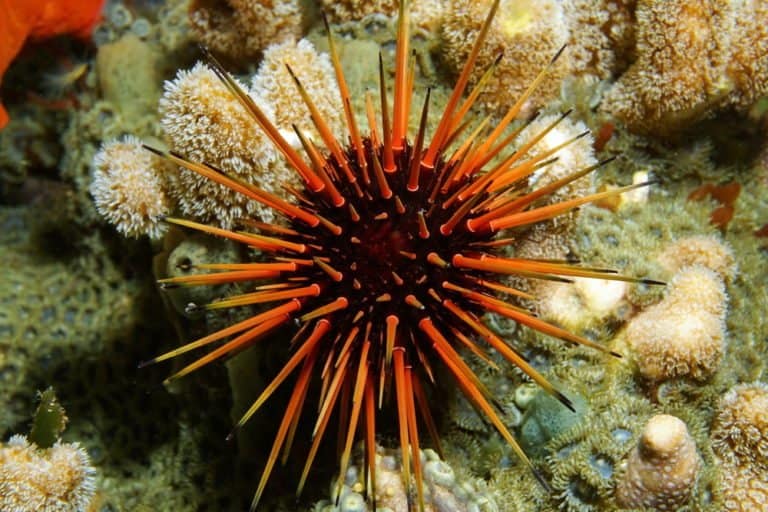
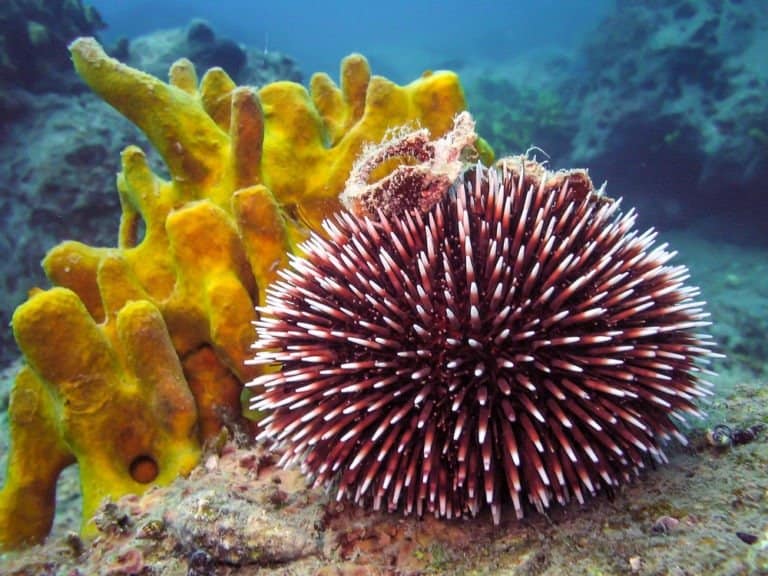
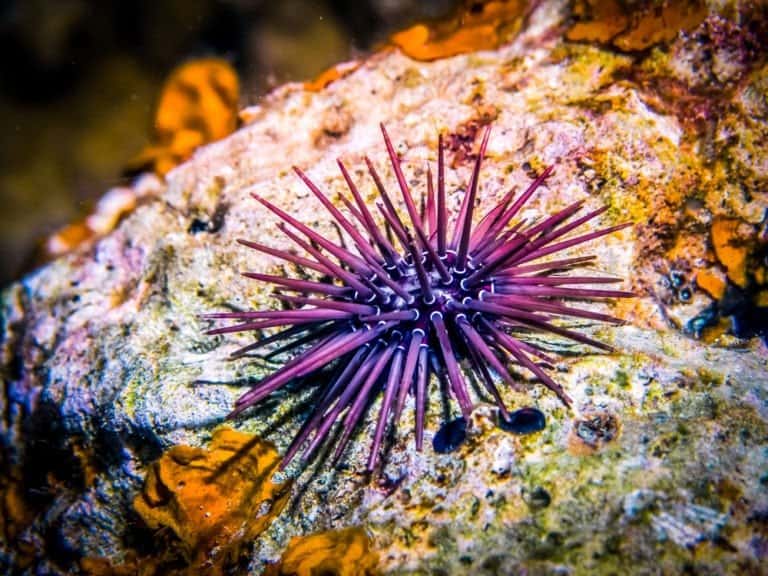



Sea urchins are animals that are typically small, spiny, and round. They live in all the earth’s oceans, at depths ranging from the tide line to 15,000 feet. Because they cannot swim, they live on the sea floor. Their main defense against more agile predators like eels and otters is their hard, spiny shell called a ‘test.’
3 Sea Urchin Facts
- Secret weapon: The carrier crab uses a sea urchin like a suit of armor for extra protection from predators.
- Five-fold symmetry: The bodies of mature sea urchins contain five symmetrical sections, unlike mammals, which have two.
- Shy of the spotlight: They have no detectable eyes, but experts suspect their entire body is a compound eye that is sensitive to light.
Classification and Scientific Name
Sea urchins are classified in the Echinodermata phylum and the Echinoidea class. Some sea urchins are in the Camarodonta order, and families such as Echinidae and Strongylocentrotidae, which include genera like Strongylocentrotus and Lytechinus.
History and Origins
Sea urchins form colonies in the ocean for a specific purpose. When they spawn, males release sperm, and females release eggs that then fertilize when they meet. This is why larger colonies are advantageous, as they have a better chance of producing more embryos. Sea urchins have been around for an astounding 450 million years, constantly adapting to environmental changes to survive. It’s remarkable that such a creature with no brain can stay alive for so long.
Sea urchin fossils have been found dating as far back as 450 million years ago, to the Middle Ordovician period. The hard calcite plates of these creatures are well-preserved in rocks from this time period, with some specimens even having spines. Isolated spines are also commonly found as fossils. Some of the Cidaroida from the Jurassic and Cretaceous periods had club-shaped spines that were quite heavy.
Fossils of sea urchins from the Paleozoic era are often incomplete and consist of spines and pieces of crushed individuals. Estonia is well-known for its Ordovician and Silurian period shallow-water limestones featuring sea urchins. These ancient sea urchins likely lived in calmer waters, as their thin shells would not have been able to withstand being in more turbulent seas like some present-day species. During the Paleogene and Neogene periods, 66 to 1.8 million years ago, sand dollars emerged with flattened shells and small spines that were adapted for life in shallow water or even under the sand. These fossils are common in southern European limestones and sandstones.
Species
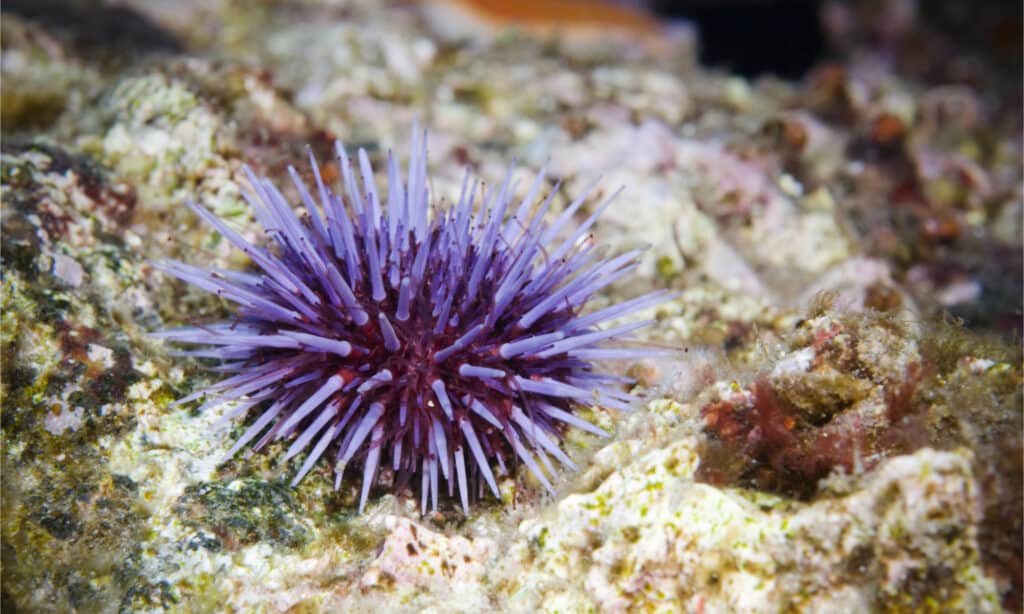
There are hundreds of species of sea urchins.
©NatalieJean/Shutterstock.com
Some of the more interesting types of the 950 species include:
- Strongylocentrotus purpuratus, the Pacific purple sea urchin, is a key ingredient in uni sushi.
- The inky black Diadema sea urchin helps keep Caribbean coral reefs healthy by keeping plant growth down.
- Toxopneustes pileolus, whose common name is flower urchin, is among the most toxic. It inhabits the warm oceans of the Western Indo-Pacific region.
- The giant red sea urchin, or Mesocentrotus franciscanus, is the largest species, with its test averaging about 18 centimeters (seven inches) across and spines eight centimeters (three inches) in length. It inhabits the coastal Pacific waters of North America.
- Heterocentrotus mamillatus, the slate pencil urchin, lives in tropical Indo-Pacific oceans. It has stubby spines with rounded, striped ends that can bore into rock.
- Echinarachnius parma, known by the common names of sand dollar, sea cookie, or pansy shell, is a flat sea urchin that has short spines called cilia for burrowing into the sand. It lives in seas throughout the Northern Hemisphere.
- The green sea urchin, Strongylocentrotus droebachiensis, is one of the 18 edible species. Processors harvest the gonads, glands within the shell, primarily for use in Japanese uni sushi. Green sea urchins live in the Northern Atlantic waters.
Appearance
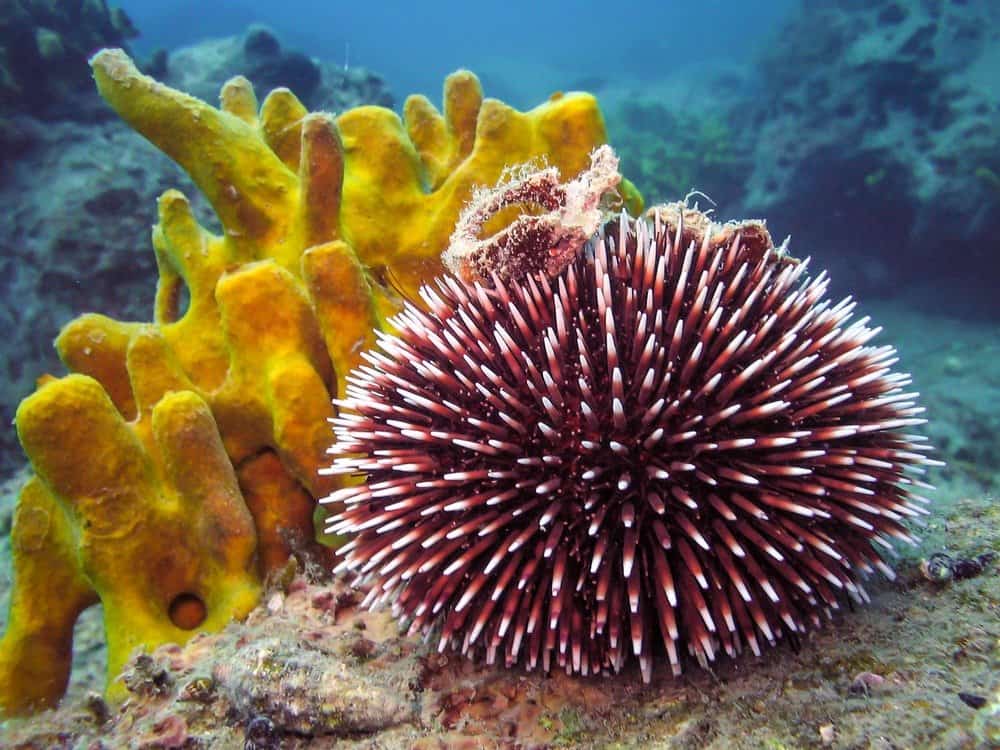
Sea urchins are animals.
©JGA/Shutterstock.com
Sea urchins are small sea animals that have spherical shells called tests that are typically covered in spines similar to those of a porcupine. Very small tube-shaped feet among the spines help them move slowly along the ocean floor. They come in just about every color, from black to white, red, orange, green, brown, purple, pink, yellow, blue, and gray. They range in size from about an inch in diameter up to 14 inches. On average, they weigh about one pound.
Because there are nearly one thousand types of sea urchins, these animals can vary significantly in appearance. You can easily identify most of them by their spiny exteriors, but some, like sand dollars, have only short hairs all over their bodies. Others, like pencil sea urchins, have rounded-off spines that are not sharp like typical urchin spines.
Distribution, Population, and Habitat
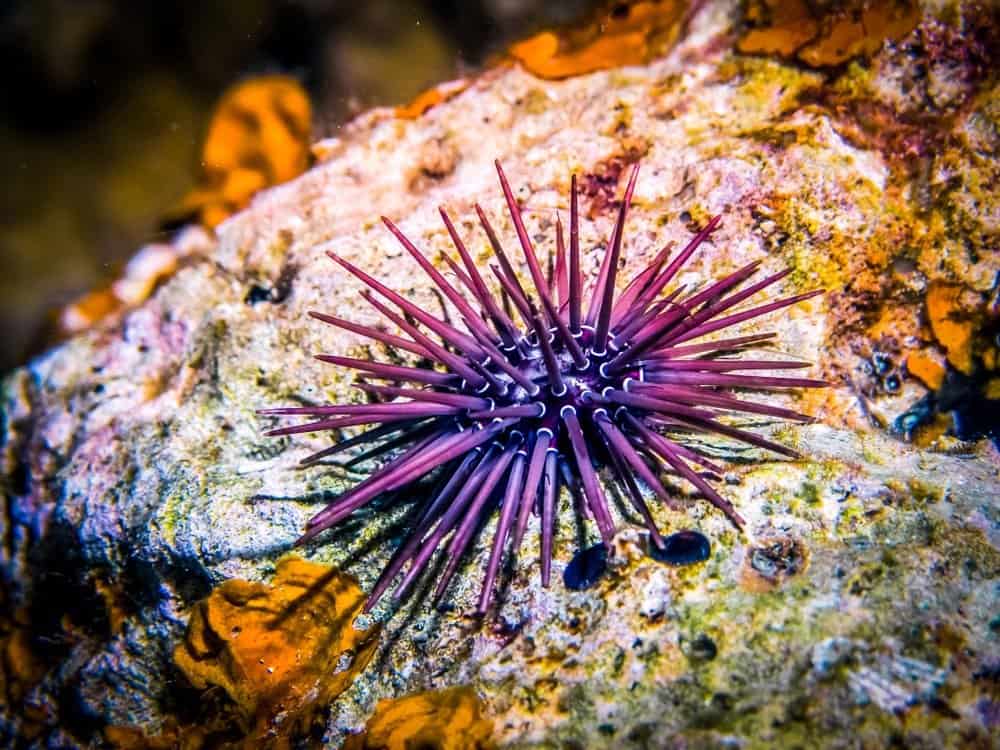
Sea urchins live in every ocean in the world.
©HotFlash/Shutterstock.com
Sea urchins live in oceans throughout the world. Arctic or tropic, shoreline or deepest sea trenches, you can find them there. Because they cannot swim, the ocean floor is their home. Some, like the shingle urchin, live in the shallows near beaches where the sun shines. Others, like the ones in the Pourtaleslidae family, live so deep below the surface that they are in total darkness.
Barren underwater areas have dense populations of these creatures, and populations nearer to the shore are the densest by far. While they live throughout the world, the greatest numbers live in temperate and tropical ocean habitats in the shallows up to ten meters down, where the plants they eat are plentiful.
With so many types and such a wide-ranging habitat, it is impossible to know for sure. However, a recent marine study in Oregon estimated that the purple species population on just one coastal reef numbered around 350 million, a figure that represented a 10,000-fold increase in just a few years, putting them in the least concern conservation category. Researchers attributed the exponential expansion of this Pacific coast class of urchins to a marine ecosystem that is out of balance.
Meanwhile, in the Mediterranean, the purple sea urchin population is currently in a near-threatened state. Factors that have decimated the species include warming sea temperatures and invasive fish that eat algae, depriving the urchins of a dietary staple. Again, the underlying cause is an imbalance in the ecosystem.
However, scarcity of food does not necessarily mean the species is headed for extinction. Purple urchins can go dormant and survive with no food for years at a time. With such extraordinary persistence, these populations may ebb, but they also flow.
Predators and Prey
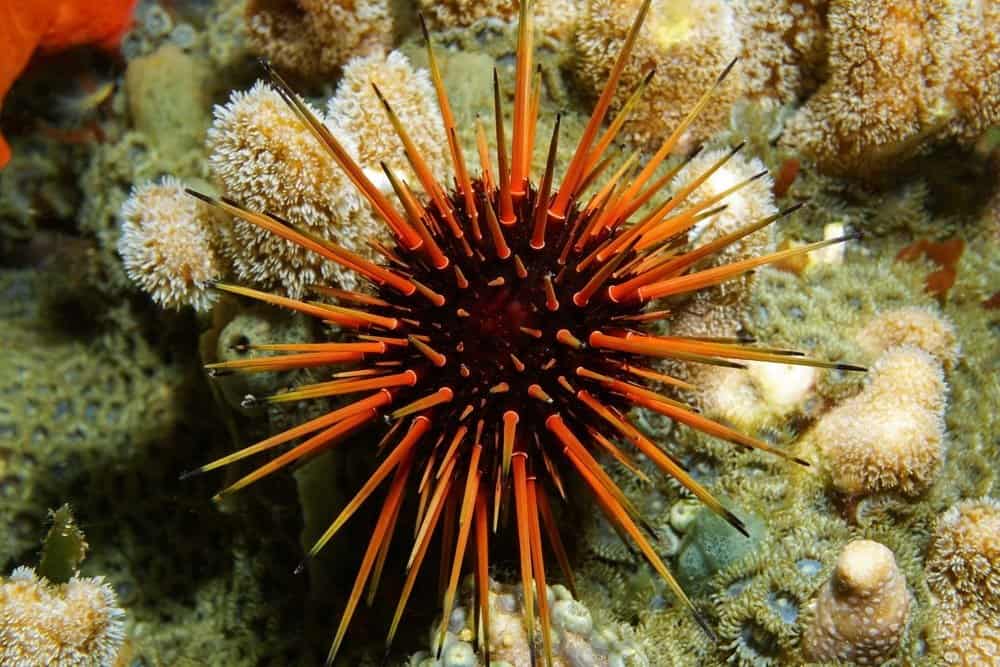
Sea urchins are vulnerable to bacterial diseases.
©Damsea/Shutterstock.com
Despite their inborn resiliency, sea urchins are subject to threats from disease as well as predators. A 1981 bacterial disease nearly wiped out the Hemicentrotus pulcherimus and Pseudocentrotus depressus species in Japan. Bald sea urchin disease, another bacterial illness, threatens some sea urchin populations, causing the animals’ spines to fall out and leave them defenseless against predators.
What Eats Sea Urchin?
Shellfish like crabs and lobsters are among these creatures’ natural predators. Triggerfish and wrasse are two fish that prey on them. The wolf eel is specially equipped to hunt and eat those in the Northern Hemisphere. Sea otters in regions like British Columbia help maintain ecological balance by keeping urchins from overpopulating.
Although they are slow-moving, sea urchins do have some means of protecting themselves. Their sharp spines are often enough to discourage some predators. A few urchin species are venomous, too.
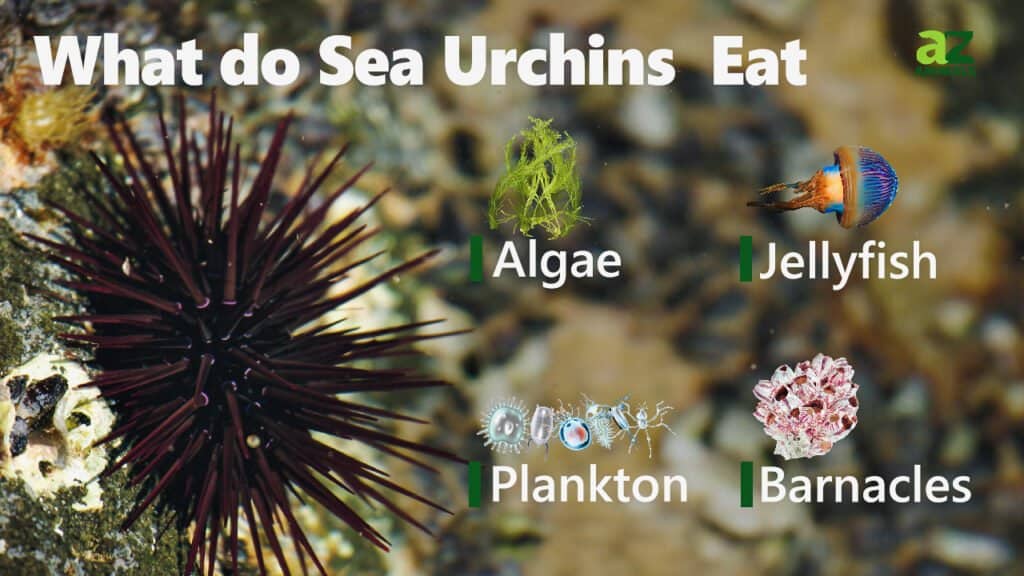
What Do Sea Urchins Eat?
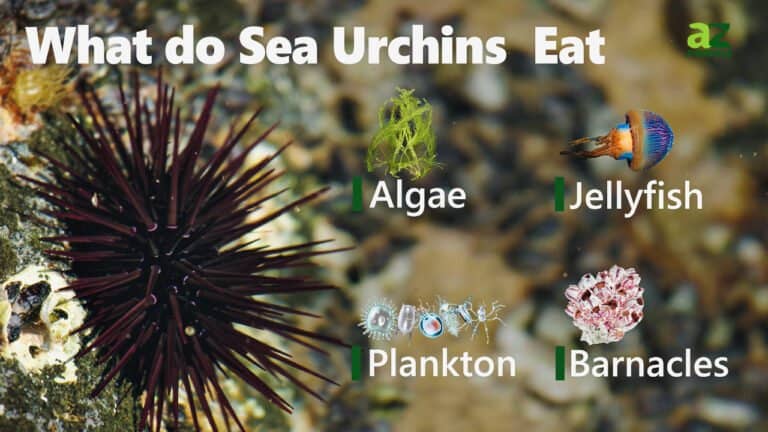
Sea urchins mainly eat marine vegetation like algae and kelp. They also prey on sessile, or immobile, sea creatures such as coral and sea sponges.
Reproduction and Lifespan
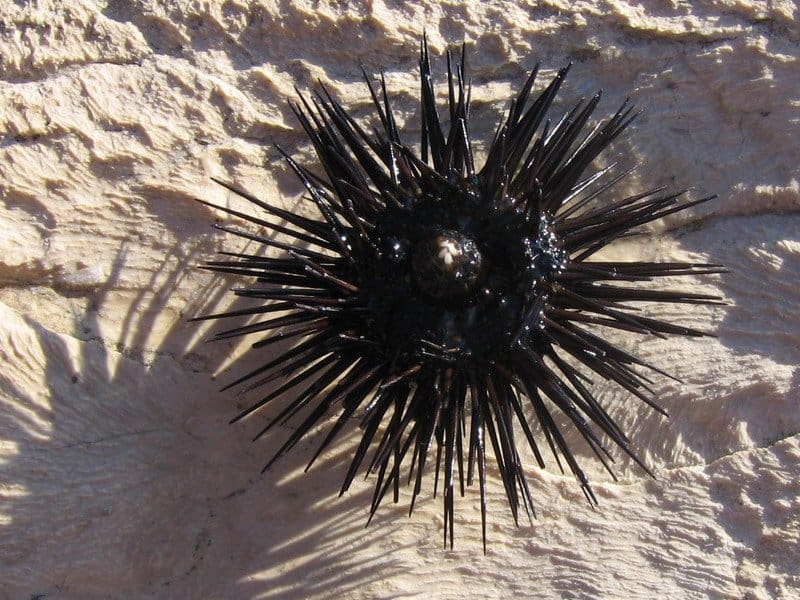
Sea Urchins eat sea vegetables.
©Lacen – Public Domain
Females of the species produce eggs. Most release these eggs into the sea for fertilization by the sperm that males have released. The females of a few species hold their eggs among their spines rather than let them float freely.
Once fertilization occurs, it takes only about 12 hours for the egg to become an embryo. Soon thereafter, the embryo becomes a larva with cilia that can collect microscopic food to nurture its growth. It takes several months for the larva to transform into a fully developed sea urchin. It will grow for a few more years to reach adulthood. Depending on the species, they live for several years. For example, the purple species has a life expectancy of around 20 years.
Fishing and Cooking
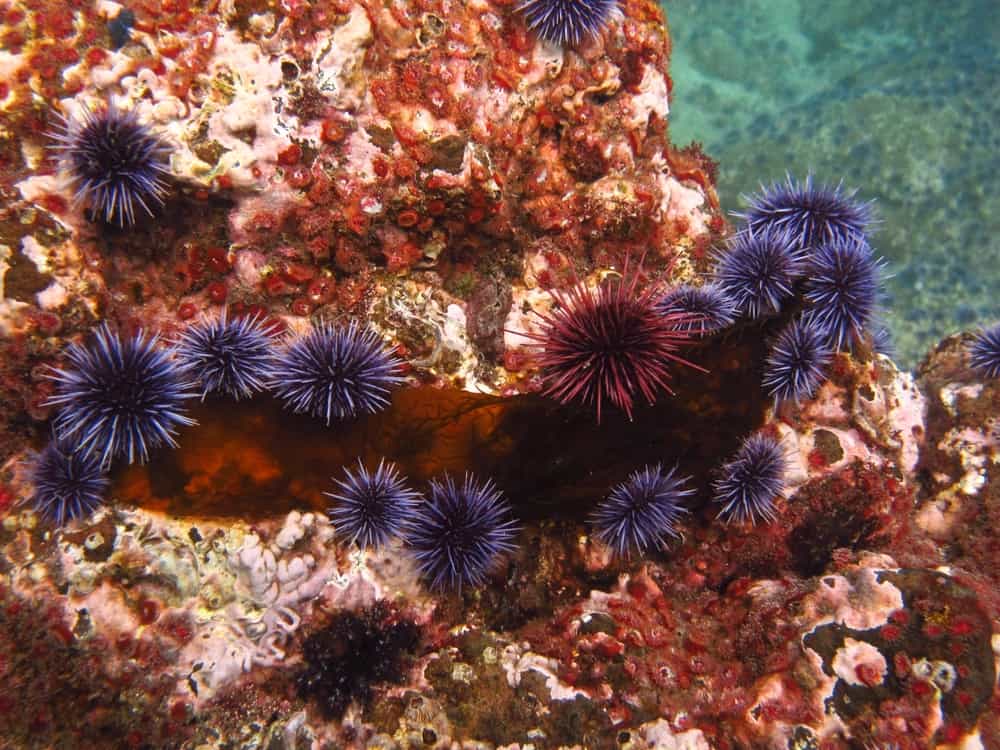
Purple and red sea urchins eat a piece of kelp.
©Brandon B/Shutterstock.com
In many international cuisines, from Alaska to New Zealand, the gonads, or roe, are a delicacy. Typically, people eat them raw with lemon juice or olive oil. In other regions, chefs incorporate the roe in gourmet sauces, omelets, and soups.
The Japanese enjoy the roe in uni sushi. They consume about 50,000 tons of urchin roes per year, which amounts to approximately 80 percent of the world’s commercially processed supply.
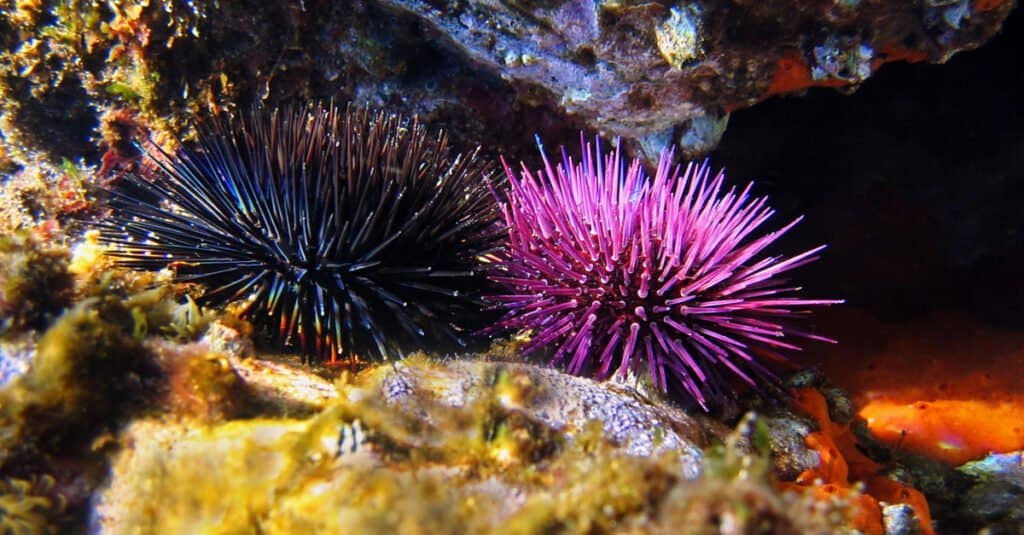
Sea urchins use their spiked shells to protect themselves from predators.
©Damsea/Shutterstock.com
Sea Urchin Pictures
View all of our Sea Urchin pictures in the gallery.

Lacen - Public Domain
Sources
- Wikipedia / Accessed November 8, 2019
- WHOI / Accessed November 8, 2019
- The Guardian / Accessed November 8, 2019
- Britannica / Accessed November 8, 2019
- The perils of reduced pH on sea urchin development, Jessica Poppe, Tufts University / Accessed November 8, 2019
- National Geographic / Accessed November 8, 2019
- Field Marine Biology / Accessed November 8, 2019
- Oceana / Accessed November 8, 2019
- Scuba Diving / Accessed November 8, 2019
- National Library of Medicine / Accessed November 8, 2019