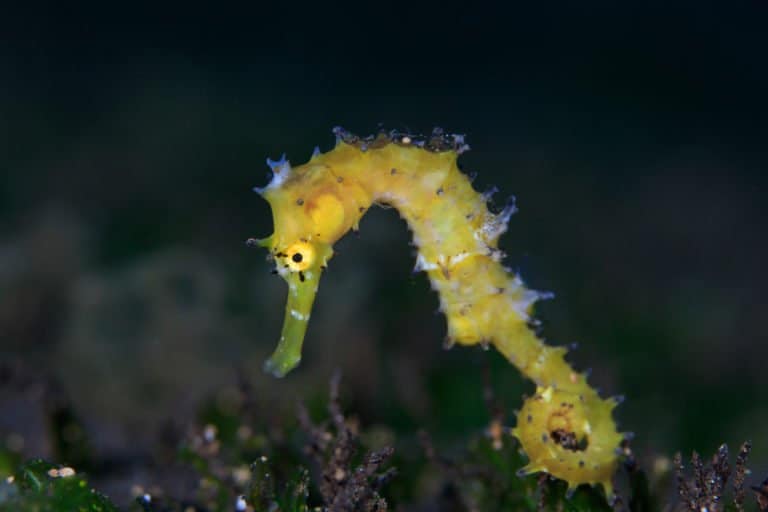
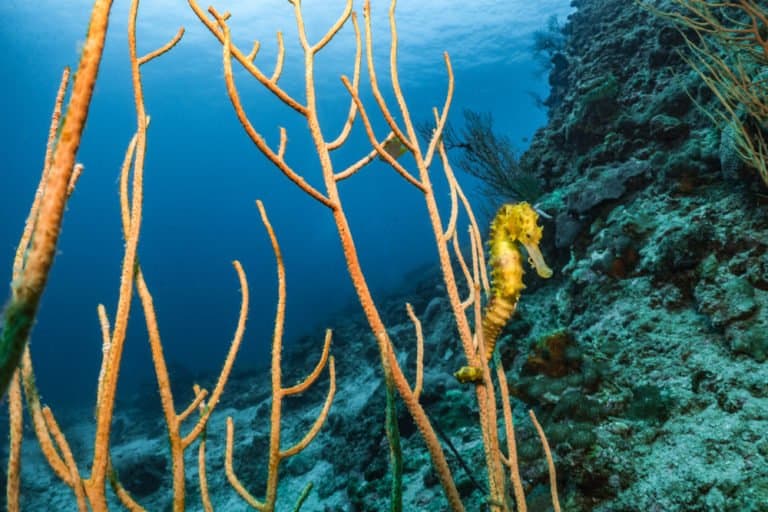
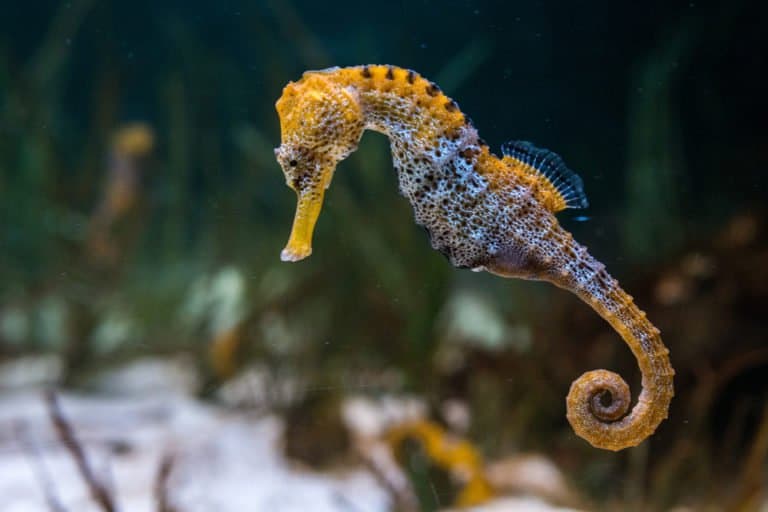
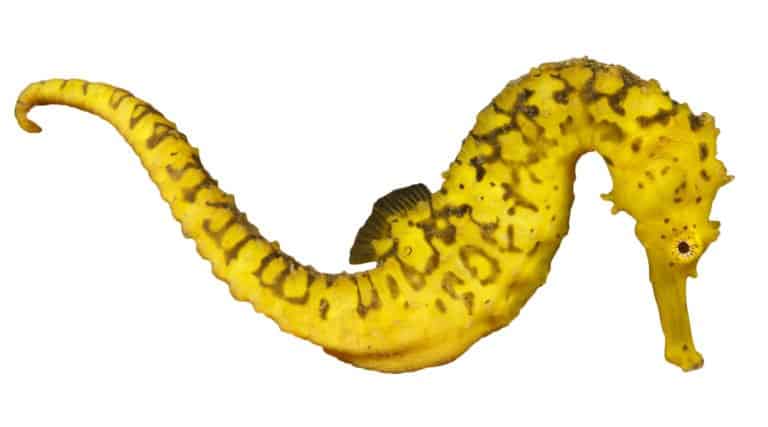

The seahorse is a small family of vertebrate species that is found in tropical shallows and temperate waters around the world. The seahorse is a fish that is also commonly found around coral reefs, where there is plenty of food and places for the seahorse to hide.
Five Facts About Seahorses
- The seahorse is the slowest-moving marine fish in the world: According to the Guinness Book of World Records, the dwarf seahorse is the slowest-moving marine fish in the world. Its reported top speed is just 60 inches per hour!
- They’re a fish: The seahorse has a shape that’s instantly identifiable and looks very little like other fish species. However, the seahorse is a type of fish that’s closely related to pipefish and seadragons.
- Seahorses don’t have stomachs: Seahorses are fish that have digestive tracts that lack a stomach! That means they have to eat nearly continuously to stay alive.
- Male seahorses give birth: It’s true, male seahorses get pregnant and give birth to more than a thousand offspring at once! Female seahorses lay their egg in a male’s pouch, which is fertilized. After about three weeks of the seahorse embryos developing, they’re ejected from the male’s pouch at an extremely rapid rate (you’ll want to see the video on what this looks like below!)
- Seahorses are romantics and will “dance” for days before choosing their mates: Many seahorse species are monogamous, meaning a single male and female pair will mate for their entire lives. In addition, seahorse courtship often involves a “dance” that can last for days before they choose their mates!
Classification and Scientific Name
Seahorses are classified in the genus Hippocampus. The origin of Hippocampus is Greek, and roughly translates to ‘sea monster.’ Examples of individual seahorse species include the dwarf seahorse with its scientific name Hippocampus zosterae, and the Zebra seahorse, Hippocampus zebra.
Seahorses belong to the family Syngnathidae, which includes seahorses, pipefishes, and seadragons. As of 2025, there are about 46 recognized seahorse species (genus Hippocampus), with several new species described in recent decades. The seahorse is most closely related to pipefish and seadragons. The seahorse does not have scales like most fish; instead, the seahorse has a bone structure that is made up of little plates and covered with a thin layer of skin.
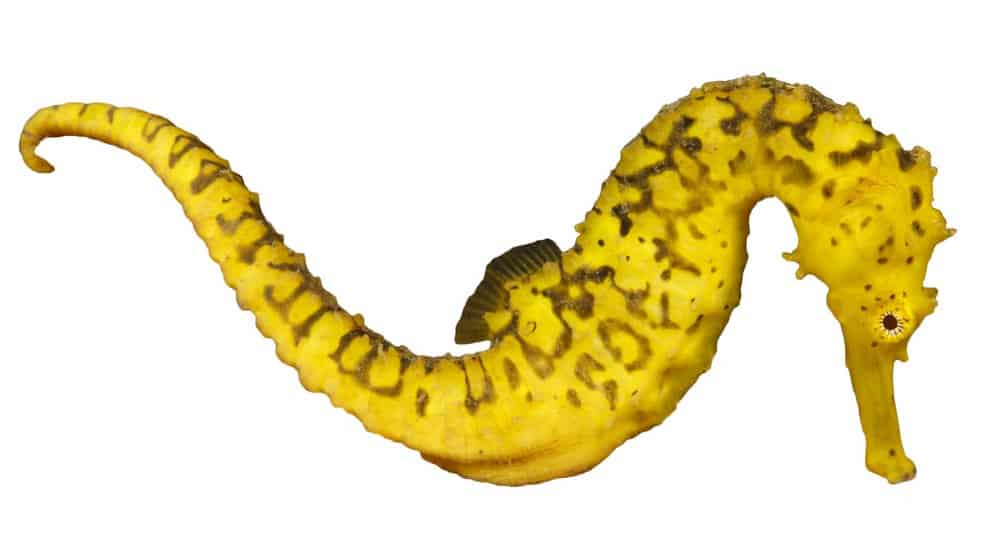
Seahorses do not have scales; instead, their bodies are covered with a thin layer of plates that is covered with skin.
©Rich Carey/Shutterstock.com
Evolution
It is believed that pipefish and seahorses diverged during the late Oligocene in response to large areas of shallow water created as a result of tectonic events. These events happened in the western Pacific Ocean — the seahorses’ probable point of origin. The shallow water would allow seagrasses to grow, offering the seahorses camouflage for their upright posture.
Species: Types of Seahorse
There are over 46 recognized species of seahorse found in most of the world’s oceans, primarily in tropical and temperate coastal waters, but are absent from the eastern Pacific and polar regions. Seahorses are generally small animals, averaging around 10cm in height, although this is dependent on the species. For example, the big-belly seahorse can reach 14 inches (35 cm) in length. Below, we’ve detailed selected types of seahorses.
Dwarf Seahorse (Hippocampus zosterae)
The dwarf seahorse lives across the Gulf of Mexico, the Bahamas, and Florida. It reaches a max length of just 5 cm and has been named the world’s slowest fish by the Guinness Book of World Records. The dwarf seahorse is popular in aquariums but faces threats related to habitat loss.
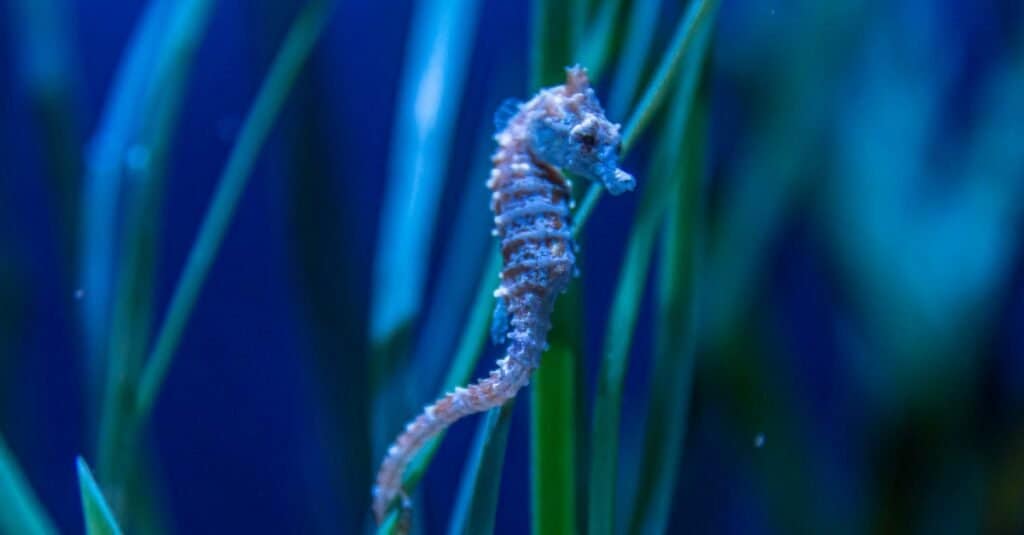
A dwarf seahorse clings to an underwater leaf. It is recorded as the slowest-moving fish, with a painful top speed of about 150 centimeters per hour.
©iStock.com/MWCPhoto
Pygmy Seahorse (Hippocampus bargibanti)
The pygmy seahorse lives in the Western Pacific offshore Indonesian islands and northern Australia at depths ranging from 16 to 40 meters. It prefers living near soft corals. The species is one of the smallest seahorses, measuring a maximum of just 2.4 cm. The pygmy seahorse has a unique appearance, with red bulbous tubercles across their body, which allow them to seamlessly blend in with coral reefs, and a short snout.
Big-Belly Seahorse (Hippocampus abdominalis)
The big-belly seahorse is found in southern Australia and New Zealand. The species can reach 35 cm (14 inches) in length, making it one of the largest seahorse species. Big-belly seahorses are nocturnal and live in depths ranging from 0 to 104 meters of water.
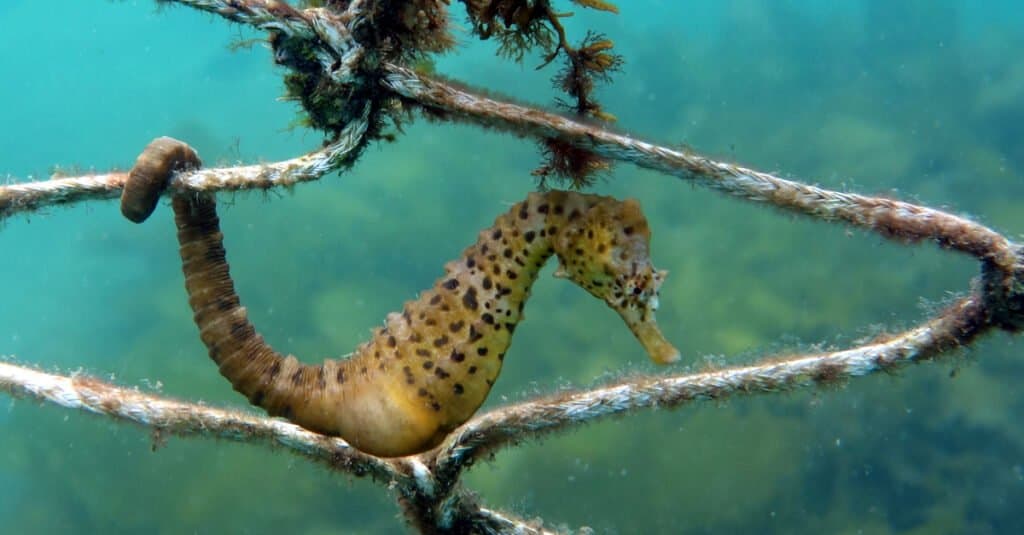
The big-belly seahorse is found in southern Australia and New Zealand.
©Dirk van der Heide/Shutterstock.com
Zebra Seahorse (Hippocampus zebra)
The zebra seahorse gets its name from its black and white alternating stripes that look very similar to zebras. The species was first described in 1964, and relatively little is known about it. It’s found off the coast of Australia’s Queensland state along reefs and reaches a maximum length of 8 cm.
Giant Seahorse (Hippocampus ingens)
The giant seahorse reaches up to 30 cm (12 inches), which makes it slightly smaller than the big-belly seahorse. The species lives in reefs along the Eastern Pacific. Its range stretches from the northern limit of San Diego down to the Galapagos Islands. The species was assessed by the IUCN as Vulnerable in late 2016.
Barbour’s Seahorse (Hippocampus barbouri)
Barbour’s seahorse grows up to 15 cm (6 in) and lives along islands and reefs near Indonesia and the Philippines. The species prefers hard coral reefs. It was assessed in 2017 as Vulnerable by the IUCN.
Giraffe Seahorse (Hippocampus camelopardalis)
Found from Tanzania down to South Africa, the giraffe seahorse lives across Africa’s coast in waters ranging up to 45 meters in depth. The species prefers seagrass and algal beds.
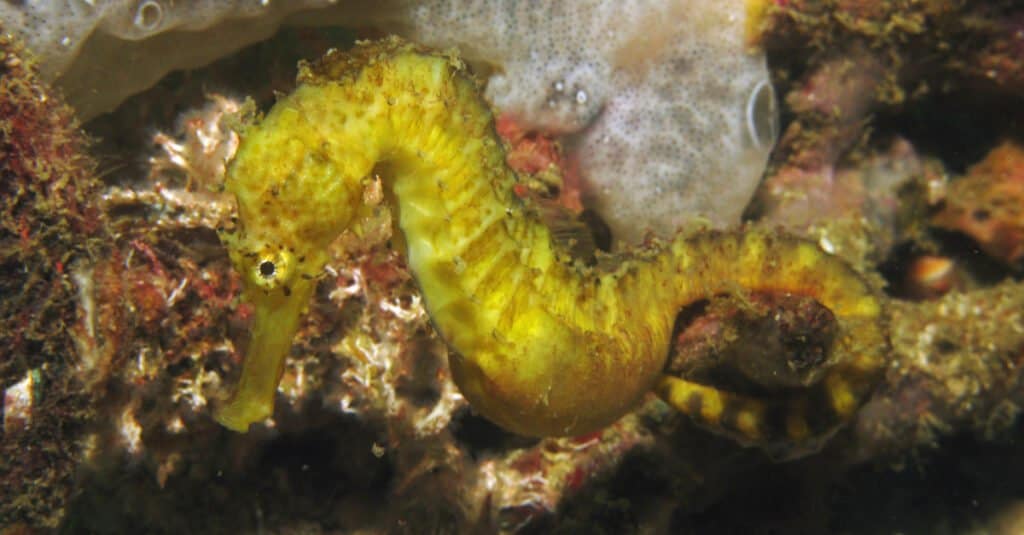
Tiger Tail Seahorses are found throughout Southeast Asian waters.
©S J Carr/Shutterstock.com
Tiger Tail Seahorse (Hippocampus comes)
The tiger tail seahorse is found throughout Southeast Asian waters and can grow to nearly 20 cm (8 inches). The species is monogamous and lives along reefs and aquatic vegetation such as sponge gardens. With a “tiger-like” striping across its body, the species is a popular choice for aquariums. However, since 2013, the species has been assessed as Vulnerable by the IUCN.
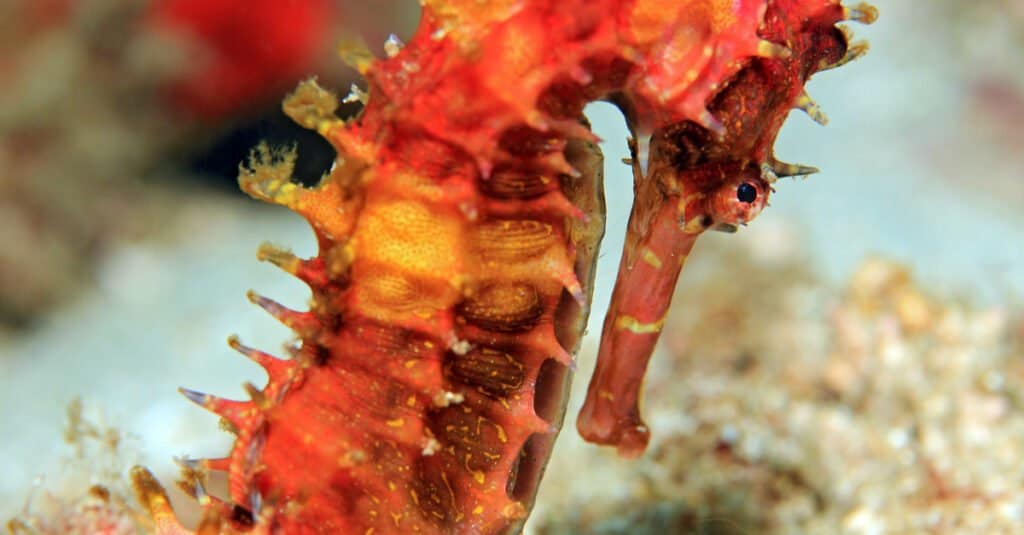
The Spiny Seahorse gets its name from the thorny growths that cover its body.
©iStock.com/AndamanSE
Spiny Seahorse (Hippocampus histrix)
Spiny seahorse gets its name from the “thorn” objects that cover its body. The species has a long snout and one of the most distributed ranges of all seahorses. Spiny seahorses have been identified across much of the Pacific Ocean and across the Indian Ocean as well. The species has been assessed as Vulnerable by the IUCN and faces threats from habitat destruction.
Appearance
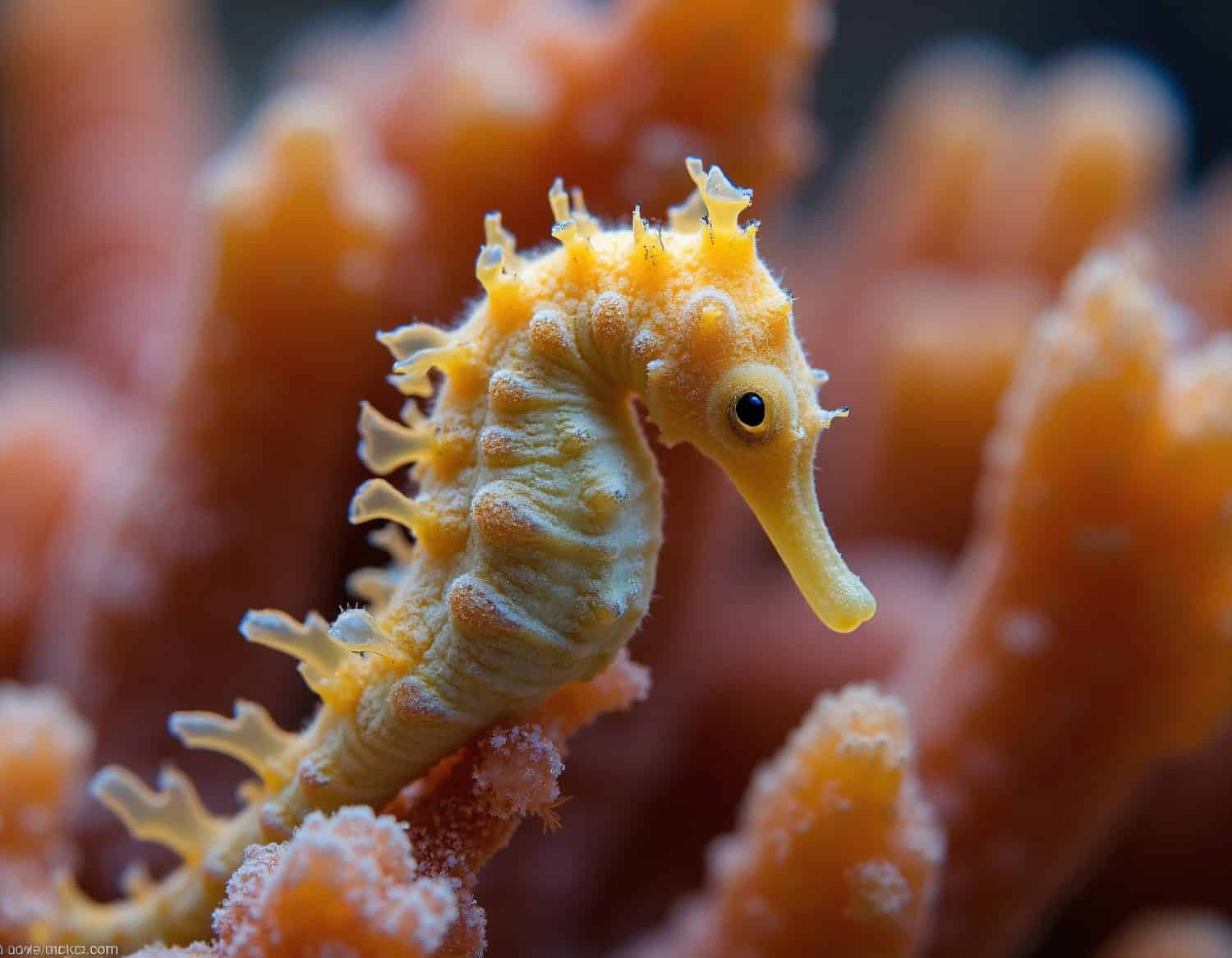
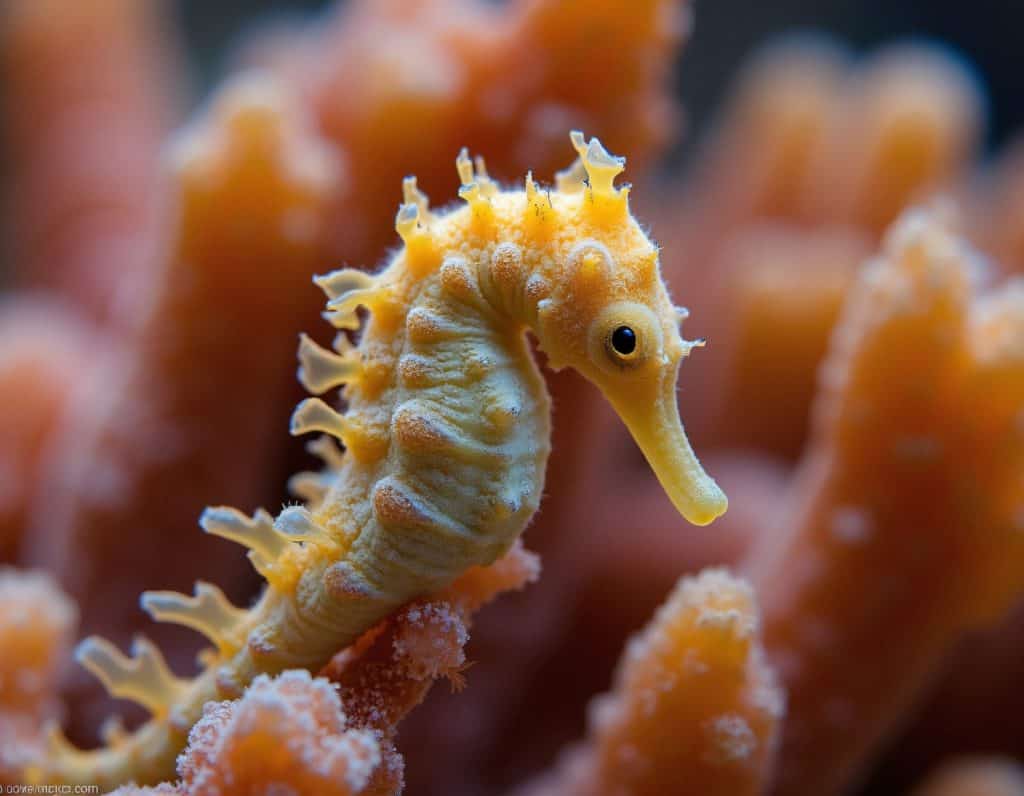
Seahorses are one of the most unique-looking animals in the world. Their head resembles a horse’s, they have a pouch like a kangaroo’s, and their tail is prehensile for gripping objects, like a monkey’s. In addition, their body is covered by a series of bony plates, and they have tiny “wings” (which are dorsal fins) for guiding them slowly and clumsily through the water.
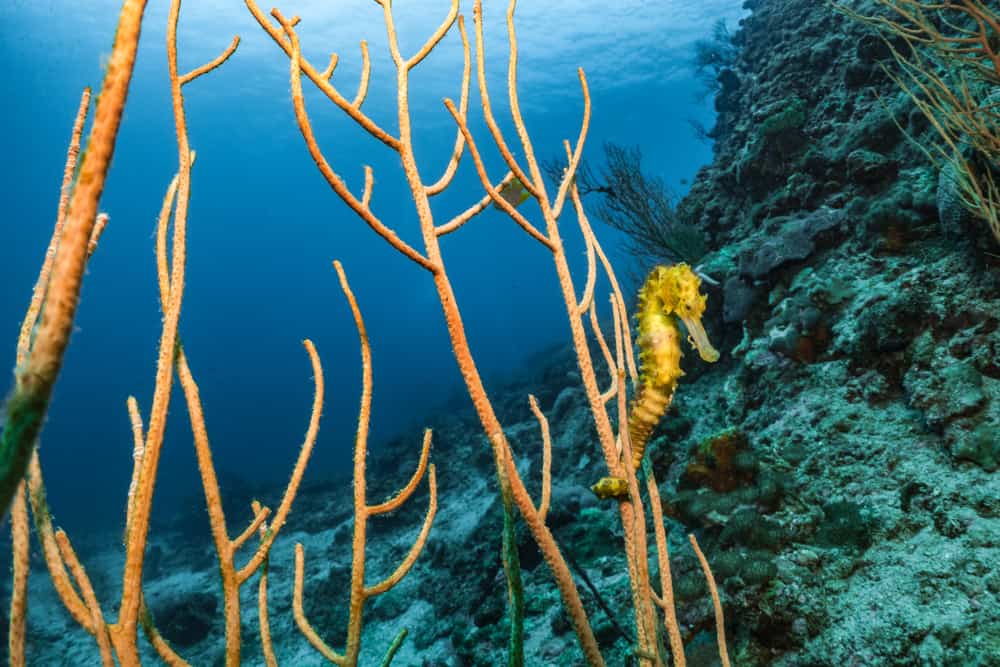
Seahorses use their excellent camouflage to hide from predators.
©Adam Leaders/Shutterstock.com
Seahorses are masters of camouflage, with the color and even textures of different species closely matching their environments, which helps them hide from predators. One species, the pygmy seahorse (Hippocampus bargibanti), has such extreme camouflage that the species was first discovered in 1970 after the coral colony had been collected for an aquarium, and it was later realized there was a new species of seahorse on the coral! On the other side of the size spectrum, the big-belly seahorse is the largest seahorse species in the world and can reach nearly 14 inches in length!
Seahorses move via their dorsal fins, which resemble tiny “wings” on their back. However, their movement is extremely plodding, and the Guinness Book of World Records has ranked the dwarf seahorse as the slowest marine fish in the world. During storms and adverse weather, seahorses will use their prehensile tail to grip objects to prevent getting tossed around by rough waters.
The seahorse’s snout is normally long and thin, which allows them to probe into coral and other sea vegetation to suck up small invertebrates and other food. Their jaws are fused and don’t chew food.
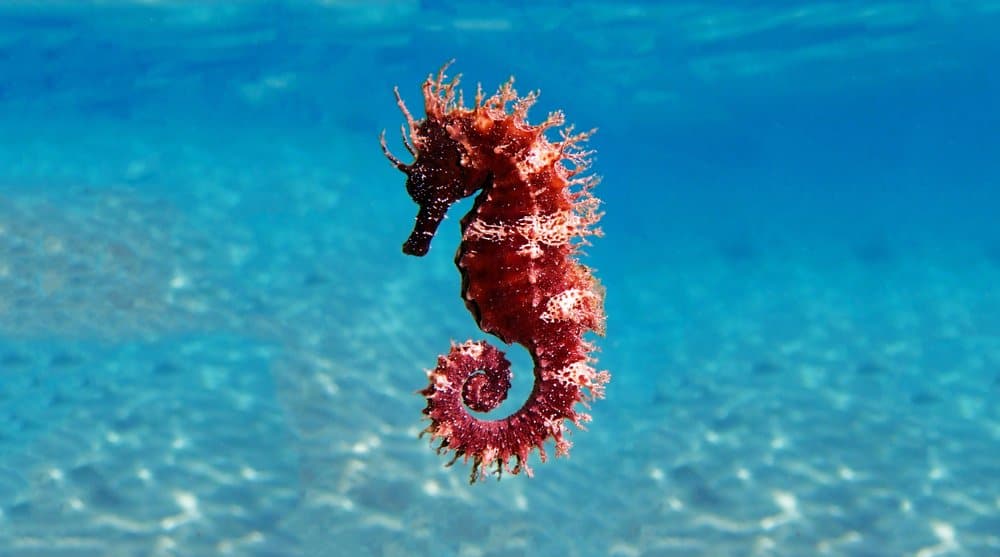
A seahorse near the ocean bottom.
©Vojce/Shutterstock.com
Distribution and Habitat
Seahorses are found across the world’s oceans, but most species reside in tropical or warm, temperate waters. The densest concentration of species is in Southeast Asia and the Western Pacific where a number of species live in different habitats.
Generally, seahorses prefer soft coral environments and live in offshore reefs that rarely exceed 100 meters in depth. However, habitats the species can also be found in include kelp, eelgrass, open water, grass beds, and many other environments that feature aquatic vegetation the seahorse can cling to or blend in with.
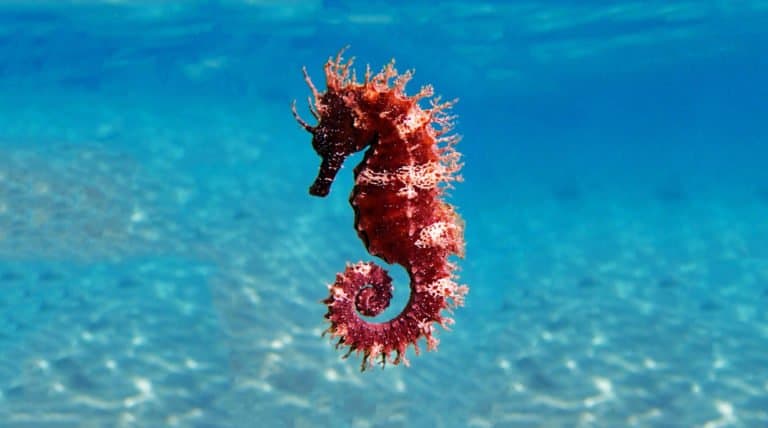
Seahorses have a number of distinctive features that help them survive in their marine environments. The seahorse has a long snout for sucking in food and a long tail, which the seahorse uses both for moving through the water and also for clinging onto coral and aquatic plants, which the seahorse does by curling its long tail around things in order to anchor itself down.
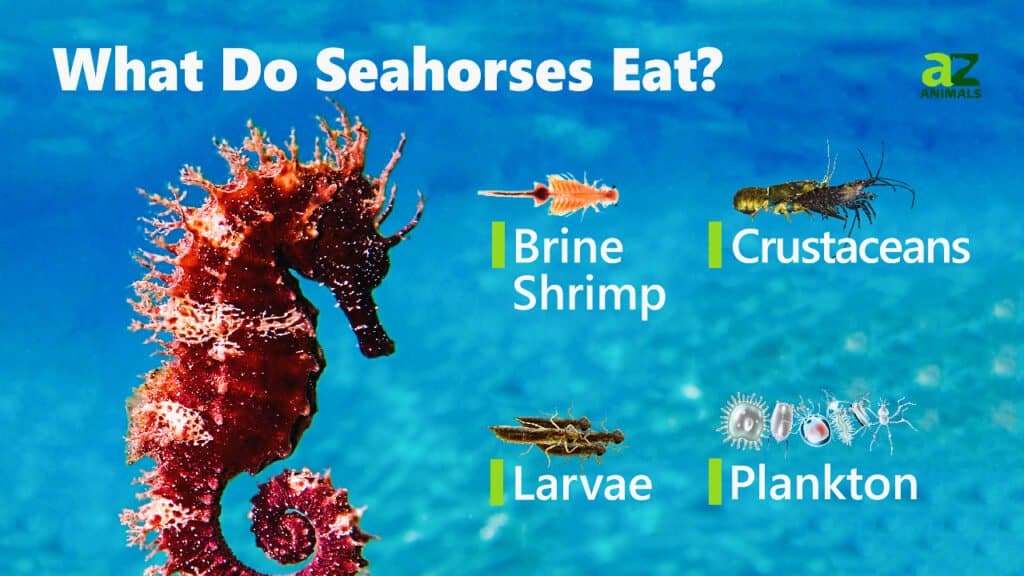
Predators and Prey
The seahorse is primarily a carnivorous animal. It sucks food into its body through its elongated snout, which lacks teeth or the ability to chew. The seahorse primarily feeds on brine shrimp, plankton, and tiny species of fish. Because the seahorse lacks a stomach, it has to feed almost continuously, sometimes consuming a fourth of its body weight in a single day!
Due to the small size and vulnerability of the seahorse, the seahorse has numerous predators within its natural environment. Crustaceans such as crabs, fish, and rays are all common predators of the seahorse. Predator fish species such as the bluefin tuna have also been discovered with seahorses in their stomach. However, humans who harvest the seahorse for use in medicine are their primary threat (see more in our population and conservation status section).
The seahorse is also vulnerable to bad weather — in storms, seahorses are often thrown from the place that they were clinging onto and onto the shore.
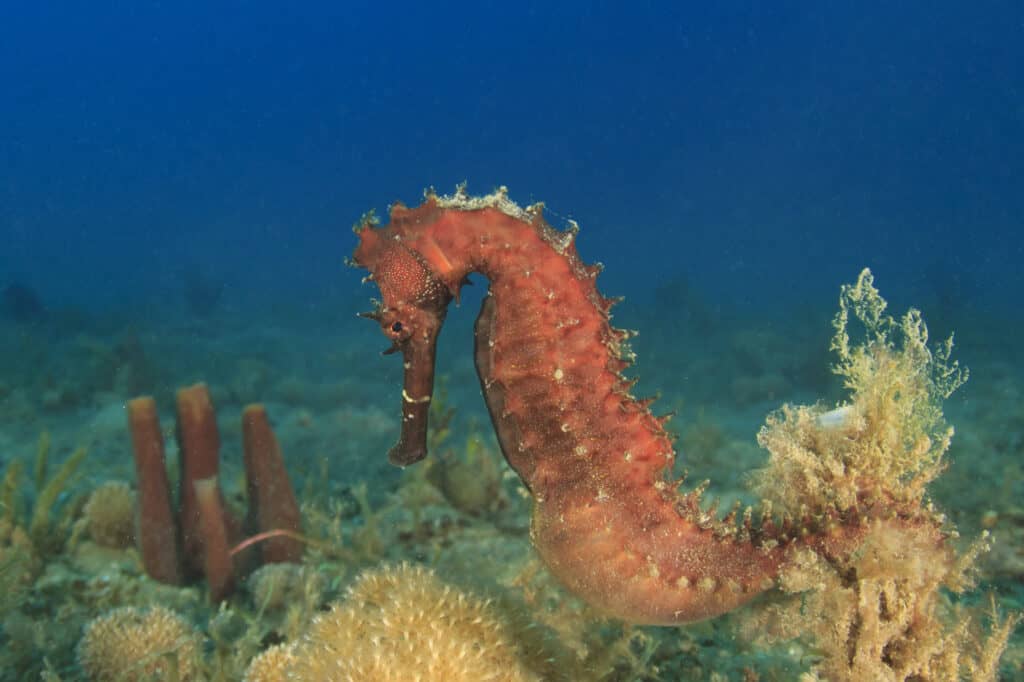
Pregnant Thorny Seahorse. The male seahorse carries the young in a pouch.
©Rich Carey/Shutterstock.com
Reproduction and Lifespan
The sea horse is best known for the remarkable fact that the male seahorse is the one that actually carries the eggs before they hatch. In most other animal species, the female is the one to protect the offspring until birth. Instead, the female seahorse lays her eggs (anywhere between 5 to more than 1,000 eggs are laid, depending on the species of seahorse), into the male’s brooding pouch, where they remain until they hatch around 3 to 6 weeks later.
The birthing process is best illustrated in a short video, which you can see below:
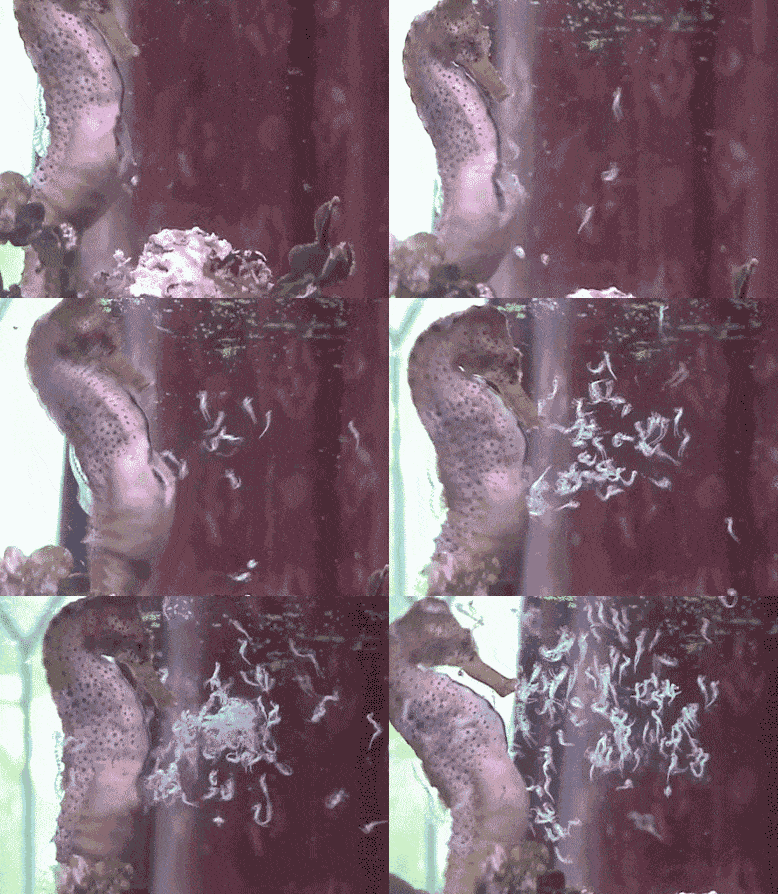
After birth, seahorse offspring will cling to objects but are extremely susceptible to predators. In general, a very low percentage of seahorse babies (called “fry”) will survive. This depends on the species, but for some it can be less than 1%.
Many seahorse species are monogamous, meaning males and females will mate for life. Seahorse species are also famous for their deliberate courtship rituals, which can last anywhere from hours to days.
Courtship relies on a synchronized “dance.” Males and females will lock their prehensile tails and engage in synchronized movements, often changing colors. This “dance” can last for several days, where the males and females follow a similar swimming pattern.
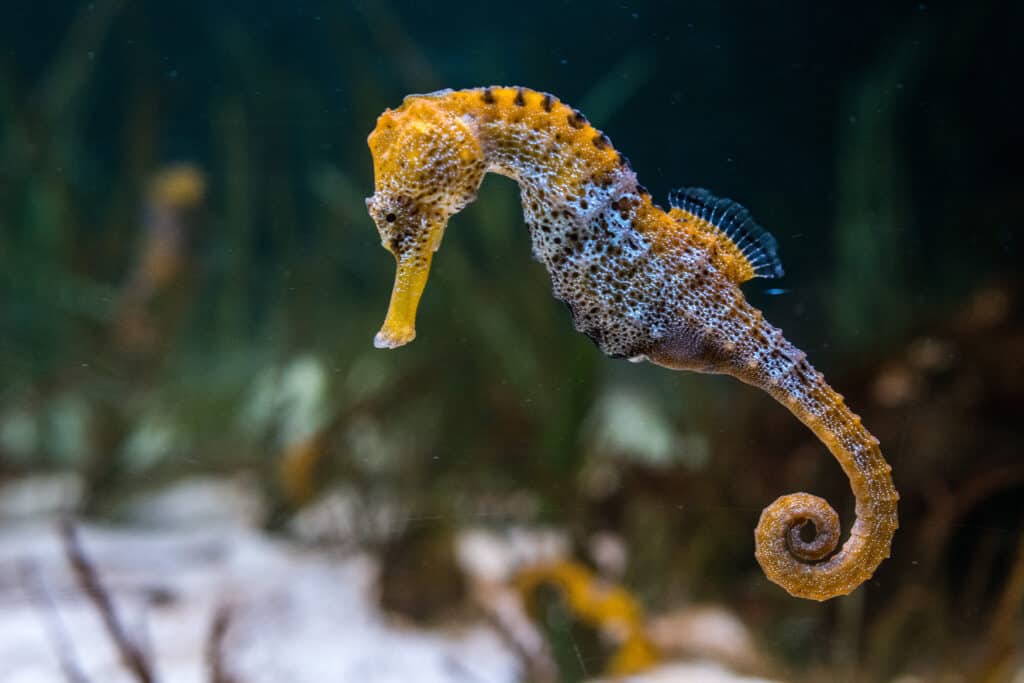
Specimen of long snout seahorse (Hippocampus reidi), also known as a slender seahorse.
©Marcos del Mazo/Shutterstock.com
Population and Conservation Status
As of late 2022, two seahorse species are listed as Endangered, and 12 are identified as Vulnerable, one as Near Threatened, and 10 as Least Concern by the IUCN. The primary threats to the species include habitat loss and its use in traditional Chinese medicine.
The loss of coral reefs and also seabeds that house seahorses has accelerated the decline of many species in recent decades. A study on the white seahorse found that significant habitat loss was the primary contributing factor to population declines.
In addition, traditional Eastern medicine (spanning several countries) values dried seahorses for their purported benefits for impotence and other medical disorders. There is no known scientific basis for these claims, but dried seahorse retails for nearly the price of gold in many Asian markets. Overfishing for traditional medicine has put pressure on many species, including pygmy seahorses.
Seahorse Pictures
View all of our Seahorse pictures in the gallery.

Vojce/Shutterstock.com
Sources
- David Burnie, Dorling Kindersley Animal, The Definitive Visual Guide To The World's Wildlife / Accessed November 14, 2008
- Tom Jackson, Lorenz Books The World Encyclopedia Of Animals / Accessed November 14, 2008
- David Burnie, Kingfisher The Kingfisher Animal Encyclopedia / Accessed November 14, 2008
- Richard Mackay, University of California Press The Atlas Of Endangered Species / Accessed November 14, 2008
- David Burnie, Dorling Kindersley Illustrated Encyclopedia Of Animals / Accessed November 14, 2008
- Dorling Kindersley Dorling Kindersley Encyclopedia Of Animals / Accessed November 14, 2008