
S
Species Profile

Stag Beetle

Lucanidae

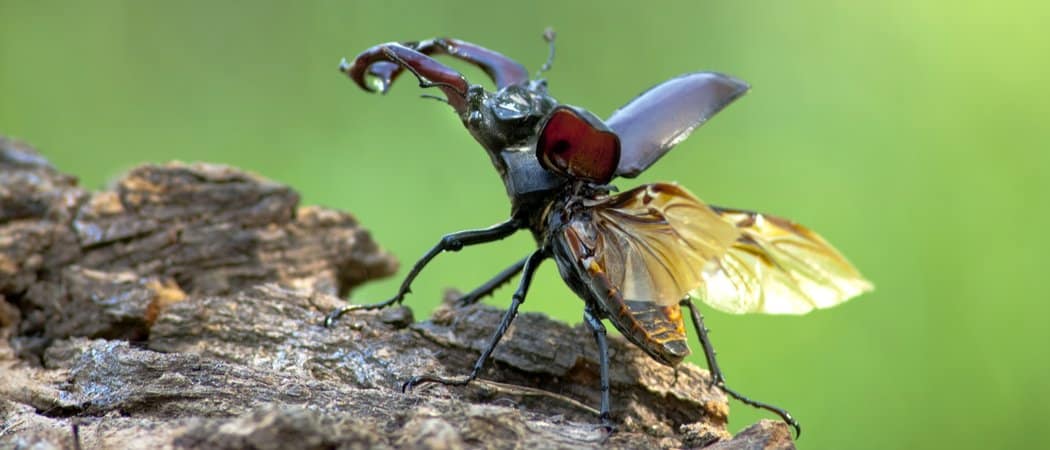
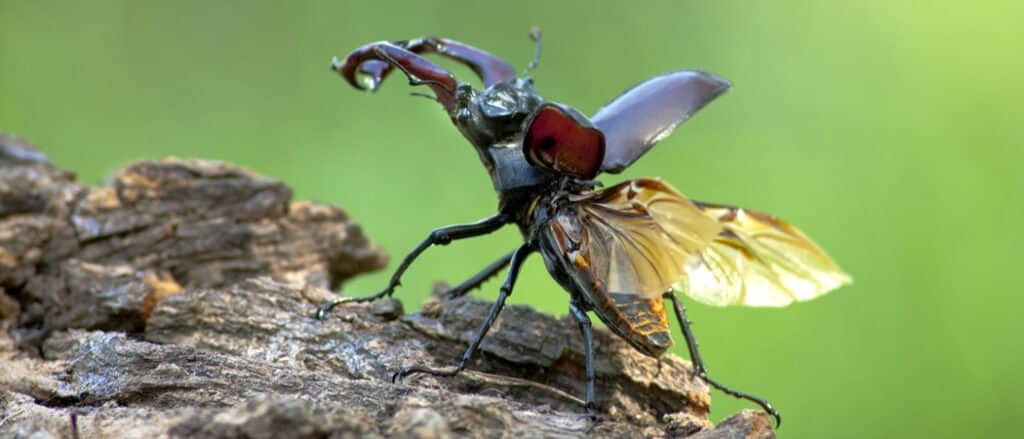
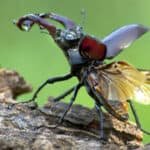
Antlers of the insect world
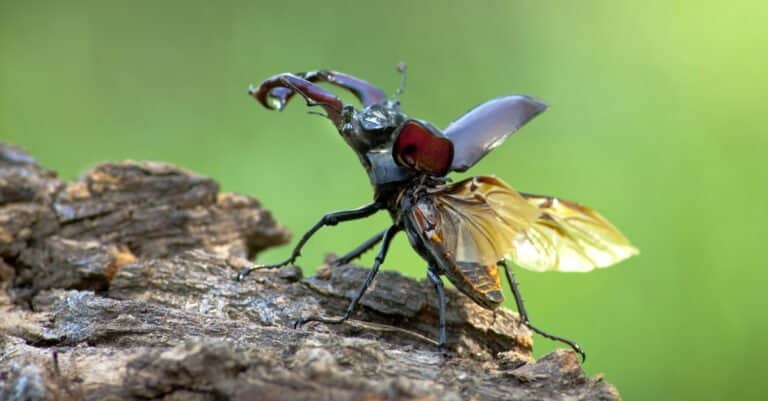
Czesznak Zsolt/Shutterstock.com

Stag Beetle Distribution

Click a location to explore more animals from that region

Loading map...

Found in 81 countries

Stag Beetle

At a Glance

Family Overview This page covers the Stag Beetle family as a group. Stats below are general traits shared across the family.
Also Known As stagbug, lucanid, Hirschkäfer, kuwagata, ciervo volante, lucane
Activity Nocturnal+
Lifespan 3 years
Weight 0.03 lbs
Status Not Evaluated
Did You Know?

Family size range: roughly ~0.5-12 cm long, from tiny forest dwellers to giant tropical species.

Scientific Classification

Family Overview "Stag Beetle" is not a single species but represents an entire family containing multiple species.

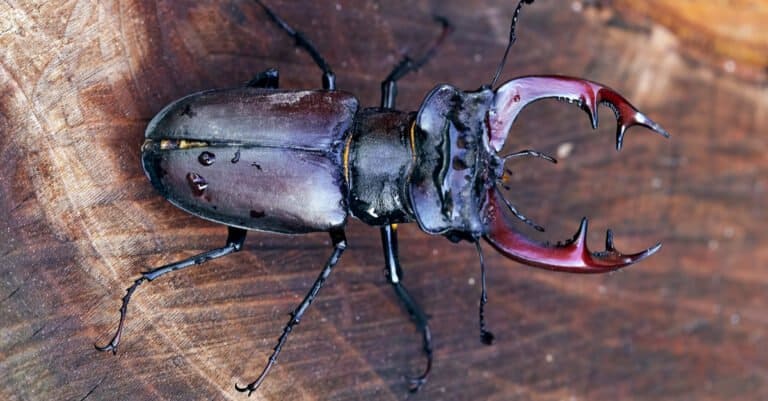
Stag beetles (family Lucanidae) are a group of scarab-like beetles best known for the enlarged mandibles of many males, used primarily for wrestling rivals. They are part of the beetle order (Coleoptera) and include hundreds of species worldwide.

Kingdom
Animalia
Phylum
Arthropoda
Class
Insecta
Order
Coleoptera
Family
Lucanidae

Distinguishing Features

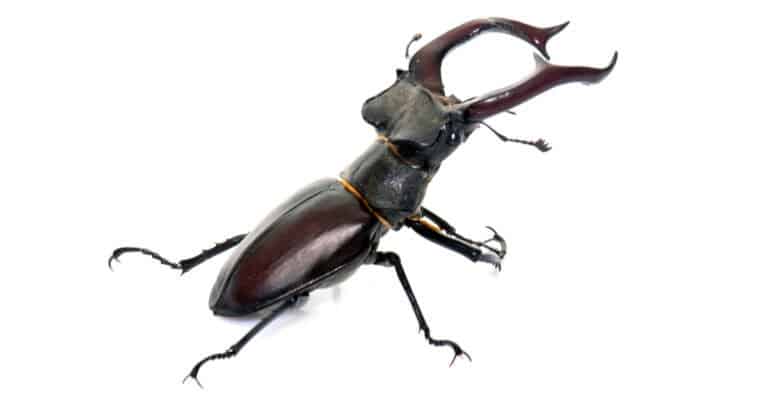
  • Males of many species have enlarged, antler-like mandibles used in combat
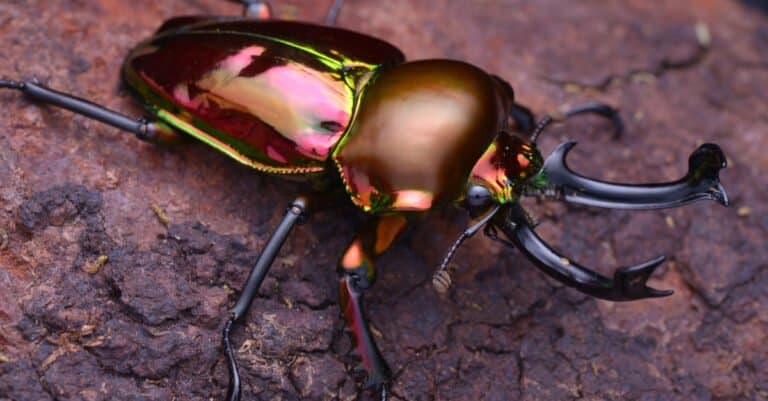
  • Robust beetle body; often chestnut-brown to black, sometimes metallic in certain genera
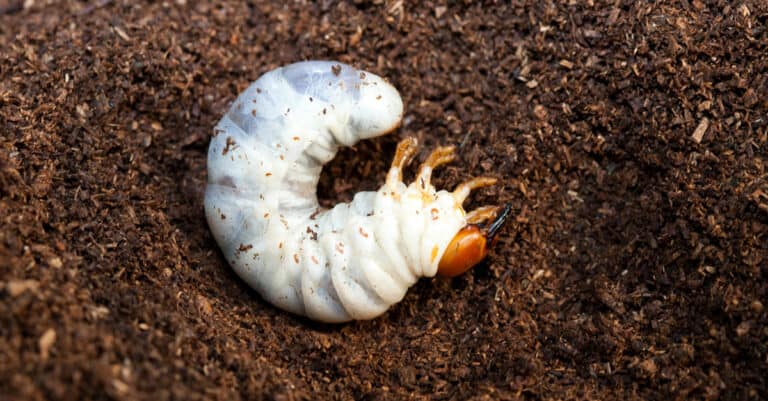
  • Larvae are wood-feeding grubs developing for multiple years in decaying wood
  • Adults may feed on sap, nectar, or fruit; some adults feed little

Physical Measurements

Males and females differ in size

Height
0 in (0 in – 1 in)
Length
2 in (0 in – 5 in)
1 in (0 in – 3 in)
Weight
0 lbs (0 lbs – 0 lbs)
Top Speed
7 mph
flying

Appearance

Primary Colors
Secondary Colors
Skin Type Hard chitinous exoskeleton with thick elytra; surface ranges from matte to highly glossy, sometimes finely punctured.
Distinctive Features
  • Adult body length across family roughly ~0.3-11.5 cm (smallest to largest species).
  • Robust, scarab-like build with strong legs and prominent tarsal claws for gripping bark.
  • Antennae elbowed with lamellate (fan-like) clubs; club size varies among genera.
  • Mandibles often enlarged and multi-toothed in males, ranging from short to extremely elongated.
  • Elytra typically thick and protective; flight ability ranges from strong fliers to more reluctant flyers.
  • Larvae are deadwood-dependent grubs in rotting logs/stumps/roots; development often prolonged.
  • Typical total lifespan range ~1-8 years (larval stage ~1-6+ years; adults usually weeks to months).
  • Adult ecology commonly woodland-associated; many feed on tree sap, fermenting fruit, or nectar, but diets vary.
  • Activity patterns vary: many are nocturnal/crepuscular, while some species are more diurnal.
  • Male-male contests (wrestling, pushing, lifting) are common where mandibles are enlarged; intensity varies by species.

Sexual Dimorphism

Sexual dimorphism is often strong: males commonly have disproportionately enlarged, toothed mandibles and broader heads for wrestling. Females usually have smaller mandibles and a more compact head; overall body color can be similar but varies by species.

  • Mandibles frequently greatly enlarged, sometimes exceeding head length; shapes vary by genus.
  • Head often wider with more developed musculature and ridges for mandible leverage.
  • Forelegs and tarsi may be more robust for gripping rivals and substrates.
  • Some species show more pronounced gloss/metallic sheen in males than females.
  • Mandibles generally short and functional for feeding and digging/handling substrates.
  • Head typically narrower and less armored; body often appears more compact.
  • In many species, females have proportionally larger abdomen for egg development.
  • Some taxa show subtler coloration or less pronounced surface shine in females.

Did You Know?

Family size range: roughly ~0.5-12 cm long, from tiny forest dwellers to giant tropical species.

Many species show strong sexual dimorphism: males often have oversized mandibles, while females have shorter, sturdier jaws.

Most of a stag beetle's life is spent as a larva inside rotting wood; adults are comparatively short-lived.

Adult diets vary widely across the family: many sip tree sap or fermenting fruit, while some adults feed little at all.

Males typically fight by grappling and trying to flip rivals off a branch-more like wrestling than biting.

They're key "saproxylic" insects: their larvae help break down dead wood, supporting nutrient cycling in forests.

Stag beetles occur on most continents (absent from Antarctica), with especially high diversity in tropical and subtropical forests.

Unique Adaptations

  • Enlarged male mandibles ("antlers") evolved primarily for competition and display; shapes range from short and stout to extremely elongated, often with species-specific teeth and curves.
  • Powerful thorax and leg grip for wrestling on bark and branches; many species can lever rivals using body strength rather than relying on cutting bites.
  • Saproxylic larval physiology: larvae are adapted to nutrient-poor, decaying wood and rely on gut microbes to help process tough, woody material.
  • Robust, chisel-like female mandibles in many species for chewing into rotten wood or soil-wood interfaces during egg-laying.
  • Hard elytra (wing covers) protect the body and wings while moving through rough wood and debris; coloration ranges from matte black to chestnut to metallic sheens in some groups.
  • Chemical communication: many species use pheromones and scent cues to locate mates and feeding sites, though signals differ among lineages.

Interesting Behaviors

  • Ritualized male combat: males grapple with mandibles, lifting or tossing opponents; the exact "rules" and mandible shapes vary greatly among genera.
  • Sap runs and fermenting fruit gatherings: adults of many species aggregate at oozing tree sap, wounds, or fallen fruit-often at night.
  • Nocturnal vs. diurnal activity: many are crepuscular/nocturnal and come to lights, but activity timing differs among species and habitats.
  • Deadwood specialization: females lay eggs in decayed logs, stumps, or buried wood; larvae tunnel and feed for years in some species.
  • Dispersal differences: some species are strong fliers, while others (in certain lineages) show reduced flight or heavier-bodied females that fly less.
  • Seasonal emergence: adults often appear in warm months; in some regions adults may overwinter or persist for multiple weeks/months depending on species and climate.

Cultural Significance

Stag beetles (Lucanidae) are well known woodland insects. In Japan children and hobbyists keep and watch them and even stage fights. In parts of Europe they stand for old-growth habitat and deadwood ecology, needing veteran trees, stumps, and rotting logs.

Myths & Legends

Ancient Roman natural history: Pliny the Elder wrote about a beetle called "lucanus," associated with Italy's Lucania region-an early cultural landmark in the naming history of stag beetles (the family name Lucanidae preserves this root).

Central and Northern European folk names link them to storms: traditional names such as "thunder beetle" reflect a belief that their summer flights were connected with thunderstorm weather.

European rural superstition recorded in various regions treated large beetles with antler-like jaws as ominous or uncanny "devil" insects-more feared for their appearance than for real harm-showing how their dramatic mandibles shaped folklore.

In Japan, stag beetles (Lucanidae) are a summer symbol. Not one single myth, but they appear in children's stories and summer customs as forest champions whose tiny fights are watched like little duels.

You might be looking for:

European stag beetle

28%

Lucanus cervus

Large, well-known stag beetle of Europe; males have prominent antler-like mandibles.

Lesser stag beetle

17%

Dorcus parallelipipedus

Smaller, dark stag beetle in Europe; males have shorter, sturdier mandibles.

Giraffe stag beetle

14%

Prosopocoilus giraffa

Large Asian species complex popular in collections; males often with long mandibles.

Rainbow stag beetle

12%

Phalacrognathus muelleri

Metallic green/orange Australian lucanid; sometimes called a stag beetle despite distinct appearance.

Metallic stag beetles

9%

Cyclommatus spp.

Asian genus with elongated mandibles in males; many species traded/kept by hobbyists.

Life Cycle

Birth 50 larvas
Lifespan 3 years

Lifespan

In the Wild
1–8 years
In Captivity
1–10 years

Reproduction

Mating System Polygynandry
Social Structure Solitary
Breeding Pattern Transient
Fertilization Internal Fertilization
Birth Type Internal_fertilization

Across Lucanidae, mating is typically driven by male-male competition at sap flows or oviposition sites; successful males mate with multiple females, and females may mate multiply as well. No pair bonds form; post-mating care is absent and varies mainly in intensity among species.

Behavior & Ecology

Social Aggregation Group: 3
Activity Nocturnal, Crepuscular, Diurnal
Diet Detritivore tree sap (especially fermenting sap flows)
Seasonal Hibernates

Temperament

Generally non-social; males can be highly competitive and aggressive at feeding or mating sites.
Female interactions are typically brief and pragmatic: feeding, oviposition site choice, mating.
Injury is usually limited; many contests are ritualized pushing/wrestling rather than biting.
Ecological diversity is broad: forests, woodlands, and deadwood-rich habitats; some species are more arboreal.
Family-wide size range is extreme: adults roughly ~0.5-12 cm depending on species and sex.
Life history varies widely: larvae typically develop ~1-6+ years in decaying wood; adults often weeks to months.

Communication

Stridulation (chirps/squeaks) produced by rubbing body parts, especially when handled or during conflict.
Sex pheromones and odor cues to locate mates and feeding/oviposition resources.
Tactile signals during courtship and male-male wrestling Antennae, legs, mandibles
Substrate-borne vibrations through bark/wood during movement and contest escalation.
Visual assessment at close range: mandible size display and posture during rival interactions.

Habitat

Biomes:
Tropical Rainforest Tropical Dry Forest Savanna Mediterranean Temperate Forest Temperate Rainforest Boreal Forest (Taiga) Alpine Wetland +3
Terrain:
Mountainous Hilly Plateau Plains Valley Coastal Island Riverine Volcanic Karst Rocky +5
Elevation: Up to 11482 ft 11 in

Ecological Role

Saproxylic decomposer lineage (deadwood-associated detritivores) that channels energy from decaying wood and plant exudates into forest food webs.

deadwood breakdown and nutrient cycling soil formation and humus production via wood-to-soil conversion support of wood-decay microbial and fungal communities (including spore movement via adult visitation) creation/maintenance of microhabitats in decomposing logs used by other invertebrates prey base for birds, mammals, reptiles, and other insects bioindicator value for mature forests and deadwood continuity (in many regions)

Diet Details

Other Foods:
Decaying wood Wood detritus and humus Wood-decay fungi and fungus-conditioned wood Tree sap Fruits and fruit juices Nectar and pollen

Human Interaction

Domestication Status

Semi domesticated

Lucanidae (stag beetles) are wild insects found worldwide. Many species are bred in captivity for hobby, display, and teaching, producing limited semi-domestication. People select for calmness, easy breeding, and larger size in some lines, but stag beetles have not undergone true long-term domestication.

Danger Level

Low
  • Pinches from mandibles or legs (can break skin in larger species, typically minor and avoidable with proper handling).
  • Allergic reactions or asthma exacerbation from insect frass, substrate molds, or mites associated with rearing media.
  • Secondary infection risk if a pinch wound is not cleaned (uncommon).
  • Ecological risk if non-native individuals are released (potential establishment, competition, or pathogen/parasite spread).
  • Conservation/ethical risk: over-collection of wild populations in some areas, especially for large-bodied or locally protected species.

As a Pet

Suitable as Pet

Legality: Legality varies by place and species. Captive-bred stag beetles (Lucanidae) are often legal, but wild collection, import/export, moving, or releasing may need permits or be illegal. Check local laws and rules.

Care Level: Moderate

Purchase Cost: $10 - $500
Lifetime Cost: $50 - $600

Economic Value

Uses:
Pet and hobbyist breeding trade (live insects, rearing kits) Education and public outreach (museums, classrooms, insectariums) Scientific research (behavior, sexual selection, biomechanics, taxonomy, conservation) Conservation flagship/indicator value tied to deadwood and forest management Collecting/curio markets (regulated in some places; can impact wild populations if unmanaged) Local ecotourism and nature appreciation (night walks, sap-site viewing in some regions)
Products:
  • live adult beetles and larvae (captive-bred)
  • rearing substrates (fermented hardwood sawdust/wood-mold), breeding containers, and husbandry supplies
  • educational displays and outreach materials
  • mounted specimens and collections (where legal and ethically sourced)

Relationships

Related Species 5

Stag beetle
Stag beetle Lucanus Shared Family
Lesser stag beetle Dorcus Shared Family
Giraffe stag beetle Prosopocoilus Shared Family
Rainbow stag beetle Phalacrognathus Shared Family
Long-mandibled stag beetle Cyclommatus Shared Family

Ecological Equivalents 5

Animals that fill a similar ecological role in their ecosystem

Bess beetles Odontotaenius disjunctus Like many lucanids, passalids are primarily saproxylic (dependent on dead or decaying wood), with larvae developing in rotting logs. Both groups are important decomposers in forest ecosystems.
Longhorn beetles Cerambycidae Many cerambycid larvae bore or feed within dead or dying wood. They overlap with lucanids in deadwood habitats and are often encountered in the same downed logs and stumps.
Jewel beetles
Jewel beetles Buprestidae Wood-associated life cycles, often in dead or stressed trees, create niche overlap with lucanids. Both are strongly influenced by forest structure and deadwood availability.
Scarab beetles
Scarab beetles Scarabaeidae Related within Scarabaeoidea. Adults often share feeding opportunities (sap flows, fermenting fruit) and have forest-edge activity periods; ecological overlap varies by subfamily and habitat.
Rhinoceros beetle
Rhinoceros beetle Dynastinae Many dynastines use decaying wood or compost-like substrates as larvae and feed on sap and fruit as adults, paralleling the resource use of common lucanids in wooded habitats.

Types of Stag Beetle

10

Explore 10 recognized types of stag beetle

European stag beetle Lucanus cervus
Lesser stag beetle Dorcus parallelipipedus
Giraffe stag beetle Prosopocoilus giraffa
Rainbow stag beetle Phalacrognathus muelleri
Metallic stag beetle Cyclommatus metallifer
Reddish-brown stag beetle Lucanus capreolus
Giant stag beetle Lucanus elaphus
Cuvier's stag beetle Odontolabis cuvera
Titan stag beetle Serrognathus titanus
Giant lesser stag beetle Dorcus titanus

The oldest known fossil of the stag beetle dates back to the Middle Jurassic Period, approximately 150 to 160 million years ago.

The stag beetle is a family of large, hard-shelled, flying insects whose distinguishing trait is the ability to consume rotting wood as a larva. The name of this insect is derived from the giant mandibles on the male, which resemble the stags of a deer in the way they curve and branch. Their numbers appear to be declining in some parts of their range due to the loss of habitats and food sources.

3 Incredible Stag Beetle Facts!

  • The giant mandibles for which this species is known have nothing to do with feeding. Instead, they allow the males to wrestle each other for access to females. The larger and stronger male usually emerges as the victor from the contest.
  • After copulating with her partner, the female will often return to the place of her birth and lay around 30 eggs near rotting wood in the soil. The larvae emerge shortly later and spend a few years in grub form, feeding on the rotting wood. It undergoes a few different larval stages before becoming an adult. The total lifespan between larva and adult can sometimes reach up to seven years.
  • The oldest known fossil of this insect dates back to the Middle Jurassic Period, approximately 150 to 160 million years ago. The form they were found in is known as a compression fossil, literally imprinted into sedimentary rock. Better-preserved fossils, dating back around 20 to 30 million years from the modern day Dominican Republic, were later found encased in amber.

Species, Types, and Scientific Name

The scientific name for the stag beetle family is Lucanidae. This name comes from the ancient Italian region of Lucania, at the southern end of the peninsula, where these beetles were used to make amulets. There are some 1,200 documented stag beetle species around the world. The best-known species is perhaps the European stag beetle, found all across the continent. Other well-known species include the multi-colored rainbow stag beetle of Australia and the cottonwood stag beetle of Arizona and the southwestern United States.

Appearance: How to Identify Stag Beetles

An adult is characterized by a wide segmented body and two pairs of wings. It is usually colored black or brown, but a select few species exhibit all manner of bright colors such as metallic green and iridescent red. The rainbow stag beetle has an entire range of bright rainbow colors. Adults normally grow 1 or 2 inches in length, but the largest species in the world, the giraffe stag beetle of southern Asia, measures about 5 inches long, much of which is just the massive mandibles. Males are obviously larger than females, again because of the mandibles. The larvae, by contrast, have a more grub-like appearance with an orange head. Measuring around 3 inches long, they’re generally larger than the adults, even without the giant mandibles.

While stag beetles have large mandibles, they generally do not bite humans. If they do do feel threatened and bite however, male stag beetle mandibles aren’t harmful while female bites can be quite painful.
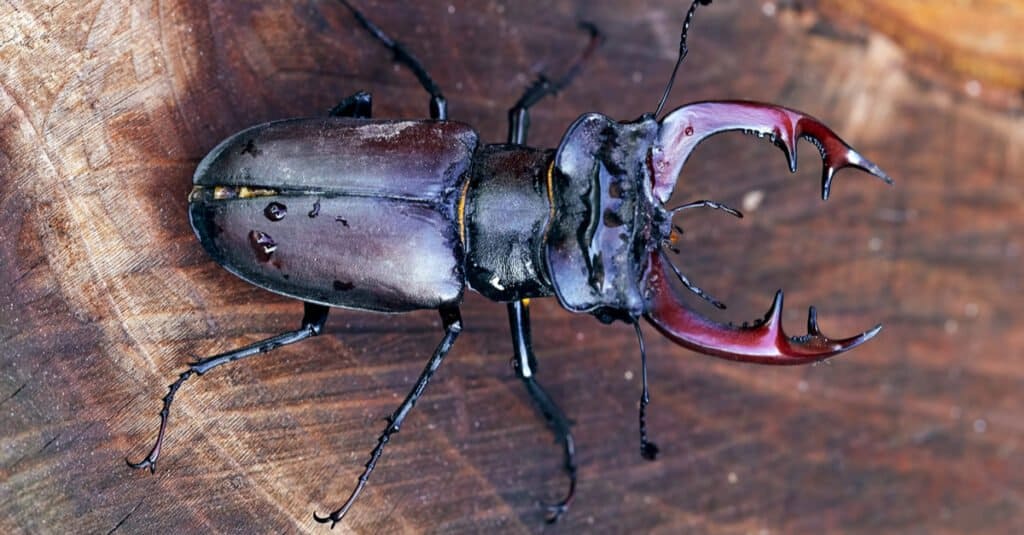
Stag Beetle

Stag Beetles have systems that are adapted for the consumption of wood.

Habitat: Where to Find Stag Beetles

This species is found all over the world, usually in places with loose soil and high average temperatures. While they tend to be found in wooded lands, they also occupy all kinds of unexpected places. The cottonwood stag beetle of Arizona is even known to consume the woodchips of playgrounds.

Diet: What Do Stag Beetles Eat?

The stag beetle is an herbivorous insect. Its digestive system is specifically adapted for consuming wood as food. The technical term for an animal that depends mostly on wood in its diet is a xylophage.

What eats the stag beetle?

This species is preyed upon by a wide range of different birds, amphibians, lizards, small mammals, and other insects. Crows, foxes, and kestrels are particularly common predators, especially when the beetle is most vulnerable in the mating season.

What does the stag beetle eat?

This insect spends the first several years of its life as a larva, feeding on rotten wood. The adult largely relies on the fat reserves left over from the larval stage to survive for the rest of its lifespan. When it does eat at all, the adult will consume rotting fruit or sap with its soft tongue.

Prevention: How to Get Rid of Stag Beetles

This species does not generally cause any harm to humans, because (unlike termites and other pests) they tend to live underground and feed on only rotting wood. Nevertheless, if you don’t want stag beetles lurking around your home, then the best way to get rid of them is to remove any remnants of rotting wood from your property. They are most likely to be found around rotting fences. Chemical use is generally not recommended, because it might cause more problems than it solves. Since population numbers have declined in many parts of their range (particularly Europe), it’s a good idea to just let them alone unless it’s absolutely necessary to remove them. Some people even deliberately encourage stag beetles by planting decaying wood on their property.

View all 390 animals that start with S

Sources

  1. Britannica / Accessed August 13, 2021
  2. People's Trust for Endangered Species / Accessed August 13, 2021
  3. Discover Wildlife / Accessed August 13, 2021
  4. AP News / Accessed August 13, 2021
A-Z Animals Staff

About the Author

A-Z Animals Staff

AZ Animals is a growing team of animals experts, researchers, farmers, conservationists, writers, editors, and -- of course -- pet owners who have come together to help you better understand the animal kingdom and how we interact.
Connect:

Thank you for reading! Have some feedback for us?


Stag Beetle FAQs (Frequently Asked Questions)

The stag beetle is a family of insects, comprising some 1,200 known species. The male of this species is easily distinguished by the large, overgrown mandibles, which are thought to resemble the antlers of a deer. These mandibles play a role in the acquisition of mates during the main reproductive season. Another very important distinguishing trait is the ability to consume rotting wood as a larva.