



S
Species Profile

Stoat

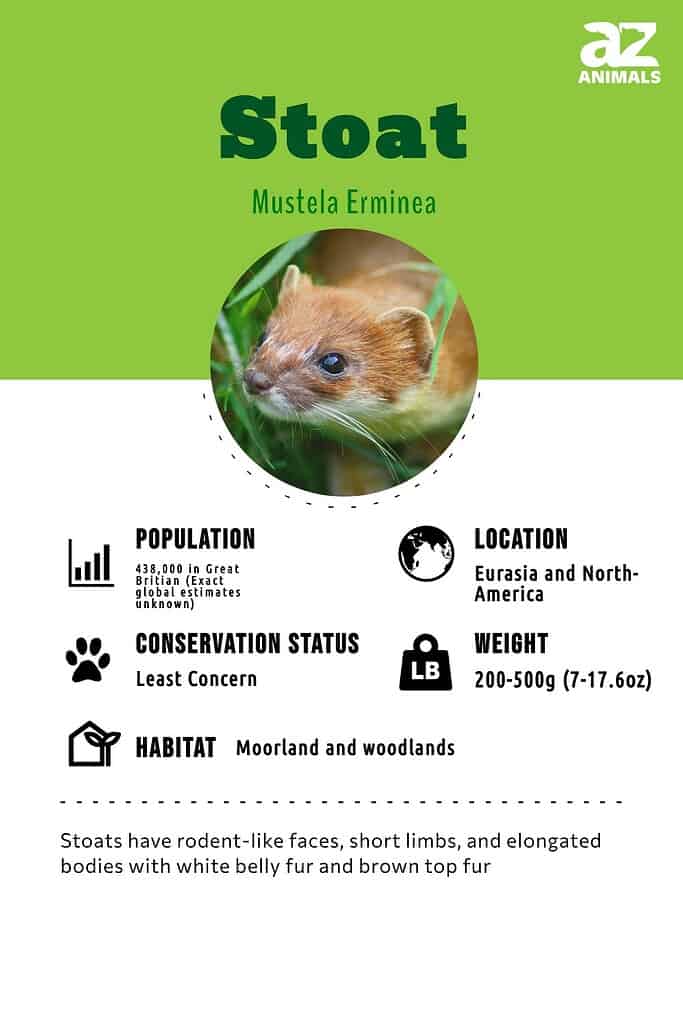
Mustela erminea

White in winter, black-tipped always
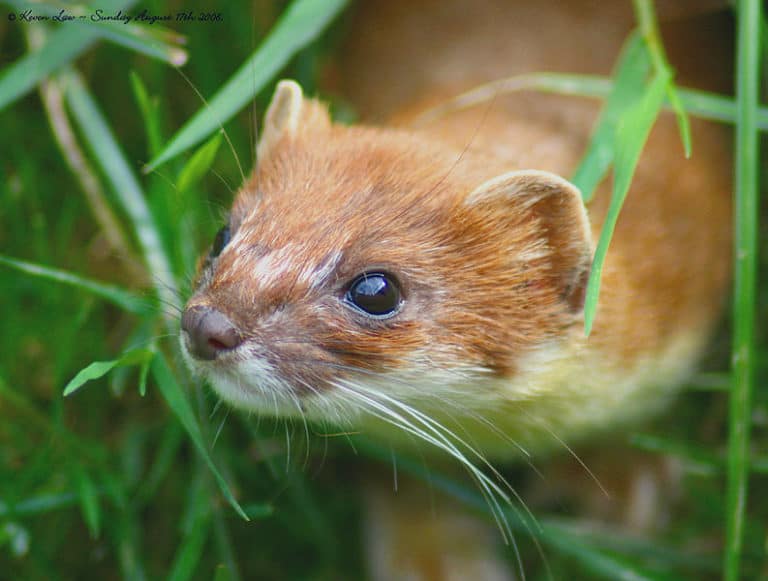
Keven Law / Creative Commons

Stoat Distribution

Click a location to explore more animals from that region

Invasive Species
Loading map...

Found in 86 locations

Stoat in the grass

At a Glance

Wild Species
Also Known As Short-tailed weasel, Weasel, Fitchet, Fitch
Diet Carnivore
Activity Cathemeral+
Lifespan 1.5 years
Weight 0.45 lbs
Status Least Concern
Did You Know?

The black tail tip stays black year-round-even when the rest turns white in "ermine" winter coat.

Scientific Classification

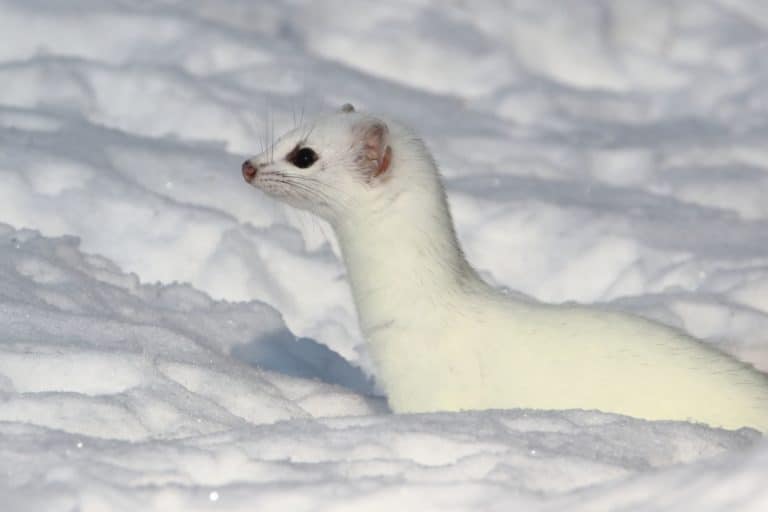
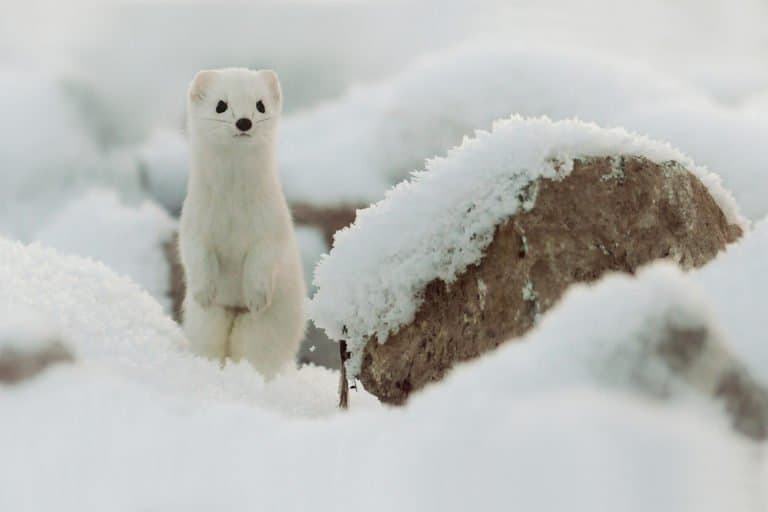
The stoat (Mustela erminea), also known as the ermine, is a small, slender mustelid predator. It is notable for seasonal coat change in many populations—brown above/white below in summer, and often entirely white in winter (the ‘ermine’ coat), typically retaining a black tail tip.

Kingdom
Animalia
Phylum
Chordata
Class
Mammalia
Order
Carnivora
Family
Mustelidae
Genus
Mustela
Species
Mustela erminea

Distinguishing Features

  • Black tip on the tail (key field mark versus some other small weasels)
  • Slender body with short legs; agile, bounding gait
  • Seasonal whitening of the coat in colder regions (ermine phase)
  • Carnivorous hunter, often specializing on small mammals (e.g., voles, rabbits)

Physical Measurements

Males and females differ in size

Length
♂ 1 ft 2 in (10 in – 1 ft 6 in)
♀ 12 in (9 in – 1 ft 2 in)
Weight
♂ 0 lbs (0 lbs – 1 lbs)
♀ 0 lbs (0 lbs – 1 lbs)
Tail Length
♂ 4 in (3 in – 5 in)
♀ 3 in (3 in – 4 in)
Top Speed
15 mph
running

Appearance

Primary Colors
Secondary Colors
Skin Type Dense mammalian fur with distinct guard hairs and underfur; strong seasonal molt in many Holarctic populations. Skin includes well-developed anal scent glands typical of Mustelidae.
Distinctive Features
  • Elongated, low-slung mustelid body; short legs and flexible spine for pursuing prey in burrows.
  • Black tail tip year-round (key trait distinguishing it from least weasel in many regions).
  • Seasonal molt: summer brown dorsum with pale underside; winter coat often white ("ermine") in colder climates.
  • Head-body length: 17-33 cm; tail length: 6-12 cm (species-level ranges reported in mammal handbooks).
  • Adult mass commonly ~0.025-0.45 kg, strongly sex- and region-dependent; males substantially heavier than females.
  • Small, rounded ears and pointed muzzle; eyes relatively large; claws sharp for digging and gripping prey.
  • Predatory behavior: active, agile hunter; uses rapid lunges and neck bite to dispatch small mammals.
  • Diet dominated by small mammals (especially voles/lemmings/rabbits depending on region); also birds, eggs, insects opportunistically.
  • Activity often crepuscular/nocturnal but flexible; uses scent-marking from anal glands for communication and territory.

Sexual Dimorphism

Males are markedly larger and heavier than females, with longer head-body and tail lengths. Both sexes show the same seasonal coat change and black tail tip, but size and skull robustness are the most consistent differences.

♂
  • Larger head-body length within the 17-33 cm range; generally longer tail (6-12 cm range).
  • Higher adult body mass (often several times heavier than females in the same region).
  • More robust head/neck and broader skull proportions.
♀
  • Smaller overall body and shorter average tail length within species ranges.
  • Lower adult body mass; slimmer head and neck proportions.
  • Often able to exploit smaller prey/burrows inaccessible to larger males.

Did You Know?

The black tail tip stays black year-round-even when the rest turns white in "ermine" winter coat.

Head-body length: males ~18.7-32.5 cm; females ~17.0-27.0 cm; tail ~6.5-12.0 cm (reported across the range; e.g., Nowak, 1999).

Mass is strongly sex-biased: males commonly ~0.258-0.450 kg; females ~0.151-0.280 kg (Nowak, 1999).

Stoats use delayed implantation: mating in summer, but births occur the following spring after total gestation of roughly ~240-345 days; active fetal growth is ~4 weeks (summarized in mustelid life-history sources, incl. King, 1983).

They often occupy and hunt through the burrow systems of their main prey (voles, lemmings, rabbits), using the stoat's long, narrow body to advantage.

In many northern populations, coat color change is driven largely by day length (photoperiod), helping match snow cover seasonally.

Wild lifespan is typically short (often ~1-2 years), though longer-lived individuals are recorded; in captivity they may live close to a decade or more (species accounts compiled in mammal references such as Nowak, 1999; King, 1983).

Unique Adaptations

  • Elongated, flexible body and short limbs-classic mustelid design-lets the stoat chase prey through narrow burrows and complex runways.
  • Black tail tip (present in all seasons) is thought to function as a deflection/targeting point for predators or as a signal; it is a defining field mark of M. erminea.
  • Seasonal coat-color change increases camouflage against snow in many northern/continental climates; some milder/coastal populations remain brown in winter.
  • Delayed implantation (embryonic diapause) decouples mating from birth, aligning lactation and weaning with peak spring-summer prey availability.
  • Very high metabolic rate for body size (typical of small mustelids) supports explosive bursts of hunting activity but requires frequent feeding.
  • Well-developed scent glands (a mustelid hallmark) provide chemical defense and communication in dense cover and underground.
  • Sharp, shearing carnassials and a strong bite relative to size enable killing prey near or above the stoat's own mass (e.g., rabbits/young hares in some regions).

Interesting Behaviors

  • Seasonal molting: many populations shift from brown-back/white-belly in summer to mostly white in winter, while retaining a black tail tip; timing is linked to photoperiod and latitude.
  • High-intensity hunting with rapid bounding, frequent direction changes, and pursuit into tunnels; stoats readily follow rodents into burrows.
  • "Surplus killing" can occur when prey is unusually abundant or confined (documented in mustelids, including stoats, in field studies such as King, 1983).
  • Caching: surplus prey may be stored for later use, especially where prey availability is highly seasonal.
  • Scent communication: like other Mustelidae, stoats use anal scent glands and urine/feces to mark routes, den sites, and territory boundaries.
  • Strong sexual size dimorphism shapes space use: males typically range more widely, especially during the breeding season, while females focus on core hunting/den areas.
  • Reproduction with delayed implantation: females can mate soon after reaching maturity; births are synchronized with spring prey availability after implantation months later.
  • Denning in insulated sites (rock crevices, logs, dense vegetation) and frequently reusing prey burrows lined with fur/vegetation.

Cultural Significance

The stoat (ermine, Mustela erminea) had white winter fur used in Europe for royal capes, heraldry, and to show purity. Since 19th-century introduction to New Zealand, stoats are seen as destructive invasive predators of native birds.

Myths & Legends

Medieval European bestiaries tell that the ermine would rather die than soil its white coat; hunters could trap it by surrounding it with mud, because it would not cross the dirty ground.

A Brittany story links the white ermine (Mustela erminea) to the duchy's badge: it would not cross mud to escape dogs, choosing danger rather than dirtying its fur—'Rather death than dishonor.'

Christian-era symbolism adopted the ermine as an emblem of purity and moral integrity, drawing on the old belief that it keeps its coat immaculate; this association carried into European ceremonial dress and iconography.

In Renaissance courts, the stoat or ermine (Mustela erminea) was a knightly symbol. The "Order of the Ermine" and heraldry used it for honor and rank, seen in portraits like "Lady with an Ermine."

Conservation Status

LC Least Concern

Widespread and abundant in the wild.

Population Stable

Protected Under

  • Bern Convention on the Conservation of European Wildlife and Natural Habitats (Appendix III-protected fauna; exploitation regulated)
  • National/regional wildlife regulations in parts of its range (e.g., regulated trapping/hunting seasons and permit requirements in some jurisdictions)

Life Cycle

Birth 6 kits
Lifespan 2 years

Lifespan

In the Wild
1–7 years
In Captivity
3–10 years

Reproduction

Mating System Polygyny
Social Structure Solitary
Breeding Pattern Transient
Fertilization Internal Fertilization
Birth Type Internal_fertilization

Solitary, territorial males range over multiple females and mate opportunistically during the spring-summer rut (≈April-July). Internal fertilization with delayed implantation (~8-9 months); active gestation ~25-30 days; litters typically 4-9. No pair bond; females rear kits alone.

Behavior & Ecology

Social Solitary Group: 1
Activity Cathemeral, Crepuscular
Diet Carnivore Arvicoline rodents (especially voles and lemmings)

Temperament

Strongly territorial and solitary; same-sex overlap typically limited outside breeding season (King & Powell 2007).
Bold, high-energy, persistent hunter; performs rapid exploratory movements and frequent den-switching when disturbed.
Activity timing flexes with prey and risk-often crepuscular, but more nocturnal or diurnal locally (King & Powell 2007).
Sex differences common: males range and disperse farther than females; males often roam widely during rut (Erlinge 1977; King & Powell 2007).
Opportunistic predator with surplus killing and prey caching reported when prey temporarily abundant (King & Powell 2007).

Communication

High-pitched squeaks and chirps during close interactions King & Powell 2007
Hissing or snarling as threat/defense at close range King & Powell 2007
Shrill screams/keening during intense aggression or distress King & Powell 2007
Scent marking via urine, feces, and anal gland secretions; used for territorial signaling King & Powell 2007
Body postures and facial expressions (arched back, open-mouth threat) during aggression and defense.
Tactile communication: mother-kit grooming, carrying, and close-contact nursing within the den.
Spatial signaling: repeated use of runs, den sites, and marking points to advertise occupancy King & Powell 2007

Habitat

Biomes:
Temperate Forest Boreal Forest (Taiga) Tundra Alpine Temperate Grassland Wetland
Terrain:
Mountainous Hilly Plateau Plains Valley Coastal Island Riverine Rocky Sandy Muddy +5
Elevation: Up to 13123 ft 4 in

Ecological Role

Native-range mesopredator specializing on small mammals; in many regions (especially where introduced, e.g., New Zealand) a high-impact invasive predator of birds.

Regulation of small-mammal populations (top-down control of voles/lemmings and mice) Trophic coupling and prey-switching that can stabilize or destabilize local prey communities depending on system Prey base for higher predators (raptors and larger carnivores), supporting food webs In introduced ranges, strong negative impacts on native birds via predation on adults, chicks, and eggs (ecosystem disservice)

Diet Details

Main Prey:
Arvicoline rodents Mice Shrews Lagomorphs Ground-nesting birds, passerines and bird eggs Amphibians Reptiles Invertebrates +2

Human Interaction

Domestication Status

Wild

The stoat/ermine (Mustela erminea) is a wild mustelid, not domesticated like the ferret. Humans used its white winter ermine fur for robes, valued it for control of rats and rabbits, and managed it where invasive (e.g. New Zealand). Small (17–33 cm), black-tipped tail, solitary hunter, active at dawn and dusk, with seasonal coat change.

Danger Level

Low
  • Bites/scratches if handled or cornered (sharp canines; can break skin)
  • Zoonotic disease potential typical of wild carnivores (risk depends on region; e.g., rabies where endemic; ectoparasites such as fleas/ticks)
  • Indirect risks from invasive-population control (traps/poisons used in management can pose secondary risks to people/pets if misused)

As a Pet

Not Suitable as Pet

Legality: Keeping a stoat (ermine, Mustela erminea) as a pet is usually illegal or impractical. Many places ban private native wildlife without permits; some regions ban mustelids. Where allowed, permits and transport rules apply.

Care Level: Expert Only

Purchase Cost: Up to $500
Lifetime Cost: $4,000 - $15,000

Economic Value

Uses:
Fur/commodity (ermine pelts historically high-value; ceremonial and fashion use) Ecosystem services (rodent control in some agricultural contexts) Human-wildlife conflict (predation on poultry/gamebirds; rabbit and bird predation in sensitive ecosystems) Invasive-species impacts and management costs (major driver of predator-control programs where introduced, e.g., New Zealand) HUBS (Mustelidae group): wide human interaction spectrum-fur trapping (mink/stoat/otter historically), domestication and pet-keeping (ferrets), working animals (pest control/ratting), conservation flagship and legal protection (otters, martens), conflict/invasive predator control (stoats/mink in islands), disease ecology (rabies/distemper in some regions), and cultural symbolism (ermine in heraldry/royal regalia).
Products:
  • Ermine fur (winter-white pelts; historically trimmed with black tail tips for regalia and ceremonial garments)
  • Pest-control services (non-commercial, ecological value via predation on rodents)
  • Cultural/heritage value (heraldry, symbolism of the "ermine" coat)

Relationships

Related Species 10

Least weasel Mustela nivalis Shared Genus
European polecat
European polecat Mustela putorius Shared Genus
Steppe polecat
Steppe polecat Mustela eversmanii Shared Genus
Siberian weasel Mustela sibirica Shared Genus
Mountain weasel Mustela altaica Shared Genus
European mink Mustela lutreola Shared Genus
Long-tailed weasel Neogale frenata Shared Family
American mink
American mink Neogale vison Shared Family
European otter Lutra lutra Shared Family
Pine marten
Pine marten Martes martes Shared Family

Ecological Equivalents 5

Animals that fill a similar ecological role in their ecosystem

Least weasel Mustela nivalis Stoats hunt similarly to least weasels, eating mainly small rodents and using the same runways and tunnels. Stoats are larger, so they can also catch rabbits and young lagomorphs.
Long-tailed weasel Neogale frenata Ecological analogue in North America: a slender, semifossorial small-mammal predator that hunts in rodent burrows and along field edges, exhibits similar prey-switching with vole cycles, and overlaps in prey-size spectrum and hunting behavior (rapid pursuit and a neck bite).
American mink
American mink Neogale vison Stoats and mink are mustelid predators with flexible diets near wetlands. Stoats hunt more on land and take smaller prey, while mink are more aquatic and eat more fish and crayfish; both eat amphibians, small birds, and rodents.
European polecat
European polecat Mustela putorius Similar generalist mustelid predator in farmland-woodland mosaics; overlaps in prey (rodents, rabbits, and ground-nesting birds). Stoats typically exploit smaller burrow prey more efficiently due to their narrower body plan and can be more strongly tied to vole and lemming population dynamics.
Small owl guild Asio flammeus Not a close taxonomic relative but a niche analogue as a vole-cycle predator in open habitats. Both track small-mammal abundance and show population responses to rodent irruptions, indicating functional overlap in prey base and habitat use.

The stoat is the small, but bold, predator of the Northern Hemisphere.”

Stoats may be small animals, but this doesn’t stop them from being energetic and ambitious predators across a wide geographic range that includes large swaths of North America, Europe, and Asia. They generally prefer temperate, cool and cold climates and adapt to winter temperatures by donning a distinctive white coat, which has long been known by trappers as the luxurious “ermine” material. They also have high invasive potential when introduced to new environments and can decimate native populations of rodents, birds, and other species. The name stoat comes from an old Dutch word that means “bold” or “pushy,” which is an apt description for these aggressive carnivores.

4 Incredible Stoat Facts!

  • Changing fashion: Stoats are animals that shed their coats each year and may grow a pure white layer of fur, called ermine, to see them through the winter months.
  • Tiny invaders: Stoats are voracious and aggressive predators that can seriously damage new environments that they invade.
  • Delayed birth: Female stoats carry embryos in a form of stasis for almost an entire year before they begin gestation in the uterus.
  • Benefits of age: Older male stoats can control stretches of territory over 50 times bigger than younger males.
Scientific Name
stoat vs weasel

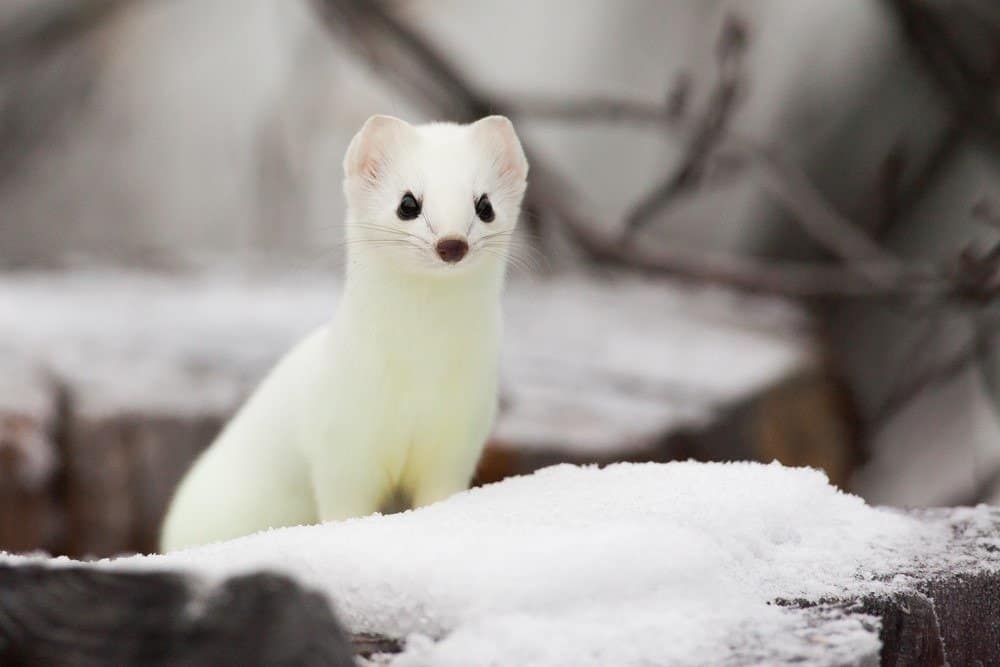
Although stoats are referred to as ermine, the term can also be applied to its other relatives that are capable of growing pristine white coats in winter

The stoat, also known as the short-tailed weasel, is often mistaken for other mustelids like weasels or ferrets. Their external similarities only compound the potential for confusion caused by the common name “ermine,” which can be applied to stoats as well as several other related species that grow a pure white coat during the winter months. Stoats are known as Mustela erminea by the scientific community and are members of the Mustelidae family, which is part of the Mammalia class.

Evolution
stoat vs weasel

The ancestor of the stoat first appeared about 2 million years ago and lived in Eurasia

The evolutionary history of the stoat goes back to about 6 million years ago, when rolling plains replaced northern forests. This change resulted in an significant increase in small-sized terrestial rodents. Around 4 million years after this process, the long-tailed weasel’s ancestor emerged in North America. Soon afterwards, its Eurasian counterpart the ancestor of the stoat known as Mustela palerminea emerged on the evolutionary scene in Central and Eastern Europe. Scientists assert that the earlier form of the stoat was larger in size and that it was actually reunited with the long-tailed weasel 1.5 million years later following the emergence of the Bering land bridge.

Appearance
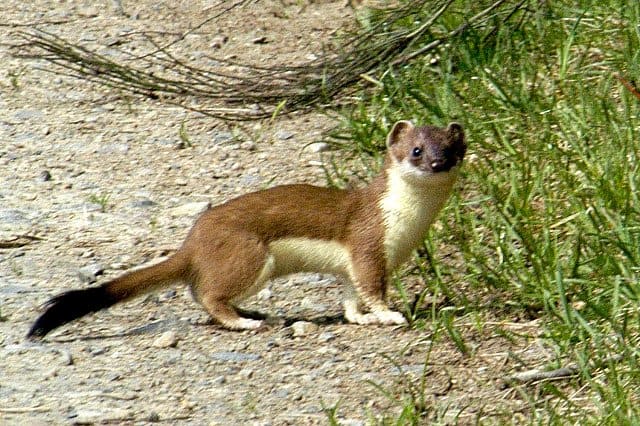
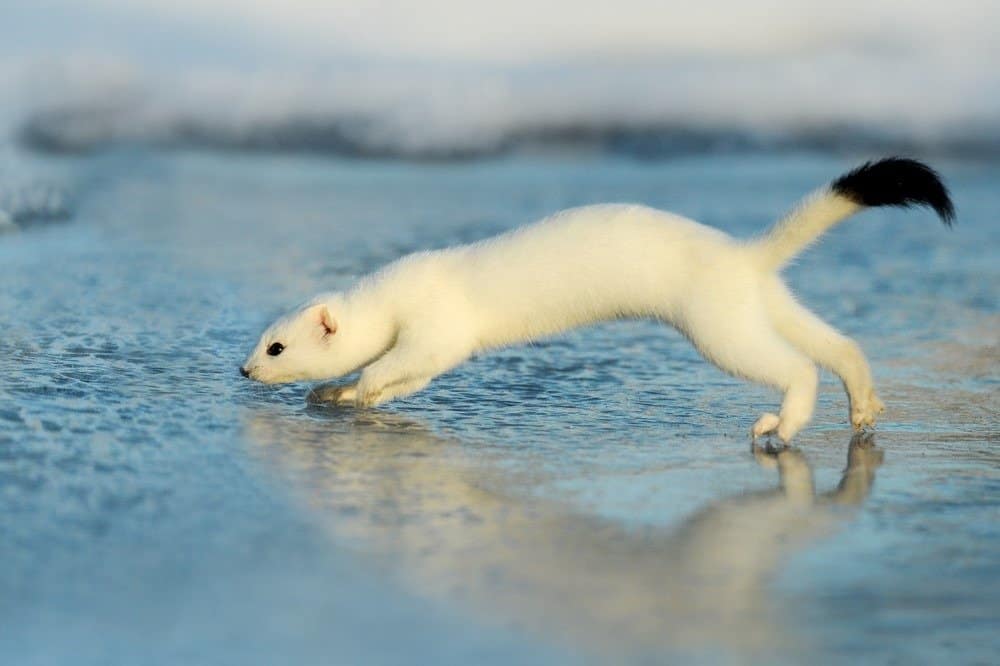
Although stoats are referred to as short-tailed weasels, stoats actually have longer tails than their relatives

Stoats are animals that share many physical features with weasels and ferrets, including a markedly elongated body that is almost serpentine-like in appearance. Adults range in length from 7 to 13 inches and typically weigh between 6 and 9 ounces, with males being about 25 percent larger than females. They have a small, triangular head and a uniform, symmetrical body shape that is well-suited for following prey into narrow burrows or tunnels.

Their typical fur coloration is primarily brown with a white bib and underbelly with a black tip on the very end of the tail. Despite its alternate name as the short-tailed weasel, stoats usually have longer tails than weasels do. Notably, stoats may grow a pure white coat during cold winter months or if they reside in particularly cold climates. It’s only when wearing this coat that they can properly be called ermine and are desired by hunters or trappers for their pelts.

Behavior
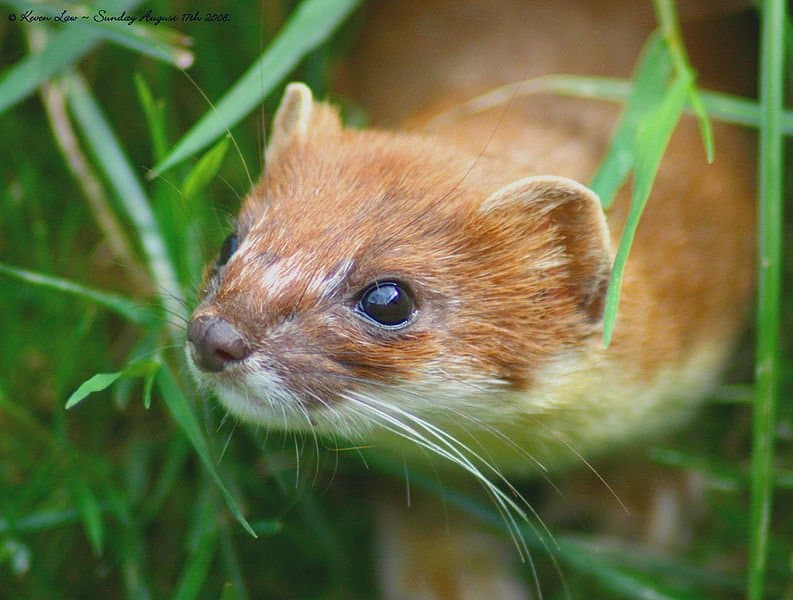
Stoat in the grass

Male stoats are territorial, especially during mating season

Unlike their mustelid cousins, stoats move with an arched back in a bouncing gait that makes them look like they are hopping along. Despite the apparent awkward motion, they are actually quite agile, lithe, and fast. Males are somewhat territorial, especially during mating season, and older males tend to control much more space than younger ones. They don’t dig their own burrows, but instead reside in the underground tunnels or nests of prey that they’ve slain.

Habitat
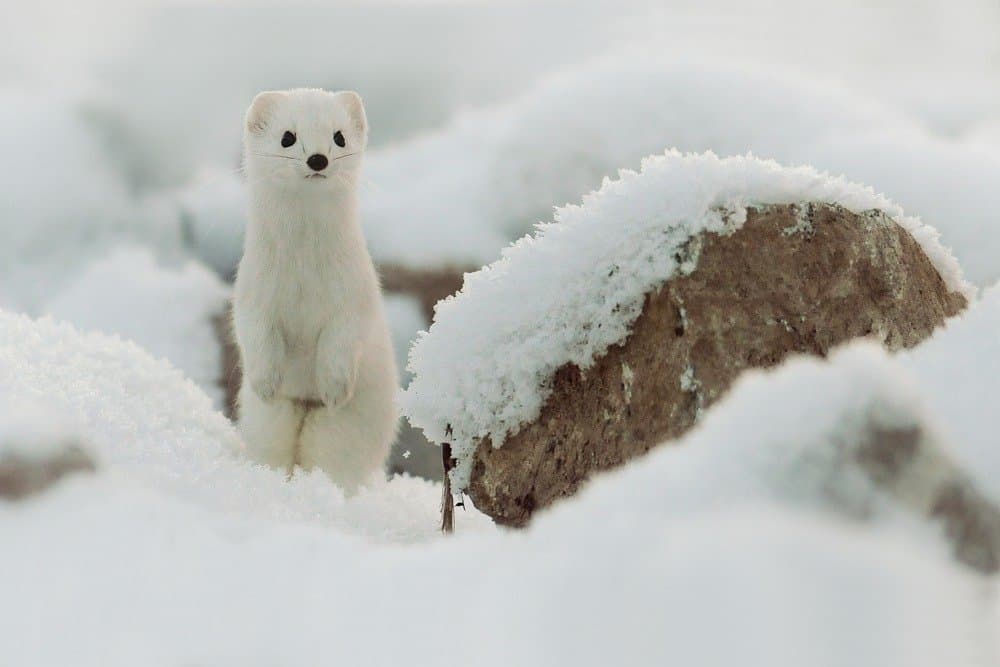
A white-coated stoat

Stoats generally live in cool, temperate regions

Stoats are flexible and adventurous predators, so they can be found just about anywhere where their prey lives. Their primary habitat is usually woodlands, grasslands, and moorlands in cool and temperate regions. However, they are also known to spread into coastal regions and live near farms, orchards, and other areas in close proximity to humans. Their flexible body and low physical profile make it easy for them to hunt and hide in many kinds of environments.

The species has a vast geographic distribution that covers much of the northern hemisphere, including most of Europe, Canada, Alaska, and Russia. Separation of local populations across such massive distances has led to the development of dozens of identified subspecies that have slightly different body proportions, fur density, and color markings to better suit the temperature range or camouflage needs of their local habitat.

Diet
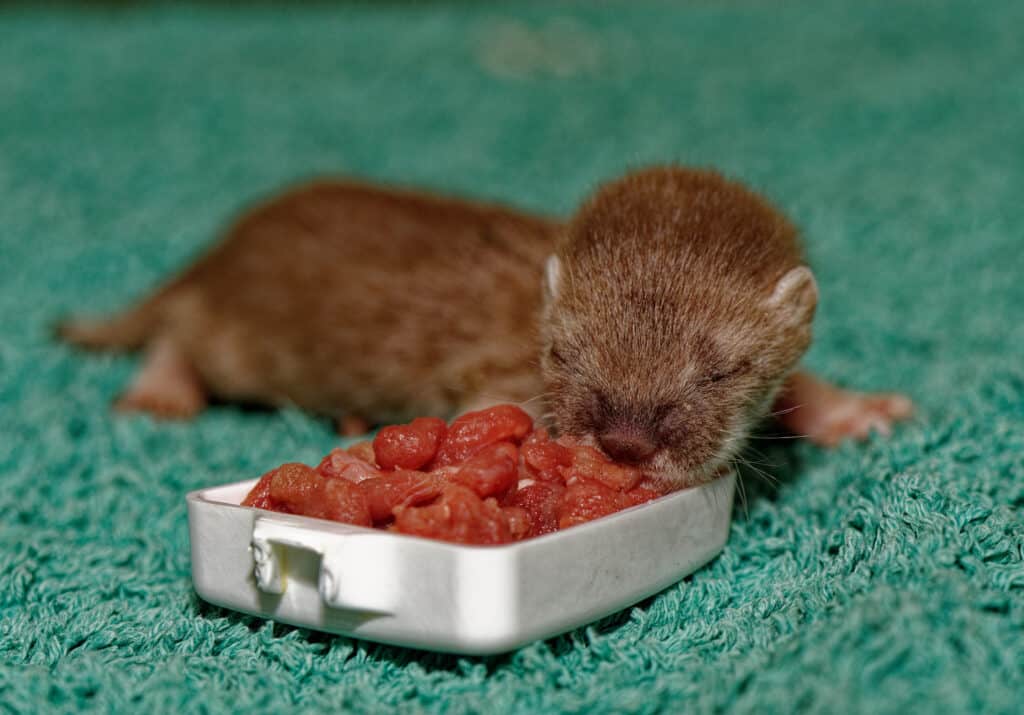
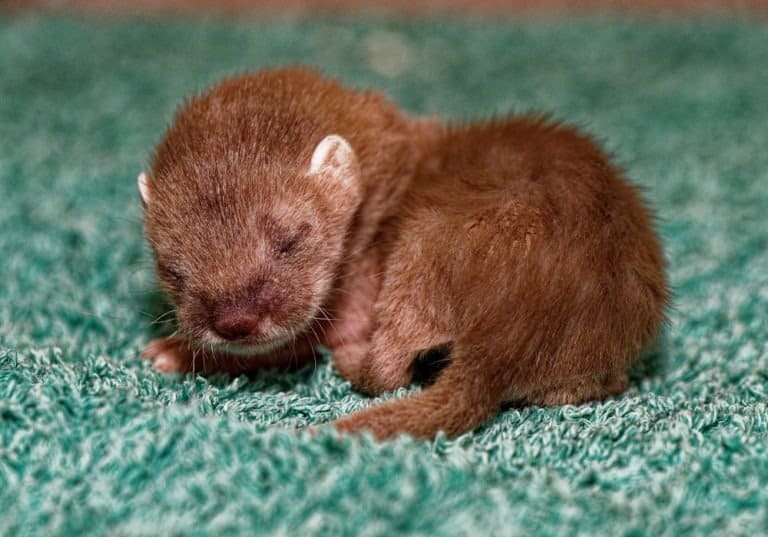
Stoat Baby

Stoats are carnivores and hunt rodents, reptiles, and amphibians in the wild

Stoats are ambitious carnivores that prey on many kinds of prey species, including some animals that are notably bigger than they are. They can be active during the day or night and rely on a combination of speed, tenacity and stealth to catch their prey. Their bodies are well-suited to following burrowing animals into their den, which is a primary defense mechanism many prey animals have against larger predators.

What do stoats eat?

Small rodents are a staple feature of the stoat’s diet, including mice, voles, and hamsters. They aren’t all that picky about what they eat though, so almost any small animal is on the table. Stoats are known to target amphibians, lizards, birds, and even insects when necessary. They can also take down hares and rabbits that are equal or greater than them in size by striking at their neck.

Predators and Threats
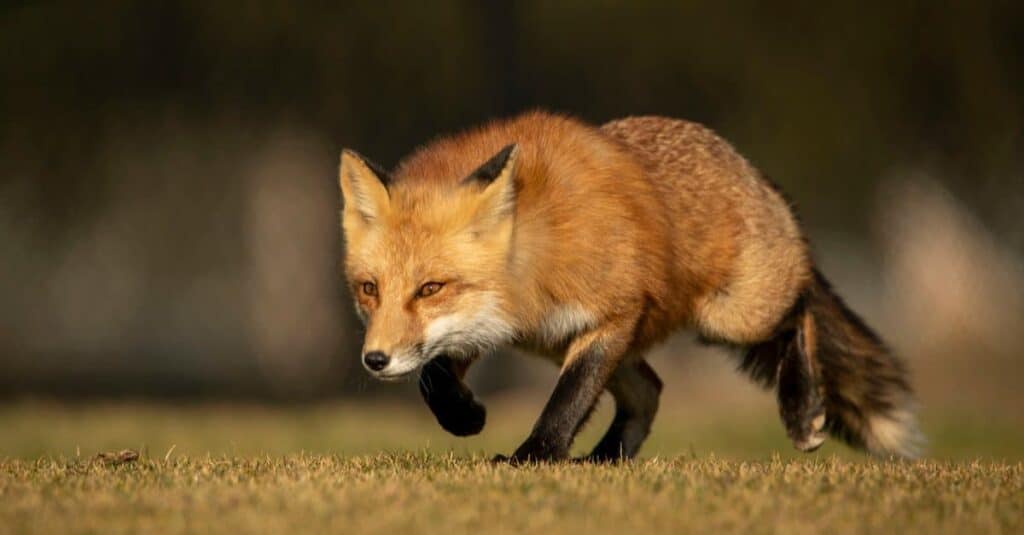
wild fox stalking prey

Foxes can constitute a risk to stoats since they may hunt them

Stoats can have various natural predators depending on their native environment. Birds of prey, like eagles and larger hawks, are a prime threat due to their speed and large viewing distance. Larger carnivorous mammals are also a threat, especially foxes and other animals that share their stealthy, crafty behavior.

Humans are one of the primary threats to wild stoats, although they are rarely sought after as a source of food. The fur of the animal’s winter coat, or ermine, has been a prized commodity for centuries. It is still a traditional element of many types of formal European clothes and has plenty of applications in modern fashion. Stoats are typically captured with traps or hunting dogs as guns and other weapons are likely to seriously damage and devalue the pelt.

Despite a long history of hunting by humans, stoats are still relatively common throughout their wide native range. Their conservation status is listed as least concern, and there are few if any restrictions on hunting or trapping the animals in most countries. One of the biggest natural threats to younger stoats is a lack of available hunting territory and prey competition with mature members of their species.

Reproduction, Babies, and Lifespan

Stoats typically reproduce during spring and early summer, which usually stretches from April to July. The bodies of mature males typically ramp up testosterone production during this period to maximize temporary fertility during the mating season. Increasing day length typically triggers reproductive urges in females, but their period of being “in heat” can be relatively short. Adults may seek multiple partners during a single season and do not remain together to care for young.

Stoats are one of the few animals that undergoes a process called embryonic diapause, which means fertilized eggs don’t immediately implant in the uterus. Instead, they are held in a state of stable hibernation following fertilization for up to 300 days. After this period, they are implanted in the uterus and undergo gestation for 3 to 4 weeks before being born as a live baby.

Baby stoats, called kits, are essentially helpless and are completely reliant on their mother for weeks. Females typically give birth to litters of 5 to 12 kits, which they nurse until they begin the weaning process at about 5 to 6 weeks. Baby stoats are usually independent at about 12 weeks and female young are usually sexually mature at this point. Wild stoats have a life expectancy of 4 to 5 years, but some individuals have lived up to 10 years in captivity.

Population
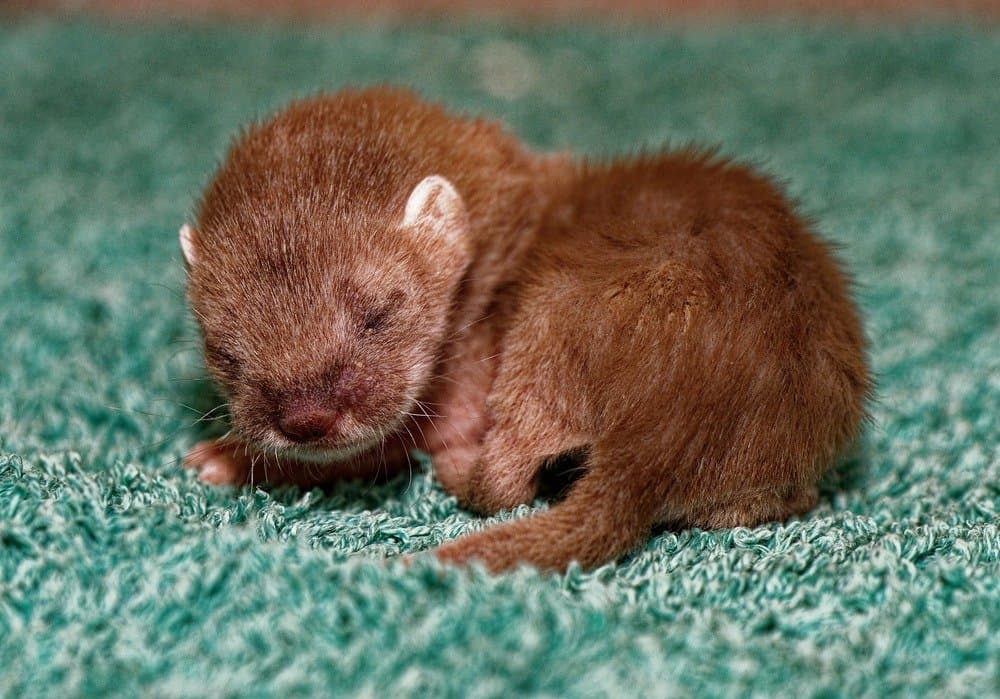
4-week-old stoat baby, also called a kit

Stoats constitute an invasive species in New Zealand

Exact numbers are unknown due to wide geographic distribution and habitat diversity, but stoats are considered common and not in danger of significant population decline. Their native range includes large portions of North America, almost all of Europe, and a large part of Asia. There are populations within the Arctic circle and various islands, including Greenland and mountainous regions in Japan.

The stoat’s introduction and subsequent wilderness invasion in New Zealand has prompted conservationists there to seek containment strategies to mitigate damage to local wildlife. Ireland is one of a few countries that has restricted hunting and trapping stoats, but there are plenty of regions where hunting for ermine is still an active industry.

View all 390 animals that start with S

Sources

  1. Wikipedia
  2. Wildlife Trusts
  3. Mammal
  4. Discover Wildlife
  5. https://www.doc.govt.nz/nature/pests-and-threats/animal-pests/stoats/
  6. The Animal Files https://www.theanimalfiles.com/mammals/carnivores/stoat.html Jump to top
Dana Mayor

About the Author

Dana Mayor

I love good books and the occasional cartoon. I am also endlessly intrigued with the beauty of nature and find hummingbirds, puppies, and marine wildlife to be the most magical creatures of all.
Connect:

Thank you for reading! Have some feedback for us?


Stoat FAQs (Frequently Asked Questions)

Stoats are carnivores that seek food by hunting out in the open and pursuing prey down into their burrows. They are known to seek food in both day and night time.