



Quick Take
- Achieving the highest injury rate against humans in Europe is a territorial requirement.
- The tubular shape of their eyes creates a monocular vision constraint during hunting.
- Surprisingly, hearing is more essential for hunting than better vision.
- Owlets must survive a territory-scouting phase at 3 months old to prevent starvation.
A species of wood owl, tawny owls are highly territorial and about the size of a wood pigeon. These medium-sized owls live across Europe and in some parts of Asia, but you will mainly find them in wooded places in Europe. In fact, these owls are one of the most common owls that live in Europe, and they are the most widespread owl species in the United Kingdom.

Incredible Tawny Owl Facts
- Tawny owls are also commonly known as brown owls.
- Tawny owls are sometimes confused with an owl-like bird called the tawny frogmouth.
- The classic call of “twit twoo” is attributed to this owl. However, this is a misinterpretation of the sound of a male and a female’s sounds overlapping.
History and Evolution
Like most owls, the tawny owl is nocturnal and has developed many features to help them hunt at night.
One example is their adaptation of their ears. They are asymmetrical and angled differently. The right ear is also larger than the left. These features help these owls pinpoint movement in the brush on the forest floor. They actually rely more on their hearing than their sight for hunting.
The tawny owls’ eyes are also adapted for their hunting, although they are not much more sensitive to low-light situations than our own. Their eyes are somewhat tubular in shape and located on the front of their face, which provides a higher percentage of their field of vision being binocular (unlike some other birds with a more monocular percentage).
Classification and Scientific Name
The scientific name of the tawny owl is Strix aluco. Strix is a Greek derivative meaning “owl.” Aluco, however, comes from the Italian words allocco. Allocco means tawny owl from the Latin ulucus (“screech-owl”). They are also referred to as brown owls.
11 Types of Tawny Owls
- Strix aluco aluco: This is a nominal species of Tawny Owl, and it can be found in Europe, from the Mediterranean and the Black Sea up to Scandinavia.
- Strix aluco biddulphi: This subspecies is known as Scully’s Wood Owl and lives in Pakistan and also India.
- Strix aluco harmsi: The Common Night Owl, this bird can be found in Turkmenistan.
- Strix aluco sanctinicolai: The Zagros Tawny Owl lives in Iran and Iraq and hybridizes with the Common Tawny Owl.
- Strix aluco Siberiae: The Siberian Night Owl, as you might guess, has its territory in western Siberia and middle Russia.
- Strix aluco sylvatica: The Common Tawny Owl can be found in Great Britain and most of western Europe.
- Strix aluco willkonski: The Caucasian Night Owl’s habitat stretches from northern Iran to Palestine.
- Strix aluco ma: The Korean Tawny Owl lives in Korea, of course, and also parts of China.
- Strix aluco mauritanica: The North-west African Tawny Owl dwells near Tunisia, Mauritania, and Morocco to surrounding areas of northwestern Africa.
- Strix aluco yamadae: This tawny owl can be found in Taiwan.
- Strix aluco nivicola: This subspecies has its territory ranging from Nepal to southeast China, including Burma and Thailand.
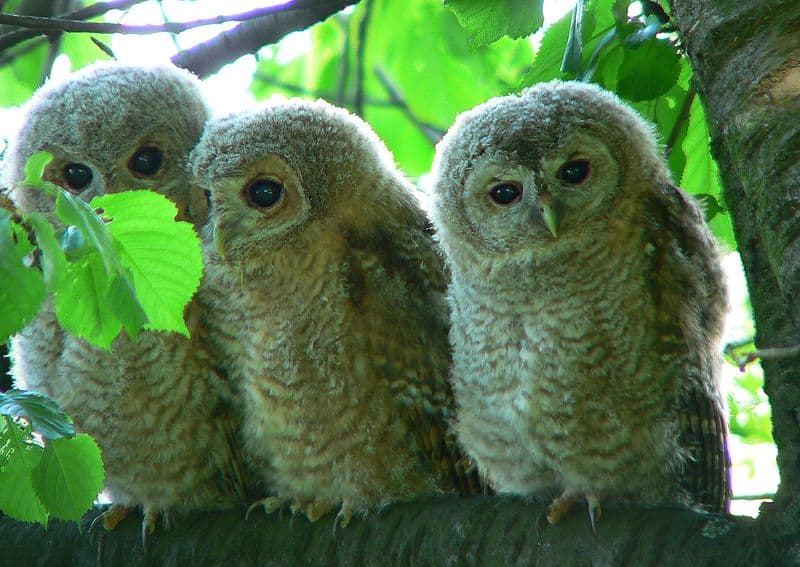
Worldwide, the population of these owls extends from the United Kingdom throughout Europe and eastwards to Russia.
©photo taken by Artur Mikołajewski / Creative Commons – Original / License
Appearance
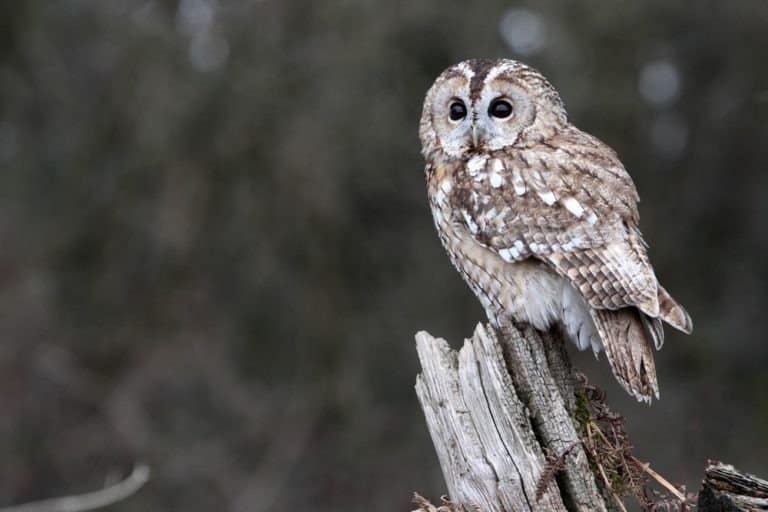
Tawny owls are considered robust owls, measuring up to 16.9 inches tall and having wingspans as long as 39.4 inches. They are stockier than other similar species of owl, including eagle and Ural owls. On average, these owls weigh around 1lb. You can recognize it from its rounded head and body and the ring of darker feathers around its eyes. They are seen in the wild in brown, grey, or reddish-brown colors. All colors of tawny owls have paler underparts with dark streaks.
Females are, on average, 5% longer and more than 25% heavier than males. The northern subspecies average 10% longer and 40% heavier than other subspecies.
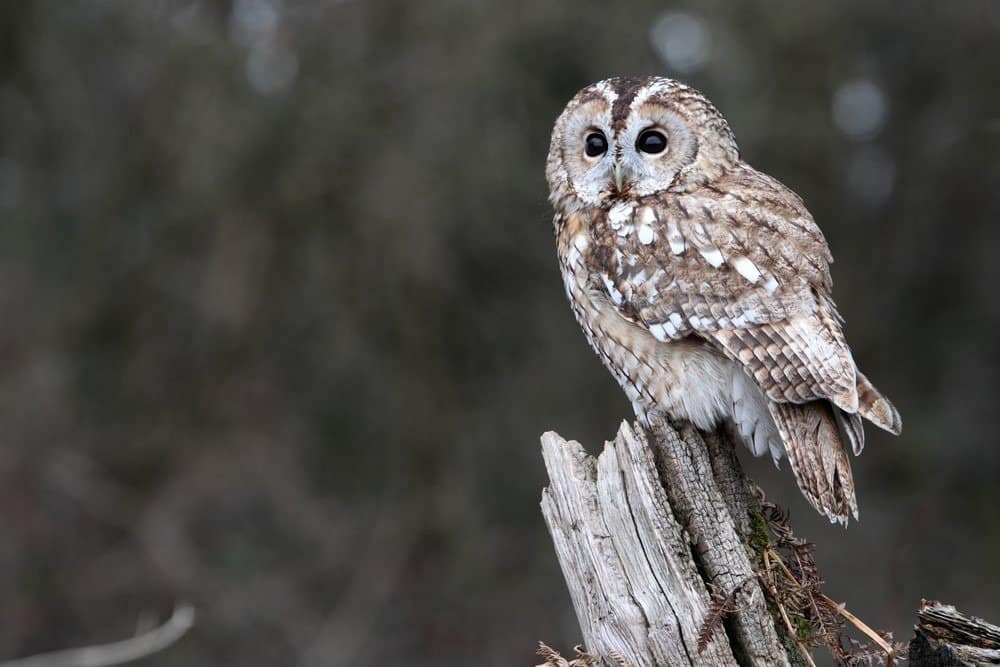
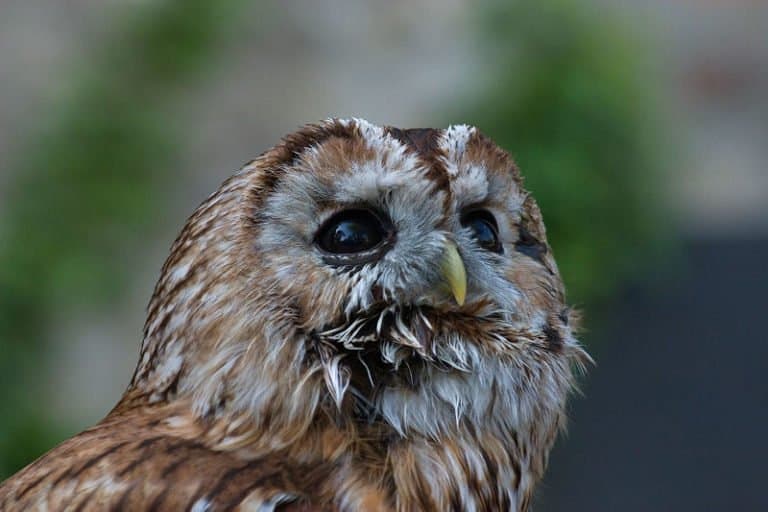
Tawny owls have rounded heads and bodies, and they have a ring of darker feathers around their eyes.
©Erni/Shutterstock.com
Behavior
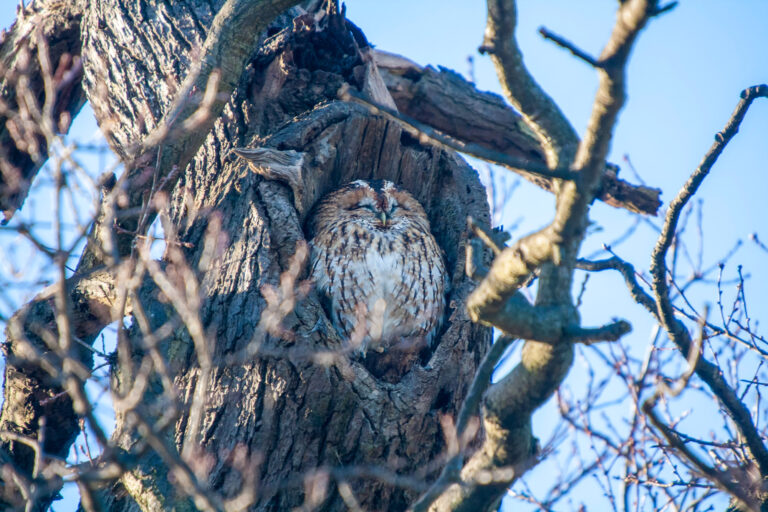
These owls are nocturnal birds of prey. Typically, this means that they can be found asleep in their tree hole nests during the daylight hours. During the early spring breeding season, however, males might be seen hunting during the day to collect food for their mates.
These agile owls are extremely vocal during autumn, winter, and early spring. During the night, they can often be heard making hooting and screeching noises. These various calls allow them to mark their territory, communicate with other owls, and help attract a mate. When defending their nests, they can be very aggressive. They cause more injuries to humans than any other bird in Europe. Tawny owls do not live with others unless they have a mate or owlets.
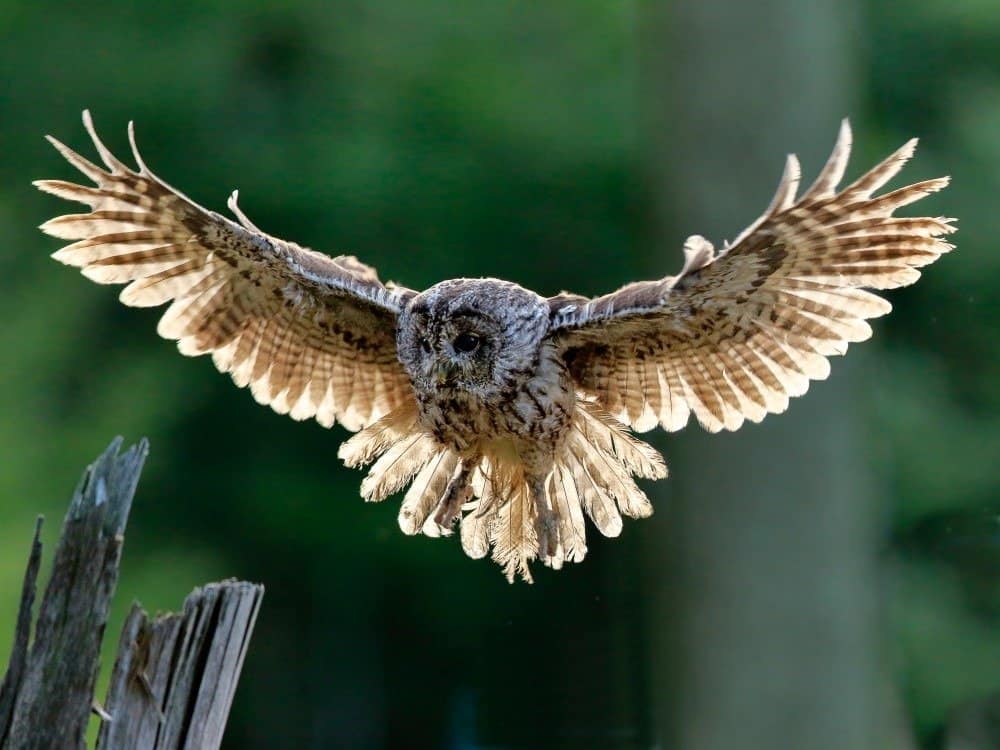
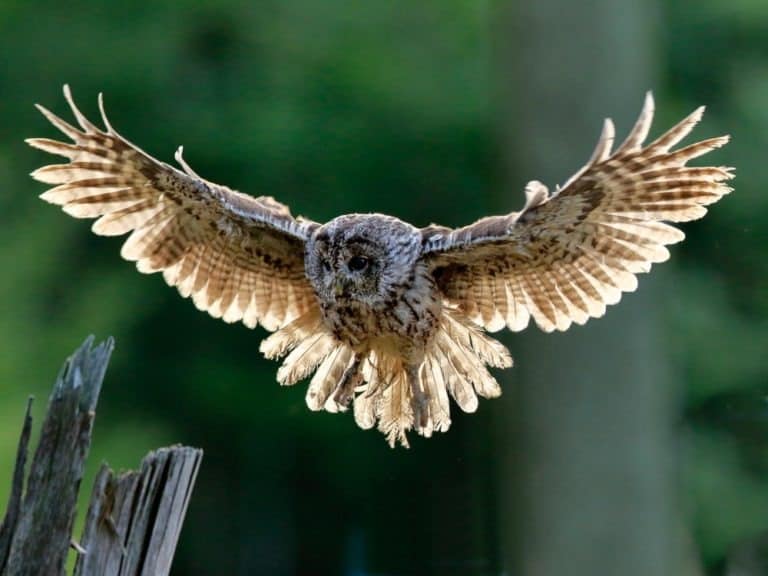
Tawny owls can be very aggressive when defending their nests.
©Daniel Dunca/Shutterstock.com
Habitat
Tawny owls are considered resident birds across their large geographical range of 3.8 million square miles. The world’s wild population of these owls extends from the United Kingdom eastward into western Siberia. Therefore, although these owls are confused with tawny frogmouths, they do not even live on the same continent as the Australian bird. This means they do not migrate outside of their territories. When fledglings leave their parents’ nest, they do not travel very far to find their own independent territory.
These owls make their homes in dense forests and woodland. These covered landscapes allow them to rest undisturbed during the day. They are mainly found in deciduous and mixed forests and like to be near water. Green spaces, like cemeteries and parks, in urban areas, have allowed their habitat to expand into places like central London. They also prefer lowlands, especially in colder climates.
They are well-adapted to wooded areas, thanks to superior vision and hearing. Because they are nocturnal, the evolution of tawny owls has given them front-facing eyes for better binocular vision. Their night vision is significantly better than that of humans, allowing them to see well in low-light conditions. Evolution has also given them uniquely shaped ear openings to improve directional hearing.
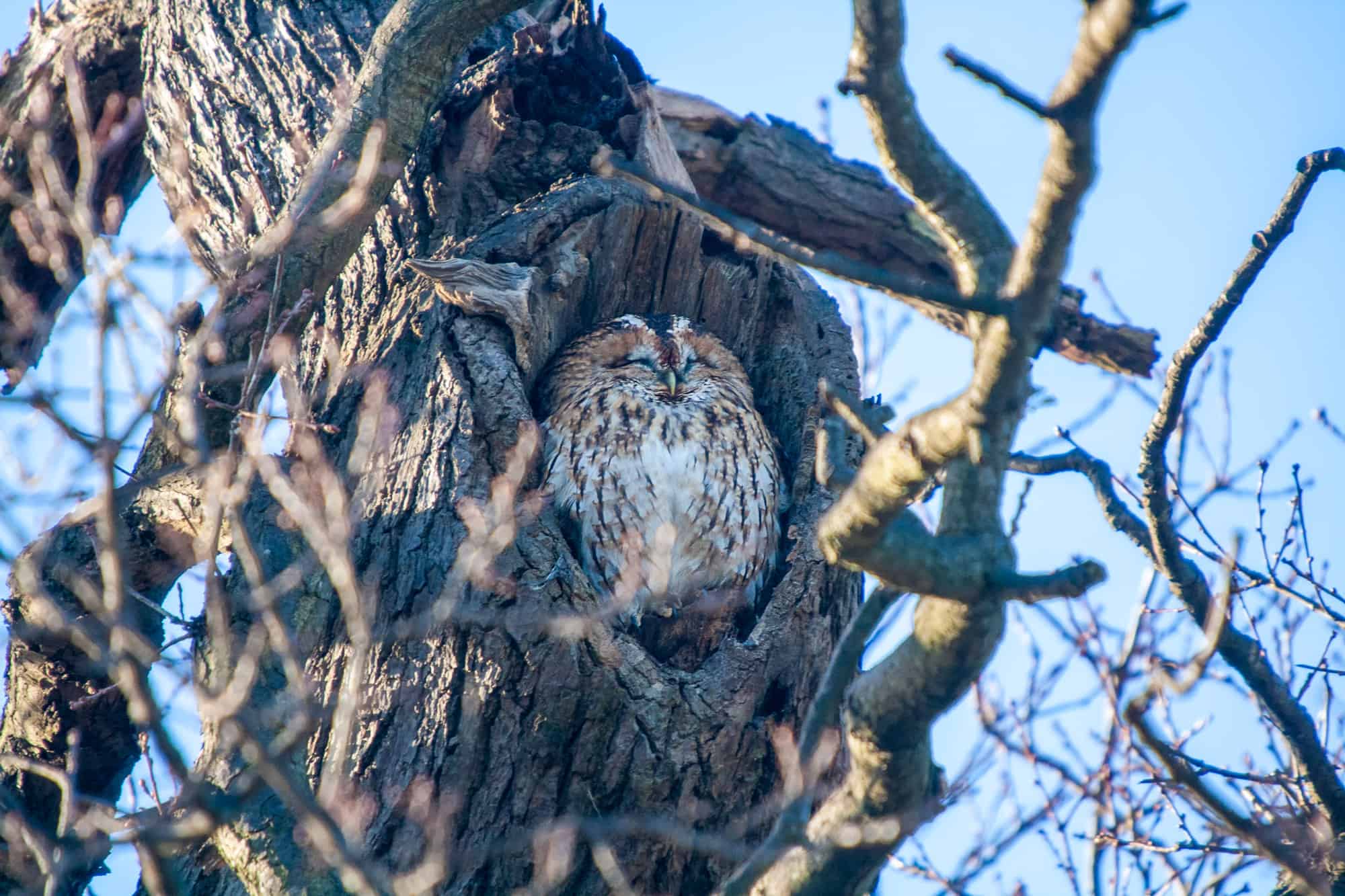
Tawny owls make their homes in dense forests and woodland.
©iStock.com/Rob Atherton
Diet
Because tawny owls are nocturnal, they can use the advantage of incredible hearing and night vision to catch their prey swiftly. Their flight is almost completely without sound, which makes it easy for them to glide down to their victims. These owls prey on small rodents such as voles and mice, and also beetles, frogs, and fish. In the same way as other species of owl, they swallow their prey whole. After a few hours, they will regurgitate anything that is indigestible. These undigestible parts take the form of medium-sized, grey pellets consisting of fur and tiny bones.
Tawny owls are also predators of other, less-aggressive woodland owls. Little owls and long-eared owls find it hard to coexist with them for this reason.
Predators and Threats
Tawny owls are relatively small birds compared to other birds of prey. Their smaller size makes them a more obvious target for several natural predators within their environment. Predators of these owls include larger birds of prey such as hawks, eagles, buzzards, and even larger species of owls. Eagle owls and northern goshawks are the birds of prey of most concern. Other animals might be a threat to them, in particular their eggs and chicks, including dogs, cats, and foxes. Pine martens have also been known to raid their nests for eggs.
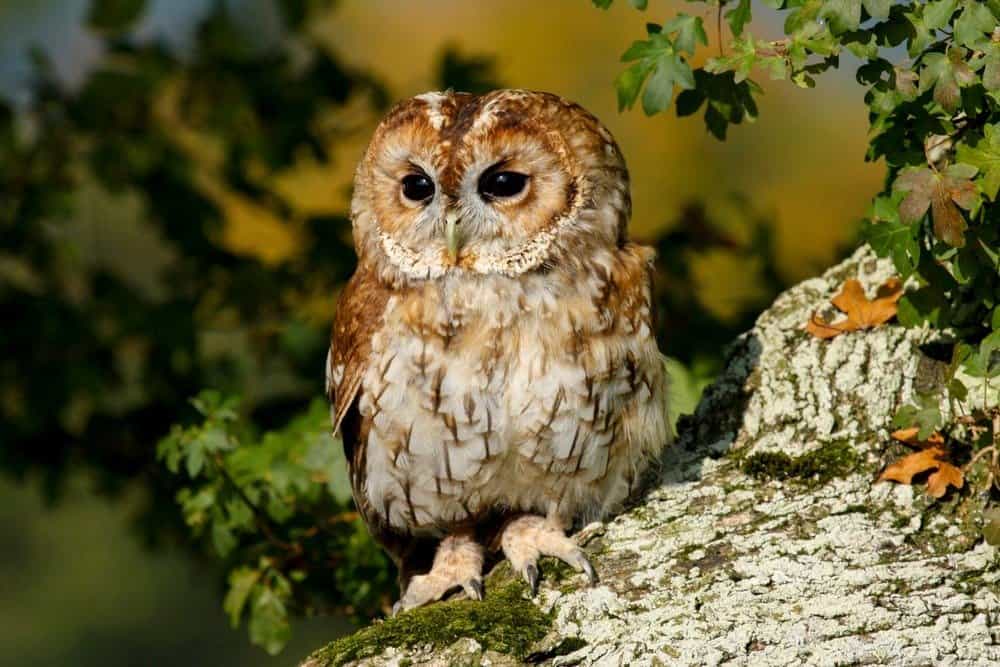
The small size of tawny owls makes them an obvious target for several natural predators within their environment.
©Helen J Davies/Shutterstock.com
Reproduction, Babies, and Lifespan
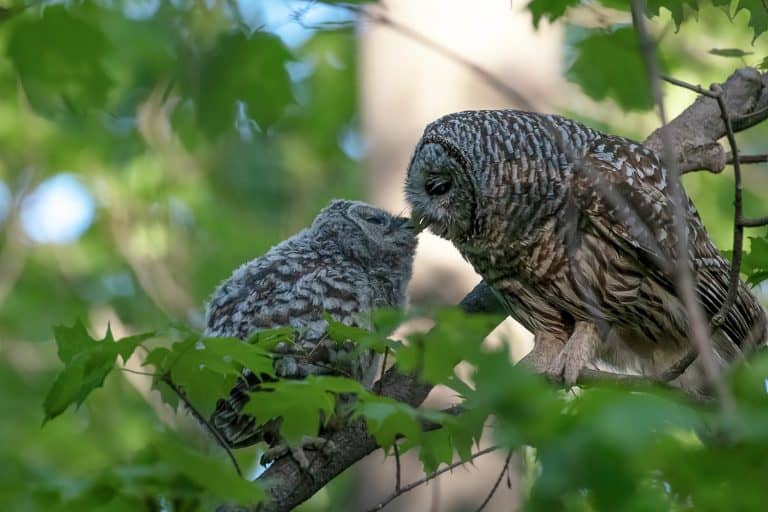
Around the age of one, these owls begin to pair off. They are known to mate for life, but this is not universal. In fact, some males have been recorded as polygamous. Most tawny owls establish nests in tree holes, but may also readily use old European Magpie nests, holes in buildings, and manmade nest boxes.
Anywhere from 3 to 6 eggs are laid by a female owl in early spring, typically from March to early April. A female will spend about one month incubating her eggs while her mate brings her food. A mated pair will raise their chicks until they are around just 2 months old. Evidence shows, however, that these owls might look after their chicks for as long as 3 months of age.
Wild tawny owls generally live between 4 and 6 years, depending on different factors. The oldest recorded owl was a captive bird that lived in the UK for 27 years. In the wild, the oldest known tawny owl lived 18 years. Besides becoming victims of stronger birds of prey, there are a few things that shorten their lifespan. Young owls recently removed from their parent’s nest often starve while trying to establish a territory of their own. This is very common with young owls that refuse to move out of the parental territory. Otherwise, they die in accidents related to vehicles, trains, and wires.
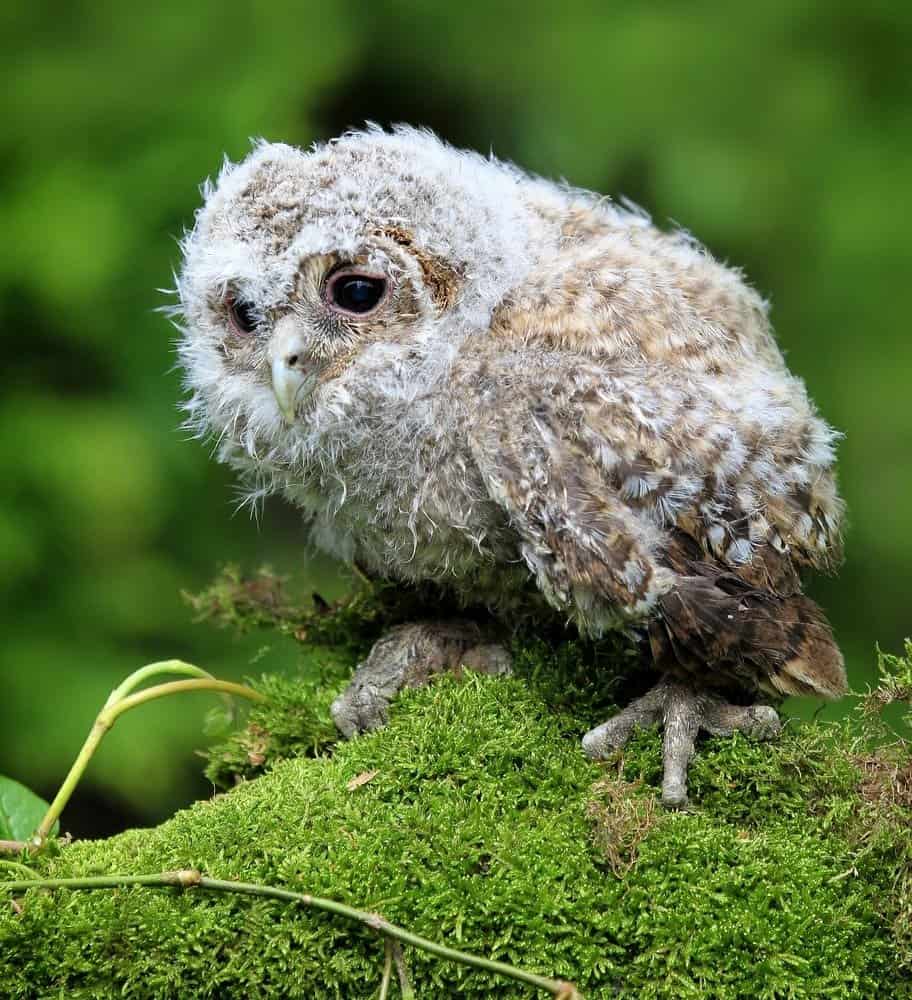
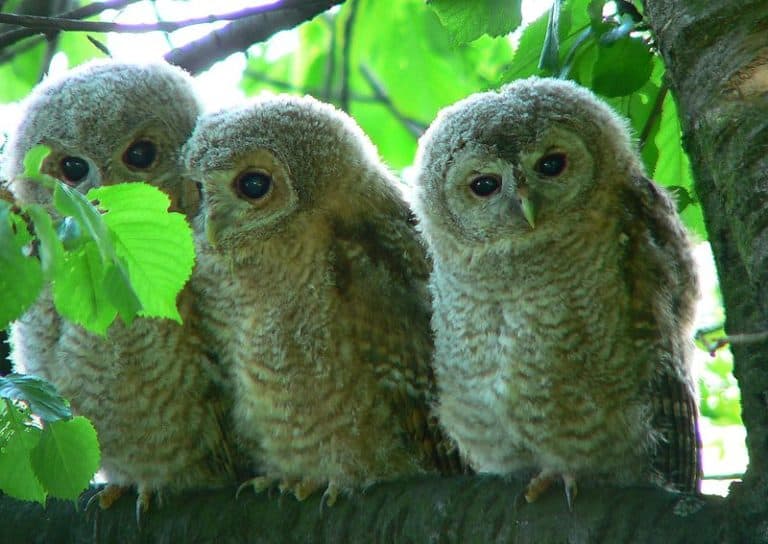
Young tawny owls recently removed from their parents’ nest often starve while trying to establish a territory of their own.
©Mark Caunt/Shutterstock.com
Population
Worldwide, the population of these owls extends from the United Kingdom throughout Europe and eastwards to Iran. There are tawny owls as far east as western Siberia, Iran, and parts of Central Asia such as Tajikistan. In the United Kingdom, they are absent from the islands, as well as Ireland. There is a bit of lore or myth that these owls do not like to make short trips over the sea, which could explain this distribution.
Just in the continent of Europe, there are an estimated 1,260,000 to 1,870,000 of these owls. Their population has not been regularly recorded over the years, but evidence points to an overall increase.
Tawny Owl Pictures
View all of our Tawny Owl pictures in the gallery.

Sources
- David Burnie, Dorling Kindersley Animal, The Definitive Visual Guide To The World's Wildlife / Accessed November 10, 2008
- Tom Jackson, Lorenz Books The World Encyclopedia Of Animals / Accessed November 10, 2008
- David Burnie, Kingfisher The Kingfisher Animal Encyclopedia / Accessed November 10, 2008
- Richard Mackay, University of California Press The Atlas Of Endangered Species / Accessed November 10, 2008
- David Burnie, Dorling Kindersley Illustrated Encyclopedia Of Animals / Accessed November 10, 2008
- Dorling Kindersley Dorling Kindersley Encyclopedia Of Animals / Accessed November 10, 2008
- Christopher Perrins, Oxford University Press The Encyclopedia Of Birds / Accessed November 10, 2008
- The Barn Owl Trust / Accessed October 23, 2020
- RSPB / Accessed October 23, 2020
- BBC Wildlife / Accessed October 23, 2020