



W
Species Profile

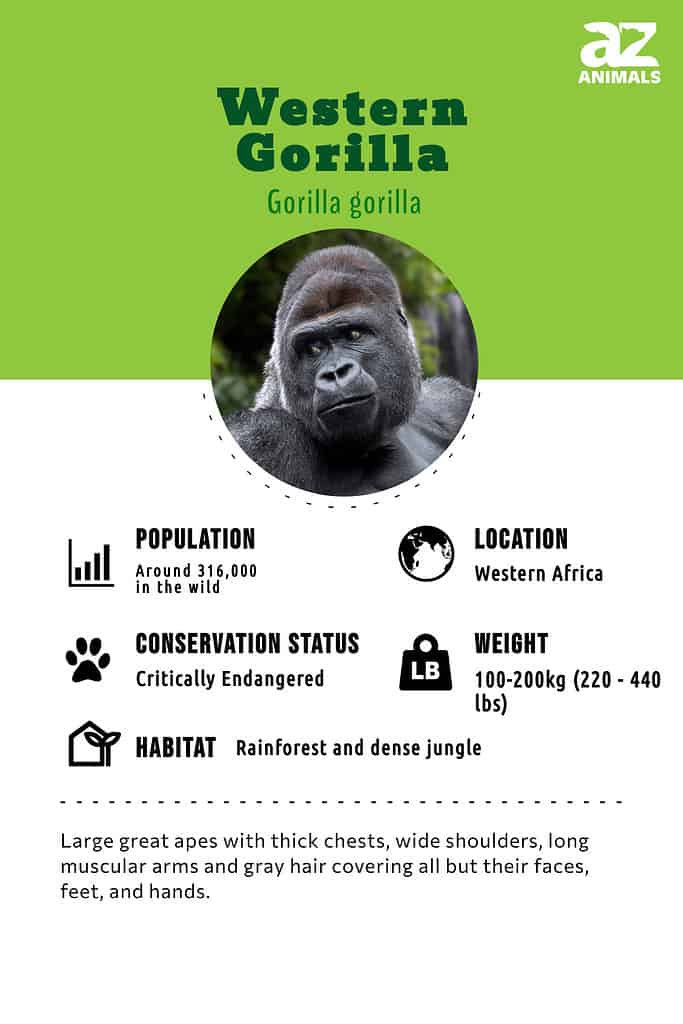
Western Gorilla

Gorilla gorilla

Forest giants of west-central Africa
Philippe Clement/Shutterstock.com

Western Gorilla Distribution

Click a location to explore more animals from that region

Endemic Species
Loading map...

Size Comparison

Human 5'8"
Western Gorilla 5 ft 1 in

Western Gorilla stands at 90% of average human height.

Western lowland gorilla

At a Glance

Wild Species
Also Known As Gorilla, Ape, Great ape, Silverback
Diet Herbivore
Activity Diurnal+
Lifespan 35 years
Weight 200 lbs
Did You Know?

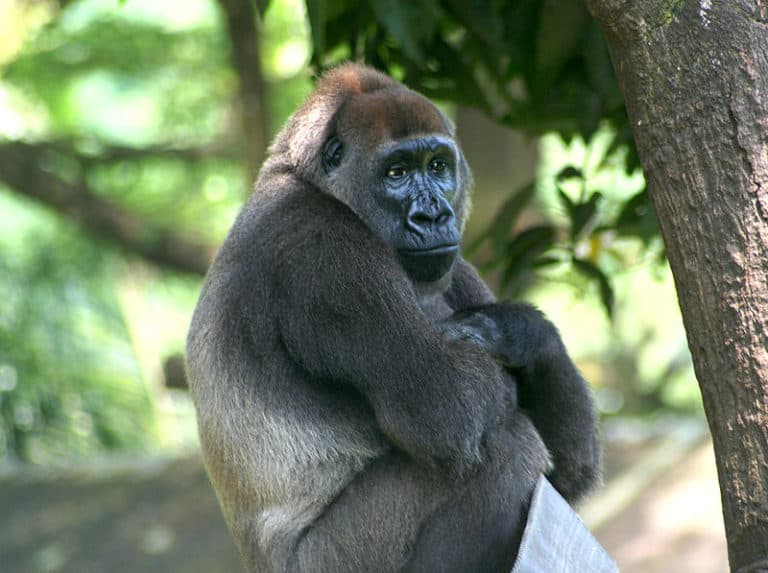
Two subspecies exist: western lowland (G. g. gorilla) and the rarer Cross River gorilla (G. g. diehli).

Scientific Classification

The western gorilla is a large-bodied great ape from west-central Africa. It includes two recognized subspecies (western lowland and Cross River) and differs from eastern gorillas in distribution, morphology, and genetics.

Kingdom
Animalia
Phylum
Chordata
Class
Mammalia
Order
Primates
Family
Hominidae
Genus
Gorilla
Species
Gorilla gorilla

Distinguishing Features

  • Broad chest and powerful arms
  • Dark coat with silverback males
  • Generally smaller than eastern gorillas
  • Forest-adapted, largely terrestrial knuckle-walker

Physical Measurements

Males and females differ in size

Height
1 in (1 in – 1 in)
4 ft 3 in (3 ft 11 in – 4 ft 7 in)
Weight
375 lbs (309 lbs – 441 lbs)
159 lbs (128 lbs – 216 lbs)
Top Speed
25 mph
running

Appearance

Primary Colors
Secondary Colors
Skin Type Coarse fur
Distinctive Features
  • Hairless black facial skin with pronounced brow ridge.
  • Large, wide nostrils and unique nasal crease pattern (noseprint).
  • Very long, muscular forelimbs; knuckle-walking hands with thickened skin.
  • Broad barrel chest and massive shoulders; neck appears short.
  • Sagittal crest prominent in mature males; supports powerful jaw muscles.
  • Dense, coarse guard hairs; shorter hair on face, hands, and feet.
  • Adult male body mass commonly ~140-200 kg; females ~70-100 kg.
  • No external tail; compact trunk with strong, wide pelvis.

Sexual Dimorphism

Adult males are markedly larger and more robust than females, with a prominent sagittal crest and enlarged canines. Mature males also develop a silver-gray dorsal saddle, while females typically retain uniformly dark pelage.

  • Silver-gray dorsal saddle developing with maturity ('silverback').
  • More pronounced sagittal crest and broader, blockier skull.
  • Much greater shoulder and chest breadth; heavier overall build.
  • Larger canines and more massive jaw musculature.
  • Uniformly dark pelage without silver saddle.
  • Smaller body size with less pronounced sagittal crest.
  • Narrower shoulders and lighter, more gracile build.
  • Reduced canine size relative to adult males.

Did You Know?

Two subspecies exist: western lowland (G. g. gorilla) and the rarer Cross River gorilla (G. g. diehli).

Adult males typically weigh about 140-200 kg; adult females about 70-100 kg in the wild.

Gestation lasts ~257 days, and mothers commonly have one infant every 4-6 years.

Cross River gorillas number only ~200-300 individuals, among Africa's most threatened great apes.

Western lowland gorillas can be highly frugivorous; fruit often dominates diet when seasonally abundant.

They build a fresh sleeping nest every night; individuals may nest on the ground or in trees.

Unique Adaptations

  • Enlarged hindgut supports fermentation, helping extract energy from fibrous leaves, pith, and bark.
  • Knuckle-walking is enabled by reinforced wrist and hand bones that protect fingers while moving.
  • Adult males develop a sagittal crest for enlarged jaw-muscle attachment, boosting bite force.
  • Broad molars and thick enamel help process tough plant parts and hard, fibrous foods.
  • Long forelimbs and strong grasping hands support climbing and careful feeding in dense forest vegetation.

Interesting Behaviors

  • Stable groups are usually led by one silverback, often with multiple females and their offspring.
  • Males use chest-beating and powerful vocalizations to advertise strength and avoid costly fights.
  • They practice daily nest-building, selecting supports and weaving vegetation into a platform.
  • Western lowland gorillas may wade and have been reported using sticks to gauge water depth.
  • Foraging routes shift with fruiting seasons, with groups traveling farther when fruit is scarce.

Cultural Significance

Western gorillas are flagship species for Congo Basin forests, central to conservation and ecotourism narratives. Their protection also safeguards vast biodiversity and supports local livelihoods tied to intact, disease-resilient forests.

Myths & Legends

The name "gorilla" traces to Hanno the Navigator's ancient account of encountering "Gorillai" on an Atlantic African voyage, later echoed by classical writers.

Nineteenth-century explorer Paul du Chaillu's Gabon reports popularized the gorilla in global imagination as a powerful, elusive "forest giant."

Across parts of west-central Africa, great apes are sometimes treated as near-human "forest people" in oral tradition, reinforcing taboos and cautionary respect for deep forests.

Conservation Status

CR Critically Endangered

Facing an extremely high risk of extinction in the wild.

Population Decreasing

Protected Under

  • CITES Appendix I
  • CMS Appendix I
  • National wildlife laws

Life Cycle

Birth 1 infant
Lifespan 35 years

Lifespan

In the Wild
30–40 years
In Captivity
40–60 years

Reproduction

Mating System Polygyny
Social Structure Harem Based
Breeding Season Year-round; no distinct seasonal breeding
Breeding Pattern Long Term
Fertilization Internal Fertilization
Birth Type Internal_fertilization

Typically one silverback monopolizes 2-6 adult females in stable groups lasting years; mating is internal. Females have ~257-day gestation and ~4-year interbirth intervals; dominant male guards and fathers most infants.

Behavior & Ecology

Social Troop Group: 8
Activity Diurnal, Crepuscular
Diet Herbivore ripe fruit

Temperament

Wary
Generally calm
Protective
Dominance-displays
Socially tolerant

Communication

grunts Salmi 2013
barks Salmi 2013
screams Salmi 2013
roars Salmi 2013
hoot series Salmi 2013
chest beating Salmi 2013
visual threat postures
tactile grooming
play signals
scent cues

Habitat

Biomes:
Tropical Rainforest Wetland
Terrain:
Mountainous Hilly Plains Valley Riverine Coastal
Elevation: Up to 6683 ft 1 in

Ecological Role

Large-bodied seed disperser and forest-structure modifier in Central African rainforests

seed dispersal nutrient cycling understory pruning forest gap creation

Diet Details

Main Prey:
Fruit Leaves
Other Foods:
Fruit Young leaves Herb stems Pith Bark Roots Flowers +1

Human Interaction

Domestication Status

Wild

Never domesticated. Wild great ape of west-central Africa; human use is conservation, zoos, and research. Adult males ~140-200 kg, females ~70-100 kg; lifespan ~35-40 years wild, 50+ years in captivity (IUCN/AZA).

Danger Level

High
  • severe bite injuries
  • defensive charging
  • crushing strength trauma
  • zoonotic disease transmission
  • risk during habituation/poaching

As a Pet

Not Suitable as Pet

Legality: Illegal in most places; CITES Appendix I permits only.

Care Level: Expert Only

Purchase Cost:
Lifetime Cost: $1,000,000 - $5,000,000

Economic Value

Uses:
Tourism Research Conservation Education
Products:
  • ecotourism
  • research

When thinking of gorillas, most people conjure a vision of an angry, snarling great ape – beating his chest before charging to attack. Some might think of “King Kong” – another famous angry ape, or the gorillas in “Planet of the Apes” – more angry apes! In reality, gorillas are peace-loving creatures that like to hang out with their families, watch their kids at play, and eat fruit and bamboo shoots.

The western gorilla is one of two gorilla sub-groups found on the African continent (the other being the eastern gorilla). The western gorilla is the most numerous of the gorilla species and is found inhabiting the tropical jungles and forests of western and central Africa, along with lowland swamps and secondary forests. All western gorillas are now considered to be critically endangered as much of their natural habitat has now been deforested or taken over by humans.
Species

The western gorilla is one of the great apes, a group that includes orangutans, gorillas, humans, and chimpanzees. As with the other great apes, the western gorilla has a number of features that makes living in the jungle a bit easier, including having opposable thumbs which come in handy when the western gorilla is peeling fruit.

There are two separate subspecies of the western gorillas which are the western lowland gorilla and the cross-river gorilla. Although only slightly different in appearance, the two western gorilla species are distinguished by their differing skull and tooth sizes.

Western Gorilla (Gorilla gorilla)

Eastern Gorilla (Gorilla beringie)

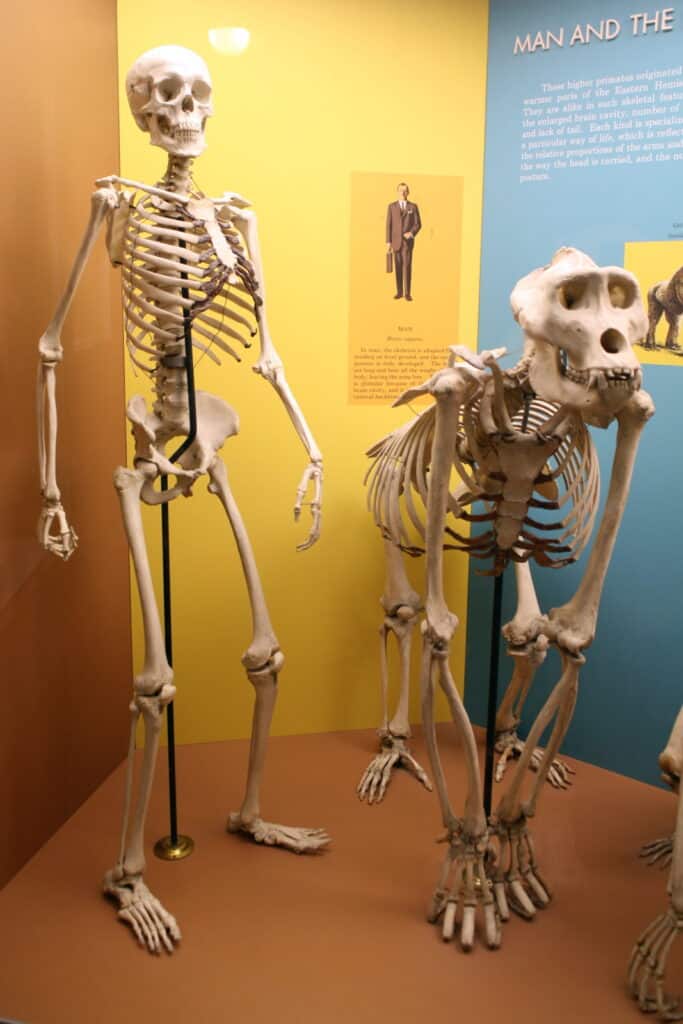
Not the left, a human Skelton, on the right a gorilla Skelton. Three walls (L-r, brown,yellow,blue) are behind the display which appears to be in a museum. On the yellow wall is a poster with a photograph of a male presenting human in a business suit (jacket, trousers,tie) carrying a brief case in his right hand,, with indecipherable verbiage underneath. The blue wall has raised white letters that spell MAN AND THE - rest out of frame. A paragraph of white letters below with information regarding the display.

Gorillas are closely related to humans and share many traits.

Evolution

Although not much is known about the evolution of gorillas, they are closely related to humans and chimpanzees. They all diverged from a common ancestor about 7 million years ago. Human gene sequences differ from gorilla sequences by only 1.6% on average.

Gorillas were previously thought to be a single species with three subspecies (Western lowland, eastern lowland, and mountain gorillas), but it is now agreed that there are two main species, the Western gorilla, (Gorilla gorilla) and the Eastern gorilla (Gorilla beringei), and they each have two subspecies. Western and Eastern gorillas split into two groups around 77,700 years ago.

Appearance and Behavior
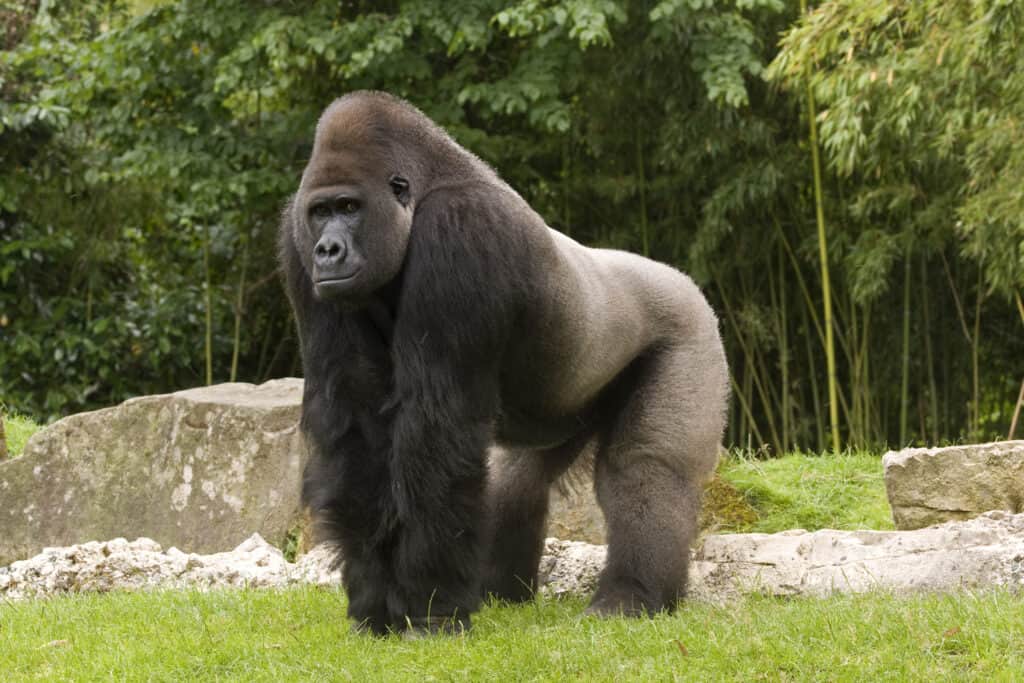
Silverback intimidate his own reflection

Western silverback gorillas can weigh up to 440 pounds.

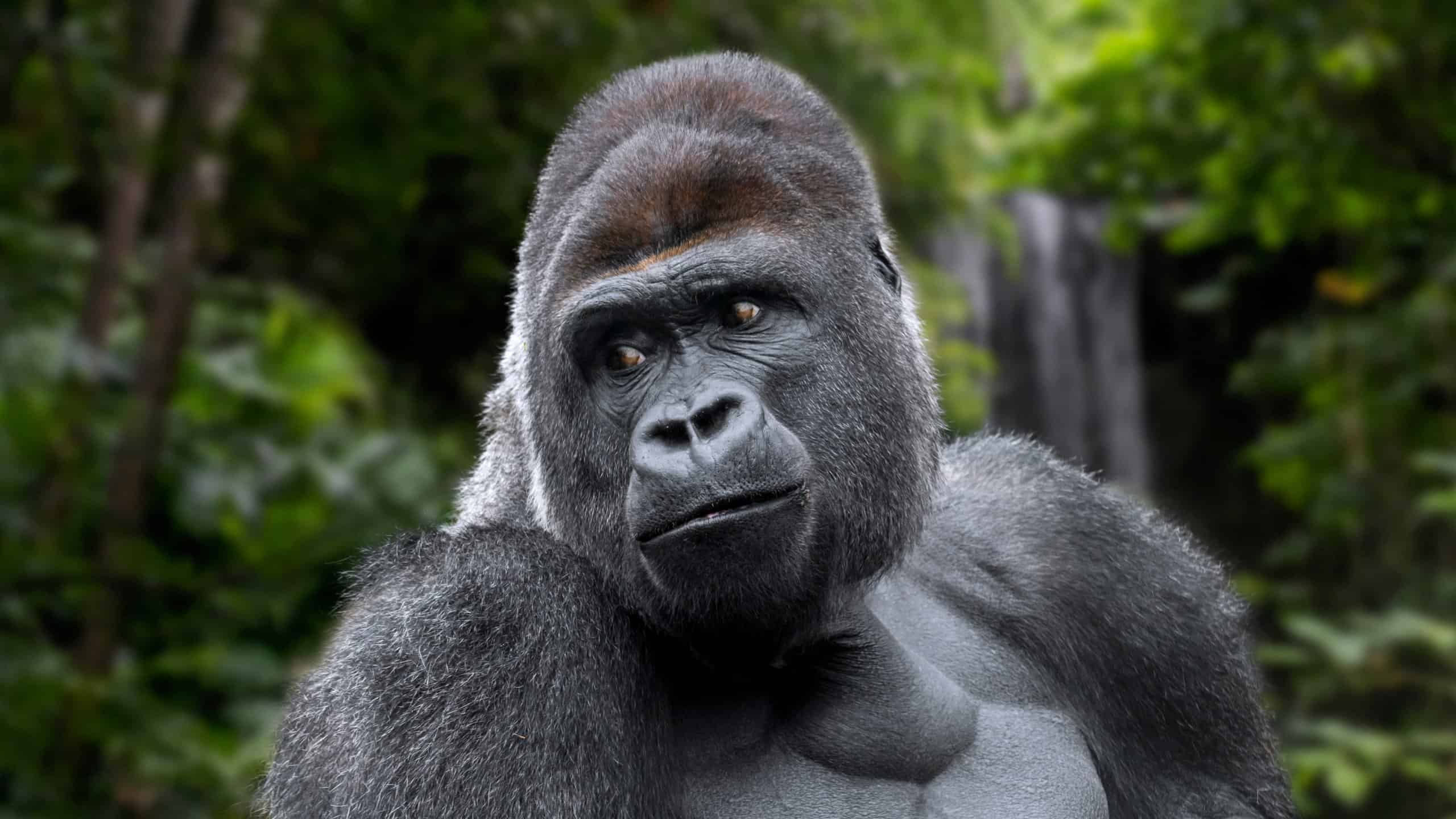
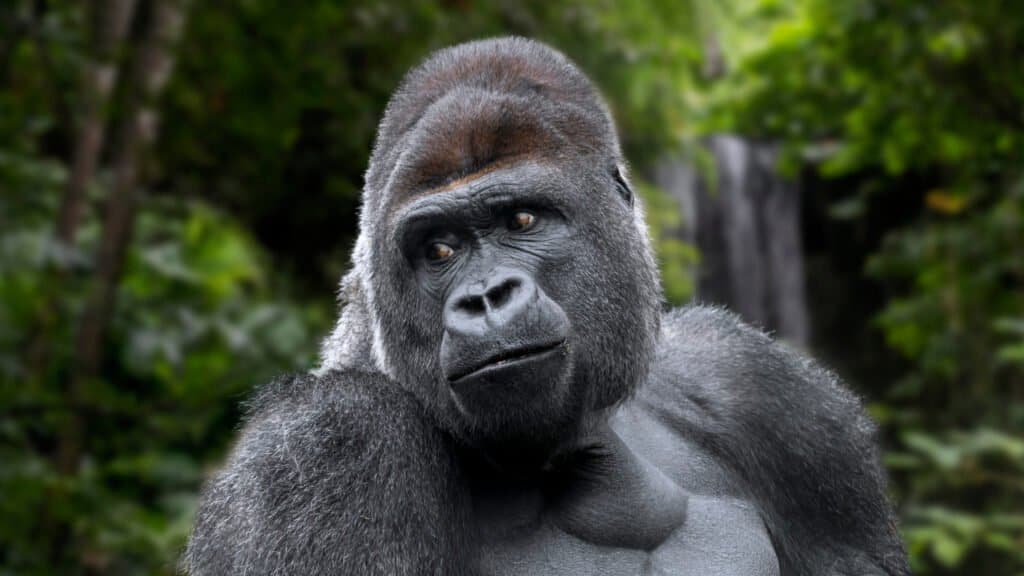
Western gorillas are certainly as strong as they appear to be – with thick chests, wide shoulders, and long, heavily muscled arms that they use to propel themselves on their knuckles. They are covered in dark, brown-gray fur except for their faces, hands, and feet; older males may also have bare chests. Adult males develop gray or silver hairs in a saddle pattern on their lower back which is why mature males are referred to as silverbacks.

The Western gorilla is smaller than the Eastern gorilla. They weigh anywhere from 220 to 440 pounds, while their Eastern counterparts weigh 450 – 500 pounds. Their height ranges from 4.7 to 5.5 feet, ranging from a child’s height or the average adult human height. Like other great apes, these gorillas have opposable thumbs, making using tools and other activities much easier.
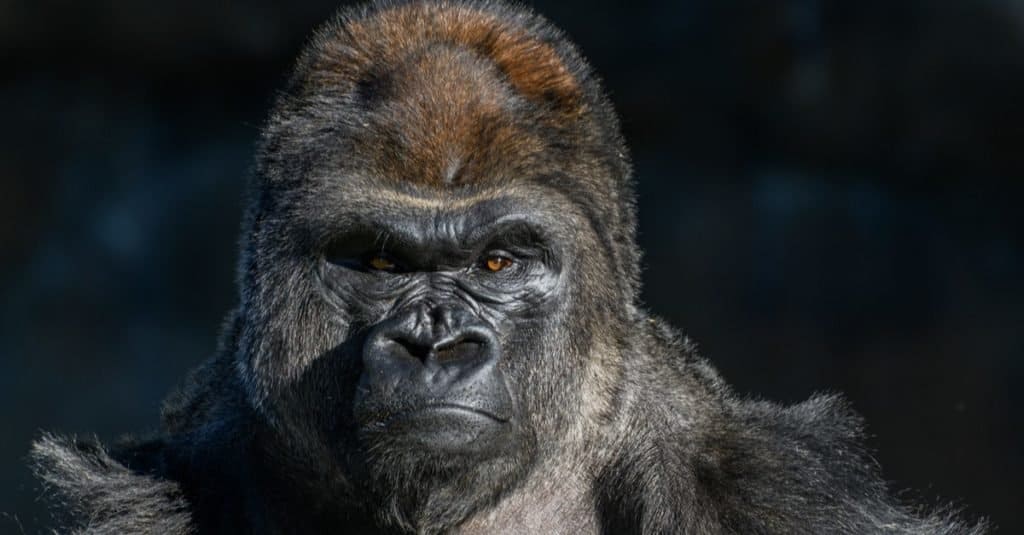
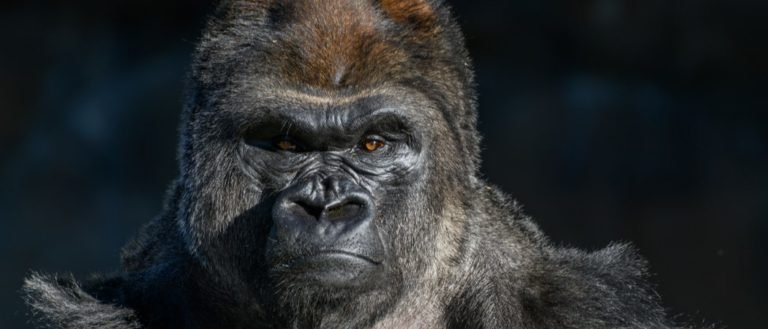
Western Lowland Gorilla with strong, angry look on face

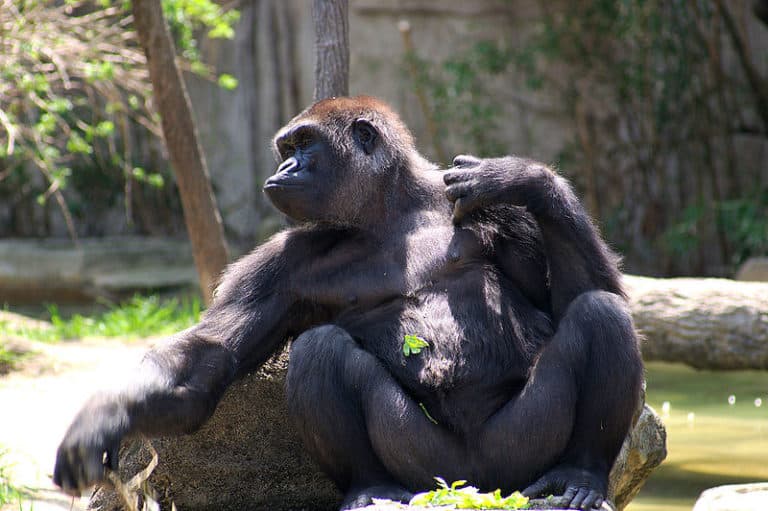
Male western gorillas are almost twice as large as females.

They have wider skulls than other gorillas, and their brow ridges are more pronounced. It is also far easier to distinguish the females from males in Western gorillas as the females are almost half the size of silverbacks.

How can you tell the difference between the Western gorilla and the Eastern? The Western gorilla’s hair is a dark brown-gray color, with a little bit of red or auburn on top of its head. Eastern gorillas have much darker hair and are larger.

A group of gorillas is called a troop or a band. They claim an area between one and 16 square miles and walk throughout that area to feed. Several bands may inhabit the same area without conflict. Western gorillas build nests of vegetation every night, either on the ground or in trees.

Diet
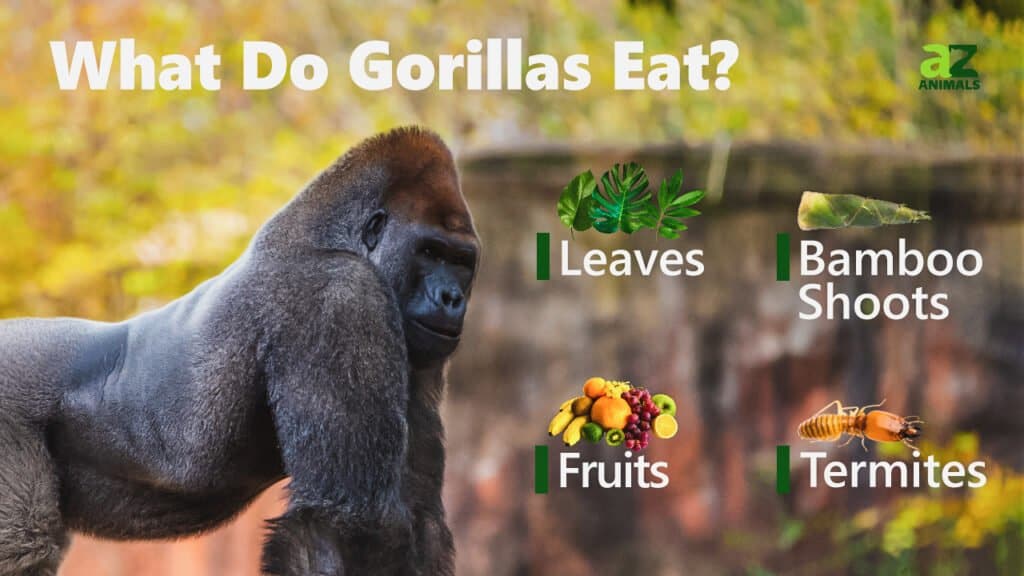
What Do Gorillas Eat
Gorillas eat leaves, bamboo shoots, fruits, and termites.

The western gorilla is an omnivorous animal, but the majority of its diet is made up of eating fruit – which they are known to travel vast distances through the forests to find. The western gorilla also eats leaves, nuts, and berries, along with insects and occasionally small animals such as lizards and rodents. The western gorilla has also been observed using basic tools in the wild in order to more effectively gather food.

Predators and Threats
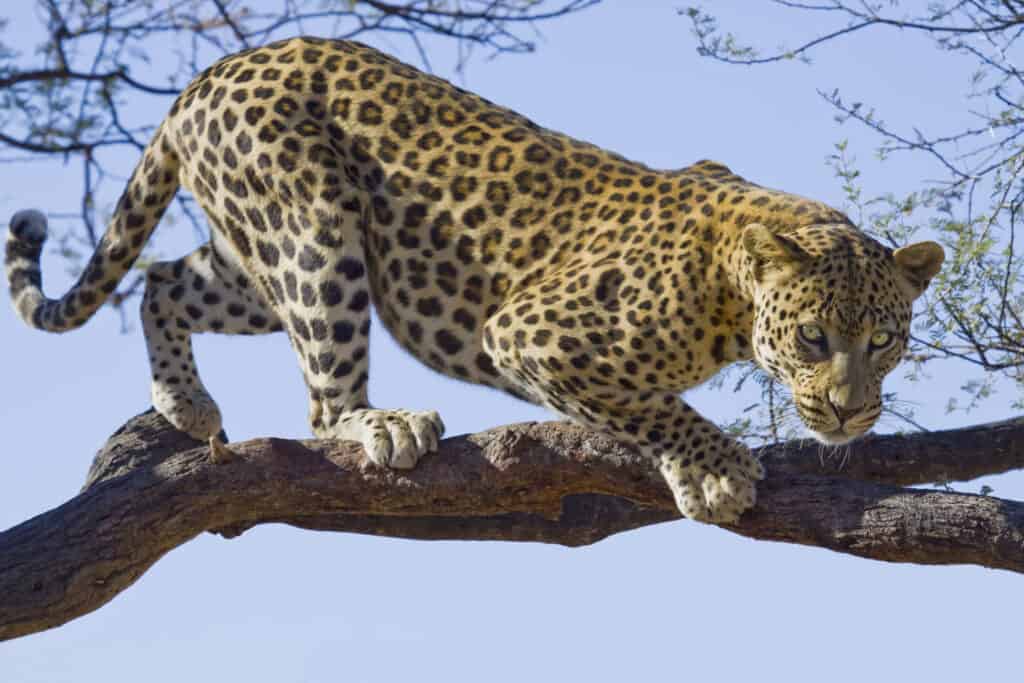
leopard

Leopards have been known to prey on gorillas.

Due to its large size, the western gorilla has few real predators in its native African forests, with large cats such as leopards and the odd crocodile being the only real natural threat to the western gorilla. The biggest threat to the western gorilla is habitat loss caused by deforestation and also being hunted by humans. Parts of the western gorilla’s territory have also been taken over by civil unrest in recent years, which, along with poaching, has had a truly devastating effect on wild populations.

Reproduction and Babies
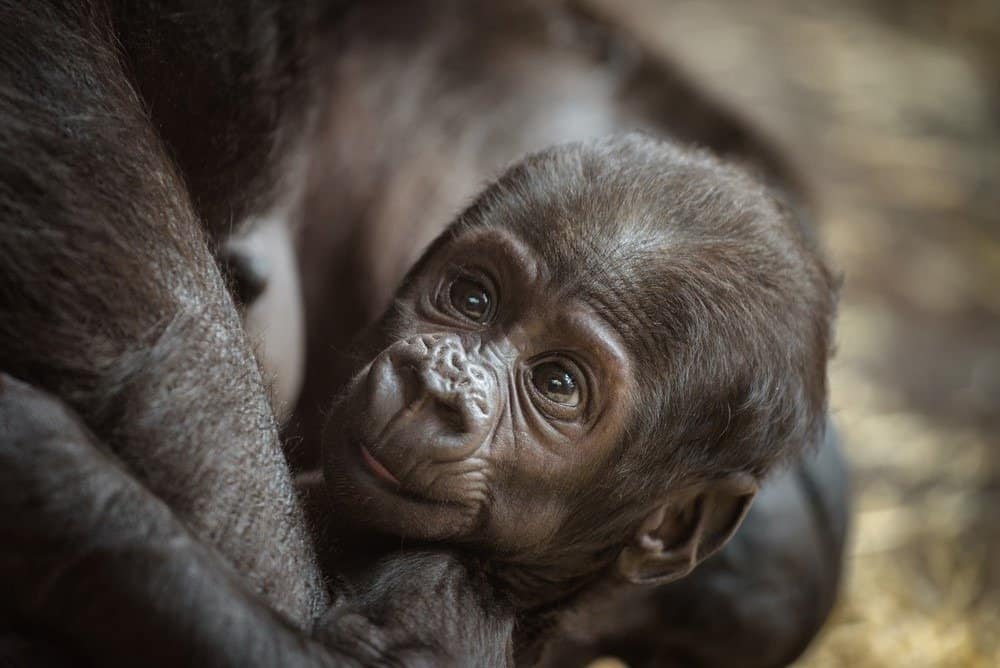
Six-week-old baby of a Western lowland gorilla

Baby gorillas are born helpless and need total care from their mothers.

The western gorilla tends to live in groups that are led and protected by the alpha male. Females reach sexual maturity around the age of seven. Their gestational period is approximately eight and a half months long. On average, they give birth to a sole baby every four years. Males mature more slowly, and they attain maturity between 12 and 13 years. Upon reaching maturity, males leave the troop and form their own with adult females that they kidnap from other bands during raids. The juveniles of the troop are all fathered by the one or two silverbacks that lead the group.

Western gorilla babies remain with their mothers until they are a few years old and become independent. They are helpless from birth until about three months and spend most of their time being carried in their mother’s arms. Baby gorillas are able to cling to their mother’s chest or back, but they are not able to care for themselves or walk.
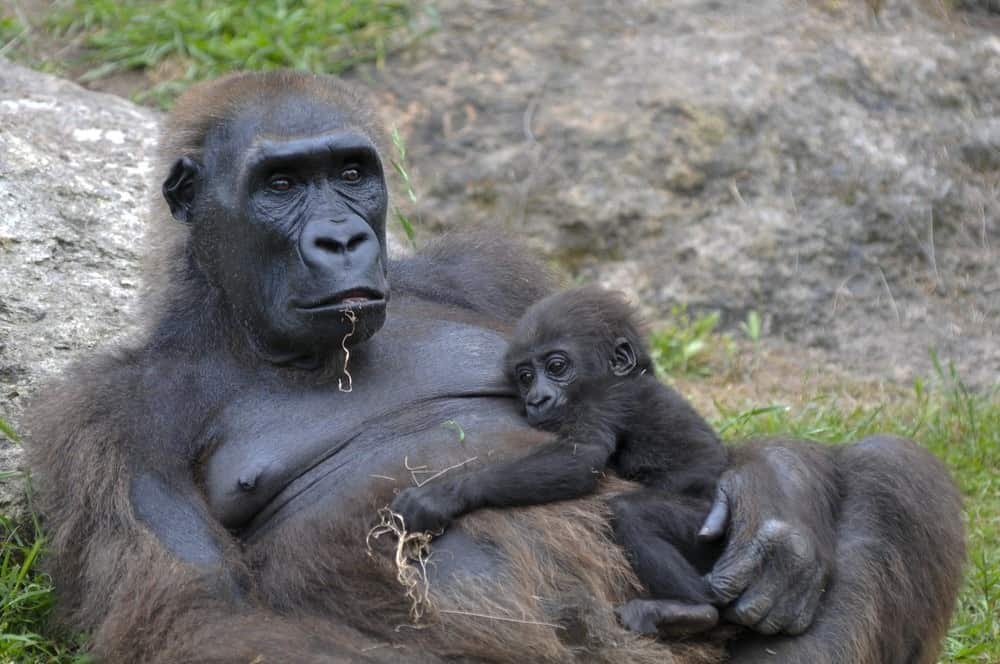
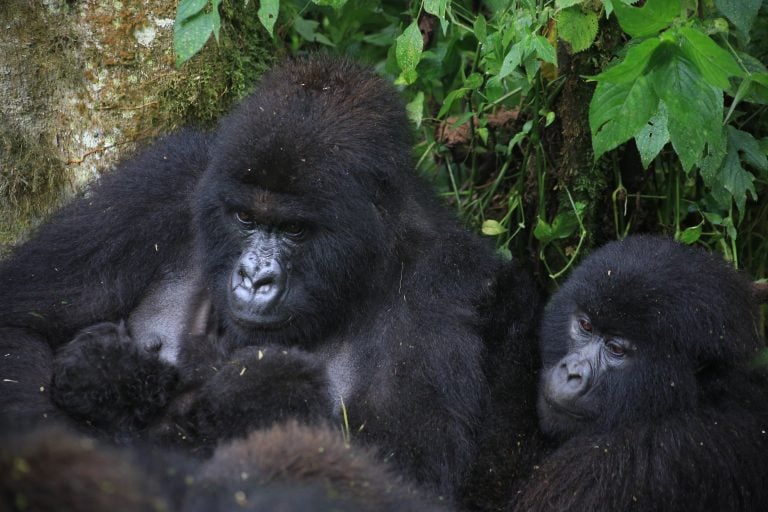
Female Western lowland gorilla with a young offspring on her body

Western gorilla babies stay with their mothers for around 3 years.

Population

Today, all western gorillas are critically endangered species but there are thought to be 95,000 western lowland gorillas remaining in the wild, significantly more than their cross-river gorilla cousins, whose numbers in the wild are thought to be as low as 300 individuals.

View all 442 animals that start with W

Sources

  1. David Burnie, Dorling Kindersley (2011) Animal, The Definitive Visual Guide To The World's Wildlife / Accessed July 13, 2010
  2. Tom Jackson, Lorenz Books (2007) The World Encyclopedia Of Animals / Accessed July 13, 2010
  3. David Burnie, Kingfisher (2011) The Kingfisher Animal Encyclopedia / Accessed July 13, 2010
  4. Richard Mackay, University of California Press (2009) The Atlas Of Endangered Species / Accessed July 13, 2010
  5. David Burnie, Dorling Kindersley (2008) Illustrated Encyclopedia Of Animals / Accessed July 13, 2010
  6. Dorling Kindersley (2006) Dorling Kindersley Encyclopedia Of Animals / Accessed July 13, 2010
  7. David W. Macdonald, Oxford University Press (2010) The Encyclopedia Of Mammals / Accessed July 13, 2010
Lisha Pace

About the Author

Lisha Pace

After a career of working to provide opportunities for local communities to experience and create art, I am enjoying having time to write about two of my favorite things - nature and animals. Half of my life is spent outdoors, usually with my husband and sweet little fourteen year old dog. We love to take walks by the lake and take photos of the animals we meet including: otters, ospreys, Canadian geese, ducks and nesting bald eagles. I also enjoy reading, discovering books to add to my library, collecting and playing vinyl, and listening to my son's music.

Thank you for reading! Have some feedback for us?


Western Gorilla FAQs (Frequently Asked Questions)

Western Gorillas are Herbivores, meaning they eat plants.