
The classification of organisms is an important system for understanding how they are all related. Based on the Linnaeus method, organisms are arranged and grouped based on shared characteristics. Swedish botanist Carolus (Carl) Linnaeus developed this hierarchical system of classification in the 1700s.
The Linnaeus method, also known as Linnaean taxonomy, creates a hierarchy of groupings called taxa, as well as binomial nomenclature that gives each organism or species a two-word scientific name. This method of giving scientific names to creatures is typically rooted in Latin by combining the genus and species names. For example, humans are classified as Homo sapiens, while wolves are Canis lupus.
The more features that living organisms share, the more specific the classification group is. Every species is defined based on eight branching categories:
- Domain
- Kingdom
- Phylum
- Class
- Order
- Family
- Genus
- Species
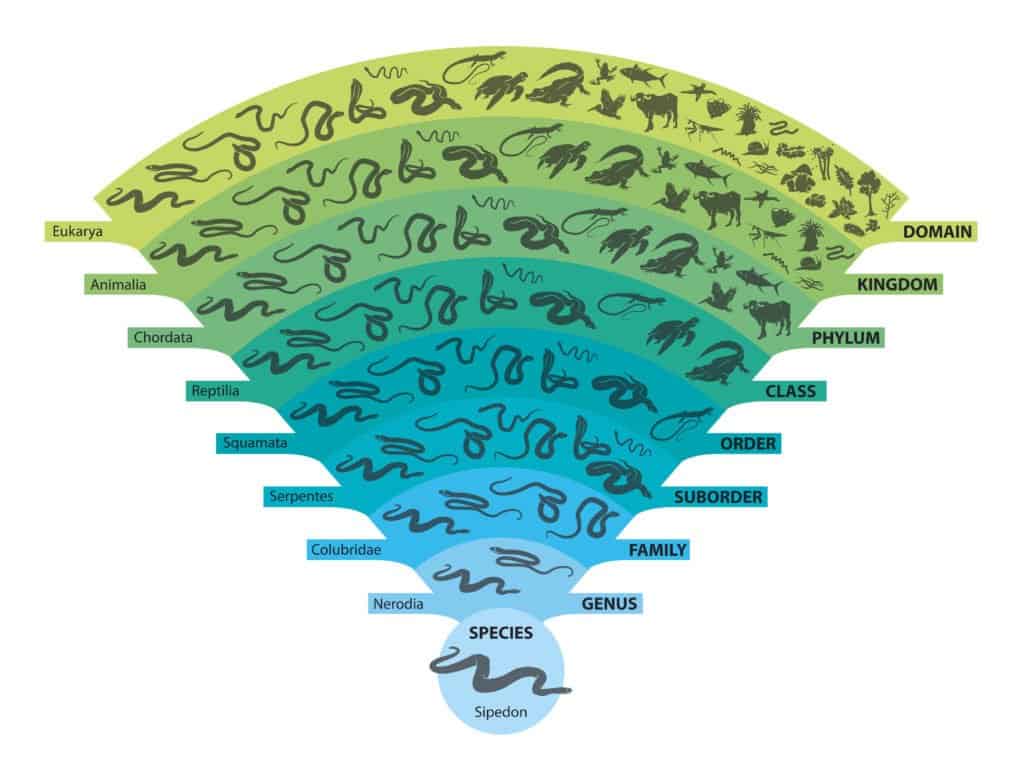
The above graphic shows the classification chart for the common watersnake, Nerodia sipedon.
©EreborMountain/Shutterstock.com
Classification
Kingdom
All living organisms can be placed into one of six kingdoms. The characteristics of each kingdom are the following:
- Animal – A kingdom of complex multi-celled organisms that do not produce their own food. This kingdom contains all living and extinct animals. Examples include elephants, whales, and humans.
- Plants – Complex and multi-cellular autotrophic organisms, meaning they produce their own food through photosynthesis. Examples include trees, flowers, and grass.
- Fungi – Multi-celled organisms that do not produce their own food, unlike plants. Examples include molds, mushrooms, and yeast.
- Protista – Single-celled organisms with more complexity than either eubacteria or archaebacteria. Examples include algae and amoebas.
- Eubacteria – Single-celled organisms found in everything from yogurt to your intestines. This kingdom contains all bacteria in the world not considered archaebacteria.
- Archaebacteria – The oldest known living organisms. Single-celled and found in hostile and extremely hot areas like thermal vents or hot springs.
Phylum
After kingdom, these living organisms fall into a phylum. There are between 31 and 35 phyla, depending on which sources you look at, but most organisms fall into one of seven phyla. These phyla are the most well-known and best understood:
- Porifera – Marine organisms more commonly known as sponges and found in every ocean on earth.
- Cnidaria – Mostly marine organisms that include over 11,000 species. Examples include coral, jellyfish, and anemones.
- Platyhelminthes – Typically parasitic flatworms. Lacking in any respiratory or circulatory system, oxygen passes through their bodies in a process known as diffusion. Examples include tapeworms and flukes.
- Annelida – More complex than Platyhelminthes, these are segmented and symmetrical worms containing a nervous system, respiratory system, and sense organs. Examples include the common earthworm and leeches.
- Mollusca – The second largest phylum by species count and the largest marine phylum. Invertebrates with soft unsegmented bodies. It is estimated almost a quarter of marine life falls in this category. Examples include clams, mussels, and snails.
- Arthropoda – Invertebrates with an exoskeleton and segmented bodies. Contains insects, crustaceans, and arachnids. This is the largest phylum by species count. Examples include scorpions, butterflies, and shrimp.
- Chordata – Vertebrates. Animals that develop a notochord, a cartilaginous skeletal rod that supports the body in the embryo and can often become a spine. Most animals we are familiar with, including dogs, horses, birds, and humans, fall into this category.
Class
Phyla are then further divided into even smaller groups, known as classes. Classes group organisms according to a shared level of structural complexity and characteristics or features. For example, the Chordata phylum splits into seven classes:
- Agnatha (jawless fish) – Primitive jawless fish including lampreys, hagfishes, and extinct groups.
- Chondrichthyes (cartilaginous fish) – Composed of fish with skeletons composed of cartilage. Includes two subclasses: Elasmobranchii (rays, skates, sawfish, and sharks) and Holocephali (chimaeras, also called ghost sharks).
- Osteichthyes (bony fish) – Includes saltwater and freshwater fish with bony skeletons like eels, anglerfish, clown fish, and swordfish, and catfish, carp, trout, and salmonids.
- Amphibia (amphibians) – Four-limbed, ectothermic vertebrates, including frogs, toads, salamanders, and newts.
- Reptilia (reptiles) – Vertebrates with dry skin and scales such as snakes, turtles, lizards, and crocodilians.
- Aves (birds) – Warm-blooded, egg-laying animals characterized by two wings, two legs, and feathers.
- Mammalia (mammals) – Warm-blooded four-legged (or two-armed, two-legged) animals that breathe with lungs and birth live young.
Order
Each class is divided into orders, which are formed by grouping related families according to shared characteristics. There is no universally accepted breakdown for the class Mammalia. Some outline as many as 26 different orders for the class Mammalia. Some of the most popular examples include the following:
- Artiodactyla (even-toed hoofed animals) – Examples include moose, camels, and giraffes.
- Carnivora – Animals that specialize in mostly eating meat but also contain omnivores and herbivores. Further divided into suborders: Feliformia (characterized as having retractile or semi-retractile claws and short rostrums (snouts)) and Caniformia (non-retractile claws and longer rostrums). Examples include cats, dogs, and bears.
- Rodentia (gnawing mammals) – Examples include beavers, mice, and squirrels.
- Chiropptera (bats) – The only mammals that can fly. Examples include free-tailed and vampire bats.
- Cetacea (porpoises and whales) – Examples include killer whales, dolphins, and hump-backed whales.
- Primates – Includes prehensile hands and feet, commonly with opposable thumbs. Examples include gorillas, chimpanzees, and humans.
Family
Classification breaks down further into families based on a narrowing of shared structural and functional features. Families are basically subdivided into two main groups—vertebrates and invertebrates. The Carnivora order, for example, includes 16 families:
- Canidae (dogs, wolves, coyotes, African wild dogs)
- Ursidae (bears)
- Procyonidae (raccoons, coatis, olingos)
- Mustelidae (weasels, badgers, otters)
- Viverridae (genets and oyans)
- Hyaenidae (hyenas)
- Felidae (cats)
- Herpestidae (mongooses)
- Nandiniidae (African palm civets)
- Eupleridae (Malagasy mongooses and civets)
- Prionodontidae (Asiatic linsangs)
- Otariidae (eared seals, i.e., sea Lions and fur seals)
- Phocidae (true or earless seals)
- Odobenidae (walruses)
- Mephitidae (skunks and stink badgers)
- Ailuridae (red panda)
Another example would be the order for lagomorphs, Lagomorpha. It contains two families. These hare-shaped animals belong either to family Leporidae, which includes rabbits and hares, or Ochotonidae (pikas).
Genus
Classification narrows further into a genus. The organisms here shared very similar features and are closely related. For example, the Felidae (cat) family contains 14 extant genera:
- Catopuma (Asian golden cat and bay cat)
- Pardofelis (marbled cat)
- Caracal (caracal)
- Leptailurus (serval)
- Leopardus (small cats native to the Americas: spotted cat, pampa, ocelot)
- Lynx (lynx)
- Acinonyx (cheetah)
- Herpailurus (jaguarundi)
- Puma (cougar)
- Otocolobus (manul)
- Prionailurus (spotted wildcats native to Asia)
- Felis (small and medium-sized cats and domestic cats)
- Neofelis (clouded leopard and Sunda clouded leopard)
- Panthera (tiger, leopard, snow leopard, jaguar, and lion)
Species
Each organism within a genus is given a species name derived from Latin and based on its features or characteristics. To form a creature’s scientific name, the genus name and species name are combined. For example, the scientific name for the common dolphin is Delphinus delphis. A red fox is Vulpes vulpes.
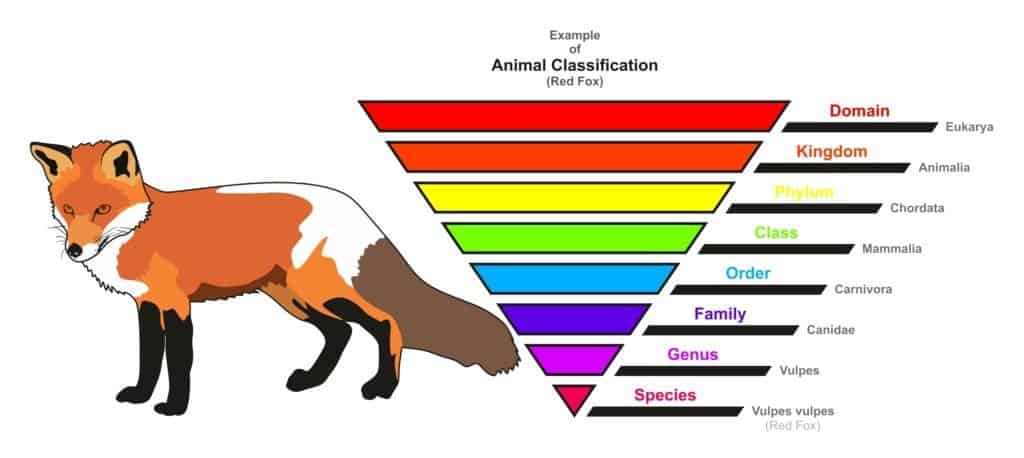
This chart outlines the taxonomy of the red fox, according to the Linnaeus method.
©udaix/Shutterstock.com
Animal Classification Example 1 – Red Fox
- (Vertebrate)
- Class: Mammalia (Mammal)
- Order: Carnivora (Carnivore)
- Family: Canidae (Dog)
- Genus: Vulpes
- Species: Vulpes vulpes (red fox)
Animal Classification Example 2 – Orangutan
- Kingdom: Animalia (Animal)
- Phylum: Chordata (Vertebrate)
- Class: Mammalia (Mammal)
- Order: Primates
- Family: Hominidae (Great Apes)
- Genus: Pongo
- Species: Pongo pygmaeus (Orangutan)
- (Vertebrate)
- Class: Mammalia (Mammal)
- Order: Carnivora (Carnivore)
- Family: Canidae (Dog)
- Genus: Vulpes
- Species: Vulpes vulpes (red fox)
Animal Classification Example 2 – Orangutan
- Kingdom: Animalia (Animal)
- Phylum: Chordata (Vertebrate)
- Class: Mammalia (Mammal)
- Order: Primates
- Family: Hominidae (Great Apes)
- Genus: Pongo
- Species: Pongo pygmaeus (Orangutan)