
B
Species Profile

Blind Snake

Typhlopidae

Wormlike, but 100% snake.
Ken Griffiths/Shutterstock.com

Blind Snake Distribution

Click a location to explore more animals from that region

Invasive Species
Loading map...

Found in 125 countries

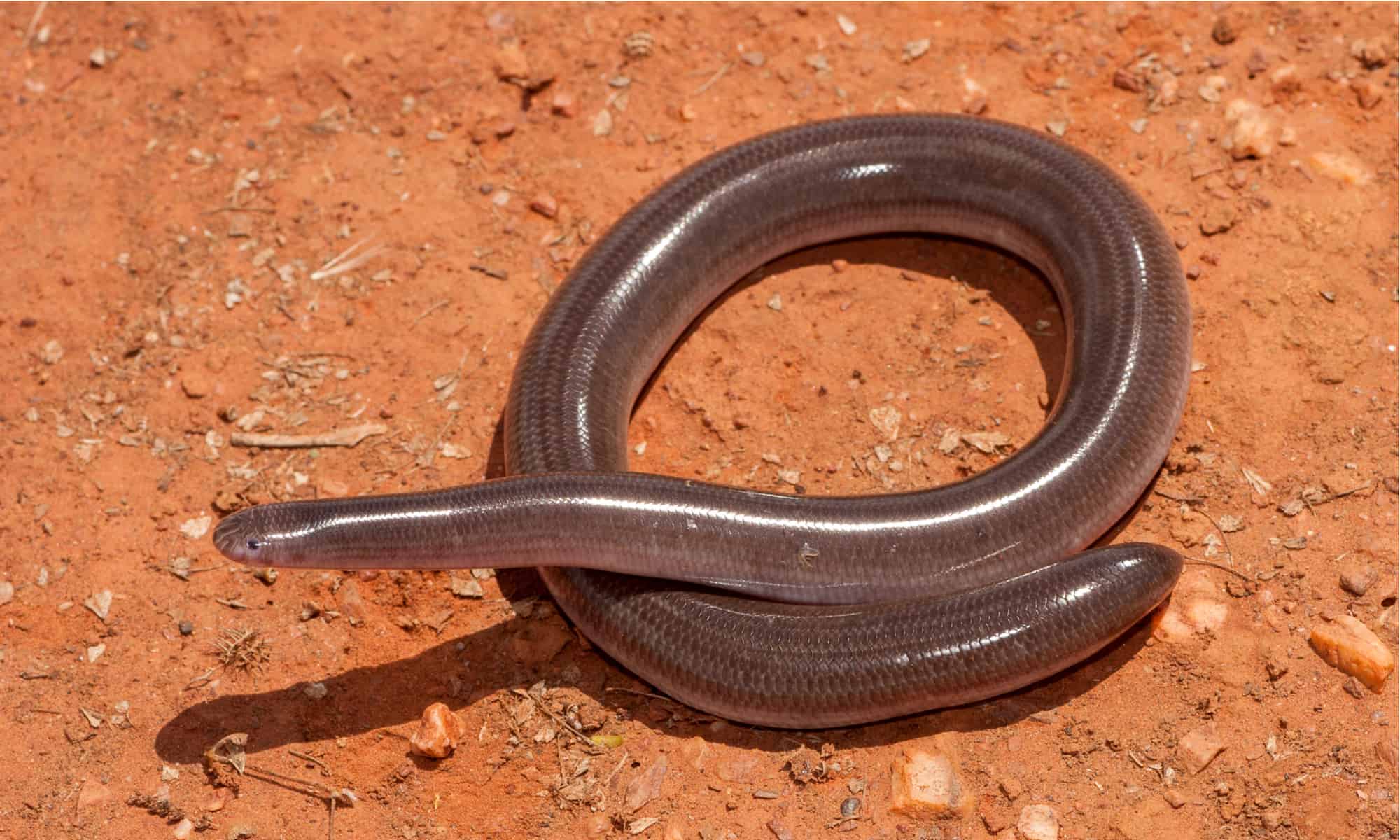
Australian Robust Blind Snake on red soil. Blind snakes have cylindrical bodies with a short tail and blunt head.

At a Glance

Family Overview This page covers the Blind Snake family as a group. Stats below are general traits shared across the family.
Also Known As threadsnake, thread snake, worm snake, blindworm, flowerpot snake
Activity Nocturnal+
Lifespan 5 years
Weight 0.08 lbs
Status Not Evaluated
Did You Know?

Family-wide size range is extreme: from ~8-10 cm miniatures to species around ~1 m (occasionally reported a bit longer).

Scientific Classification

Family Overview "Blind Snake" is not a single species but represents an entire family containing multiple species.

Typhlopidae (typical blind snakes) are small, predominantly subterranean snakes with reduced eyes, smooth shiny scales, and a wormlike appearance. They feed mainly on ants and termites (especially larvae and pupae) and are harmless to humans.

Kingdom
Animalia
Phylum
Chordata
Class
Reptilia
Order
Squamata
Family
Typhlopidae

Distinguishing Features

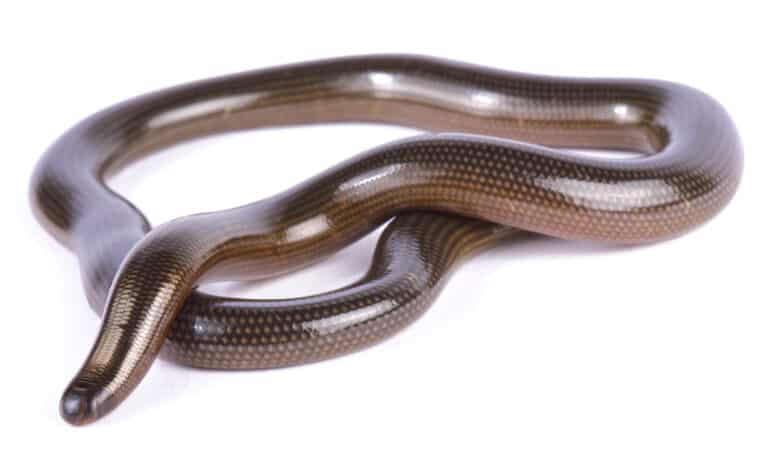
  • Very small, cylindrical body with smooth, glossy scales
  • Blunt head and tail; tail often ends in a small spine
  • Eyes highly reduced and covered by scales (not truly blind, but vision is minimal)
  • Mouth small; specialized for eating social insects
  • Often mistaken for earthworms; movement is serpentine but often stiff/earthworm-like

Physical Measurements

Males and females differ in size

Length
10 in (3 in – 3 ft 7 in)
12 in (3 in – 3 ft 5 in)
Weight
0 lbs (0 lbs – 0 lbs)
Tail Length
1 in (0 in – 3 in)
1 in (0 in – 2 in)
Top Speed
1 mph
Surface: 1–2 km/h

Appearance

Primary Colors
Secondary Colors
Skin Type Smooth, glossy, tightly overlapping scales with a highly 'polished' appearance; head scales often form reinforced, shovel-like shields for burrowing. Eyes are externally visible only as small, darkened spots beneath translucent scales (reduced, not truly absent).
Distinctive Features
  • Fossorial (subterranean) specialization: cylindrical, wormlike body; short tail often ending in a small keratinized spine or tip used for bracing/defense.
  • Reduced eyes (often appearing as tiny dark spots under scales): vision is very limited but typically not 'complete blindness'; orientation relies heavily on tactile/chemosensory cues (forked tongue/Jacobson's organ) and head contact with substrate.
  • Burrowing head morphology varies across genera (rounded to more shovel-snouted), but most have enlarged, firm head shields and a compact, wedge-like skull for pushing through soil.
  • Scales are smooth and shiny; belly scales are not strongly widened into large ventral scutes like many surface-active snakes-this helps distinguish them from many other snakes but can make them superficially resemble earthworms.
  • Typhlopids (Typhlopidae) have dry, shiny, scaly skin, a clear head with large shield scales, a forked tongue, and a true tail tip or spine, not a wormlike, pointed body.
  • Both are tiny burrowing snakes. Typhlopidae are thicker, shiny, with strong head shields; Leptotyphlopidae are very threadlike with different head scales and jaw and teeth. Separation needs close inspection and is hard in the field.
  • Diet specialization (family-wide trend with variation): primarily ants and termites, especially larvae and pupae; some species may broaden to other small soil arthropods, but myrmecophagy/termitophagy is the dominant pattern.
  • Usually live underground and are secretive; often seen after heavy rain, when soil is dug up, or at night or at dawn/dusk. Some live in dry sand or rocky soils; others prefer humid forest soils.
  • Global distribution and diversity: Typhlopidae are widespread in tropical and subtropical regions across multiple continents and island systems; the family includes many localized endemics and habitat specialists.
  • Size across Typhlopidae: most blind snakes are about 10–40 cm long; smallest about 8–10 cm, largest near 70–80 cm. Body width is a few millimeters up to ~2 cm, showing strong fossorial (burrowing) streamlining.
  • Lifespan (range across species; data sparse): likely several years for many species; documented/estimated longevity spans roughly ~2 to 15+ years depending on species and conditions (wild vs. captivity), with substantial uncertainty for many taxa.

Sexual Dimorphism

Sexual dimorphism exists but is usually subtle and variable among species. Differences are most often in body size proportions and tail length rather than coloration or conspicuous ornamentation.

  • Often slightly longer tail relative to body length (accommodating hemipenes), with proportion differences being more noticeable than color differences in many species.
  • In some species/populations, males may be slightly smaller or more slender than females, though this varies and is not universal.
  • Females are frequently equal to or larger than males in total length and/or body robustness in many species, consistent with fecundity selection, but the direction and strength of dimorphism varies across the family.
  • Coloration is generally similar to males; obvious sex-specific color patterns are uncommon in typhlopids.

Did You Know?

Family-wide size range is extreme: from ~8-10 cm miniatures to species around ~1 m (occasionally reported a bit longer).

Many are so fossorial they're mostly seen only after heavy rain, digging, or when ant/termite nests are disturbed.

Several species (notably the widely introduced "flowerpot snake," Indotyphlops braminus) can reproduce without males (parthenogenesis).

Their eyes are greatly reduced and often covered by translucent scales-useful underground, where vision matters less than smell/vibration.

A tough, enlarged snout scale (rostral shield) works like a built-in digging tool.

They eat mainly ants/termites-especially larvae and pupae-making them highly specialized predators.

Despite being called "blind," they navigate well using chemical cues (tongue + Jacobson's organ) and substrate vibrations.

Unique Adaptations

  • Burrowing headgear: a reinforced skull and an enlarged rostral scale form an efficient "soil wedge," letting them push through sand/soil with minimal friction.
  • Ultra-smooth, glossy scales: tight, polished scales reduce abrasion and help them slip through narrow subterranean spaces.
  • Eye reduction: tiny eyes under scales protect against grit and damage; reliance shifts to chemosensation and vibration detection.
  • Ant/termite specialization: narrow jaws and feeding mechanics are well-suited to swallowing small prey items in high numbers, especially soft brood.
  • Tail tip spine (in many species): a rigid terminal scale can aid anchoring in tunnels and serves as a defensive "false head" focus.
  • Compact, cylindrical body plan: the uniform, wormlike profile is convergent with other burrowers and supports efficient underground locomotion.
  • Wide ecological breadth across the family: Typhlopidae occur from tropical forests to arid regions, with local adaptations in moisture tolerance, microhabitat use, and activity timing.

Interesting Behaviors

  • Fossorial routine: most Typhlopidae spend the majority of their lives underground in loose soil, leaf litter, or inside/near ant and termite galleries; surface activity is often brief and weather-driven (e.g., rains).
  • Nest-raiding foragers: many species concentrate hunting around ant/termite nests and follow subterranean tunnels; diet is typically dominated by soft-bodied brood (larvae/pupae), though exact prey mix varies by species and region.
  • Low-visibility navigation: individuals frequently "taste" their surroundings with tongue-flicks and respond strongly to vibrations-behavior that can look like purposeful, confident movement despite reduced eyes.
  • Defense by deception: when threatened, many hide the head and present the tail tip (often spine-tipped) as a decoy; some also release musk/cloacal secretions.
  • Reproduction varies across the family: most are egg-layers, but reproductive modes and clutch/litter sizes differ among lineages; a few notable species can reproduce asexually (parthenogenesis).
  • Human-associated dispersal is common in a few species: small, soil-dwelling forms can be transported in potted plants, soil, and landscaping materials, leading to far-from-native records.

Cultural Significance

Because they look like earthworms and come out after rain, blind snakes are called "worm-snakes" in folklore. The "flowerpot snake" (typhlopids) travel in plant soil, teaching about spread of species, city wildlife, harmless snakes, how burrowing reptiles evolved alike, and the role of ants and termites in food chains.

Myths & Legends

"Flowerpot snake" story among gardeners: small blind snakes found in potted plants became a common tale about snakes coming from soil, linked to real spread of some typhlopids via plant trade.

Many people call blind snakes (Typhlopidae) "two-headed" because they hide their real head and show a tail with a tiny spine that looks like a head, so people find them strange and hard to read.

After rain, blind snakes (Typhlopidae) surface and people often group them with worms and soil omens about garden luck or unease, because of their sudden appearance and secret underground life, not formal myths.

Conservation Status

NE Not Evaluated (family-level; conservation status is assessed primarily at the species level-Typhlopidae contains many species spanning categories from Least Concern to Data Deficient and a smaller number that are Vulnerable/Endangered/Critically Endangered, especially range-restricted island endemics).

Has not yet been evaluated against the criteria.

Population Unknown

Protected Under

  • Family-level protection is not uniform: most Typhlopidae are not covered by a single global listing, but many populations occur within protected areas where suitable habitat remains (e.g., national parks, forest reserves).
  • Some threatened, range-restricted species receive additional protection through national/subnational wildlife laws and site-based conservation measures; enforcement and effectiveness vary widely by country/region.
  • Because many species are subterranean and poorly surveyed, a recurring conservation need is improved assessment (distribution mapping, population baselines) to reduce Data Deficient designations and target habitat protection more effectively.

You might be looking for:

Slender blind snakes

32%

Leptotyphlopidae

Very small, threadlike burrowing snakes (often called threadsnakes); also commonly referred to as blind snakes in some regions.

Dawn blind snakes

18%

Anomalepididae

A smaller Neotropical family of burrowing snakes sometimes included under the broad ‘blind snakes’ label.

Blind snakes (broad sense)

18%

Scolecophidia

A higher clade/infraorder grouping that includes Typhlopidae, Leptotyphlopidae, and Anomalepididae; often what people mean by ‘blind snakes’ collectively.

Life Cycle

Birth 5 hatchlings
Lifespan 5 years

Lifespan

In the Wild
2–15 years
In Captivity
4–20 years

Reproduction

Mating System Promiscuity
Social Structure Solitary
Breeding Pattern Transient
Fertilization Internal Fertilization
Birth Type Internal_fertilization

Behavior & Ecology

Social Aggregation Group: 1
Activity Nocturnal, Crepuscular, Cathemeral
Diet Myrmecophage Ant brood (eggs, larvae, pupae) and termite brood (eggs, nymphs)
Seasonal Hibernates

Temperament

Secretive, cryptic, and generally non-aggressive toward conspecifics and potential threats; most avoid confrontation by burrowing deeper or attempting to escape.
Defensive behaviors commonly include vigorous writhing, pushing with the reinforced head, rapid burrowing, and release of cloacal contents/musk; biting is uncommon and usually ineffective due to small gape (variation exists among species).
Blind snakes (Typhlopidae) are burrowing hunters that eat ants and termites, mainly larvae and pupae. They use narrow tunnels and insect nests, surfacing after heavy rain, floods, or to disperse.
Blind snakes (Typhlopidae) range from single-digit to low teens of centimeters up to over 1 m, though most are small. Lifespans are usually a few to around 10 years or more, sometimes mid-teens.

Communication

Rare, faint hissing/air expulsion when handled or tightly restrained Not a primary communication mode
Chemical communication is likely dominant: use of pheromones/scent cues for mate location and reproductive state recognition; chemical investigation via tongue-flicking.
Tactile interaction during mating (body contact/aligning) and during incidental crowding in shared refugia.
Substrate-borne vibrations/body movements may function in close-range deterrence or spacing, especially in confined burrows; likely variable among species and contexts.
Cloacal gland secretions used primarily for defense and may incidentally convey chemical information.

Habitat

Biomes:
Tropical Rainforest Tropical Dry Forest Savanna Desert Hot Desert Cold Mediterranean Temperate Grassland Temperate Forest Temperate Rainforest Wetland +4
Terrain:
Plains Hilly Plateau Valley Coastal Island Riverine Rocky Sandy Volcanic Karst +5
Elevation: Up to 9842 ft 6 in

Ecological Role

Subterranean predators specialized on social insects (ants and termites), functioning as soil-dwelling mesopredators.

Help regulate local ant and termite populations (especially brood) Alter micro-ecology within nests and soil food webs via predation pressure Indirectly influence soil nutrient cycling and decomposition dynamics by interacting with termite/ant activity Serve as prey for larger reptiles, birds, and small mammals, linking subterranean and surface food webs

Diet Details

Main Prey:
Ant brood Termite brood Ant Termite Small soft-bodied invertebrates

Human Interaction

Domestication Status

Wild

Typhlopidae (typical blind snakes) are wild, not domesticated. People meet them by chance when digging, gardening, or after heavy rain. They are small (about 7–80 cm), live mostly underground, and eat ants and termite larvae. They can be moved in soil or plants and sometimes become local invaders. They are harmless and often mistaken for earthworms.

Danger Level

Low
  • Essentially harmless: non-venomous, tiny mouthparts; bites are rare and typically insignificant
  • Potential zoonotic risk common to reptiles (e.g., Salmonella) if handled without hygiene
  • Misidentification (handled as 'worms') can lead to stress/injury to the animal rather than risk to people
  • Indirect ecological risk in some regions if introduced populations establish (impacting local invertebrate communities), which can create conservation/biosecurity concerns rather than direct human injury

As a Pet

Not Suitable as Pet

Legality: Laws differ by country, state, or province. Many places don’t ban blind snakes (Typhlopidae) but may limit taking from the wild, import/export, or keeping non-native snakes. Check local wildlife, biosecurity, and animal welfare rules.

Care Level: Expert Only

Purchase Cost: Up to $50
Lifetime Cost: $200 - $1,200

Economic Value

Uses:
Ecosystem services Horticulture/agriculture (indirect) Education/research Pet trade (limited) Biosecurity (indirect costs)
Products:
  • Natural predation on ants/termites (ecosystem service; not a harvested product)
  • Occasional use in educational displays or research collections
  • Limited live-animal trade (small, niche)
  • Biosecurity management costs where introduced via soil/potted plants (indirect)

Relationships

Related Species 8

Threadsnakes Leptotyphlopidae Shared Family
Dawn blind snakes Anomalepididae Shared Order
Asian and Australasian blind snakes Gerrhopilidae Shared Family
Madagascar blind snakes Xenotyphlopidae Shared Order
Indo-Malayan blind snakes Indotyphlops Shared Family
African blind snakes Afrotyphlops Shared Family
American blind snakes Amerotyphlops Shared Family
Worm blind snakes Xerotyphlops Shared Family

Ecological Equivalents 5

Animals that fill a similar ecological role in their ecosystem

Threadsnakes Leptotyphlopidae Very similar fossorial, wormlike snakes that specialize on ant and termite brood. They often occur in the same habitats and are easily confused with typhlopids.
Worm lizards Amphisbaenia Burrowing, soil-dwelling squamates that use tunnels and loose soil and feed on small invertebrates; they occupy the same microhabitats and have many of the same predators.
Caecilians
Caecilians Gymnophiona Limbless, subterranean vertebrates with reduced eyes and annulated bodies. They occupy comparable underground niches, though they are amphibians and often prefer wetter soils.
Fossorial skinks Scincidae Many skinks are sand- or soil-burrowers that occupy arid and tropical soils, overlapping in habitat with blind snakes; both groups prey on small invertebrates.
Ant and termite specialist lizards Ecologically similar through reliance on social insect prey (especially larvae and pupae), despite differences in hunting mode (surface foraging versus subterranean raiding).

Types of Blind Snake

15

Explore 15 recognized types of blind snake

Brahminy blindsnake
Brahminy blindsnake Indotyphlops braminus
Beaked blindsnake Grypotyphlops acutus
Worm blindsnake Xerotyphlops vermicularis
Schlegel's blind snake Afrotyphlops schlegelii
South American blindsnake Amerotyphlops brongersmianus
Reticulated blind snake Amerotyphlops reticulatus
Müller's blind snake Malayotyphlops muelleri
Black blind snake Ramphotyphlops nigrescens
Common blind snake
Common blind snake Ramphotyphlops polygrammicus
Papuan blind snake Malayotyphlops ruficauda
Bimini blindsnake Cubatyphlops biminiensis
Haitian giant blind snake Typhlops hectus
Solomon Islands giant blind snake Acutotyphlops subocularis
Madagascar blind snake Madatyphlops arenarius
Malagasy blind snake Madatyphlops madagascariensis

The blind snake is often mistaken for a worm, even with hundreds of different species.

It can reach up to 3.3 feet long, though most of them are no more than about half a foot long in their adult size. Some species of this snake can lay eggs that hatch without fertilization, keeping their population steady. However, an estimated number is not available because they all live underground.
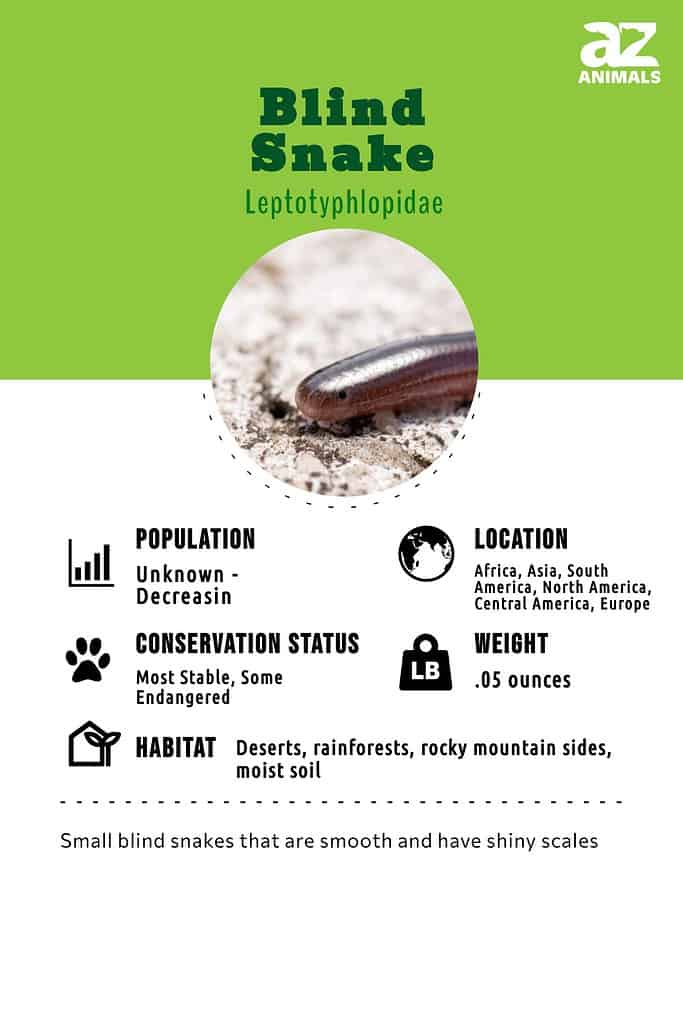
Blind Snake Infograhic

5 Amazing Facts

  • The blind snake family consists of 18 genera and over 200 individual species.
  • The tail of every blind snake has a horned scale.
  • While the majority of blind snake species are found in tropical habitats, the flowerpot snake is found primarily on islands around the world as well.
  • The Brahminy blind snake is exclusively female, and it lays eggs that are self-activated in development rather than fertilized. Even if only one were left, it could create a new population.
  • Blind snakes are non-venomous.

Where to Find Them

Since there are so many blind snakes around the world, they are found on every single continent, though they prefer to live in tropical areas. In fact, according to many researchers, these blind snakes are in every tropical area.

They can be found in tropical areas in Africa and Asia and South and Central America. However, the Bimini island of the Caribbean is primarily home to pink blind snakes.

Despite being found across the world, no snakes at all are found in Ireland, but European countries with a tropical zone have found blind snakes in their regions as well. Since they prefer a wetter climate, the easiest time to spot them in these habitats is after heavy rain. Sometimes, they’ll reside in trees to give them access to ants and termites as their food.

With over 200 species in 18 genera, the specific location depends on the species.

Types of Blind Snakes

Blind snakes come down to 18 genera, though some of the most commonly known snakes within this family include the:

  • Brahminy blind snake: The Brahminy blind snake primarily lives in southeast Asia, but they’ve also been found in Florida since the 1970s. Instead of being pink, this snake is so dark that it appears to be black, and they grow to be about 7 inches long at its full size.
  • Texas blind snake: The Texas blind snake is brown, and it is also called the Texas thread snake or the Texas slender blind snake. They range from 3 to 13 inches long, and they are found throughout the state that they are named for, even though it is not tropical.
  • Western blind snake: The western blind snake is bright pink, and it is found throughout California. It doesn’t have much of a neck, and it is incredibly small.

Scientific Name
Africa, Animal, Animal Wildlife, Animals In The Wild, Horizontal
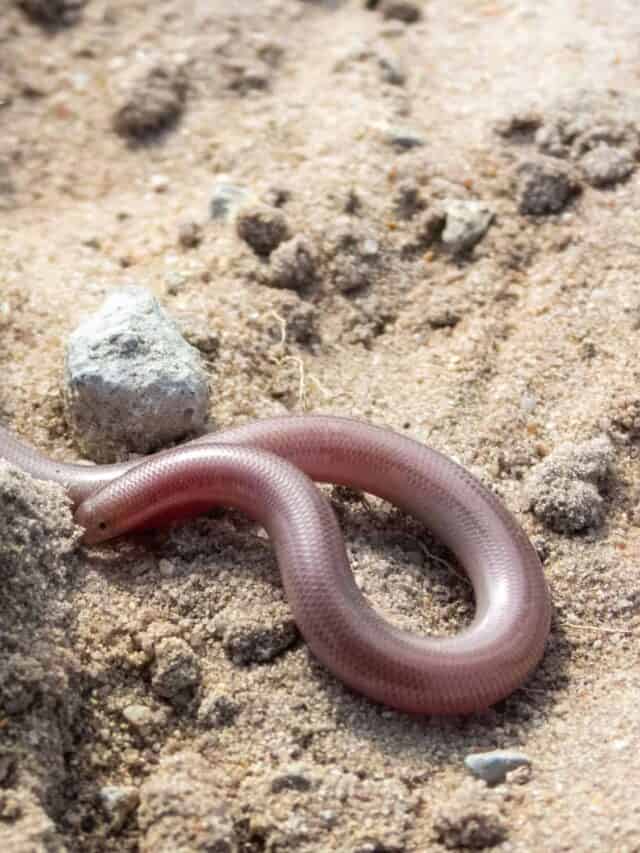
Blind snakes are also called worm snakes and thread snakes.

The blind snake, superfamily Typhlopoidea, is known by the scientific name Typhlopidae. There are 250 nominate species under this family, which is under the Reptilia class. The word “Typhlopidae” comes from the Greek words “tuphlós” and “ṓps,” translating to mean “blind eye.”

Blind snakes belong to the families Anomalepidae, Leptotyphlopidae, and Typhlopidae.

Some common species include the Texas blind snake, the western blind snake, and the Brahminy blind snake.

Population and Conservation Status
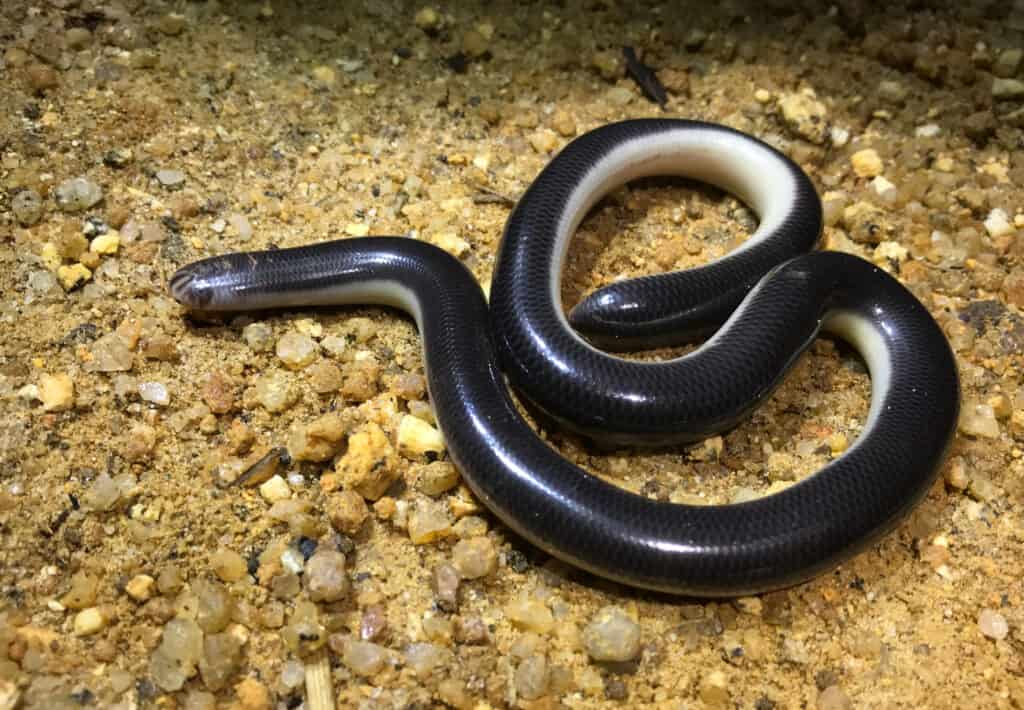
Close up of Mueller's blind snake

Some species of blind snakes are threatened, stable, or endangered.

The entire blind snake family comes down to about 250 species, but their subterranean nature makes it difficult for researchers to determine an estimated population. For the most part, the IUCN says that blind snakes are considered to be “Not Extinct.” There are a few species that are of Least Concern (Bismarck sharp-nosed blind snake, Liwale blind snake, and the Costa Rica worm snake), and multiple extinct species. The Madagascar blind snake, however, is currently considered Critically Endangered.

Appearance and Description
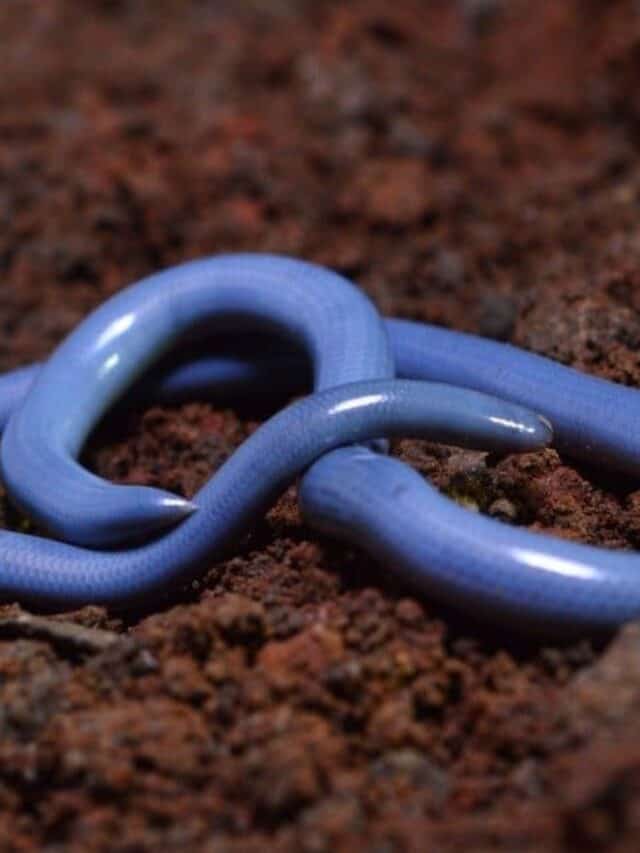
Brahminy Blind Snake
Thin and tiny, the Brahminy blind snake is sometimes mistaken for a baby snake of another species.

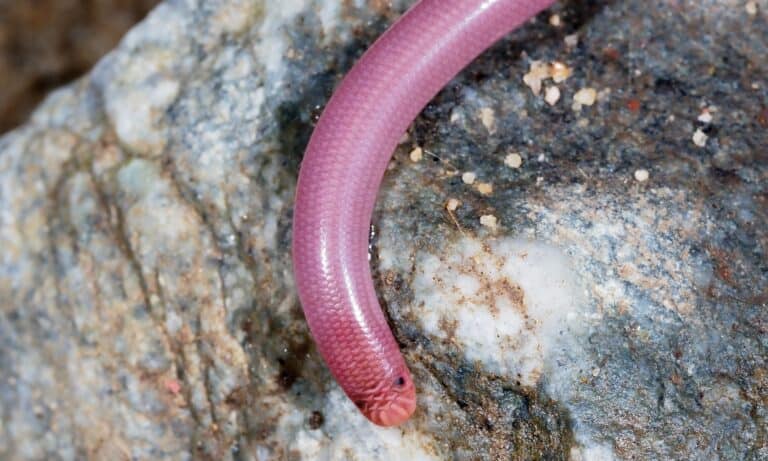
Since there are so many different species, it is hard to say a specific description for all of them. Most of these snakes have teeth in their upper jaw and black spots in the eye to make it easier to see in the dark burrows in which they live. They have no real use for their vision, and they have cylindrical bodies with short tails and blunt heads. Their scales are smooth and shiny. Most of these snakes have a rather small size, ranging from 5.5 to 12 inches, though some species could reach up to 3.3 feet. They look like worms, often featuring a gray or pink body. Pink blind snakes are more likely to be found on Bimini in the Caribbean, though the brown blind snake is often mistaken for an earthworm.

How to identify blind snakes:

  • Up to 3.3 feet long, though typically measures 5-12 inches in overall size.
  • Pink or grey body with smooth scales.
  • Blunt head with a short tail.
  • Looks fairly similar to a worm.

Diet

Trinidad Blind Snake

Currently listed as endangered, the Trinidad blind snake lives in only a few places on Earth

Blind snakes consume small creatures without spinal columns, such as bugs, spiders, daddy longlegs, centipedes, and millipedes. Most of these species favor ants and termites, but many of them will eat almost anything, including caterpillars, fly maggots, beetles, cockroaches, and crickets.

Blind snakes are able to track down ant and termite hills by following the scent that the insects leave on the ground. Once the snake finds the hill, it slips inside and eats as much as it can. They specifically enjoy consuming ant eggs, pupae, and larvae. The lower jaw of these slender creatures can be extended and retracted rapidly, which allows them to feast on many eggs, larvae, and pupae in a very brief period.

The blind snake is able to protect itself from ants, which are known for their aggressive defense of their nests. When confronted, the snake curls into a ball and covers itself with a mixture of slime and feces. The foul-smelling substance scares away the ants, allowing the snake to go back to its meal.

Pictures
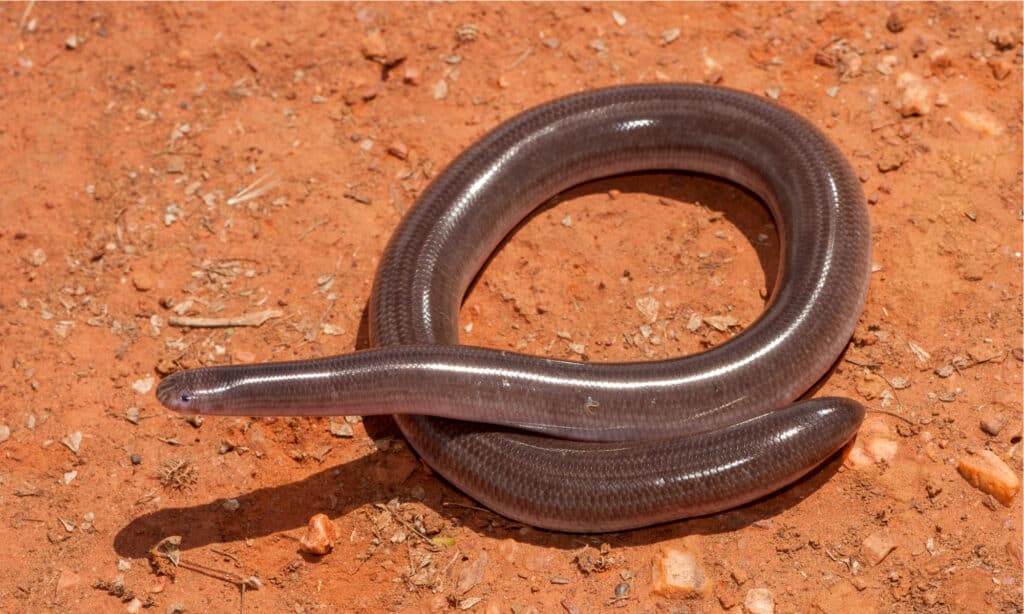
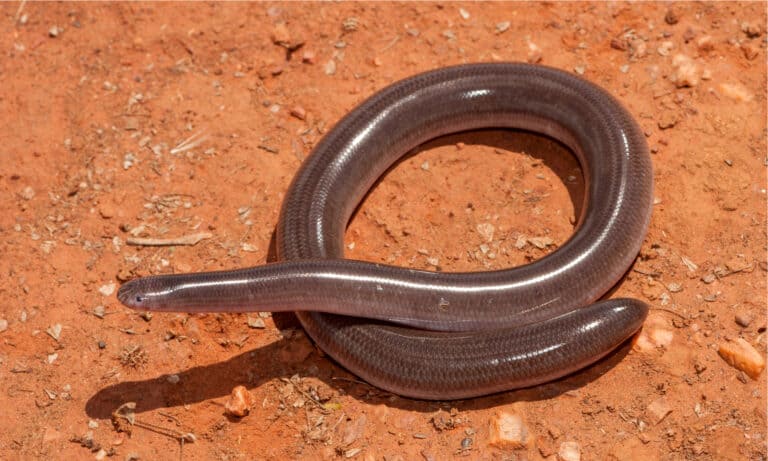
Australian Robust Blind Snake on red soil. Blind snakes have cylindrical bodies with a short tail and blunt head.

Australian Robust Blind Snake on red soil. Blind snakes have cylindrical bodies with a short tail and blunt head.

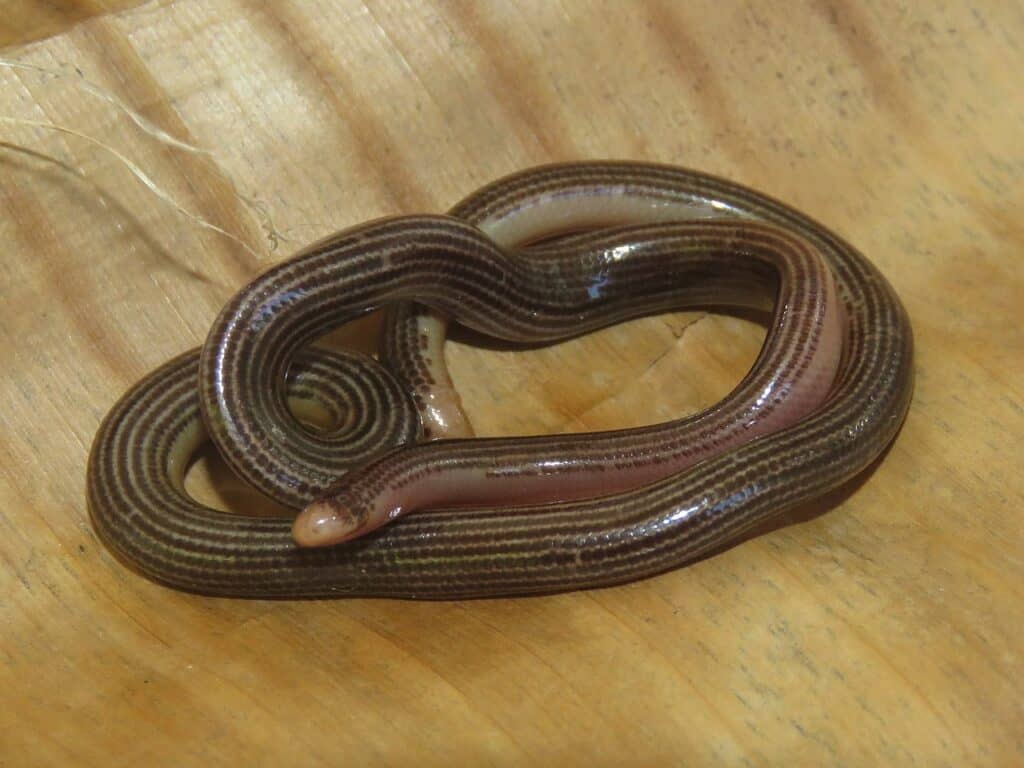
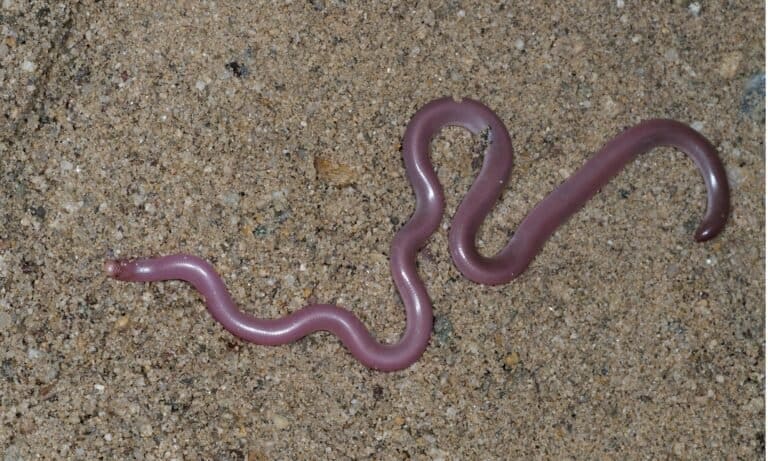
European worm snake or blind snake, Typhlops vermicularis. Blind snakes look like worms, often featuring a gray or pink body.

European worm snake or blind snake, Typhlops vermicularis. Blind snakes look like worms, often featuring a gray or pink body.

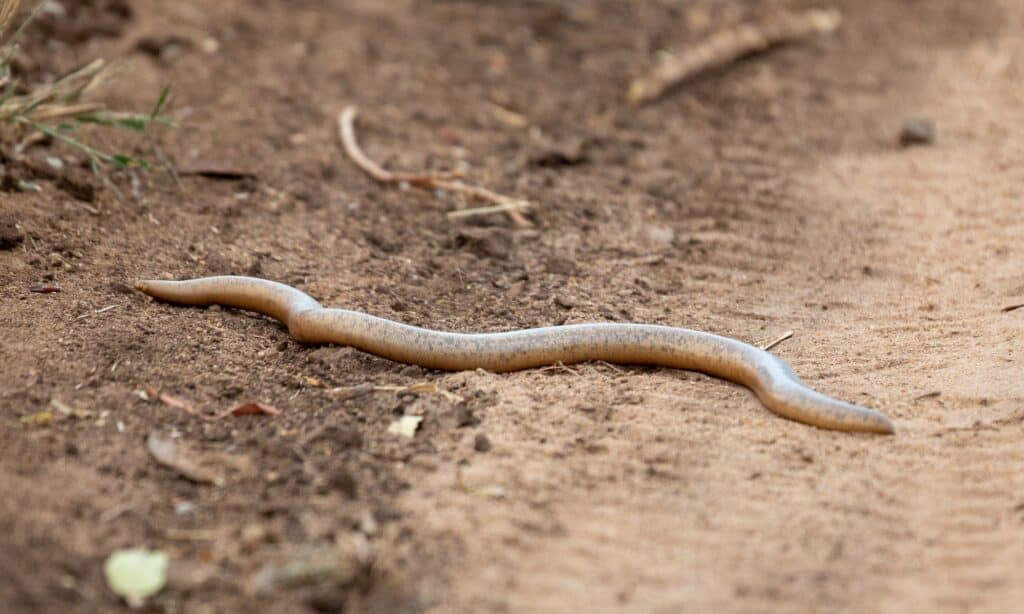
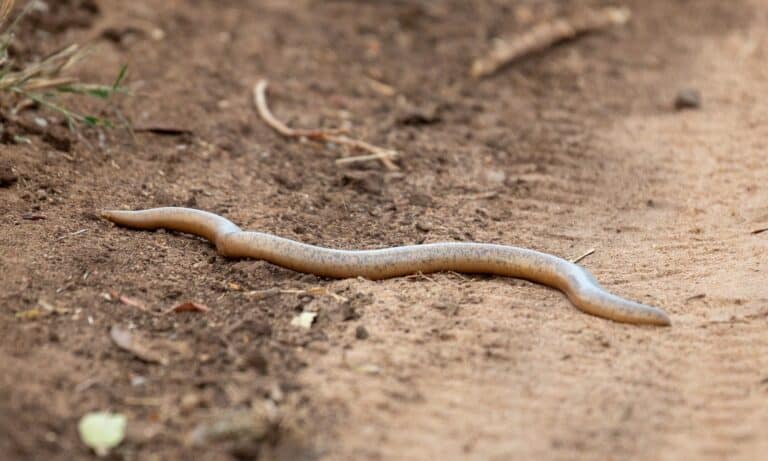
Schlegel's beaked blind snake is Africa's largest Blind snake averaging 60cm but may reach a length of 1m. It spends most of its life underground.

Schlegel’s beaked blind snake is Africa’s largest Blind snake averaging 60cm but may reach a length of 1m. It spends most of its life underground.

Venom: How Dangerous Are They?

Since blind snakes carry no venom, they aren’t really harmful at all. They burrow underground, though their take has a sharp spine at the tip that can be intimidating. They have teeth on their upper jaw, but their mouth is such a small size that they can’t open it any larger than what it would take to eat its typical food of ants and termites. There’s no risk of being bitten.

Reproduction and Lifecycle
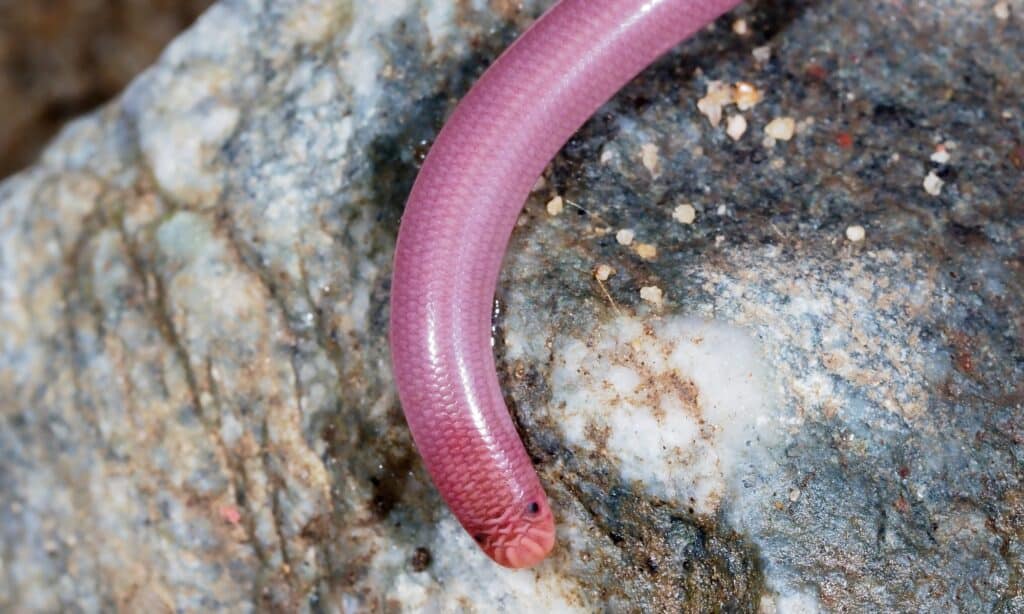
Blind snakes lives underground in soft soils, between plant roots and under stones.

Blind snakes live underground in soft soils, between plant roots and under stones.

Blind snakes reproduce sexually, with males using a modified limb called the hemipenis to inseminate females. The female will lay a clutch of two to ten eggs at a time; these take approximately one month to hatch. The newborns are independent from birth and measure around 4 inches.

The lifespan of blind snakes can range from 4-20 years, depending on the species, although some may live even longer. They generally inhabit tropical regions and spend most of their lives underground or in leaf litter, emerging only occasionally for food or during the breeding season. Due to their subterranean lifestyle, they have adapted over time by developing an acute sense of smell which allows them to detect prey such as insects and earthworms. Blind snakes also benefit from having no eyes since this reduces water loss through evaporation when burrowing in dry soil conditions.

Behavior and Humans
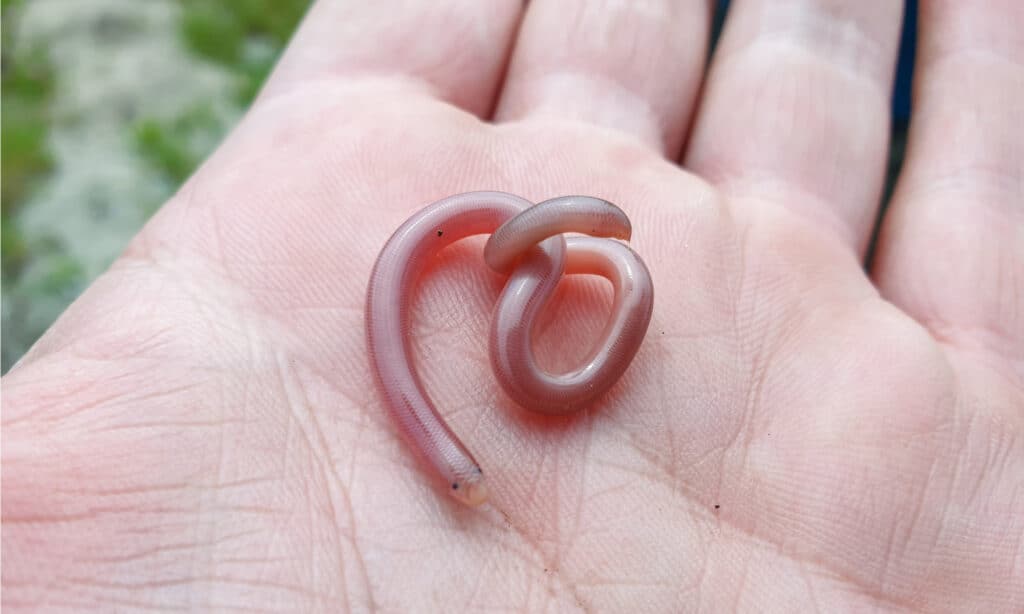
Delalande's Beaked Blind Snake

Blind snakes are often mistaken for worms. They are shy and like to stay underground.

Blind snakes stay underground, and they are incredibly shy around anyone. When they encounter a human, their main inclination is to get away (instead of bite). Some people may keep the blind snake as a pet, but they aren’t very interactive or outgoing, so they may not be entertaining. Plus, since they are non-venomous and aren’t aggressive, they don’t bite anything more than their small prey.

Predators and Threats
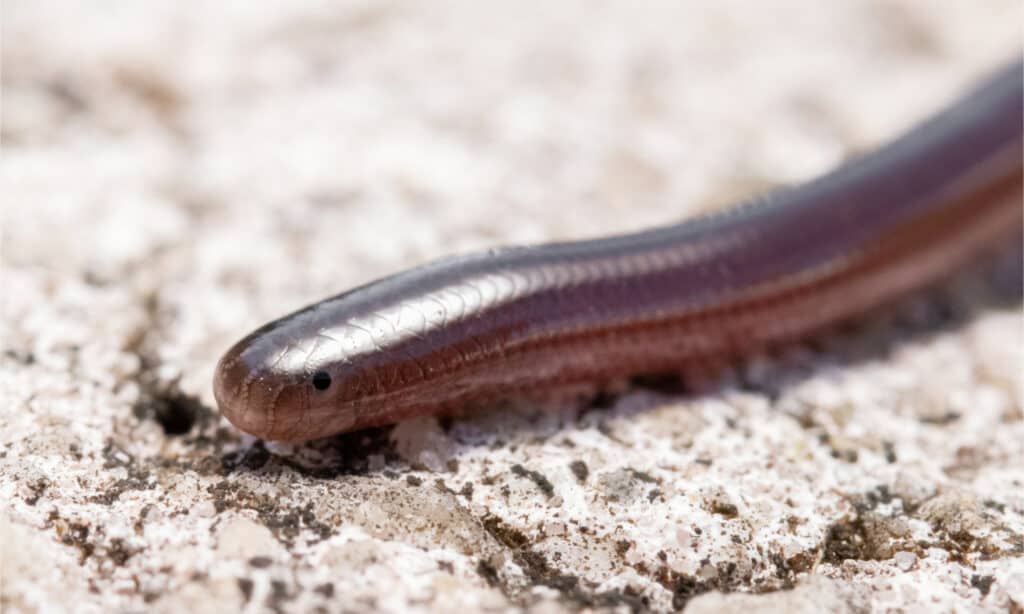
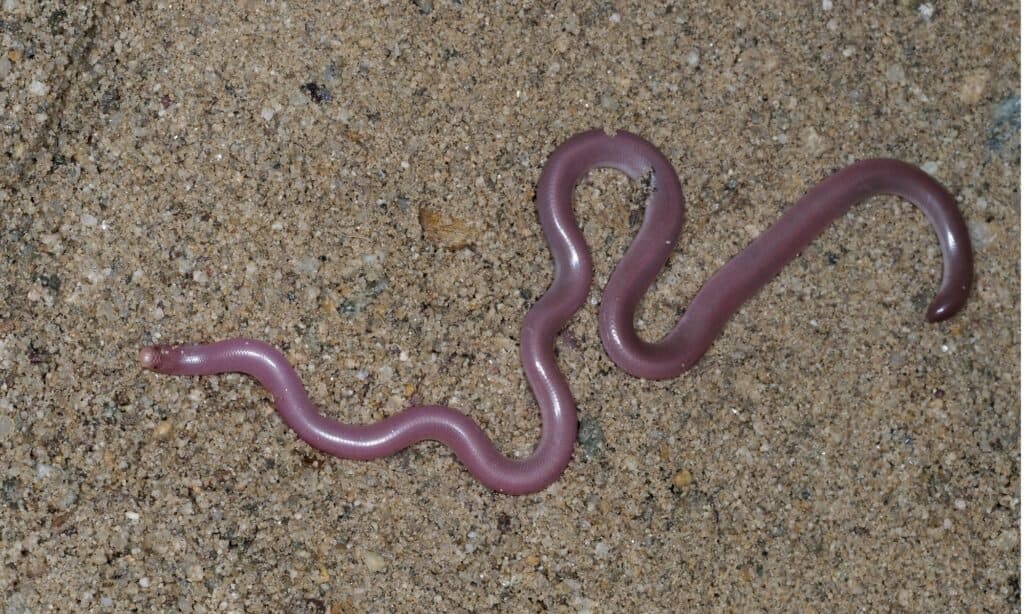
Brahminy Blindsnakes are small, thin, and shiny silver gray, charcoal gray, or purple.

Brahminy Blindsnakes are small, thin, and shiny silver gray, charcoal gray, or purple.

The main predators of the blind snake are birds, cats, and other small mammals. They will usually hunt for them in their burrows or when they come to the surface to feed. Other potential threats include habitat destruction due to human activities such as land clearing and urban development, which can reduce food sources for the snakes and make it harder for them to find shelter or cover from predators. Climate change is also a threat, as rising temperatures can cause droughts that result in decreased prey availability for blind snakes.

View all 453 animals that start with B

Sources

  1. Wikipedia / Accessed May 1, 2022
  2. Britannica / Accessed May 1, 2022
  3. Queensland Museum / Accessed May 1, 2022
  4. Kidadl / Accessed May 1, 2022
Heather Hall

About the Author

Heather Hall

Heather Hall is a writer at A-Z Animals, where her primary focus is on plants and animals. Heather has been writing and editing since 2012 and holds a Bachelor of Science in Horticulture. As a resident of the Pacific Northwest, Heather enjoys hiking, gardening, and trail running through the mountains with her dogs.

Thank you for reading! Have some feedback for us?


Blind Snake FAQs (Frequently Asked Questions)

No. No species of blind snake is venomous. It is relatively harmless.