G
Species Profile

Giant Leopard Moth

Hypercompe scribonia

Spotted wings, secret colors
Radu Privantu / CC BY 2.0 / flickr

Giant Leopard Moth Distribution

Click a location to explore more animals from that region

Loading map...
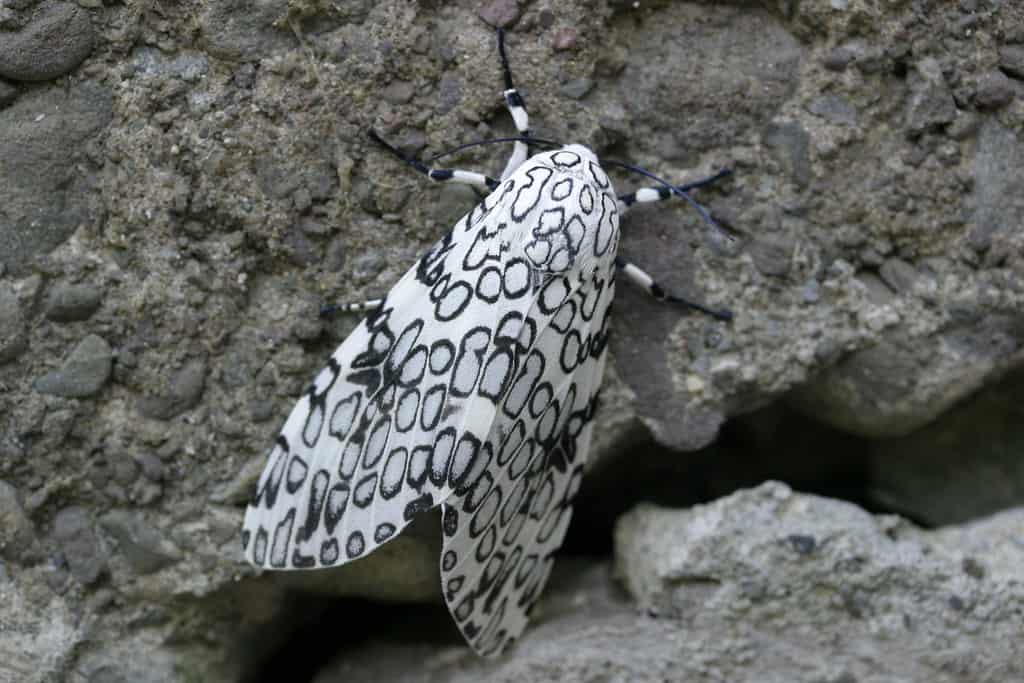
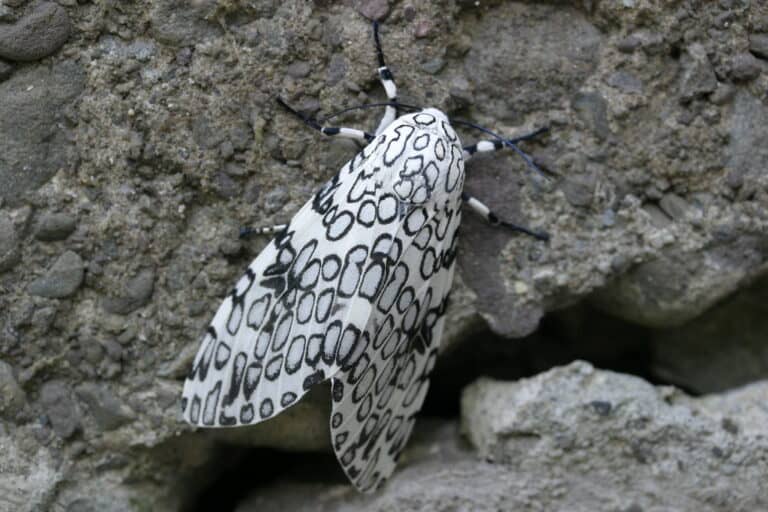
A giant leopard moth on a rock

At a Glance

Wild Species
Diet Herbivore
Activity Nocturnal+
Lifespan 12 years
Status Not Evaluated
Did You Know?

Wingspan is typically 5.1-7.6 cm (BugGuide: Hypercompe scribonia; Moth Photographers Group).

Scientific Classification

A large, striking tiger moth (subfamily Arctiinae) known for white forewings with bold black spotting and often vivid blue/orange markings on the hindwings/abdomen revealed in flight or when disturbed.

Kingdom
Animalia
Phylum
Arthropoda
Class
Insecta
Order
Lepidoptera
Family
Erebidae
Genus
Hypercompe
Species
Hypercompe scribonia

Distinguishing Features

  • White forewings densely marked with black spots/rings (leopard-like pattern)
  • Large size for a tiger moth; robust, fuzzy body
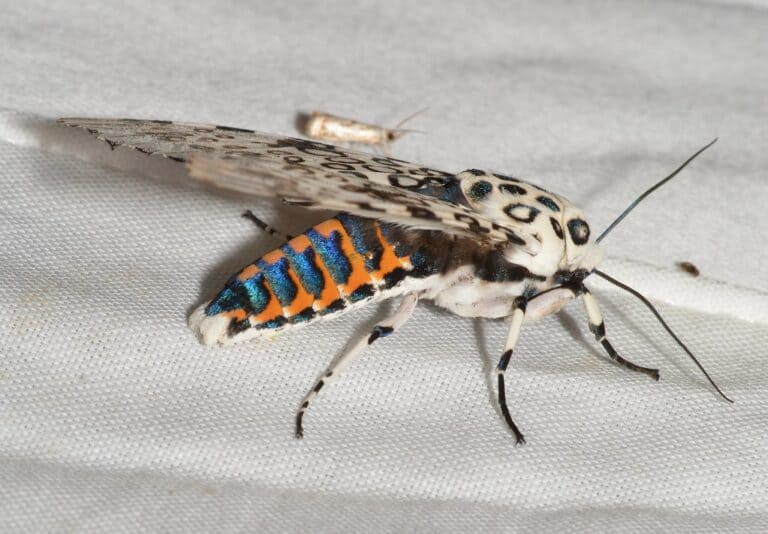
  • Often flashes iridescent blue and orange/red on hindwings/abdomen when startled
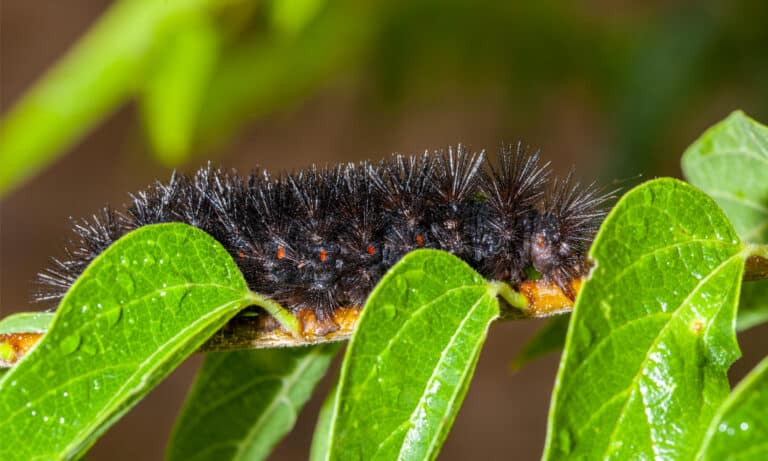
  • Larva is a black, bristly “woolly bear” caterpillar

Did You Know?

Wingspan is typically 5.1-7.6 cm (BugGuide: Hypercompe scribonia; Moth Photographers Group).

Adults have white forewings with bold black "leopard" spotting; when startled they often reveal a metallic blue abdomen with orange between segments (BugGuide).

The caterpillar is a bristly "woolly bear," reaching about 6 cm and often showing red/orange bands between segments when stretched (BugGuide).

It overwinters as a larva (caterpillar) and pupates later in a thin cocoon that incorporates its own hairs-common among tiger moths (BugGuide; Wagner 2005).

Adults are mainly nocturnal and frequently come to porch/UV lights, making them a common backyard moth despite their large size (BugGuide).

Larvae are highly polyphagous: recorded host plants include many low plants and broadleaf trees/shrubs (e.g., dandelion Taraxacum, plantain Plantago, violets Viola, clover Trifolium, cherry/Prunus, and others) (Wagner 2005; BugGuide host records).

Unique Adaptations

  • High-contrast disruptive patterning: the crisp black spots on white wings break up the moth's outline on bark and lichen-like backgrounds, aiding daytime concealment while at rest.
  • Flash coloration: the hidden, vivid abdominal colors are suddenly revealed in motion, which can startle predators or redirect attacks away from vital body parts (a defensive strategy widespread in Arctiinae).
  • Protective larval setae: dense bristles reduce palatability and make handling difficult for predators; in some people, the hairs can cause mild skin irritation (a common woolly-bear trait).
  • Bat-defense toolkit (group trait): tiger moths and other nocturnal Erebidae possess tympanal hearing organs for detecting echolocating bats; many arctiines also employ last-ditch evasive maneuvers when they detect bat ultrasound (well established in the subfamily even when not tested in every species).

Interesting Behaviors

  • Startle/flash display: when disturbed, adults spread or flick wings to expose the bright blue-and-orange abdomen, a classic tiger-moth "flash coloration" defense (BugGuide).
  • Nocturnal flight and light attraction: adults fly after dark and readily visit artificial lights, where they often rest with wings tented to emphasize the black-on-white spotting.
  • Larval defensive posture: the woolly bear curls into a tight ball, presenting a dense "hedgehog" of setae (hairs) to deter predators; it may also drop from vegetation when threatened.
  • Wandering pre-pupation: mature larvae leave host plants and travel along the ground to find sheltered sites (leaf litter, under objects) before spinning a sparse cocoon.
  • Chemical-signal mating (typical for Erebidae/Arctiinae): females call with pheromones; males follow odor plumes upwind using enlarged antennae and zig-zag flight to locate mates (well documented across tiger moths; species-specific field observations reported by collectors/naturalists).

Cultural Significance

The Giant Leopard Moth (Hypercompe scribonia) is a well-known North American tiger moth. Adults have white wings with big black spots, come to lights at night, and its woolly bear caterpillar is used to teach the life cycle and can overwinter.

Myths & Legends

The English name Giant Leopard Moth (Hypercompe scribonia) follows an old folk habit of naming showy insects after powerful animals, such as leopards, to explain their patterns and drama, not one origin tale.

In Persian and Urdu Sufi poetry, the "moth and the flame" story makes a moth drawn to a candle a symbol of longing and self-surrender; large night moths like Hypercompe scribonia match this image.

The Giant Leopard Moth (Hypercompe scribonia) was named by Stoll in 1790. Then, showy moths were traded, drawn, and kept in curiosity cabinets, becoming symbols of night beauty and change.

Conservation Status

NE Not Evaluated

Has not yet been evaluated against the criteria.

Population Unknown

Life Cycle

Birth 100 larvas
Lifespan 12 years

Lifespan

In the Wild
10–14 years
In Captivity
8–16 years

Reproduction

Mating System Promiscuity
Social Structure Solitary
Breeding Pattern Transient
Fertilization Internal Fertilization
Birth Type Internal_fertilization

The giant leopard moth (Hypercompe scribonia) is a nocturnal, solitary moth. Females call with pheromones; mating happens when they meet and is brief. Males give a spermatophore. No pair bonds or parental care; eggs are laid on host plants. Adults live days to weeks.

Behavior & Ecology

Social No formal group (solitary) Group: 1
Activity Nocturnal, Crepuscular
Diet Herbivore Violet (Viola spp.) leaves (commonly reported larval host foliage)
Seasonal Hibernates

Temperament

Non-aggressive; does not exhibit territoriality or cooperative defense.
Primarily defensive when disturbed: adults commonly rely on startle/flash displays (sudden reveal of brightly colored hindwings/abdomen) and immobility/avoidance rather than attack; larvae rely on dense setae (bristles) as a mechanical deterrent.

Communication

Chemical: sex pheromone signaling for mate attraction Female calling; male orientation via antennae
Tactile: close-range courtship/contact cues during mating Antennae/legs contact typical of moth courtship
Chemical Defensive): larvae and adults rely on deterrence strategies; any warning/repellent chemicals are primarily for predator deterrence rather than intraspecific social signaling (species-specific compounds are not consistently quantified in primary sources for H. scribonia

Habitat

Biomes:
Temperate Forest Temperate Grassland
Terrain:
Plains Hilly Valley Coastal Riverine Rocky
Elevation: Up to 6561 ft 8 in

Ecological Role

Generalist herbivorous caterpillar (foliage consumer) with adults that can act as occasional nectar-feeding flower visitors

Transfers primary production to higher trophic levels (important prey biomass for insectivores despite chemical/physical defenses) Contributes to plant community dynamics through folivory (selective feeding on forbs/weeds) Potential incidental pollination when adults visit flowers for nectar

Diet Details

Other Foods:
Leaves of broadleaf herbaceous plants Violets Dandelion Plantain Wild cherry Honeysuckle Magnolia Aster-family weeds and low forbs Flower nectar +3

Human Interaction

Domestication Status

Wild

Hypercompe scribonia (Giant Leopard Moth) is a wild North American tiger moth (Erebidae: Arctiinae) with no history of domestication or selective breeding. It is sometimes kept short term for education, usually as caterpillars. Adults have a wingspan of about 5.1–7.6 cm; mature larvae reach ~5 cm. One generation per year; larvae often overwinter.

Danger Level

Low
  • Larval hairs (setae) can cause mild skin irritation or contact dermatitis in sensitive individuals; avoid rubbing eyes after handling and wash hands.
  • Allergic reactions are uncommon but possible with repeated exposure (as with many hairy caterpillars).
  • Adults are harmless (no sting, no venom) and do not bite.
  • Ecological risk if transported and released outside the native range (best practice: do not move live specimens between regions).

As a Pet

Suitable as Pet

Legality: Giant Leopard Moth (Hypercompe scribonia) is usually legal to keep or raise where found, often for education. Do not move live moths across state or country lines without checking rules; protected land collecting may need permits.

Care Level: Easy

Purchase Cost: Up to $25
Lifetime Cost: $10 - $75

Economic Value

Uses:
Environmental education Citizen science & biodiversity monitoring Nature photography/eco-tourism Non-pest herbivory (occasionally noted, rarely economically significant)
Products:
  • No commercial products; value is primarily educational/scientific (e.g., classroom rearing, public insect programs, moth-survey events).

Relationships

Predators 6

Big brown bat Eptesicus fuscus
Little brown bat
Little brown bat Myotis lucifugus
Orb-weaver spider
Orb-weaver spider Araneidae
Paper wasps Polistes spp.
Tachinid flies Tachinidae
Braconid parasitoid wasp Braconidae

Related Species 5

Perforated tiger moth Hypercompe permaculata Shared Genus
Suffused tiger moth Hypercompe suffusa Shared Genus
Virginian tiger moth Spilosoma virginica Shared Family
Salt marsh moth Estigmene acrea Shared Family
Virgin tiger moth Apantesis virgo Shared Family

Ecological Equivalents 4

Animals that fill a similar ecological role in their ecosystem

Wood leopard moth Zeuzera pyrina Look-alike: both are large black-and-white 'leopard'-patterned moths that hide on bark and can be confused; Zeuzera pyrina larvae bore into trees, while Hypercompe scribonia larvae feed on many leaves.
Perforated tiger moth Hypercompe permaculata Closest niche match within the same genus: nocturnal tiger moths with similar warning/flash coloration and similar life history (hairy, generalist-feeding larvae; adults commonly attracted to lights).
Salt marsh moth Estigmene acrea Similar trophic role and defenses. Both are arctiine "woolly bear" caterpillars that feed on a wide range of herbaceous plants and are commonly preyed upon by generalist predators and parasitoids. Adults are nocturnal and often attracted to lights.
Virginian tiger moth Spilosoma virginica Parallel niche: polyphagous, hairy caterpillars on low vegetation; adults are nocturnal and frequently attracted to porch and UV lights. Occupies overlapping habitats with H. scribonia (fields, gardens, edges).

The giant leopard moth starts out as a prickly black caterpillar.

It has orange markings across its body and although its prickly fur appears to cause injury, these bristles on their bodies aren’t urticant, which means they don’t splinter off when touched. You could touch it gently with your fingertips—although, it may curl up in defense. Another defense mechanism giant leopard moths use is the release of yellow fluid from their thoraxes. After a period of hibernation, the caterpillar emerges as the giant leopard moth, to enjoy a nocturnal life.

6 Giant Leopard Moth Facts

Learn 6 interesting facts that set giant leopard moths aside from other types of moths.

  1. If you spot a giant leopard moth near lights at night, it’s like a male because females are less drawn to the brightness.
  2. These moths start out as black, prickly caterpillars.
  3. Giant leopard moths enjoy broad-leafed plants and leaves from different types of trees.
  4. These moths only take flight at night because they are nocturnal.
  5. When threatened, giant leopard moths release yellow fluid to keep predators away.
  6. When giant leopard moths mate, their mating sessions last over 24 hours.

Species, Types, and Scientific Name

The scientific name for the giant leopard moth is Hypercompe from the H. scribonia species. It is also commonly referred to as the tiger moth. It’s from the Erebidae family, which is a family of moths from the superfamily Noctuoidea. There are over 70,000 species of moths that form this superfamily—they refer to “night owl” moths that can be found traveling throughout the night.

This species of moth was previously recognized as part of the Arctiidae family. However, they were reclassified because of their nocturnal lifestyles. The males are highly attracted to bright lights at night, while the females are less commonly found swirling about lights with their male counterparts.

The giant leopard math has two subspecies:

  • H. s. scribonia
  • H. s. denudate

The name doesn’t lie—these moths are as large as a human palm. They have a wingspan of three inches and the males are almost twice as large as the females. They’re easy to spot because of their unique black and white spotted pattern. As “wooly bear” caterpillars, they hibernate during the winter months and spin into cocoons during springtime.

Appearance

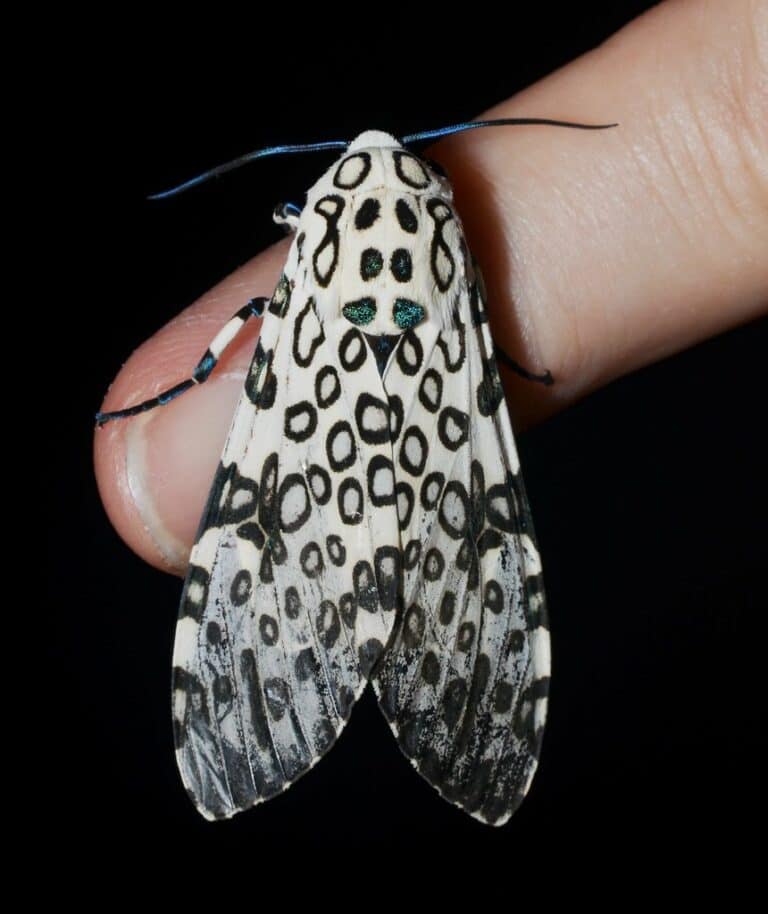
Giant leopard moths have a beautiful, easy-to-spot appearance. The males and females have slightly different appearances, but both have large white wings peppered with black dots. Some of the dots are solid, while others are hollow. On the top side of their abdomens, you can spot a dark blue, iridescent color with some orange markings.

The bottom side of their abdomens is like their wings—white with black spots. Their legs are also black and white but instead of spotted, these colors are banded. Male leopard moths have a distinctive yellow line on each of their sides.

These moths can sometimes be spotted living together with other moths on a tree. However, these are solitary creatures, and they don’t typically live in groups. However, the males and females come together to mate. Their average litter size is about 50 eggs. Their spotted wing design is ideal for helping them blend in with their surroundings and avoid predators.
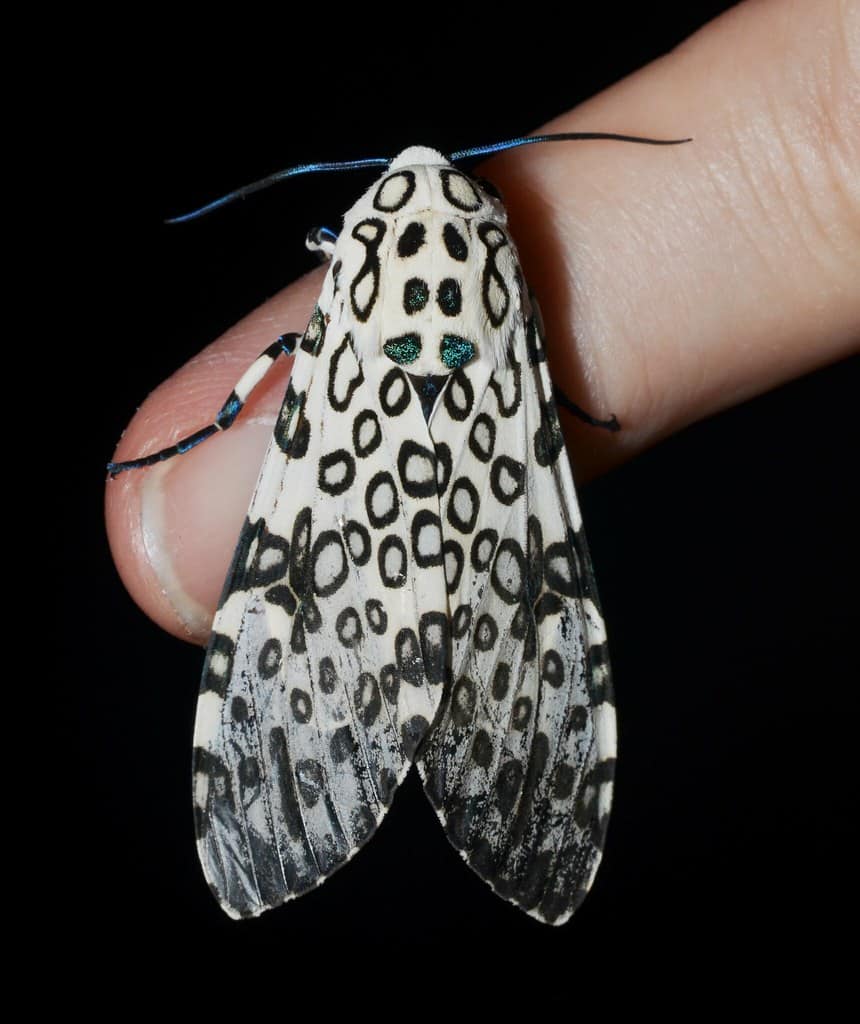
A giant leopard moth resting on a human finger highlights its size

Giant leopard moths moths are as large as a human palm, with a wingspan of three inches and the males are almost twice as large as the females.

Habitat

Giant leopard moths can be found in forest environments. This is where they find host plants. However, they do travel and can be spotted in public areas like farmlands and gardens. They love environments like fields and meadows as well. Host plants include:

  • Cabbage
  • Dandelion
  • Violet
  • Willow
  • Sweet Orange
  • Black Locust
  • Flamevine
  • Magnolia
  • Plantain
  • And more!

Specific Locations Where this Insect Is Found

The giant leopard moth can be found in different countries, ranging from southern Canada, throughout the United States, and through several South American countries, all the way down to Colombia. These countries include:

Diet

As a caterpillar, these moths enjoy broad-leafed plants. This can include anything from lettuce to sunflowers. They also enjoy eating the leaves from several different types of trees, like willows and cherry trees.

Prevention: How to Get Rid of Giant Leopard Moths

Giant leopard moths may sometimes be found in areas close to where humans reside, like in gardens or under wood chips where they rest. Since these insects are nocturnal, it’s not common for you to spot one, unless you spend a lot of time outdoors at night. The male moths are attracted to bright lights, so if you intend to spend time outdoors at night, use a bug shield to keep the male leopard moths away.  

If you’re interested in learning about different types of moths, check out the links below:

View all 261 animals that start with G

Sources

  1. Entomology and Nematology Department, University of Florida / Accessed June 9, 2022
  2. American Association for the Advancement of Science / Accessed June 9, 2022
Angie Menjivar

About the Author

Angie Menjivar

Angie Menjivar is a writer at A-Z-Animals primarily covering pets, wildlife, and the human spirit. She has 14 years of experience, holds a Bachelor's degree in psychology, and continues her studies into human behavior, working as a copywriter in the mental health space. She resides in North Carolina, where she's fallen in love with thunderstorms and uses them as an excuse to get extra cuddles from her three cats.
Connect:

Thank you for reading! Have some feedback for us?


Giant Leopard Moth FAQs (Frequently Asked Questions)

No, moths don’t contain poison and don’t pose a danger to humans. They are unable to bite, particularly once they’re fully grown, which makes them harmless to humans.