M
Species Profile

Malayan Civet

Viverra tangalunga

Stripe-tailed night forager of SE Asia
Dellex / Creative Commons

Malayan Civet Distribution

Click a location to explore more animals from that region

Loading map...

Size Comparison

Human 5'8"
Malayan Civet 12 in

Malayan Civet stands at 17% of average human height.

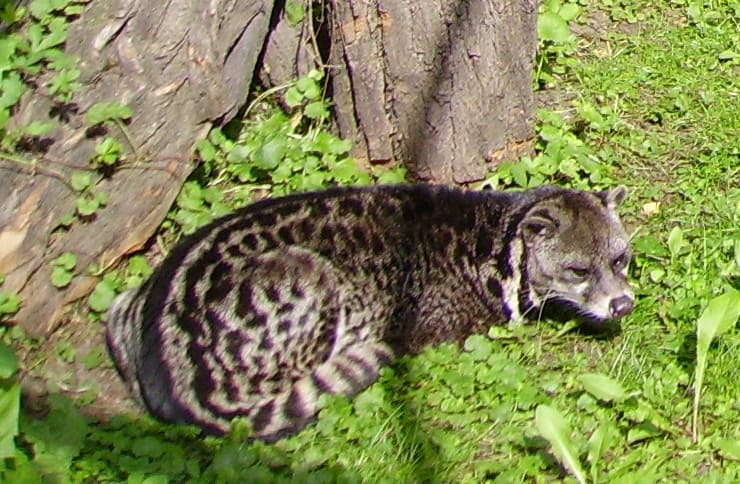
Malayan Civet on grass

At a Glance

Wild Species
Diet Omnivore
Activity Nocturnal+
Lifespan 8 years
Weight 5 lbs
Status Least Concern
Did You Know?

Adults are typically 58-75 cm head-body with a 30-40 cm tail (field guides & mammal compendia report these ranges).

Scientific Classification

The Malay (Malayan) civet is a nocturnal, omnivorous small carnivore in the family Viverridae, characterized by a long body, short legs, a pointed muzzle, and a typically banded/striped pattern on the body and tail. It is adaptable and commonly uses forest edges, secondary growth, and human-modified landscapes.

Kingdom
Animalia
Phylum
Chordata
Class
Mammalia
Order
Carnivora
Family
Viverridae
Genus
Viverra
Species
Viverra tangalunga

Distinguishing Features

  • Elongate body with short legs and a pointed, fox-like muzzle
  • Coat typically shows dark spots/stripes; tail often banded
  • Nocturnal and largely solitary; scent-marking is prominent
  • Omnivorous diet (small animals, insects, and fruit) and frequent use of edge habitats

Physical Measurements

Height
12 in (10 in – 1 ft 2 in)
Length
3 ft 10 in (3 ft 1 in – 4 ft 7 in)
Weight
8 lbs (6 lbs – 11 lbs)
Tail Length
1 ft 8 in (1 ft 5 in – 2 ft 1 in)

Appearance

Primary Colors
Secondary Colors
Skin Type Mammalian skin with short-to-medium coarse fur; well-developed perineal scent glands (civet) used for scent marking.
Distinctive Features
  • Head-body length 58-66 cm; tail length 28-35 cm (Nowak 1999; Francis 2008).
  • Adult mass typically ~3-5 kg, males averaging larger (Nowak 1999; Francis 2008).
  • Long, low-slung body with short legs; cat-like stance but longer muzzle and civet profile.
  • Pointed muzzle with dark facial mask; small rounded ears; pale throat patch common.
  • Tail long and strongly ringed with alternating dark and pale bands.
  • Coarse guard hairs; markings usually sharper on shoulders/flanks than on rump.
  • Prominent perineal (civet) glands; frequent scent marking on trails, logs, and edges.
  • Nocturnal and largely solitary; adaptable to secondary forest, plantations, and human-modified landscapes across Southeast Asia.

Sexual Dimorphism

Sexual dimorphism is subtle: males average slightly heavier with broader head and neck. Coat coloration and patterning are essentially the same in both sexes, so size and genital region are the most reliable field cues.

  • Slightly larger average body mass and more robust head/neck.
  • May show more prominent musculature around shoulders and neck.
  • Slightly smaller average body mass and narrower head/neck.
  • Teats may be visible when lactating; otherwise pelage pattern matches males.

Did You Know?

Adults are typically 58-75 cm head-body with a 30-40 cm tail (field guides & mammal compendia report these ranges).

Reported adult mass is commonly ~3-5 kg (with heavier individuals occasionally noted).

It's a true civet (Genus Viverra), not the species associated with civet coffee-the Asian palm civet (Paradoxurus hermaphroditus).

Malay civets use powerful perineal/anal gland secretions for scent-marking-one of the defining traits of the family Viverridae.

They're omnivores: small vertebrates, insects, and fruit can all feature in the diet, helping them persist near farms and secondary growth.

They are largely solitary and most active at night, which is why they're more often detected by tracks, scat, or camera traps than by direct sightings.

Unique Adaptations

  • Well-developed perineal/anal scent glands (Viverridae hallmark): enables long-lasting chemical communication in dense, low-visibility habitats at night.
  • Camouflage patterning: dark body bands/spots and a ringed tail help break up the outline in dappled understory light.
  • Generalist dentition and gut tolerance: accommodates both animal prey and fruit, supporting survival where prey availability fluctuates.
  • Low-slung, agile body plan: long body with relatively short legs aids stealthy movement through undergrowth and along narrow trails.
  • Strong olfaction: scent-based navigation and foraging are especially effective for a nocturnal omnivore.

Interesting Behaviors

  • Nocturnal, mostly solitary movement: typically travels alone at night, using cover along forest edges, trails, and riparian strips.
  • Scent marking with gland secretions: deposits strong-smelling secretion on substrates (and may rub or drag the perineal region) to advertise territory and reproductive status.
  • Use of latrine-like sites: like other viverrids, may repeatedly defecate in particular locations, creating detectable signposts for communication.
  • Opportunistic omnivory: switches among fruiting trees, insects, carrion, and small prey depending on season and availability-well suited to disturbed habitats.
  • Terrestrial foraging with some climbing: primarily ground-oriented but capable of climbing to access food or avoid threats.
  • Edge-and-mosaic habitat use: commonly recorded in secondary forest, forest-plantation interfaces, and other human-modified landscapes, especially where cover and food remain.

Cultural Significance

The Malayan Civet (Viverra tangalunga) is known for civet musk used in perfumes and incense across Asia. In Southeast Asia it has local names and visits farms and fruit trees at night, making people tolerate it or try to keep it away.

Myths & Legends

In historic Asian and Middle Eastern perfume traditions, civet musk (often from various civet species, not always named) was valued as a strong, attractive scent, a sign of luxury and romance among the elite.

In parts of Southeast Asia, people see Malay civets (Viverra tangalunga) as nighttime raiders. They eat fruit and sometimes take chickens or eggs, so villagers warn others to lock food and animals.

The English name "Malay/Malayan civet" links the species (Viverra tangalunga) to the Malay Archipelago and Southeast Asia. Local names often say where it is seen—forest edge, orchard, or village fringe—rather than strict species limits.

Conservation Status

LC Least Concern

Widespread and abundant in the wild.

Population Decreasing

Protected Under

  • Malaysia: Wildlife Conservation Act 2010 (Act 716)
  • Philippines: Wildlife Resources Conservation and Protection Act (Republic Act No. 9147)

Life Cycle

Birth 2 kits
Lifespan 8 years

Lifespan

In the Wild
4–12 years
In Captivity
12–20 years

Reproduction

Mating System Promiscuity
Social Structure Solitary
Breeding Season Year-round (no well-defined, species-wide breeding season reported across the range)
Breeding Pattern Transient
Fertilization Internal Fertilization
Birth Type Internal_fertilization

Malay civets are largely solitary; adults come together briefly to mate, with males ranging widely and likely mating with multiple females. Females den alone and raise litters without male assistance; no lasting pair bond is known.

Behavior & Ecology

Social Solitary Group: 1
Activity Nocturnal, Crepuscular
Diet Omnivore Fallen/ripe fruits (especially soft forest fruits such as figs)

Temperament

Typically solitary; contact mainly occurs during breeding and between mothers and dependent young.
Generally wary and avoids open confrontation; retreats or freezes when disturbed (Payne et al., 1985).
Opportunistic and adaptable in disturbed habitats; may tolerate proximity to humans if undisturbed (IUCN Red List: Duckworth et al.).
Likely territorial/spacing behavior indicated by regular scent-marking and latrine use (Viverridae behavior syntheses: Macdonald & Loveridge, eds.).

Communication

Low growls and snarls during threat/aggression General Viverridae descriptions; Payne et al., 1985
Hisses/spits in defensive encounters at close range Viverridae behavior accounts
Soft grunts/chirr-like contact calls reported in captivity/handling contexts Zoo husbandry notes; species-level data sparse
Scent-marking via perineal/anal gland secretions on substrates Key Viverridae signal; Macdonald & Loveridge, eds.
Urine spraying/urine marking along travel routes and territory boundaries Viverridae field accounts
Fecal deposition at repeated sites Latrines) to advertise occupancy and status (civet behavioral ecology reports
Body postures Arched back, piloerection) and facial threat displays in close conflicts (carnivore ethograms

Habitat

Biomes:
Tropical Rainforest Tropical Dry Forest Wetland
Terrain:
Plains Hilly Mountainous Valley Coastal Island Riverine +1
Elevation: Up to 4921 ft 3 in

Ecological Role

Generalist mesopredator and omnivorous forager linking forest and edge/agroecosystems.

Regulates small-vertebrate populations (notably rodents in agricultural mosaics) Controls some insect/invertebrate populations Seed dispersal via fruit consumption and defecation away from parent plants (especially for small-seeded soft fruits) Trophic coupling between forest, edge, and plantation habitats through flexible prey switching

Diet Details

Main Prey:
Rats and mice Small mammals Birds and bird eggs Reptiles Amphibians Large insects and other arthropods Earthworms and other soil invertebrates Crabs and other small aquatic and shoreline animals +2
Other Foods:
Fallen ripe fruits Cultivated fruits Oil palm fruits Plant matter

Human Interaction

Domestication Status

Wild

Malay civet (Viverra tangalunga) is wild and not domesticated. It is solitary and nocturnal and can live near people in forest edges, plantations, or villages — this shows it can use changed habitats, not that it is tamed. Size: body 58–70 cm, tail 28–45 cm, weight ~3–7 kg. Humans may hunt or keep them as pets.

Danger Level

Low
  • Bites/scratches if cornered, trapped, or handled (can cause serious wounds due to carnivore dentition).
  • Zoonotic disease risk typical of small wild carnivores when handled (e.g., rabies risk where present; bacterial infection from bites).
  • Strong-smelling anal gland secretions used defensively can cause eye/skin irritation and severe odor nuisance.
  • Rarely, conflict incidents around poultry or refuse can provoke defensive encounters.

As a Pet

Not Suitable as Pet

Legality: The Malay (Malayan) Civet (Viverra tangalunga) is treated as an exotic wild carnivore. Laws vary: often banned or allowed only with permits and paperwork; cross-border import/export rules may also apply. Check local laws.

Care Level: Expert Only

Purchase Cost: $500 - $3,000
Lifetime Cost: $15,000 - $50,000

Economic Value

Uses:
Ecosystem services (predation on rodents/invertebrates; scavenging) Wildlife tourism/education (limited, mostly incidental sightings) Local hunting/consumption and small-scale trade (varies by region) Human-wildlife conflict (poultry/fruit raiding; property nuisance; roadkill impacts) Research/monitoring (camera-trap studies in SE Asia)
Products:
  • No major standardized commercial products are specifically associated with Viverra tangalunga; where utilized by people it is typically as bushmeat or occasional skin use at local scales, plus indirect value via pest-control ecosystem services.

Relationships

Related Species 8

Large Indian civet Viverra zibetha Shared Genus
Malabar civet Viverra civettina Shared Genus
Large-spotted civet
Large-spotted civet Viverra megaspila Shared Genus
Small Indian civet Viverricula indica Shared Family
Common palm civet
Common palm civet Paradoxurus hermaphroditus Shared Family
Binturong
Binturong Arctictis binturong Shared Family
Banded palm civet
Banded palm civet Hemigalus derbyanus Shared Family
Owston's civet Chrotogale owstoni Shared Family

Ecological Equivalents 5

Animals that fill a similar ecological role in their ecosystem

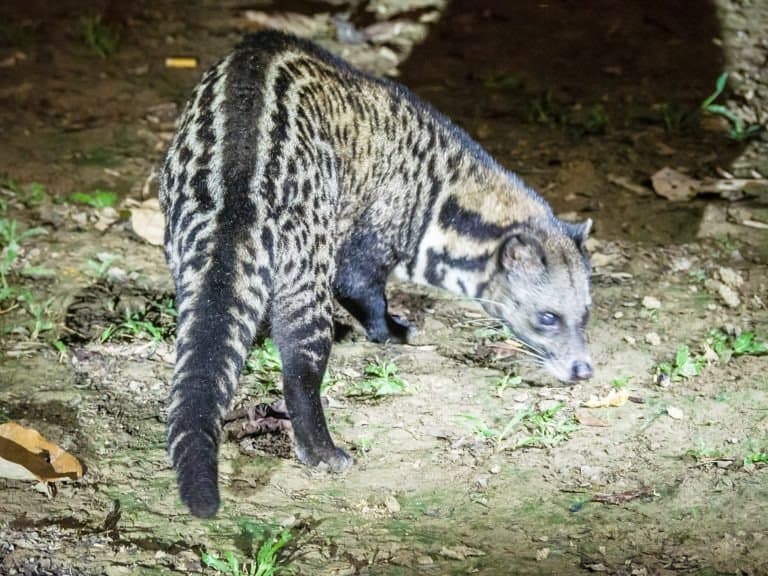
“The Mayalan Civet is the most distinguishable civet due to its dark legs and its long, striped tail”

The species of civet is common in Southeast Asia, but is native to the Malay Peninsula. Also known as the Malay Civet and Oriental Civet, it inhabits the rainforests and tropical jungles in mainland Malaysia, the Phillippines, Indonesia, and Singapore. It is valued for food and musk but treated as a pest when dwelling near people.

Incredible Malayan Civet Facts!

  • It is one of the species that can be tamed and kept to extract musk.
  • This species was introduced to the Maluku islands surrounding the Malay Peninsula.
  • It is ground-dwelling, but will climb trees if necessary.
  • It has adapted to deforestation to include other habitats.
  • The 15 black bands on its tail give it more camouflage.

Malayan Civet Scientific name

The Malayan Civet’s scientific name is Viverra tangalunga. Tangalunga refers to the species. Viverra is the genus of civets. It is a genus of the family Viverridae which consists of small to medium-sized mammals known as viverrids (civets and genets) and contains 15 genera, which are subdivided into 38 species.

Common to all viverrids are feet with four or five toes and retractable claws. Each jaw has six incisors and molars in front of two tubercular grinders in the upper jaw, with one grinder in the lower jaw. The tongue is rough and prickly. There is no cecum. There are two subspecies of Mayalan Civet: Viverra tangalunga lankavensis and Viverra tangalunga tangalunga.

Civets fall into the Feliformia (also known as Feloidea) suborder of the order Carnivora, as do cats, hyenas, mongooses and other cat-like carnivorans. They are actually not related to cats but are closely related to other small carnivores such as weasels and mongooses. However, they are more primitive and have less diversity than Felidae (cats).

Malayan Civet Appearance

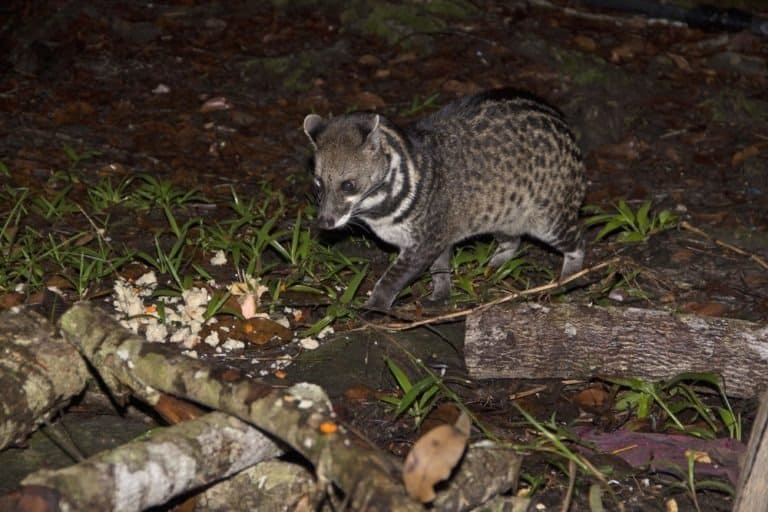
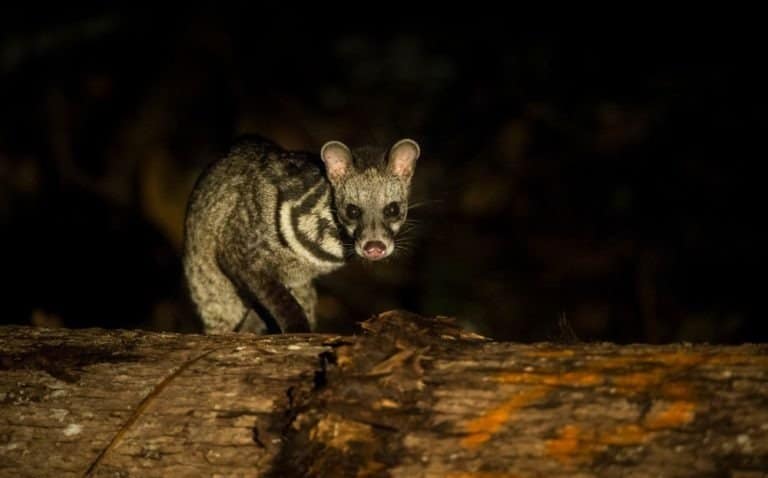
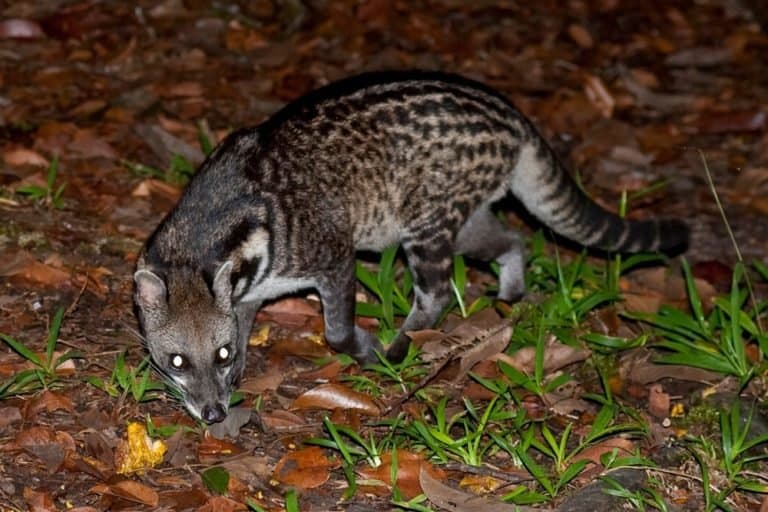
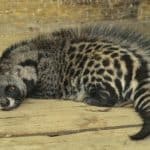
Like other civets, this species shares the whiskers, long, slender and sleek body, feet, teeth and other physical features. Its fur resembles the coloring and pattern of a cheetah. Its long tail has a vertical black stripe on top with bands underneath against pale fur. The rest of its fur has black spots.

It has a somewhat pointed snout and its fur is the color black plus either brown, grey, yellow, tan, or white. The feet are all black. Malayan Civets have an average weight of 3.5-11kg (7.72-24.25lb) a body length of 58.5-95cm (23-37.4in), and a tail length of 30-48.2cm (11.8-19in). Females have two or three pairs of teats, while males have a baculum.
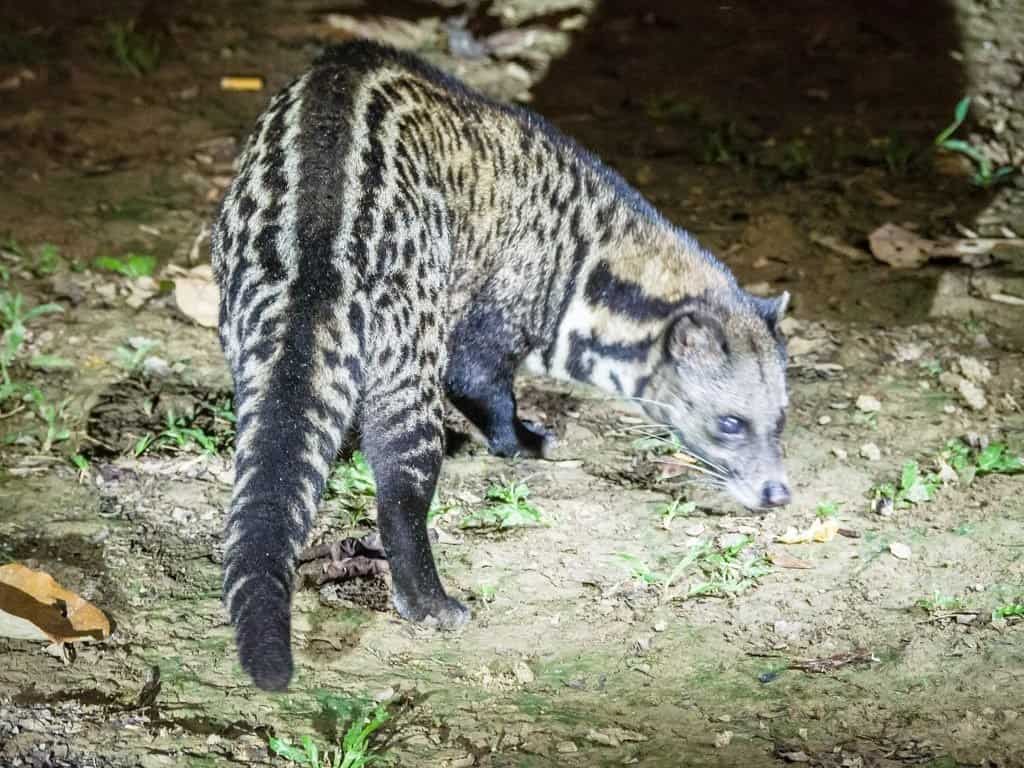
Malayan Civet Feeding at Kinabatangan Jungle Camp

Malayan Civet Behavior

Malayan Civets are solitary, territorial creatures. They come out at night to hunt for food on the forest floor. They also climb trees to hunt for food or to hide from predators. During the day, they are sedentary and sleep under the cover of trees. They hunt by stalking and pouncing on their prey. When threatened or communicating with other civets by scent, they secrete a musk called civet or civetone from their perianal glands. They are not aggressive unless cornered.

Malayan Civet Habitat

The Malayan Civet’s native habits are originally the rainforests and tropical jungles of the Malay Peninsula and the surrounding islands of the Riau Archipelago, Borneo, Banggi, Langkawi, and Penang. It also lives in Sumatra, Sulawesi, the Indonesian islands of Java, Bawal and Telok Pai, and the Phillippine island of Leyte.

It range of habits has expanded beyond primary forests to include the disturbed land of secondary forests along with brush, grasslands and mountain forests. They also live near villages in order to steal poultry, but never far from trees. The mean range overlap of territories among civets are 15% for males and 0% for females, while the home range of each male overlaps one or two females. The species enjoys high altitudes and have had habitats up to 1100m high.

Malayan Civet Diet

The favorite prey of the Malayan Civet is mice, rats and other rodents. Eggs, Lizards, snakes, frogs, insects and other small creatures from the forest floor also make up the bulk of its diet. However, they include fruit and some roots, so while they rely on the protein from small vertebrates and invertebrates, they are actually omnivorous. For example, they enjoy the seed pods of the Rain Tree, the fruits of the Fishtail Palm, mangoes, bananas and sapota.

Malayan Civet Predators and threats

Malayan Civets may compete with palm civets in logged forests over food. Timber harvesting in Borneo for palm oil plantations threaten their habitats there. The species is a predatory animal but has many predators that are larger carnivores, including large cats such as tigers and leopards and large reptiles such as large snakes and crocodiles.

It also runs the risk of being snared or experiencing other forms of ground-level trapping along with being hunted by dogs. However, the species persists and adapts in spite of general levels of threat. People treat it as a pest that raids fruit, poultry, and other small livestock, and occasionally hunt it for food.

Malayan Civet Reproduction, Babies, and Lifespan

Males and females come together for mating and the females raise the young. Females reproduce twice a year and give birth in dense vegetation, hollow tree trunks or holes in the ground. Gestation lasts a couple of months. Litters have up to 4 kittens but 2 on average. Sometimes, the mothers eat their young right after giving birth. The kittens are born with fur and eyes closed and are weaned after a month. They can crawl at birth and their hind legs can support them after about 5 days. They start venturing out on their own two or three months after birth.

Malayan Civets on average live 5-12 years and even up to 20 years. Such an age is rare, so it is more common to see older civets live between 15 to 20 years instead.

Malayan Civet Population

The density of Malayan Civet populations are denser in unlogged forests as opposed to logged. The species’ secretiveness makes it difficult to determine their population, but their numbers remain stable. Their conservation status is “vulnerable” and currently “not threatened,” while the IUCN red list states it is of “least concern.” They are treated as a pest in rural areas of the Malay Peninsula. Under Section 55 of the WPA of 1972, farmers can shoot any threatening wild animal after making a reasonable effort to frighten it away.

Malayan Civet In the Zoo

The Malayan Civet lives about 12 years in captivity. It is often housed with other viverrid species, such as other civets or genets. Their enclosures are large, filled with shrubbery, tall grasses, artificial caves, and many other different types of high spots and hiding places. When rescued young, they require round-the-clock care. This species is one of the attractions at zoos not only in Southeast Asian countries but in Europe, including Hungary, France, and the UK.

View all 330 animals that start with M

Sources

  1. David Burnie, Dorling Kindersley (2011) Animal, The Definitive Visual Guide To The World's Wildlife / Accessed August 10, 2010
  2. Tom Jackson, Lorenz Books (2007) The World Encyclopedia Of Animals / Accessed August 10, 2010
  3. David Burnie, Kingfisher (2011) The Kingfisher Animal Encyclopedia / Accessed August 10, 2010
  4. Richard Mackay, University of California Press (2009) The Atlas Of Endangered Species / Accessed August 10, 2010
  5. David Burnie, Dorling Kindersley (2008) Illustrated Encyclopedia Of Animals / Accessed August 10, 2010
  6. Dorling Kindersley (2006) Dorling Kindersley Encyclopedia Of Animals / Accessed August 10, 2010
  7. David W. Macdonald, Oxford University Press (2010) The Encyclopedia Of Mammals / Accessed August 10, 2010
  8. Wikipedia / Accessed October 29, 2020
  9. Animalia / Accessed October 29, 2020
  10. Animal Diversity Web / Accessed October 29, 2020
  11. Science Direct / Accessed October 29, 2020
  12. Thai National Parks / Accessed October 29, 2020
A-Z Animals Staff

About the Author

A-Z Animals Staff

AZ Animals is a growing team of animals experts, researchers, farmers, conservationists, writers, editors, and -- of course -- pet owners who have come together to help you better understand the animal kingdom and how we interact.
Connect:

Thank you for reading! Have some feedback for us?


Malayan Civet FAQs (Frequently Asked Questions)

Also called the Oriental Civet or Malaysian Civet, it is a species of civet native to the rainforests and tropical jungles of Malaysia and the surrounding islands.