

M
Species Profile

Mississippi Kite

Ictinia mississippiensis

The buoyant insect-hawk of summer
iStock.com/garytog

Mississippi Kite Distribution

Click a location to explore more animals from that region

Loading map...
A Mississippi Kite on a post as it searches for food.

At a Glance

Wild Species
Activity Diurnal
Lifespan 6 years
Weight 0.388 lbs
Status Least Concern
Did You Know?

Size: 30-37 cm long; wingspan 91-99 cm; mass ~0.214-0.388 kg (reported ranges in Birds of the World/Cornell Lab).

Scientific Classification

A small, graceful kite (raptor) native to the central and eastern United States and parts of Mexico and Central America, notable for its buoyant flight and heavy reliance on aerial insects; also takes small vertebrates opportunistically.

Kingdom
Animalia
Phylum
Chordata
Class
Aves
Order
Accipitriformes
Family
Accipitridae
Genus
Ictinia
Species
Ictinia mississippiensis

Distinguishing Features

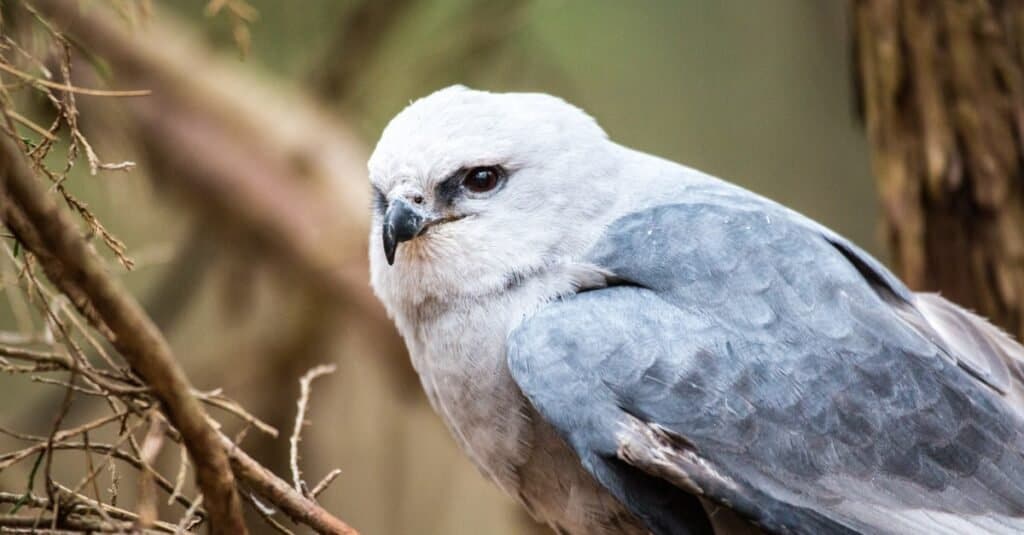
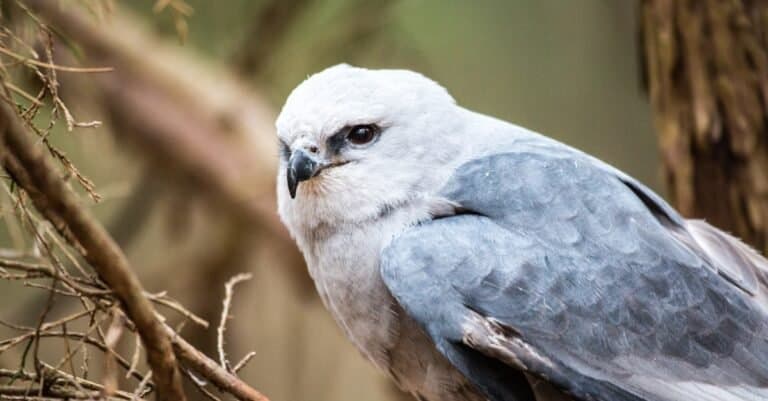
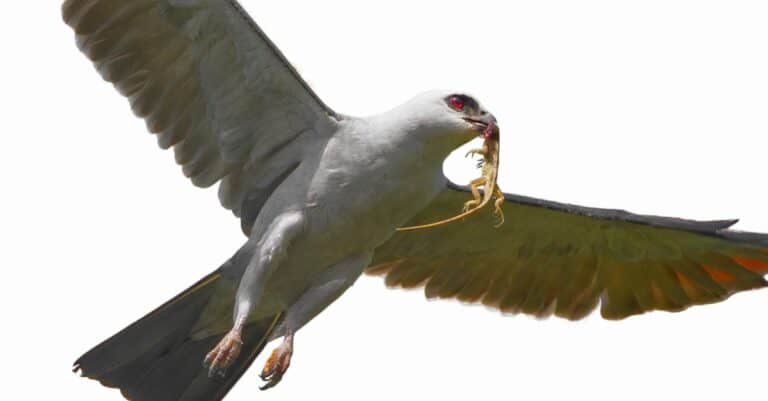
  • Overall pale gray plumage with darker gray wings (smooth, uniform look at distance)
  • Long, pointed wings and a relatively small head giving a sleek silhouette
  • Often seen soaring and gliding with quick, elastic wingbeats; adept at catching insects in flight
  • Red eyes in adults are sometimes visible at close range

Physical Measurements

Males and females differ in size

Length
1 ft 1 in (12 in – 1 ft 2 in)
1 ft 1 in (12 in – 1 ft 3 in)
Weight
1 lbs (0 lbs – 1 lbs)
1 lbs (1 lbs – 1 lbs)
Tail Length
7 in (6 in – 7 in)
Top Speed
36 mph
flying

Appearance

Primary Colors
Secondary Colors
Skin Type Feathered (contour feathers with long, pointed flight feathers; scaly tarsi/feet).
Distinctive Features
  • Adult size: total length 30-37 cm; wingspan 91-99 cm; mass 0.214-0.388 kg.
  • Long, narrow, pointed wings and buoyant, tern-like gliding/tilting flight.
  • Tail is square to slightly notched (not deeply forked), often with a dark terminal/subterminal band.
  • Small raptor head with short, sharply hooked bill; pale gray head can look slightly lighter than body.
  • Adult iris typically red; juveniles generally darker brownish-eyed.
  • Aerial insectivory: frequently captures large insects on the wing; also takes small vertebrates opportunistically.
  • Often perches conspicuously in woodland edges, riparian trees, and increasingly urban neighborhood trees during breeding.

Sexual Dimorphism

Sexes are very similar in plumage (near-monomorphic). Females average slightly larger/heavier than males, consistent with many Accipitridae, but field separation by appearance alone is usually unreliable.

  • Slightly smaller average body mass and wing dimensions than female.
  • Plumage generally identical to female: uniform slate-gray with blackish flight feathers.
  • Slightly larger average body mass and wing dimensions than male.
  • Plumage generally identical to male; size difference subtle without direct comparison.

Did You Know?

Size: 30-37 cm long; wingspan 91-99 cm; mass ~0.214-0.388 kg (reported ranges in Birds of the World/Cornell Lab).

Diet specialty: often hunts large aerial insects-cicadas, dragonflies, grasshoppers, beetles-snatching them in flight with rapid twists and rolls.

Breeding output is small: typically 2 eggs (range 1-3) in a stick nest placed high in tall trees along woodland edges and rivers.

Defends the nest boldly: adults commonly dive-bomb people and predators that approach too closely-one reason urban nesting gets noticed.

Long-distance migrant: breeds mainly in the central/eastern U.S. and winters largely in South America, traveling in loose groups and sometimes large roosting flocks.

Genus spotlight (Ictinia): the Mississippi Kite's closest relative, the Plumbeous Kite (Ictinia plumbea), fills a similar "insect-hawking kite" niche in the Neotropics-showing how this genus specializes in agile aerial hunting.

Unique Adaptations

  • Long, narrow, pointed wings (high aspect ratio) support low-energy gliding and quick banking-well-suited to chasing erratic flying insects.
  • Streamlined head and body plus agile tail control allow abrupt midair course changes during insect pursuits.
  • Vision and timing tuned for aerial prey capture: hunts by spotting moving targets against sky/foliage and intercepting them with short bursts of speed.
  • Flexible, generalist backup diet: while insect-heavy, it can switch to small vertebrates (e.g., small reptiles, amphibians, nestling birds, small mammals) when opportunities arise-useful during weather-driven insect shortages.

Interesting Behaviors

  • Aerial "hawking" and "kiting": patrols above treetops and open areas, then accelerates to intercept insects mid-air; often eats on the wing, transferring prey to the bill.
  • Thermal and wind surfing: uses rising warm air and light winds to travel and hunt with minimal flapping, giving its signature floating, elastic flight style.
  • Urban-edge nesting: increasingly breeds in neighborhood shade trees, parks, and street plantings where tall trees border open lawns that concentrate flying insects.
  • Nest defense dives: repeatedly stoops at intruders near the nest (including humans), typically from above and behind; defense intensity peaks during the nestling period.
  • Post-breeding sociality: after young fledge, individuals may gather in communal roosts and forage in loose flocks, especially during migration staging.

Cultural Significance

Mississippi Kite (Ictinia mississippiensis) is a summer sign in the southern Great Plains and Southeast U.S., floating over neighborhoods and parks and nesting in city trees. It is part of a North American group of slender, flying raptors, unlike bulkier hawks, and is loved for grace and insect-chasing.

Myths & Legends

In the Southern U.S., Mississippi Kites (Ictinia mississippiensis) are often called "mosquito hawks." People believe seeing them near homes and farms means there will be fewer biting insects.

Mississippi Kite (Ictinia mississippiensis) links to the Mississippi River area noted by early American naturalists; its genus Ictinia comes from Greek words for 'kite' used for graceful, soaring European birds of prey.

Seasonal-sky association: in some communities, the kite's return to town trees is treated as a sign that the hot season and cicada/dragonfly swarms have arrived-an informal, recurring piece of local nature-calendar lore.

Conservation Status

LC Least Concern

Widespread and abundant in the wild.

Population Increasing

Protected Under

  • United States: Migratory Bird Treaty Act (MBTA)
  • Mexico: Ley General de Vida Silvestre (general wildlife protections)
  • Mexico: General Wildlife Law (general wildlife protections)

Life Cycle

Birth 2 chicks
Lifespan 6 years

Lifespan

In the Wild
1–11.25 years
In Captivity
5–20 years

Reproduction

Mating System Monogamy
Social Structure Socially Monogamous
Breeding Pattern Seasonal
Fertilization Internal Fertilization
Birth Type Internal_fertilization

Mississippi Kites form socially monogamous pairs for the breeding season, sometimes nesting in loose aggregations. Copulation is internal; both sexes defend the nest area and provision young. Clutches are usually 1-2 eggs, with biparental care through fledging.

Behavior & Ecology

Social Flock Group: 20
Activity Diurnal
Diet Insectivore Large, seasonally abundant aerial insects-especially cicadas and orthopterans (grasshoppers/katydids/crickets).
Seasonal Migratory 3,728 mi

Temperament

Generally tolerant of conspecifics at roosts and during migration; less tolerant near nests.
Strong nest defense: repeated aerial dives and close passes at intruders, including humans (Birds of the World).
Foraging style is buoyant, agile aerial hunting; concentrates where insect swarms emerge (Birds of the World).
Opportunistic predator: primarily insects, but will take small vertebrates when available (Birds of the World).
Longevity record: 12 years 0 months (USGS Bird Banding Laboratory longevity records).

Communication

High, squeaky whistle often rendered as "pwee/pweee" Birds of the World
Rapid, higher-intensity alarm/calling series often rendered as "klee-klee-klee" near nests Birds of the World
Juvenile begging calls: persistent, higher-pitched squeals/chitters during provisioning Birds of the World
Aerial chase and swooping flight displays during courtship and territorial interactions Birds of the World
Threat communication via repeated stoops, close passes, and pursuit of intruders near the nest Birds of the World
Group coordination at roosts via synchronized circling/soaring and following movements into roost trees.

Habitat

Biomes:
Temperate Forest Temperate Grassland Savanna Tropical Dry Forest Tropical Rainforest Wetland Freshwater +1
Terrain:
Plains Riverine Valley Hilly Coastal
Elevation: Up to 6561 ft 8 in

Ecological Role

Aerial mesopredator specializing on large flying insects; opportunistic predator of small vertebrates during periods of high demand.

Suppresses populations of seasonally abundant flying insects (e.g., cicadas, grasshoppers/locusts, large beetles) Contributes to trophic coupling between forest edge/canopy and open habitats by removing insects dispersing across habitat boundaries Provides natural pest-control services in agricultural and suburban landscapes where it forages over fields and neighborhoods Acts as a bioindicator of aerial-insect availability and broader insect community health in breeding landscapes

Diet Details

Main Prey:
Cicada Grasshoppers and locusts Katydids and crickets Dragonflies and damselflies Beetles Moths and butterflies Flying ants and termite alates Wasps and bees Small vertebrates Small birds Bat Small rodents +6

Human Interaction

Domestication Status

Wild

The Mississippi Kite (Ictinia mississippiensis) is a fully wild bird of prey with no domestication history. It is not bred as a pet; captive birds are held only with special permits for rehab, education, or science. Eats insects in flight, migrates long distances. Size: 30–37 cm long, 91–99 cm wingspan, 0.214–0.388 kg. Will fiercely defend nests, sometimes dive-bombing in towns.

Danger Level

Moderate
  • Seasonal aggressive nest defense in breeding areas (especially in urban/suburban settings): repeated close passes and occasional talon contact to the head/scalp of pedestrians.
  • Minor injuries possible (scratches/lacerations); serious injury is uncommon but risk increases for people who approach nests or linger under nest trees.
  • Indirect risks common to wild raptors in human landscapes: collision incidents (birds hitting vehicles/windows) can create brief hazards if a stunned bird falls near people, though this is not a typical direct attack risk.

As a Pet

Not Suitable as Pet

Legality: Mississippi Kite (Ictinia mississippiensis) is usually illegal to keep as a pet in the U.S. Protected by the Migratory Bird Treaty Act; state laws also ban private ownership. Only licensed rehabbers or permitted educational programs may have them.

Care Level: Expert Only

Purchase Cost:
Lifetime Cost: $15,000 - $60,000

Economic Value

Uses:
Ecosystem services (insect pest suppression) Non-consumptive recreation (birdwatching/ecotourism) Education/conservation value (permitted programs) Human-wildlife conflict costs (localized)
Products:
  • Biological control service: heavy consumption of aerial insects (notably large flying insects such as cicadas, dragonflies, grasshoppers taken on the wing), which can reduce local pest pressure in breeding areas.
  • Recreation value: species is conspicuous in summer over towns/parks and attracts birders; contributes to local biodiversity interest.
  • Education value (permit-based): occasionally used in raptor education after non-releasable rehabilitation.
  • Conflict externalities: defensive dive-bombing near nests in neighborhoods/parks can prompt management costs (signage, temporary area closures, nuisance complaints).

Relationships

Predators 5

Great Horned Owl Bubo virginianus
Cooper's Hawk
Cooper's Hawk Accipiter cooperii
Red-tailed Hawk Buteo jamaicensis
American Crow Corvus brachyrhynchos
Raccoon
Raccoon Procyon lotor

Related Species 5

Plumbeous Kite Ictinia plumbea Shared Genus
Swallow-tailed Kite Elanoides forficatus Shared Family
White-tailed Kite Elanus leucurus Shared Family
Snail Kite Rostrhamus sociabilis Shared Family
Black Kite
Black Kite Milvus migrans Shared Family

Ecological Equivalents 5

Animals that fill a similar ecological role in their ecosystem

Swallow-tailed Kite Elanoides forficatus Overlaps strongly in foraging mode (aerial capture while on the wing) and in diet (large flying insects plus small vertebrates). Both are slender, buoyant-flying accipitrids that frequently hawk insects over open habitats near woods or water.
Common Nighthawk Chordeiles minor Belongs to a different lineage (Caprimulgidae) but occupies a convergent niche as a highly aerial insectivore, capturing flying insects in sustained flight over open areas. Often occurs in the same summer landscapes where Mississippi Kites feed heavily on swarming insects.
American Kestrel Falco sparverius Another small raptor that regularly consumes large insects (e.g., grasshoppers, beetles) and small vertebrates. Overlaps in open-country hunting, though kestrels more often hover or perch-hunt, while Mississippi Kites more often sally and glide-catch insects.
Eastern Kingbird
Eastern Kingbird Tyrannus tyrannus Shares summer breeding habitat and aerial sallying behavior for flying insects; also well known for aggressive nest defense and mobbing of raptors, including kites, creating frequent ecological interactions.
Purple Martin Progne subis Strong niche overlap as an obligate aerial insectivore, exploiting the same seasonal pulses of flying insects (including large-bodied insects during swarms) in open and edge habitats.

They are among the most common birds of prey in the southern United States. Entire groups of these birds can be seen roosting together in the summer. There are many fun facts to discover about this fascinating bird of prey.

3 Amazing Mississippi Kite Facts

  • One of the most interesting fun facts is that the Mississippi kite has an unusual call that sounds a bit like a squeaky toy.
  • The Mississippi kite gains weight in August to prepare for the annual migration.
  • The Mississippi kite has incredible eyesight that can spot small flying prey from a long distance.

Where to Find the Mississippi Kite

The name of this bird is a bit of a misnomer. The Mississippi kite can be found roosting and hunting near hardwood forests, open prairies, and even urban and suburban neighborhoods throughout the entire central and southeastern United States, sometimes even appearing in locations as far north as New England. Its migratory route takes it all the way down to South America as well.

Mississippi Kite Nests

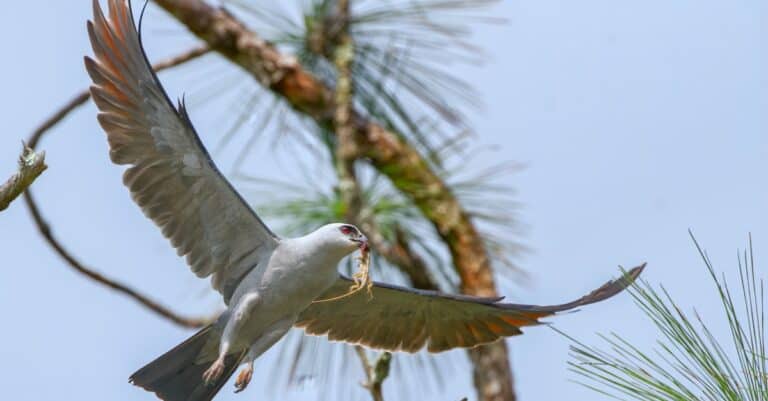
Mississippi kites will take up residence in elm, oak, mesquite, or eastern cottonwood trees, just high enough to prevent predators from easily accessing their roost. The nest is constructed out of twigs and green leaves.

Mississippi Kite Scientific Name

The scientific name of the Mississippi kite is Ictinia mississippiensis. Ictinia, derived from the Greek word for a kite, contains only one other species, the Plumbeous kite of Central and South America. Mississippiensis is a Latinized version of the state with which it’s commonly associated.

Mississippi Kite Size, Appearance, and Behavior

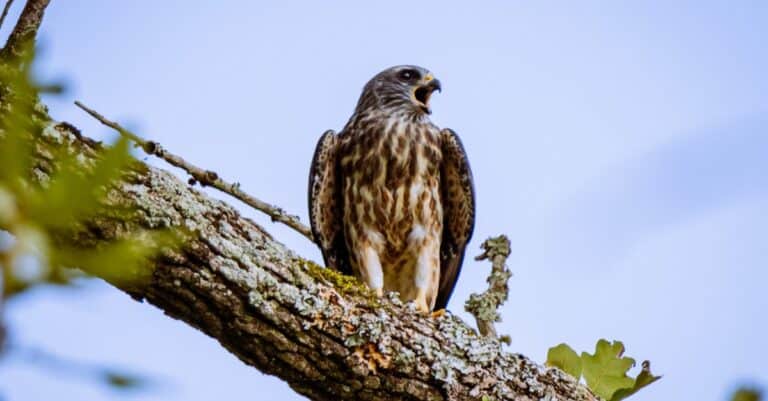
The Mississippi Kite is a slender raptor, measuring about a foot tall and weighing less than a pound. It can be identified by the subdued color pattern, including a white or light gray head and stomach, dark gray wings, and black wingtips and tail. Other prominent features include red eyes (surrounded by a circular pattern of gray feathers), a sharp gray-colored beak, and yellow talons. Males and females are fairly similar in appearance, but juveniles look very different; identification is a matter of finding the dark brown streaks along the chests and under wings, and a banded tail.

The Mississippi Kite is an excellent flyer. It spends a great deal of time in the air, gliding along updrafts, while sometimes executing incredible aerial maneuvers to catch fast-moving prey. Unlike some birds of prey, this is a highly social species that roosts together in large flocks and does not keep an individual territory. Sometimes it can be heard making a high-pitched two-note whistle-like call.
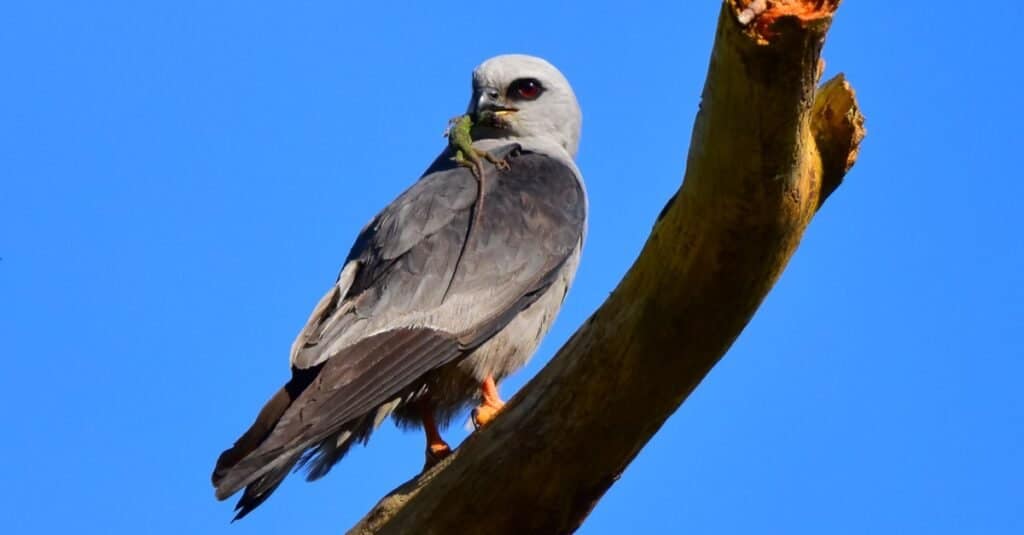
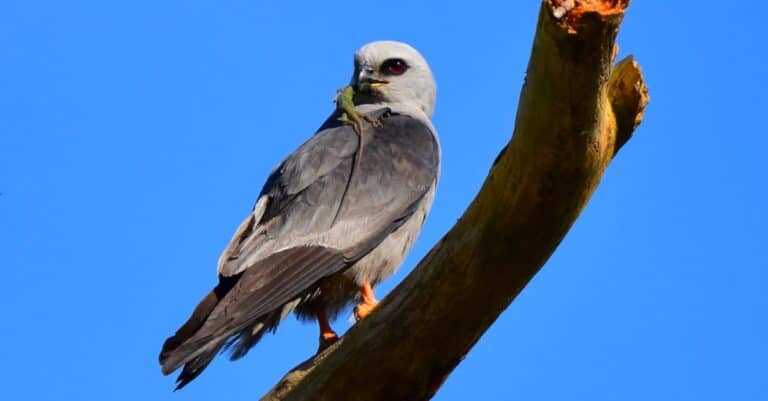
Mississippi kite (Ictinia mississippiensis) perched on tree snag with <a class=
Mississippi kite (Ictinia mississippiensis) perched on a tree snag with a green anole lizard (Anolis carolinensis) in its beak.

Migration Pattern and Timing

After the completion of the breeding season, the Mississippi kite travels south toward its Central and South America range for the winter; most of them eventually settle in Brazil and Argentina. The migration proceeds in small groups of 20 to 30 birds at a time.

Mississippi Kite Diet

These Kites are carnivorous and opportunistic birds. It consumes almost any kind of meat it can find.

What does the Mississippi kite eat?

The diet of the kite mostly consists of insects. Grasshoppers, cicadas, beetles, moths, and dragonflies are among its favorite foods. It will also supplement this with frogs, snakes, turtles, bats, rodents, and smaller birds.

Mississippi Kite Predators, Threats, and Conservation Status

These kite faces very few natural threats in the wild, but some birds do fall victim to predators, human hunters, poisoning, collisions with vehicles, and other accidents. It is currently classified by the IUCN Red List as a species of least concern. The species as a whole is protected by the Migratory Bird Treaty Act in the United States.

What eats the Mississippi kite?

An adult kite has few consistent predators, but eggs and young hatchlings are sometimes preyed upon by raccoons, snakes, crows, owls, and other birds of prey. Groups of kites will emit a loud call and mob a predator that gets too close to the nests.
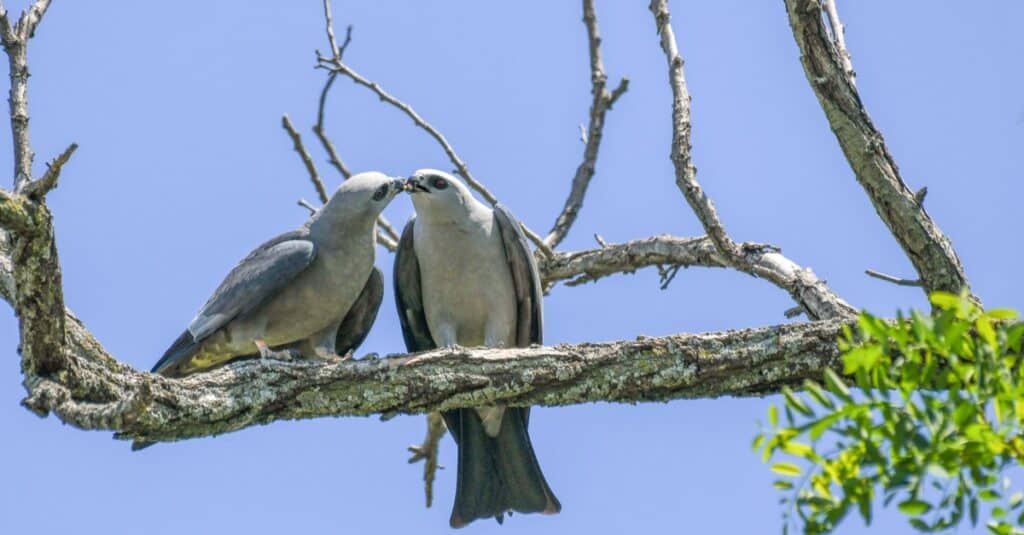
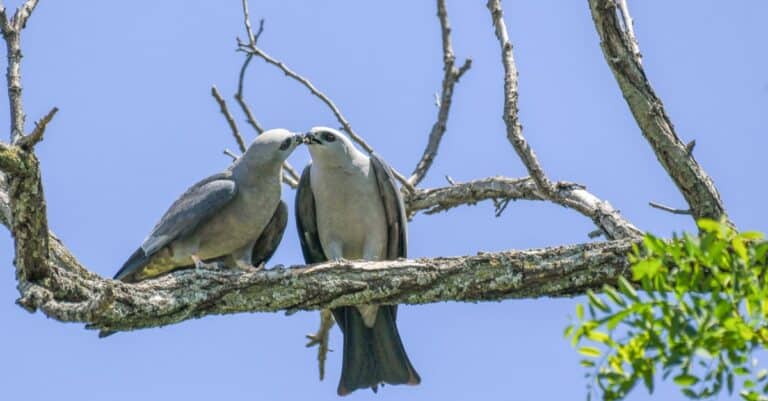
A pair of Mississippi Kite share an insect.

A pair of Mississippi Kites share an insect.

Mississippi Kite Reproduction, Young, and Molting

These kites form intimate pair bonds that generally last for life. Courtship may involve some form of aerial acrobatics, but generally doesn’t continue once the bond is established. The breeding season occurs every year between May and July and produces one or two (rarely three) eggs. During the month-long incubation period and the subsequent brooding, the parents take turns protecting, feeding, and keeping the young warm.

By the five-week mark, the youngsters have already ventured out from the nest and begun to fly. However, they will continue to be fed by the parents until about eight weeks after hatching. They are considered to be sexually mature by around one or two years of age. The lifespan of the typical kite is about eight years, but the oldest known member of the species had a lifespan of 11 years.

Mississippi Kite Population

The estimated global breeding population of these kites is around 700,000. The species was in a state of decline by the middle of the 20th century, but it has since staged a comeback and is now expanding its range throughout the United States.

View all 330 animals that start with M

Sources

  1. Animal Diversity Web / Accessed November 14, 2021
  2. Audubon / Accessed November 14, 2021
  3. The Peregrine Fund / Accessed November 14, 2021
A-Z Animals Staff

About the Author

A-Z Animals Staff

AZ Animals is a growing team of animals experts, researchers, farmers, conservationists, writers, editors, and -- of course -- pet owners who have come together to help you better understand the animal kingdom and how we interact.
Connect:

Thank you for reading! Have some feedback for us?


Mississippi Kite FAQs (Frequently Asked Questions)

Yes, it migrates south toward warmer environments after the end of the breeding season.