O
Species Profile

Onager

Equus hemionus onager

Iran's lightning-footed onager
Sergei25/Shutterstock.com

Onager Distribution

Click a location to explore more animals from that region

Endemic Species
Loading map...

Found in 1 country

Size Comparison

Human 5'8"
Onager 3 ft 7 in

Onager stands at 64% of average human height.

Onager

At a Glance

Wild Species
Also Known As Onager, Asiatic wild ass, Asian wild ass, Khur
Diet Herbivore
Activity Crepuscular+
Lifespan 15 years
Weight 260 lbs
Status Endangered
Did You Know?

Size (Asiatic wild ass data used for this subspecies where published): shoulder height ~100-140 cm; head-body length ~200-260 cm; mass ~200-290 kg (IUCN/Equid specialist references; zoological handbooks).

Scientific Classification

The onager most commonly refers to the Persian onager, a subspecies of the Asiatic wild ass (Equus hemionus), a swift, arid-land equid native to parts of Iran and historically wider regions of Southwest Asia.

Kingdom
Animalia
Phylum
Chordata
Class
Mammalia
Order
Perissodactyla
Family
Equidae
Genus
Equus
Species
Equus hemionus

Distinguishing Features

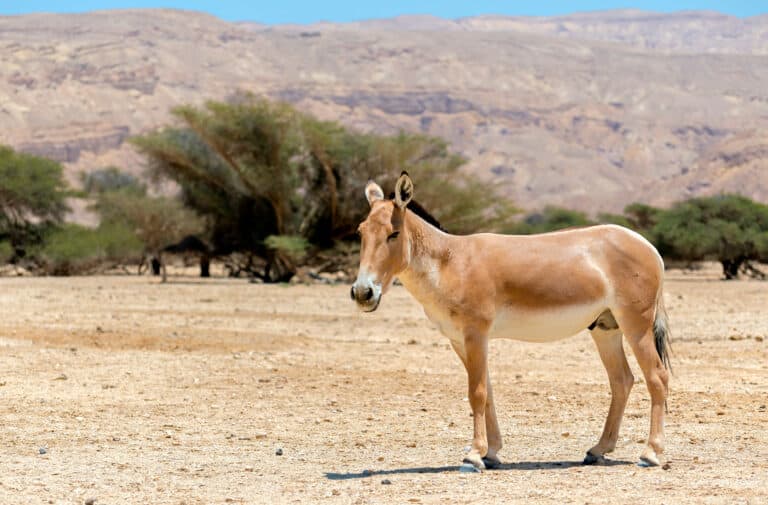
  • Slender, donkey-like equid adapted for running in open arid terrain
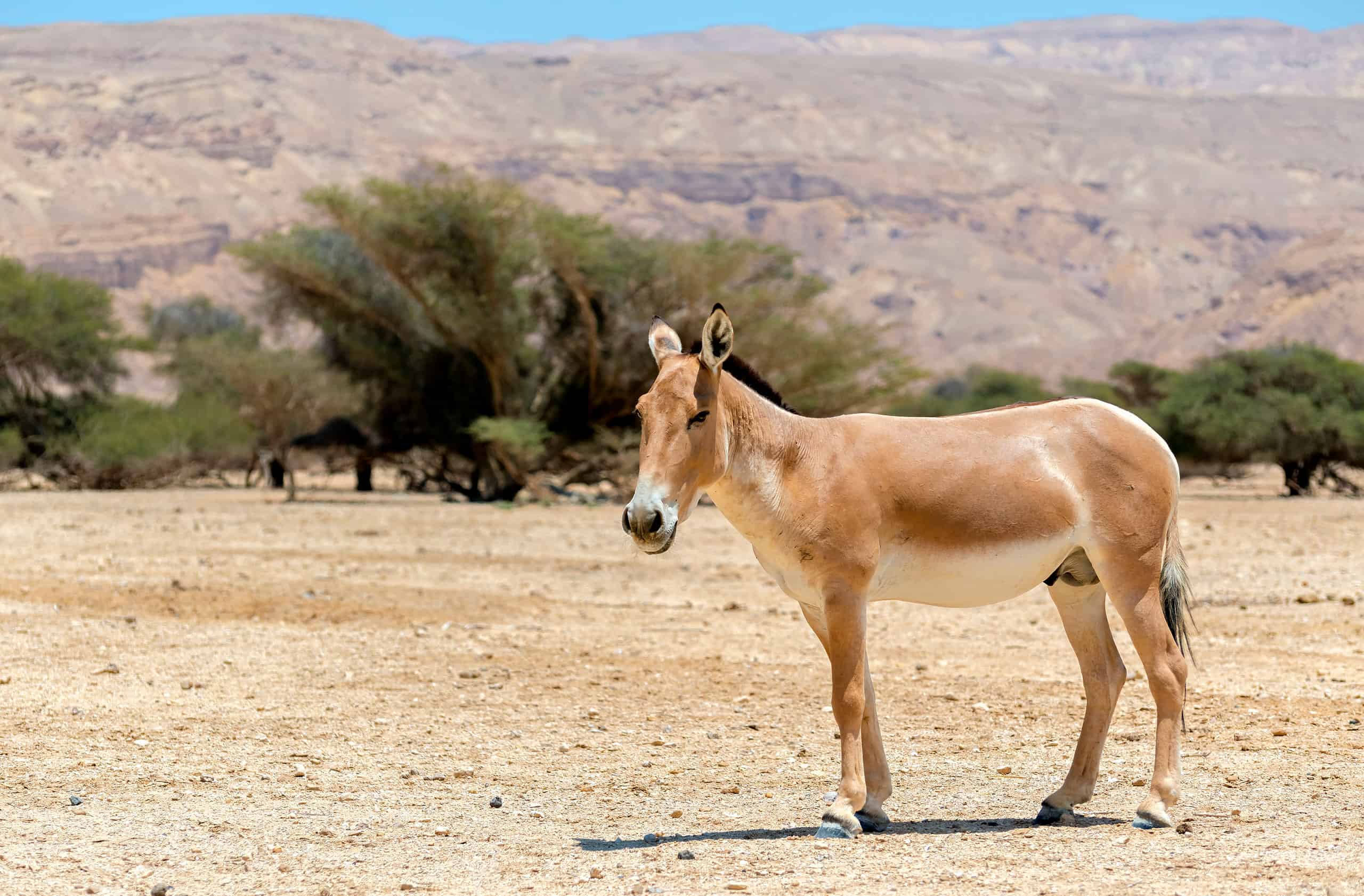
  • Typically sandy to reddish-brown coat with pale underside
  • Dark dorsal stripe; seasonal coat variation
  • Large ears; strong legs and narrow hooves suited to firm, dry ground

Physical Measurements

Males and females differ in size

Height
4 ft 1 in (3 ft 11 in – 4 ft 5 in)
3 ft 9 in (3 ft 7 in – 3 ft 11 in)
Length
1 in (1 in – 1 in)
8 ft 4 in (7 ft 10 in – 8 ft 10 in)
Weight
551 lbs (441 lbs – 639 lbs)
463 lbs (397 lbs – 529 lbs)
Tail Length
1 ft 6 in (1 ft 2 in – 1 ft 10 in)
1 ft 6 in (1 ft 4 in – 1 ft 8 in)
Top Speed
43 mph
running

Appearance

Primary Colors
Secondary Colors
Skin Type Short, dense, seasonally molting fur over thick equid skin; coarse guard hairs in winter.
Distinctive Features
  • Onager usually refers specifically to Persian onager, Equus hemionus onager, in Iran (IUCN Red List: Equus hemionus).
  • Typical external build: long-legged, slender desert equid with narrow hooves adapted to firm arid ground (Moehlman et al., 2008).
  • Diagnostic markings: dark mid-dorsal stripe from mane to tail; short, upright mane; dark tail tuft (Moehlman et al., 2008).
  • Common facial contrast: pale to white muzzle and eye rings against darker head; large ears prominent in profile (Moehlman et al., 2008).
  • Reported size for onager/Asiatic wild ass complex: shoulder height ~100-140 cm; head-body length ~200-250 cm; mass ~200-260 kg (Moehlman et al., 2008; IUCN Red List: Equus hemionus).
  • Lifespan reported for Asiatic wild asses: ~14 years in the wild; up to ~26 years in captivity (Moehlman et al., 2008).
  • Typical social behavior: small, fluid groups; seasonal movements tracking forage and water in arid-steppe/desert landscapes (Moehlman et al., 2008; IUCN Red List: Equus hemionus).
  • Conservation context in Iran: Persian onager populations are highly threatened locally; the species Equus hemionus is listed as Near Threatened on the IUCN Red List.

Sexual Dimorphism

Sexual dimorphism is subtle. Adult males average slightly larger and more robust, with thicker necks and more pronounced head/neck musculature; females tend to be slightly smaller and more gracile (Moehlman et al., 2008).

  • Slightly greater overall body mass and shoulder height on average (Moehlman et al., 2008).
  • Thicker neck and more robust shoulder/forequarter musculature in adults.
  • May show more prominent crest along the short upright mane.
  • Slightly smaller, more slender body profile on average (Moehlman et al., 2008).
  • Neck and forequarters typically less robust than males.
  • Overall coloration and dorsal stripe pattern generally similar to males.

Did You Know?

Size (Asiatic wild ass data used for this subspecies where published): shoulder height ~100-140 cm; head-body length ~200-260 cm; mass ~200-290 kg (IUCN/Equid specialist references; zoological handbooks).

Speed: hemiones can sprint up to ~70 km/h, an anti-predator strategy in open desert-steppe (equid field guides; large-mammal ecology texts).

Reproduction: gestation about 11-12 months (~365 days); usually a single foal; births tend to peak in spring-early summer in arid ranges (equid reproductive biology sources).

Social system: typically small, fluid groups (often 2-7) with fission-fusion dynamics; adult males may hold territories that females pass through (field studies on *E. hemionus* sociality).

Conservation: the Persian onager persists mainly in Iran in protected areas; key threats include habitat loss/fragmentation, competition with livestock for forage/water, and poaching (IUCN SSC Equid Specialist Group; Iranian conservation reports).

Unique Adaptations

  • Arid-land physiology: efficient water economy (highly concentrated urine and dry feces typical of desert-adapted equids) allows longer intervals between drinking when necessary.
  • Heat management: large ears and a short summer coat aid heat dissipation; a denser winter coat improves cold tolerance in continental steppe climates.
  • Hoof/leg build for hard ground: narrow, tough hooves and long legs support rapid travel over firm, stony, and sandy substrates.
  • Foraging flexibility: grazing and browsing across grasses, forbs, and shrubs enables survival through seasonal swings in plant availability on steppe and semi-desert.
  • Wide-ranging navigation: strong homing and route fidelity to water/forage patches-an advantage in landscapes with sparse, predictable resources.

Interesting Behaviors

  • Fission-fusion grouping: individuals form small, changeable parties rather than stable herds-useful where forage and water are patchy in deserts and semi-deserts.
  • Territorial males: stallions may defend areas (often centered on resources or travel routes) using dung piles, vocalizations, chasing, and ritualized displays; female groups move between male ranges.
  • Seasonal movements: local nomadic/seasonal shifts track rainfall-driven plant growth and the availability of reliable water sources.
  • Vigilance in open habitats: heads-up scanning and coordinated flight; in flat terrain, early detection plus high-speed running replaces hiding cover.
  • Dust-bathing and rolling: used for coat maintenance and ectoparasite control; commonly followed by mutual spacing/avoidance to reduce aggression.
  • Foal strategy: newborns may spend time resting while the mare forages nearby; the pair rejoins moving groups as the foal's mobility improves.

Cultural Significance

The Persian onager (Iranian wild ass, Equus hemionus onager) links to royal hunting and the Sasanian king Bahrām V ("Gur"). It stands for the wild, fast life of deserts and now is a conservation symbol for Iran's desert ecosystems.

Myths & Legends

In Persian tales (including the Shāhnāmeh), Bahrām Gur's title "Gur" comes from his love of hunting Persian onagers (Equus hemionus onager). The onager is a desert prize whose speed tests royal skill.

In the Persian tale of Bahrām Gur and Āzādeh, the king shows amazing archery while hunting Persian onagers (Iranian wild ass, Equus hemionus onager); the hunt teaches a court lesson about pride and power.

Roman cultural naming lore: Latin *onager* ("wild ass") was also the nickname for a Roman torsion catapult, likened to a wild ass's kick-an enduring historical association between the animal's reputed power and military imagery.

In Biblical and ancient Near Eastern texts, the 'wild ass' (often Asiatic wild asses) stands for untamed freedom and the harsh wilderness ruled by God, a main way Western Eurasia pictured onager-like equids.

Conservation Status

EN Endangered

Facing a very high risk of extinction in the wild.

Population Decreasing

Protected Under

  • CITES Appendix I (Equus hemionus)
  • National protection in Iran under the Iranian Department of Environment (protected wildlife; key populations occur in legally designated protected areas such as Touran and Bahram-e Gur)

Life Cycle

Birth 1 foal
Lifespan 15 years

Lifespan

In the Wild
12–20 years
In Captivity
18–30 years

Reproduction

Mating System Polygyny
Social Structure Transient
Breeding Pattern Transient
Fertilization Internal Fertilization
Birth Type Internal_fertilization

During the May-August rut, stallions defend territories/water and court passing estrous females, mating with multiple partners. Female-foal pairs form; females rear a single foal after ~11-12 months gestation; no male care and groups are temporary.

Behavior & Ecology

Social Herd Group: 6
Activity Crepuscular, Cathemeral, Diurnal
Diet Herbivore Fresh spring grasses (notably perennial steppe grasses such as Stipa spp.) when available; shifts to halophytic shrubs (Atriplex/Salsola) in dry seasons (Moehlman 2002; IUCN/SSC Equid Specialist Group species accounts for Equus hemionus).

Temperament

Highly vigilant and flight-prone; rapid retreat response to humans and predators is typical.
Stallions can be aggressive during rut, with biting/kicking and parallel threats; territoriality reported in E. hemionus subspp.
HUBS (Equus hemionus subspecies complex): fission-fusion sociality with resource-driven aggregation; activity shifts toward nocturnality in heat/drought.
Longevity reported for E. hemionus: ~14 years wild, up to ~26 years captivity (Animal Diversity Web, Equus hemionus).
Morphometrics often reported at species level; E. hemionus ranges ~97-138 cm shoulder height and ~200-290 kg mass (Nowak; ADW).

Communication

Bray-like calls used in contact and separation contexts Reported for Asiatic wild asses
Snorts/blows during alarm and vigilance escalation.
Squeals during aggressive encounters Especially stallion-stallion
Nickers/low calls between mare-foal and close-range affiliative contexts.
Dung pile latrines and fecal marking for territorial/resource signaling Notably by males
Urine marking and sniff-investigate sequences; flehmen response to reproductive cues.
Visual signals: ear position, head/neck posture, tail carriage; threat displays precede chases.
Tactile aggression: bites, neck wrestling, kicks; chases used to enforce spacing/territories.

Habitat

Biomes:
Desert Cold Desert Hot Temperate Grassland Freshwater
Terrain:
Plateau Plains Hilly Rocky Sandy
Elevation: 1640 ft 5 in – 6561 ft 8 in

Ecological Role

Large-bodied desert-steppe grazer-browser that links sparse primary production to higher trophic levels and redistributes nutrients across arid landscapes.

Regulates plant community structure by selective grazing and seasonal browsing (shifts pressure from grasses to shrubs/halophytes during drought) Nutrient cycling and soil fertilization via dung and urine concentrated around movement corridors and water points Seed dispersal/transport (endozoochory and epizoochory) for steppe/desert plants; dung provides germination microsites Creates/maintains travel paths and disturbance patches that can influence vegetation heterogeneity and access to resources for other wildlife Provides prey biomass/carrion supporting large predators and scavengers in Iranian desert-steppe ecosystems (context-dependent)

Diet Details

Other Foods:
Grasses Sedges and rushes Forbs Artemisia-dominated steppe shrubs Chenopod shrubs Desert shrubs and small trees Thorny desert legumes Roots, bulbs and other underground storage organs +2

Human Interaction

Domestication Status

Wild

Persian onager (Equus hemionus onager) is a wild subspecies, not domesticated like the donkey. Humans have hunted it for meat and hide, and livestock compete for grazing and water. It faces poaching and deaths from fences and roads. Modern efforts include protected areas, ranger protection, moving and releasing animals, and zoo breeding.

Danger Level

Moderate
  • Defensive aggression if cornered/handled: powerful kicks (hindlimb strike), bites, and strikes with forefeet-especially from adult males during breeding season or around water.
  • Handling/transport risks in captivity (stress-induced injury to handlers; need for professional chemical restraint protocols).
  • Vehicle collisions in open-range habitats/roads bordering reserves (human injury risk is indirect but real where roads intersect movement corridors).
  • Zoonotic/animal-health interface risks typical of equids at livestock boundaries (generally low to humans, but relevant for veterinary/public health management).

As a Pet

Not Suitable as Pet

Legality: Not legal or practical as a pet. The Persian onager (Equus hemionus onager) is protected; capture and private possession are banned except for government conservation or science. Export, import, and ownership usually limited to zoos or strict permits.

Care Level: Expert Only

Purchase Cost: $10,000 - $50,000
Lifetime Cost: $150,000 - $600,000

Economic Value

Uses:
Conservation (flagship species for arid rangeland protection) Ecotourism and protected-area visitation Scientific research (movement ecology, arid-land adaptation, genetics) Captive breeding/display in accredited zoos Historical subsistence use (meat/hide) where hunted (now illegal in most contexts)
Products:
  • non-consumptive value: tourism/recreation associated with protected areas
  • conservation funding leverage (flagship/umbrella role)
  • research outputs (genetic samples, telemetry datasets) under permit
  • no legitimate commercial animal products (trade is generally prohibited/restricted)

Relationships

Predators 4

Gray wolf
Gray wolf Canis lupus
Persian leopard Panthera pardus saxicolor
Striped hyena
Striped hyena Hyaena hyaena
Asiatic cheetah Acinonyx jubatus venaticus

Related Species 8

Asiatic wild ass
Asiatic wild ass Equus hemionus Shared Species
Mongolian wild ass Equus hemionus hemionus Shared Species
Turkmen kulan Equus hemionus kulan Shared Species
Indian wild ass Equus hemionus khur Shared Species
Kiang
Kiang Equus kiang Shared Genus
African wild ass Equus africanus Shared Genus
Domestic donkey
Domestic donkey Equus asinus Shared Genus
Plains zebra Equus quagga Shared Genus

Ecological Equivalents 5

Animals that fill a similar ecological role in their ecosystem

Kiang
Kiang Equus kiang A large, wide-ranging steppe equid of arid to semiarid areas that forms fission–fusion groups, is primarily a mixed feeder that mainly grazes, escapes predators by fast running, and requires open habitat to detect predators.
Turkmen kulan Equus hemionus kulan Very similar niche and behavior to other E. hemionus subspecies in desert/steppe mosaics: long movements between food and water, seasonal shifts from grasses to shrubs, and social structure of solitary/territorial males and groups of females.
Goitered gazelle Gazella subgutturosa Shares Iranian steppe and desert habitats and resource use: occupies open arid plains and seasonal temporary pastures and has a mixed diet of grasses, forbs, and shrubs; avoids predators by staying alert and fleeing quickly, acting as a counterpart to smaller desert ungulates.
Urial
Urial Ovis vignei Uses the same arid and semi-arid rangelands, grazing and browsing on sparse steppe plants. Prefers more broken, hilly ground but is also dependent on rangelands and sensitive to drought, low water availability, and competition with livestock.
Tibetan wild ass Equus kiang When treated as part of the hemionus group, the Persian onager is a similar steppe equid: a wide-ranging, group-living grazer of open lands that avoids predators by speed and early detection. Included as an ecological analogue despite taxonomic debate.

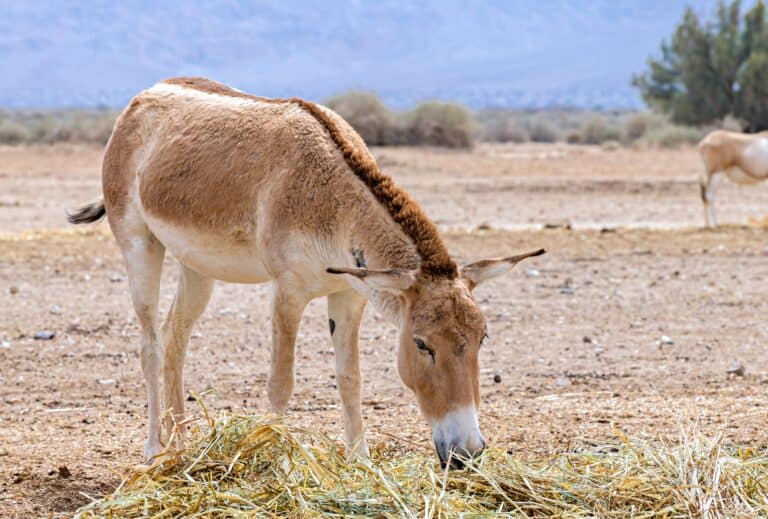
An onager’s coat changes color with the season.

Facts

  • Endangered: Onagers are an endangered species of equines. Only 28,ooo exist in the world today.
  • Almost extinct: Only 600-700 Persian onagers are left in the wild today.
  • Good memory: Onagers are very intelligent animals. They have a great memory and can recall the face of someone they met 25 years prior, so make sure you’re nice to them.
  • Free-spirited souls: The task of domesticating onagers was “abandoned” many years ago when humans found it easier to tame horses and donkeys.
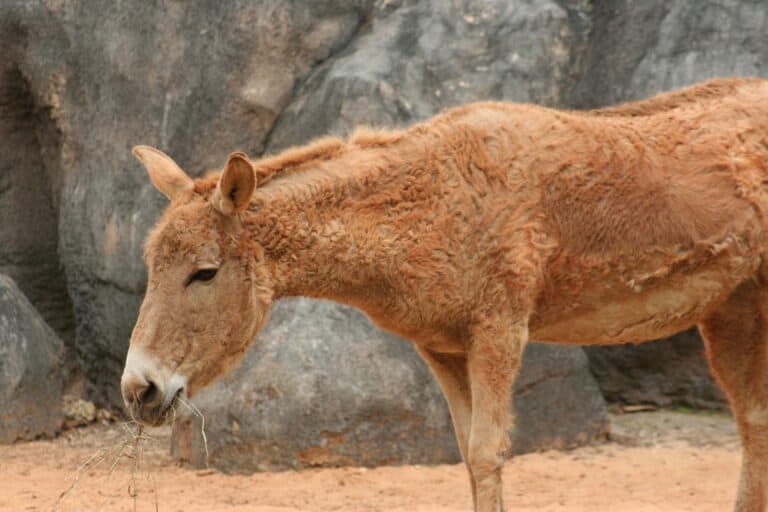
  • Winter coat: Onagers are adaptable to weather changes. In times of extreme cold, they can grow a curly, dense coat for the winter.

Onager Summary

If you are a keen reader of historic texts and literature, you might have come across the mention of the onager. Previously used as beasts of burden, onagers were once domesticated, but now, they live in the wild. They bear a remarkable resemblance to donkeys, and it would take a trained eye to tell them apart. Two subspecies of the onager are extinct and the species is near threatened.

Onager Scientific Name

Onager is a name that comes from the Greek words onos meaning “donkey” and agrios meaning “wild.” Scientifically, the onager is known as Equus hemionus. The generic name Equus is Latin for “horse” while the specific name is a compound word derived from Greek hemi and onos meaning “half donkey.” Onagers are also called hemiones or the Asiatic wild ass.

Members of the genus Equus are odd-toed ungulates, which refers to animals with hoofs, and they have oval-shaped hoofs. Other animals that belong to this genus are horses and zebras.

The onager consists of five subspecies with the Mongolian wild ass as the nominate subspecies.

  • Mongolian wild ass (E. h. hemionus) – the nominate subspecies
  • Syrian wild ass (E. h. hemippus)
  • Persian onager (E. h. onager)
  • Indian wild ass (E. h. khur)
  • Turkmenian kulan (E. h. kulan)
  • European wild ass (E. h. hydruntinus)

The European wild ass and the Syrian wild ass are both extinct subspecies. The name Onager is commonly used only for the Persian onager whose subspecific name is onager, but it is actually the name of the entire species.

Onager Evolution and History

Onagers belong to the genus Equus which houses every living equine. The oldest known equine fossil found in Idaho comes from Equus simplicidens and is described as resembling a zebra but with the head structure of a donkey. Onagers have existed for over four million years, being among the oldest Equus species to diverge from their most recent common ancestor followed by the African zebra.

Many ancient literary works mention onagers. They were domesticated thousands of years ago and originally used as beasts of burden. However, human beings never managed to completely tame these wild creatures and so they were replaced by the horse, donkey, and mule.

Onager Appearance
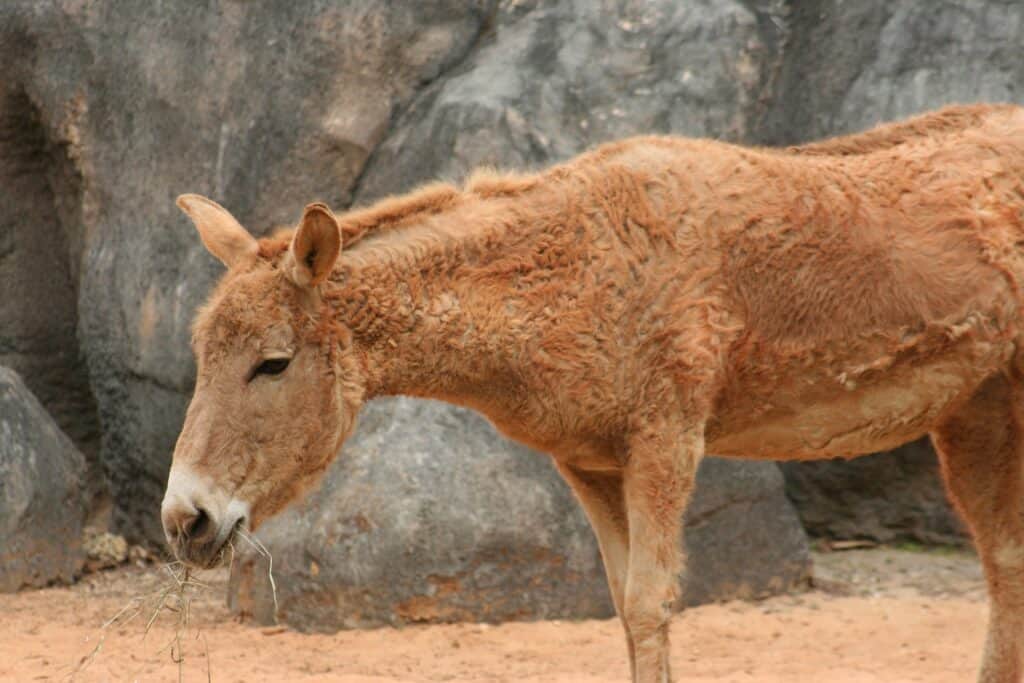
Persian Onager

Onagers are adaptable to weather changes. In times of extreme cold, they can grow a curly, dense coat for the winter.

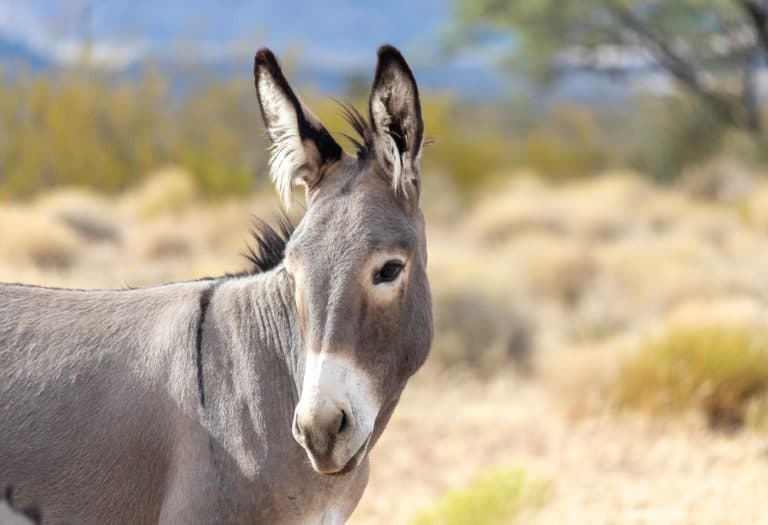
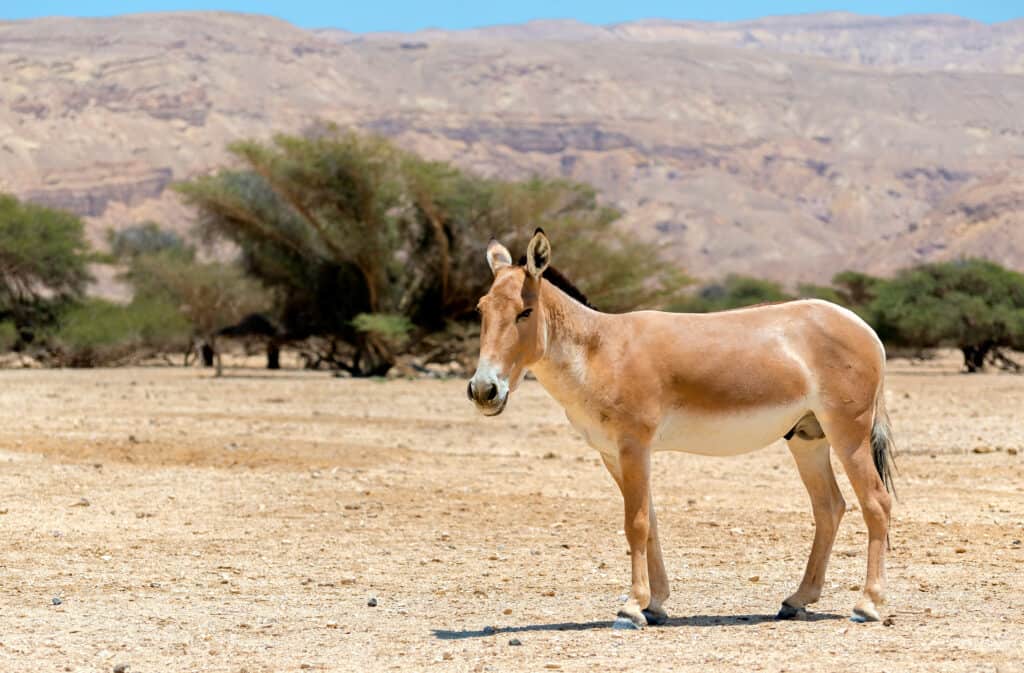
Onagers are a species of wild asses. They have a short mane, large ears, and pale hair that changes color depending on the season. In the summer, they become reddish-brown, and this changes to yellowish or grayish-brown in the winter. The onager’s winter coat gets longer and coarser as well.

Commonly misidentified with donkeys, onagers are much larger than donkeys. They weigh up to 440 to 640 pounds and are 6.9 to 8.2 feet in length and 4.9 feet at the shoulder. Also, onagers look more horse-like than donkeys. Another distinguishing feature between donkeys and onagers is a black stripe with a white border that runs down the middle of the onager’s back. Onagers have white rumps, bellies, and muzzles.

Onager Behavior

Onagers are crepuscular animals with activity levels peaking during dusk and early in the morning at dawn when the weather is cooler and lowering when the sun is out.

Although onagers can get their required daily amount of water from their food alone, they prefer to live near a reliable water source. This comes in handy, especially for lactating mothers who need a consistent supply of water. Onagers are a migrating species and make large migratory hikes that cover up to 15 square miles annually.

Onagers are also very social animals that practice polygamy. They live in groups of about 10 to 12 members. The group usually includes a male onager (jack), a group of females (jennets), and their offspring. Onagers tend to form much bigger groups during fall and winter when and where resources are abundant and this herd can swell to sizes of 300 to 1,200 individuals. This herd is not uniform and is made up of several autonomous groups that break off after a short while in the herd. Older jacks are usually solitary.

When threatened by a predator, onagers defend themselves as most equids do and work together to kick powerfully at their assailant and chase them away.

When it comes to their relationship with people, this species is infamously difficult to tame. They are quite a stubborn species.

Onager Diet

Onagers are herbivorous and folivorous animals. Their diet consists primarily of perennial grasses, and they also forage for herbs, fruit, leaves, and, in more arid climes, trees and shrubs. They are also known to feed on tree bark.

Onagers tend to live very close to water bodies. When water is lacking, they dig holes into dry riverbeds to reach water near the surface. In the colder months, onagers have been seen eating snow as a source of water. They get their required liquid intake from the food they consume.

Onager Habitat and Population

Onagers live in arid, temperate, and cold regions of Asian countries including China, Iran, Uzbekistan, Turkmenistan, India, Mongolia, and Israel. These equids inhabit grasslands, shrublands, desert plains, oases, steppes, mountain steppes, and the savanna.

The onager subspecies prefer to reside in different habitats. You can find this Mongolian wild ass in the deserts and grasslands of Mongolia and northern China. They are the most widespread onager subspecies, but their population is dwindling due to poaching and habitat loss. They are extinct now in Kazakhstan and some regions in China and Siberia.

As its name suggests, the Indian wild ass inhabited the arid regions and desert steppes of northwest India and Pakistan. However, now, 4,500 individuals are located in Gujarat, living in wildlife sanctuaries.

The Turkmenian kulan prefers to live in cold and hot deserts. You can find this subspecies in Turkmenistan and returning to Uzbekistan and Kazakhstan through reintroduction.

The rare Persian onager likes to reside in desert and semidesert regions of Turkmenistan and northeastern Iran. This subspecies was decimated by the loss of habitat, resource competition with domestic livestock, and poaching. About 600 to 700 government-protected Persian onagers are left in the wild and less than 100 in captivity worldwide.

According to the IUCN Red List of Threatened Species, the Persian onager is an endangered species with only about 790 individuals in total remaining. The onager species is Near Threatened on the protection list with only about 28,000 onagers worldwide. The onager species is currently extinct in Jordan, Syria, some parts of Siberia, Saudi Arabia, Iraq, and Palestine.

Onager Reproduction and Lifespan

Onagers reach sexual maturity at two years old but they don’t typically start mating until they reach three to four years of age. These animals practice polygyny, where one male mates with multiple females in one season. They do this in two main ways. Firstly, dominant onager males typically guard territories that are abundant in resources such as food and water. Then, the females wander between these guarded areas to mate with them. In the other mating method, a dominant male mates with the females in his harem and breeds with them.

Mating season takes place from April through to September, peaking in the summer months of June and July. Gestation usually lasts 11 months and the female onager gives birth for a bit over ten minutes to usually one foal. Onager foals are precocious and can stand up with little to no help and nurse just 15 to 20 minutes after given birth to. These foals reach full independent age at one to two years of age.

Onagers can live a plentiful life of 14 years in the wild and up to 26 years in captivity.

Onager Predators and Threats

Equids such as onagers usually have a long list of natural predators that hunt them. The onagers in Iran are prey to Persian leopards and striped hyenas. In India, mugger crocodiles are on the hunt for migratory onagers. Asiatic lions, tigers, Asiatic cheetahs, and bears also prey on them. Presently, gray wolves are the primary predator of onagers.

Apart from predation, onagers also face the following threats:

  • Poaching for their meat, hide, and body parts
  • Competition with domestic livestock for resources
  • Acute separation from other members of their subspecies which can lead to adverse genetic conditions from continuous inbreeding
  • Fragmentation as a result of human encroachment into the onager’s natural habitat.

The onager is a protected species in most of the countries it inhabits and many breeding programs have been set up to ensure that the onager has a future. It is currently being reintroduced to some of its native territories.

View all 88 animals that start with O

Sources

  1. Animal Diversity / Accessed November 17, 2022
  2. Wikipedia / Accessed November 17, 2022
  3. Wikipedia / Accessed November 17, 2022
  4. Animalia / Accessed November 17, 2022
  5. Young People's Trust for the Environment / Accessed November 17, 2022
Rose Okeke

About the Author

Rose Okeke

Hi! I am a writer, actor, and filmmaker. Reading is my favorite hobby. Watching old movies and taking short naps are a close second and third. I have been writing since childhood, with a vast collection of handwritten books sealed away in a duffel bag somewhere in my room. I love fiction, especially fantasy and adventure. I recently won the James Currey Prize 2022, so now, naturally, I feel like I own words. When I was 11, I wanted to be a marine biologist because I love animals, particularly dogs, cats, and owls. I also enjoy potatoes and chocolate in all their glorious forms.
Connect:

Thank you for reading! Have some feedback for us?


Onager FAQs (Frequently Asked Questions)

Onagers may look like donkeys at first glance, but you can quickly tell them apart if you know what to look for.

Onagers are much larger than donkeys. Also, onagers look more horse-like than donkeys. Another distinguishing feature between donkeys and onagers is a black stripe bordered by white that runs down the middle of the onager’s back. Onagers have white rumps, bellies, and muzzles.