
Orchid dottybacks are very popular aquarium pets because of the splash of color and activity they add to the environment. However, these bright purple fish are also crafty predators. They camouflage themselves in order to capture prey and manage to still look cute while doing it.
Amazing Facts About the Orchid Dottyback
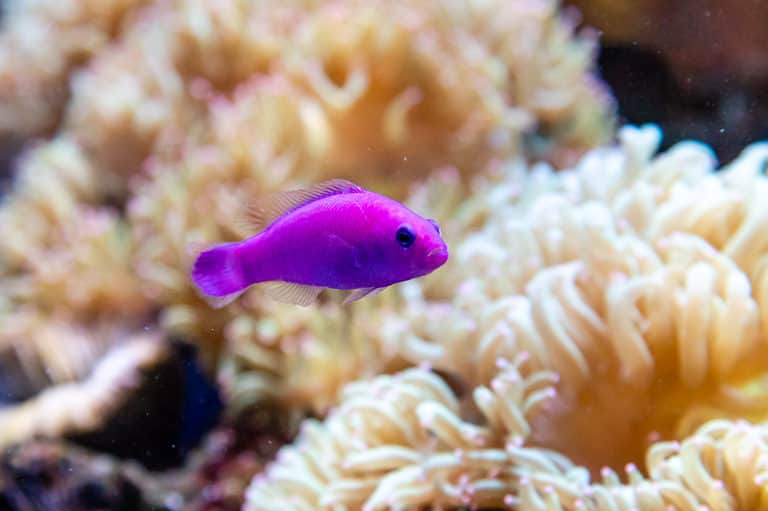
- The orchid dottyback is a brilliantly purple fish. They are sought after by aquarium owners to spruce up their tank’s appearance.
- The orchid dottybacks, generic name Pseudochromis, means false color, because the fish has the ability to mimic the colors of its background and the colors of its prey.
- The orchid dottyback disguises itself as its prey’s parents to trick the fish into becoming prey itself. This method is so successful that the juvenile fish have started catching on to the trick. When this occurs, the dottyback usually relocates to a new environment to continue its trade.
- The orchid dottyback uses its obscuring talents to hide from predators by camouflaging as its background.
- Unlike some other aquatic creatures that can change their colors on a whim, orchid dottybacks cannot. Their transformations can take several days to complete.
Orchid Dottybacks as Pets
- Orchid dottybacks are very tiny fish. They grow up to three inches in length.
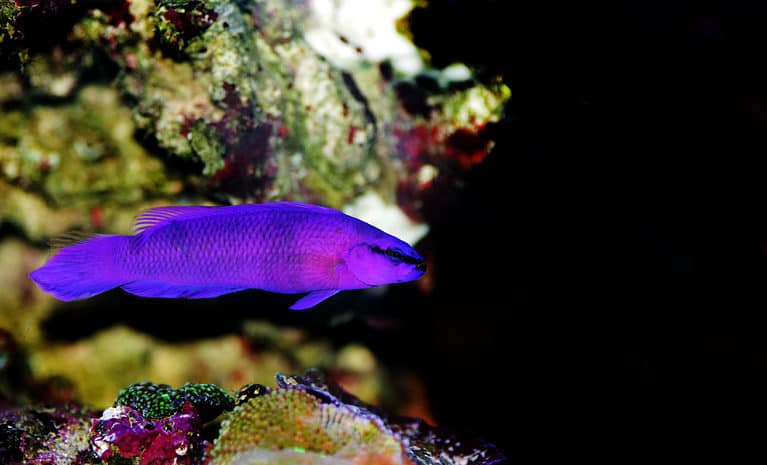
- Orchid dottybacks are usually confused with purple dottybacks, which look almost exactly the same. The only difference is that orchids have a black stripe that runs from their head to their eye.
- The orchid dottyback is a protogynous hermaphrodite. This means that they are born with the sexual organs of both female and male and can choose which one to become. These fish are initially born female. The more dominant fish within a group usually becomes the male.
- Orchid dottybacks are a great starter fish for beginner owners. They are not difficult to maintain, and they are opportunistic feeders.
- Orchid dottybacks are an aggressive species and should only be introduced in a tank last and not first. They are very territorial animals and do not like home invaders.
Classification and Scientific Name
The orchid dottyback belongs to the genus Pseudochromis and is classified as Pseudochromis fridmani. It is also a member of the famed dottyback family, Pseudochromidae. The generic name Pseudochromis is derived from two Greek words, pseudes meaning “false” and chromo meaning “color.” This is a nod to the abilities of the dottyback fish to mimic the appearance of its prey to increase the success of catching it. The specific name fridmani is to honor David Fridman, the man who collected the specimen in Israel.
These fish are called dottybacks because of the colorful spots and patterns on their bodies. The orchid dottyback is also called Fridman’s dottyback or Fridman’s pseudochromis.
Evolution and History
Orchid dottybacks belong to the class of ray-finned fishes, Actinopterygii, which comprises over 50% of all vertebrate species alive.
The earliest fossil record of an Actinopterygian species was found to date back to the Late Silurian Period, over 420 million years ago, and belongs to Andreolepis hedei. Its remains have been discovered in Sweden, Estonia, and Russia.
The dottyback order, Pseudochromidae, is distinguishable from other fish families by the spines in their dorsal fins, which number three or fewer, and also by their partial lateral line organ.
Dottybacks also possess special cells that enable them to camouflage themselves by changing their coloration. These cells are known as chromatophores, and they contain pigment sacs. When the fish pulls on these sacs with the use of small radial muscles, they can expand and contract the pigment, thereby changing its color. They use this feature of theirs to hide from predators, and also to entrap other fish as prey by pretending to be one of them.
Appearance
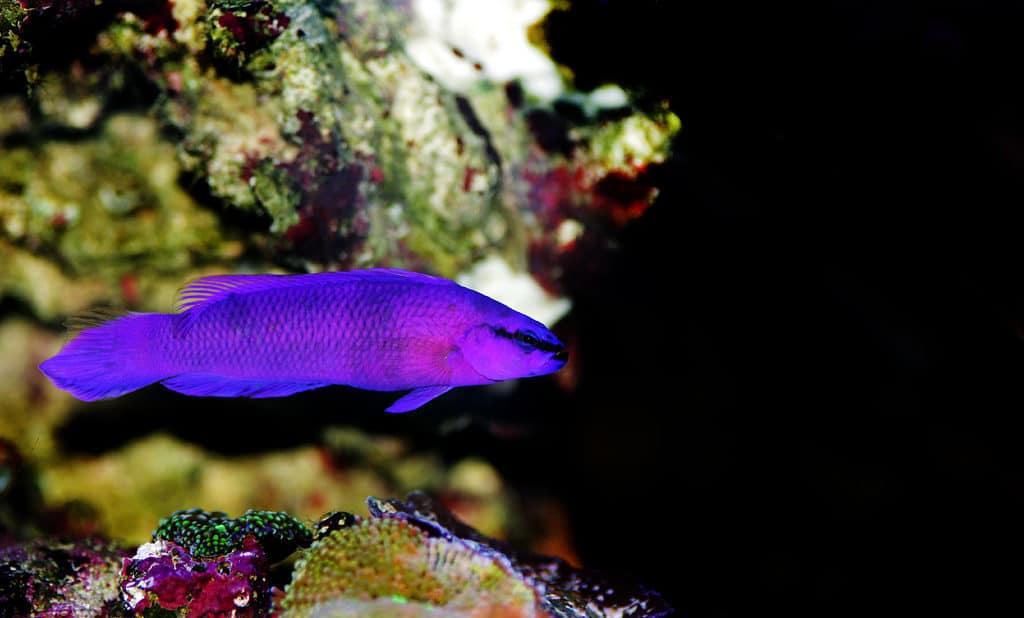
Unlike some other aquatic creatures that can change their colors on a whim, orchid dottybacks cannot. Their transformations can take several days to complete.
©Vojce/Shutterstock.com
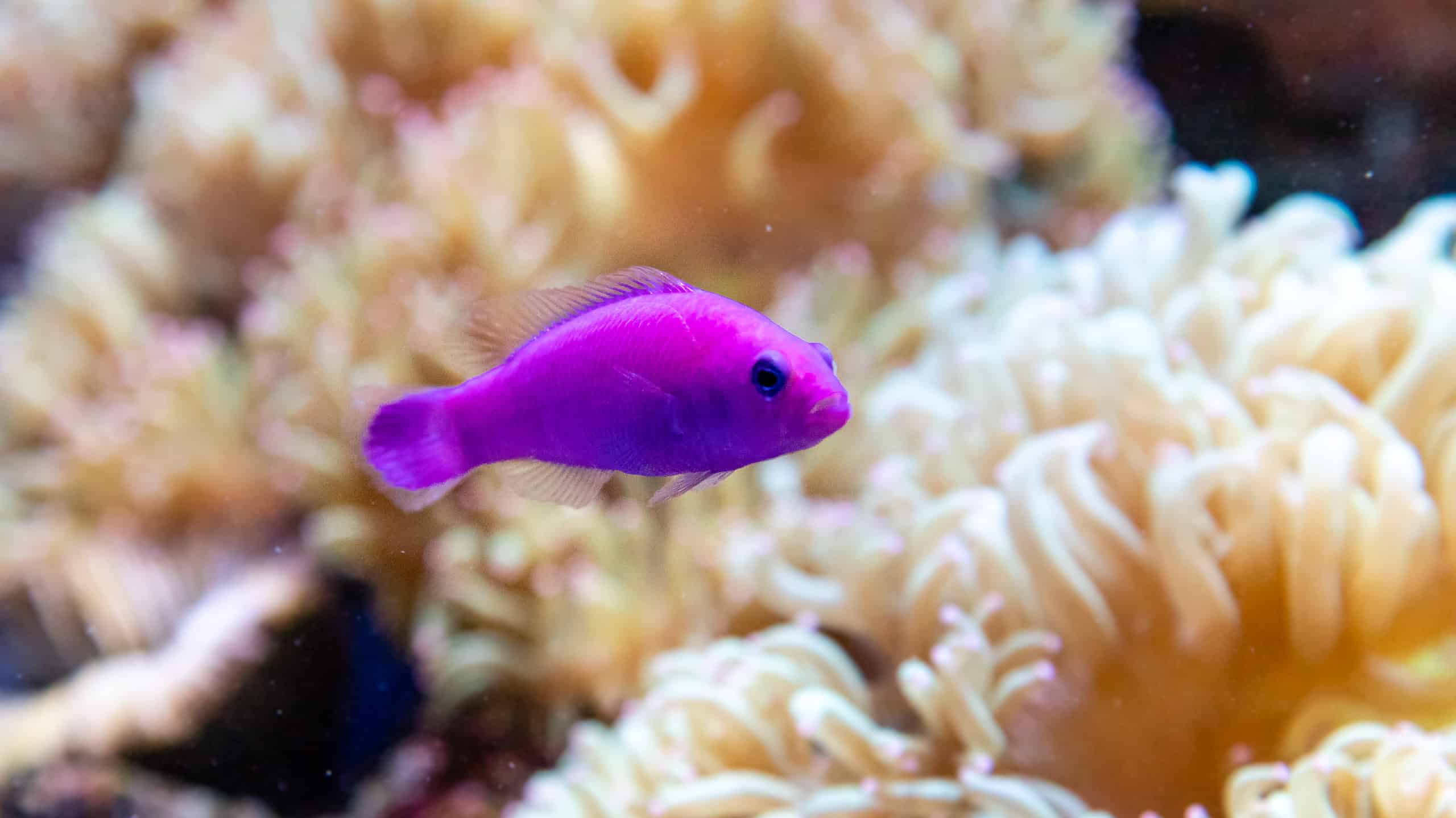
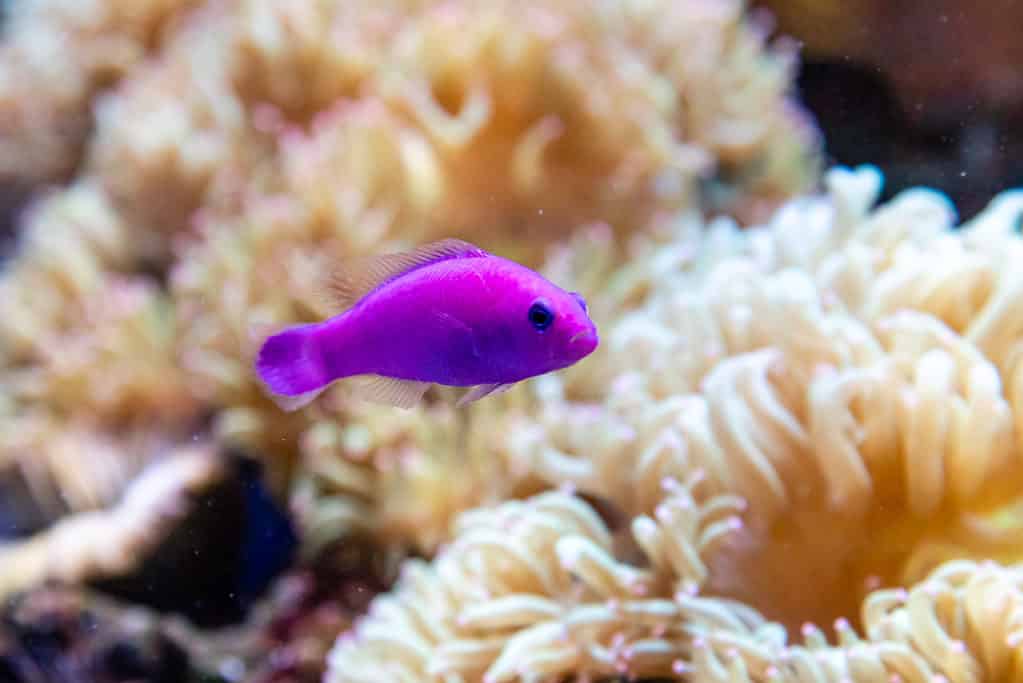
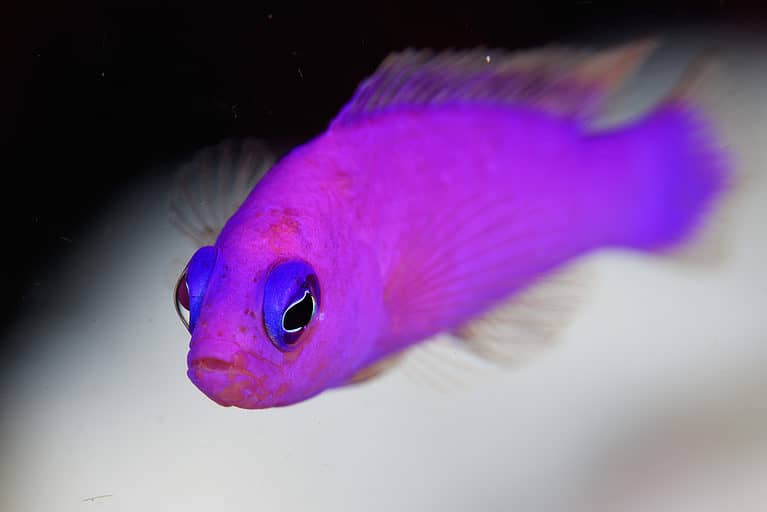
The orchid dottyback is a beautiful, vivid purple saltwater fish. It is often mistaken for the purple dottyback fish (Pseudochromis porphyreus), which is also a bright purple color. However, the orchid dottyback can be identified by the black stripe that runs across its head and over its eyes. The orchid dottyback is a tiny fish, measuring from 2.7 to 3 inches long.
The coolest thing about orchid dottybacks is that they have the power of mimicry. Just like other members of Pseudochromidae, the orchid can change its color due to the chromatophores it possesses. Chromatophores are skin cells that contain pigment and reflect light. This gives the fish the ability to steadily modify their coloration.
Orchid dottybacks have no sexual dimorphism. They all look the same, especially at a young age. When they are mature, the females tend to have bigger bellies and can be a bit stockier as opposed to the more slender bodies of the males.
Behavior
The orchid dottyback is a small, unassuming fish, but beneath their flashy exterior exists a cunning master of disguise. Dottybacks are one of many species of the dottyback family Pseudochromidae that are known to mimic the appearance of their prey. Orchid dottybacks possess chromatophores, or pigmented cells on their scaly bodies that reflect light and allow them to manipulate their coloration. By doing this, they mimic the appearance of their main prey’s parents.
Orchid dottybacks prey on juvenile damselfish by pretending to be their parents, and it works! Scientists who studied the behavior of these purple tricksters discovered that when the dottybacks mimicked the damselfish, they were three times as successful in catching their prey. Sometimes, they even travel with schools of damselfish for easy access to prey.
The only downside to their neat trick is that, unlike some other camouflaging marine creatures like squids, the dottybacks cannot change their colors instantly. It usually takes them many days to do so.
Fridman’s dottybacks also use their obscuring talents to hide from their predators by camouflaging as their background. It has been observed that dottybacks would usually rather disguise themselves as damselfish to hunt prey than disguise themselves as their background to hide from predators. It is clear where their priorities lie.
Orchid Dottybacks as Pets
Orchid dottybacks are great starter fish for beginner fish owners. They are a hardy species, and feeding them isn’t an issue since they eat just about anything. However, these fish are very territorial and can get aggressive with their space. Adding new fish to an aquarium with existing dottybacks may lead to bullying, so dottybacks are best added later to an already occupied tank.
Orchid dottybacks should be kept in a lidded tank as well because they are very active and love to jump. They can become quite accustomed to their owners and are known to follow them around in the tank when they pass by.
What do Orchid Dottybacks Eat?
Orchid dottybacks are rapacious predators for their small size. In the wild, they mostly prey on other smaller fish, primarily juvenile damselfish.
Orchid dottybacks are very opportunistic eaters. In captivity, they will eat just about anything presented to them. They especially love meaty food items such as brine shrimp, frozen mysis shrimp, plankton, and live worms. They will also eat fish flakes.
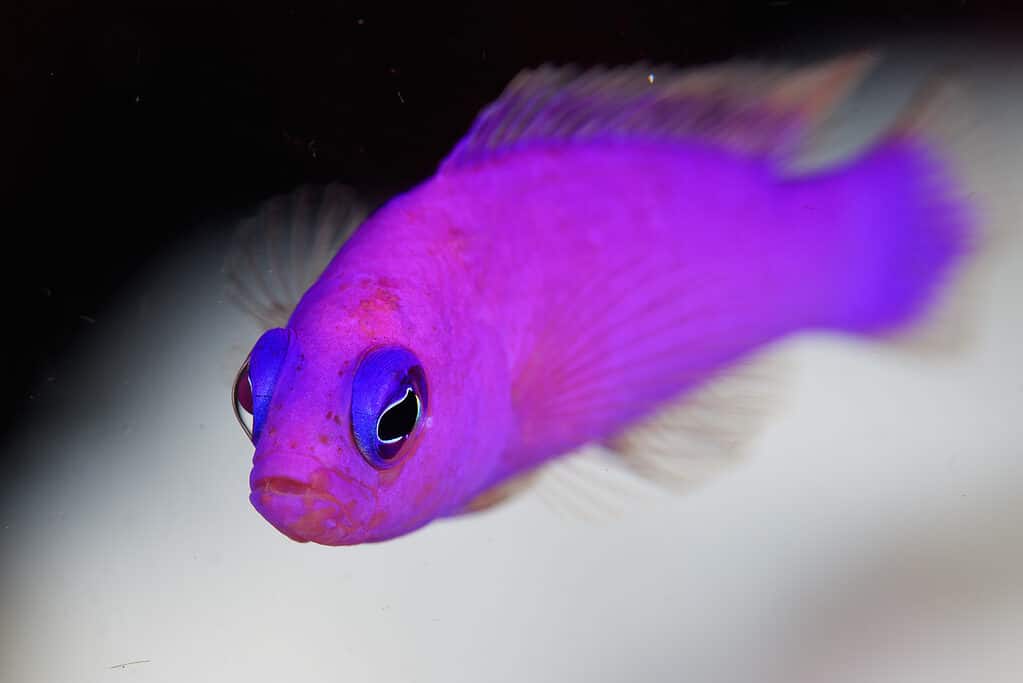
The orchid dottyback is a brilliantly purple fish. They are sought after by aquarium owners to spruce up their tank’s appearance.
©SergeiUWPhoto/Shutterstock.com
Habitat and Population
The orchid dottyback is native to the Red Sea. The Red Sea is renowned for its salty water, which is perfect for the dottyback. It prefers tropical water and loves to make its home in coral reefs, holes, crevices, and regions with abundant rocks. This dottyback lives in fairly shallow waters of up to 196.9 feet in depth.
The orchid dottyback is also very popular as an aquarium pet. They used to be expensive to obtain from their native region, but the appearance of breeders and aquarists helped lower the cost for pet owners.
The exact population of the orchid dottyback is unknown, but the species is listed as Least Concern on the IUCN Red List of Threatened Species.
Reproduction and Lifespan
The orchid dottyback is a protogynous hermaphrodite. This means that they are born with the sexual organs of both female and male and can choose which one to become. These fish are initially born female. The larger fish within a group would become the male.
The sexual dimorphism in the Pseudochromis fridmani species is low. It is almost impossible to tell the males and females apart. At times, mature females have full bellies, slimmer males, but this isn’t in stone.
Orchid dottybacks mate several times. The process starts when the male performs a mating dance outside his shelter to convince the female to enter. When she eventually does, she will lay up to 1,000 eggs. The male dottyback watches over the eggs until they hatch into babies called fry. They repeat the spawning process each week.
Orchid dottybacks can live five to seven years in captivity and possibly even longer when taken care of properly.
Predators and Threats
Orchid dottybacks are small fish and, as such, are prey to larger marine animals such as eels, triggers, and lionfish. They might also be prone to saltwater fish diseases such as dropsy, marine ich, black ich, and ammonia poisoning.
Orchid Dottyback Pictures
View all of our Orchid Dottyback pictures in the gallery.

SergeiUWPhoto/Shutterstock.com
Sources
- Current Biology / Accessed December 14, 2022
- Wikipedia / Accessed December 14, 2022
- Wikipedia / Accessed December 14, 2022
- Wikipedia / Accessed December 14, 2022
- reefapp / Accessed December 14, 2022