
S
Species Profile

Spotted Skunk

Spilogale

Small skunk, big attitude.
Holly Kuchera/Shutterstock.com

Spotted Skunk Distribution

Click a location to explore more animals from that region

Loading map...

Size Comparison

Human 5'8"
Spotted Skunk 6 in

Spotted Skunk stands at 8% of average human height.

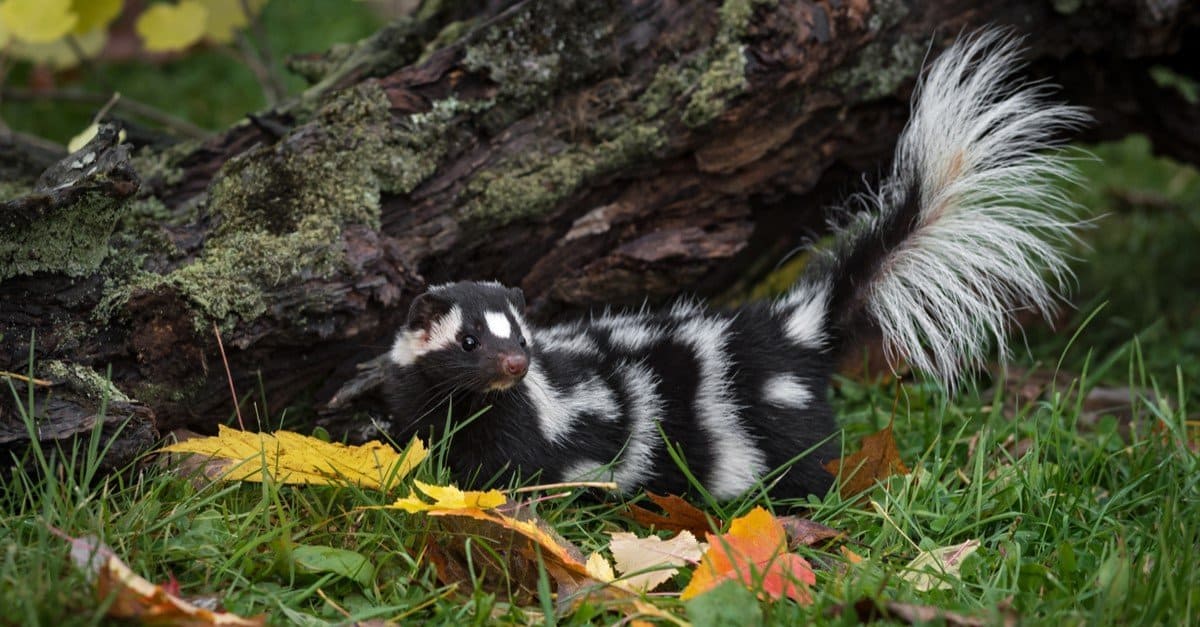
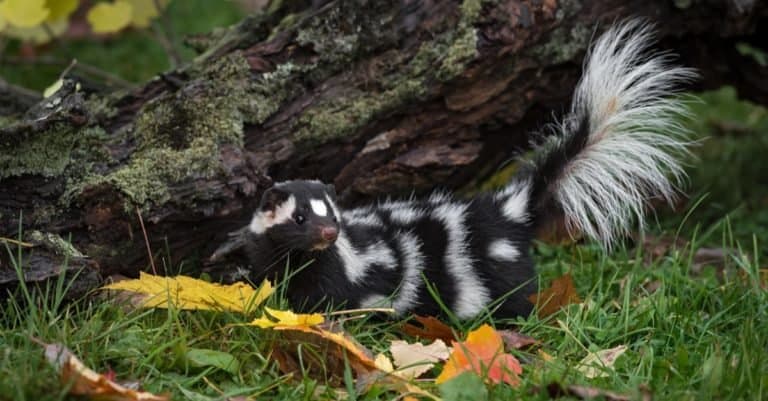
Eastern Spotted Skunk (Spilogale putorius) tail lifted near log.

At a Glance

Genus Overview This page covers the Spotted Skunk genus as a group. Stats below are general traits shared across the genus.
Also Known As dancing skunk, polecat, skunk, zorrillo pintado, zorrillo moteado
Diet Omnivore
Activity Nocturnal+
Lifespan 3 years
Weight 1.1 lbs
Status Not Evaluated
Did You Know?

Spotted skunks (Spilogale) are generally smaller and more agile than striped skunks (Mephitis), with broken stripes that form spots and patches.

Scientific Classification

Genus Overview "Spotted Skunk" is not a single species but represents an entire genus containing multiple species.

Spotted skunks are small mephitids (skunk family) in the genus Spilogale, distinguished from striped skunks by broken stripes/spot-like white markings and a frequent “handstand” defensive display before spraying. They are omnivorous nocturnal mammals that forage for insects, small vertebrates, fruit, and other plant material.

Kingdom
Animalia
Phylum
Chordata
Class
Mammalia
Order
Carnivora
Family
Mephitidae
Genus
Spilogale

Distinguishing Features

  • Black coat with white spots/broken stripes (more fragmented than in striped skunks)
  • Smaller body size than striped skunks (Mephitis spp.)
  • Defensive handstand or foreleg-stand display often shown before spraying
  • Nocturnal, secretive behavior; uses dens in rock crevices, burrows, hollow logs, or buildings

Physical Measurements

Males and females differ in size

Height
6 in (4 in – 7 in)
Length
1 ft 6 in (12 in – 1 ft 9 in)
1 ft 2 in (11 in – 1 ft 5 in)
Weight
2 lbs (0 lbs – 2 lbs)
1 lbs (0 lbs – 2 lbs)
Tail Length
7 in (4 in – 9 in)
6 in (4 in – 7 in)
Top Speed
15 mph
running

Appearance

Primary Colors
Secondary Colors
Skin Type Short, dense mammalian fur with a plush undercoat; moderately bushy tail; well-developed anal scent glands.
Distinctive Features
  • Genus-wide size range (smallest to largest species): head-body ~12-35 cm; tail ~9-20 cm; mass ~0.2-1.1 kg.
  • Lifespan across the genus: typically ~2-4 years in the wild; up to ~8-10 years documented in captivity.
  • Compared with striped skunks (Mephitis): smaller-bodied with broken/spotty white markings rather than long continuous stripes.
  • Often performs a distinctive defensive "handstand"/hind-end display before spraying; intensity and frequency vary by species and context.
  • Nocturnal/crepuscular, mostly solitary foragers; diet broadly omnivorous (insects, small vertebrates, fruit, carrion), shifting with season and habitat.
  • Dens in rock crevices, hollow logs, burrows, or human structures; habitat use spans forests, shrublands, grasslands, and arid regions depending on species.
  • Agile climbers and capable of tight maneuvering; regional differences in habitat preference (e.g., more wooded/eastern vs more arid/western).

Sexual Dimorphism

Sexual dimorphism is generally subtle across Spilogale. Males average slightly larger/heavier with broader heads and longer bodies; females are smaller-bodied, with lactation-related changes (enlarged nipples) when breeding.

  • Slightly greater average body mass and length
  • Broader head/neck; more robust build in many populations
  • Slightly smaller average size
  • Enlarged nipples/mammary prominence during lactation

Did You Know?

Spotted skunks (Spilogale) are generally smaller and more agile than striped skunks (Mephitis), with broken stripes that form spots and patches.

Across the genus, adults range roughly ~28-54 cm total length (including tail) and about ~0.2-1.1 kg, depending on species and region.

Many spotted skunks perform a dramatic defensive "handstand" (often with tail raised and hind end aimed) before they spray.

Their diet is broadly omnivorous: insects and other invertebrates are major foods, but they also take small vertebrates, fruit, and other plant material-amounts vary by habitat and season.

Several species (notably in temperate regions) show delayed implantation, timing births to favorable spring conditions; breeding schedules vary across the genus.

They're excellent den-users, rotating among rock crevices, burrows, hollow logs, and sometimes human structures; some populations den communally in colder weather.

Unique Adaptations

  • Powerful paired anal scent glands producing a persistent, sulfur-rich spray used for defense against predators; they can aim and deliver multiple bursts.
  • Aposematic black-and-white spotting/broken striping: high-contrast patterning that functions as a warning signal, distinct from the continuous stripes typical of Mephitis.
  • Acrobatic threat behavior (handstand) that visually magnifies the animal and positions the spray apparatus toward a threat.
  • Reproductive timing flexibility in parts of the genus (delayed implantation in several species) that helps synchronize births with favorable conditions.
  • Compact, agile body plan suited to climbing, squeezing into crevices, and pursuing prey in complex ground cover.

Interesting Behaviors

  • Handstand/"stilt-walking" threat display: a conspicuous warning posture that can precede spraying; intensity varies among species and individuals.
  • Nocturnal foraging with quick, weasel-like movements: hunting insects, digging for grubs, and searching under logs/rocks.
  • Opportunistic denning: use of multiple den sites across a home range; dens may shift with weather, disturbance, or food availability.
  • Seasonal social tolerance: typically solitary, but some populations show increased den-sharing during cold periods or among females with young.
  • Food flexibility: invertebrate-heavy feeding in many areas, with more fruit/plant material taken when seasonally abundant; prey choices vary across the genus' diverse habitats (woodlands, brushlands, rocky deserts, tropical dry forests).

Cultural Significance

Spotted skunks (Spilogale) are less famous than striped skunks but appear in regional nature stories, ranch lore, and museum outreach. Known for a handstand threat display and eating insects and rodents at night. Their pelts ("civet cat") entered the fur trade.

Myths & Legends

In multiple Native American oral traditions recorded across North America, Skunk appears as a small but formidable character whose powerful scent protects it from larger animals-stories often emphasize humility, boundaries, and the consequences of arrogance.

Tale cycles found in different communities include "how Skunk got its stripes/markings," explaining the animal's distinctive black-and-white pattern as the result of a transformative event or lesson.

In Plains and woodland storytelling traditions, Skunk is sometimes portrayed as an unlikely victor who uses warning and cleverness rather than strength-reinforcing themes that even the smallest beings deserve respect and personal space.

Frontier-era folklore and naming traditions sometimes called small skunks "civet cats" or "polecats," reflecting historical associations with scent, night-roaming habits, and the fur trade rather than biological relationships.

Conservation Status

NE Not Evaluated (IUCN does not assign a single Red List category to the entire Spilogale genus; statuses vary by species)

Has not yet been evaluated against the criteria.

Population Decreasing

Protected Under

  • Legal status varies widely by country/state/province; some Spilogale populations are managed as furbearers while others receive protective listings as species of conservation concern.
  • Range-wide persistence depends heavily on protected areas, habitat conservation programs, and local hunting/trapping regulations rather than a single unified international protection framework.

You might be looking for:

Eastern Spotted Skunk

34%

Spilogale putorius

Smaller spotted skunk native to the central and eastern United States; noted for handstand threat display; conservation concern in parts of its range.

Western Spotted Skunk

34%

Spilogale gracilis

Spotted skunk of western North America; commonly referred to as “spotted skunk” in the western U.S.

Southern Spotted Skunk

18%

Spilogale angustifrons

Occurs from Mexico into Central America; often included when “spotted skunk” is used in a broader, non-U.S. context.

Pygmy Spotted Skunk

14%

Spilogale pygmaea

Small, localized species endemic to Mexico’s Pacific coastal region.

Life Cycle

Birth 4 kits
Lifespan 3 years

Lifespan

In the Wild
1–7 years
In Captivity
5–12 years

Reproduction

Mating System Polygynandry
Social Structure Solitary
Breeding Pattern Transient
Fertilization Internal Fertilization
Birth Type Internal_fertilization

Spotted skunks are mostly solitary; during seasonal breeding, males roam and may mate with multiple females, and females may mate with more than one male. Copulation is brief with internal fertilization, and females den and raise young without male help.

Behavior & Ecology

Social None (mostly solitary) Group: 1.5
Activity Nocturnal, Crepuscular, Cathemeral
Diet Omnivore Insects and other invertebrates (especially seasonally abundant beetles and orthopterans)

Temperament

Secretive and wary; avoids open areas and human activity when possible
Bold when threatened; may handstand, stomp, and display before spraying
Generally intolerant of same-sex conspecifics at close range outside denning/breeding contexts
Flexibly tolerant during communal denning or around abundant resources; varies by species and season

Communication

Hisses and snorts during threat escalation
Growls and raspy chatters in close confrontations
Squeals/screams during high arousal Handling, fights, or predator encounters
Soft grunts/whines between mother and young
Strong chemical signaling: anal-gland spray and scent marking on substrates
Visual threat displays: tail-raise, piloerection, handstand posture, short charges
Foot stamping and body posturing to deter predators without spraying
Olfactory investigation and scent trails for mate finding and territory assessment

Habitat

Biomes:
Temperate Forest Temperate Grassland Mediterranean Desert Hot Desert Cold Tropical Dry Forest Tropical Rainforest Wetland +2
Terrain:
Mountainous Hilly Plateau Plains Valley Coastal Riverine Rocky Sandy +3
Elevation: Up to 10498 ft 8 in

Ecological Role

Small-bodied mesopredator/omnivorous forager across multiple ecosystems (from arid scrub to woodlands and tropical regions), with species-level and regional variation in reliance on invertebrates vs. small vertebrates vs. fruit.

Regulation of insect populations (including agricultural pest insects in some areas) Suppression of small-vertebrate prey populations (rodents and other small mammals) Seed dispersal via fruit consumption (where fruit is a significant seasonal component) Nutrient recycling through opportunistic scavenging/carrion use Serving as prey for larger carnivores and raptors, supporting food webs

Diet Details

Main Prey:
Insects Invertebrates Small mammals Small reptiles and amphibians Birds, nestlings and eggs Carrion
Other Foods:
Fruit and berries Cactus and other succulent fruits Seeds and nuts Soft plant material/green vegetation Roots, tubers and fallen mast Human-associated foods

Human Interaction

Domestication Status

Wild

Spilogale (spotted skunks) are not domesticated. People sometimes keep them as exotic pets or in captivity, and some are captive-bred, but they keep wild behaviors and defensive spray. Most human encounters are accidental (road crossings, yards, denning near buildings) and can cause conflict (odor, egg or poultry loss). Some populations need conservation.

Danger Level

Moderate
  • Defensive spray causing intense odor, eye/nose/throat irritation, and short-term incapacitation at close range
  • Bites/scratches when handled or cornered (higher risk during denning or when trapped)
  • Zoonotic disease risk (e.g., rabies exposure risk varies by region; also possible leptospirosis and other pathogens)
  • Ectoparasites (fleas/ticks) and associated disease concerns
  • Secondary risks from conflicts with pets (pet injury, vaccination/quarantine costs, and repeated spray incidents)

As a Pet

Not Suitable as Pet

Legality: Laws about keeping Spilogale (spotted skunks) as pets vary by place and species. Many areas ban them or need permits; rules cover rabies, transport, capture, breeding, vet care, and enclosures. Check local laws.

Care Level: Expert Only

Purchase Cost: Up to $800
Lifetime Cost: $6,000 - $25,000

Economic Value

Uses:
Ecosystem services (pest/insect control) Wildlife management (nuisance response/relocation where legal) Research/education (limited, regulated) Historical fur use (localized/limited relative to other furbearers) Ecotourism/nature appreciation (minor)
Products:
  • pest reduction services via predation on insects/rodents (non-market ecological benefit)
  • educational value in wildlife programs/zoos (where legally held)
  • historically: pelts (localized, not a major modern commodity)

Relationships

Related Species 5

Striped skunks Mephitis Shared Family
Striped Skunk Mephitis mephitis Shared Family
Hooded Skunk Mephitis macroura Shared Family
Hog-nosed skunks Conepatus Shared Family
American Hog-nosed Skunk Conepatus leuconotus Shared Family

Ecological Equivalents 5

Animals that fill a similar ecological role in their ecosystem

American Badger Taxidea taxus Overlaps in habitat in parts of North America and can use similar den and burrow resources; both are terrestrial mesocarnivores that hunt small vertebrates and invertebrates. Badgers are generally larger and more specialized, being fossorial predators.
Raccoon
Raccoon Procyon lotor Nocturnal omnivore that forages along edges, riparian areas, and human-modified landscapes. Similar diet breadth (invertebrates, small vertebrates, fruit), although raccoons are larger and more dexterous and more arboreal.
Virginia Opossum Didelphis virginiana Nocturnal, opportunistic omnivore and scavenger that commonly uses edge habitats and den sites; competes for food such as insects, eggs, carrion, and fruit.
Gray Fox
Gray Fox Urocyon cinereoargenteus Small omnivorous mesocarnivore occupying many of the same ecosystems (woodlands, brush, edges). Overlaps in prey (rodents, insects) and in fruit use, though foxes are more cursorial predators.
Long-tailed Weasel Neogale frenata Small carnivore that hunts similar small prey (rodents, birds) and uses dens and cover. Differs by being more strictly carnivorous and less reliant on chemical defense.

Types of Spotted Skunk

7

Explore 7 recognized types of spotted skunk

Southern Spotted Skunk Spilogale angustifrons
Rocky Mountain Spotted Skunk Spilogale gracilis
Plains Spotted Skunk Spilogale interrupta
Desert Spotted Skunk Spilogale leucoparia
Eastern Spotted Skunk Spilogale putorius
Pygmy Spotted Skunk Spilogale pygmaea
Yucatán Spotted Skunk Spilogale yucatanensis

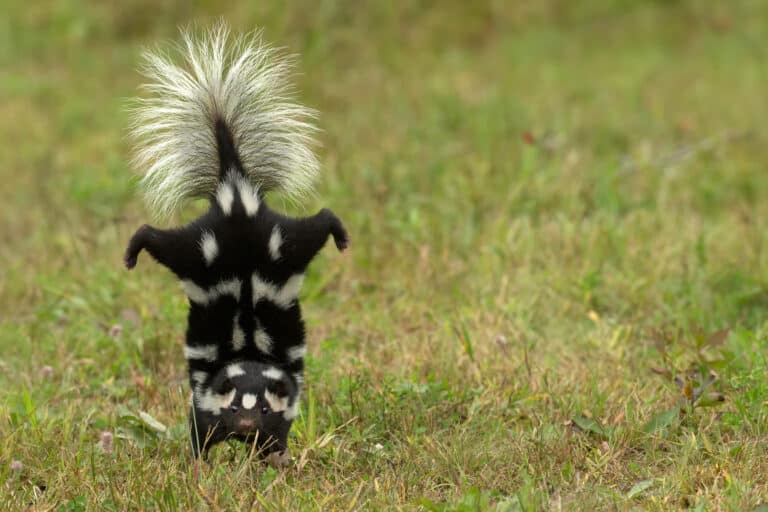
Spotted skunks are known for their acrobatic abilities. They perform handstands before spraying their enemies.

Facts

  • They are the only skunks that can climb trees.
  • The pygmy spotted skunk can fit into the palm of a person’s hand.
  • These skunks give a fair warning before they spray nasty fumes. They stamp their front feet, hiss, and raise their tails. Then they perform repeated handstands.
  • This animal has a very unique and gorgeous fur pattern. Unfortunately, hunters kill them for their pelts, which brands use to make clothes.
  • They are endangered in several places due to habitat loss and poaching.
  • Some spotted skunks knock down honeycombs for the honey, despite the risk of bee stings.
  • During the mating season, males get a testosterone boost and go around spraying bigger animals.
  • Their secretion is very oily and doesn’t go away easily. It takes an average of two to four months for the smell to dissipate from an object.
  • Some spotted skunks can swim but prefer to do so only when their lives are in danger.
  • Western spotted skunks are capable of living in urban areas populated by humans. They can adapt well to these conditions without the risk of endangerment.

Spotted Skunk Summary

These skunks are definitely adorable creatures, but they pack a rancid punch if you ever get in their way. These weasel-like, wild creatures have a distinct, beautiful black and white pattern which makes them easily distinguishable from other types of skunks. Unfortunately, some species are at risk of endangerment.

Scientific Name

Spotted skunks make up the genus Spilogale, a name derived from the Greek words spilo which means “spotted” and gale meaning “weasel.” This is a befitting name as the skunk does resemble the weasel. However, skunks no longer belong to the weasel family, Mustelidae. Scientists placed them into their own family called Mephitidae. Their closest relatives are stink badgers.

They consist of four official species:

  • Eastern spotted skunk (Spilogale putorius)
  • Western spotted skunk (Spilogale gracilis)
  • Pygmy spotted skunk (Spilogale pygmaea)
  • Southern spotted skunk (Spilogale angustifrons)

Although biologists strongly believe that there are about three more species, conducting research has been difficult because catching the skunks is a pretty difficult task.

Other names for these skunks are civet cat, polecats, phoby skunk, phoby cat, tree skunk, weasel skunk, black marten, little spotted skunk, four-lined skunk, four-striped skunk, and sachet kitty.

Evolution and History

Spotted skunks belong to the skunk family Mephitidae, which also consists of stink badgers. The members of this family have the distinct trait of possessing well-developed anal scent glands which are capable of producing secretions that repel their enemies.

Mephitidae comprises four living genera with 12 species among them. The Spilogale genus contains four of these species.

The spotted skunks diverged 2.6 million to 11,700 years ago during the Pleistocene Epoch. One million years ago, the skunks divided into clades, or genetic subgroups based on adaptations to different geological barriers, and, more significantly, due to climate change during the Ice Age. These different adaptations resulted in the skunks evolving genetic differences.

The members of the genus Spilogale are the only skunks that can climb trees. They have claws which can be used for digging, and some have adapted to a semiaquatic lifestyle and live in dens that are partially submerged in water. Some species of terrestrial spotted skunks can also swim when their lives depend on it.

Spotted Skunk Appearance
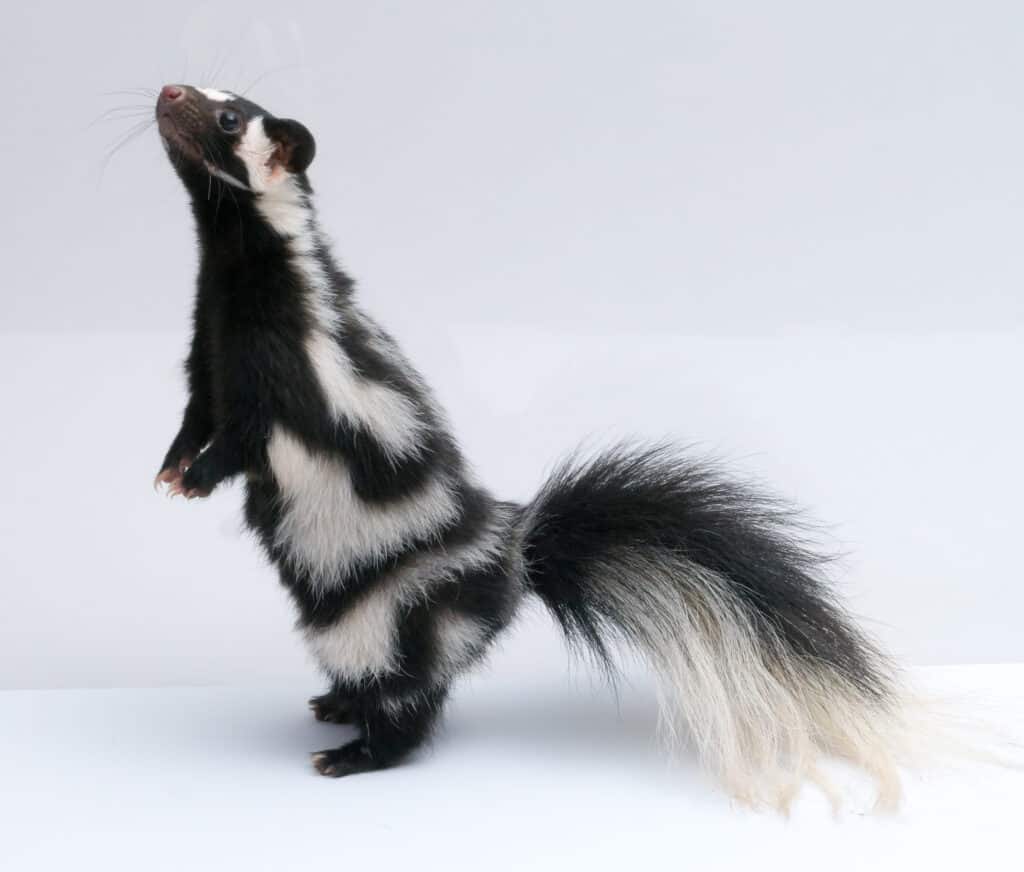
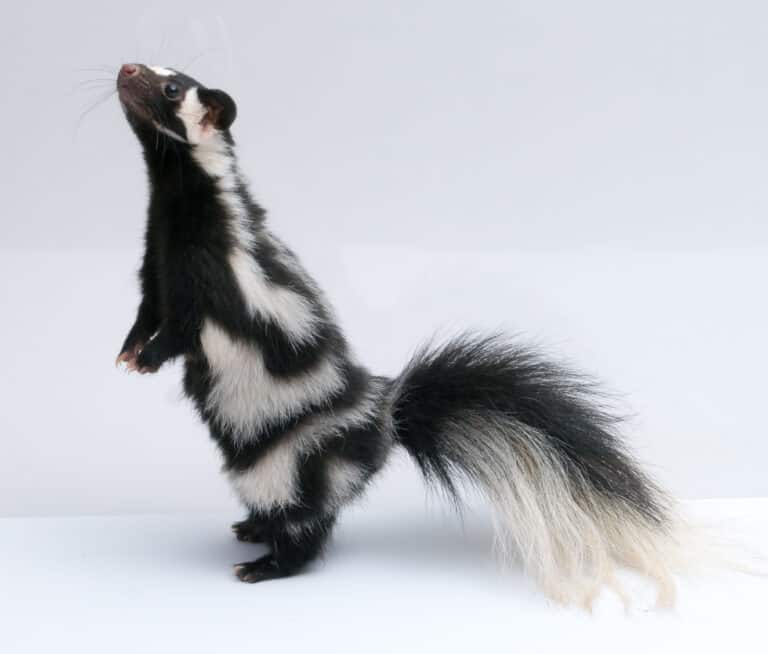
Spotted skunk

The spotted skunk has six white stripes on the anterior side of their body and two white bands on the posterior side.

They are medium-sized animals with unique black and white fur patterns. Although they no longer belong to the weasel family, Mustelidae, they still closely resemble them. They have small, tapered heads and round, blunt noses. They have slender bodies that grow chunkier towards the rear. Their fur is shortest on the head and longest on the tail.

Spotted skunks have six white stripes on the anterior side of their body and two white bands on the posterior side. They have one white spot on each side of their rump and two around the base of their tail. These skunks also have one white spot on their forehead and in front of each ear.

Their snout to rear body length is around 4.5 to 13.6 inches and their tail is 2.8 to 8.7 inches long. They have 34 teeth and five toes on each of their four feet. These toes have curved, sharp claws that are digging and climbing tools. The claws on their fore feet are over twice as long as the ones on their back feet.

All skunks have special glands in their anal region that spray a foul-smelling oily secretion. They use this secretion to defend themselves against attackers.

Males are generally larger in size than the females. Both sexes generally weigh less than two pounds.

Spotted Skunk Behavior

Spotted skunks are generally nocturnal and active animals. They hunt and forage in the night and rest during the day. Out of all the members of the skunk family, the spotted skunks are the only ones with the ability to climb.

Despite being perfectly capable of digging their own homes, they usually live in dens made by other animals like gophers, wood rats, or armadillos.

Most species are very gregarious animals, and they don’t mind sharing their dens with other skunks. It is a common occurrence to find up to eight skunks sharing a den together. However, this is not always the case with all members of the group. Maternal skunks prefer to share their dens only with other maternal skunks. Also, when mating season rolls around, the skunks are less interested in communal living. A group of skunks is called a surfeit.

Some species live mostly solitary lives until mating season.

Skunks are notorious for their defensive ability to spray foul-smelling liquid on anything or anyone who threatens them. Spotted skunks do the same thing but in a more unique and almost comical way.

When they feel threatened, they can project a repulsive oily liquid from their anal glands over 13 feet. However, what makes the spotted skunk unique is that it sprays this secretion while doing acrobatic handstands with both hind feet in the air. It assumes this position when it feels threatened so that it can keep its eyes on its assailant before showering it in the repugnant liquid.

These skunks don’t often spray at the first sign of an opponent. First, they issue a warning by stamping on the ground, hissing, and raising their tails, giving their assailant enough time to escape.

Spotted Skunk Diet

These animals are opportunistic omnivores. This means that they will typically eat anything they can get their hands on. Their diet depends strongly on the time of the year. They eat fruits, berries, corn, garbage, and also arthropods, small mammals, eggs, lizards, snakes, carrion, frogs, birds, and larvae. The eastern spotted skunk has even foraged for wild honey from honeycombs, all while enduring stings from the angry bees.

Habitat and Population

Spotted skunks inhabit North American regions such as Canada, the United States, Mexico, and parts of Central America like El Salvador.

They typically prefer to live in forests, riparian hardwood, shrubbery, thickets, and regions with a moving body of water such as streams. They also like tall-grass prairies and rocky zones.

These animals make their nests in dens located in natural hollows such as slumps or in logs. They often occupy abandoned dens, preferring this rather than digging their own.

The western spotted skunk inhabits the southern region of British Columbia all the way down to Central America. They also live in some U.S. states like Texas, Montana, and Colorado.

The eastern spotted skunk lives in the southeastern and central parts of the United States and Mexico. Its population declined rapidly in the 1940s and it is considered endangered by several state agencies. The eastern spotted skunk is currently listed as a vulnerable species on the IUCN Red List of threatened Species. The pygmy spotted skunk, whose native origin is Mexico, is also considered a vulnerable species. Both of these species’ populations are decreasing.

Reproduction and Lifespan

Mating season starts around March or April depending on the species. From March, the testes of the male begin to swell up and testosterone production rises. During this period, they exhibit certain behaviors known as “mating madness” where they wander about spraying bigger animals at will.

The skunks begin to mate around this time and the baby skunks are usually conceived in about 14 to 16 days. The gestation period typically lasts for 50 to 65 days. About four to six baby skunks called kits are born with the average litter size being 5.5.

The kits are born blind and helpless and their eyes don’t open until after one month. They are also covered with a fine down that is patterned with the unique markings of a spotted skunk. Kits are able to eat solid food at about 42 days old and they are weaned at two months.

The skunk babies grow to adult size at three months old and leave the nest at four months old. They become sexually mature at 11 months to one year old.

Parental responsibilities fall on the mothers only, as the males do not assist in raising the young.

Spotted skunks have a lifespan of one to two years in the wild, and up to 10 years in captivity.

Predators and Threats

Spotted skunks are preyed upon by larger carnivores including foxes, coyotes, raptors, and birds of prey, particularly great-horned owls.

They face many threats outside of predation. Eastern spotted skunks are poached by humans for their pelts to use for clothes. Two species are considered vulnerable with decreasing populations in their regions. In many states, they are considered endangered or threatened. Conservation efforts are being made to protect these species and save their populations from further decline.

View all 390 animals that start with S

Sources

  1. Animal Diversity / Accessed November 28, 2022
  2. Wikipedia / Accessed November 28, 2022
  3. MN Mammals / Accessed November 28, 2022
  4. IUCN Redlist / Accessed November 28, 2022
  5. Science Daily / Accessed November 28, 2022
Rose Okeke

About the Author

Rose Okeke

Hi! I am a writer, actor, and filmmaker. Reading is my favorite hobby. Watching old movies and taking short naps are a close second and third. I have been writing since childhood, with a vast collection of handwritten books sealed away in a duffel bag somewhere in my room. I love fiction, especially fantasy and adventure. I recently won the James Currey Prize 2022, so now, naturally, I feel like I own words. When I was 11, I wanted to be a marine biologist because I love animals, particularly dogs, cats, and owls. I also enjoy potatoes and chocolate in all their glorious forms.
Connect:

Thank you for reading! Have some feedback for us?


Spotted Skunk FAQs (Frequently Asked Questions)

They eat fruits, berries, corn, garbage, and also arthropods, small mammals, eggs, lizards, snakes, carrion, frogs, birds, and larvae.